
98% of the world’s sovereign wealth funds | 18 of 20 of the world’s largest pension funds | 10 of 10 of the largest charitable foundations | 85% of the world’s largest family offices | 100+ billionaires, every morning |
Nvidia’s latest filing shows revenue rising while quarterly cash generation fell and receivables and days sales outstanding increased. In Australia, private-credit managers changed redemption terms before and around a major developer’s administration. The common risk is timing;the legal and economic channels are not the same.
|
|
Revenue measures recognised sales. Cash flow records when the money moves.
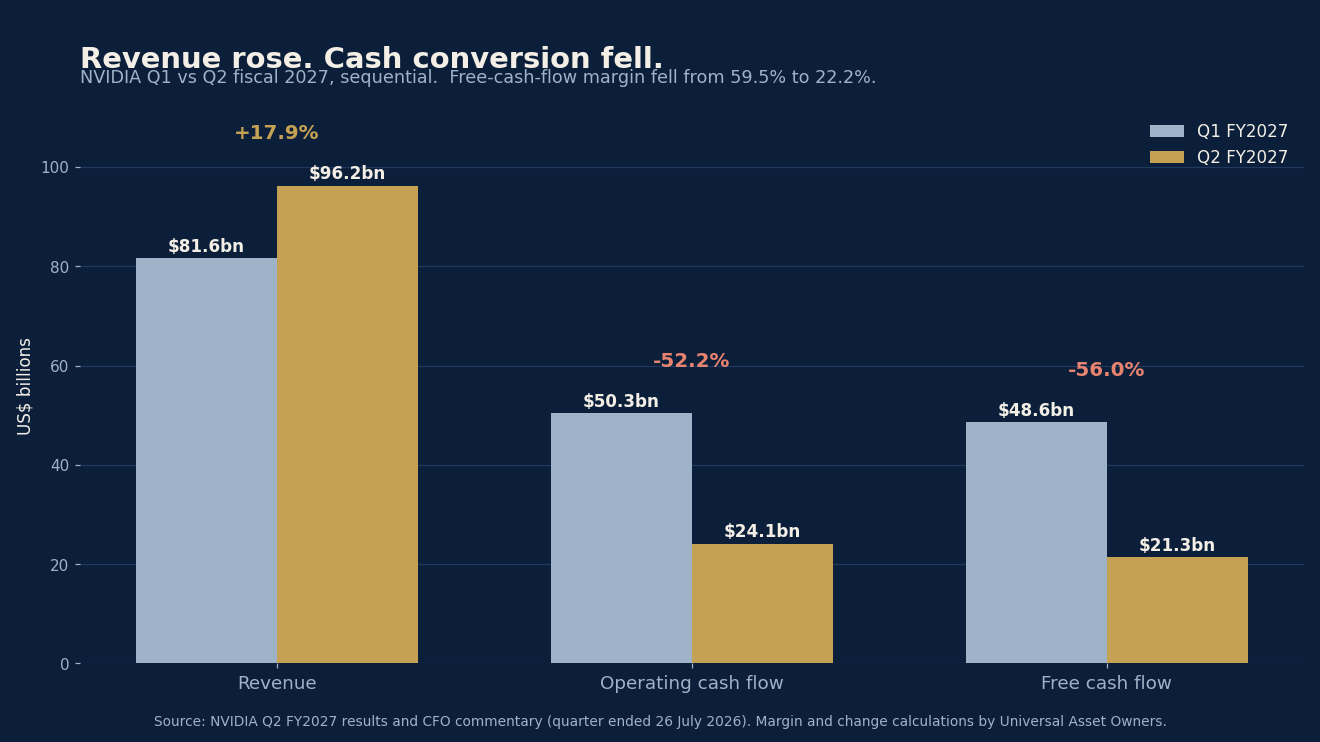
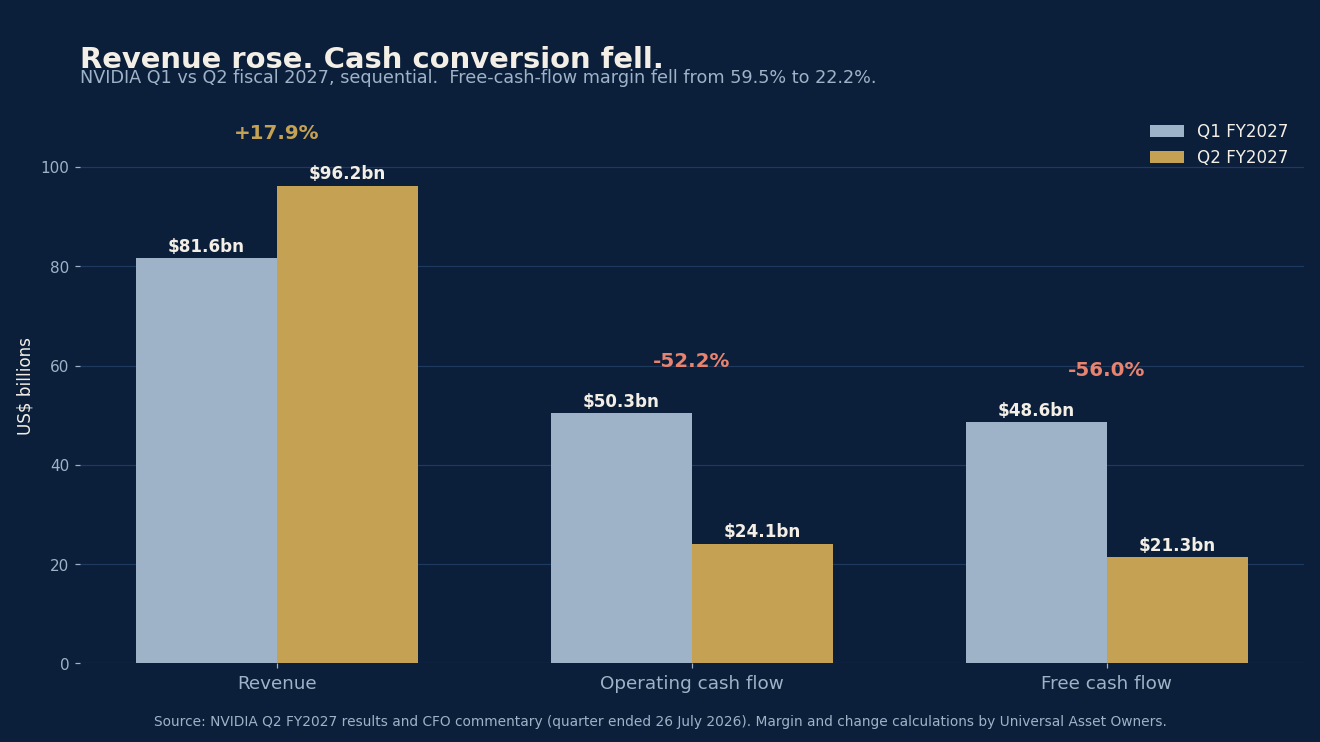
Nvidia’s second quarter showed a sharp sequential divergence between revenue and cash generation. The company reported $96.2 billion of revenue, up 18% from the previous quarter and 106% from a year earlier. Free cash flow, using Nvidia’s definition, fell to $21.3 billion from $48.6 billion in the first quarter, a sequential decline of 56%. Free-cash-flow margin fell from 59.5% to 22.2%, by our calculation. Operating cash flow fell 52%, to $24.1 billion.
The comparison is unusually sensitive to the chosen period:free cash flow and operating cash flow were still 59% and 57% above the year-earlier quarter. Nvidia attributed the sequential operating-cash-flow decline to higher working-capital adjustments and cash taxes. This is not a distress story. It is a cash-generation and working-capital story with a strong balance-sheet countercase. Form 8-K exhibit ›

Nvidia moved part of the financing clock
Nvidia said days sales outstanding rose to 60 days from 45 because it granted extended payment terms on large, multi-quarter agreements with certain investment-grade customers. Its filing says payment is generally due shortly after delivery, but that some investment-grade purchases can receive terms from 90 days to one year to support large data-centre builds. That is disclosed trade credit, not evidence of delinquency.
Accounts receivable reached $63.1 billion, up $22.3 billion from the previous quarter;the balance had been $38.5 billion at the start of the fiscal year. Five direct customers represented 70% of the receivable balance when the disclosed shares are added together —up from 56% a year earlier. Inventory reached $31.6 billion, up from $25.8 billion, which Nvidia attributed to preparation for the Vera Rubin launch. Customer advances ended at $2.8 billion versus $160 million in January;the filing does not identify them as the same customers or obligations represented in receivables, so they are not a direct offset.
The commitment schedule is more nuanced than a single “$279 billion unpaid”headline. Nvidia disclosed $279 billion of supply and capacity commitments, up from $119 billion one quarter earlier. At 26 July, $92 billion was scheduled for the remainder of fiscal 2027, against $95 billion at 26 April —but a quarter elapsed between the two schedules, so the windows differ and the $3 billion decline does not by itself establish that near-term commitments eased. The schedule places $175 billion across fiscal 2028 and 2029, at $87 billion and $88 billion. Nvidia also says some supplier arrangements may be cancelled, rescheduled or adjusted before firm orders are placed, potentially at additional cost.
The same note reports $366 billion of future commitments in total:the $279 billion of supply and capacity, plus $29 billion of cloud-service agreements, $25 billion of data-centre leases not yet commenced, $25 billion of contingent equity-investment commitments and $8 billion of capital expenditure. Separate disclosures cover $56 billion of additional customer-support commitments and up to $108.5 billion of maximum gross guarantees —of which up to $105 billion is phased residual-value support for the SB Energy PORTS-Pike campus, first effective in fiscal 2029, and $3.5 billion supports certain AI-cloud partners’land, power and shell obligations.
Do not add these into one exposure number. They are different legal forms, they may overlap economically, they activate at different times, and several are contingent amounts that may never become cash payments. Reconcile them by counterparty, trigger, seniority and maturity instead.
The channels must be separated. Extended customer payment terms, the $56 billion of customer-support commitments and the maximum gross guarantees can shift timing or contingent support toward Nvidia. By contrast the $279 billion supply-and-capacity schedule secures Nvidia’s own upstream inputs;the $29 billion cloud-service schedule and $25 billion of not-yet-commenced leases support its research, development, engineering and testing;and equity-investment commitments are contingent. Monitor each on its own terms.
This updates this desk’s earlier compute-financing work. On 19 August we said a quarterly filing would trigger escalation if it either recognised a material share of purchase commitments as liabilities, or disclosed a step-up in guaranteed minimum values. The 10-Q did not recognise the $279 billion schedule as liabilities. The guarantee retained the already disclosed $105 billion aggregate cap, but Schedule II containing the guaranteed-minimum-value terms was omitted or redacted. The first limb did not fire;the public filing does not establish whether the second did. We therefore record no public confirmation of escalation, rather than saying the trigger did not fire.
|
|
In Australia, the gate moved before administration
The chronology matters, and it inverts the intuition.
On 14 August —eleven days before Bathla Group entered voluntary administration —The Australian reported that Centuria Bass had temporarily paused applications and redemptions in the Centuria Bass Credit Fund and the Bass Property Credit Fund after increased redemption requests linked to concern about the developer. The contemporaneous report put the funds’combined assets under management at about A$670 million;that is reported approximate AUM, not redemption requests and not a realised loss. The manager said the pause could last two to six months and that the funds remained operational, with ordinary-course distributions subject to liquidity.
On 25 August, directors appointed voluntary administrators across Bathla Group entities, including Universal Property Group and the associated Raj &Jai Construction, with Teneo appointed. Universal Property Group had reported about A$3.2 billion of liabilities at 30 June 2025 —a balance-sheet total, not an administrator-verified current debt claim. Teneo said its immediate priority was to stabilise operations and support continued project delivery.
Current reporting describes roughly 2,000 homes under construction and about 13,000 additional homes in the development pipeline —about 15,000 across the two categories, not 15,000-plus under construction. The administration has not established that pipeline homes will be cancelled. Administrators reportedly told lenders that about A$20 million was needed to sustain the next five weeks of building activity;no funding outcome was verified at our research cutoff.
On 25 August, 360 Capital Mortgage REIT requested an ASX trading halt pending disclosure —a listed-market disclosure measure, not a fund-redemption gate. On 26 August it disclosed A$31.6 million of Bathla-related exposure across four secured loans:A$18.3 million secured by first mortgages over 12 completed homes and 13 titled land lots, and A$13.3 million secured by 137 titled apartments and townhouses. Against the A$46.6 million loan portfolio reported at 30 June that would be about 68%, though the dates differ and the portfolio may have changed. It reported A$6.8 million of cash, no borrowings or back leverage, continuing monthly distributions and an expectation of full recovery on current information —which is a stated expectation, not an established recovery.
Separately, the trustee of MA Financial’s MA Secured Loan Series, an unlisted real-estate credit fund with about A$2.3 billion of assets, limited the aggregate amount available to satisfy redemption requests in each monthly redemption period to up to 1% of funds under management. The measure initially applies to the 31 August, 30 September and 31 October periods and remains subject to review. The underlying fund said it had no Bathla exposure and attributed the measure to elevated redemption activity and broader market conditions. It disclosed A$95 million of cash, or 4.1% of assets, below its 5% target. MA Credit Income Trust said it had about 20% indirect exposure to the series and did not expect a material effect.
What this evidence does and does not show. It does not show that Bathla’s administration caused every restriction, or that credit losses spread to a vehicle with no Bathla exposure. The chronology also does not support a four-manager, forty-eight-hour chain. What it does show is that redemption pressure and manager discretion became observable before the administrator appointment, and that a second manager later tightened liquidity in the same market while reporting no exposure to the borrower.
Why credit loss and liquidity loss are separate events
Institutions routinely file these in the same folder. A secured first-mortgage loan can recover in full while the fund holding it stops paying redemptions for six months. The reverse also happens:a fund can meet every withdrawal on time by selling its most liquid assets, quietly leaving non-redeeming investors with a worse mix. In neither case does an impairment appear first. The first observable signal is a change in the exit terms.
A construction loan against a half-built house does not become cash because an investor has asked for cash. Someone must fund completion first. Until they do, the collateral is worth less than the appraisal and more than the rubble, and nobody can say precisely where in that range.
The countercase, at full strength
The Reserve Bank of Australia’s March 2026 Financial Stability Review —which predates the administration —put private credit at below 2% of Australian financial-system assets, and non-bank lenders as a whole at about 6%. Non-bank housing arrears were a little below 1%;for non-bank business loans visibility was limited, and liaison suggested arrears had risen slightly but remained contained. Those observations limit a system-wide claim. They do not disconfirm the later, fund-specific liquidity events. RBA FSR ›
Research supports the narrower reading. A March 2026 NBER working paper by Gregor Matvos, Tomasz Piskorski and Amit Seru finds that traditional closed-end private-credit funds are highly capitalised —equity typically 65–80% of assets against about 10% for US banks —with fund lives of roughly 10–12 years against shorter underlying loan maturities, implying little maturity transformation. The mismatch does not live in the asset class. It lives in the wrapper. Closed-end vehicles with capital calls never promised that a construction loan could become cash on a monthly dealing day. Semi-liquid, open-ended and listed vehicles did. NBER w34991 ›
For private-credit vehicles:stated dealing frequency, normal redemption cap, manager or trustee discretion, notice and settlement periods, borrowing capacity, suspension power, in-kind authority, and the longest plausible workout of the underlying loans. A quarterly dealing date is not a promise that every request will be paid in full.
For AI exposure:vendor payment terms, receivable concentration, supply and capacity commitments by year, investments, leases and guarantees. Revenue and backlog are not substitutes for that schedule.
- Which cash needs in the next 12 months assume private-asset distributions or redemptions that a manager can defer?
- Where do sponsor, borrower, valuation-agent, servicer and refinancing-date concentrations recur across manager brands?
- Which AI counterparties appear more than once —as customer, investee, lessee, guarantor beneficiary or financing partner?
- What proportion of last year’s private-credit distributions was funded by cash interest actually received, rather than fund-level borrowing, asset sales or non-cash accrual? Require the answer as a ratio.
- What observable would falsify the concern? For Australia, controls lifting on schedule with completion funding in place. For Nvidia, DSO and receivables normalising while the commitment schedule stops expanding.
The conclusion is not that the money is gone. It is that availability has a contract, a calendar and a counterparty.
Signals —not yet confirmed
ReportedThe Wall Street Journal puts the Vanguard–Altruist consideration at approximately $4 billion. Vanguard’s own release states that “terms of the transaction were not disclosed.”This confirms or dies on a regulatory filing carrying a price.
Reported ·call onlyOn the earnings call —not in the results release —Nvidia management guided to roughly 70% revenue growth in fiscal 2028 and a gross-margin trough near 71–72% in the fiscal fourth quarter, citing memory and component costs. These are call commentary, not filed guidance, and are labelled as such here.
EmergingNvidia’s release names a multiyear technology partnership with SK hynix on next-generation memory, and it has secured land, power and shell capacity with SB Energy at the PORTS-Pike campus in Ohio. Read alongside the $119 billion→$279 billion commitment move, these describe a company contracting hard for physical and component inputs it does not manufacture. The single published fact that would confirm or kill the reading that memory is now the binding constraint:high-bandwidth memory contract pricing for 2027 allocation. No estimate of the constraint’s size appears here because none has been published.
Nothing else cleared the evidence bar this morning. Items supplied overnight without an inspectable source are not listed.
The Vector —when the financial meets the physical
Today’s brief covered a matrix of events that look unrelated:a chip vendor whose cash conversion halved while its revenue rose, an Australian homebuilder whose collapse followed rather than caused a fund gate, an army buying reactors it does not intend to own, and a sovereign quietly widening the share of its debt that reprices with the policy rate.
1 ·The supply-chain shock —a Bayesian belief network
The maths in plain English. A Bayesian network calculates conditional probability:how one confirmed event raises the likelihood of another downstream.
Today’s verified inputs. Nvidia’s manufacturing, supply and capacity commitments more than doubled in a single quarter, from $119 billion to $279 billion, and the filing states they are primarily related to the procurement of memory. The company disclosed a multiyear technology partnership with SK hynix on next-generation memory. On the other side of the same trade, the Bank of Korea raised its Base Rate to 3.00% on a six-to-one vote, lifting its 2026 growth forecast to 3.3% from 2.6% and citing semiconductor-led exports and investment.
The output. The same scarcity appears twice —as a forward purchase obligation on a United States balance sheet, and as an export and investment boom in Korea’s national accounts. When the largest buyer of a component commits $279 billion forward and simultaneously signs a multiyear supply partnership, it is behaving like a party that expects the input to stay scarce. That points to structural rather than cyclical input-cost pressure for everyone downstream who is not first in the queue.
2 ·The physical wall —a jump-diffusion process
The maths in plain English. Standard project models assume smooth progress. A jump-diffusion model assumes smooth progress interrupted by a hard, discrete roadblock —a sudden downward step that no gradual curve predicted.
Today’s verified inputs. Nvidia’s own release names Blackwell Ultra, Rubin and Rubin Ultra as separate deployment classes inside the 2027–28 window alone. The US Army awarded up to $2.2 billion across fiscal 2027–2031 to five developers to own, construct and operate microreactors at named installations —a programme structured around milestones precisely because the delivery date is the risk.
The output. You can commit billions to compute. You cannot compress a substation queue, a turbine backlog or the licensing of a reactor design. When three chip generations are named inside a two-year deployment window, the financing tenor and the technology tenor are different lengths —and that gap does not close gradually. It closes in a step, on the day a project misses its energisation date.
3 ·The liquidity trap —a continuous-time Markov chain
The maths in plain English. A Markov chain tracks movement between states, and some transitions run one way. What matters is not where an asset sits today but whether it moves to a worse state before it moves back.
Today’s verified inputs. This channel did not have to be modelled. It was observed —and the dates invert the intuition. Centuria Bass paused two funds on 14 August, on commentary and a research downgrade, while the borrower was still trading. Bathla did not enter administration until 25 August. 360 Capital then took a trading halt and disclosed A$31.6 million of secured exposure. MA Financial subsequently capped redemptions at up to 1% a month in a vehicle it said had no Bathla exposure at all.
The output. Eleven days, not forty-eight hours. Nothing here moved at the speed of a credit event, because nothing here was a credit event. The transition ran through investor behaviour and wrapper design. What the sequence establishes is narrower and more useful than contagion:redemption pressure and manager discretion became portfolio facts before any recovery was known.
Two paths
Physical bottlenecks slow deployment and margins compress, but the system does not seize, because public balance sheets step in where private ones will not. This is not speculation. The US Army put up to $2.2 billion behind a technology no infrastructure fund would underwrite without an operating record. Brazil’s Treasury widened its Selic-linked band to 49–53%, accommodating investors who preferred floating-rate paper at a 14.00% policy rate.
The cost: stickier inflation and elevated sovereign yields, because the state funds this by issuing. Confirms: further sovereign or state vehicles absorbing first-loss or duration in Q4. Kills: a state-backed programme cancelled on cost, or a sovereign narrowing its floating band back.
Project delays compress the cash flows of the mid-market companies building the physical layer. Distributions to limited partners depend more on fund-level borrowing than on cash interest received. Lenders tighten, redemption requests rise, and controls spread beyond vehicles with disclosed exposure —as one already has. Institutions relying on private-credit distributions to fund benefit payments must raise cash elsewhere, and the liquid public book is what gets sold.
Confirms: a further manager restricting redemptions without disclosed Bathla exposure, or the 4 September creditors’meeting ending without secured bridge funding. Kills: controls lift on the indicated timetable and 4 September produces completion funding.
Where the two paths meet. The single observable that decides which dominates is the legal form of Nvidia’s 10 August framework with Apollo, BlackRock, Blackstone, Brookfield, Goldman Sachs and KKR —over $500 billion of third-party capital, still subject to definitive agreements. Whether those land in closed-end vehicles with capital calls and a stated life, or in evergreen, periodically redeemable structures, determines whether an allocator ends up holding the same timing mismatch twice. That fact will be published. It has not been yet.
Public capital as a proving ground
The US Army announced five selected vendors and initial sites, and said it was negotiating Other Transaction Authority agreements worth up to a combined $2.2 billion across fiscal 2027–2031. Contractors would own, construct and operate nuclear microreactors, with government payments tied to technical milestones. With expected private capital and expansion beyond the five initial sites, the Army says more than 20 reactors could be built across military installations —a programme ambition, not a guaranteed build count.
The initial pairings are Antares Nuclear at Fort Bragg, BWXT Advanced Technologies at Fort Campbell, General Atomics Electromagnetic Systems at Fort Hood, Radiant Industries at Fort Benning and Westinghouse Government Services at Fort Drum. Radiant says its agreement is worth up to $750 million for 15 one-megawatt reactors by 2030 —an awardee figure, attributed as such. Army Secretary Dan Driscoll said the awards are intended to accelerate the ability to deliver safe, reliable baseload power directly to installations.
The structure is the point. Milestone-based rather than paid up front;developers own and operate rather than deliver. The state is not buying reactors. It is buying an operating record —the asset that does not exist yet, and without which no infrastructure fund can underwrite the technology at a sensible cost of capital.
Allocators should also note the regulatory arbitrage. Reactors on military installations are licensed by the Army, not the Nuclear Regulatory Commission, under the Department of War’s independent authority in Section 91 of the Atomic Energy Act. Jurisdiction turns on purpose, not design:NRC authority attaches whenever a reactor’s primary purpose is commercial or utility-scale power. Point one of these units at a data centre and it is a different regulatory animal. The Army says it is aligning its processes so designs proven under military authority should not need major change for later NRC licensing. Whether that holds is the thing to watch —not the reactors. The September 2028 first-reactor target is the first hard test.
The Long Horizon —one month is not a regime
US real consumer spending was unchanged on a rounded basis in July, while current-dollar spending rose 0.2%. Nominal services spending increased $86.2 billion and nominal goods spending fell $49.9 billion. Those are current-dollar category movements in a single month;they do not prove that households have structurally moved out of the physical economy. Real disposable personal income rose 0.4%, an important counterpoint to flat real spending. Headline and core PCE inflation were 3.7% and 3.3% from a year earlier, and the personal saving rate was 3.0%. The BEA publishes its annual update on 30 September, when today’s history may be revised. BEA 26–39 ›
The pension implication is conditional, not mechanical. Higher discount rates can reduce the present value of long liabilities, but the whole-balance-sheet result depends on asset duration, inflation linkage, hedging, contributions and sponsor strength. One monthly PCE print cannot settle that question —and the asset side of that same balance sheet is being invited into twenty-year compute infrastructure at exactly this point, against a technology cycle that names three chip generations inside a two-year deployment window.
Scenario ·The Two Clocks
Containment path. Nvidia’s extended-term invoices convert to cash;DSO and receivables normalise without a revenue break. The $279 billion supply-and-capacity total stabilises and no material portion is reclassified as a recognised liability. Administrators announce credible interim funding and a project-level completion process. Centuria Bass reopens within its indicated window, the Series limit is withdrawn after its initial August–October application rather than extended, and no additional manager without direct Bathla exposure changes terms.
Escalation path. Nvidia reports DSO above 60 or receivables again growing faster than revenue. The commitment schedule expands again, becomes more front-loaded, or moves from adjustable arrangements to firm obligations. Administrators report that interim funding cannot be secured or that construction must pause. Another Australian manager without disclosed Bathla exposure suspends, caps or materially delays redemptions. A manager changes valuation, recovery or distribution guidance on Bathla-related loans.
Relief path. Receivables normalise while revenue and customer quality hold. Nvidia discloses cash conversion and commitment reductions without customer or margin deterioration. Administrators secure completion funding, controls lift, and secured recoveries track stated expectations.
⛔ No point probability is printed. A probability appears in this publication only with its method, timestamp, range and update rule attached. None has been computed for this scenario, so none is shown.
Decisions due
- Today, 13:00 ET —US Treasury auctions $44 billion of 7-year notes (CUSIP 91282CRJ2). Results ›
- Today, 20:00 ET —the Federal Reserve Bank of Kansas City posts the full Jackson Hole agenda. Chair Kevin Warsh speaks Friday 28 August, 10:00 ET. No remarks are published and none are characterised here. KC Fed ›
- 31 August —first of three monthly redemption periods under the MA Secured Loan Series 1% cap;the disclosed floor runs to 31 October.
- 4 September —Bathla first creditors’meeting. The confirmation trigger is whether secured bridge funding appears.
- 30 September, 08:30 ET —BEA August personal income and outlays, with the first simultaneous annual update of the national, industry and regional accounts. A second consecutive negative real-goods month would confirm the physical-demand reading. Release schedule ›
- End Q1 2027 —Victory / First Eagle target close, subject to regulatory approvals, shareholder approval and client consents.
- September 2028 —Army Janus first-reactor target.
The Universal Owner Risk Radar
| Signal | Confirms | Falsifies or relieves | Where it lands | Observation |
|---|---|---|---|---|
| Nvidia cash conversion stays weaker | DSO stays above 60, or receivables again outgrow revenue | DSO and receivables normalise while revenue holds | Public equity, supply chain, equipment finance | SEC EDGAR 10-Q |
| Near-term commitments become harder to change | More of the schedule becomes firm, non-cancelable or front-loaded | Like-for-like near-term commitments decline | Equity, infrastructure, counterparty risk | NVDA financial reports |
| Australian restrictions broaden beyond direct exposure | Another manager with no disclosed Bathla exposure changes terms | Centuria reopens and the Series limit is withdrawn after October | Semi-liquid credit, real-estate debt, OCIO books | ASX announcements |
| Bathla workout threatens project completion | Administrators report construction pauses or failure to secure interim funding | Secured bridge and project-level completion plan confirmed | Australian property credit, farm-out lenders | Teneo |
| Household goods demand contracts while capex expands | A second consecutive negative real-goods month on 30 September | Goods spending recovers with the annual update | Consumer, freight, industrials, inflation path | BEA personal income |
| Affiliated concentration found outside one insurer | Another insurer restates related-party exposure | Delaware plan approved and contained | Annuities, private credit, insurance equity | Delaware DOI |
| Duration migrating from investors to issuers | Other sovereigns widen floating-rate bands as Brazil has | Long-duration demand recovers at auction | EM sovereigns, LDI, bank and pension books | Tesouro Nacional |
| Army prototypes become financeable infrastructure | First unit meets the September 2028 target with disclosed cost and uptime | Milestone slippage, cost reset or programme cancellation | Infrastructure, utilities, energy transition | US Army |
Every radar item carries a dated, reproducible observation. The live risk map is maintained on the Command Center. Explore the live Risk Map →
People &moves
USS hires CalSTRS’s Robert Ross to lead private equity. The UK’s largest private pension scheme has appointed Robert Ross to the newly vacant role of head of private equity funds and co-investments at USS Investment Management. He joins in September from the California State Teachers’Retirement System, where he spent more than a decade, most recently as a senior portfolio manager in private equity including emerging-manager strategies, and earlier at TIAA-CREF. He succeeds Geoffrey Geiger, who retired last year, and reports to Ben Levenstein, head of private markets. Private Equity Wire › ·Buyouts ›
Why it matters:this is senior LP and co-investment expertise moving from one of the largest US public plans into a major UK retirement system, at a moment when roughly a third of USS assets sit in private markets and the whole industry is re-examining what a redemption promise is worth. Watch whether Ross changes pacing, the manager roster or the co-investment ratio —disclosed through USS’s investment-plan updates rather than announcements.
Future Fund:Raphael Arndt to depart at end-2026. The chief executive of Australia’s sovereign wealth fund will leave at the end of the year after six years in the role and almost two decades at the institution. No successor has been named and a global search is underway. The fund reported a 14.8% return for the year ended 30 June 2026 against a government-mandated target, with assets of about A$289.7 billion on the portfolio update and a ten-year annualised return of 9.0%. Future Fund › ·Investment Magazine ›
This is a planned transition after strong performance, not governance distress. Its significance is timing:the next chief executive inherits a larger institution, a recently appointed investment chief and a broader national-investment mandate. The governance test is whether the board protects process continuity while letting new leadership define the next three-year strategy.
Moves, mandates and searches are compiled from named institutional sources only. Items without an inspectable source are held, not published. Send tips to info@universalassetowners.com.
|
|
Careers &mandates
Where the allocator seats actually get posted. These are the primary boards —we link the source rather than re-list roles that change hourly.
| CPP Investments | Public pension, Toronto ·investment and total-fund management | Open roles › |
| Norges Bank Investment Management | Sovereign fund, Oslo ·equities, real assets, stewardship | Open roles › |
| CalPERS | Public pension, Sacramento ·investment office | Open roles › |
| CalSTRS | Public pension, West Sacramento ·private markets and total portfolio | Open roles › |
| Ontario Teachers’Pension Plan | Public pension, Toronto ·private capital, infrastructure | Open roles › |
| GIC | Sovereign fund, Singapore ·multi-asset and private markets | Open roles › |
| Temasek | Investment company, Singapore ·direct investment | Open roles › |
| Mubadala | Sovereign investor, Abu Dhabi ·direct and fund investment | Open roles › |
| USS Investment Management | Pension, London ·private markets —see People &moves above | Open roles › |
| Future Fund | Sovereign fund, Melbourne ·CEO search underway | Open roles › |
Hiring for an allocator seat and want it in front of this readership? Reply to this edition.
Numbers to know
| −56% | Nvidia free cash flow quarter on quarter —not cash, not profit, not revenue |
| +59% | Nvidia free cash flow against the year-earlier quarter —the countercase to the sequential read |
| 60 days | Nvidia days sales outstanding, up from 45, on extended terms to certain investment-grade customers |
| 70% | Share of the receivable balance held by five direct customers, up from 56% a year earlier |
| $279bn | Supply and capacity commitments —not all firm orders, not all immediately payable |
| $366bn | Total future commitments in the disclosed schedule, separate from customer-support commitments and guarantees |
| $108.5bn | Maximum gross guarantees, of which up to $105bn is phased PORTS-Pike residual-value support first effective FY2029 |
| A$670m | Reported approximate combined AUM in the two paused Centuria Bass funds —not the amount requested for redemption |
| A$3.2bn | Universal Property Group liabilities at 30 June 2025 —not an administrator-verified current debt total |
| Up to 1% | Temporary cap per monthly redemption period on the MA Secured Loan Series;initially August–October, subject to review |
| <2% | RBA estimate of private credit’s share of Australian financial-system assets, March 2026 |
| −$49.9bn | Fall in US nominal goods spending in July, against services +$86.2bn —one month, current dollars |
The Back Page

Explore the desk
| Scenario Lab | Trigger-based scenarios, updated daily |
| Command Center | The live Universal Owner risk map |
| The Registry | The allocator and manager registry |
| Probability Desk | Live probability tracking |
| The Odds | Where the market is pricing it |
| Allocator Class | The people who move the capital |
| Listen | Every episode of The Universal Owner |
| Watch | Briefings, films and the back page |
| Intelligence | The full daily archive |
| Newsroom | Reporting beyond the daily |
| Frontier | Long-horizon research |
| Membership | Access and institutional terms |
Recent editions
- 26 Aug —Britain bought a stake in a tungsten mine. It still has no tungsten.
- 25 Aug —38% of $15.6bn. The private-markets exit is rationed.
- 24 Aug —A fund that is 35.8% cash. Seven exit doors, from 5% to 10%.
- 21 Aug —The canal rationed itself. The bond auction turned buyers away.
- 26 Aug —The Probability Desk ·PD Chart of the Day
Sources
Every figure in this edition traces to a document we opened. Primary filings and official releases are marked primary;independent reporting is used for context and is marked as such.
- primaryNVIDIA Q2 FY2027 results —Form 8-K exhibit (revenue, margin, cash flow, balance sheet)
- primaryNVIDIA investor relations —quarterly results and CFO commentary
- primaryNVIDIA Form 10-Q filings index (DSO, commitments, guarantees, receivable concentration)
- primaryAWS and NVIDIA to deliver 2 million additional GPUs (26 Aug)
- primaryNVIDIA guarantees SB Energy’s PORTS-Pike campus (17 Aug)
- primaryNVIDIA / SB Energy PORTS-Pike release as filed with the SEC
- primaryNVIDIA partners with Apollo, BlackRock, Blackstone, Brookfield, Goldman Sachs and KKR (10 Aug)
- contextBlackstone —same compute-financing partnership announcement
- contextApollo —same compute-financing partnership announcement
- contextCNBC —Nvidia backing $105 billion of financing for OpenAI’s Ohio data centre
- primaryBEA —Personal Income and Outlays, July 2026 (BEA 26–39)
- primaryBEA —release schedule (30 September annual update)
- primaryReserve Bank of Australia —Financial Stability Review, March 2026
- contextABC News —Bathla Group enters voluntary administration (25 Aug)
- contextABC News —ASIC warns of ‘first significant cracks’in private credit (27 Aug)
- contextFinancial Standard —Centuria Bass freezes private-credit fund redemptions (17 Aug)
- contextFinancial Standard —Bathla collapse rattles private credit
- context360 Capital Mortgage REIT —Bathla exposure and security schedule
- contextKalkine —Centuria defends Bass Credit Fund after SQM Research downgrade
- primaryMA Financial —MA Secured Loan Series
- contextMA Credit Income Trust (ASX:MA1) plays down impact of new redemption limits
- primaryNBER w34991 —Matvos, Piskorski &Seru, Private Credit, Balance Sheets and Financial Stability
- primaryBank of Korea —raises base rate to 3.00% (27 Aug)
- contextKorea Herald —BOK delivers ‘preemptive’back-to-back hikes
- contextSeoul Economic Daily —BOK board members see rate rising as high as 3.50%
- contextWashington Times —US Army to spend up to $2.2bn on nuclear microreactors (26 Aug)
- contextOrrick —deploying reactors under DOE and DOW authority (Atomic Energy Act §91)
- primaryVanguard —to acquire Altruist (26 Aug, terms not disclosed)
- contextPensions &Investments —Victory Capital acquires First Eagle Investments
- contextPrivate Equity Wire —USS hires CalSTRS veteran to lead private equity
- contextBuyouts —veteran LP Robert Ross to lead private equity at USS
- primaryFuture Fund —CEO to depart the Future Fund Management Agency
- contextInvestment Magazine —‘Good time to leave’:Arndt says Future Fund ready for fresh leader
- contextInsurance Business —Mark Walter’s insurers face federal probe over related-party investments
- primaryUS Treasury —auction announcements, data and results
- primaryFederal Reserve Bank of Kansas City —Jackson Hole Economic Symposium
- primaryCalSTRS —13.9% net return, fiscal year 2025–26
Corrections and additions:info@universalassetowners.com ·Readership &methodology ·Institutional access
Universal Asset Owners ·The Editorial Team