Lead | Consensus failed; the liabilities did not
COP31 closed on 22 November without consensus on the Antalya Pact, its proposed overarching political agreement. The UK government says the Paris Agreement remains in place. Progress in other negotiations should be distinguished from adoption of the failed cover text.
For asset owners, the immediate consequence is a weaker common policy signal. Existing contracts, liabilities and physical exposures continue. A carbon levy, shipping disruption, insurance renewal and capital requirement each need their own analysis; a single commodity hedge cannot cover all four.
The draft proposed work on mountains and climate change, including dialogues in 2027 and 2028. Those provisions remain proposals, not implemented obligations. Keep draft commitments in the scenario register and decisions supported by current evidence in the operating plan.
Our assessment: the task is to make decision authority more precise as international policy becomes less predictable. Identify the evidence behind each investment assumption, the person responsible for it and the threshold that requires the board to revisit it.
UNFCCC draft Antalya Pact · UK COP31 outcome, 22 November
Listen | The Universal Owner
Today in 90 Seconds
The United Nations and the UK government confirm that COP31 concluded on 22 November without consensus on the Antalya Pact. The UK says the Paris Agreement remains in place; progress on other negotiations should not be confused with adoption of the failed cover text.
New today: Partners Group has agreed to acquire StraitNZ from Morgan Stanley Infrastructure Partners. The buyer expects completion in the first half of 2027, subject to conditions and New Zealand approval. No purchase price is disclosed in the announcements.
Singapore and China announced 29 deliverables at today's bilateral council. They renewed a services-trade memorandum and signed a public-health agreement. A small-value fast-payment link is being explored; it is not an operating service yet.
Also today, Singapore announced changes to household support thresholds and a one-off 2027 property-tax rebate for owner-occupied homes. The details matter for cash-flow analysis.
In recent background: Norway's signed Zurich property disposal, PGGM's incoming chief executive, and the World Economic Forum's 20 November study of data-centre power requirements.
Partners Group StraitNZ acquisition, 23 November · Singapore China confirmed outcomes, 23 November · Singapore support thresholds, 23 November
Asset investment case | Norway recycles a mature office holding
Let’s start with a transaction whose stage is unusually clear. NBIM signed an agreement on 19 November to sell 100 percent of Uetlihof for CHF850 million. UBS Asset Management’s Swiss real-estate funds are the buyers. Closing is scheduled for January 2027.
That gives us three different dates and states. The asset was acquired in 2012. The sale agreement is now signed. Cash is expected at close. The announcement does not say where the proceeds will be reinvested, so we should not invent that next step.
For a board, the deeper exercise is return attribution over a fourteen-year hold. Separate rental income, capital expenditure, lease structure, currency, market repricing and exit timing. The headline price is useful, but it cannot tell you which part of the investment thesis worked.
Then record the next decision. Does the sale increase liquidity, finance rebalancing or support another real asset? Until the fund says so, it remains optionality—not a new allocation.
Credit | Singapore adjusts household-support thresholds
Singapore's Ministry of Finance announced today that the annual-value thresholds used for social-support eligibility will rise from 1 March 2027. The first tier moves from S$21,000 to S$24,000. The upper boundary of the second tier moves from S$31,000 to S$32,000.
This concerns the assessed annual value of a home, alongside other eligibility criteria. It is not a household salary threshold or a grant equal to those amounts. The government says the change is intended to preserve access to support as assessed property values rise.
Our credit interpretation is to model the actual support a borrower qualifies for and when it starts. A higher property assessment does not itself put cash in that borrower's bank account. Distinguish household relief from collateral appreciation.
Singapore support thresholds, 23 November
Treasury | A payments link remains exploratory
Today's Singapore-China closing statement confirms that the two countries are exploring a fast-payment-system link for small-value transfers. The proposal remains exploratory.
For treasury teams, the operational questions come before projected savings: which currencies and payment types would qualify, which institutions would participate, and what settlement and compliance rules would apply? Today's statement does not supply an implementation date or full technical terms.
Keep current payment arrangements in the base case. Put a possible future linkage into the planning register with an owner and a review date. A promising bilateral announcement should not trigger an untested change in corporate cash operations.
Singapore China confirmed outcomes, 23 November
Politics and oil | Contract risk before price risk
COP31’s breakdown increases policy dispersion. Different jurisdictions may move on different timetables, which makes contract terms more important.
An oil hedge addresses the commodity price. It does not automatically cover a change in carbon levy, delayed shipping, higher insurance or an unplanned capital requirement. For each exposure, identify who bears the cost and what triggers a pass-through.
This is not a call on one future climate policy. It is a reminder that failed consensus widens the range of plausible paths. The portfolio has to survive more than one.
Pensions | PGGM’s next operating chapter
In the recent appointment file, PGGM has appointed Bas van den Dungen as chief executive from early January. He comes from the Dutch Ministry of Finance and inherits an organisation administering pensions for almost six million people.
PGGM says it managed €260 billion at the end of September. Five client funds moved to the reformed Dutch system at the start of 2026. That means the new chief executive’s scorecard should include implementation, data quality and participant service, not only investment performance.
A pension reform is not complete when legislation passes. Converting liabilities, administration and investment implementation is an operating programme. Milestones and escalation rights matter.
Chart | AI power demand is a systems problem
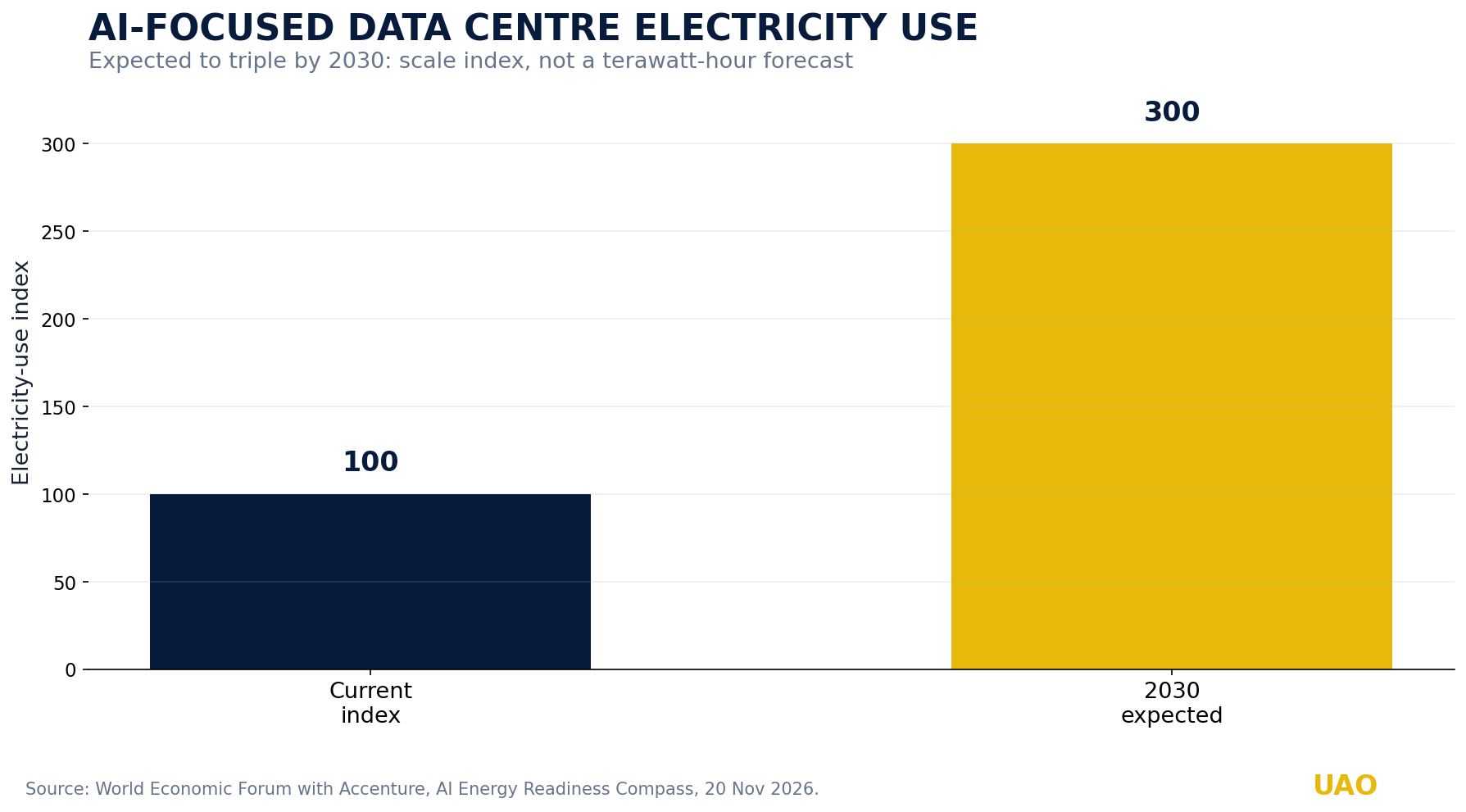
The chart converts one official statement into an index. In its 20 November report, the World Economic Forum says electricity use at AI-focused data centres is expected to triple by 2030. We set the current level at 100 and the 2030 expectation at 300.
This is not a terawatt-hour forecast. It is a scale comparison. The investment implication is that a financed data-centre building is not the same thing as a deliverable operating campus.
Transmission, transformers, generation, cooling, water, land and community consent can each become the binding constraint. Underwrite the campus and the enabling network as one delivery chain, even when the contracts sit in different companies.
World Economic Forum AI Energy Readiness Compass
European direct lending | A cross-market contract test
For European direct-lending teams, the new StraitNZ transaction offers a useful cross-market contract case. The seller says it introduced three-year, inflation-linked take-or-pay freight contracts and secured port leases lasting several decades during its ownership.
Our analysis is that these protections address different risks. A freight commitment can support receipts, while a port lease supports access. Neither removes vessel maintenance, customer credit or the risk that operating costs reset before revenue does.
No financing terms for this acquisition were disclosed in the releases we checked. We are not reporting a European loan deal or assigning an invented leverage figure. The diligence lesson is to align debt service with contract duration and test the cost of a prolonged interruption.
Morgan Stanley StraitNZ sale agreement, 22 November
Acquisitions | StraitNZ agreement awaits approval
Partners Group's 23 November announcement covers two Cook Strait vessels and a road-freight operation. It says the business carries recurring freight and passenger traffic between New Zealand's North and South islands.
Morgan Stanley's seller release, dated 22 November, confirms the agreement. Partners Group identifies New Zealand Overseas Investment Office approval among the closing requirements. The expected window is the first half of 2027, rather than an immediate transfer.
The buyer plans improvements to sales channels and digital operations. For an asset owner, the next documents to examine are the approval conditions, final ownership structure and operating plan. Announced acquisition, funded ownership and realised return remain different milestones.
Partners Group StraitNZ acquisition, 23 November · Morgan Stanley StraitNZ sale agreement, 22 November
European prices and wages | Inflation is still composition
In background released 18 November, Eurostat’s final October reading put annual inflation at 4% in both the euro area and the European Union, up from 3.8% in September.
Energy contributed 1.89 percentage points to the euro-area rate, while services contributed 1.55. The composition points to different margin paths for utilities, manufacturers, service businesses and regulated assets.
A board should ask which costs reprice automatically, which require negotiation and which are trapped until the next contract or regulatory reset. The next flash estimate, for November, is due 1 December.
European biomethane | A market mechanism, not a purchase contract
In the open-opportunity calendar, announced 4 November, the European Commission’s first Biomethane Mechanism matching round is open for buyer demand until 23 December. Suppliers are scheduled to express interest from late January to early March, with results on 18 March.
A match is not an offtake contract. Financing still depends on volume, duration, certification, delivery point, price adjustment and counterparty credit.
The commercial proof is conversion. How many matches become contracts long enough to support project debt? That is the number investors should watch.
European Commission Biomethane Mechanism
Climate and nature | Separate the draft from the mandate
The 22 November draft Antalya Pact proposed a two-year work programme on mountains and climate change, dialogues in 2027 and 2028, a high-level dialogue at COP32 and a report for COP33.
Those are draft provisions. The cover decision was not adopted. They should not be reported as obligations.
But physical risk remains. Glacier-dependent water systems, heat, flood and insurance availability do not wait for the next plenary. Keep two lists: decisions requiring a new policy mandate and decisions already justified by current evidence and fiduciary duty.
People | Bas van den Dungen moves from policy to pension execution
Van den Dungen’s background is in public administration, finance policy and healthcare rather than portfolio management. PGGM’s supervisory board emphasised his organisational and public-service experience.
That can fit a pension platform navigating system reform, but an appointment is not an operating outcome. Watch for the baseline he sets: service performance, reform milestones, technology dependencies and accountability.
The handover is strongest when the board defines how progress will be measured before the new executive starts.
Governance | Delegated authority after consensus failure
When external consensus fails, internal authority has to become clearer. A board can delegate modelling, manager selection or execution. It cannot delegate the consequence of using a draft as though it were policy.
Give every critical decision four fields. Evidence status: draft, consultation, signed or completed. Named owner: who decides. Authority limit: what can be done without returning to the board. Escalation trigger: what forces the decision to be reopened.
This is the control that stops an analyst’s assumption, a service provider’s shortcut or a manager’s interpretation from silently becoming portfolio policy.
Executive profile | Mohammed Saif Al-Sowaidi and the conversion test
Mohammed Saif Al-Sowaidi has led Qatar Investment Authority since November 2024. This is a leadership profile, not a new appointment announcement. QIA's published biography traces his career through corporate banking, energy and several investment teams before he became chief executive.
He joined QIA in 2010, led private-equity funds, technology, media and telecommunications, and industrials, and later served as chief investment officer for the Americas. He also headed QIA Advisory in New York. Before the fund, he worked at Masraf Al-Rayan and began his career at ExxonMobil in Qatar.
QIA lists his board roles at Qatar National Bank, Qatar Airways, Ooredoo, Volkswagen and Harrods. Those positions span businesses with very different capital needs. Banking depends on liquidity and credit quality; transport and manufacturing require physical investment; communications needs continual network renewal. The breadth provides context, not proof of performance.
The immediate case for examining his leadership is Friday's German initiative with Brookfield. Their 20 November memorandum envisages exploring critical-industries and defence opportunities, with an aggregate investment ambition of €15 billion. That figure describes a target for collaboration. It is neither a named acquisition nor a cash payment already made.
Our assessment starts with how such an ambition becomes a mandate. An investment team needs a defined opportunity set, return requirements, acceptable concentration and clear decision rights. Without those boundaries, a large headline can become a target that encourages deployment for its own sake. An effective leader should leave room to decline a transaction.
QIA's governance statement separates the roles. The Supreme Council approves overall objectives and strategy. The board provides guidance and oversight, while the chief executive and management run day-to-day operations. QIA says investment decisions use economic and financial criteria with a long-term horizon. Those are the institution's stated arrangements, rather than an independent audit of this new initiative.
For a co-investor, that makes the practical question more specific: which decisions can the deal team make, and which require a higher approval? A sector framework should be followed by transaction-level evidence on customers, pricing power, capital expenditure and exit options. Strategic importance does not eliminate commercial risk or the possibility of paying too much.
The operating partner also matters. Brookfield brings industrial and infrastructure experience to the proposed collaboration. Investors should still examine the division of responsibilities, fee arrangements, information rights and treatment of conflicts. A familiar partner can shorten the learning curve, but it cannot substitute for an investment committee's own judgement.
Al-Sowaidi's career suggests familiarity with both corporate assets and external investment managers. The useful test is whether that experience produces clear accountability when an investment moves from the originating team to the people responsible for long-term ownership. Who checks the original assumptions after approval, and who can require corrective action when they stop holding?
A sensible public scorecard would track named opportunities progressing into signed deals, conditions satisfied, capital funded and operating results against the underwriting case. Where information is unavailable, the honest entry is unknown. It would be premature to attribute returns, jobs or production capacity to an exploratory memorandum.
For pension and sovereign boards watching QIA, the broader lesson is to judge leadership by decisions over time. A chief executive creates value partly by selecting opportunities and partly by rejecting weak ones. The quality of the rejection process is rarely visible in a press release, yet it can matter as much as the largest announced deal.
That is the conversion test facing this initiative: preserve the long horizon while demanding evidence at each step. Al-Sowaidi's biography explains the experience he brings. The eventual transactions and their results will show what that experience delivers. Until then, our description remains a substantial exploration framework under an established investment leader.
QIA and Brookfield · QIA executive biography · QIA governance
Careers | Open institutional seats
Two current institutional openings. Ontario Pension Board is recruiting a Senior Investment Officer in Toronto, reference 2026-28E. The work includes investment strategy, asset mix, delegated-manager oversight and scenario analysis. See the employer’s application page for current status.
Vestcor is recruiting an Investment Analyst in Quantitative Investing in Fredericton. The official posting lists a 25 November deadline and work in quantitative research, portfolio analysis and research systems.
These are employer vacancies, not endorsements. Use the official application pages for status and instructions.
Ontario Pension Board career · Vestcor career
Decision calendar and risk radar
Singapore and China confirmed their latest cooperation outcomes today. The services memorandum is renewed and the public-health agreement signed. Keep the proposed payments linkage on a separate implementation watch.
Singapore's newly announced property-tax rebate applies to owner-occupied homes in 2027: 15% for HDB flats, and 10% capped at S$100 for private residential properties. Bills are due 31 January. Do not apply this household measure to a commercial-property portfolio.
On the European calendar, the ECB lists Philip Lane at a climate-economy meeting in Dublin today at 14:30 local time, 09:30 in Toronto. His slides are expected on the ECB website. This is a scheduled presentation, not a rate announcement or a speech we have already read.
Vestcor's stated application deadline is Wednesday, 25 November. The biomethane buyer window closes 23 December. StraitNZ's expected acquisition close is in the first half of next year, subject to approval. Each deadline requires its own evidence check.
European Commission Biomethane Mechanism · Vestcor career · Singapore China confirmed outcomes, 23 November · Singapore property tax rebate, 23 November · ECB weekly calendar
Watch the latest UAO LIVE with Ryan Lafield

UAO LIVE Episode 70 with Ryan Lafield, released 20 November 2026, examines technology-control weaknesses at major European banks. Watch the latest completed programme below.
The Take
Consensus is valuable, but it is not a control system. COP31’s breakdown removes one shared policy signal. It does not remove the liabilities or physical exposures already inside the portfolio.
Label the evidence by stage. Draft proposals belong in scenarios. Consultations belong in regulatory watch. Signed agreements belong in the closing ledger. Completed transactions belong in the portfolio record.
And physical risks supported by current evidence belong in today’s decision process.
The universal owner’s advantage is not certainty. It is the ability to keep acting precisely when certainty is unavailable.
Source Desk
UNFCCC draft Antalya Pact · QIA and Brookfield · NBIM Uetlihof sale · World Economic Forum AI Energy Readiness Compass · Eurostat October inflation · European Commission Biomethane Mechanism · PGGM CEO appointment · QIA executive biography · Ontario Pension Board career · Vestcor career · UK COP31 outcome, 22 November · Partners Group StraitNZ acquisition, 23 November · Morgan Stanley StraitNZ sale agreement, 22 November · Singapore China confirmed outcomes, 23 November · Singapore support thresholds, 23 November · Singapore property tax rebate, 23 November · ECB weekly calendar · QIA governance
Back Page | The missing piece
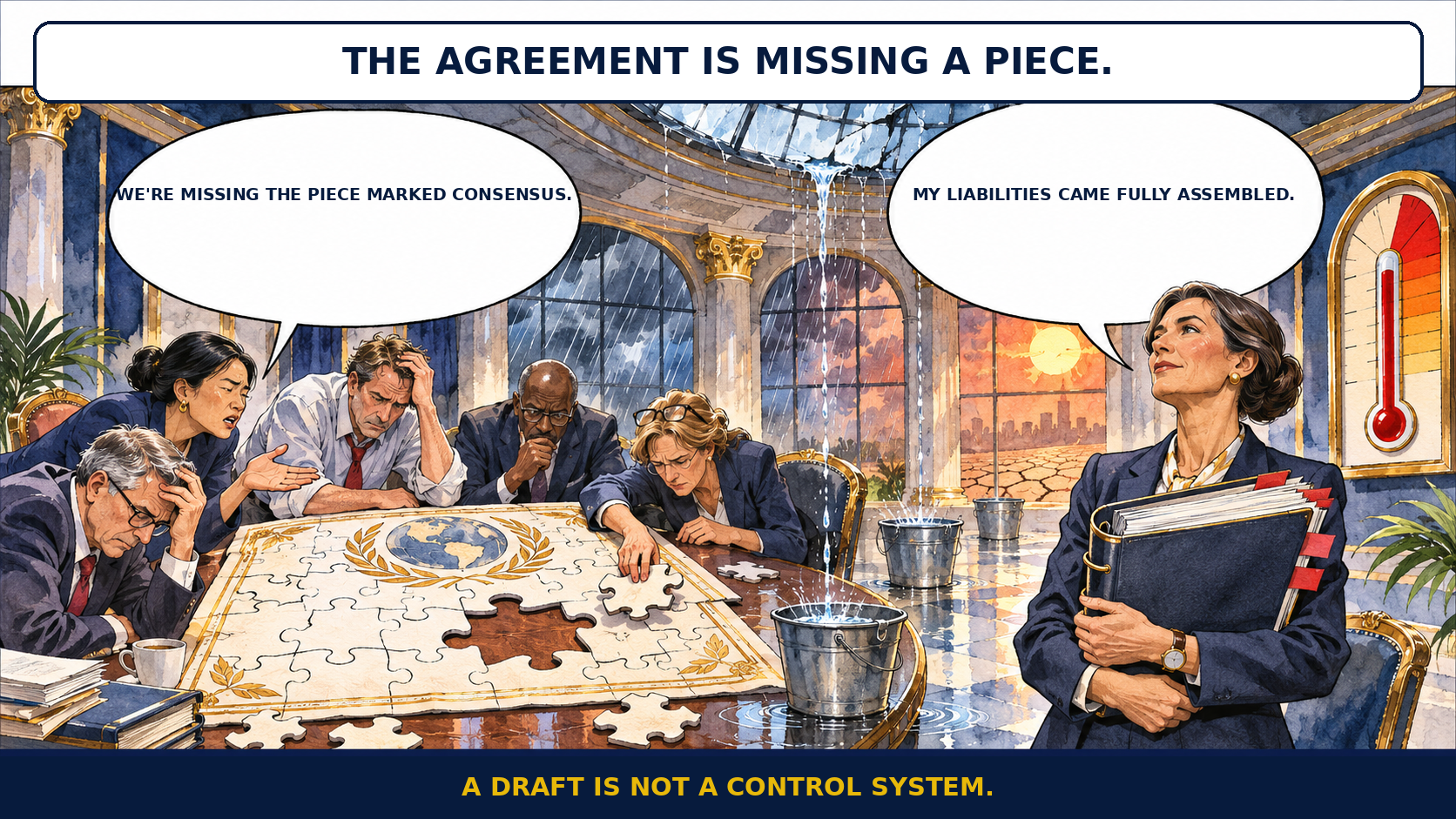
Negotiators search for the piece that makes the agreement whole. The asset owner faces a different puzzle: exposures that continue through the delay. Our original cartoon examines governance under uncertainty, alongside its animated edition.