The Lead | Which clock moved?
New Australian wage data, Japanese trade figures and a Japanese long-bond auction bring different kinds of evidence to the investment committee this morning. The releases are fresh; their reference periods are not the same. Australian wages describe the September quarter, Japanese trade describes October, and the auction records today's financing event.
Treating all three as “November data” obscures the distinction between a release date and the period it measures. For asset owners, the useful question is not whether the news is broadly good or bad. It is which exposure, assumption or decision the new evidence changes.
Today's briefing separates reported results from forecasts, nominal values from physical volumes, and announced transactions from completed investments. The institutional task is to connect those clocks without forcing them to show the same time.
Today in 90 Seconds
Australia's Wage Price Index rose 1.1% in the September quarter and 3.5% over the year. Newly published State Accounts put national real growth at 2.3% in 2025–26, compared with 3.1% in Queensland and 3.2% in the Northern Territory. ABS wages; ABS State Accounts.
Japan's provisional October merchandise figures show both exports and imports rising, with imports larger. Its 20-year government-bond auction produced an average accepted yield of 3.756%. Japan Customs; Ministry of Finance.
NVIDIA reported quarterly revenue of US$115.8 billion after yesterday's US close. Its forward guidance remains an expectation, not a reported result. Later in this edition: researcher Stijn Van Nieuwerburgh, portfolio dependencies, and the difference between a stress model and a prediction. Company results.
Regional Ledger | A country is not one exposure
Australia's new State Accounts report growth in every state and territory in financial year 2025–26. National real growth was 2.3%; Queensland grew 3.1%. In New South Wales, information, media and telecommunications grew 7.0%, with data-centre activity among the drivers identified by the ABS. These are historical accounts newly published today, not a forecast for the coming year. ABS.
For a global owner such as Norway's fund, the investment interpretation is to map underlying revenues before relying on a national label. An office, an electricity connection and a digital-infrastructure investment can share customers while appearing in different asset classes. No new Norwegian allocation is implied.
Credit Support | Revenue is not repayment
NVIDIA reported revenue of US$115.8 billion for the quarter ended 25 October, up 103% from a year earlier. A supplier's strong results do not establish that every borrower financing the surrounding infrastructure can service its debt. NVIDIA.
Credit analysis needs the contractual path from revenue to repayment: who pays the project company, when its debt matures, what is pledged, and what happens if a customer changes its purchase schedule. The lender still needs a cash-flow waterfall, an enforceable claim and a realistic refinancing case. That is investment analysis, not a conclusion the company makes about its customers.
Treasury | Price the liability, not the headline
Japan's 20-year government-bond auction produced an average accepted yield of 3.756%. Competitive bids totalled ¥1,914 billion against ¥525.8 billion accepted. The separate non-price-competitive allocation does not belong in that competitive denominator. Japan Ministry of Finance.
One auction is a verified funding observation, not a trend. A judgement about demand requires a comparable series. Liability-driven investors must also compare duration, currency and collateral requirements with the liability being hedged. The nominal yield is only one input; a foreign investor also needs to account for the hedge and its capacity to hold through price changes.
Geopolitics & Energy | Value is not volume
Japan's October petroleum import value rose 60.5% from a year earlier while quantity fell 0.7%. More money spent did not mean more physical fuel imported. The figures alone do not identify the contribution of a conflict, exchange rates or supply decisions. Japan Customs.
Portfolio analysis should separate volume sensitivity from price and currency sensitivity. A transport asset, utility and exporter can respond differently to the same import bill. Operating hedges and financial hedges cover different risks. The committee needs to know which exposure its reported protection actually offsets.
Pensions | Follow the formula
Australia's quarterly wage-price increase was 1.3% in the public sector and 1.0% in the private sector. These are wage-price measures, not changes in total payroll or employment. ABS.
For pension institutions, wages can affect contributions, benefit formulas, service-provider costs and portfolio-company revenues. The direction and timing depend on the plan and its contracts. A higher contribution base does not automatically strengthen funding if liabilities or costs respond differently. Identify the relevant formula, lag and cap before translating a wage release into a funding conclusion.
Chart | Growth rates, not economic size

The ABS State Accounts compare national growth of 2.3% with Queensland's 3.1% and the Northern Territory's 3.2% over the same financial year. The chart uses one percentage scale. It measures growth, not the size of each economy or its contribution to the national result. Source: ABS.
A small economy can grow quickly without driving national output. Portfolio construction must distinguish the growth rate, the amount of capital exposed and the reliability of the revenue stream.
European Direct Lending | Test economic headroom
Today's wage and funding observations raise a question for European direct lenders, not a new European default forecast: how much protection comes from the contractual coupon, and how much depends on the borrower's ability to absorb labour, energy and refinancing costs?
Covenant compliance is not the same as economic headroom. A borrower can comply at a reporting date and still face a large maturity or working-capital demand later. Compare the base case with slower cash collection, identify interest-rate assumptions, and establish who can require corrective action. This is analysis; no new European lending transaction is claimed.
Capital Flows & Transactions | Agreement is not closing
Background: Mubadala and Centerbridge's 16 November agreement values Canaccord's UK and Crown Dependencies wealth business at approximately £1.17 billion. Closing is expected in the first half of 2027, subject to approvals and conditions; management is expected to retain an ownership interest. This is an announced transaction, not a new overnight deal or a completed acquisition. Announcement.
Client-asset controls, conduct oversight, operational resilience and decision rights must be ready before control and cash transfer. New wage or financing data can change operating assumptions without changing the legal status of the agreement.
European Prices & Wages | Match the index
Australia's fresh wage release is not a proxy for European wages. Measures, bargaining systems and reference periods differ. The useful cross-market question is how each portfolio company's prices respond to its costs.
Does a contract reset monthly, annually or only on renewal? Is its index the one used in the investment case, and are increases capped? Those details determine how costs move into margins.
No later European inflation print is included at this edition's overnight cutoff. UK October figures were not added because the official release remained unavailable when checked after 07:00 UTC. Scheduled releases and forecasts are not reported results.
European Biomethane | A match is an introduction
Background calendar: under the Commission's 4 November announcement, buyers can submit demand to the Biomethane Mechanism until 23 December. Suppliers can respond from 21 January to 4 March 2027, with matching results planned for 18 March. European Commission.
A match is not an offtake contract. Diligence still requires feedstock availability, certification, connection rights, delivery obligations and buyer credit. Today's Japanese energy-import figures sharpen the reason to examine energy exposure; they do not establish a return for a European biomethane project.
Climate, Nature & Sustainability | Preserve the evidence
A severe energy-cost scenario can test resilience without becoming a prediction. Record the source, reference period, calculation and accountable owner behind an investment assumption. Separate actual emissions or energy use from a modelled reduction.
This is governance analysis, not a new climate-policy announcement. A transition label does not replace counterparty, construction and demand analysis. Equally, a difficult quarter does not alone invalidate a long-term thesis. An institution needs a documented process for deciding which new facts warrant changing that thesis.
People | Read the qualifications
NVIDIA's results announcement identifies Colette Kress as interim chief executive and chief financial officer. That is the title in the dated company release, not a new appointment announced here. Company announcement.
The fourth-quarter revenue outlook is US$130 billion, plus or minus 3%. It includes an additional week and assumes no China data-centre compute revenue. Those qualifications matter for quarter-to-quarter comparisons. Guidance is management's expectation, not an industry forecast or proof that governance questions are resolved.
Governance & Delegated Authority | Keep a change record
Operational risk can begin with teams using different clocks: one refreshes a wage assumption, another keeps an old financing rate, and a third moves an announced transaction into the funded column before closing.
A useful change record identifies the new fact, its effective date, the models it affects, the authorised decision-maker and the response deadline. Authority to change a hedge, approve a revised valuation or escalate a closing delay should remain distinct, even when one dashboard displays their effects. The record should explain the decision, not merely show that someone downloaded a new file.
Executive Profile | Stijn Van Nieuwerburgh
This profile examines Stijn Van Nieuwerburgh, the Columbia scholar whose research connects property markets, financing and the wider economy. This is a research-leadership profile, not news of a corporate appointment. He holds Columbia's Earle W. Kazis and Benjamin Schore real-estate chair, is a finance professor and co-directs the Paul Milstein Center for Real Estate.
His educational path began with an economics degree from Ghent in 1998. At Stanford he completed master's degrees in economics and financial mathematics in 2001, followed by an economics doctorate in 2003. His dissertation examined equity returns and housing as collateral. That early subject is a useful guide to the questions that run through his later work: what can support a financial claim, and what changes when that support weakens?
His curriculum vitae records a long period at New York University's Stern School, beginning as an assistant professor in 2003. He became a tenured associate professor in 2009, then a professor, and directed Stern's real-estate finance research centre. He moved to Columbia in 2018 and became co-director of the Milstein Center in July 2024.
The career is not confined to academic appointments. His record includes leadership of the 2015 expert review commission for Norway's Government Pension Fund Global, service on the Federal Reserve's stress-testing Model Validation Council from 2019 to 2022, and a Moody's ratings board role ending in 2025. These are distinct historical roles. They should not be presented as current seats or as endorsements of a particular model.
Columbia reports more than 50 published research articles and recognition including the 2016 Bernacer Prize and the 2020 TIAA Paul Samuelson Award. His research spans commercial property, mortgage-market design, housing affordability, asset management and government debt. For an asset owner, the interest is that these subjects cross the boundaries between the portfolio and the economy that ultimately supports it.
The institutional interpretation of that leadership contribution is methodological. A property valuation is not just a spreadsheet discount rate. It combines expected rents, financing conditions and the resilience of the tenants paying those rents. A pension's government-bond holding is not just a safe-asset label. Its usefulness depends on the circumstances in which the institution needs liquidity. Research helps make those connections explicit enough to examine.
His November working paper with Zijin Su, Clouds of Credit, maps the financial network behind AI compute. It treats contractual connections as an important route through which losses can spread. It is a model-based research contribution, not a prediction that a stated loss will occur. Today's newly reported company results are observations against which investors can interrogate assumptions, not an automatic validation or rejection of that framework.
The practical lesson is to ask a researcher three questions. Which mechanism is doing the work? Which assumption would most change the answer? Which exposures in our own portfolio correspond to the model's actors? Those questions are more useful than asking whether a paper is bullish or bearish.
There is also a limit to the translation. A published model cannot know every private covenant, guarantee or collateral arrangement held by an institution. Investment staff must supply those details, and governance must decide what action the evidence warrants. Academic authority does not substitute for that responsibility.
That is the leadership standard this profile highlights: make complicated dependencies discussable, preserve the difference between evidence and inference, and leave decision-makers with questions they can test. The value is not a dramatic number on a slide. It is a clearer account of what the institution owns, what supports it and what could change the result.
For an investment committee, this approach also disciplines how research enters the agenda. Staff can distinguish a mechanism worth investigating from a conclusion ready for implementation, then identify the institution-specific evidence needed to bridge that gap. The resulting discussion is neither deference to an academic name nor dismissal of a model because it simplifies reality. It is a structured examination of what the simplification reveals and what it leaves unresolved.
Institutional Careers | Check the employer
Ontario Teachers' employer pages provide career leads for an Investment Analyst in Dynamic Asset Allocation, Total Fund Management and an Investment Analyst in Infrastructure & Natural Resources. Candidates should check the current employer listing before applying. These are leads, not a claim that a vacancy remains open or a hiring decision has been made; no salary estimates are included.
For institutions, the capability question is how total-fund allocation and asset-level underwriting communicate. Detailed project knowledge does not prevent a shared portfolio exposure from being missed. Hiring, decision design and information flow all matter.
Decision Calendar | Assign the next update
Completed releases on the desk are Australia's wage and State Accounts figures, Japan's provisional October trade report and its 20-year auction. NVIDIA's quarterly results arrived after yesterday's US close. Release dates remain distinct from measurement periods.
Later today, the Bank of Canada advisory schedules Deputy Governor Toni Gravelle's speech text on scenario analysis and monetary-policy risk management for 12:30 p.m. Eastern, and the speech for 12:45 p.m. These were future events at the overnight cutoff; their contents are not reported here. Bank advisory.
Assign an owner to each consequential update. If a new release changes an investment discussion, its source note, chart and decision record should all refer to the same version.
The Take | Connect the clocks
A wage price, nominal trade value, financing yield, reported revenue and management forecast are different units of analysis. Each can be correct while pointing to a different decision. Identify the exposure before declaring a number good or bad for every asset.
Long-horizon owners still face near-term cash, collateral and governance deadlines. Good judgement makes those deadlines visible without allowing them to erase the long-term objective. The task is to connect the clocks, not force them to show the same time.
Watch the Latest UAO LIVE with Ryan Lafield

Watch the latest completed programme, Episode 67, shared on 17 November. Watch Episode 67
Listen | The Universal Owner
Source Desk
Primary reporting and background sources are distinguished throughout. Overnight source and inbox review completed after 07:00 UTC on 18 November 2026. Numerical releases retain their reference periods; analysis is not presented as a new transaction or policy announcement.
Australian wage release 18 November 2026
Australian State Accounts 18 November 2026
Japan Customs provisional October trade 18 November 2026
Japan MOF twenty year auction 18 November 2026
NVIDIA fiscal third quarter results 17 November 2026
Mubadala Canaccord agreement 16 November 2026 background
European biomethane matching calendar 4 November 2026 background
Stijn Van Nieuwerburgh Columbia biography
Stijn Van Nieuwerburgh curriculum vitae October 2026
Clouds of Credit November 2026 working paper
Ontario Teachers total fund management career listing
Ontario Teachers infrastructure career listing
Bank of Canada speech advisory 18 November 2026
Back Page | Capital has more than one clock
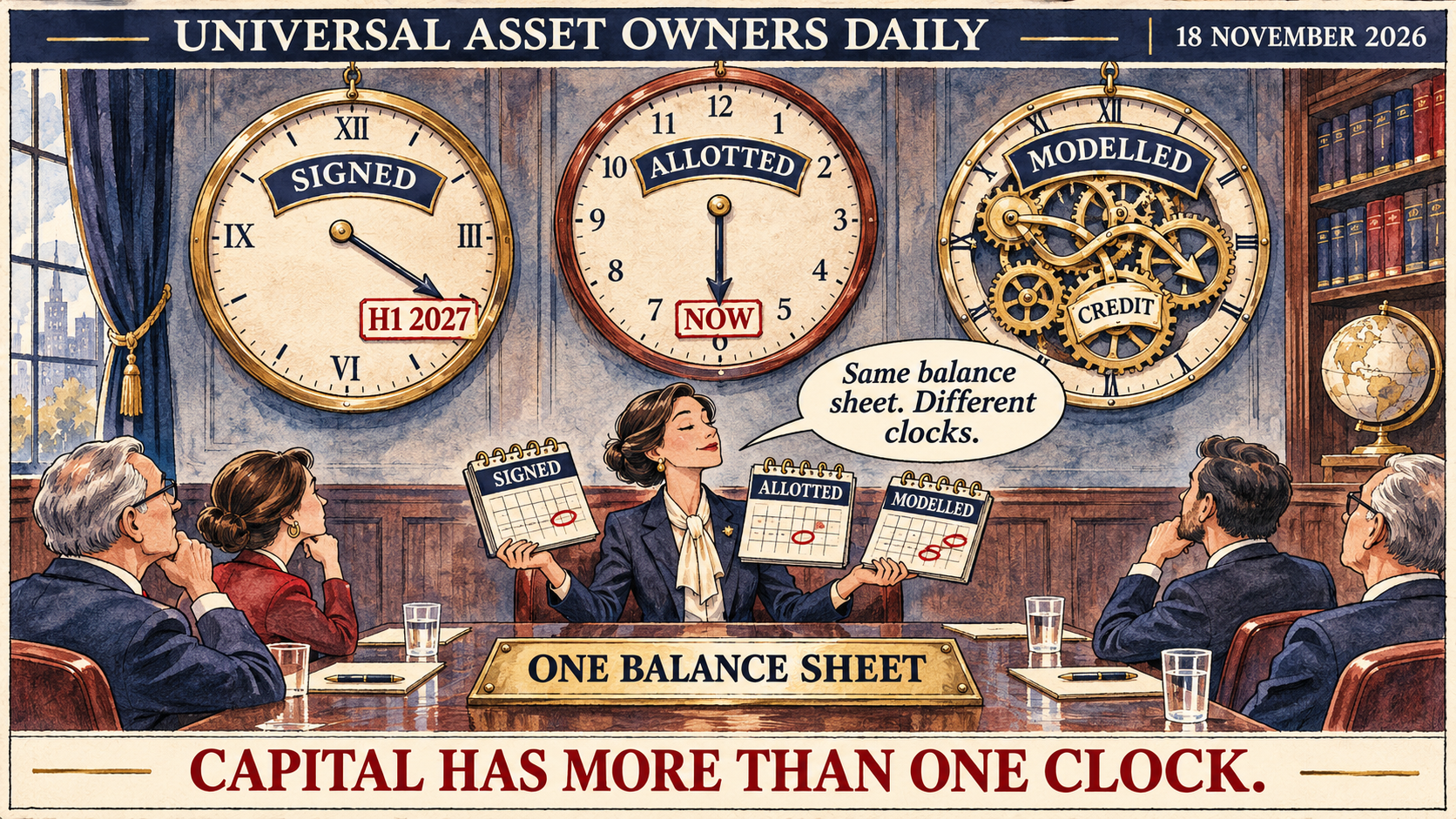
Signed, allotted and modelled are different states, not interchangeable milestones. Today's releases add another distinction: the publication date is not the period being measured. The committee should ask which clock moved before deciding what to do.