UNIVERSAL ASSET OWNERS DAILY
The distance between a promise and a portfolio
Sunday 15 November 2026 · Toronto
Final news and inbox check: 05:04 Toronto / 10:04 UTC
A technical committee is not a concession. An investment conference is not financial close. A useful Sunday edition starts by keeping those distinctions intact. A new Jordan-Türkiye circular-economy initiative joins a wider set of infrastructure opportunities and climate-finance negotiations. For asset owners, the question is how an intention becomes an enforceable, financed and operable asset, and where responsibility sits before that transition is complete.
Listen to The Universal Owner
Today in 90 seconds
- A November 15 Jordanian official report identifies a proposed circular-economy cooperation pathway, not a signed investment agreement.
- Jordan is preparing transport and energy opportunities for an upcoming investor conference. Their financing and execution remain prospective.
- COP31 has reached its midpoint. Negotiation progress must not be confused with a final climate-finance settlement.
- UK workplace savings access is expanding, but payroll savings and pension assets serve different purposes.
- Maldives Pension Office is exploring climate-finance opportunities while emphasizing retirement security; no allocation was announced.
- The US airspace investigation separates restored operations from an unresolved cause.
- Our executive profile examines Simon Stiell and the institutional work of turning negotiations into implementation.
The lead - the first mile of investability
Petra reported on November 15 that Jordan and Türkiye’s Zero Waste Foundation plan a cooperation memorandum, with signing envisaged in January 2027. It is not a financed investment.
Our analysis: this is a first-mile signal. Before a proposal becomes suitable for institutional capital, someone must define the revenue, asset ownership, operating obligations and remedies for failure. A cooperation document can help build that framework, but cannot replace it. The discipline is to record which stage has actually been reached, then specify the next piece of evidence an investment committee needs.
This is not an argument to wait until every uncertainty disappears. Development investors often work precisely where institutions are incomplete. It is an argument to price and govern the uncertainty that remains, rather than presenting political endorsement as an investment guarantee.
Watch the latest completed UAO LIVE with Ryan Lafield

Episode 65, NVIDIA Without Jensen Huang: What Comes Next for Investors? — released 13 November 2026. Watch the latest completed UAO LIVE programme with Ryan Lafield; this is an archive replay.
Sovereign and foundation allocation lens
Maldives Pension Office's November 14 forum report says its fund crossed MVR 30 billion in net assets this year. CEO Yazmeed Mohamed said the institution is exploring ESG initiatives, including climate financing, while stressing financial discipline and members' retirement security. The report describes discussion and exploration, not an approved allocation or a new climate fund.
The Jordan-Türkiye circular-economy announcement, meanwhile, brings a foundation into a policy partnership without disclosing an endowment investment. No separate new sovereign commitment was independently verified.
Our analysis: asset owners should distinguish a convening organization from a capital provider. A foundation may contribute expertise, standards or connections without underwriting project risk. Conversely, an investor may supply capital without controlling municipal collection systems or enforcement. The investment case must say which institution performs each role.
For a sovereign investor, a local development objective may be part of the mandate. For an endowed foundation, a spending policy and mission may shape an entirely different risk budget. Neither should inherit the other's assumptions merely because both sit under the broad heading of public-purpose capital.
Credit - underwrite the revenue, not the conference
Brookfield's Q3 earnings-call transcript is dated November 6, not November 14. As explicitly dated background, management described its AI-infrastructure approach as assets supported by long-term contracts with major counterparties. That is management's investment thesis, not a guarantee of returns or a fresh overnight transaction. We do not repeat its fundraising totals as newly raised capital.
Our analysis concerns underwriting, not a recommendation to buy a security.
The first question is who pays. Infrastructure revenue may depend on usage, an availability contract, a regulated tariff or a public purchaser. Each creates a different exposure. The second question is whether the revenue currency matches debt service. The third is who bears construction overruns, operating shortfalls and changes in law.
A credible sponsor and a valuable public service can improve a project's prospects without eliminating these risks. Credit analysis should follow the contractual cash flow through its weakest point. Ask what happens if an expected public payment is delayed, if demand is below plan, or if the operating asset does not meet its promised standard. The headline size of an opportunity says little about recoveries.
Treasury / balance-sheet discipline
No new Treasury auction or sovereign funding decision was independently verified in the reviewed sources. This lane is editorial analysis of the balance-sheet work that precedes a private commitment.
An owner can be solvent over decades and still face a liquidity squeeze next quarter. Capital calls, currency hedges and collateral needs should be modeled together rather than delegated to separate spreadsheets. A staged project may require cash before it produces revenue; that timing is part of its economics.
The useful committee question is not simply whether the portfolio has enough cash today. It is which other assets would have to be sold if several commitments called capital at the same time. A resilient funding plan gives the institution room to negotiate rather than forcing it to accept an unfavorable sale.
Politics - humanitarian access and operating risk
The EU's November 14 statement expresses concern about Gaza's humanitarian conditions, flooding and winter exposure, and calls for humanitarian access and reopened crossings. It reiterates civilian protection and the EU's two-state position. This is a diplomatic statement, not a new sanctions decision or an announced ceasefire.
Our analysis: humanitarian access, legal permissions and commercial operability are separate dimensions of country risk. Investment teams should not infer that one diplomatic development settles all three. Where an asset depends on cross-border movement, the relevant diligence includes actual operating access and the continuity of essential services, not only the wording of a political communiqué.
AFP reported on November 14 that the White House announced a Trump-Xi-Putin meeting in Shenzhen the following Thursday. Officials described nuclear arms and Iran as intended topics, with Ukraine on a separate negotiating track. That is a planned meeting, not an agreement. Source
Pensions - savings resilience is not pension accumulation
HM Treasury’s November 14 announcement expands potential access to workplace payroll savings. The number concerns eligibility, not verified participation or pension flows.
Our analysis: emergency liquidity and retirement provision solve different problems. A household's accessible buffer should not be confused with long-term pension wealth, and an employer's offer is not proof of participation. For trustees and sponsors, the practical issue is clear communication about purpose, access and choice. Report each product's outcomes on its own terms.
Chart - the commitment ladder
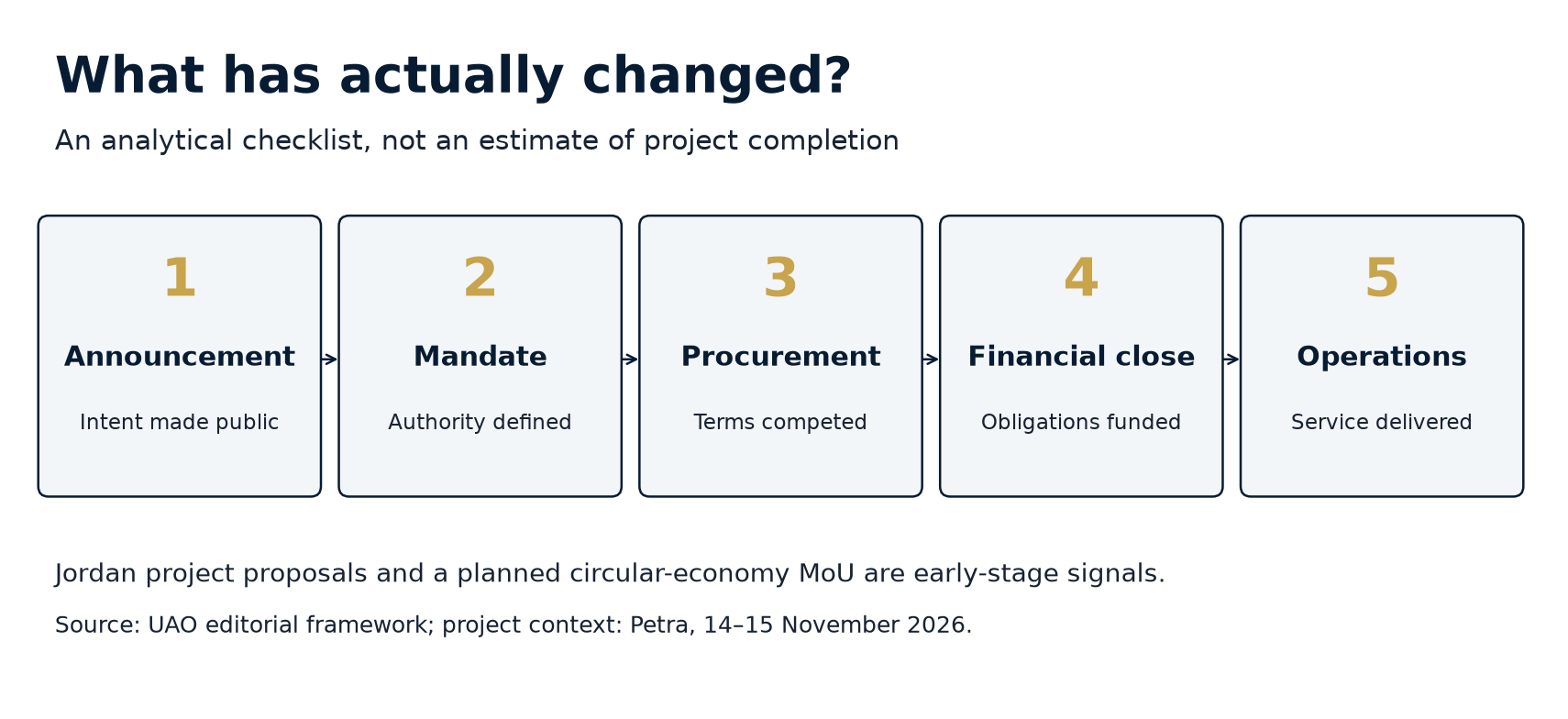
Illustrative sequence: announcement -> mandate -> procurement -> financial close -> operating asset. This illustrative sequence may overlap or loop backward. Each transition requires new evidence; no project is assumed to complete every step.
This is an editorial classification, not a numerical forecast. The visual should make the missing steps visible rather than turning a collection of plans into an aggregate investment total.
Development lending / institutional capital
Development capital can help bridge the gap between a useful public project and a structure that a pension fund can evaluate. That is an editorial proposition, not a claim that a particular guarantee or loan has been approved today.
Our analysis: the most valuable intervention may be project preparation, contractual clarity or risk allocation rather than a larger headline funding number. A guarantee must identify the covered obligation, the conditions for a claim and the party that remains exposed. A blended-finance label by itself does not explain any of those things.
Institutional investors should also examine whether the proposed structure can be replicated. One exceptionally negotiated transaction can be attractive without establishing a scalable market. Repeatability requires usable documentation, data and governance, not simply enthusiastic participants.
Acquisitions / exit execution
No fresh acquisition or completed exit was independently verified in this narrow source window. We do not relabel an earlier transaction as an overnight deal to fill the lane.
Our analysis: the same distinction between intention and completion applies to corporate transactions. Announced consideration, regulatory approval, financing conditions and the actual transfer of control belong in separate fields. An investment committee needs a clear view of which risks remain with the seller and which will transfer to the buyer.
For private-market owners, an exit plan also needs a liquidity plan. A valuation based on an assumed sale date should be tested against delay. The appropriate response to an empty fresh-deal tape is transparent reporting, not a recycled headline with a new date.
Geography - Jordan's infrastructure invitation
Petra’s November 14 report describes Jordan’s transport pipeline ahead of investor meetings. More than US$5 billion of proposed projects is not capital already secured.
Our analysis: a conference can improve access to counterparties, but project selection should still follow demand, contractual structure and delivery capacity. Regional connectivity is a strategic rationale; it is not a substitute for project-level revenue evidence. Investors should identify which proposed assets have completed feasibility work and which remain early concepts before comparing opportunities.
Energy infrastructure - storage specifications are not returns
Petra’s November 14 energy report describes the proposed Mujib pumped-storage facility. Its specifications are plans, not commissioned capacity or completed financing.
Our analysis: storage economics depend on more than duration. The investment case needs to identify the contracted service, charging costs, dispatch arrangements and operating constraints. Capacity, energy delivered and revenue are different measures. A useful technical specification can support diligence, but cannot establish a project return on its own.
Climate - midpoint is not agreement
UNFCCC’s November 14 midpoint remarks call for compromise at COP31. They do not announce a final agreement or funded commitment.
Our analysis: a mandate count measures work to be done, not capital committed. For owners, the relevant transmission channels are the policies, financing terms and implementation arrangements that emerge. A negotiating text can alter expectations before it becomes binding, but those expectations should remain explicitly conditional.
People moves
No new verified asset-owner appointment is announced in this edition. Today's executive profile concerns an incumbent leader, not a new hire.
Our analysis: an institution's ability to execute depends on continuity as well as recruitment. When a public initiative names a technical committee, investors should eventually be able to identify who has decision rights, who supplies expertise and who is accountable for delivery. A name in a press release is not enough to establish delegated authority.
Operational risk - reopening is not root-cause resolution
USDOT's November 14 update says US airspace reopened after the November 13 nationwide ground stop, while delays and cancellations could continue. Secretary Sean Duffy described a suspected router-related disruption during a remote copper-to-fiber change; whether installation error or faulty equipment caused it remained undetermined. He said officials did not believe it was cyber-related. FAA Administrator Bryan Bedford distinguished the maintenance work from the separate Peraton-FAA modernization effort. These are officials' provisional explanations, not a completed investigation.
L3Harris's November 14 statement says it is supporting the investigation and reports more than 70% of the planned communications conversion completed with partners and the FAA. That company-reported progress measure does not settle fault for the disruption.
Our analysis: restoration, root-cause identification and corrective action are three different milestones. Owners of essential infrastructure need evidence for each.
Before a commitment leaves an organization, the record should identify the approved version, accountable owner, counterparties and unresolved conditions. A handoff should transfer responsibility without erasing uncertainty. If a transaction's status is unclear, repeating it is not a reconciliation method.
This is an institutional process lesson, not an allegation about any entity in today's news. The goal is a record that another competent person can read and understand without relying on the original team's memory. That discipline matters as much for a small pilot as for a large mandate, because pilots often become the templates for later scale.
Executive profile - Simon Stiell
Our executive profile today is Simon Stiell, Executive Secretary of UN Climate Change. At COP31's midpoint yesterday, he pressed governments to tackle the difficult negotiations rather than consume the remaining time with tactical delays. That is a useful introduction to his job: keeping an international process moving when its participants retain the power to say no. Source
Stiell is Grenadian. Antonio Guterres appointed him in August 2022 and reappointed him for a second three-year term in June 2025. Before the United Nations, he served in Grenada's government from 2013 until June 2022, including five years overseeing climate resilience and the environment. His earlier responsibilities included education and human-resource development. He also served in the Senate as Leader of Government Business. Source
This is not a career built entirely inside international diplomacy. Before government, Stiell spent roughly fourteen years in technology, holding senior positions at businesses ranging from Silicon Valley start-ups to Nokia and GEC Plessey Telecommunications. He trained in engineering and completed his MBA at the University of Westminster in 1998. Source
Our interpretation is that this combination matters more than a personality label. Technology companies, national ministries and multilateral institutions operate with very different incentives. His career has exposed him to all three. But that background does not prove he can secure an agreement, and it certainly does not give him authority over the balance sheets of governments or institutional investors.
So what does he actually control? He leads the UNFCCC secretariat. Its responsibilities include technical support, reviewing information countries report, maintaining the registry of national climate commitments, and supporting negotiations. It also helps connect governments with cities, companies, investors and other participants through international climate-action initiatives. Source
Think of that as the supporting machinery of cooperation, not a global finance ministry. For this profile, we separate three things: authority, budgets and implementation. A statement by the Executive Secretary is not itself a national spending authorization. A negotiated financial goal is not a signed investment agreement. And an investment agreement is not a completed power grid, flood defence or industrial project. Those distinctions matter when assessing announcements.
His November 13 finance speech sets out his priorities.
Our analysis: the leadership challenge is deciding what information a coalition needs before it can act. More meetings do not automatically produce a better decision. A useful convenor makes disagreements legible: which concern is about the objective, which about who pays, and which about whether delivery is possible? Those distinctions can turn an apparently universal objection into a specific problem that someone has authority to solve.
Investors can apply the same test to their own committees. If the objection is liquidity, a stronger sustainability narrative does not answer it. If it is execution capacity, a larger return forecast does not answer it. The quality of leadership is partly visible in whether the next conversation addresses the actual constraint. This is our framework for assessing leadership, not a claim that Stiell has resolved every negotiation through it.
For asset owners, our analytical takeaway is to follow the chain from political language to an investable proposition. Who can authorize the project? Who bears construction, currency and demand risk? What revenue supports repayment? Which institution can actually deliver? Those are our assessment questions, not claims that this week's negotiations have supplied the answers.
And the measure of Stiell's leadership?
We would look for clearer commitments, usable information and arrangements that make implementation easier to scrutinize. We would not confuse visibility with execution. His midpoint intervention asks governments to compromise; his finance intervention asks institutions to coordinate. The executive challenge is connecting those two conversations without pretending that convening them makes their outcomes automatic. That makes him consequential to investors, but not a substitute for their diligence. His influence deserves attention precisely because influence and direct investment authority are not the same.
Careers - two deadlines today
CERN’s existing investment-committee expert vacancy closes November 15, with no stated cutoff hour. The opening takes effect in May 2027.
The National Wealth Fund CIO search also closes November 15. This is an existing recruitment deadline, not an appointment announcement.
Our analysis: both searches emphasize judgement across mandates, risk and execution, but the governance responsibilities differ. Applicants should read the actual terms and verify that submission remains open rather than infer an end-of-day deadline from this newsletter.
Decision calendar and risk radar
Great British Energy’s call closed November 14 at 23:55 London. Selection and approval still precede any investment award.
- November 15: CERN investment-committee expert and National Wealth Fund CIO applications close; neither reviewed source states a cutoff time.
- This week: follow the investment conference for actual agreements and terms, not only its advertised pipeline.
- COP31 second week: distinguish draft negotiating positions from adopted outcomes.
- Before year-end: the Jordan-Türkiye committee aims to prepare its memorandum; signing is planned for a January 2027 visit.
Our analysis: a calendar becomes useful when each date has an observable decision attached. Record what would count as progress and what would remain unresolved afterward.
A dated research signal: an ECGI working paper published November thirteenth examines US public pensions using data through June 2025. The authors find reduced support for environmental and social shareholder proposals after state anti-ESG policies, without a significant change in portfolio ESG ratings. It is a working-paper finding, not a new regulation or evidence that portfolio holdings were unchanged. Source
The Take
The opportunity is not to dismiss early announcements. It is to give them the correct weight. A new committee can begin useful work. A conference can introduce counterparties. A funding call can organize a pipeline. None should be represented as a fully financed operating asset before the evidence supports that conclusion.
For universal owners, this discipline protects both investment performance and public credibility. It keeps a portfolio's financial exposure separate from the ambitions associated with it, while making it easier to see where an institution could contribute something useful.
Our editorial test for the week ahead is simple: what has changed in the contract, the financing or the ability to deliver? Follow those changes. Do not add proposals, envelopes and operating capacity into a single number that no participant has actually committed.
Source Desk
- Maldives Pension Office forum report, November 14; exploration, not allocation.
- USDOT airspace update, November 14; provisional cause, restoration with potential delays.
- L3Harris statement, November 14; attributed company response.
- CERN Pension Fund expert vacancy, direct employer listing; deadline November 15.
- National Wealth Fund CIO candidate pack, October 2026; deadline November 15.
- Brookfield Q3 transcript, November 6, explicitly background, not new fundraising.
- Petra, Jordan-Türkiye circular economy, November 15, 08:05:16 Amman. Cooperation pathway, not signed investment.
- UNFCCC, COP31 midpoint remarks, November 14. Official negotiating status.
- HM Treasury, workplace savings, November 14. Potential access, not participation or pension flows.
- Petra transport source.
- Petra, Mujib storage, November 14, 13:52 Amman. Proposed specifications.
- Council of the EU, Gaza statement, November 14, 13:20. Diplomatic statement.
- Great British Energy source.
Publication dates are not automatically Toronto dates. This edition separates dated developments, planned activity and our analysis.
Back Page - the commitment ladder
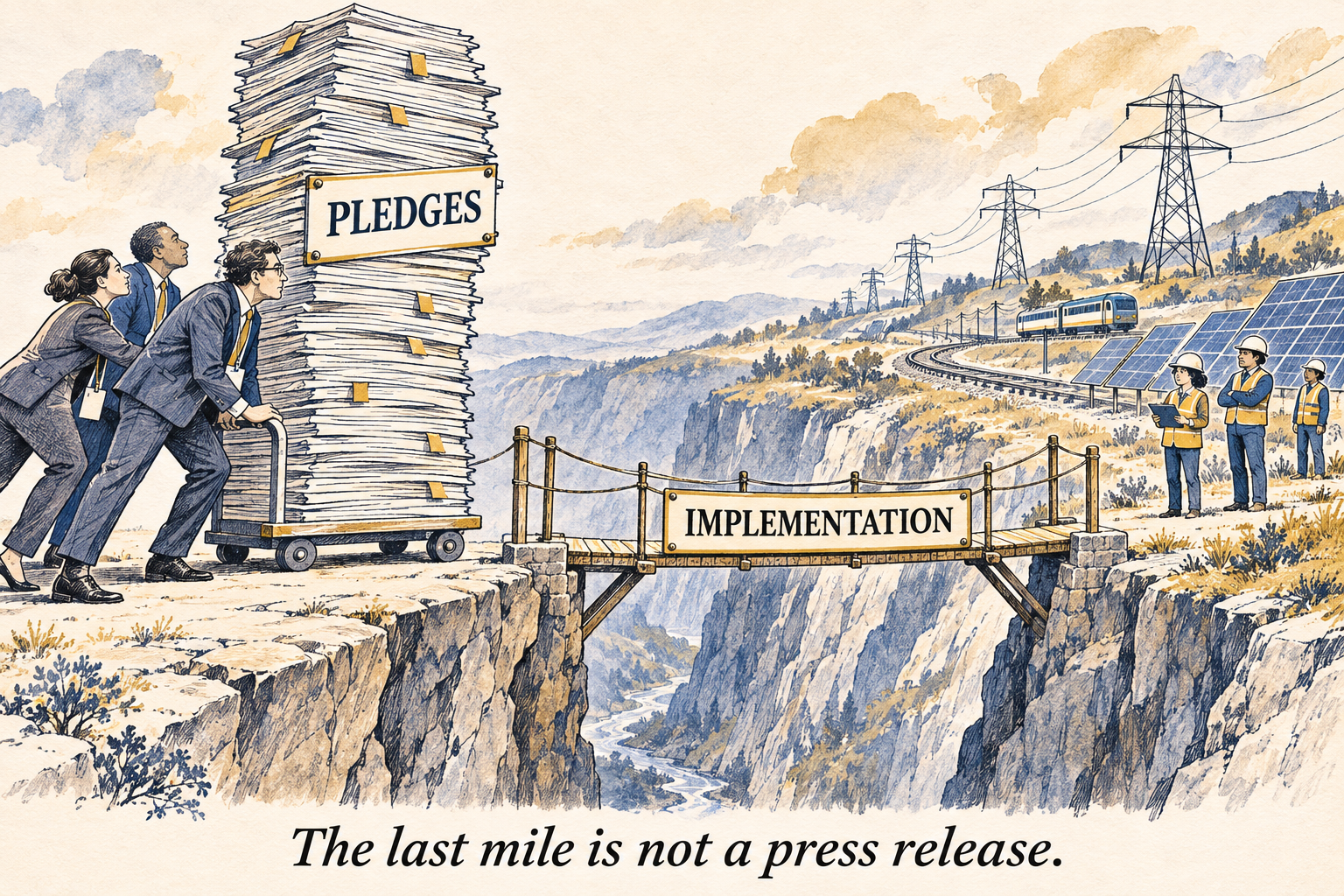
The Back Page follows the distance between pledges and implementation. Delegates wheel pledges toward a narrow implementation bridge, with real assets on the far side. The caption is: "The last mile is not a press release."
The joke is about premature certainty, not the value of cooperation. The serious point is that each step has a different owner, different evidence and a different risk.
Universal Asset Owners - The Editorial Team
This publication is general institutional research, not individualized investment advice.