The constraint is not capital
Monday, 16 November 2026
Asset owners are arriving at the same diagnosis from different directions: capital is available, but the policy and governance machinery that turns it into durable investment is still inconsistent. At COP31, a closed-door asset-owner roundtable put systemic climate risk and credible long-term policy at the centre of the discussion. In Sacramento today, CalPERS will put total-fund management, sustainable investment and the measured effect of divestment on one public committee agenda. The connection is practical. If policy signals, governance tests and portfolio architecture do not line up, mandates remain smaller, slower and more expensive than the risk requires.
That is why today’s lead is not another pledge total. It is the operating system behind the pledge.
TODAY’S PODCAST · 16 NOVEMBER · 10 MIN 30 SEC Capital needs policy and governanceKatie Alexandra reports on CalPERS, Japan and China, Treasury settlement, Canaccord, and maritime and launch-provider risks. The complete daily briefing, presented by Katie Alexandra. Listen on Podbean. Apple Podcasts show · Spotify show |
Today in 90 seconds
- CalPERS’ governance test. The Investment Committee meets from 08:45 Pacific time with a quarterly portfolio report, the Total Fund Portfolio Management annual review, the Sustainable Investments annual review, the Responsible Contractor Program review and an annual consultant analysis of divestments. The published quarterly portfolio snapshot reports US$651.3 billion of assets under management, a 6.9% five-year net annualized return (not cumulative) and 250 basis points of active risk, against an operating range of 250–350 basis points, all as of 30 September 2026. CalPERS quarterly portfolio report. The agenda is forward-looking; no meeting decisions are implied.
- Climate finance’s missing variable. The Financial Times reports that participants including pension funds, insurers and sovereign investors focused on climate events as a systemic financial risk and on policy credibility as the investment bottleneck. UNFCCC schedule | FT report.
- Treasury settlement day. The US Treasury’s US$125 billion November refunding settles today: US$58 billion of three-year notes, US$42 billion of ten-year notes and US$25 billion of thirty-year bonds, raising about US$28 billion of new cash. US Treasury, 4 November.
- Europe’s next data checkpoint. The ECB releases euro-area investment-fund and financial-vehicle-corporation statistics today. Its wage tracker, updated 4 November, places headline negotiated wage growth at 2.7% in the second half of 2026 and 2.8% in the first half of 2027, with coverage declining further out. ECB statistical calendar | ECB wage tracker.
- Asia’s new activity readings. Japan’s first estimate puts real GDP at -0.0% quarter on quarter (rounded), or -0.1% annualised. China’s October industrial output grew 4.8% year on year and nominal retail sales 0.4%; January–October fixed-asset investment excluding rural households fell 8.1% year on year. The investment figure is cumulative, not monthly. Japan Cabinet Office | China NBS.
Portfolio architecture: CalPERS puts the system on the agenda
CalPERS’ 16 November agenda matters less because any one item is novel than because the items are being considered together. The fund’s published portfolio report says the Total Portfolio Approach was implemented on 1 July 2026 and distinguishes active programmes from reference-portfolio assets. Today’s committee papers then connect that architecture to sustainable-investment implementation and to the measured portfolio effects of divestment.
The allocator lesson is straightforward. A universal owner cannot treat climate, liquidity, public-market beta and private-market pacing as separate conversations. They meet in the same total-fund risk budget. The useful question is not whether a policy is labelled sustainable, active or strategic. It is whether the policy changes expected return, concentration, liquidity, implementation cost or the institution’s ability to hold risk through a shock.
For boards, the public agenda offers a good sequence: establish the portfolio baseline; review the operating model; examine the investment programme; and then test whether exclusions or divestments achieved their stated objective without impairing the fund’s duty. That sequence is more valuable than a symbolic vote detached from measurement.
CalPERS Investment Committee, 16 November 2026 | Quarterly Portfolio Report | Consultant Review of CalPERS Divestments
Sovereign and pension allocations: the governance premium
Canaccord Genuity announced on 15 November a definitive agreement to sell its UK and Crown Dependencies wealth-management business to a Centerbridge–Mubadala joint venture at an enterprise value of GBP1.17 billion. Completion is expected in the first half of 2027, subject to regulatory and customary approvals. This is an announced agreement, not a closed transaction or an already-deployed allocation. Company release.
The COP31 asset-owner discussion and today’s CalPERS meeting point to the same transmission mechanism. Long-term pools can fund grids, resilient cities, clean industry and adaptation, but only when rules support credible cash flows and boards can trace the risk through the total fund. The Financial Times account describes participation by pension funds, insurers and sovereign investors. Treat this as attributed reporting, not an official attendance register.
The institutional response should be to price a governance premium. Where a jurisdiction has stable regulation, transparent procurement, investable project pipelines and predictable permitting, required returns can fall and mandate capacity can rise. Where rules oscillate, even generous subsidies can fail to produce a durable allocation. This is a balance-sheet issue: policy instability raises the option value of waiting.
Norway’s model remains useful context. The Government Pension Fund Global separates the political decision about the fund’s mandate from delegated execution by Norges Bank Investment Management, with public reporting and a reference index. That does not eliminate controversy; it makes responsibility legible. The same clarity is needed when asset owners are asked to finance policy goals through private markets.
Norwegian Ministry of Finance, Government Pension Fund | NBIM strategy
Credit support: guarantees should buy additionality
The EIB and CIB Bank’s 6 November Hungarian mid-cap facility is a useful current template. A EUR100 million EIB guarantee is expected to support up to EUR200 million of new lending and mobilise about EUR280 million of investment, with more than 60% of financing expected to reach less-developed regions. The crucial word is expected: a guarantee is not deployment, and mobilised investment is not the same denominator as bank lending.
For asset owners evaluating credit-support structures, the diligence list is familiar but often neglected: What risk is transferred? Who retains first loss? What lending would have happened without the guarantee? How are regional or climate objectives measured? And what happens when the support expires? A credible programme should lower a real financing constraint rather than subsidise transactions already clearing the market.
Treasury: settlement is the portfolio event
Today’s US refunding settlement puts duration and cash management back on the allocator’s desk. Treasury is issuing US$58 billion of three-year notes, US$42 billion of ten-year notes and US$25 billion of thirty-year bonds. Against about US$97 billion of maturing privately held notes and bonds, the package raises roughly US$28 billion of new cash.
The numbers do not constitute a directional rate call. They do create an implementation question: how much duration should be added at settlement, and how should collateral, liquidity sleeves and derivative overlays be adjusted? Treasury says nominal coupon and floating-rate-note auction sizes are expected to remain stable for the next several quarters, while bills remain the near-term balancing item. That makes the composition of demand—banks, money funds, foreign reserve managers, pensions and households—as important as the headline size.
US Treasury quarterly refunding statement | Treasury buyback schedule
Politics, oil and chokepoints
The Joint Maritime Information Center’s 15 November advisory reports a tanker attack in the Arabian Gulf before entry into Hormuz, citing Indian shipping authorities. The crew is safe; damage and environmental impact remain unknown. It does not establish a mine or sinking. Bab el-Mandeb remains open, while commercial Hormuz traffic is reduced. JMIC update 114. Keep this separate from the Bahrain drone statement below.
Bahrain’s foreign ministry said on 15 November that an explosive drone had been intercepted and destroyed. The Union of OIC News Agencies carried the ministry’s statement. This is attributed official reporting, not independent verification of the wider military situation or evidence of tanker disruption. Weekend reporting around Gulf security requires unusually careful attribution. Publicly available claims remain uneven, and operational details can change faster than portfolios can rebalance. The investment conclusion is not to trade every headline. It is to map physical dependencies—diesel, insurance, shipping capacity, strategic inventories and port access—and to pre-agree decision thresholds.
For universal owners, the risk transmission runs from security events to freight and energy, then into inflation, monetary policy and fiscal support. The current oil market also contains a tension between broad supply expectations and tighter middle-distillate conditions. That argues for scenario ranges rather than a single spot-price narrative.
The board-level question is whether the portfolio has enough liquid protection to hold long-duration assets through an energy shock without becoming a forced seller.
Europe: capital, credit and the scale-up gap
The EIB Group’s 9 November announcement brings fifteen institutional investors and seven member states into an alliance intended to channel more than EUR10 billion into European scale-ups. The named investors indicated more than EUR8 billion, while seven member states and the EIB Group are working toward roughly EUR2 billion for a first closing of a fund-of-funds. The stated ambition is to mobilise up to EUR80 billion in total investment, with average tickets of EUR200 million.
Those are different stages and denominators: intention, commitment, first closing and mobilisation should never be collapsed into a single deployed-capital number. The strategic point is still important. Europe is trying to create the patient, large-ticket equity channel that allows companies to scale without relocating. For pensions and insurers, the attraction is not simply policy alignment; it is access, governance and the possibility of institutional-size co-investment.
Direct lending faces the same test. Public credit support can open a market, but managers must show that underwriting standards, covenants, workout capacity and valuation discipline survive when growth slows. The best partnership structures make public and private responsibilities explicit before stress arrives.
European prices and wages
The ECB’s wage tracker is not a forecast, and its employee coverage falls as the horizon extends. With that caveat, it shows headline negotiated wage growth at 2.7% for the second half of 2026 and 2.8% for the first half of 2027, before declining to 2.4% in the third quarter of 2027 on still-limited coverage. The tracker excluding one-off payments rises from 2.6% in 2026 to 2.8% for the first three quarters of 2027.
That profile complicates an easy disinflation story. Energy effects may fade or reverse, but wage-intensive services can remain sticky. Asset owners should therefore distinguish a temporary energy shock from the persistence embedded in contracts and compensation. Today’s ECB investment-fund and financial-vehicle statistics add a second lens: whether portfolios are absorbing the rate and growth uncertainty through duration, liquidity or leverage.
ECB wage tracker, 4 November 2026 | ECB calendar
European biomethane: a market-design test
The European Commission’s first biomethane matching round is open for buyer demand until 23 December. Suppliers can express interest from 21 January to 4 March 2027, with matching results scheduled for 18 March. The mechanism is voluntary and free, and the Commission says its new regulatory dashboard initially covers selected countries responsible for more than 90% of current EU biomethane production.
The mechanism does not itself create a bankable offtake contract. It reduces search costs and exposes differences among national frameworks. That is valuable, but investors still need feedstock traceability, lifecycle-emissions integrity, grid connection, counterparty quality and price-risk allocation. For infrastructure portfolios, the opportunity is not just plant ownership; it can include aggregation, storage, certification and cross-border market services.
European Commission, 4 November 2026
Climate, nature and stewardship
The Principles for Responsible Investment said on 12 November that the global climate transition is moving from target-setting toward implementation, supervision and enforcement. That is precisely where stewardship must become more specific. Voting policies need to connect to capital allocation, transition plans, audit quality and board accountability; otherwise engagement becomes a parallel reporting exercise.
The Canada-UK climate-finance statement provides another scale marker: Canada cited CAD13 billion of international climate support over five years; the UK cited GBP6 billion of overseas-development assistance over three years and GBP6.7 billion of public finance. FinDev Canada, British International Investment and Norfund stated an intention to mobilise US$10 billion by 2030. Again, public support, institutional intent and mobilised private capital are distinct.
PRI, 12 November 2026 | Government of Canada, 13 November 2026
Chart: CalPERS’ three portfolio numbers
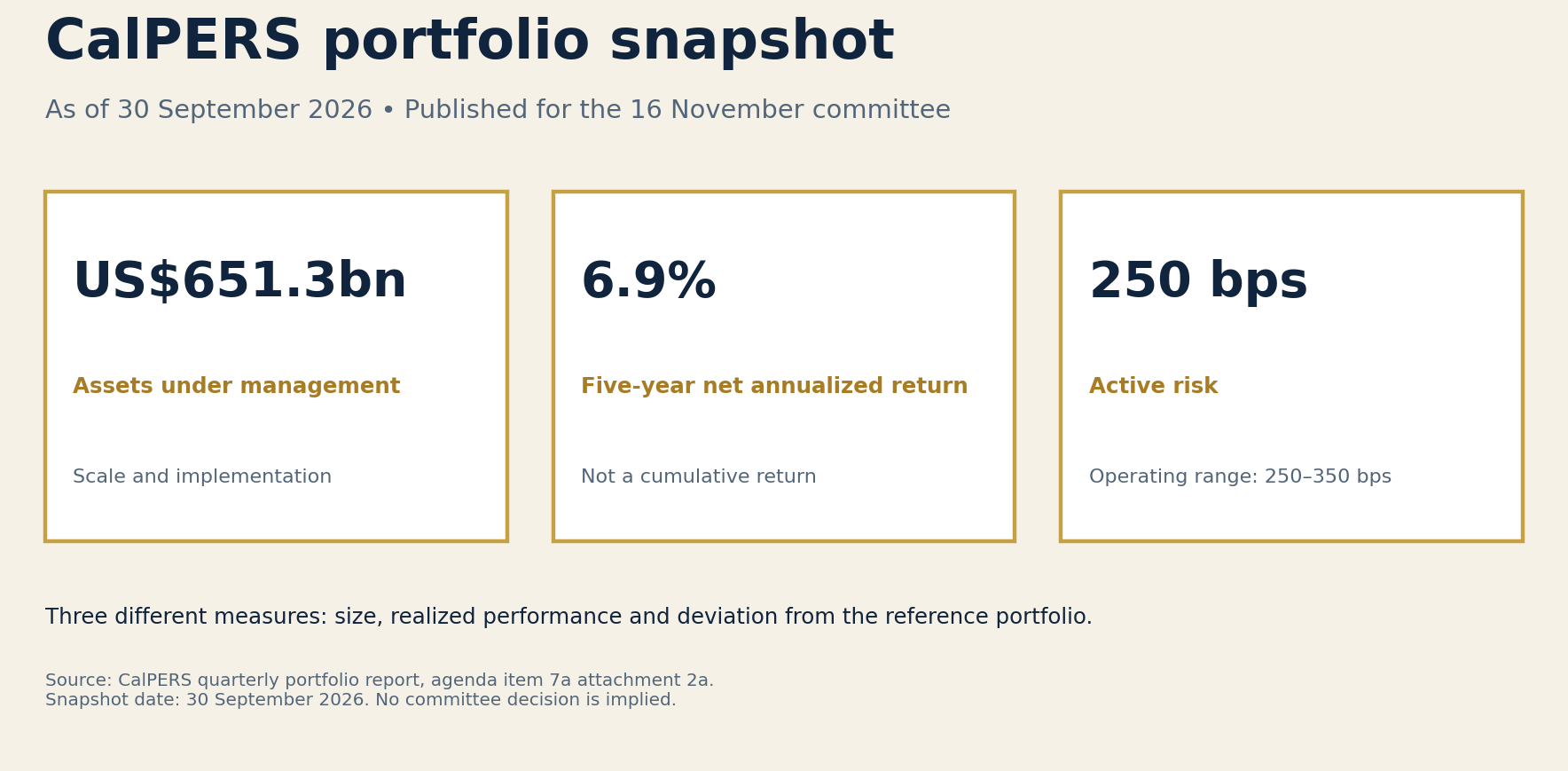
Three numbers frame today’s committee discussion: scale, realised medium-term outcome and the amount of risk taken away from the reference portfolio. None is sufficient alone. A large fund can still be constrained by liquidity; a five-year return needs a benchmark and risk context; active risk needs a governance budget. Read together, they create the baseline against which programme claims should be tested.
Operational delegated-authority risk
Delegation works only when the board knows which decisions it owns and which it has handed to staff or external managers. The risk is not simply that a manager makes a poor trade. It is that objectives, limits, data and escalation rights do not match. Today’s CalPERS agenda is a reminder that total-fund architecture must be accompanied by traceable authority: who can allocate, hedge, rebalance, suspend, exclude and disclose—and under what evidence threshold.
The practical controls are mundane but decisive: independent valuation, mandate-level liquidity limits, side-letter inventories, cyber and data access, key-person succession, incident reporting and an agreed path to revoke authority. Those controls should be tested in calm markets, not written for the first time during a crisis.
Executive profile: Stephen Gilmore, the portfolio architect in public
Stephen Gilmore arrived at CalPERS in July 2024 with a career spanning central banking, multilateral work, private finance and sovereign investment. As chief investment officer, he leads an investment organisation of more than 300 professionals. The scale has moved materially since his appointment: the committee papers’ 30 September snapshot puts assets under management at US$651.3 billion.
His public-sector formation matters. Gilmore studied economics at the University of Canterbury and worked at the Reserve Bank of New Zealand. At the International Monetary Fund he served as a resident representative in Tajikistan during the country’s post-Soviet reconstruction. Those roles place institutions, policy capacity and political constraints alongside market prices in the investment frame.
In private finance he held international positions at Morgan Stanley and AIG Financial Products. He later became chief investment strategist at Australia’s Future Fund, responsible for portfolio strategy, overlays, investment risk, data and analytics. The common thread is total-fund construction: not selecting one attractive asset, but deciding how risks interact and how the institution can hold them.
Before CalPERS, Gilmore spent more than five years as chief investment officer of the New Zealand Superannuation Fund. CalPERS says the New Zealand fund nearly doubled to NZ$75 billion during his tenure and had generated annual investment returns above 12% from 2013 to 2022. Those figures are institutional history, not a promise for a larger defined-benefit system with different liabilities, governance and cash flows.
Gilmore has described the Investment Office mission as helping make the pension system sustainable by generating long-term returns. He has also identified organisational change—bringing people with entrenched processes toward a new operating model—as the difficult part. That makes today’s committee agenda a revealing management document. The Total Portfolio Approach, investment-data architecture, sustainable-investment programme and divestment review are not isolated policies. They are tests of whether the organisation can convert a total-fund idea into repeatable decisions.
The leadership risk is scale. At more than US$650 billion, even modest changes can move markets, strain internal systems or create unintended concentrations. The opportunity is scale too: CalPERS can build internal capabilities, negotiate access, absorb long horizons and demand clearer data. Gilmore’s challenge is to preserve those advantages while making the portfolio legible to a public board and beneficiaries.
Today’s useful question is not whether one programme outperforms in one quarter. It is whether the operating model makes better decisions visible, measurable and reversible. That is the real portfolio architecture under review.
In that CalPERS interview, Gilmore links New Zealand’s results to risk appetite, a total-portfolio framework, governance and a horizon that permits buying into weakness. He also describes the value of constructive challenge, including an investment-committee discussion in which a junior colleague supplied the strongest observation. Those are his stated leadership priorities, not proof that every institution he leads will reproduce the same results.
Our interpretation is that the test for CalPERS lies in the incentives around those principles. Staff need reasons to share information across asset-class boundaries rather than defend separate performance tables. A board needs a way to distinguish a sound decision with a poor short-term outcome from an attractive result produced by uncontrolled risk. Neither requirement is solved by changing a portfolio label.
For beneficiaries, the practical evidence will be understandable reporting, disciplined implementation costs and decisions that remain consistent when markets become uncomfortable. For other allocators, Gilmore’s transition offers a case to follow: can the institution explain its aggregate exposures, identify responsibility for trade-offs and learn from disagreement before a loss forces the issue? Those are questions for oversight, not conclusions about performance.
CalPERS biography | CalPERS Q&A | CalPERS Investment Committee
People moves
Ontario Pension Board’s previously announced appointment of Marc Rondeau as chief executive took effect on 15 November. The effective date is current; the announcement itself is not new. The governance point is succession execution: a pension CEO inherits not just a portfolio but the relationship among board, sponsor, members, investment staff and operating systems.
Appointments belong in a different ledger from open roles. A named executive move is evidence about institutional direction; a vacancy is an invitation to apply. Combining them obscures both.
Institutional careers
The following employer postings were accessible at production time. Salary information is deliberately omitted.
- CalPERS — Total Fund Data Analyst (Investment Officer II), Sacramento. Supports governance and resolution of capital-markets and total-fund data issues, including cash and liquidity reporting. Final filing date: 21 November 2026. Official application — JC-538115.
- CalPERS — Infrastructure Investment Officer (Investment Officer III), Sacramento. Works on manager evaluation and portfolio activity across digital infrastructure, renewables, power, energy and transportation. Final filing date: 30 November 2026. Official application — JC-534361.
- CalPERS — Investment Data Architect Lead (Investment Officer III), Sacramento. Leads architecture, governance and operating processes for the Investment Office data platform. Final filing date: 4 December 2026. Official application — JC-535524.
- CalPERS — Emerging Markets Portfolio Manager, Sacramento. Covers local rates, currency and sovereign and corporate credit within the global fixed-income team. Open until filled; first stated review cutoff is 8 December 2026. Official application — JC-537611.
Decision calendar and risk
- 08:45 PT: CalPERS Investment Committee. Watch the quarterly portfolio baseline, Total Fund Portfolio Management review and divestment analysis.
- 10:00 CET: ECB euro-area investment-fund and financial-vehicle-corporation statistics.
- US settlement: November quarterly refunding settles; monitor cash, collateral and curve response.
- Asia data now released: Japan’s first-estimate GDP was essentially flat; China’s October industrial growth outpaced retail spending. Treat preliminary estimates and cumulative investment figures according to their actual definitions.
- 17 November: US Treasury announces the next long-duration liquidity-support buyback operation, scheduled for 20- to 30-year nominal coupons with settlement on 18 November.
The risk trigger is not one disappointing release. It is a combination: weaker activity, persistent wage or energy pressure, and tighter financing conditions. That mix would raise the cost of waiting on policy while also narrowing the portfolio’s room to act.
The Take
Capital is not a substitute for policy, and policy is not a substitute for governance. Asset owners can commit money, but they cannot manufacture permits, stable regulation, credible counterparties or a decision process that survives public scrutiny. Those are the rails on which long-term capital moves.
The practical response is not to wait for perfect certainty. It is to design mandates that price policy risk explicitly, stage commitments, preserve liquidity and define what evidence will unlock the next tranche. That turns uncertainty from an excuse into a governed variable.
Source Desk
- California Public Employees’ Retirement System, Investment Committee agenda and attachments, 16 November 2026.
- CalPERS, Stephen Gilmore — Chief Investment Officer, accessed 15 November 2026.
- Japan Cabinet Office, July–September GDP first preliminary estimates, 16 November 2026.
- National Bureau of Statistics of China, October activity releases, 16 November 2026.
- Bahrain Ministry of Foreign Affairs via UNA, Interception statement, 15 November 2026.
- Financial Times, Pension funds raise alarm on systemic risk from climate events, 15 November 2026. Secondary reporting used with attribution.
- US Department of the Treasury, November 2026 quarterly refunding statement, 4 November 2026.
- European Central Bank, Wage tracker update, 4 November 2026; statistical calendar, accessed 15 November 2026.
- European Investment Bank, European scale-up alliance, 9 November 2026; Hungary mid-cap guarantee, 6 November 2026.
- European Commission, Biomethane Mechanism first matching round, 4 November 2026.
- Principles for Responsible Investment, Global climate transition implementation, 12 November 2026.
- Official employer job postings, accessed 15 November 2026.
Watch the Latest UAO LIVE with Ryan Lafield

Ryan’s verified 13 November archived programme, Episode 65, examines the investor implications of leadership change at NVIDIA. Watch the latest completed UAO LIVE.
Back Page: the lever

The reservoir is full. The projects are visible. The spillway works. Everyone is waiting for the small lever marked POLICY CREDIBILITY.
The Editorial Team