UNIVERSAL ASSET OWNERS DAILY
The surplus that still feels tight
Saturday 14 November 2026 · Toronto
Final news and inbox check: 05:00 Toronto / 10:00 UTC
Yesterday's delivered edition awaited publication of the IEA report. The now-published November balance supplies a material update: the oil balance has turned before the bottlenecks have. The International Energy Agency says global supply exceeded demand for the first time since the Iran conflict began, helped by recovering Gulf exports and a 52-million-barrel rise in observed October inventories. Yet diesel remains scarce, freight remains expensive and on-land stocks remain at their lowest level since at least 2016. For long-horizon owners, "surplus" is not a single condition. It depends on the product, the location, the route and the asset that must turn crude into usable fuel.
Listen to The Universal Owner
Today in 90 seconds
- Eurostat's November 13 flash release pairs positive quarterly GDP growth with flat employment; estimates remain subject to revision.
- An Australian notice dated November 14 changes one targeted-financial-sanctions listing. Its scope must not be mistaken for worldwide sanctions relief.
- Carlyle agreed on November 13 to sell Disguise to Yamaha, subject to regulatory approvals. Expected December completion remains prospective.
- New Fed reporting distinguishes computing debt from future obligations; 10by30 coordinates climate investment without creating a jointly committed fund.
- Public capital continues to move closer to operating assets, but Friday's question is more specific: which cash flow is actually available, in the right place, after logistics, conversion and governance?
The lead - one market, several balances
The IEA's November Oil Market Report, published November 13, supplies the material update that the prior delivered edition awaited. Its balance has moved toward surplus while product and logistics constraints remain. This is the now-published report, not a second overnight release.
Our analysis: exposure mapping should separate upstream production, transport, refining, utilities, inflation-linked revenues and household affordability. The same headline can improve one asset's margin and weaken another's credit quality. A shipment is not available inventory simply because the cargo exists; delivery, conversion and contract performance determine when it becomes useful cash flow.
For a board, the useful question is what evidence would change its decision. Does a hedge protect the product actually consumed? Does infrastructure revenue depend on delivered volume or contracted capacity? Are counterparties exposed to the same disruption? These are our analytical questions, not findings that a named institution has failed them.
Watch the latest completed UAO LIVE with Ryan Lafield

Episode 65, NVIDIA Without Jensen Huang: What Comes Next for Investors? — released 13 November 2026. Watch the latest completed UAO LIVE programme with Ryan Lafield; this is an archive replay.
Sovereign and foundation allocation lens
For sovereign funds and foundations, the new development-finance proposal raises an allocation question, not an automatic recommendation. No separate new sovereign allocation was independently verified in the overnight sources reviewed for this lane.
Our analysis starts with mandate fit. A public reserve fund, a development investor and an endowed foundation can have very different spending obligations and risk limits. The same loan pool might fit one and fail another.
Ask what role the exposure plays: return, diversification, development impact or some explicit combination. Then set a benchmark and liquidity budget consistent with that role. A worthy purpose does not replace a clear mandate.
Credit - advanced-computing leverage
The Fed's November 13 Financial Stability Report, generally using information available October 28, reports advanced-computing debt issuance above US$680 billion by October versus US$130 billion in 2023. Outstanding public debt exceeded US$1.1 trillion. Separately, undiscounted future leases exceeded US$1 trillion and other obligations US$2 trillion. These are not directly comparable to debt or an additive debt total.
Our analysis: map borrowers, guarantors, counterparties and cash-flow triggers separately before aggregating exposures. A common spending cycle can connect instruments with different legal labels.
Treasury / balance-sheet discipline
We have not independently verified a new Treasury auction or funding announcement in the overnight sources reviewed for this lane. Rather than repeat yesterday's auction, we turn to the balance-sheet implication of today's financing proposals.
Our analysis: a prospective private investment needs a funding plan before it needs a headline allocation. Model capital calls, the currency of liabilities, collateral needs and the time before cash distributions.
A long-term mandate does not make short-term liquidity irrelevant. Test the conditions under which the owner could be forced to sell another asset to support this one.
Politics - jurisdiction-specific sanctions
Australia's DFAT notice dated November 14 says the targeted-financial-sanctions listing of Hay'at Tahrir al-Sham was revoked and its aliases removed from the consolidated list. The page provides no publication clock; we do not assign it a Toronto publication date. This is a specific Australian listing change, not removal of all international restrictions.
Our analysis: screening teams should review the relevant instrument and applicable jurisdictions before changing a counterparty decision. Legal status, physical security and commercial bankability are separate questions. A change in one does not automatically resolve the others.
Pensions - private-credit suitability
The new World Bank argument is an invitation to examine an investment channel, not a new obligation to allocate. No separate new pension-rule decision was independently verified in the overnight sources reviewed.
Our analysis: trustees should compare net returns after fees, liquidity, currency hedging and operational costs. A pooled structure may be easier to access, but managers still need to explain underlying borrowers and recovery processes. Match the investment to benefit payments and governance capacity. Beneficiary outcomes, not the scale of the proposing institution, are the relevant test.
Chart - the IEA's asymmetric reset
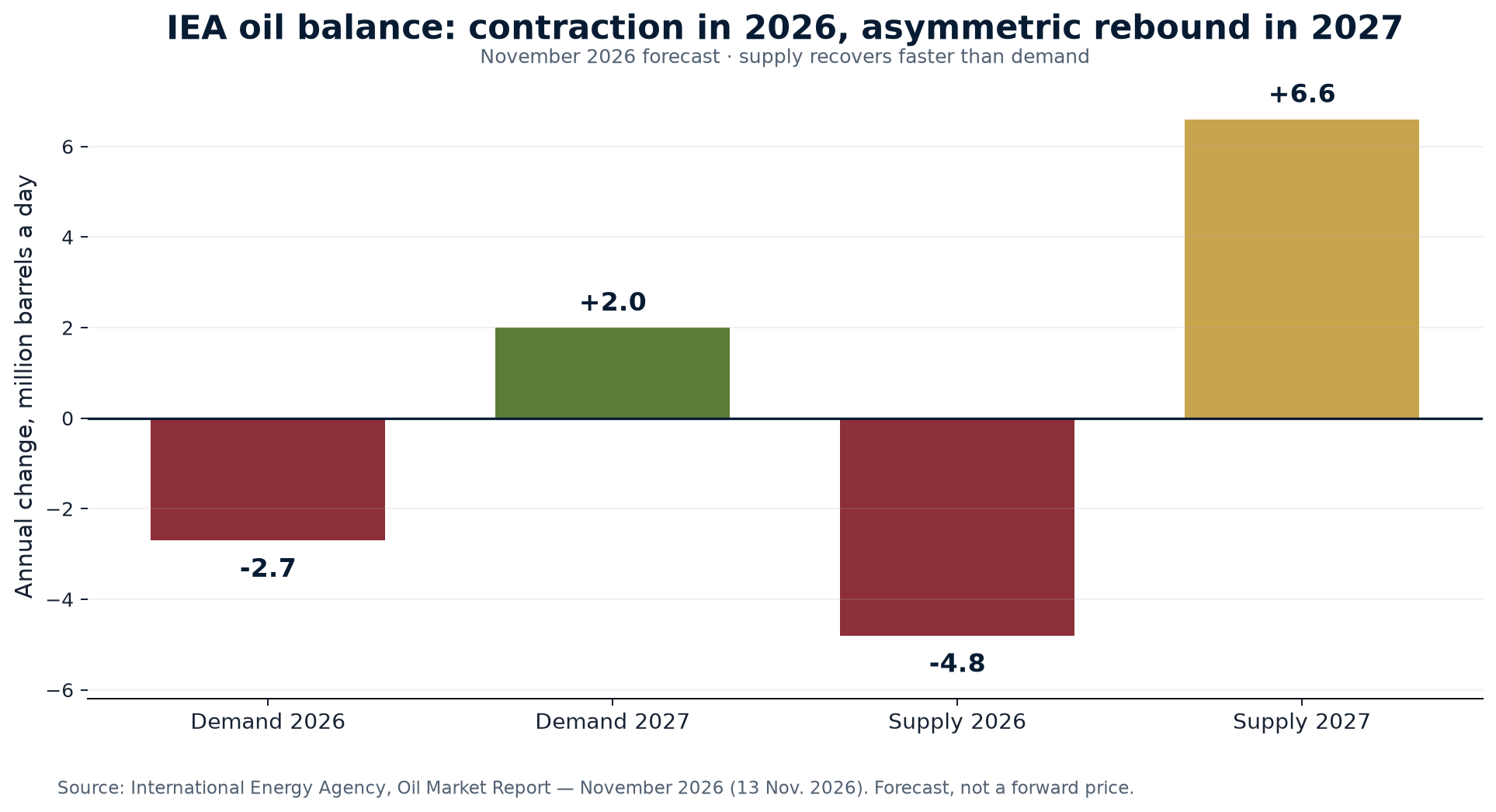
Our chart plots the IEA's forecast annual changes in world oil demand and supply. Demand is forecast to fall 2.7 million barrels a day in 2026 and rise 2.0 million in 2027. Supply is forecast to fall 4.8 million in 2026 and rebound 6.6 million in 2027. The asymmetry explains why a fourth-quarter surplus can coexist with product stress and why 2027 remains sensitive to shipping security and Gulf production.
Development lending / institutional capital
The November 13 World Bank article by Ajay Banga and Sjoerd Sjoerdsma describes work with five other development banks on common assessment, documentation and transfer structures for institutional investment in emerging-market loans. Its US$1 trillion illustration assumes a 1% allocation from US$100 trillion: an ambition, not money already mobilised.
Our analysis: standardisation can improve comparability and access without eliminating underwriting. Currency exposure, recovery rights, servicing, concentration and political risk still require portfolio-specific judgment. A familiar wrapper is not proof that the underlying assets are interchangeable.
Acquisitions / exit execution
Carlyle's November 13 announcement says it has agreed to sell visual-production technology company Disguise to Yamaha. Closing is expected in December, subject to customary regulatory approvals. No sale price or fund-level realised return is provided in the release.
Our analysis: an agreed sale is not completed liquidity. Owners should distinguish signing, closing and the eventual cash distribution, and should not book prospective proceeds as money already received. The strategic buyer is evidence of an exit route, not proof of its final economics.
Europe - growth and employment
Eurostat's November 13 flash release reports Q3 GDP growth of 0.4% in the euro area and 0.5% in the EU quarter on quarter, with employment flat in both. GDP increased 1.3% and 1.5% year on year respectively; employment rose 0.4% in both. These flash estimates remain subject to revision.
Our analysis: output growth without more employed persons is not a wage forecast. Distinguish headcount, hours, productivity and labour costs before translating these figures into revenue or liability assumptions.
European policy / AI and Ukraine
The European Council's November 13 Dublin meeting account links AI competitiveness to investment, infrastructure, affordable clean energy and reduced dependencies. President Costa also outlined a proposed European diplomatic team for Ukraine and a November 26-27 discussion of financing needs.
These are policy and coordination developments, not a peace agreement or a newly committed financing package. Our analysis: investors should distinguish priorities from funded projects, and diplomatic coordination from security guarantees and actual appropriations.
Climate - 10by30 coordination
FinDev Canada's November 13, 12:27 ET issuer release details its signed coordination memorandum with BII and Norfund. Their strategies aim to support at least US$10 billion of climate investment over five years/by2030, including private capital, not a committed or deployed fund. The MOU creates no joint platform, legal entity or financial commitment; individual mandates, governance and approvals remain.
Our analysis: sharing pipelines and diligence can improve coordination without pooling liability. Investors should still identify who approves, bears risk and reports outcomes. The memorandum is the fresh detail, not the initiative's first political launch.
People moves
Friday's World Bank article is jointly authored by Ajay Banga, World Bank Group president, and Sjoerd Sjoerdsma, the Netherlands' minister of foreign trade and development cooperation. These are current author roles, not new appointments. The executive profile below examines Banga's career and the distinction between an investment ambition and its execution.
Operational delegated-authority risk
Today's fresh stories cover an agreed sale, contemplated loans, an institutional-market proposal and a jurisdiction-specific delisting. Each has a different legal status.
Our operational recommendation is a status register: proposed, signed, approved, closed, funded and distributed. Record the source, date and jurisdiction beside every transition.
The person approving an investment should be able to trace which evidence establishes that status. A press release can confirm an agreement without proving completion, and a policy speech can establish direction without authorising spending.
Clear status labels are a practical control against turning aspirations into assets.
Executive profile - Ajay Banga
Our executive profile is Ajay Banga, president of the World Bank Group. The reason to examine his career today is not a new appointment. It is his November thirteenth argument, with Dutch minister Sjoerd Sjoerdsma, for bringing institutional investors into emerging-market finance at greater scale. The question behind that proposal is how an executive with a commercial background turns a development ambition into a workable investment system.
Banga began his five-year World Bank term on June second, 2023, following selection by the executive directors that May. Immediately before the Bank, he was vice chairman at General Atlantic. Earlier, he was president and chief executive of Mastercard. Those dates matter: this is a profile of an established leader's current agenda, not a suggestion that he has just arrived or that a new financing platform has already delivered its promised scale.
Mastercard's own filings give the earlier sequence. He served as president and chief operating officer in 2009 and 2010, then as president and chief executive during the following decade, before becoming executive chairman in January 2021. Before Mastercard, his experience included senior Citigroup roles, among them Asia-Pacific chief executive, as well as earlier leadership positions at Nestle India and PepsiCo.
Our interpretation is that the career crosses consumer businesses, banking and a payments network. That gives him a commercial frame for thinking about distribution, operating scale and connecting participants. It does not mean development finance is equivalent to card payments. A loan portfolio still carries credit, currency, political and servicing risks that cannot be removed simply by putting transactions onto a more familiar platform.
The World Bank's current biography identifies job creation as central to his agenda and describes his launch of the Private Sector Investment Lab. That lab brings together business leaders and asset managers to address barriers to investment in emerging markets. The biography also records his chairmanship of the International Chamber of Commerce from 2020 to 2022 and his role in founding Mastercard's Center for Inclusive Growth.
The significance for an allocator is the emphasis on participation, not just public lending. But participation needs a price and a structure. Our analytical questions are straightforward: who bears the first loss; who services a loan after transfer; what information reaches investors; how recoveries are handled; and whether the development institution retains enough exposure to keep incentives aligned. These questions test a proposal. They are not allegations about a particular transaction.
Friday's article offers the current policy connection. It argues that institutional investors need scale, diversification, reliable information and familiar structures, rather than thousands of differently documented loans. That is a proposed route toward a larger market. The article's trillion-dollar illustration remains an ambition, not a report that pension funds have committed or transferred that amount.
That distinction should shape Banga's scorecard. In our view, announcements and potential investor interest are early evidence, not the final result. A stronger assessment would follow actual transactions, the capital released for new projects, realised losses, recovery experience and the development outcomes associated with financing. Private participation can expand capacity, but the relevant question is whether it does so on terms that remain sound through a difficult cycle.
His biography explains why he is comfortable engaging commercial investors. It does not settle whether every asset belongs in an institutional portfolio. The World Bank presidency requires translating between public purpose and private underwriting rather than pretending they are identical objectives.
So the profile ends with a practical test, not a personality verdict. Banga is asking investors to look at development finance as a repeatable opportunity rather than isolated projects. Owners should examine that opportunity with open minds and demanding evidence: understandable assets, clear obligations, credible reporting and returns that fit their mandates. That is where a persuasive agenda becomes an investable proposition.
Careers
We have not independently verified a new institutional vacancy in the overnight sources reviewed. We are not recycling yesterday's two job postings as fresh opportunities.
Our careers lens instead follows today's investment work: loan servicing, credit documentation, portfolio reporting, project preparation and sanctions screening. Those are functions implicated by the stories, not advertisements for specific open jobs.
Where a new official opening is confirmed, its employer page and closing date should establish the opportunity before it enters the programme.
Decision calendar and risk radar
The November 13 U.S. nationwide ground stop linked to intermittent air-traffic-control telecommunications problems was subsequently lifted. No cyberattack or precise lifting time is asserted. Our operational takeaway is to test communications redundancy and recovery procedures rather than infer an outage's cause from its scale.
- 26-27 November: EU leaders plan discussion of Ukraine financing needs; no funding commitment inferred.
- December, expected: Disguise sale completion, subject to regulatory approvals; not yet a realised exit.
Our risk radar focuses on credit documentation and servicing, conditional finance, regulatory completion, jurisdiction-specific screening and the gap between policy direction and investable cash flow. The operating rule is to identify the evidence that changes status before treating a proposal as an asset.
The Take
The most dangerous word in Friday's oil report is not "surplus." It is the assumption that one surplus resolves every shortage. The crude balance can loosen while diesel, freight, refining capacity and on-land inventories remain tight. An owner who follows only the aggregate signal will hedge the wrong risk.
The same principle applies across the portfolio. A fund announcement is not deployed capital. A contract is not operating capacity. A long-duration asset is not liquid because its liability is long. And a proposed financing package is not deployed capital until approvals and disbursement are established.
Universal ownership is the business of tracing the bottleneck after the headline changes.
Source Desk
1. IEA November Oil Market Report, November 13: https://www.iea.org/reports/oil-market-report-november-2026 2. Eurostat Q3 GDP/employment flash, November 13: https://ec.europa.eu/eurostat/web/products-euro-indicators/w/2-13112026-ap 3. European Council Dublin meeting, November 13: https://www.consilium.europa.eu/en/meetings/european-council/2026/11/13/ 4. World Bank Banga/Sjoerdsma article, November 13: https://blogs.worldbank.org/en/voices/the-next-big-asset-class-could-come-from-emerging-markets 5. Carlyle Disguise sale agreement, November 13: https://www.carlyle.com/zh-hans/node/41171 6. DFAT notice, November 14; publication clock unspecified: https://www.dfat.gov.au/news/news/change-listings-under-part-4-charter-united-nations-act-1945 7. World Bank current Ajay Banga biography; publication date not displayed: https://www.worldbank.org/ext/en/who-we-are/leadership/ajay-banga 8. World Bank appointment announcement, May 3, 2023: https://www.worldbank.org/en/news/press-release/2023/05/03/ajay-banga-selected-14th-president-of-the-world-bank 9. Mastercard FY 2020 Form 10-K, biographies as of February 12, 2021: https://www.sec.gov/Archives/edgar/data/1141391/000114139121000018/ma-20201231.htm 10. Latest completed programme, Episode 65 archive replay: https://universalassetowners.substack.com/p/nvidia-without-jensen-huang-what
11. Federal Reserve, Financial Stability Report, November 13; information generally as of October 28, PDF pages 30-31: https://www.federalreserve.gov/publications/files/financial-stability-report-20261113.pdf 12. FinDev Canada issuer release, November 13 12:27 ET: https://www.newswire.ca/news-releases/findev-canada-british-international-investment-and-norfund-sign-a-10by30-mou-to-originate-usd-10-billion-in-climate-finance-by-2030-882777926.html 13. UK-Canada climate finance joint statement, November 13 (related context): https://www.gov.uk/government/publications/uk-canada-climate-finance-joint-statement/uk-canada-climate-finance-joint-statement 14. U.S. DOT, lifting of nationwide ground stop, November 13: https://www.transportation.gov/briefing-room/icymi-us-transportation-secretary-sean-p-duffy-announces-lifting-nationwide-ground
15. FAA official statement, November 13 ground stop: https://www.faa.gov/newsroom/faa-statement-nationwide-ground-stop 16. Port of Seattle official November 13 ground-stop updates: https://www.portseattle.org/news/november-13-faa-ground-stop-updates
Source dates are not inferred to be Toronto publication dates. Career material is historical; current developments and editorial analysis are distinguished.
Back Page - same barrel, different bottleneck
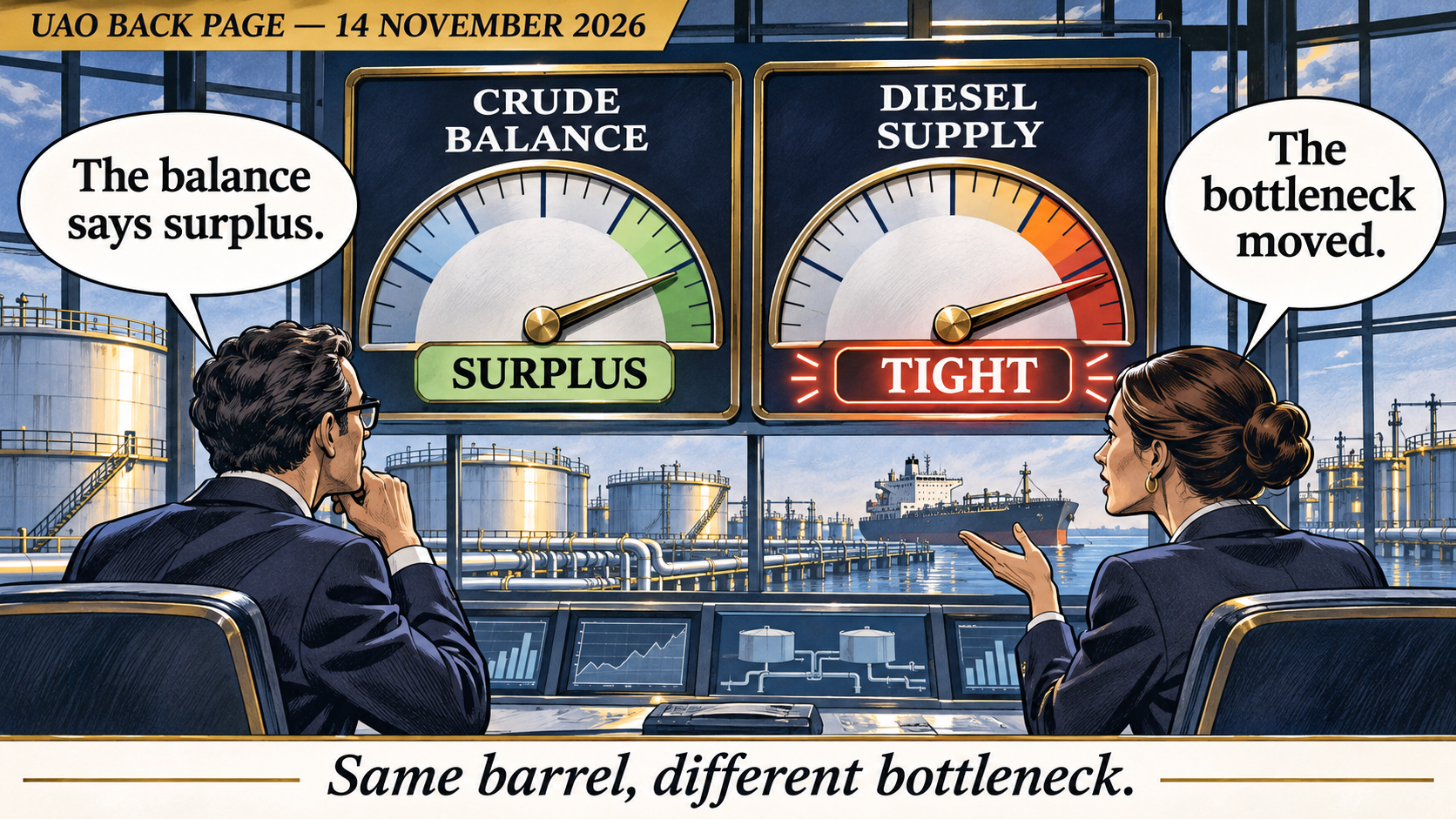
One operator points to a crude-balance gauge marked "surplus." The other points to the diesel gauge flashing "tight."
"The balance says surplus." "The bottleneck moved."
The joke is about aggregation. The serious point is that location, conversion and logistics decide whether a market balance becomes an investable cash flow.
This publication is general institutional research, not individualized investment advice.