
UNIVERSAL ASSET OWNERS DAILY
The capital stack closed before the turbines turned
Thursday, 12 November 2026
What £12 billion of offshore-wind investment says about investability, credit support and delegated authority.
Watch UAO LIVE | Ryan Lafield, Episode 63
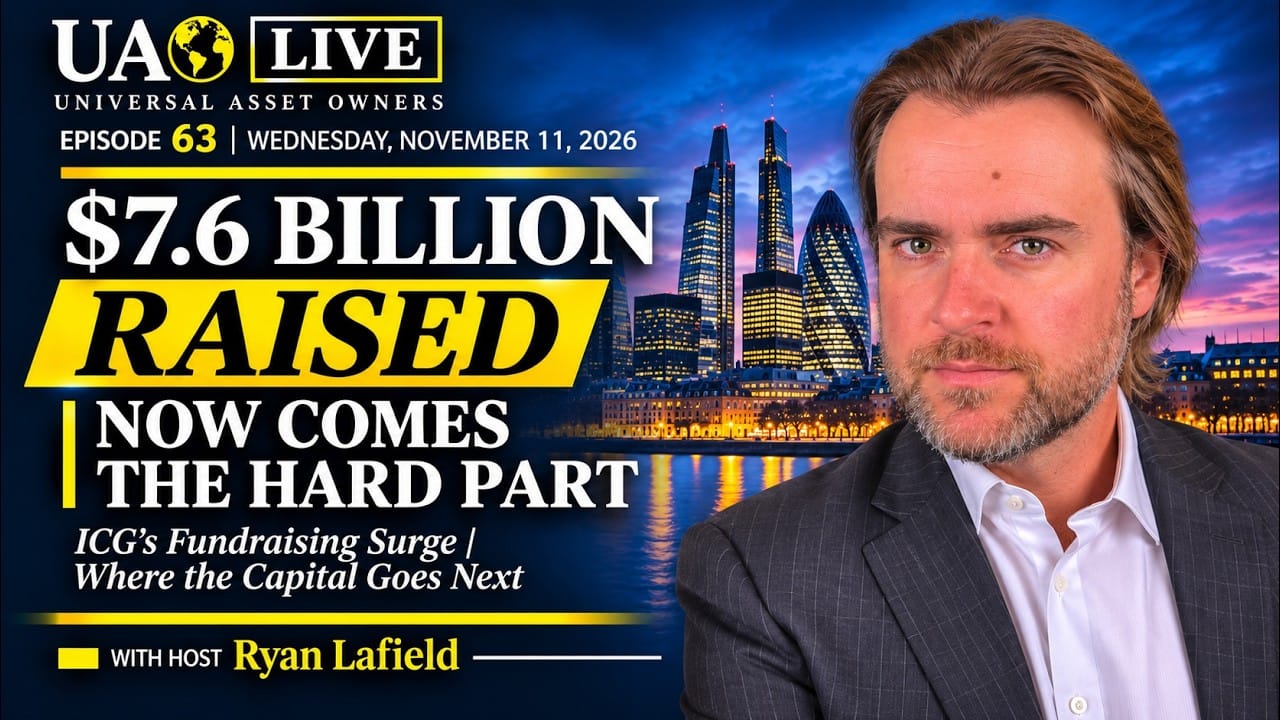
Latest completed programme · 11 November 2026. Ryan examines where newly raised institutional capital goes. This archive replay is separate from today’s newly prepared Ryan/Alex production package.
Lead | The capital stack closed before the turbines turned
RWE and KKR reached equity and financial close on Vanguard West and Vanguard East, two 1.4 GW offshore-wind projects representing about £12 billion of total investment. Thirty-five banks are providing £11.1 billion of cash facilities and £1.7 billion of ancillary facilities. The UK National Wealth Fund is committing £1 billion, with credit cover from Euler Hermes and EIFO. Offshore construction is expected to begin in early 2027 and full commissioning in 2030.
Headlines | The overnight changes
New Zealand Super Fund has ended one internal active-equities mandate and kept its domestic allocation intact. T. Rowe Price reports US$10.8bn of October net outflows. RWE’s new results show stronger earnings alongside heavy investment. Argentic plans a European real-estate lending platform for 2027. The EU–Ukraine Investment Conference opens today in Warsaw.
The common question for owners is how capital gets from a mandate or financing agreement to an accountable operating result. Below, we separate new announcements from older policy background and management forecasts.
NZ Super Fund · 12 November · T. Rowe Price · 11 November · Argentic · 11 November
Balance sheet | Follow leverage across the boundary
RWE carried €17.0 billion of net debt at September 30 and expects about €12 billion at year-end, mainly because the Vanguard joint venture will be deconsolidated. Economic risk has not vanished; it has moved into a project structure. Corporate debt, non-recourse debt, guarantees and contingent obligations must be read together.
Treasury | Assets under management are not net flows
T. Rowe Price’s 11 November release puts October-end assets under management at US$1.834tn, compared with US$1.863tn at September-end. October net outflows were US$10.8bn. The US$29bn change in assets therefore must not be described as US$29bn of client withdrawals.
Our interpretation: separate client flows from market and other valuation effects before drawing conclusions about distribution, investment performance or fee capacity.
Monetary policy | A Bank of Japan board member’s caution
In a 12 November speech, Bank of Japan board member Toichiro Asada says consumption lacks strong growth momentum and recent price increases have not necessarily been demand-driven. He urges care over the pace of further tightening. This is a board member’s speech, not a new collective policy decision.
Our interpretation: owners should separate a change in the policy rate from evidence about the path ahead. The same inflation reading can produce different implications for household cash flow and the discount rate applied to long-lived assets.
European credit | Argentic’s next platform is still ahead
Argentic says it plans to expand its real-estate lending platform into Europe in 2027, backed by Elliott Investment Management. Klaus Betz-Vais has been selected to lead the build-out and will join after completing existing professional commitments. The announcement does not disclose a European fund size or an already deployed loan book.
The diligence question: how will local origination, collateral enforcement, servicing and portfolio limits work across the UK and continental Europe? Platform plans become investable evidence when those arrangements and actual exposures are visible.
Chart | One project, overlapping financing measures
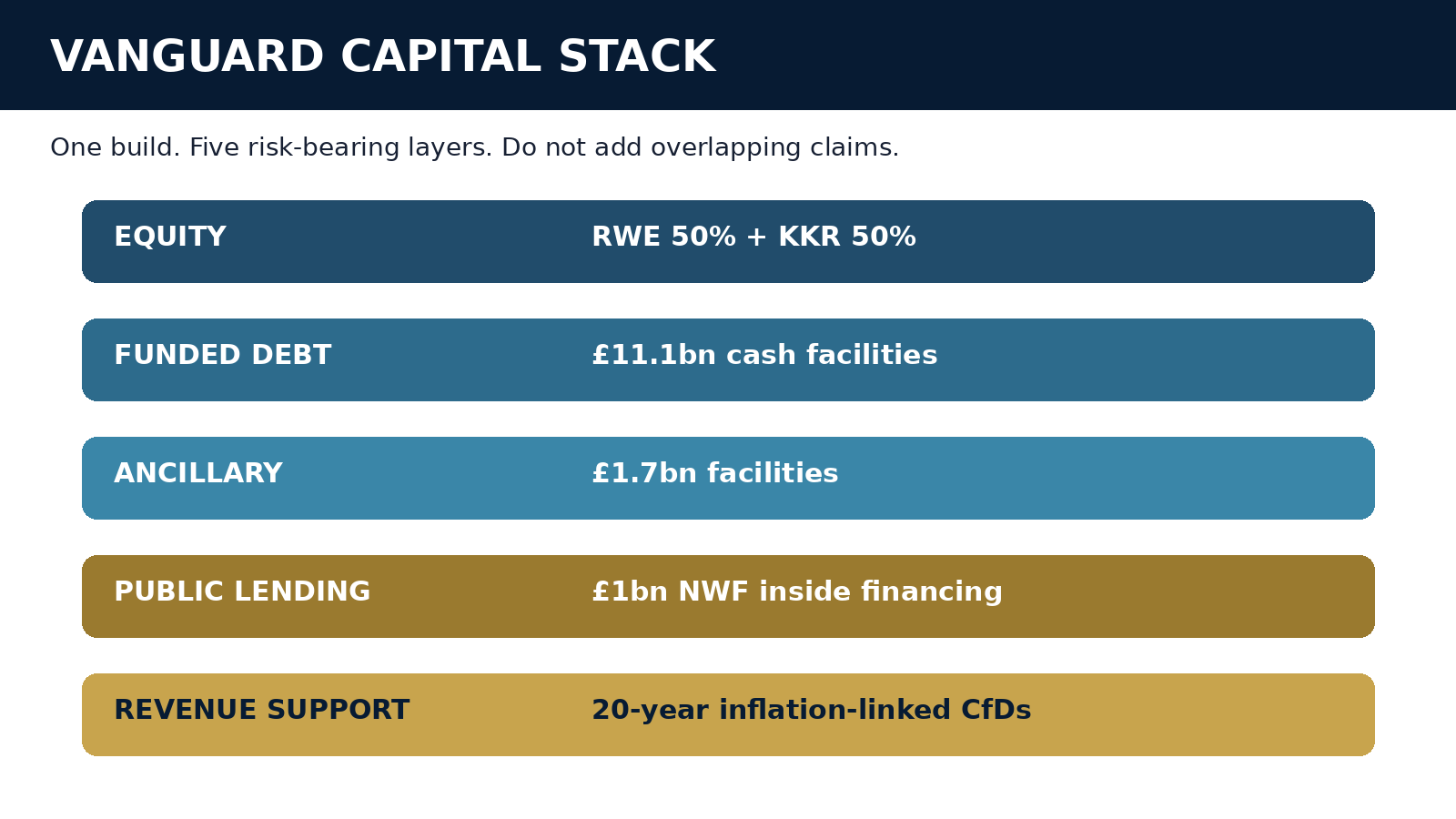
The National Wealth Fund’s £1bn commitment is part of the £12.8bn financing package. It must not be added again. Project investment, facilities, equity ownership and contracted revenue describe different things. A lender commitment also is not proof that every pound has been drawn.
RWE financing announcement · National Wealth Fund’s financing breakdown
Pensions | NZ Super changes the method, not the market
In its 12 November stakeholder update, NZ Super Fund says a review led it to end its internally managed fundamental active New Zealand equities mandate. Capital has moved into other internal NZ equity strategies and the team will take new roles. Domestic listed equities remain around 4% of the fund’s net asset value. Mint Asset Management’s external mandate, valued at NZ$814m on 30 September, is unchanged.
Our interpretation: portfolio commitment and method selection are different decisions. A long investment horizon does not require retaining a strategy indefinitely. An owner should document the evidence that would change a mandate, then preserve the ability to act on it.
Foundations | A commitment with a ten-year horizon
Novo Nordisk announced a US$200m commitment to the World Diabetes Foundation for 2027–2036. This is corporate funding for prevention and care in low- and middle-income countries; it is not a commitment by the Novo Nordisk Foundation and it is not an immediate disbursement of the full amount.
Our interpretation: duration can improve programme planning, but a ten-year promise still needs milestones, operating capacity and evidence that services reach the intended communities.
Climate and stewardship | Taxonomies move toward infrastructure
The IPSF survey says a broad majority of respondents selected interoperability as a guiding principle. Reported use is not comparable across jurisdictions: China cited 17.2% of outstanding bank loans as green-labelled, Australia said banks representing about 80% of market share use its taxonomy in some way, and the EU reported alignment metrics for covered companies. Data quality, technical complexity and verification remain obstacles.
Norway | Classification becomes useful through execution
The IPSF taxonomy survey explains Norway’s use of the EU taxonomy through the EEA framework and notes financing tools that can support aligned activity. The broader lesson is that a shared classification can help a lender organise diligence, but cannot establish construction performance, cash flow or credit quality by itself.
Our interpretation: ask what the classification changes in a specific financing decision: eligible use of proceeds, documentation, pricing, verification or reporting. Keep that answer separate from the projected return.
Grid and long horizon | Digital networks before decentralised power
Background, newly highlighted on 11 November: this is a communications update about a project running from April 2024 to the end of 2028, not a new funding award.
The €200.67 million Gabreta smart-grid project runs through 2028, with €100.34 million of EU support. It includes three cross-border medium-voltage links, four primary substations, about 1,324 digital secondary substations and 8,000 monitoring devices across Bavaria and Czechia. The long-horizon signal is that flexibility depends on networks and control systems, not generation alone.
Geopolitics and capital | Ukraine investment conference
The European Commission and Ukrainian authorities are convening investors and public officials in Warsaw on November 12–13. Priorities include SME finance, energy, strategic and dual-use industries, corporate governance and rule-of-law reform. This is a pipeline and matchmaking event, not a financing close.
Prices, households and system risk
ECB researchers find euro-area wealth inequality rose through the sovereign-debt crisis and later eased, but remained elevated in the hardest-hit countries. The wealth Gini moved from 68.2 in 2010 to 69.7 in 2014 and 68.5 in 2023. The distributional channels matter for owners because infrastructure costs, inflation and policy support reach household balance sheets differently.
Research worth reading | Resource efficiency
The IEA says the world generates about 2.6 billion tonnes of municipal waste each year and argues that materials efficiency, recycling and appropriate conversion of waste to bioenergy can strengthen economies and lower emissions. The investment discipline is to translate the systems case into verified feedstock, leakage, technology and revenue assumptions.
People | Specialist alternatives need specialist controls
NZ Super Fund’s new Portfolio Manager, Alternative Investments, David Kandziora will focus on catastrophe bonds, insurance-linked products and spectrum strategies. The appointment is a separate item from the fund’s domestic-equities mandate decision; the update does not say one caused the other.
Our interpretation: diversification labels cannot replace contract-level expertise. Catastrophe risk and spectrum rights require different models, legal analysis and monitoring. Map the decision authority and the backup for each specialist mandate.
Operational risk | Delegation still needs an accountable owner
Policy background, 10 November: the UK government’s pension-governance response sets out plans for minimum administration standards and a registration framework. The proposals address records, resilience and continuity while retaining trustee accountability.
Our analysis: the same test applies to a project financed by many institutions. A board needs named control owners, common reporting definitions, independent evidence at milestones and an escalation route that survives a provider change. Delegation should make responsibility more visible.
Executive profile | Markus Krebber
Markus Krebber has been RWE’s chief executive since May 2021. His current leadership test connects growth, leverage, delivery and public commitments.
Krebber joined the RWE group in 2012 as managing director and chief financial officer of Supply & Trading. He became that business’s chief executive in 2015, joined RWE AG’s executive board as group CFO in 2016 and moved into the top job five years later. Before RWE he spent seven years at Commerzbank in roles spanning group finance, integration, operations and product management. He began with a Deutsche Bank traineeship, worked at McKinsey, and earned a doctorate at Humboldt University’s institute for banking, stock exchanges and insurance.
That résumé matters because RWE’s strategy is a sequencing problem. It must build generation and storage, manage commodity and power-market exposure, recycle capital, maintain ratings and preserve political legitimacy. The first nine months of 2026 show the scale: €10.7 billion of net investment, €4.6 billion of adjusted EBITDA and €17.0 billion of net debt at September 30.
The Vanguard partnership is a clean example of his operating model. RWE keeps delivery leadership and half the equity, while KKR brings partner capital and execution capacity. Non-recourse financing moves debt to the project perimeter. The contract for difference reduces long-term price uncertainty. Public and export-credit institutions broaden credit support. Each move makes the project more financeable, but each also creates another interface to govern.
Our interpretation is that Krebber is managing a coordination problem: generation, storage, grids, partner capital and regulation must arrive in a workable sequence. The closed financing demonstrates progress on one part of that problem. It does not prove future construction costs, realised returns or total system affordability. Those remain tests for owners rather than conclusions from management’s announcement.
The September balance sheet provides both confidence and caution. Earnings were stronger across all segments, and management expects full-year results near the upper end of guidance. Yet net debt had risen with investment and seasonal cash flow. The projected decline to about €12 billion depends materially on deconsolidating Vanguard after the KKR transaction. The result is a more capital-efficient parent, not a risk-free project.
His governance remit spans communications, regulation, legal, compliance, insurance, mergers and acquisitions, strategy and sustainability. That concentration makes cross-functional judgment central. A decision on offshore wind is simultaneously a capital-allocation, regulatory, contract, supply-chain, community and climate decision.
The near-term scorecard has five lines. First, can construction begin in early 2027 and remain on schedule? Second, can RWE preserve financial discipline while carrying 13.5 gigawatts under construction? Third, do asset recycling and partnerships create value after fees, guarantees and lost control? Fourth, can affordability remain credible as capital-intensive infrastructure reaches bills? Fifth, can management keep a coherent control system across joint ventures and contractors?
The universal-owner lesson is that energy transition leadership is not measured by gigawatts announced. It is measured by risk allocated, cash flow delivered, resilience preserved and public promises kept. Krebber now has a closed capital stack. The harder evidence begins when steel enters the water. A useful board review would separate the decisions management controls from the shocks it cannot control. Procurement discipline, contingency planning, contractor selection and reporting quality belong on the first list. Weather, wholesale prices and changes in policy belong on the second, but management still owns the preparation for them. This is our analytical framework, not an additional claim about RWE’s undisclosed contracts. Krebber’s finance background suggests questions to ask; it does not answer them. Long-term shareholders should follow the evidence quarter by quarter, including cash conversion, project milestones and the obligations that remain outside consolidated debt. A strong partnership should improve that visibility rather than make accountability harder to locate.
Careers
Current EBRD employer pages list Principal Counsel (Equity Funds) in London, closing November 20; Associate Banker in London, closing November 19; and Associate, Corporate Sector Advisory in Kyiv, with possible temporary relocation to Warsaw, closing November 16. Re-check the employer page before applying. No salary figures are included.
EBRD · Principal Counsel, Equity Funds · EBRD · Associate Banker · EBRD · Corporate Sector Advisory
Decision calendar
November 12–13: EU–Ukraine Investment Conference. November 16, 19 and 20: the cited EBRD application deadlines. Early 2027: Vanguard offshore construction expected to begin. 2030: full commissioning expected. The portfolio triggers are cost, schedule, covenant headroom, grid access and counterparty quality.
European Commission · EU–Ukraine conference · RWE · Vanguard transaction
The Take
Investability is engineered. Equity, bank debt, public lending, export-credit support, revenue contracts and operating authority make risk visible and allocable. They also create interfaces. Universal owners should ask who pays when the base case is wrong—and whether that answer survives the life of the asset.
Source Desk
- RWE · Vanguard transaction
- RWE · Nine-month results
- National Wealth Fund
- UK pension-governance response
- International Platform on Sustainable Finance
- European Commission · EU–Ukraine conference
- CINEA · Gabreta smart grids
- European Central Bank research
- International Energy Agency
- RWE · Markus Krebber biography
- EBRD · Principal Counsel, Equity Funds
- EBRD · Associate Banker
- EBRD · Corporate Sector Advisory
- UAO LIVE Episode 63 · 11 November
- NZ Super Fund
- T. Rowe Price
- Argentic
- Bank of Japan
- Novo Nordisk
Back Page
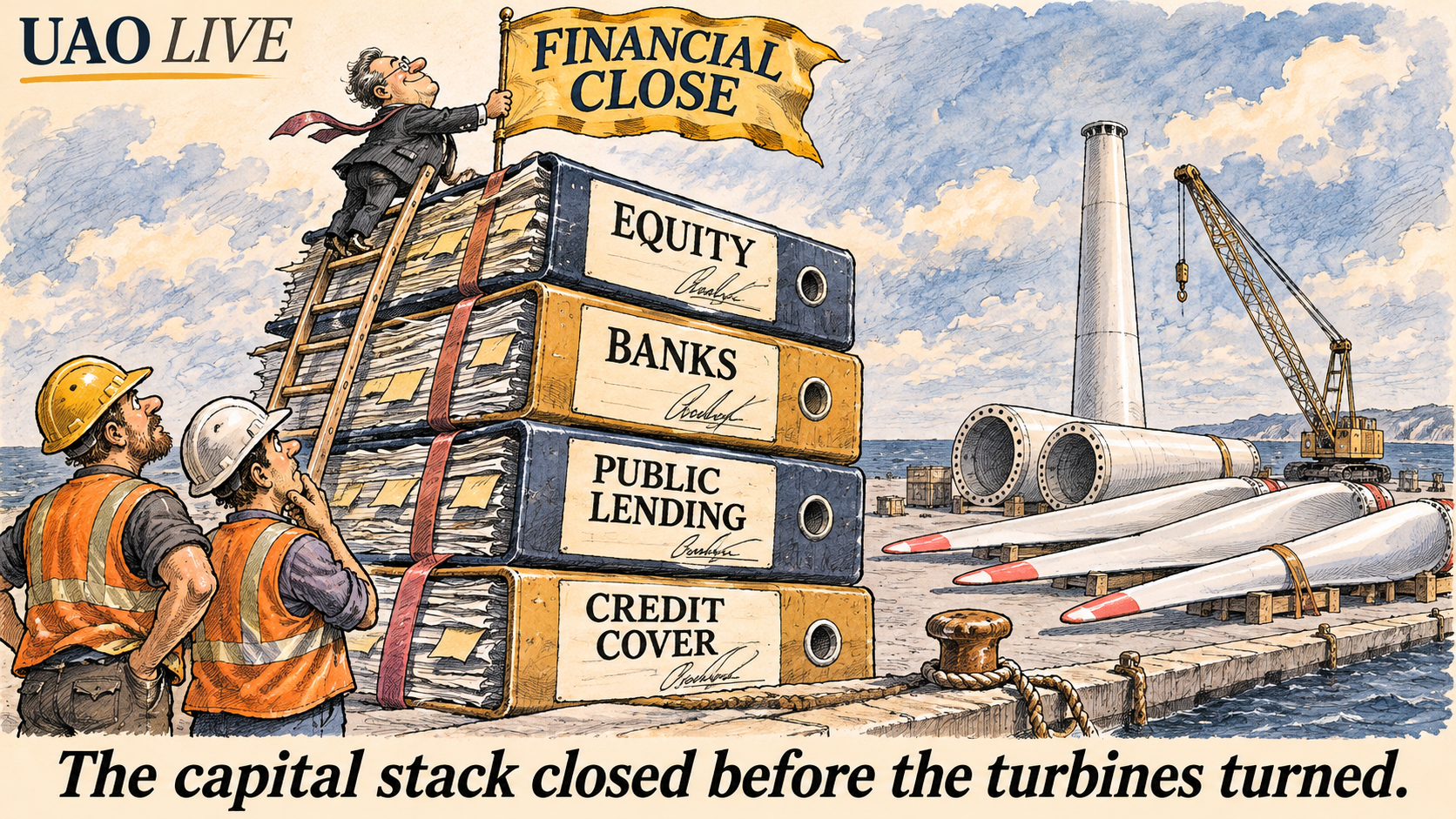
The capital stack closed before the turbines turned.
Financial close is the start of execution evidence—not the end of risk.
Universal Asset Owners · Institutional intelligence for long-horizon investors. Reporting dates are identified above; forecasts and our analysis are distinguished from observed results.