
Public capital moves closer to the asset
Today in 90 seconds
Headlines. PwC says the ten largest sovereign and pension institutions hold about 41 per cent of the combined pool, while the top fifty hold 77 per cent. Roughly US$66 billion of state-investor capital went into AI and digitisation in 2025.
Overnight, Avatar Capital announced a US$156 million first close for its second Japan real-estate fund, with a strategic partnership involving GCM Grosvenor and the Teacher Retirement System of Texas.
Nscale’s revised prospectus draws a sharp line between active infrastructure and contracted future capacity. And the FCA is proposing pension-fee changes, not announcing a completed reform.
Foundations enter the innovation lane too: Gates Foundation and Flagship Pioneering plan a joint five-year discovery effort of up to US$25 million. We separate pledged capacity from deployed money.
Listen to The Universal Owner
The lead - from allocator to principal
PwC's new study reframes the scale debate. It estimates that sovereign wealth fund assets could reach US$22.4 trillion by 2030 and public pension assets US$36.3 trillion - US$58.7 trillion combined. The more consequential finding is structural: these institutions are increasingly originating transactions, building platforms and operating assets rather than remaining solely allocators to external managers. PwC says the ten largest institutions hold about 41% of the combined pool, and roughly US$66 billion of state-investor capital went into AI and digitisation in 2025. The underlying study is careful: the 2030 numbers are model-based outlooks, not forecasts, and some sovereign-fund figures are third-party estimates. The investment question is therefore not whether one headline number will arrive on schedule. It is whether governance, operating capability and accountability can scale with the capital.
The operating consequence is easy to underestimate. A fund that chooses managers mainly governs selection, monitoring, liquidity and aggregation. A principal investor also governs development pipelines, counterparties, construction interfaces, cyber systems, operating companies and exit pathways. That can reduce fee leakage and improve strategic control, but it also moves more failure modes inside the owner's perimeter.
PwC's comparative work covers the world's 350 largest public investors, with transaction-level analysis concentrated on large Canadian, Gulf and Singaporean institutions. The report says the top 50 hold 77% of the combined sovereign and pension pool. Concentration can create execution advantages; it can also concentrate political, operational and reputational consequences. Read the figures as a governance agenda, not a league table.
Watch the latest completed UAO LIVE with Ryan Lafield
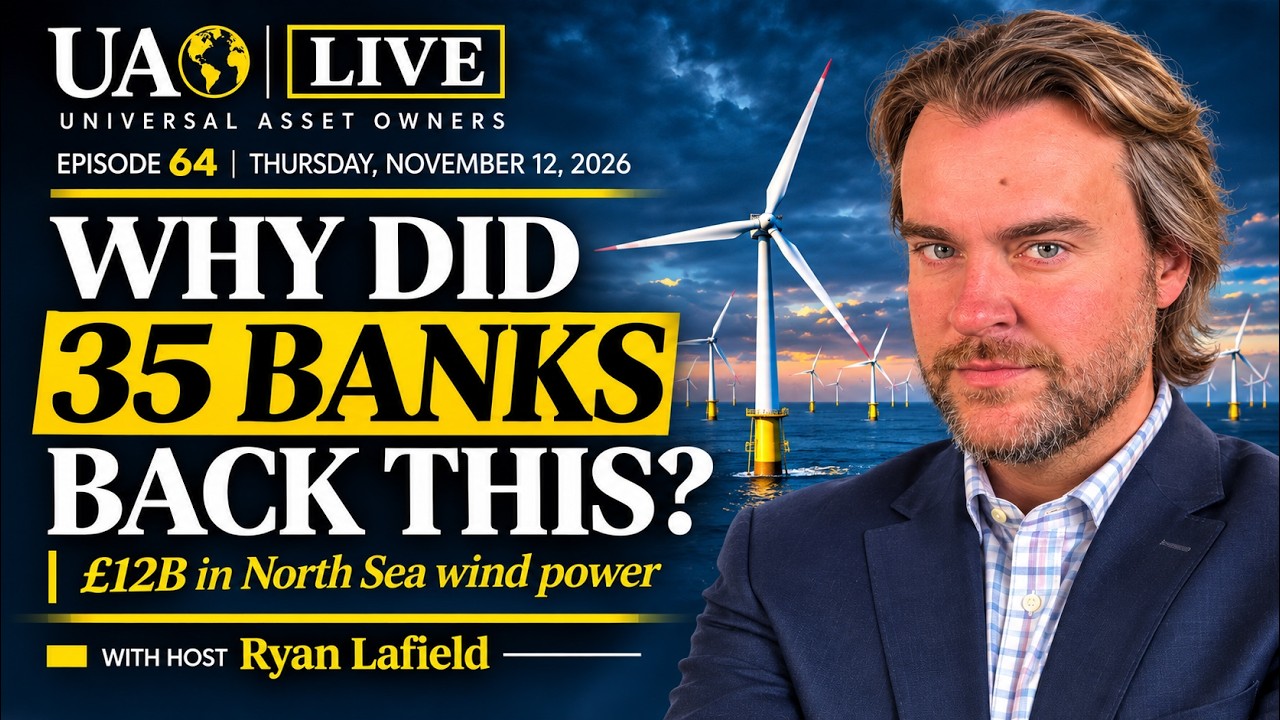
Episode 64, released 12 November, examines the £12 billion North Sea wind financing backed by 35 banks. This is the previous completed programme, not today’s new show, podcast or Allocator.
Sovereign and pension allocations
The FCA’s November 12 consultation proposes excluding certain performance-linked fees from the default workplace-pension charge cap. The intended benefit is access to investments where manager remuneration depends on performance.
This is consultation, not a rule already in force. Responses close January 14, 2027; the regulator expects final rules in summer 2027. Transparency, fair allocation of charges and valuation safeguards remain central.
A separate fresh allocation signal comes from Avatar’s Japan living-sector fund. GCM Grosvenor and Texas teachers have committed up to US$100 million combined. That ceiling is not a cheque already deployed into buildings.
Our analysis: expanded access and lower headline constraints do not establish net value. Trustees still need to compare total fees, return persistence, valuation practice and the ability to meet member withdrawals.
Norway’s asset-investment case shows what principal ownership looks like in practice. Norges Bank Investment Management paid US$300 million for a direct ten per cent interest in Aypa Power alongside Brookfield.
That transaction was signed and completed on October 28 and disclosed November 4, so it is context, not overnight news. Aypa had about 6.5 gigawatts operating, under construction or contracted and a pipeline above 20 gigawatts.
NBIM already had indirect exposure through Brookfield’s Global Transition Fund. Adding a direct co-investment can reduce fee layering and sharpen exposure. It also requires the owner to understand platform governance, development risk and the line between manager authority and co-investor oversight.
The investment case is not battery storage in the abstract. It is the price paid, the project pipeline, contracted revenue, grid interconnection, construction execution and the rights attached to ten per cent ownership.
Capital and deals
Completed infrastructure transaction. Sempra reported on November 12 that it completed the sale of a 45% interest in SI Partners to KKR-led entities with CPP Investments as an indirect co-investor. Cash paid at closing was US$4.56 billion, subject to post-closing adjustments, not the full consideration: deferred principal comprises a further US$4.14 billion and US$1.20 billion, plus interest. Following closing, ownership is 65% KKR Partners, 25% Sempra and 10% ADIA. The filing does not assign CPP Investments a separate percentage stake. Sempra SEC filing.
For context from the November12 European morning, FREY and GIC announced a EUR400 million equity partnership on November 12 for premium European retail parks. The ownership split is eighty per cent GIC and twenty per cent FREY.
The announced seed portfolio comprises three parks valued at EUR176 million. The full vehicle equity capacity is not the seed purchase price and has not been established as fully deployed.
In foundations, Gates Foundation and Flagship Pioneering announced a five-year collaboration with up to US$25 million jointly for discovery in health, women’s health and agriculture benefiting lower-income countries.
The allocation models differ. One is real-estate ownership; the other funds discovery with uncertain commercial translation. Our question in both is what milestone unlocks the next commitment and what evidence justifies it.
Credit support moves to AI infrastructure. In a November 12 amended SEC filing, Nscale separates active contract value of US$6.4 billion from US$105.8 billion across active and contracted agreements.
Its preliminary nine-month figures show US$307.5 million of revenue and a US$1.692 billion net loss. That is not a completed IPO or evidence that its backlog has already become revenue.
The filing counts roughly 461,000 GPUs across active and contracted capacity. Contract commencement depends on successful delivery. That total does not represent equipment already operating.
Our analysis: a lender must bridge construction, power availability, customer acceptance and cash receipts. Contract value is useful evidence, but it cannot replace liquidity, covenant and counterparty analysis.
Treasury and balance-sheet health
The US Treasury sold US$25 billion of thirty-year bonds on November 12. The official result reports a high yield of 5.441 per cent and a bid-to-cover ratio of 2.36.
Within competitive awards, indirect bidders took approximately 68.1 per cent, direct bidders 20.5 per cent and primary dealers 11.4 per cent. Those shares use competitive awards as the denominator; they do not describe every tender or investor’s nationality.
The asset-owner point is duration. Long liabilities can support long bonds, but liability matching does not eliminate mark-to-market, collateral or opportunity-cost risk.
PwC’s concentration finding matters here. Large public institutions can influence primary demand, yet each one still operates under its own currency, liquidity and political constraints.
Europe - growth, prices and wages
The ONS estimates UK real GDP rose 0.7% in the third quarter after 0.5% in the second, leaving output 1.9% above a year earlier. Services grew 0.9%, production 0.1% and construction fell 0.7%. Growth therefore broadened imperfectly: stronger business-facing services coexist with a construction contraction that matters for real assets, housing and infrastructure delivery.
Across the EU, Eurostat reports a 2025 average full-time-adjusted salary of EUR41,500, up 4.3% from EUR39,800, while warning that the figures are not inflation-adjusted. Its October flash estimate put euro-area inflation at 4.0%, with energy at 20.8%. The comparison is not a real-wage calculation - the periods and measures differ - but it identifies the board question: which nominal revenue and wage assumptions survive an energy-led inflation shock?
Governance and fiduciary affairs
The Court of Justice of the European Union dismissed seven Polish challenges to Fit for 55 measures covering land use, vehicle standards, the market stability reserve, effort sharing, emissions allowances for buildings and road transport, the carbon border adjustment mechanism and energy efficiency. The judgment preserves the legal framework; it does not settle the capital-allocation consequences.
Trustees and boards should separate legal validity from transition execution. A rule can survive in court while project economics, household affordability and political support remain volatile. The control response is scenario-based: identify exposures to carbon prices, vehicle standards, border adjustments and building costs; define the evidence that triggers repricing; and document how member outcomes remain the governing objective.
Operational control and continuity
Operational delegated-authority risk is concrete in Nexperia’s November 12 statement. It describes a court order made on November 11, not an order issued on the statement date.
Nexperia’s allegations about its China operations are the company’s account in a disputed governance situation. We are not presenting those allegations as independent findings.
The company also describes expanding capacity in Malaysia and the Philippines. Our analysis is that continuity planning has to connect legal control, physical production, banking authority and customer delivery.
An owner’s checklist should identify who may move cash, direct inventory and change systems during a dispute. Diversifying factories can help physical resilience, but it does not automatically resolve authority or restore access to records.
Energy, oil and chokepoints
Politics and oil remain connected through shipping and inventories. The US Energy Information Administration says October Brent averaged US$124 a barrel as inventories fell and tanker attacks disrupted routes.
EIA expects Brent near US$100 for the rest of 2026 and an average of US$77 in the fourth quarter of 2027 as inventories rebuild. That is a forecast under assumptions, not a forward contract.
The agency estimates Middle East shut-ins averaged 2.5 million barrels a day in October, down from 10.9 million at the May peak. Alternative routes and ship-to-ship transfers can restore volume while raising cost and operational risk.
The IEA lists its November Oil Market Report for November 13. At this early Toronto production cutoff, the report itself is not yet verified as published. Its release remains a later-morning check, not a result to invent.
European direct lending
The enevo financing is a current example of European direct lending attached to acquisition execution rather than a broad fund-capacity announcement. Investec discloses senior debt, a sponsor relationship and the target's operating field, but not pricing, leverage or maturity. That missing information is part of the investment conclusion.
Private lenders can tailor covenants and hold through complexity; borrowers can obtain speed and certainty. The universal-owner test is whether the return compensates for illiquidity, information asymmetry and workout concentration - and whether the lender's own funding can survive the same cycle as the borrower.
European biomethane
The European Commission's first biomethane matching round is open for buyer demand submissions until 23 December. Suppliers express interest from 21 January to 4 March 2027, with results scheduled for 18 March. The dashboard initially covers countries representing more than 90% of current EU biomethane production.
The mechanism is voluntary and does not itself close contracts or finance plants. It may reduce search and regulatory-information costs. Investment still depends on sustainable feedstock, leakage control, permitting, grid injection, certificates, offtake and creditworthy counterparties. Treat the matching dates as commercial milestones, not proof of supply.
Climate and nature
The Fit for 55 ruling keeps the EU's policy architecture standing. The finance question is now implementation across sectors and balance sheets. For owners, carbon-border exposure, building renovation, transport standards and allowance prices should sit beside conventional credit and demand analysis.
At COP31 on 13 November, Canada's published pavilion schedule includes sessions on financing coal-to-clean transitions, early-warning systems, emerging-market clean-energy capital and a planned climate-finance announcement. Those are forward events. Any commitments must be reported only after official documents specify amount, instrument, recipient, timing and whether the number represents new money, mobilisation capacity or a restated envelope.
People moves
Future Fund has appointed Richard Brandweiner CEO effective 1 January 2027; he remains CIO until then and the fund says a CIO recruitment will begin in due course. Canada has appointed Bridgewater co-CIO Karen Karniol-Tambour as inaugural CEO of the Canada Strong Fund. The fund is intended to operate at arm's length with its own board, initially through a Canada Development Investment Corporation subsidiary while standalone Crown-corporation legislation is developed.
Appointments are not vacancies. For counterparties, the immediate work is to map decision continuity, interim authority and the evidence each new leader will need before changing mandates.
Executive profile - Karen Karniol-Tambour
Karen Karniol-Tambour moves from a mature systematic investment institution to the task of building a public principal investor. Bridgewater describes her as co-chief investment officer responsible for the investment process: systemising research into trading strategies, developing proprietary models, designing client portfolios and overseeing Asia strategies, including its China subsidiary. She joined in 2006 after Princeton.
The Canadian mandate is structurally different. The government says the C$25 billion fund will invest on commercial terms through two streams: co-investment with federally supported projects and independent strategic investments in Canadian companies and projects. It also proposes a retail participation product with principal protection. Karniol-Tambour therefore inherits more than portfolio construction. She must help define governance, underwriting, public-accountability, product design and the boundary between strategic purpose and commercial return.
Her Bridgewater experience gives her a disciplined language for macro regimes, risk balancing and decision systems. It does not automatically answer project-finance questions. The new institution will need asset-level capability in infrastructure, operating companies, legal structuring, engineering evidence and stakeholder management. The strongest transferable skill may be the conversion of a view into an auditable process: what evidence changes the thesis, how risk is sized, and how disagreement is recorded.
Arm's-length status will be tested in practice. A fund can have an independent board and still face intense pressure over sector choice, regional distribution, foreign partners and timing. Commercial terms must be demonstrated transaction by transaction. Co-investing beside government support also creates a denominator problem: announced project value, public subsidy, fund commitment and private mobilisation are not interchangeable.
The retail product adds another layer. Principal protection can broaden participation, but someone must bear the protection cost and manage liquidity between a long-duration asset pool and household expectations. The final structure, fees, valuation method, redemption terms and loss-absorption mechanism will determine whether the product is an access innovation or an implicit contingent liability. Those details remain to be established.
Karniol-Tambour's public work has emphasised modern mercantilism, fragmentation, AI and carbon pricing. That gives the fund a relevant macro frame, yet national strategy can tempt an institution to treat a theme as an underwriting conclusion. The operating discipline is to separate a country's strategic need from an individual asset's price, contract and governance.
Her first scorecard should be institutional rather than performative: a board with clear reserved matters; an investment policy that distinguishes commercial return from policy objectives; independent valuation and risk functions; transparent reporting of commitments versus deployment; procurement and conflicts controls; and a staffing plan that does not concentrate knowledge in the chief executive. The question is not how quickly C$25 billion can be announced. It is whether the fund can build repeatable decisions that remain defensible through a political cycle, a market drawdown and the operating life of the assets.
Her biography also identifies investment-committee work for the Robin Hood Foundation and service on the Dallas Federal Reserve’s financial-services advisory council. These roles expose her to institutions with different objectives and constraints; they do not establish how she will resolve every conflict in a new public mandate.
Our leadership analysis: the fund should retain each original underwriting case, specify evidence required at successive stages and compare outcomes with that case after deployment. Missed targets should produce a documented explanation and revised decision, not a revised history. That matters especially when political cycles are shorter than asset construction and holding periods.
Careers
European Bank for Reconstruction and Development - Principal Counsel, Equity Funds - London. The direct employer posting closes 20 November 2026. The role covers structuring and negotiating EBRD equity-fund transactions across its countries of operation.
United Nations Joint Staff Pension Fund - Senior Investment Officer, Fixed Income Credit - New York. The official UN posting closes 15 November 2026. The office manages a US$100 billion-plus multi-asset portfolio, largely in house. No salary figures are reproduced here.
These are current vacancies, not appointments. Applicants should re-check the direct employer page before applying.
Chart - the scale and the control burden
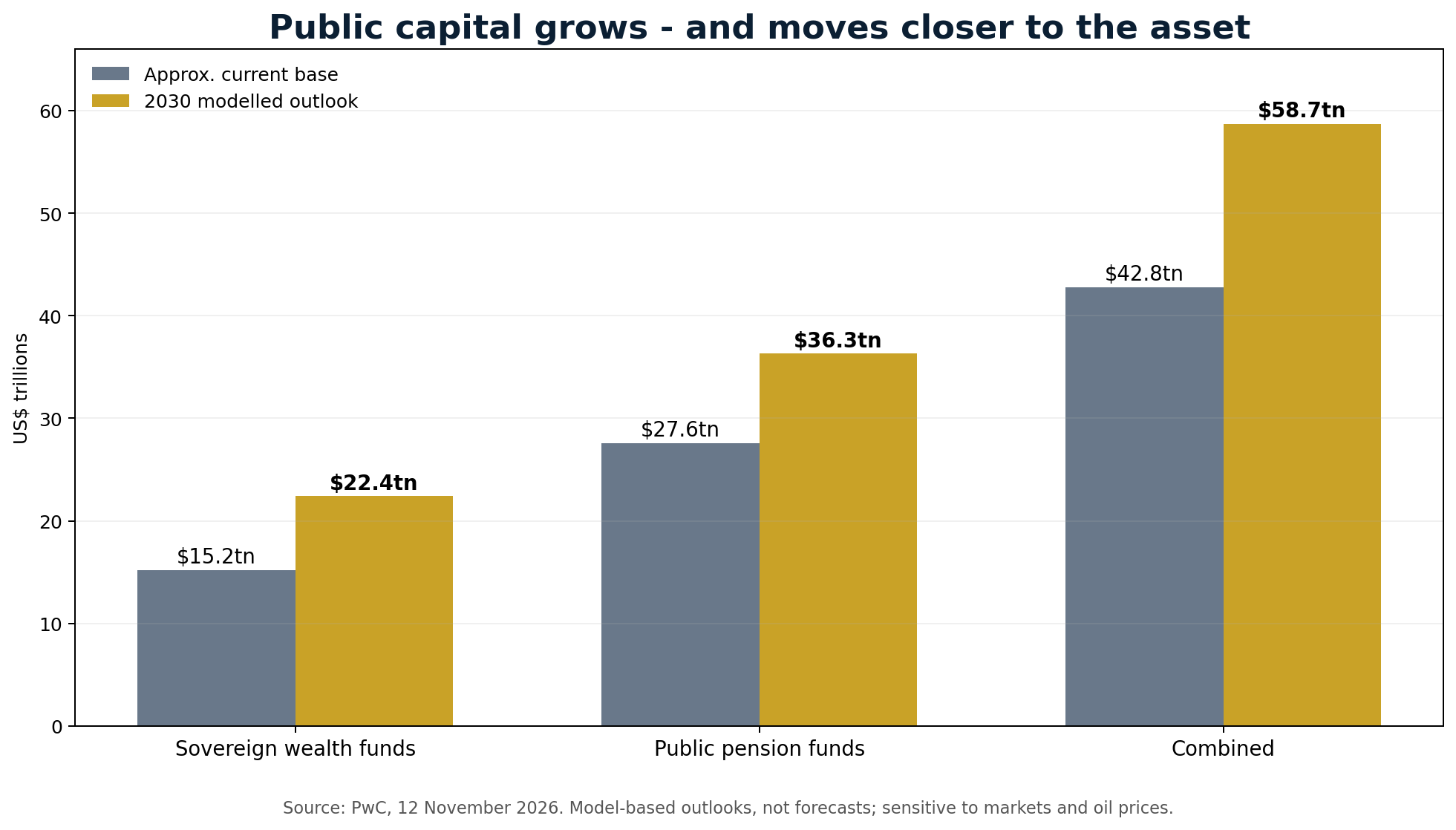
PwC's modelled outlook moves sovereign assets from a 2025 baseline of roughly US$15.2 trillion to US$22.4 trillion and public pensions from US$27.6 trillion to US$36.3 trillion by 2030. The combined change is US$15.9 trillion. Because the numbers are model-based and sensitive to markets and oil prices, the chart is a scale scenario - not a forecast error band.
Decision calendar and risk radar
Decision calendar. The November 12 Treasury auction is now confirmed in our result ledger. Friday’s IEA oil report and Eurostat GDP and employment estimate require a publication check later this morning; this early edition does not pretend those results are already known.
Also today at COP31: scheduled climate-finance and clean-energy sessions. On November 15, the UN fixed-income role closes. On November 20, the EBRD role closes. On December 23, biomethane buyer demand submissions close.
Risk calendar: concentration among the largest public owners; political direction versus commercial return; duration and liquidity mismatch; model risk in the asset-pool outlook; oil-route disruption; long-bond repricing; and integration risk inside direct holdings.
The operational rule is to predefine the evidence that forces review. A missed milestone should not need a headline before it reaches the board.
The Take
Public investors are not becoming important because one study puts a larger number on 2030. They are becoming different institutions. Originating, co-owning and operating assets can improve control over fees, duration and strategic fit. It also turns governance quality into a direct source of return - or loss.
The durable question is simple: when an owner moves closer to the asset, does its evidence move with it? Boards need asset-level facts, reserved matters, independent challenge, liquidity plans and a visible line from public mandate to commercial decision. Scale without those controls is not patient capital. It is concentrated ambiguity.
Source Desk
- Avatar Capital: Fund II first close
- Nscale amended SEC filing
- FCA pension-fee consultation
- FREY and GIC equity partnership
- Gates Foundation and Flagship Pioneering
- Nexperia November12 statement
- Treasury November12 auction result
- PwC - Sovereign wealth and public pension assets to hit US$58.7 trillion by 2030 (12 November 2026).
- PwC - Sovereign wealth and pension funds: The new principal investors (12 November 2026).
- Office for National Statistics - GDP first quarterly estimate, UK: July to September 2026 (12 November 2026).
- US Department of the Treasury - Quarterly Refunding Statement (4 November 2026).
- US Energy Information Administration - Short-Term Energy Outlook (10 November 2026).
- Court of Justice of the European Union - Court dismisses seven Polish actions against Fit for 55 measures (12 November 2026).
- Investec - Direct Lending supports Horizon Capital with its acquisition of enevo (11 November 2026).
- European Commission Directorate-General for Energy - Biomethane Mechanism: first matching round (4 November 2026).
- Norges Bank Investment Management - First direct investment in battery storage (4 November 2026).
- Prime Minister of Canada - Prime Minister announces CEO of the Canada Strong Fund (9 November 2026).
- Bridgewater Associates - Karen Karniol-Tambour biography (accessed 12 November 2026).
- Future Fund - Future Fund appoints new CEO (10 November 2026).
- Eurostat - Annual full-time adjusted salary in EU grew 4.3% in 2025 (6 November 2026).
- Eurostat - Euro area annual inflation up to 4.0% (4 November 2026).
- Eurostat - GDP up by 0.4% in the euro area and 0.5% in the EU (30 October 2026).
- European Bank for Reconstruction and Development - Principal Counsel Equity Funds (posting closes 20 November 2026).
- United Nations Careers - Senior Investment Officer Fixed Income Credit P5 (posting closes 15 November 2026).
- International Energy Agency - Oil Market Report November 2026 launch (13 November 2026).
- Environment and Climate Change Canada - Canada Pavilion schedule for 13 November 2026 (10 November 2026).
Back Page - the passive button disappeared
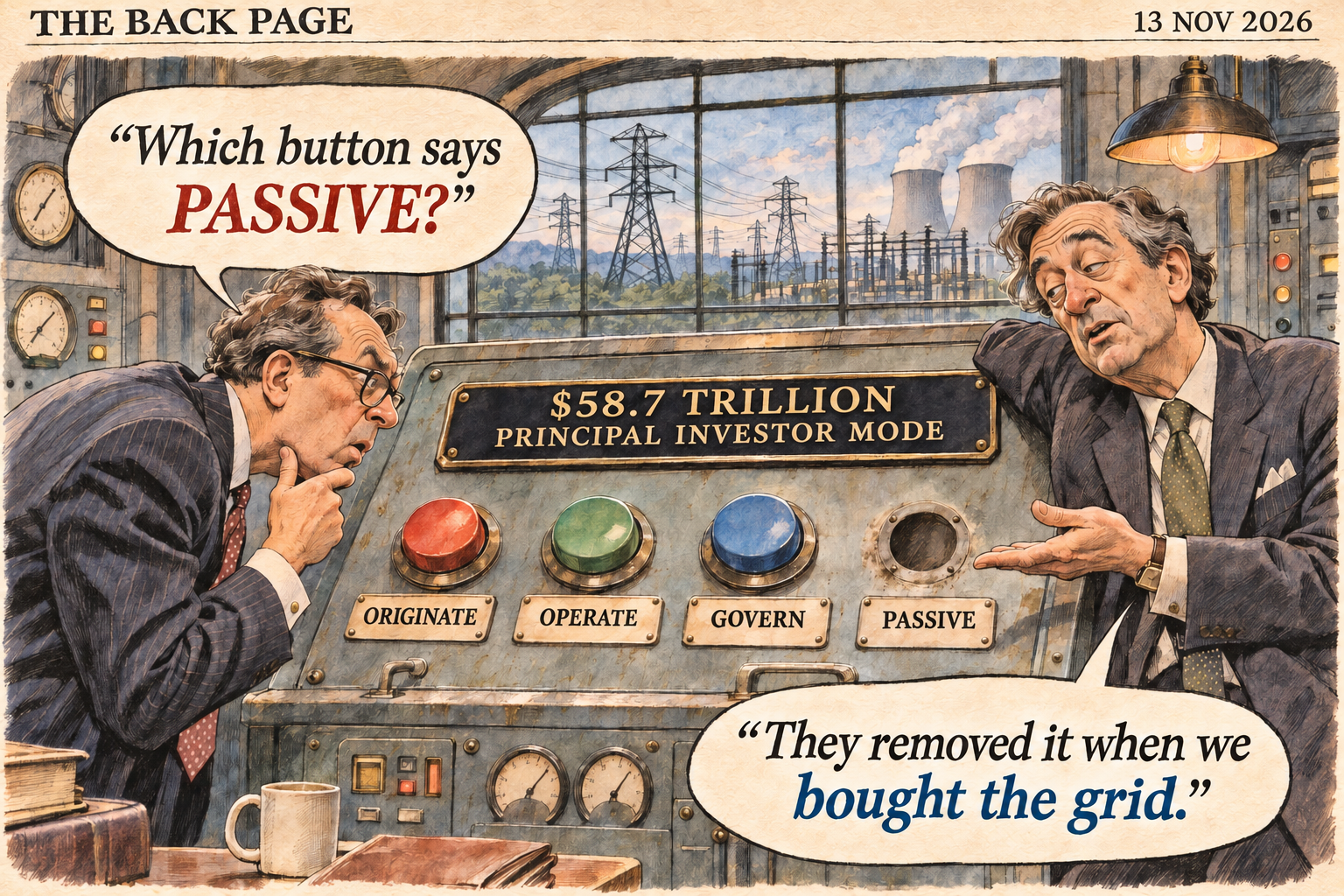
Two operators stand before a control panel marked US$58.7 trillion. One asks which button says passive. The other answers: “They removed it when we bought the grid.”
The joke is about disappearing distance. The serious point is that bigger capital pools require bigger control systems.