
The fund grew. The portfolio didn’t.
Wednesday, 11 November 2026 · Toronto
Flows rescued the quarter-end asset total at CPP Investments. Today’s edition separates return, transfers and balance-sheet growth—and follows that discipline through deals, credit, climate data and delegated authority.
Watch UAO LIVE — Ryan Lafield, Episode 62
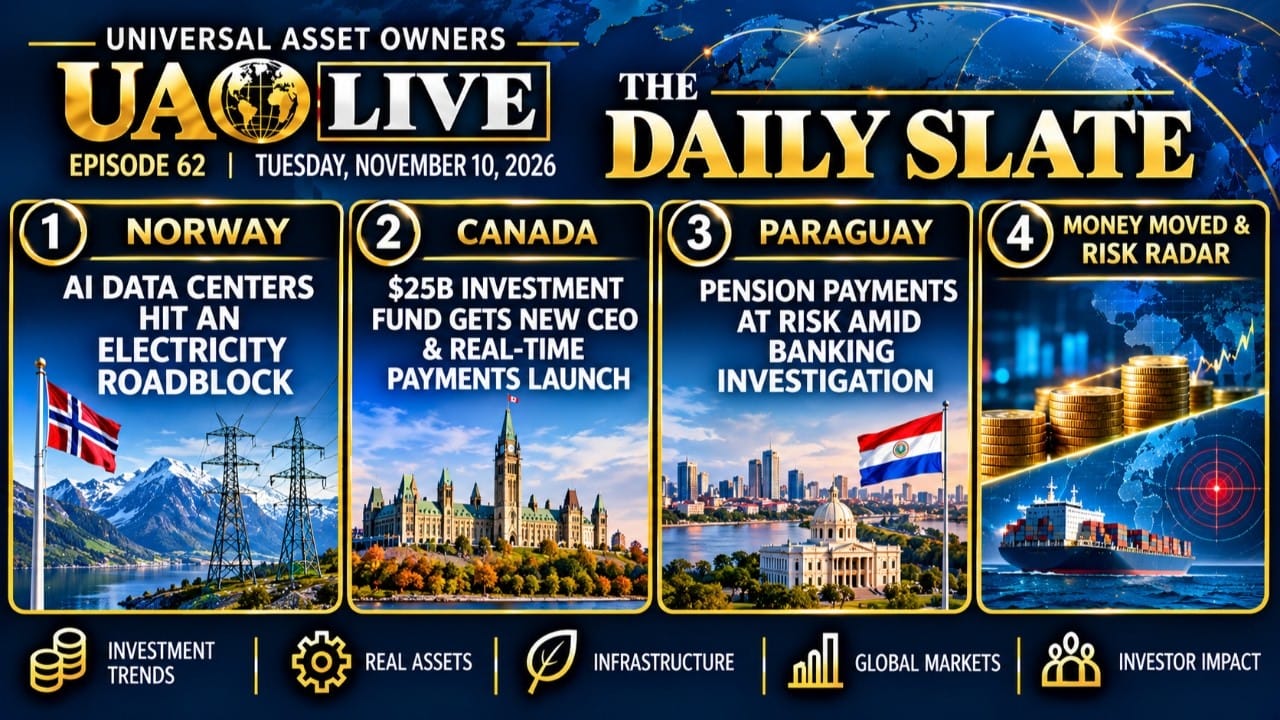
Latest completed programme · 10 November 2026. Ryan examines the power constraints behind AI investment, domestic capital and private-credit oversight.
Today’s essential number
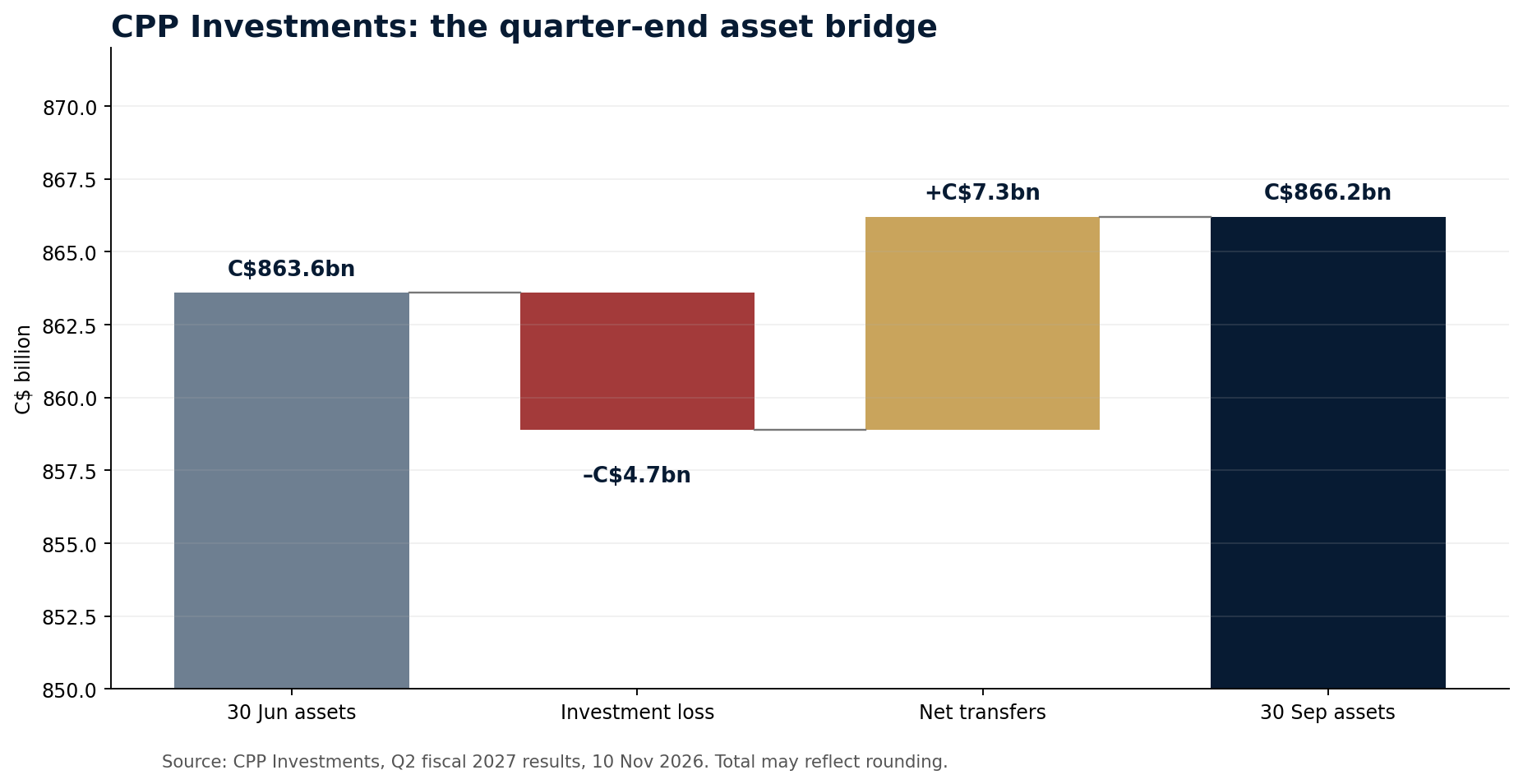
CPP Investments’ quarter-end net assets rose C$2.6bn even though investment performance was negative. The bridge is the story: a C$4.7bn net loss plus C$7.3bn in net transfers. CPP Investments, 10 Nov 2026
The lead — growth without return
A rising asset total can conceal a weak investment quarter. CPP Investments reported a negative 0.5% return for the three months to 30 September, while higher bond yields weighed on fixed income and diversification offset part of the pressure. The ten-year annualised net return remained 8.8%. For long-horizon boards, the lesson is to put return, external cash flow and ending assets on one page. The fund’s first-half result was stronger: C$55.6bn of net income, C$17.3bn of net transfers and a 7.0% net return. A quarter should not drive strategic allocation, but it should test whether the organisation can explain the result precisely. Official results
Headlines — the overnight changes
Advice consolidates: Marsh agreed to buy Wilshire, with closing conditions and client consents still ahead. Infrastructure needs liquidity: Xplore entered creditor protection. Policy remains conditional: the Bank of Canada’s newly published deliberations explain October’s increase rather than announce another one.
Wilshire, 10 November · Xplore, 10 November · Bank of Canada, 10 November
Chart — the asset bridge
Start at C$863.6bn. Subtract the C$4.7bn investment loss. Add C$7.3bn in net transfers. The result is C$866.2bn, subject to rounding. The chart does not soften the loss; it stops the balance-sheet total from being mistaken for portfolio performance.
Pensions and sovereign capital
Australia’s Future Fund appointed CIO Richard Brandweiner chief executive from 1 January 2027. He remains CIO in the interim; recruitment for a new CIO will begin in due course. Raphael Arndt continues as CEO through year-end. Continuity is useful, but the transition makes delegated authority, escalation and model ownership worth re-papering. Canada’s new C$25bn Canada Strong Fund, separately, has named Karen Karniol-Tambour as inaugural CEO. Both changes put organisation design beside asset allocation on the sovereign agenda. Future Fund appointment Canada Strong Fund
Capital & deals — cash, commitment and capacity
PSP Investments signed an agreement to acquire 50% of Enercare from Brookfield and partners for approximately C$1.6bn. The transaction is expected to close in the first half of 2027, subject to customary regulatory approvals; signed is not closed. Enercare’s recurring home-infrastructure revenues fit PSP’s high-inflation-correlated infrastructure strategy. In Saudi Arabia, two HUMAIN facilities total up to SAR2.5bn, including GPU financing and power infrastructure designed for future data-centre capacity. Lucid’s PIF support came through a US$1.75bn expansion of a delayed-draw term loan, not new equity. PSP Investments Infra/HUMAIN release Lucid
Acquisitions — Marsh agrees to buy Wilshire
Marsh’s 10 November agreement adds investment advice, analytics and alternatives capabilities. Financial terms were undisclosed; completion is expected in the first quarter of 2027, subject to conditions, approvals and client consents. Wilshire reports US$221bn under management and US$1.6tn under advisement at 30 June. Managed assets are included in the advised total: the figures must not be added.
The owner’s question: which data, manager-selection and conflict-management safeguards survive integration? Platform scale becomes useful only when the client can still see who recommends, who implements and who is paid. Buyer and target announcement
Norway and the asset investment case
NBIM’s 10% direct investment in Aypa Power for US$300m is context rather than overnight news. The attraction is a combination of contracted operating assets and a development pipeline; the risk is whether grid connections, permits and construction convert pipeline into cash flow. For universal owners, development optionality should never be valued like operating capacity. NBIM, 4 Nov 2026
Credit & liquidity
Sponsor support through credit can preserve equity optionality while increasing fixed claims. Lucid said its enlarged delayed-draw facility lifted pro-forma liquidity to US$3.75bn. Committees should ask what triggers each draw, what covenants protect the lender, and whether operating improvement is reducing dependence on sponsor capital. The transmission is through seniority, refinancing risk and dilution avoided today but not necessarily tomorrow. Lucid Q3 release
Infrastructure credit — the subsidy arrives later
Xplore said it obtained an initial Ontario creditor-protection order on 10 November and initial debtor-in-possession financing. The company attributes funding pressure partly to permitting delays and subsidy payments weighted toward project completion. It says services will continue; that is its stated plan. FTI is the court-appointed monitor.
Our interpretation: public support can improve project economics while leaving a cash-timing gap. An infrastructure lender needs the bridge between construction spending and the payment milestone, including who funds a delay. Xplore’s announcement
Treasury — the deliberations are now out
The Bank of Canada published the record of its 28 October decision on 10 November. Council considered holding at 2.25% or raising to 2.5%, and chose the increase. Members worried that prolonged energy costs would spread through the price system; they also noted core inflation near 2%, remaining slack and trade risks. Further increases remained possible, with decisions taken meeting by meeting. This explains October’s move; it is not a new rate decision.
Our interpretation: a duration plan should distinguish a policy-rate shock from a higher term premium. Both can depress bond values, but they imply different responses for liquidity, hedges and reinvestment. Read the actual deliberations
Politics & oil — keep the incident and inference separate
ADNOC Logistics & Services said one of its vessels was damaged in an attack in UAE territorial waters on the afternoon of 10 November. Its statement did not identify the attacker or quantify casualties or damage. It confirms an incident; it does not establish a wider escalation.
Risk lens: owners can map exposure through marine insurance, transport reliability and energy costs without turning an incomplete incident report into a market forecast. Company statement
Europe — prices, wages and private credit
In its 29 October statement, the ECB said energy is pushing up headline inflation while underlying measures remain broadly stable. Its wage tracker projected negotiated wage growth of 2.5%–2.8% through the rest of 2026, averaging 2.6% for the first three quarters of 2027. For private credit, a higher base rate improves coupons but can expose weak interest coverage. Owners should distinguish durable illiquidity premium from leverage that only looks attractive before a refinancing wall. ECB statement
Climate disclosure — different requirements, different clocks
The Ninth Circuit’s 9 November ruling left the denial of a preliminary injunction against SB 253 Scope 1 and 2 disclosures intact. It reversed that denial for Scope 3 and SB 261, and remanded, including for consideration of Scope 3 severability. This is a preliminary-injunction decision, not a final judgment striking down every California disclosure requirement. CARB’s programme page identifies 10 November as the 2026 Scope 1 and 2 deadline. Court opinion · CARB programme
Separately, the EBA’s 6 November update concerns a draft supervisory-reporting simplification package. The final report is expected in December 2026, with new requirements first referencing December 2027 and selected areas, including ESG, December 2028. Existing transition instructions still apply; this is not a blanket suspension of ESG reporting. EBA update
Our interpretation: keep the legal-obligation register separate from the information an investment decision needs. A changed reporting timetable does not erase a portfolio’s physical, transition or counterparty exposure.
Long horizon — biomethane
Our underwriting lens for European biomethane starts with feedstock concentration, methane leakage, grid connection, guarantee-of-origin economics, subsidy duration, digestate liabilities and offtake quality. A development pipeline is not an operating plant. The question is whether contracted revenues remain credible after operating costs, leakage and subsidy expiry—not whether the project carries a circular-economy label.
People moves
CPP Investments is combining Active Equities and Capital Markets & Factor Investing into Active Public Markets under Heather Tobin. Frank Ieraci remains an adviser through year-end; COO Jon Webster is departing. McKnight Foundation named Priya Parrish its first CIO from 30 November to oversee a US$2.8bn endowment. Leadership changes can alter mandate owners, decision rights and external-manager access even when strategic policy is unchanged. CPP results and organisation update McKnight Foundation
Executive profile — John Graham
From research scientist to institutional allocator. John Graham became CPP Investments’ president and CEO in February 2021 after joining the organisation in 2008. His route ran through total-portfolio work and private investments, then leadership of Principal Credit Investments in 2015 and Credit Investments in 2018. Before investing, he spent nine years in research and strategy at Xerox Innovation Group. He holds a doctorate from Western, an MBA from Rotman and the CFA designation. FCLTGlobal biography
SickKids adds detail to that scientific background: physical chemistry and nanotechnology, 36 patents as a named inventor and 16 peer-reviewed articles. His investment experience includes Toronto, London and Hong Kong, and he joined the hospital’s board in June 2024. Those facts establish a varied career; they do not demonstrate that a scientific credential guarantees good investment judgment. They do place his present job in a useful context: a leader who has worked with experiments, uncertain evidence and institutions with long obligations. SickKids biography
Our leadership assessment starts with explanation. The current quarter presents two facts that can sound contradictory to a beneficiary: the fund’s assets increased and its investments lost money. The published bridge resolves that tension. An effective CEO should make the explanation accessible without using either contributions or long-run returns to soften the meaning of a weak period. Trust is built when the same vocabulary is used after good results and bad ones.
The organisational test is equally concrete. CPP Investments is combining Active Equities and Capital Markets and Factor Investing into Active Public Markets, led by Heather Tobin. Fundamental and systematic approaches will operate within one department. The potential gain is a better view of overlapping exposures and investment ideas. The governance question is whether the combined platform also preserves independent challenge, clear strategy attribution and the ability to close a weak thesis. Results and organisational update
For an external manager, a new structure can alter more than the name on a meeting invitation. Relationship ownership, portfolio constraints and approval routes may change. For an internal team, the same reorganisation can improve access to data while making it less obvious who is accountable for a model or a shared position. Our test for Graham is whether collaboration arrives with a clearer record of decisions, rather than a more polished description of the organisation.
A credit background is relevant to that test. Credit work forces a distinction between a plausible business story and the cash available to meet a claim. Applied at total-fund level, the same discipline asks when contributions arrive, when benefits leave and what can be sold during stress. This is our interpretation of the demands of the role, not a claim about Graham’s private decision process. A long horizon helps only if the institution can finance the journey.
Graham also chairs FCLTGlobal, whose mission centres on long-term capital. That provides a public setting for the tension every large allocator faces: patient investment requires durable mandates, but patience must not become immunity from scrutiny. A useful long-term scorecard distinguishes an investment thesis developing slowly from an assumption that has failed. It records what evidence would change the decision and who has authority to act. FCLTGlobal board
The resulting leadership scorecard has four parts: explain performance consistently; preserve challenge through organisational change; protect liquidity across ordinary and stressed cash flows; and make decisions understandable to the people whose retirement savings are invested. No single quarter can settle that scorecard. This quarter does offer a clear observation point: a higher asset total, a negative investment result and a major public-markets reorganisation. Graham’s task is to keep all three visible at once.
Operational risk — authority must travel with the reorganisation
Leadership and team changes should trigger a review of monetary limits, model ownership, interim authorities and escalation paths. A successor can inherit a title before systems, committees and external managers agree on who may approve an exception.
Our analysis: record the decision owner, independent challenger, expiry date and audit trail for each temporary delegation. In a combined investment team, preserve strategy-level attribution so better coordination does not become an excuse for less visible accountability.
Careers
CPP Investments’ Associate, Investment Engineering & Analytics listing is for a 12-month Toronto contract, requisition JR00920, with a stated 30 November deadline. The employer’s application site was temporarily unavailable at our final check; confirm availability before applying. Future Fund’s forthcoming CIO search remains a watch item until an official application page appears. Official employer listing
Decision calendar
30 November: Priya Parrish starts as McKnight Foundation’s first CIO; the CPP Investments role above lists the same application deadline. 1 January 2027: Richard Brandweiner becomes Future Fund CEO. First quarter 2027: Marsh targets the Wilshire close, subject to conditions and consents. First half 2027: PSP targets the Enercare close, subject to approvals.
The Bank of Canada’s October deliberations are now published. Treat them as evidence about the decision already taken, rather than an upcoming release. Deliberations · Wilshire closing conditions
The Take
The institutional discipline of the day is to name the stage and denominator. Assets are not returns. A facility is not deployed equity. A signed agreement is not a closed transaction. A pipeline is not operating capacity. Put the bridge on the first page: starting position, market result, external cash flow and ending position—then identify who had authority for each step.
Source Desk
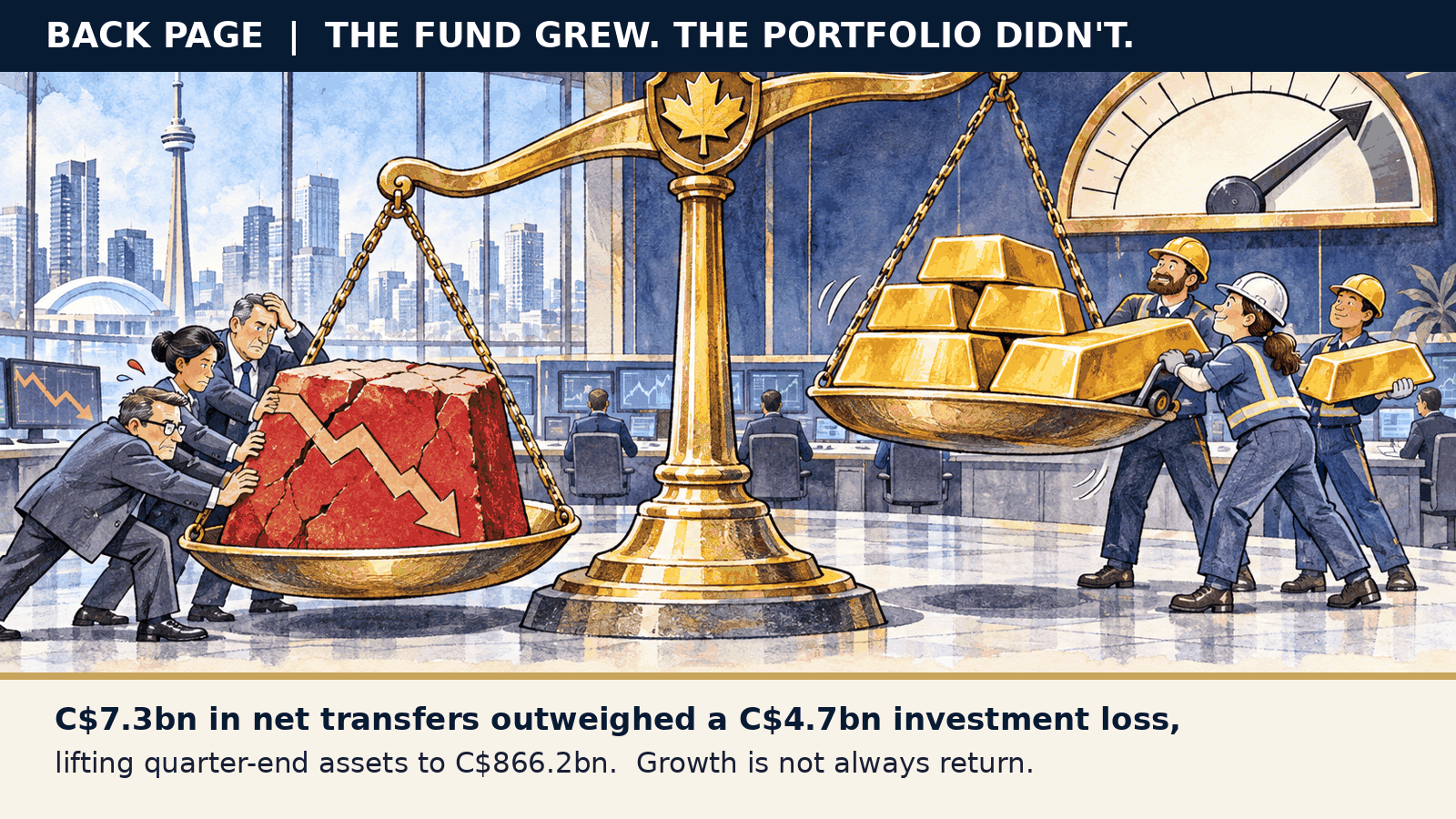
Back Page — The fund grew. The portfolio didn’t.
The fund grew. The portfolio didn’t. Net transfers outweighed the investment loss. Our original cartoon puts the two forces on a set of scales; the animation makes their different sizes visible.
Universal Asset Owners · Institutional intelligence for long-horizon investors.