
THE DAILY BRIEF
The factory bill arrived first
China’s price chain splits, Canada’s rate path hardens and energy security returns to the operating balance sheet.
Good morning. Today’s edition follows the gap between upstream pressure and the consumer checkout.
Watch the Latest UAO LIVE with Ryan Lafield

Episode 61, published November 9: Ryan Lafield examines the U.S. Treasury’s auction week and why bond yields matter.
Watch the Latest EpisodeThe Universal Owner · 10 November 2026 · 6:56 ▶ Listen: The factory bill arrived first China’s price chain, Canada’s rate path and the operating consequences of energy security. |
The price chain has split
China: October CPI rose 0.7% year on year, core CPI rose 0.8%, and the monthly headline was unchanged. Source
Factories: PPI rose 5.7% year on year and 0.7% month on month; industrial purchase prices rose 7.9% and 1.1% respectively. Source
Canada: Market participants put median year-end 2026 growth at 1.6%, CPI at 3.0% and the policy rate at 2.50%. Source
Energy: The IEA expects US$3.4tn of global energy investment in 2026, with US$2.2tn going to clean energy, efficiency and electrification. Source
Climate: COP31 is under way in Antalya; California’s corporate GHG reporting deadline is a live implementation watch. Source CARB
The factory bill arrived first
China’s October price data put three parts of the same balance sheet on different tracks. Industrial purchase prices rose 7.9% from a year earlier. Producer prices rose 5.7%. Consumer prices rose 0.7%. Source
The gap is not a forecast of mechanical pass-through. It is an underwriting question. Producers may absorb costs, reduce volumes, reprice contracts, use hedges, draw working capital or defer investment. Retail competition and household demand decide how much reaches the checkout.
The composition matters. Food prices fell 2.9% from a year earlier while non-food prices rose 1.5%. Energy pressure was much stronger upstream: oil and gas extraction prices rose 35%, coal mining and washing 36.6%, and refined petroleum and other fuel manufacturing 29.9%. Source
Universal owners hold the producers, buyers, banks, retailers and households connected by that chain. The investment edge comes from tracing who bears the difference before the consumer headline catches up - or never does.
Three prices, one production chain
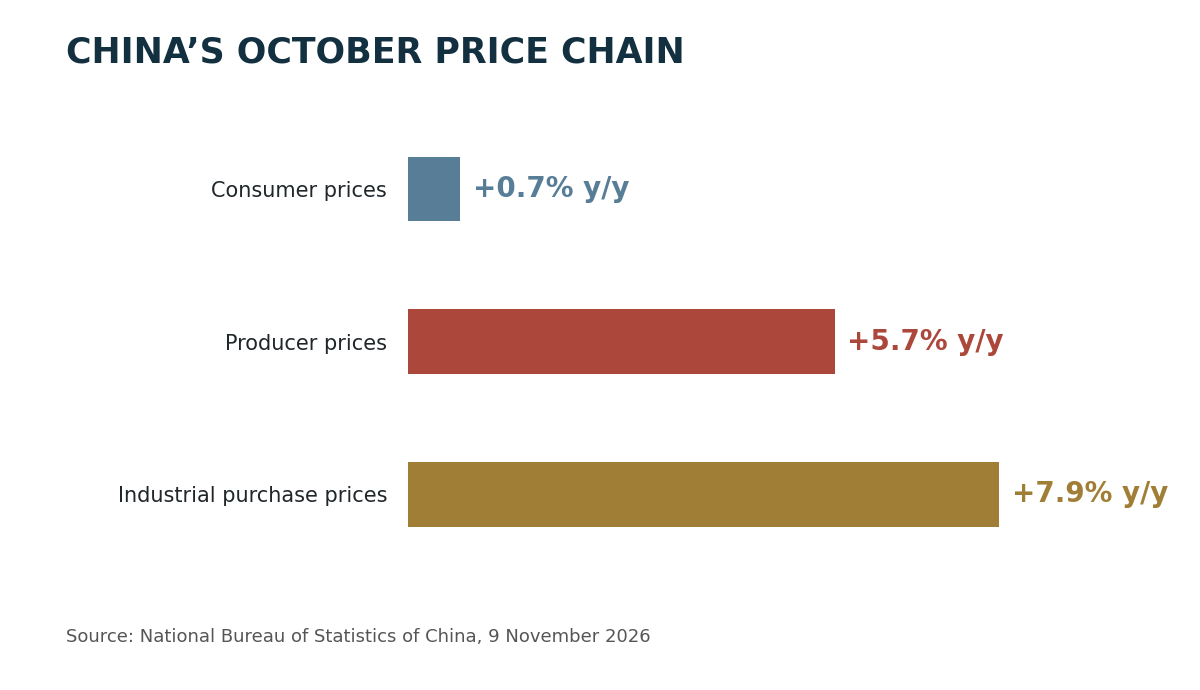
The upstream readings are not interchangeable with consumer inflation. They show where pressure begins and where cash-flow analysis must follow. Official CPI table
Canada’s survey maps the soft landing - and its limits
About 25 market participants responded to the Bank of Canada’s third-quarter survey. The median forecast put real GDP growth at 1.6% at the end of 2026 and 1.8% at the end of 2027. Ninety-two per cent saw a negative output gap. Source
The median recession probability was 13% over zero to six months, 20% over six to twelve months and 23% over twelve to eighteen months. These are participant views, not a Bank forecast.
Median CPI expectations were 3.0% at the end of 2026 and 2.0% at the end of 2027. The median policy-rate path moved from 2.50% in December 2026 to 2.75% in early 2027. For pensions and insurers, that combination can help liability discounting while pressuring duration assets and leveraged borrowers.
A C$25 billion mandate takes shape
Ottawa named Bridgewater co-CIO Karen Karniol-Tambour as the incoming CEO of the Canada Strong Fund. The government announced an initial C$25 billion capital commitment. The fund is designed to invest commercially through co-investments in federally supported projects and direct investments in Canadian projects and companies.
It is to begin as a Canada Development Investment Corporation subsidiary pending legislation for a standalone Crown corporation. For co-investors, the questions are how the board will separate public policy from underwriting, allocate risk and choose benchmarks. Prime Minister’s Office
Energy investment is record-sized; execution is the scarce asset
The IEA expects global energy investment to reach US$3.4tn in 2026, up 5%. Around US$2.2tn is expected to go to renewables, nuclear, grids, storage, low-emissions fuels, efficiency and electrification; US$1.2tn to oil, gas and coal. Source
Norges Bank Investment Management paid US$300 million for a 10% direct stake in North American battery storage platform Aypa Power, alongside Brookfield. The deal closed on 28 October and was announced on 4 November. Aypa’s roughly 6.5 GW includes operating, under-construction and contracted capacity. NBIM announcement
The portfolio question is how much announced capital becomes commissioned, contracted cash flow. Development rights, grid access, offtake, equipment delivery and operating capability still determine the result.
Input inflation reaches covenants through working capital
A borrower can report resilient revenue while cash conversion deteriorates. Higher purchase prices increase the funding required for inventories; contract lags delay recovery; customer resistance can block repricing.
Credit committees should request product-level input sensitivity, pass-through rights, inventory duration, hedge coverage and covenant headroom. Sponsor support needs a named guarantor, cap, maturity and draw conditions.
The countercase is that upstream inflation eases before costs reach households. That is why downside analysis should use cash and liquidity, not a single CPI forecast.
Europe enters winter with less gas cushion
The IEA’s Global Gas Security Review says Europe begins the heating season with storage at its lowest level in more than a decade. The report also examines the disruption of LNG flows through the Strait of Hormuz in 2026. Source
This is not a prediction of shortage. Weather, LNG availability, demand response and infrastructure performance will determine the outcome. A smaller buffer does, however, increase the value of flexibility and the cost of operational failure.
The transmission runs through industrial inputs, electricity prices, household bills, public support and the fiscal position of producing and consuming states.
Delegated authority is tested between meetings
When input costs, yields or energy conditions move quickly, monthly reporting can be too slow. Boards need explicit thresholds for hedging, refinancing, repricing and capital commitments.
The evidence chain should be visible: what was delegated, what the manager or executive monitored, when a limit was breached and what action followed. In private assets, budget revisions and covenant forecasts often reveal stress before reported earnings.
Fiduciary discipline is not a larger dashboard. It is timely information connected to real decision rights.
Methane credibility moves from promise to market design
The IEA listed a new report on 9 November on building a voluntary near-zero-intensity methane marketplace. The publication is a market-design contribution, not evidence that a liquid market already exists. Source
For biomethane and low-emission gas, investors should ask who measures intensity, how certificates map to physical delivery, whether claims can be double counted and how any premium reaches the operator that bears the cost.
COP31 is under way in Antalya through 20 November. Treat speeches, negotiating text, national commitments, finance announcements and operating assets as different stages. Source
Deadlines are operating events
CARB identifies 10 November as the 2026 Scope 1 and Scope 2 reporting deadline under California’s corporate GHG programme. CARB also describes enforcement discretion for 2026 and says use of its intake platform is voluntary. Covered entities should consult the official guidance for applicability and submission options; rulemaking for subsequent years continues. Source
EU Delegated Regulation 2026/1563 enters into force on 10 November and applies for financial years beginning on or after 1 January 2027. EUR-Lex
Disclosure requirements create a control burden before they create a report: data ownership, assurance, system access, legal accountability and board sign-off all need to work.
Nicolai Tangen: curiosity, technology and public accountability
Our executive profile is Nicolai Tangen, chief executive of Norges Bank Investment Management, the organization responsible for managing Norway’s Government Pension Fund Global.
He took the job in September 2020. In March 2025, Norges Bank’s Executive Board renewed his appointment for another five years, beginning that September. By November 2026, he is well into that second term, leading an institution whose decisions matter both to Norway’s future finances and to companies around the world.
Tangen arrived with a career built in investment research and fund management. He worked as an equity analyst at Cazenove, then as a partner and senior analyst at Egerton Capital. In 2005, he founded AKO Capital, where he served as chief executive and chief investment officer.
His education reaches beyond finance. He has a finance degree from Wharton, a master’s in art history from the Courtauld Institute of Art, and a master’s in social psychology from the London School of Economics. He also studied Russian at the Norwegian Armed Forces’ School of Intelligence and Security.
Those credentials provide an interesting backdrop for someone responsible for evaluating companies, developing investment teams and understanding how people make decisions. He also established the AKO Foundation in 2013, supporting education, the arts and climate-related initiatives.
His transition into public investment management required formal separation from his former business. Revised employment arrangements in 2020 provided for the irrevocable transfer of his AKO ownership and dividend rights to the foundation. That history highlights a central requirement of this role: public confidence in the independence of the person managing national wealth.
To understand Tangen’s leadership, we also need to understand the limits of his authority.
Norway’s parliament, Ministry of Finance, Norges Bank’s Executive Board and NBIM have distinct responsibilities. The ministry sets the management mandate. The strategic benchmark is 70 percent equities and 30 percent fixed income. Tangen leads the organization carrying out that mandate, within its rules and risk limits.
The job therefore combines investing with stewardship, operational discipline and public accountability. A fund of this size needs to explain how it earns returns, how much it costs to operate and how its decisions compare with the benchmark established for it.
The latest quarterly disclosure makes the scale tangible. At September 30, 2026, the fund was worth approximately 22 trillion Norwegian kroner. It reported a third-quarter return of minus half a percent, trailing its benchmark by 0.18 percentage points. Fixed-income investments returned minus 3.5 percent as rising interest rates weighed on results.
These figures are a useful reminder that even a very large, patient investor faces market losses and periods of underperformance.
Tangen’s current agenda puts substantial emphasis on technology and organizational learning.
NBIM’s strategy through 2028 calls for stronger feedback, intellectual honesty and systematic reviews of investment successes and failures. It also calls for using artificial intelligence to support decisions and improve efficiency, while retaining human judgment.
For a leadership audience, the practical idea is straightforward: better tools should help people recognize mistakes, question consensus and make better decisions repeatedly.
In his May 2026 parliamentary hearing statement, Tangen reported that all 680 employees were using AI daily. He said an internal, self-reported survey showed productivity gains above 20 percent. That distinction matters: this was management’s report of employee estimates, rather than an independently established productivity measurement.
He also addressed the risks surrounding the technology boom. At the end of 2025, the ten largest companies represented 21.3 percent of the fund’s equity investments. Seven were American technology companies. He identified that concentration as a significant risk.
That combination makes Tangen worth watching: an experienced investor encouraging rapid adoption of new technology while publicly discussing the vulnerabilities that accompany it.
For other executives, his role raises a useful question: how do you build a faster, more curious organization while keeping its judgment, accountability and long-term purpose intact?
NBIM leadership · NBIM reports and disclosures · Tangen’s parliamentary statement
Two Los Angeles pension operating seats
LACERS - Assistant General Manager, public pension operations. The official City of Los Angeles posting lists an application deadline of 8 a.m. on 13 November (the posting does not specify a time zone). Official application
City of Los Angeles - Assistant General Manager, pensions. Los Angeles Fire and Police Pensions lists a closing time of 4:30 p.m. on 18 November; confirm the time zone with the employer. Official application
Salary figures are not reproduced. Vacancies are separate from appointments.
The gaps that deserve committee attention
Margin gap: upstream costs rise faster than consumer prices.
Liquidity gap: inventory and collateral need cash before repricing arrives.
Energy gap: Europe enters winter with a smaller gas buffer.
Control gap: delegated managers act faster than boards receive evidence.
Disclosure gap: new reporting deadlines arrive before data ownership is settled.
Read the price chain, not only the headline
The National Bureau of Statistics interpretation explains how energy, industrial materials and consumer categories produced the October split. Read the NBS analysis
The Bank of Canada survey is useful as a scenario distribution rather than a single forecast. Read the survey
The IEA gas-security review connects geopolitical disruption with storage, LNG flexibility and winter resilience. Read the review
What to watch next
Today, 8:30 a.m. Eastern: U.S. October CPI and real earnings are scheduled for release. This briefing precedes those releases. BLS calendar
10 November: California corporate GHG reporting deadline and EU delegated-regulation entry into force.
Through 20 November: COP31 negotiations and finance announcements in Antalya.
U.S. Treasury: The US$42 billion ten-year note auction is scheduled for 1 p.m. Eastern today. The US$25 billion thirty-year bond auction follows Thursday at 1 p.m. Eastern. Treasury refunding statement
Next data: whether China’s upstream pressure appears in margins, trade, policy support or later consumer releases.
Inflation is a chain, not a print
China’s October data show pressure at purchase, production and household stages. The correct response is not to assume every factory cost reaches the checkout.
Universal owners should follow contracts, inventories, hedges, competition, working capital and decision rights. That is where a macro gap becomes a portfolio result.
Original documents and announcements
National Bureau of Statistics of China - October 2026 CPI and PPI interpretation
9 November 2026
National Bureau of Statistics of China - October 2026 CPI tables
9 November 2026
Bank of Canada - Market Participants Survey, Third Quarter of 2026
9 November 2026
International Energy Agency - Investment topic and World Energy Investment findings
2026
International Energy Agency - Global Gas Security Review 2026
3 November 2026
International Energy Agency - Reports listing
9 November 2026
UNFCCC - COP31 opening arrangements
9 November 2026
Norges Bank Investment Management - News and insights
accessed 9 November 2026
California Air Resources Board - Corporate GHG reporting programme
accessed 9 November 2026
The factory bill arrived first
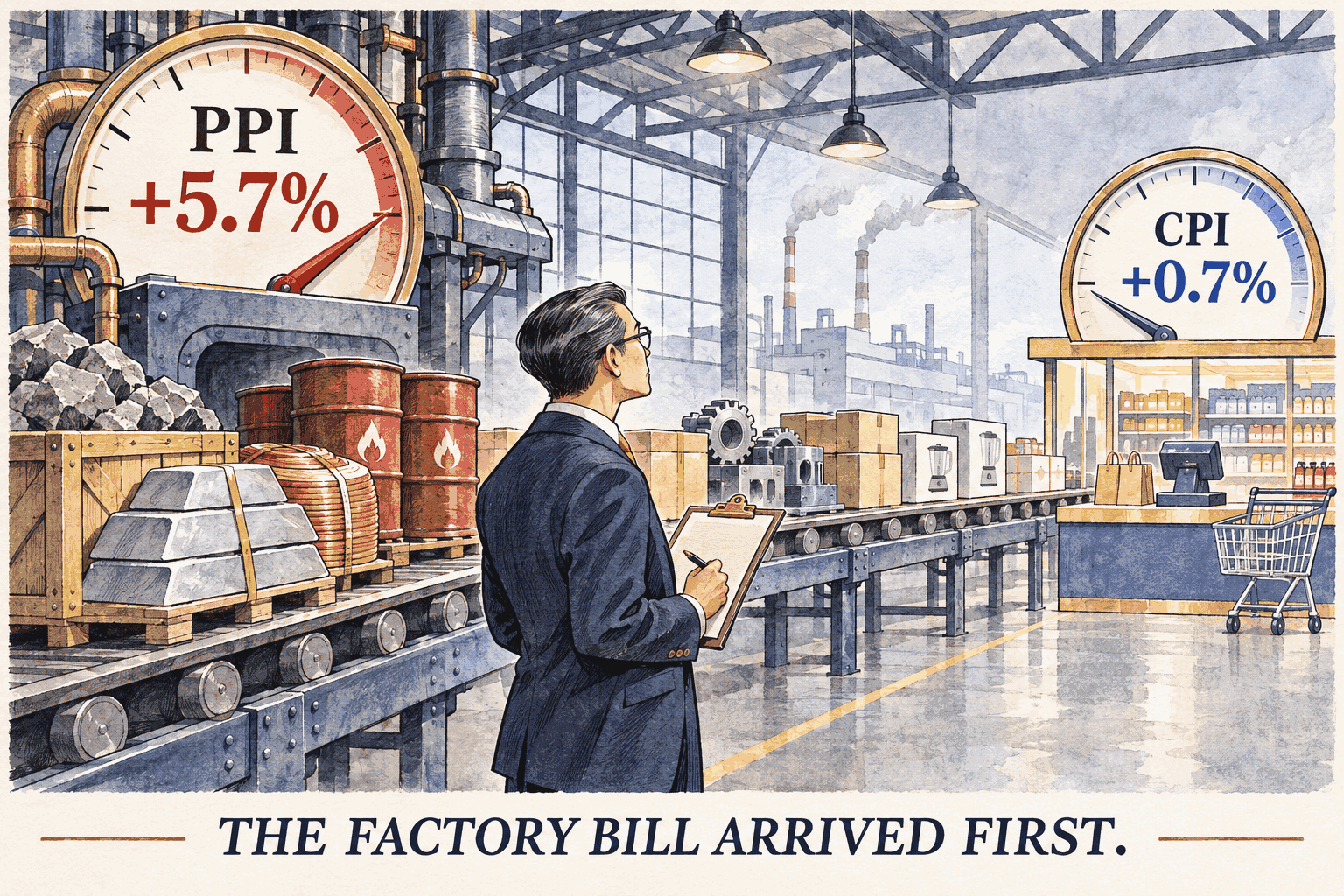
The factory gauge reads 5.7%. The checkout reads 0.7%. The allocator is still looking for the margin.
Watch the Back Page Video