
UNIVERSAL ASSET OWNERS
The Daily Brief
MONDAY, 9 NOVEMBER 2026
THE LEAD · OVERNIGHT
China’s inflation squeeze is upstream
China’s October inflation report presents asset owners with two very different price environments. Consumer prices rose 0.7% from a year earlier, while factory-gate prices rose 5.7%. Industrial producers’ purchase prices were up 7.9%. The figures were released by the National Bureau of Statistics on Monday morning in Beijing, overnight for North American readers.
The consumer basket remains restrained: food prices fell 2.9% year on year, and core inflation, excluding food and energy, was 0.8%. Yet the input side is much hotter. Fuel and power purchase prices rose 18.6%; chemical raw materials rose 16.8%; non-ferrous metals and wires rose 16.7%. An investment case built only around weak headline consumer inflation can miss substantial pressure elsewhere in the supply chain.
There is also an important distinction between direction and speed. Annual producer-price inflation accelerated, but its monthly increase slowed to 0.7%. That is still an increase in the price level. It is not a return to last year’s costs. Nor should investors subtract the CPI from the PPI and call the difference a corporate margin: the indices cover different baskets and stages of production.
The owner’s question: which portfolio companies can pass higher input costs through, how quickly, and under which contracts? Utilities, manufacturers, transport operators and infrastructure developers can experience the same inflation release very differently. Today’s useful exercise is to trace the cash-flow exposure, rather than label the entire economy inflationary or deflationary. Sources: NBS consumer prices, producer and input prices and official interpretation, 9 November.
TODAY IN 90 SECONDS
The morning’s essential numbers
0.7% / 5.7% / 7.9%: China’s annual consumer, factory-gate and industrial input-price increases for October. Energy-sensitive inputs deserve attention even where consumer demand looks soft.
US$58 billion: today’s three-year Treasury auction, scheduled for 1:00 p.m. Eastern. It opens a US$125 billion refunding package; the ten-year and thirty-year auctions follow on Tuesday and Thursday.
10:30 a.m. Eastern: the Bank of Canada’s Market Participants Survey release. These are expectations to examine when published, not results available at this edition’s cutoff.
3,000 GW: projects in advanced stages of grid-connection queues, according to the IEA’s Renewables 2026 report. A connection timetable belongs beside the return forecast.
Tomorrow, 10 November: CARB’s stated deadline for 2026 Scope 1 and Scope 2 emissions reporting. Applicability and first-year guidance still matter. Sources: U.S. Treasury, Bank of Canada, IEA, CARB.
AI INFRASTRUCTURE · REPORTED DEAL
The power plant enters the AI capital budget
Anthropic has agreed to commitments worth about US$3.4 billion for 1.7 GW of gas generators, according to Financial Times reporting summarized by CNBC-TV18 on 9 November. The report describes a transaction involving OnePWR, including Caterpillar equipment orders, engineering and construction, agreed in late September. This is a newly reported transaction, not an agreement announced as closing this morning.
For investors, the significance reaches beyond the headline equipment bill. Securing generation can reduce dependence on a constrained grid connection, while introducing fuel procurement, emissions, permitting, construction and operating obligations. The question is where those obligations sit: with the AI customer, a developer, a utility or a financing vehicle.
The report is not evidence that Anthropic acquired OnePWR. It is also not a measure of revenue already earned or power already delivered. Owners underwriting the infrastructure should ask for commissioning milestones, contractual recourse and the party responsible for overruns before treating contracted capacity as operating capacity. Read the CNBC-TV18 report, citing the FT.
CLIMATE & NATURE · COP31 TODAY
The climate summit opens; the financing test follows
COP31 opened in Antalya today. In its live conference update, the UN climate secretariat reported Executive Secretary Simon Stiell’s call for stronger outcomes on the mandated negotiating items. Türkiye is hosting the conference; Australia’s Chris Bowen is President of Negotiations. This is an opening-day development, not evidence that a new financing agreement has already been adopted. UNFCCC: COP31 live updates, 9 November.
For long-horizon investors, announcements over the coming days should be sorted by what they actually change. A political pledge, a guarantee programme, an investment mandate and a signed financing agreement have different implications for deployable capital. The useful details are the counterparty, eligibility, risk allocation, currency and route to a bankable project.
There is a direct connection to today’s grid and inflation stories. Transition targets depend on equipment, connections and contracts that can absorb changing costs. An attractive headline allocation does not itself resolve permitting, offtake or construction risk. Our conference watch will therefore focus on operational commitments and published terms, rather than treating aggregate pledges as cash already invested.
ENERGY TRANSITION · RESEARCH IN CONTEXT
The queue is an investment risk
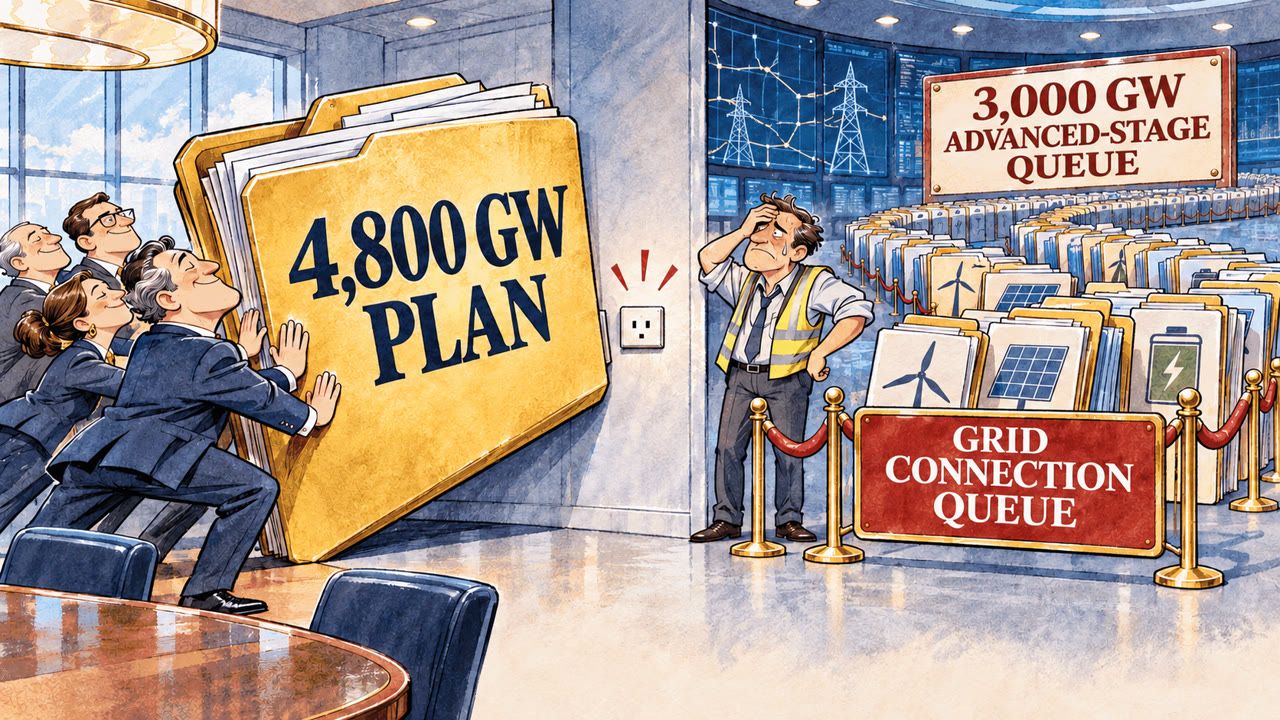
The IEA forecasts almost 4,800 GW of renewable capacity additions during 2026–2031, with solar PV providing more than three-quarters of the increase. Its Renewables 2026 assessment also identifies 3,000 GW of projects in advanced stages of grid-connection queues, a 60% increase over the past year. Storage and hybrid projects account for that increase.
Those figures describe different things: a forecast of future installations and a stock of projects seeking connections. Neither is a list of financed assets that will necessarily reach operation on schedule. Grid reform is also removing projects from queues, making gross queue size a poor substitute for project-level diligence.
For an asset owner, a credible connection date is part of valuation. A delayed asset can consume capital before generating contracted revenue, and refinancing assumptions may move with the delay. Ask whether the equity case survives a later energisation date, a higher connection bill and a period of reduced output. The IEA report supplies the sector context; the actual connection agreement supplies the asset-specific evidence. IEA executive summary (research context, published before today).
ESG & STEWARDSHIP · RECENT RESEARCH
Climate progress needs a consistent denominator
The Net-Zero Asset Owner Alliance’s 2026 progress report, released on 5 November, offers a useful benchmark for the summit week. It says 88% of targets from its first 2020–2025 cycle were fully achieved. Reported carbon intensity fell from 61 to 50 tonnes of CO₂ equivalent per US$1 million invested in listed equities, and from 73 to 50 in corporate bonds. These are portfolio-intensity measures, not a claim that global emissions fell by the same proportion. UNEP FI’s original results and methodology context.
Climate-solutions investments reached US$787 billion in 2025, up from US$555 billion two years earlier, according to the alliance. The report describes that as roughly 8% of assets under management. The number of signatories reporting climate-solutions investments rose from 17 in 2020 to 82 in 2025. Those changes in reporting coverage matter when interpreting aggregate growth.
The investment challenge now extends deeper into private markets. The alliance identifies data quality, manager engagement and asset-specific targets across private equity, infrastructure, private debt and real estate as priorities. A board reviewing its own progress should ask whether falling measured intensity reflects investee change, portfolio reallocation, valuation movements or a changed reporting boundary. Each can move the metric; they do not demonstrate the same economic outcome.
PORTFOLIO CONSTRUCTION
A pension return needs its time horizon
Japan’s GPIF reported a 1.65% loss in fiscal 2026’s second quarter, with total assets of approximately ¥314.4 trillion at quarter-end. The first-half return remained positive at 6.42%. The fund’s update presents these as period returns, not annualised figures, and reports returns gross of fees.
The distinction matters. A weak quarter can coexist with a strong first half, and a yen-based foreign-asset return includes currency effects. GPIF’s quarter included a 6.52% decline in foreign bonds and a 3.71% gain in domestic equities. That is a better starting point for attribution than an isolated headline about the aggregate loss.
The report also gives an alternatives share of 1.72% in the broader pension-reserve allocation, within a maximum of 5%. Its allocation tables include pension special-account reserves; that denominator is larger than GPIF’s own total-assets figure. Boards comparing institutions should retain those boundaries. A performance comparison is only useful when currency, period, fees and asset perimeter are aligned. GPIF fiscal 2026 second-quarter update (released before today; quarter ended September).
PENSION RISK · RESEARCH WORTH READING
Measure the AI exposure across the whole fund
Equable Institute’s 4 November analysis estimates that U.S. state and local pension funds held US$578.1 billion to US$706.6 billion in AI-related companies as of 30 June 2026. The institute calls that a conservative, lower-bound range, equivalent to approximately 9%–11% of the US$6.42 trillion pension asset pool. Its issuer press release is available through PR Newswire’s syndication on Yahoo Finance. Read the original issuer release and its qualifications.
The denominator is crucial: the 51 largest publicly traded AI-related companies represented 35.1% of reported public-equity investments, not 35.1% of all pension assets. The upper estimate combines about US$396 billion in directly reported AI-related stocks, roughly US$180 billion in public stocks not reported in detail, and about US$130 billion in private equity and corporate debt. The last two components are estimates, not a list of individually verified positions.
This is a June exposure snapshot, not a measure of today’s holdings or losses. Its practical value is the prompt to reconcile public equities, private funds, infrastructure and credit against a shared economic exposure. A pension can hold several asset classes that all rely on the same AI spending cycle, power availability and eventual customer revenue. That is a reason to examine the combined exposure, not to assume every AI-linked asset has identical risk.
PRIVATE CREDIT · INBOX PERSPECTIVE
Scarce capital—or scarce underwriting?
In commentary submitted to UAO overnight, Michel Lowy, co-founder and CEO of SC Lowy, argues that the APAC private-credit opportunity is increasingly about underwriting complex situations rather than a general shortage of capital. His regional outlook points to refinancing and regulatory change, acquisition and infrastructure finance, property exposure and uneven recoveries.
That is a manager’s perspective, not evidence of a new allocation or completed transaction. The useful diligence question is whether the strategy’s advantage comes from patient capital, local workout capacity, collateral control or simply greater willingness to accept risk.
For pension funds and family offices, the distinction should show up in portfolio construction. A collection of loans marketed across different countries can still share property exposure, refinancing dependence or enforcement risk. Ask managers to explain how a difficult credit moves from covenant breach to recovery, who controls that process and how long cash may remain tied up. Source: SC Lowy commentary supplied to the UAO newsroom on 9 November; analysis and opinion, not a transaction announcement.
PRIVATE MARKETS · LP RESEARCH
The allocation ambition meets the cash-flow budget
Goldman Sachs Asset Management’s 2026 Global Alternatives Survey draws on 225 limited partners and institutional investors, with responses compiled from June through August. Some 37% expected to deploy more capital than in the previous year, while 47% planned to maintain their pace. Lack of distributions was the most frequently cited constraint on deployment. These are respondents’ intentions from the survey period, not commitments announced overnight. Goldman Sachs: survey findings and fieldwork disclosure.
The survey describes continued interest in private credit and infrastructure alongside greater use of secondaries and co-investments. It also identifies manager underwriting discipline, specialist expertise and differentiated approaches as important selection considerations. Appetite and liquidity can therefore point in different directions: an institution may want more exposure but have less cash available to make new commitments.
For investment committees, the useful follow-through is a cash-flow plan that distinguishes capital calls, expected distributions, secondary-sale proceeds and available liquid assets. A planned secondary sale is not the same as cash on the balance sheet, and a co-investment can concentrate decision-making and funding demands. Manager selection and commitment pacing need to be reviewed together, especially when deployment plans assume exits will recover.
RATES & LIQUIDITY · TODAY’S CALENDAR
Treasury supply puts duration back on the agenda
The U.S. Treasury’s November refunding comprises US$58 billion of three-year notes, US$42 billion of ten-year notes and US$25 billion of thirty-year bonds. Against about US$97 billion maturing, the US$125 billion package raises approximately US$28 billion of new cash. Settlement is scheduled for 16 November.
The three-year auction is today, 9 November, at 1:00 p.m. Eastern; the ten-year follows on 10 November and the thirty-year on 12 November. These are scheduled offerings. Auction yields, bid-to-cover ratios and investor allocations will only be known after the relevant results.
For liability-aware portfolios, the decision is not simply whether a yield looks high. It is whether the duration fits the liability profile and whether cash, collateral and currency hedges remain adequate under adverse market moves. This week’s supply offers an observable test of demand across maturities without requiring a premature verdict on the result. Treasury refunding statement, 4 November.
CANADA · FORWARD WATCH
Read expectations as expectations
The Bank of Canada is scheduled to release its Market Participants Survey at 10:30 a.m. Eastern today. At this edition’s cutoff, that release is still ahead. No survey medians or policy implications are being presented as known results.
When it arrives, the useful comparison will be across expected inflation, growth, policy rates and the distribution of risks. A consensus forecast is a snapshot of respondents’ expectations, not a central-bank commitment. Changes in the distribution can matter even when a headline median moves little.
Canadian institutional portfolios should connect the release to existing exposures: rate-sensitive liabilities, domestic credit, property refinancing and the cost of foreign-currency hedging. The goal is to test assumptions already embedded in the portfolio, rather than turn a survey into a trading instruction. Bank of Canada release notice.
GOVERNANCE & CLIMATE · DEADLINE WATCH
Tomorrow’s reporting obligation is a data test
California’s Air Resources Board states that the deadline for entities to report Scope 1 and Scope 2 greenhouse-gas emissions is 10 November 2026. The board’s page describes SB 253’s coverage of qualifying entities with annual revenue above US$1 billion that do business in California, alongside 2026 guidance and enforcement discretion.
This is an approaching deadline under an existing framework, not a rule newly adopted overnight. The 2026 submission platform is optional; CARB also describes an email submission route. First-year treatment and later-year rulemaking should not be collapsed into a single claim that every company must submit the same data in the same way tomorrow.
For owners, the stewardship issue is operational: who owns the data, how organisational boundaries were drawn, which estimates remain and what controls support the disclosure? A reported emissions total is more useful when the methodology and limitations are legible. Portfolio companies should use the regulator’s current guidance to determine their own obligations. CARB programme page and reporting guidance.
GOVERNANCE & FIDUCIARY DUTY · OPEN CONSULTATION
The whole portfolio belongs in the decision
The UK Department for Work and Pensions opened a consultation on pension trustees’ investment and fiduciary duties on 5 November. The draft seeks to explain the existing legal framework; the government explicitly says it does not change trustees’ duties. It remains a consultation, not final guidance. Official consultation and full draft guidance.
The draft’s treatment of financial materiality is directly relevant to universal owners. It says considerations can arise at investment, portfolio, system or economy level, and may be quantitative or qualitative. Paragraphs 47–50 discuss sustainability, climate change, nature loss, biodiversity and the real financial value of pensions. The test remains their relevance to the fund and its purpose of paying pensions over time; the draft does not turn every social or environmental objective into an unrestricted investment mandate.
Stewardship is part of that process. The draft describes using ownership rights and influence, including through managers, and considering proportionate collaboration where a material system-level issue cannot reasonably be addressed by a fund acting alone. It also emphasises a reasonable process rather than an obligation to investigate every conceivable factor.
The practical board question is whether mandates, monitoring and decision records explain the material risks the fund actually faces. A manager’s risk-adjusted return measure may cover an individual investment while leaving effects elsewhere in the pension portfolio unexplored. The consultation gives trustees a concrete document against which to test that distinction. Readers preparing a response should consult the government’s current submission page for the closing time.
INSTITUTIONAL CAREERS
Institutional careers: CalSTRS and LACERS
CalSTRS · Associate Portfolio Manager — Direct Investments
CalSTRS lists an Associate Portfolio Manager — Direct Investments vacancy, Job Control 535261, with a final filing date of 9 November 2026. The official listing identifies San Francisco County and a hybrid working arrangement, subject to business needs.
Applicants should read the employer’s eligibility rules, required documents and filing instructions directly. The official role and filing instructions are the authoritative application source.
View the official position and application requirements. Employer posting checked this morning; the employer controls application acceptance and any subsequent changes.
LACERS · Chief Investment Officer
The Los Angeles City Employees’ Retirement System lists a CIO position profile on its current employment page. The October specification describes responsibility for the system’s approximately US$28 billion portfolio, reporting to the General Manager and leading investment staff while advising the board. This is LACERS, the city system—not the separate county system, LACERA. Employer’s current openings page.
The profile sets out experience and qualification routes, application materials and Korn Ferry contacts. Applicants should use that document for the complete requirements and confirm timing with the recruiter; no unverified closing date or salary is being reproduced here. This remains an open recruitment listing at today’s check, not an appointment announcement. Official CIO position profile and application contacts (PDF).
UAO LIVE · LATEST OFFICIAL EPISODE
Who funds the global power boom?
Ryan Lafield’s latest officially supplied episode explores the capital behind the power build-out. “Who Funds the Global Power Boom? The $Billion Energy Question” is the most recent full episode listed on the Universal Asset Owners channel at this morning’s check.
The infrastructure questions run through today’s edition: who secures electricity, who finances the assets and who bears the cost when construction or connection slips? Watch Ryan’s programme alongside the IEA’s grid analysis and the new China input-price figures.
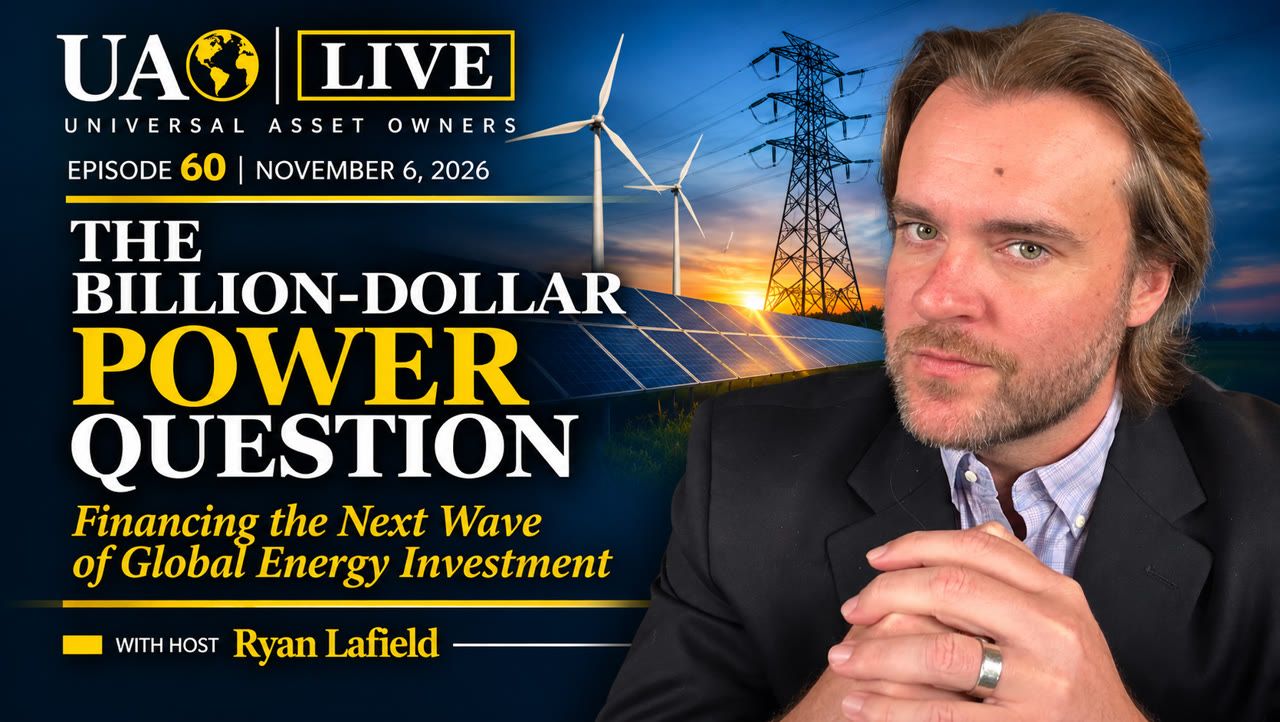
Watch the latest official UAO episode → · 14 minutes. Artwork supplied by Ryan’s production email.
THE OWNER’S TAKE
Follow the obligation to the balance sheet
Today’s stories share a practical question: where does an obligation land when an optimistic plan meets a constraint? Higher input prices can sit with a supplier, a customer or an investor. A grid delay can be carried by a developer, a lender or a contracted buyer. A reporting obligation can expose the gap between a policy commitment and the operating information needed to support it.
That makes contract detail a portfolio issue. Pass-through clauses, completion guarantees, connection milestones and disclosure controls are not merely implementation paperwork. They determine the path from a broad investment theme to distributable cash, and the party that absorbs the shortfall.
An investment committee can make the discussion concrete with three questions: what must happen before cash starts coming back; which cost can rise before that date; and who is legally responsible if the plan changes? The answers will differ by asset. A thematic label will not answer them. This is UAO editorial analysis, rather than a forecast of market returns.
SOURCES & THE DAY AHEAD
What is new, what is context, what comes next
New overnight: China’s October CPI, PPI and official commentary, published 9 November Beijing time; the CNBC-TV18 account of the FT’s Anthropic reporting; and SC Lowy’s submitted APAC credit perspective, identified above as opinion.
Prior releases used as context: the IEA’s Renewables 2026 executive summary; GPIF’s fiscal second-quarter update; and Treasury’s 4 November refunding statement. These have not been relabelled as overnight announcements.
Today, Eastern time: Bank of Canada survey at 10:30 a.m.; U.S. three-year note auction at 1:00 p.m. CalSTRS Job Control 535261 has a 9 November final filing date; consult the employer’s filing instructions.
Tomorrow: Treasury’s ten-year auction and CARB’s stated Scope 1/2 reporting deadline. Thursday: Treasury’s thirty-year auction. Source links appear beside each story so readers can inspect the underlying release and its qualifications.
Additional reporting: COP31’s opening-day update is new today. The governance consultation, ESG report, pension-exposure research and LP survey are explicitly dated context for the week ahead; current vacancies were checked against employer postings. No proposed or reported transaction is presented as a completed investment.
Source desk
- China CPI · NBS, 9 November
- China PPI and industrial input prices · NBS, 9 November
- Inflation interpretation · NBS, 9 November
- Anthropic generator agreement · CNBC-TV18, 9 November, citing the FT
- COP31 opening-day updates · UNFCCC, 9 November
- Renewables 2026 · IEA executive summary
- NZAOA progress report · UNEP FI, 5 November
- Fiscal 2026 second-quarter results · GPIF, quarter ended September
- AI pension exposure · Equable issuer release, 4 November; June holdings
- Global Alternatives Survey · Goldman Sachs, June–August 2026 fieldwork
- November refunding · U.S. Treasury, 4 November
- Market Participants Survey release notice · Bank of Canada, 9 November
- Scope 1/2 reporting deadline and guidance · CARB, current page
- Trustee fiduciary duties consultation · DWP, opened 5 November
- Pension fund trustees guidance · DWP draft, 5 November
- CalSTRS Job Control 535261 · employer posting, checked 9 November
- LACERS current openings · employer page, checked 9 November
- LACERS CIO position profile · October specification
- UAO LIVE Episode 60 · official channel; artwork supplied by Ryan
SC Lowy’s APAC credit perspective was supplied directly to the UAO newsroom on 9 November and is identified in the article as attributed opinion.
THE BACK PAGE
The plan is enormous. The socket is not.
▶ Play today’s Back Page animation — 12 seconds
An editorial illustration of the distance between planned capacity and an actual connection. The figures refer to the IEA’s almost 4,800 GW forecast of renewable additions in 2026–2031 and 3,000 GW of projects in advanced stages of grid-connection queues. Read the underlying IEA research.
Universal Asset Owners · Monday, 9 November 2026