
The pension pool is bigger. The promise is not safer.
OECD pension assets reach US$78 trillion while contribution gaps persist. Plus private credit, trustee governance, wage risk and institutional careers.
Good morning. Today’s edition separates the size of the asset pool from the durability of the retirement promise.

Watch the Latest UAO LIVE with Ryan Lafield
Join Ryan Lafield for the latest completed programme on Prudential’s investment inflows and earnings, AI infrastructure and the decisions facing long-term investors.
Watch the Latest EpisodeThe balance-sheet changes that matter
Pension scale: OECD-country pension assets rose 11.3% in 2025 to US$78 trillion, including US$7.3 trillion in public pension reserve funds; contribution adequacy remains the harder question. [1]
Private credit: Blackstone closed its fourth European senior direct-lending fund, reporting about €13 billion of investable capital across the fund and related vehicles, including anticipated leverage. [3]
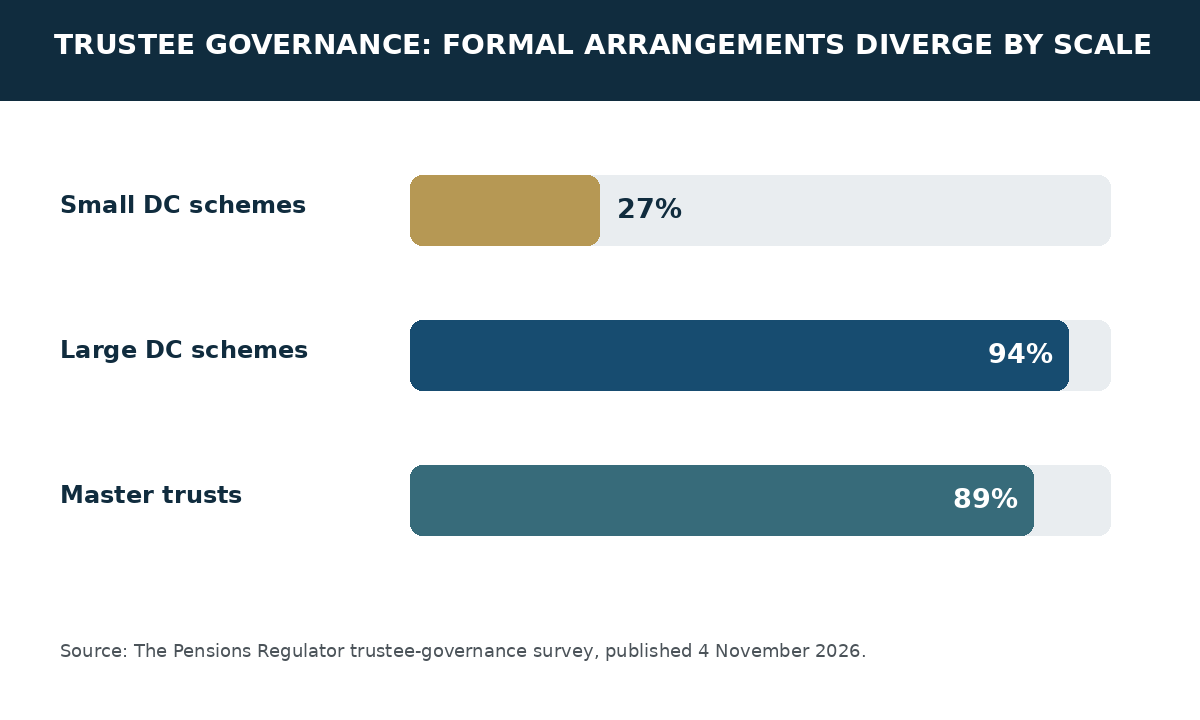
Governance: formal governance arrangements were reported by 27% of small DC schemes, against 94% of large DC schemes and 89% of master trusts. [2]
Liability signal: the ECB wage tracker puts negotiated-wage growth at 2.7% in the second half of 2026 and 2.8% in the first half of 2027. [4]
Energy plumbing: the EU opened its first biomethane matching round. A match enables contact between parties; it is not a contract or financing commitment. [5]
Completed deal: Analog Devices completed its Alif Semiconductor acquisition. The agreed economics were US$1.35 billion upfront cash plus up to US$200 million contingent consideration. [6] [7]
People: Angeles hired Shannon Morton as Senior Managing Director; TPT created a Head of Implementation role for Kayleigh Pegler-Knight. [9] [10]
The pension pool is bigger. The promise is not safer
The OECD says pension assets in member countries increased 11.3% in 2025 to US$78 trillion. That scale matters: pension assets now exceed 100% of GDP in Australia, Canada, Denmark, Iceland, the Netherlands, Sweden, Switzerland and the United States. Yet 37 of 38 OECD countries face a contribution gap against modelled retirement-income objectives. [1]
The two measures answer different questions. Asset growth describes the stock of savings and market performance; contribution adequacy asks whether workers are building enough claims on that stock. A year of strong returns can enlarge the pool while leaving future income replacement unresolved.
For a universal owner, the transmission runs across both sides of the balance sheet. Higher asset values improve near-term funding metrics, but longevity, wage paths, contribution behaviour and decumulation design determine whether the promise is durable. The countercase is that contribution-gap estimates depend on modelling assumptions and policy objectives; they are a diagnostic, not an actuarial verdict.
Scale is also a governance variable
The Pensions Regulator’s first market-wide trustee-governance survey found formal arrangements at only 27% of small defined-contribution schemes, compared with 94% of large DC schemes and 89% of master trusts. [2]
Private credit closes with leverage inside the headline
Blackstone announced the final close of Blackstone European Senior Direct Lending Fund IV. Across the fund and other European direct-lending vehicles, including anticipated leverage, the manager reports approximately €13 billion of investable capital. [3]
The denominator is the story. The €13 billion is not disclosed as unlevered equity commitments to the flagship fund alone. It aggregates related vehicles and financing capacity. For insurers and pensions, the exposure therefore travels through LP capital, separately managed accounts and the facilities that convert commitments into lending capacity.
Deployment quality remains unproven by the close. The manager cites four lead-lender transactions ranging from €382 million to €1.0 billion, but portfolio pricing, covenant quality, realised losses and leverage costs will determine outcomes.
Semiconductor consolidation crosses from agreement to ownership
Analog Devices completed its acquisition of Alif Semiconductor on 3 November. The September agreement set US$1.35 billion of upfront cash consideration plus up to US$200 million of contingent cash consideration. The contingent amount is not cash paid at closing. [6] [7]
Completion moves the risk from transaction probability to integration: product road maps, engineer retention and execution across industrial automation, data-centre infrastructure, defence, energy and robotics. The strategic case may broaden ADI’s edge-AI platform; the countercase is that the completion release gives no revised synergy or accretion guidance.
A formal process is not the same as a member outcome
TPR’s survey covered 373 trustees and found mandatory training reported by 90% of DB schemes and 77% of DC schemes. Seven in ten had benchmarked governance against the general code, but fewer than half of non-micro DB and DC schemes reported a succession plan. Only 29% said improving member outcomes was the primary driver of trustee decisions. [2]
The finding strengthens the case for skills matrices, succession planning and independent review before complexity is outsourced. It does not prove that consolidation or professional trustees automatically improve outcomes. The survey is self-reported, and formal arrangements can exist without better investment or member results.
Wages are easing, but the path is not straight
The ECB wage tracker puts headline negotiated-wage growth at 2.7% in the second half of 2026 and 2.8% in the first half of 2027, easing to 2.4% in the third quarter. Excluding one-offs, the first three quarters of 2027 average 2.8%, against 2.6% in 2026. [4]
For liability-aware portfolios, the tracker is an input into inflation persistence, real rates and discounting—not an ECB forecast. Coverage falls to 31.8% of employees in the first half of 2027 and 23.3% in the third quarter, so the forward values remain revision-prone.
A matching mechanism can improve discovery without financing a project
The European Commission opened the first biomethane matching round on 4 November. Buyers may submit demand through 23 December; suppliers respond from 21 January to 4 March; matching results are scheduled for 18 March 2027. [5]
The mechanism may improve visibility for offtake and cross-border pipelines. Its new regulatory dashboard initially covers countries representing more than 90% of current EU biomethane production. But a match merely enables parties to contact each other: it is not a purchase agreement, capital commitment, financed plant or delivered supply.
Climate-finance results need a stock-and-flow reading
The UK’s 2026 International Climate Finance results attribute 201 million tonnes of emissions reduced or avoided, 5,940 MW of clean-energy capacity, 578,000 hectares of ecosystem loss avoided and £12.6 billion of public plus £13.4 billion of private finance mobilised to programmes from April 2011 through March 2026. [8]
These are cumulative estimates across 15 years, not £26 billion newly committed on 4 November. Attribution, additionality and the absence of a single current-year denominator limit comparison with institutional portfolios. The dataset is nevertheless useful for blended-finance committees testing mobilisation ratios and outcome measurement.
Operating capacity grows around the investment office
Angeles Investment Advisors appointed Shannon Morton Senior Managing Director in Houston. She previously led Northern Trust’s West Region Foundation and Institutional Advisors investment team and will advise foundations, endowments and nonprofits on strategy, allocation and risk. [9]
TPT Retirement Solutions appointed Kayleigh Pegler-Knight Head of Implementation, a newly created role overseeing onboarding and transitions across operations, technology, administration, client and commercial teams. She reports to chief operating officer Paddy Lye. [10]
Both moves are operating signals rather than asset transfers. The first expands institutional advisory capacity; the second builds the implementation machinery required when pension consolidation moves from strategy into onboarding.
Blake Hutcheson, OMERS
Our executive profile brings those investment and operating responsibilities together: Blake Hutcheson, President and Chief Executive Officer of OMERS.
His appointment as CEO took effect on 1 June 2020. He had previously served as President and Chief Pension Officer, following his leadership of Oxford Properties from 2010 to June 2018. Earlier roles included heading global real estate at Mount Kellett and regional leadership at CB Richard Ellis.
That career sequence matters because the job now extends well beyond real estate. The CEO appointment placed responsibility for the overall enterprise in the hands of someone who had moved from a major investment business into the pension organisation itself.
OMERS’ current biography describes the breadth of his earlier pension-office remit. It covered pension services, asset-liability management, strategy, communications and public affairs, legal, technology and operations. His Oxford responsibilities had also expanded into real estate and strategic investments.
Those are distinct responsibilities with a common beneficiary. Members depend on investment performance, but also on accurate administration, dependable systems and decisions that connect assets to pension obligations. Our interpretation is that this combination makes operating oversight central to the leadership role.
A 2 July 2026 announcement provides a more recent view of how Hutcheson exercises that responsibility. OMERS changed investment leadership and reporting relationships, with Michael Hill, Scott McIntosh, Kenton Bradbury, Kal Patel and Eric Plesman reporting directly to him.
The institution described the purpose as simpler decision-making and reporting lines. Hill took responsibility for infrastructure and private equity. McIntosh’s remit combined equities and multi-asset strategies. Bradbury, Patel and Plesman continued to lead total portfolio management, global credit and Oxford Properties respectively.
These were changes to responsibilities, effective immediately at the time of the July announcement. They were not evidence of a particular investment return or a new allocation announced today.
The question for an outside observer is what simpler reporting should accomplish. Does information move more clearly between investment businesses? Can the enterprise identify exposures that appear in several portfolios? Is responsibility clear when a decision spans teams?
An organisation chart cannot answer those questions on its own. It gives us a structure against which later decisions can be assessed. For a pension investor, that is more useful than treating a leadership biography as a list of prestigious titles.
Hutcheson’s documented path connects a property investment platform, pension operations and enterprise leadership. It illustrates why an institutional chief executive must connect specialist expertise to the whole pension promise. That is our analytical reading of the record, not a claim that the reporting changes have already delivered better returns.
The test remains the one we opened with: how do the assets, the operating machinery and the obligations work together for members over time?
Sources: Official OMERS biography; June 2020 appointment; July 2026 leadership changes.
Open seats in direct investing and investment analytics
CalSTRS — Associate Portfolio Manager, Direct Investments, JC-535261. The private-equity role covers primary and secondary co-investment underwriting, sourcing and monitoring. Applications close 9 November. [13]
Hillsdale Investment Management — Senior Analyst, Investment Analytics & AI Automation. The Toronto role links investment, engineering and client-deliverables teams. Applications close 30 November. [14]
Vacancies are employer opportunities, not editorial endorsements.
The large pool can hide small pipes
Contribution risk. Confirmation: contribution rates and coverage remain below modelled objectives despite strong asset returns. Disconfirmation: policy, wages and participation close the gap.
Private-credit denominator risk. Confirmation: anticipated leverage expands faster than realised deployment quality. Disconfirmation: stable loss rates and transparent financing costs.
Governance-capacity risk. Confirmation: small schemes lack succession, risk and member-outcome processes as complexity rises. Disconfirmation: measurable improvement against TPR’s baseline.
Wage persistence. Confirmation: negotiated wages stay above inflation-consistent paths as tracker coverage improves. Disconfirmation: broader agreements revise the path lower.
What changes the thesis
Pensions: contribution policy, participation and decumulation reform will show whether the asset stock translates into durable retirement income. [1]
Private credit: unlevered commitments, facility pricing, deployment pace and credit losses will determine the economics behind the €13 billion headline. [3]
Biomethane: March matching results will still require bankable contracts, permits and project finance. [5]
Bank of England: the Monetary Policy Committee voted 8–1 to raise Bank Rate by 0.25 percentage points to 4%, according to its 5 November decision. One member preferred a 0.5-point increase to 4.25%. The next test for portfolios is how tighter monetary policy feeds into borrowing costs, inflation and growth. Monetary Policy Summary and Minutes — 5 November 2026
Three questions for the next discussion
Before the Take, here are three questions to carry into a committee discussion.
First: when we say the pension position improved, which measure improved? Ask the team to separate market returns, contributions, participation and changes in the assumptions behind the retirement objective. That makes it easier to see whether improvement came from a repeatable policy or a favourable market period. Neither should be hidden inside the other.
Second: where does our portfolio depend on financing that is counted inside a capacity headline? Ask for a bridge from investor capital to investable capital, identifying borrowing and its terms. Then ask how that bridge behaves if financing becomes more expensive or harder to renew. The answer should describe a mechanism, rather than offer a general assurance about resilience.
Third: who owns the next step? In an acquisition, it may be the integration team. In a pension transition, it may be the people joining operations and administration. In an energy project, it may be the counterparties negotiating a bankable agreement. A committee can request a named responsibility and the evidence it expects at the next review.
These are discussion prompts, not findings about any one organisation. Their value is that they make the investment thesis testable. If the next report repeats the same headline without supplying the missing evidence, the committee knows what remains unresolved. If the evidence improves, it can update its view for an identifiable reason.
Asset growth can postpone the hardest question
Pension systems can celebrate a larger pool and still fail the adequacy test. That is not a contradiction. It is the difference between a market value and a retirement promise.
Universal owners should resist single-number comfort. AUM, funding ratio, contribution rate, wage path, governance capacity and decumulation design sit on the same balance sheet. The pool matters. So does the pipe that fills it—and the rulebook that decides who receives the flow.
Original reporting and documents
[1] OECD — OECD Pensions Outlook 2026: Are We Saving Enough for Retirement?
4 November 2026, 14:00 CET
[2] The Pensions Regulator — Regulator finds significant governance gaps between small and large pension schemes
4 November 2026
[3] Blackstone — Blackstone closes fourth institutional European direct-lending fund
4 November 2026
[4] European Central Bank — ECB wage tracker suggests slightly higher wage growth in the first three quarters of 2027
4 November 2026
[5] European Commission — Biomethane Mechanism: first matching round to connect buyers and suppliers
4 November 2026
[6] Analog Devices — Analog Devices completes acquisition of Alif Semiconductor
3 November 2026, 16:05 EST
[7] Analog Devices — Agreement to acquire Alif Semiconductor
9 September 2026
[8] UK Government — UK International Climate Finance results 2026
4 November 2026, 09:30 GMT
[9] Angeles Investment Advisors — Shannon Morton appointed Senior Managing Director
3 November 2026
[10] TPT Retirement Solutions — Kayleigh Pegler-Knight appointed Head of Implementation
3 November 2026
[13] CalCareers / CalSTRS — Associate Portfolio Manager, Direct Investments, Job Control 535261
access checked 4 November 2026
[14] Hillsdale Investment Management — Senior Analyst, Investment Analytics & AI Automation
access checked 4 November 2026
[15] Universal Asset Owners — $7.4 Billion In, But Earnings Down? Prudential's Big Question | UAO LIVE Ep. 58
published 4 November 2026; checked 4 November 2026
Bank of England — Monetary Policy Summary and Minutes
5 November 2026
The pool is rising. The pipe is still narrow.

At the committee table, asset growth is welcome. Adequacy still needs a contribution.