
The capital stack is doing the heavy lifting
TPG closes a US$10.4 billion climate pool, Intel pairs AI growth with a US$23 billion equity raise, and regulators focus on the balance sheets that keep markets operating.
Good morning. Today’s issue follows the same question across climate, semiconductors, private credit, space and labour: who funds the asset before it earns?

Watch the Latest UAO LIVE with Ryan Lafield
Join Ryan Lafield for a clear view of markets, geopolitics and capital flows—and what they mean for the institutions investing across generations.
Watch the Latest EpisodeThe state changes that matter
Climate capital: TPG said its second Rise Climate fund, Global South Initiative and related vehicles reached an aggregate US$10.4 billion final close—commitments, not deployment. [1] [2]
AI capacity: Intel reported US$7.3 billion of Data Center and AI revenue, up 78%, alongside a completed US$23 billion public-equity offering. Shares fell about 29% on Friday. [13] [3]
Labour costs: US civilian-worker compensation rose 3.4% over twelve months, while private-industry real wages fell 0.6%. [4]
Europe: Preliminary third-quarter GDP grew 0.4% in the euro area and 0.5% in the EU. [5]
Private credit: ACORE closed its second opportunistic credit fund with US$1.1 billion of commitments and said US$400 million had been committed across 14 deals. [6]
Market infrastructure: ASIC proposed clearer capital, liquidity and stress-testing expectations for market licensees. [8]
The capital stack is doing the heavy lifting
The most revealing number in the private-capital tape is not a return. It is the size of the stack assembled before assets fully earn. TPG held a final close for its second Rise Climate fund and Global South Initiative, with aggregate commitments of US$10.4 billion across the two funds and related vehicles. The pool is 44% larger than the inaugural strategy, and TPG said 31% of commitments came from investors new to the firm. [2]
Those figures establish fundraising, not deployment or realised performance. TPG invested more than US$11 billion across its platform in the quarter and ended September with US$86 billion of dry powder. Climate capital is therefore abundant at the commitment stage; the harder task is converting it into operating power, industrial and infrastructure assets at returns that survive construction risk, policy change and higher financing costs. [1] [2]
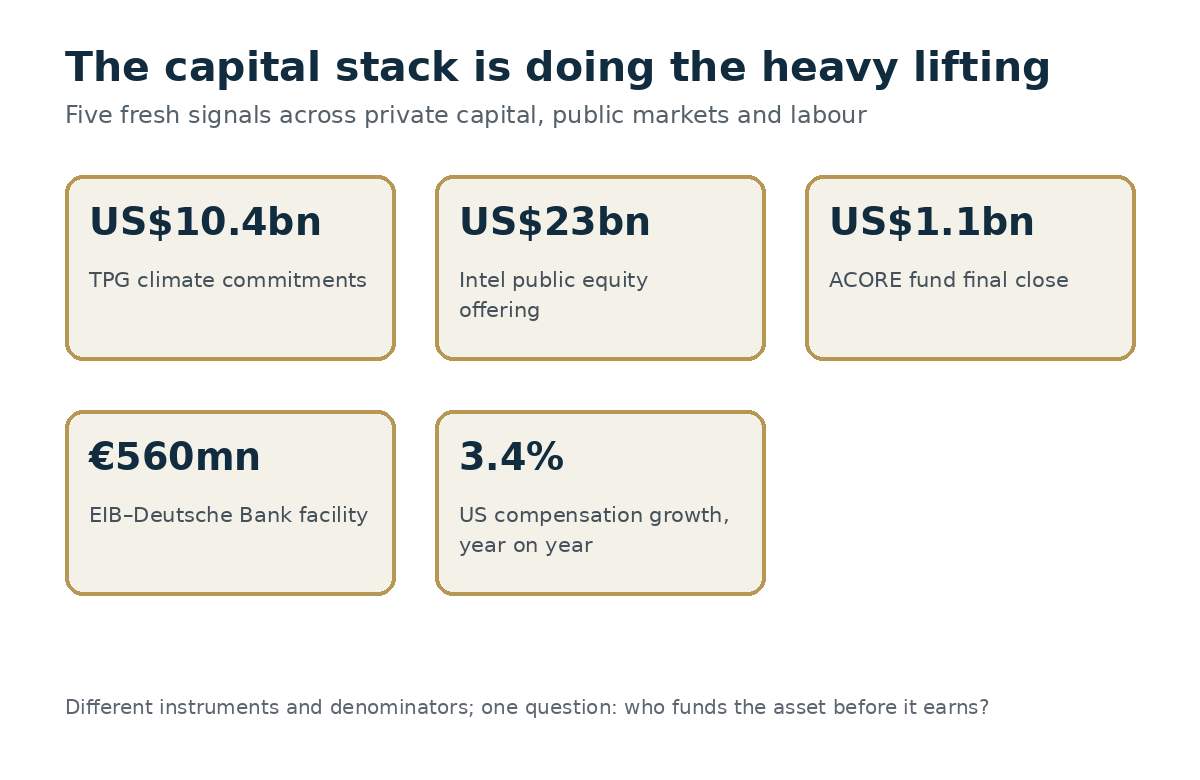
Intel supplies the public-market version of the same story. Data Center and AI revenue rose 78% to US$7.3 billion and operating cash flow was US$5.1 billion. The company also completed a US$23 billion public-equity offering, saying the proceeds support growth while preserving an investment-grade rating. AI demand is growing, but the softer fourth-quarter revenue outlook and Friday’s share-price fall expose the cost of carrying that capacity. [3]
The countercase is constructive. Large equity and fund commitments can reduce near-term financing fragility and bring forward productive capacity. The falsifier is cash conversion: if utilisation, margins and distributions do not arrive, investors discover that the financing stack was not merely support—it was the investment thesis.
Intel broadens the financing map
Intel’s third-quarter revenue rose 21% to US$16.5 billion. Data Center and AI revenue reached US$7.3 billion, while Intel Foundry reported US$6.7 billion before intersegment eliminations. The company generated US$5.1 billion of operating cash flow and guided to fourth-quarter revenue of US$15 billion to US$16 billion. [3]
The US$23 billion equity offering changes the allocator question. Capacity expansion is not being financed solely from current operating cash flow: existing owners accept dilution so the company can maintain investment-grade capacity and fund capital expenditure and working capital. The upside is a broader AI supply chain beyond accelerators. The countercase is that fourth-quarter guidance is below third-quarter revenue and client-computing revenue fell 5%.
Friday’s market verdict was much harsher. Intel shares fell about 29% on 30 October, Reuters reported, as a technology selloff tested confidence in the AI spending cycle. The Nasdaq Composite had its biggest daily decline since June. For long-horizon owners, the distinction is between strong demand for capacity and the price paid to finance it. [13]
Fundraising strength meets underwriting discipline
TPG raised more than US$15 billion in the quarter and nearly US$42 billion in the first nine months. Alongside the climate pool, it completed fundraising for its inaugural TĒCA Asia growth strategy at US$1.3 billion, brought Tech Adjacencies III to US$2.5 billion, and held a roughly US$5 billion first close for its fifth opportunistic real-estate strategy and related vehicles. The stages differ: final close, total commitments and first close should not be blended into one deployment number. [2]
ACORE separately announced a US$1.1 billion final close for Opportunistic Credit II, above its US$1 billion target and more than four times the size of its predecessor. It said US$400 million had been committed across 14 commercial-real-estate credit transactions. The opportunity is a reset in asset values and refinancing needs; the countercase is that equity-like return targets in a senior position still depend on collateral marks, borrower execution and exit liquidity. [6]
A public–private bridge from the factory floor to orbit
The European Investment Bank and Deutsche Bank agreed a partnership intended to support €560 million of investment in satellites, launch technology and space services. Around half is expected in Germany and the remainder elsewhere in the EU. The arrangement supplies Deutsche Bank with long-term funding and flexible structures; it is a financing channel, not evidence that €560 million has already been disbursed. [7]
For universal owners, space is no longer a niche technology allocation. Communications, navigation, wildfire detection and security create exposure across infrastructure, insurers, agriculture and sovereign resilience. The countercase is the sector’s long development cycles and uncertain commercial returns. Space TechEU’s wider €1.4 billion ambition becomes investable only when viable borrowers and projects pass underwriting.
Compensation cools; real private wages still contract
US civilian compensation increased 0.8% in the third quarter and 3.4% over twelve months. Wages rose 3.1% year on year; benefits rose 3.9%. After inflation, private-industry wages and salaries fell 0.6%. [4]
The mix matters more than the headline. Sticky benefit costs can keep pressure on labour-intensive margins even as nominal wage growth eases, while falling real wages weaken household resilience. The countercase is that 0.8% quarterly growth is consistent with a gradual cooling. Productivity and the October employment report will show whether compensation is becoming easier to absorb or merely shifting between employers and households.
Eurostat’s preliminary flash estimate showed third-quarter GDP rising 0.4% in the euro area and 0.5% in the EU, after 0.6% and 0.7% in the second quarter. Growth remains positive but slower, and the estimate is incomplete and revisable. [5]
Market resilience moves from a capital number to a stress test
ASIC proposed retaining the baseline that market licensees hold resources equal to at least six months of operating expenses, while clarifying how expenses are calculated and whether resources remain sufficient in recovery or orderly wind-down. For significant venues, the proposal adds scenario analysis and stress testing and separates capital from liquidity. Comments close 4 December. [8]
This is consultation, not a final rule. The fiduciary transmission is nevertheless direct: venue continuity, collateral access and settlement resilience affect every asset class. More robust buffers can reduce disruption risk but may raise costs for operators and users. The next evidence is the final guidance, transition arrangements and ASX’s separate 2029 capital milestone.
A legal duty enters the operating model
UK employment measures took effect on 30 October requiring employers to take “all reasonable steps” to prevent sexual harassment and not to permit harassment by third parties such as customers and clients. Separate trade-union access, recognition and representative protections also took effect. [9]
For asset owners, this is not solely an HR matter. Policies, reporting channels, training, customer conduct and board oversight now sit more clearly inside operational, litigation and reputation risk. Companies already at strong practice may face limited incremental cost; weak controls become more visible in due diligence and stewardship.
The transition pool gets larger; delivery remains local
TPG’s US$10.4 billion aggregate climate close is a material demand signal for power, industrial decarbonisation and supply-chain investment. It is also an invitation to examine what fund size does not reveal: asset-level leverage, construction and interconnection risk, geographic concentration, fees and the pace of capital calls. [2]
The useful stewardship question is not whether climate capital exists. It is whether projects can be permitted, connected and operated while preserving community consent and credible return assumptions. Commitments become climate outcomes only through physical delivery.
The denominator is the institution’s whole balance sheet
A climate fund, a semiconductor equity issue and a public-backed space facility look unrelated in sleeve reports. Across a universal-owner balance sheet, they draw on the same long-duration capital, power buildout, supply chains and discount rates.
That makes cross-portfolio aggregation essential. An institution can own the equity issuer, lend to the project, commit to the private fund and hedge the same rates without recognising that one demand forecast supports every exposure. Diversification by label is not diversification by driver.
Where the next loss—or release of value—could travel
Commitment-to-deployment gap — probability medium; impact high. Confirmation is slower capital calls, delayed construction or lower fee-paying activation. Disconfirmation is disciplined deployment with visible contracted cash flow.
AI capacity outruns utilisation — probability medium; impact high. Confirmation is more equity or debt issuance while revenue guidance softens. Disconfirmation is higher utilisation and improving free cash flow.
Real-estate credit resets collateral late — probability medium; impact high. Confirmation is rising extensions, restructurings and secondary discounts. Disconfirmation is repayment and asset sales near underwritten values.
Market-infrastructure concentration — probability low-medium; impact very high. Confirmation is failed stress tests or unavailable group liquidity. Disconfirmation is credible recovery planning and tested capital access.
Four observations to test, not forecasts
Climate fundraising is consolidating around scale. Test: whether new investors remain through capital calls and first distributions.
Equity is re-entering the AI financing mix. Test: whether other infrastructure suppliers follow Intel’s route to protect ratings.
Labour disinflation may be arriving through real household pressure. Test: private real wages and consumer delinquencies.
Regulators are treating continuity as a balance-sheet property. Test: final ASIC guidance and comparable requirements in other venues.
Evidence for the committee diary
2 November: Bank of Japan full Outlook Report.
3 November: US JOLTS and the US federal general election.
5 November: Bank of England policy decision; US productivity and unit labour costs.
6 November: US October employment report.
Three documents for the weekend pack
TPG’s earnings transcript: unusually detailed stage-by-stage disclosure across final closes, first closes, commitments and deployment. [2]
ASIC CS 69: a practical framework for distinguishing operating-expense buffers, capital, liquidity, recovery and orderly wind-down. [8]
BLS Employment Cost Index: the compensation mix behind the wage headline, including benefit costs and real private-industry wages. [4]
Capital is abundant; self-funding is not
The week ends with a paradox. Investors can assemble US$10.4 billion for a climate strategy, Intel can raise US$23 billion of equity and a public bank can open a €560 million financing channel. Capital scarcity is not the first-order problem.
The problem is conversion. Commitments must become assets, capacity must become revenue and institutional safeguards must work under stress. The whole-portfolio question is therefore simple: where are we underwriting the same conversion twice?
Original reporting and documents
[1] TPG — Third-quarter 2026 results
29 October 2026
[2] TPG — Third-quarter 2026 earnings transcript
29 October 2026
[3] Intel — Third-quarter 2026 financial results
29 October 2026
[4] US Bureau of Labor Statistics — Employment Cost Index — September 2026
30 October 2026
[5] Eurostat — Preliminary flash estimate for third-quarter GDP
30 October 2026
[6] ACORE Capital — Second opportunistic credit fund final close
29 October 2026
[7] European Investment Bank — EIB and Deutsche Bank launch €560 million partnership for European space businesses
29 October 2026
[8] Australian Securities and Investments Commission — CS 69 — proposed update to financial-resource requirements for market licensees
30 October 2026
[9] UK Government — New action to tackle harassment at work
30 October 2026
[12] Universal Asset Owners — U.S. Economy Booming? Why Americans Aren’t Feeling It | UAO Live Ep. 55
30 October 2026
[13] Reuters — October ends with a thud for Intel, Reddit, AI stalwarts
30 October 2026
A small cup for a very large stack
The committee asked how much cash flow supported the new infrastructure. Someone brought a measuring cup. The capital stack had already taken the conference table.