
Growth is becoming balance-sheet intensive
US output accelerates, Microsoft doubles infrastructure additions, the ECB holds amid an energy shock, and pension capital moves into towers—evidence that the next growth cycle is increasingly physical, financed and duration-sensitive.
Good morning. Today’s issue follows the same question across public markets, pensions, private capital, insurance and infrastructure: who carries the asset before it earns?

Watch the Latest UAO LIVE with Ryan Lafield
Join Ryan for a clear view of the forces shaping long-horizon portfolios—from the power grid behind AI to global capital flows, policy decisions and institutional investment.
Watch the Latest EpisodeThe state changes that matter
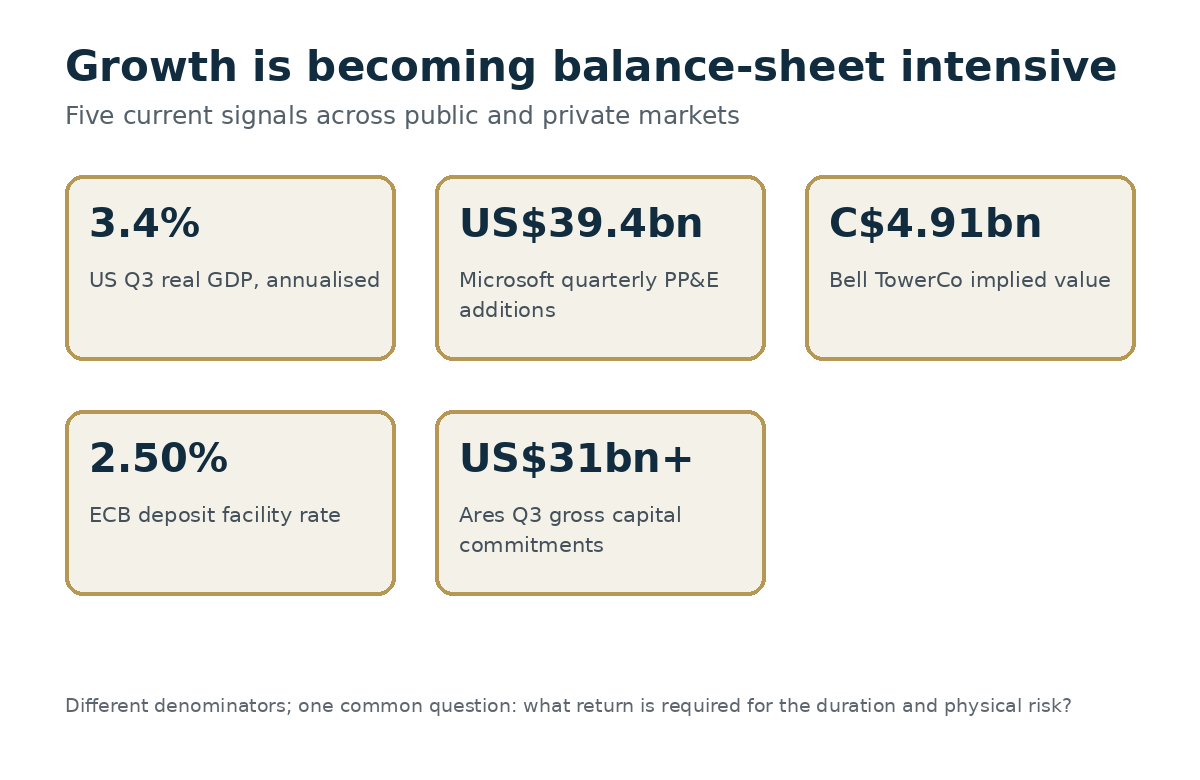
Rates: The ECB held its deposit rate at 2.50% but said the energy shock had raised upside inflation and downside growth risks while financing conditions tightened. [1]
US growth: Real GDP grew at a 3.4% annualised rate in the third quarter, while September real disposable income fell 0.3% and real consumer spending was virtually flat. [2] [3]
AI infrastructure: Microsoft reported US$39.4 billion of quarterly property-and-equipment additions, Azure growth of 48% and US$677 billion of commercial remaining performance obligations. [4]
Pension infrastructure: La Caisse agreed to buy 49.9% of a new Bell wireless TowerCo for C$2.45 billion, valuing the enterprise at C$4.91 billion. [5]
Private markets: Ares reported more than US$31 billion of gross capital commitments and US$35 billion invested in the quarter. [6]
Governance: UK regulators combined their water-industry performance evidence for the first time; ASIC put unlisted valuations and private credit into its next surveillance cycle. [9] [13]
Growth is becoming balance-sheet intensive
The strongest growth signals now come with a financing appendix. US real GDP accelerated to a 3.4% annualised pace in the third quarter, helped by inventories, information-processing equipment and government spending. Real final sales to private domestic purchasers rose 4.9%. Yet September real disposable income fell 0.3%, real consumer spending was virtually flat and the saving rate was 3.8%. [2] [3]
That split matters for universal owners. AI equipment can lift output while household buffers thin; infrastructure orders can strengthen while discount rates remain high. The same economy can support technology suppliers, raise the term premium and weaken consumer-credit resilience.
Europe adds the price of energy to the equation. The ECB held rates but explicitly paired upside inflation risk with downside growth risk and tighter financing conditions. Its balance sheets continue to shrink as APP and PEPP portfolios run off. A hold is therefore not neutral: the marginal borrower can face tighter money while the policy rate stays unchanged. [1]
The countercase is that investment-led growth builds productive capacity. New computing, power and transmission assets can raise future output enough to carry today’s financing. The test is cash conversion: utilisation, pricing, operating margins and household income must eventually validate the duration assumed by lenders and owners.
Microsoft doubles down without crossing into negative cash generation
Microsoft reported revenue of US$92.3 billion, up 19%, with Microsoft Cloud at US$63.9 billion and Azure up 48%. Commercial remaining performance obligations reached US$677 billion, up 73%. Property-and-equipment additions were US$39.4 billion, more than double the prior-year quarter, while operating cash flow was US$58.0 billion. [4]
The balance-sheet signal is more useful than the growth headline. A large backlog supports infrastructure underwriting, but long-dated obligations do not convert instantly into revenue. Depreciation, power constraints and customer concentration determine whether today’s physical build earns more than its cost of capital. The countercase is the scale of contracted demand: if backlog converts on schedule, the asset base can become a durable cash engine rather than a margin drag.
Amazon’s AI investment turns cash flow negative
Amazon’s 29 October results put the financing test in sharper relief. Trailing twelve-month operating cash flow reached US$168.3 billion, but free cash flow was an outflow of US$42.4 billion. The company attributed the change primarily to a US$94.8 billion year-on-year increase in net property-and-equipment purchases, largely reflecting AI investment. AWS quarterly sales grew 39% to US$46.0 billion. Amazon, 29 October 2026
Strong cloud demand and a cash deficit can coexist. For owners exposed through equity, credit and power infrastructure, the question is how quickly the new asset base converts demand into cash.
Japan holds rates and accelerates ETF sales
On 30 October, the Bank of Japan voted 8–1 to keep the overnight call-rate guideline around 1.25%. It also unanimously decided to raise annual ETF sales from about ¥330 billion to ¥860 billion on a book-value basis, beginning in January 2027. The J-REIT sales pace remains about ¥5 billion a year. Bank of Japan, 30 October 2026
The distinction matters for asset owners: an unchanged policy rate does not mean an unchanged central-bank footprint in equity markets. The faster disposal schedule adds a separate portfolio-flow consideration to yen and duration exposure.
La Caisse agrees a minority tower investment while Bell keeps control
On 27 October, BCE signed a definitive agreement to place more than 5,000 wireless sites into a new TowerCo and sell 49.9% to La Caisse for C$2.45 billion, subject to adjustments. The transaction values the new company at C$4.91 billion; Bell retains 50.1% and operational control. TowerCo is expected to have no financial debt at closing, targeted for the first quarter of 2027 subject to approvals. [5]
For a pension investor, the attraction is long-lived contracted infrastructure tied to mobile demand. For Bell, it is capital recycling without surrendering control. The risk sits in lease terms, maintenance capex, tenant concentration and the price of future network upgrades. The absence of debt at closing is not a promise that leverage will never enter the structure.
Private-market capital formation stays strong; underwriting must catch up
Ares reported more than US$31 billion of gross capital commitments and US$35 billion invested during the third quarter, with assets under management of about US$691 billion at 30 September. The figures span private credit and real assets rather than a single fund close. [6]
Gross commitments show demand for the platform; they do not establish the return earned by investors or the pace at which fee-paying capital becomes deployed. The portfolio question is whether abundant dry powder narrows spreads faster than it improves borrower resilience.
EIG and Acwa separately signed definitive agreements to establish Plenum Power, a platform the parties intend to launch with approximately US$4 billion of initial equity commitments for US power and storage. No asset has been acquired on announcement. The opportunity is capacity for data centres and electrification; the countercase is that permitting, interconnection and offtake can slow capital long after it is committed. [7]
Markel pays to move reserve-tail risk
Markel signed an adverse-development cover with Enstar’s Cavello Bay covering US$4.8 billion of subject reserves. Markel retains the first US$2.6 billion; Cavello Bay takes the next US$2.3 billion with US$1.2 billion of cover above booked reserves. Markel will pay a US$120 million risk premium. Closing is expected by year-end subject to approval. [8]
This is not an asset sale. It is a transfer of claims-tail and capital risk from a specialty insurer to a run-off consolidator. The structure can reduce volatility and free management attention, but Markel still owns the first-loss layer and claims control. A benign reserve outcome would make the premium look expensive; adverse emergence would test Enstar’s collateral and underwriting.
Water performance becomes comparable—and executive accountability becomes investable
Four UK regulators combined their water-industry performance evidence for the first time. The report records 2,991 pollution incidents in 2025, including 84 serious incidents, and 142 late environmental actions out of 2,254 required. Drinking-water compliance was 99.97%, while the 2025–30 investment plan exceeds £104 billion. [9]
The government said one-star environmental ratings or Category 1 incidents trigger existing bonus bans for six chief executives and promised further options. A proposed single regulator remains future policy. [10]
For equity and debt holders, the common report makes operational performance easier to compare across companies. It does not itself alter licences or cash flows. The next evidence is company-specific remediation, enforcement, the detail of bonus restrictions and delivery against the capital programme.
Climate finance grows; private mobilisation falls
The EU and its member states reported €32.3 billion of public international climate finance for 2025, up from €31.7 billion in 2024. Forty-eight per cent went to adaptation or cross-cutting action and 41% was grants. Reported private finance mobilised through guarantees, loans, direct investment and credit lines was €9.3 billion, down from €11 billion for 2024. [12]
The denominators matter: bilateral figures are commitments, multilateral figures include disbursements, and the private number excludes the public capital used to mobilise it. The result is a useful burden-sharing benchmark, not proof that every project has been built or every euro has reached a beneficiary.
Southeast Asia needs concessional capital—but not as a substitute for reform
The IEA and Convergence estimate that about US$3.7 billion of international public finance could help rooftop solar, decentralised systems, offshore wind and battery storage in Indonesia, the Philippines and Viet Nam move toward 2035 development and emissions goals. The report says US$17.9 billion of blended concessional and commercial finance has been mobilised for Southeast Asian renewables since 2016. [11]
The authors explicitly warn that blended finance cannot repair structural barriers on its own. Offshore wind may need project-preparation support before investment-stage blending; revenue frameworks, grids, ports and currency risk still determine bankability. The number is a modelled pathway across three countries and four technologies, not a capital commitment.
ASIC puts marks, borrowers and audit committees on notice
ASIC reviewed 353 financial reports and 25 audit files in its latest oversight cycle. It says ten companies agreed to improve operating-and-financial-review risk disclosure and five agreed to recognition or valuation changes. Since July 2025, ASIC reports action against 16 auditors, three directors and 57 companies, including more than A$9 million of infringement notices. [13]
For 2026–27 it plans to examine at least 200 company reports, 20 registrable superannuation entities and 20 managed schemes, including private credit and unlisted valuations. The surveillance samples are not random and comment forms are not findings of misconduct. Even so, the agenda makes NAV quality, borrower stress and audit-committee challenge current governance variables for institutional portfolios.
Central Asia’s investability gap sits beyond geology
The OECD’s new regional assessment links Central Asian critical-mineral potential to reserve-reporting harmonisation, clear investor rules, grievance mechanisms, labour rights, mine-specific water and tailings targets and stronger anti-avoidance capacity. It recommends completing transitions toward CRIRSCO-aligned reporting and improving community dialogue. [14]
This is a policy map, not proof of new reserves or reforms. For universal owners, the transmission runs through strategic supply, sovereign and joint-venture risk, social licence, tailings liability and tax leakage. The next milestones are national lists, licensing changes, reserve-code adoption and enforceable community agreements.
Lagarde sets a February departure date
The European Central Bank announced on 29 October that President Christine Lagarde will step down on 7 February 2027. The European Council will appoint her successor under the treaty nomination process; the announcement names no replacement. ECB, 29 October 2026
The transition adds a leadership decision to Europe’s energy-inflation challenge. For long-horizon investors, the next signals are the nomination and confirmation process and the successor’s policy communication. The announcement itself changes neither the ECB’s mandate nor its current interest rates.
Open seats across liquidity, risk and external managers
GIC — VP, Quantitative Research Analyst, Multi-Asset Liquidity and Execution Performance, Singapore. The live employer page covers cross-asset liquidity modelling and execution research across equities, futures, foreign exchange, rates and credit. [17]
GIC — VP/SVP, Risk Manager, Business Solutions and Risk, Singapore. A newly created embedded-risk function covers trading, treasury, securities financing, beta management and portfolio solutions, including liquidity, leverage and investment risk. [18]
Neither posting states a closing date. Both application routes were live at the 29 October check.
Where the next loss—or release of value—could travel
AI utilisation mismatch — probability medium; impact high. Confirmation is continued capex growth without backlog conversion, weaker cloud margins or rising external finance. Disconfirmation is higher utilisation and improving free cash flow.
Energy inflation broadens — probability medium-high; impact high. Confirmation is higher services inflation, wage expectations and another round of tightening. Disconfirmation is falling refining margins and stable long-term expectations.
Private-market marks lag cash reality — probability medium; impact high. Confirmation is surveillance-driven write-downs, widening secondary discounts or rising non-accruals. Disconfirmation is realised exits near stated NAV and strong repayments.
Household resilience breaks beneath strong GDP — probability medium; impact medium-high. Confirmation is further real-income declines, rising delinquencies and weak real spending. Disconfirmation is a compensation and consumption rebound.
Balance-sheet intensive growth—planning paths, not forecasts
Base — 55%. AI investment and infrastructure activity keep growth positive, while tight financing produces wider dispersion between strong and weak borrowers. Confirmation is stable credit spreads with uneven default outcomes.
Upside — 20%. Utilisation and productivity rise quickly enough to absorb depreciation and power costs. Household income recovers, and grid investment lowers delivery bottlenecks.
Downside — 20%. Energy inflation forces more tightening as household demand weakens. Capex remains high but cash conversion slips; private-market marks adjust late.
Tail — 5%. Sovereign issuance, AI financing and utility capital needs compete simultaneously for long-duration balance sheets, raising term premia and collateral demands across mandates.
Questions that cross mandate silos
1. Where does the same AI utilisation forecast appear in public equity, corporate credit, infrastructure, real estate and utility exposures?
2. Which private-market NAVs can be validated by an arm’s-length cash transaction rather than a model or sponsor-led vehicle?
3. How much energy inflation can our liability and discount-rate assumptions absorb before the portfolio changes direction?
Dates and evidence
30 October: COP17 final decisions; follow the Bank of Japan’s announced policy and ETF-sale changes.
3 November: Reserve Bank of Australia policy meeting following 4.3% annual CPI.
9 November: CalSTRS Director of Inflation Sensitive applications close. [15]
25 November: BEA second GDP estimate and October income and spending data.
Three documents for the committee pack
IEA and Convergence: a disciplined map of where concessional capital can help—and where it cannot replace policy and infrastructure. [11]
ASIC Report 842: a practical warning that private-credit and unlisted valuations now sit inside audit and supervisory priorities. [13]
OECD on Central Asia: a reminder that reserve reporting, taxation, water, tailings and community consent determine whether geological potential becomes investable supply. [14]
Capital is available; the cost of carrying reality is rising
The week’s capital stories are not evidence of scarcity in finance. Ares can raise and deploy tens of billions; Microsoft can add almost US$40 billion of property and equipment in one quarter; a pension fund can write a C$2.45 billion cheque for towers. The scarce inputs are duration, power, interconnection, trust in the marks and the household income that ultimately supports demand.
Universal owners should therefore ask a harder question than whether capital is available. Which balance sheet is carrying the asset before it earns, which liability depends on the same discount rate, and who absorbs the delay when physical delivery does not match financial commitment?
Original reporting and documents
[1] European Central Bank — Monetary policy decisions
29 October 2026
[2] US Bureau of Economic Analysis — GDP, advance estimate, third quarter 2026
29 October 2026
[3] US Bureau of Economic Analysis — Personal Income and Outlays, September 2026
29 October 2026
[4] Microsoft — FY27 Q1 results
28 October 2026
[5] BCE — BCE announces partnership with La Caisse for Bell wireless tower infrastructure
27 October 2026
[6] Ares Management — Third-quarter 2026 results
29 October 2026
[7] EIG — EIG and Acwa announce Plenum Power
29 October 2026
[8] Markel — Adverse-development cover agreement with Enstar
28 October 2026
[9] UK Government — Regulators publish first joint report on water-industry performance
29 October 2026
[10] UK Government — Environment Secretary commits further action against water bosses
29 October 2026
[11] International Energy Agency — Developing blended-finance pathways for renewable energy in Southeast Asia
28 October 2026
[12] Council of the European Union — Council publishes 2025 international climate-finance figures
29 October 2026
[13] Australian Securities and Investments Commission — ASIC oversight of financial reporting and audit 2025–26
29 October 2026
[14] OECD — Critical minerals in Central Asia
29 October 2026
[15] CalCareers — Director of Inflation Sensitive, Job Control 534298
checked 29 October 2026
[16] CalSTRS — Investment portfolio
30 September 2026 figures; checked 29 October 2026
[17] GIC — VP, Quantitative Research Analyst, Multi-Asset Liquidity and Execution Performance
checked 29 October 2026
[18] GIC — VP/SVP, Risk Manager, Business Solutions and Risk
checked 29 October 2026
[19] Universal Asset Owners — Why GE Vernova Is Spending $9 Billion on the Power Grid Behind AI
29 October 2026
European Central Bank — ECB President Lagarde to step down on 7 February 2027
29 October 2026
Amazon — Third-quarter 2026 results
29 October 2026
Bank of Japan — Statement on Monetary Policy
30 October 2026
When the balance sheet needs a loading dock
The committee asked for a lighter asset mix. The balance sheet arrived with server racks, transmission towers and a central bank attached. Growth can still be productive; it is simply getting harder to pretend the financing is weightless.