Thursday 29 October 2026
The grid bottleneck meets a higher cost of capital
GE Vernova’s US$9 billion grid agreement meets a Bank of Canada rate hike, a divided Federal Reserve, and war-risk politics that now travel directly into long-duration portfolio assumptions.
Good morning. New overnight reporting sharpens today’s investment question: capital is available for the energy and AI buildout, but physical delivery, inflation, governance and political risk are determining what that capital is worth. We examine the parts of the portfolio that all depend on the same real-world constraints.
Watch
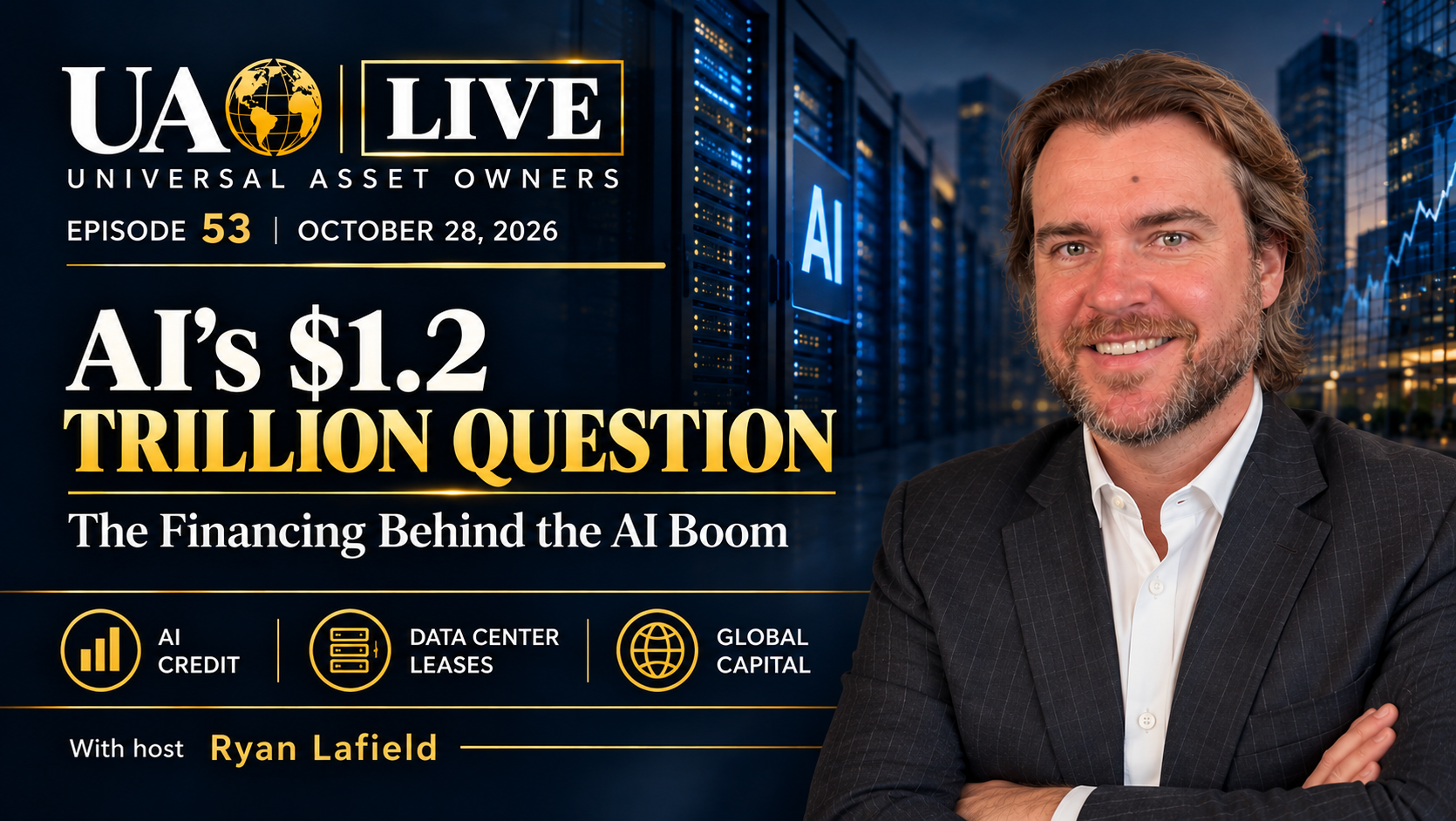
Watch the Latest UAO LIVE with Ryan Lafield
Ryan’s latest programme examines AI’s $1.2 trillion financing question: who supplies the credit, who holds the equity, and where long-horizon portfolios may be carrying the same risk more than once.
Watch the Latest EpisodeToday in 90 seconds
The state changes that matter
Central banks: Canada increased its overnight target to 2.50%; the Federal Reserve held at 3.75–4.00% by a 10–2 vote, with two members preferring a rise. BoC 28 Oct · FOMC 28 Oct
Geopolitics: Israel’s provisional election count points to 53 / 48 / 19 seats across the main Netanyahu, Eisenkot and Arab blocs, with no clear majority. CEC projections, 28 Oct
Governance: Norway’s sovereign-fund ethics council chair has threatened to resign if proposed curbs on the council are implemented; he has not resigned. Reuters 28 Oct
Grid equipment: GE Vernova agreed to acquire Trench Group from Triton for US$9.0 billion equivalent at closing. Completion is targeted for late 2027, subject to approvals and employee consultation. [1] [2]
Buyout capital: Advent closed almost US$27 billion for GPE XI and more than US$3 billion for its first dedicated mid-market strategy. These are investor commitments, not capital already deployed. [3]
Private-credit liquidity: PGIM and LGT co-led a US$680 million continuation vehicle holding first-lien loans to more than 60 US lower-middle-market companies. [4]
Governance: Australia’s Federal Court ordered Star to pay A$260 million for serious AML/CTF breaches, with four instalments running to May 2028. [7] [8]
The lead
The grid bottleneck becomes a US$9 billion asset
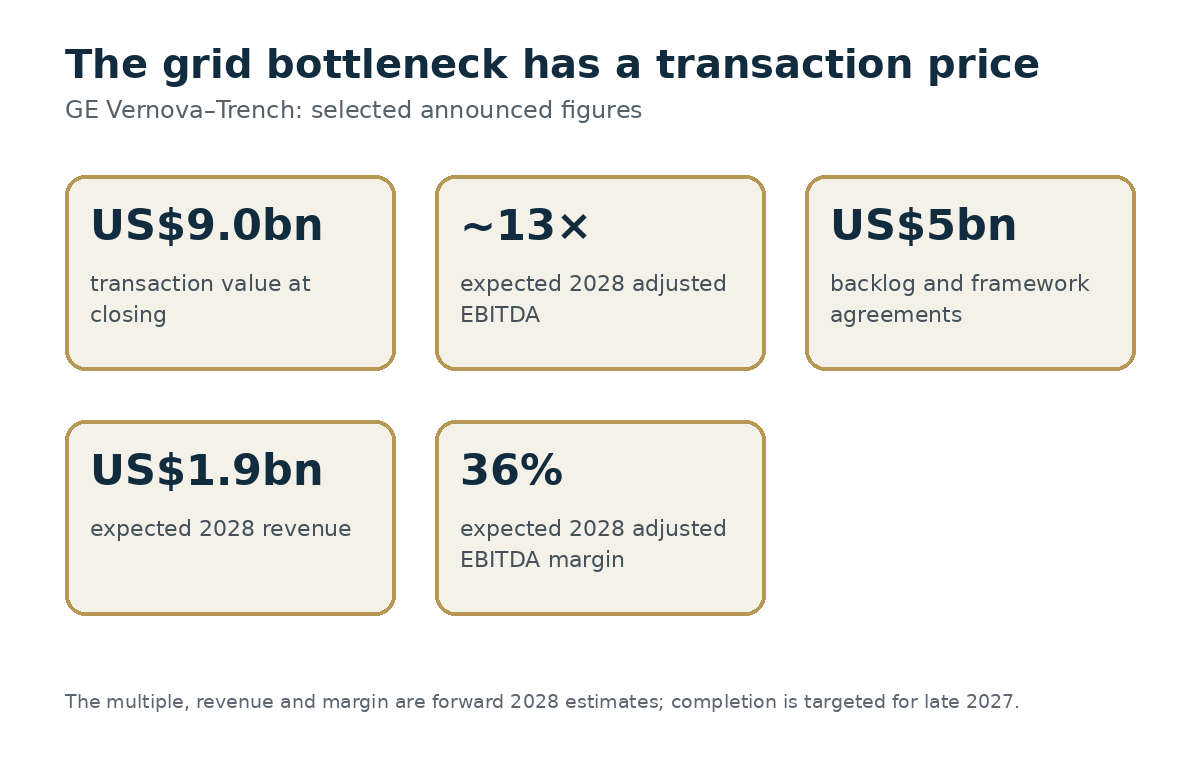
GE Vernova’s agreed purchase of Trench Group is a price signal for the part of the energy transition investors cannot accelerate with financial engineering. The buyer will pay US$9.0 billion equivalent at closing for a manufacturer of instrument transformers and high-voltage grid components. The transaction is expected to be funded about half with cash and half with debt and to close in late 2027, subject to regulatory approvals and employee consultation. [1] [2]
The multiple is built on a forward denominator: roughly 13 times expected 2028 adjusted EBITDA before synergies. Trench expects about US$1.9 billion of 2028 revenue and a 36% adjusted EBITDA margin. It also reports around US$5 billion of backlog and framework agreements. Those numbers describe a scarcity franchise; they do not remove execution risk between signing and the 2028 earnings year.
For universal owners, the transaction travels through more than the buyer’s equity. Transformer availability affects regulated-utility capital plans, data-centre energisation, renewable interconnection, industrial electrification and the debt issued against each. A higher equipment price can be absorbed by a project, socialised through a rate base or become the delay that keeps a supposedly contracted asset from producing cash.
The countercase is that premium pricing attracts supply. GE Vernova can expand manufacturing, standardise procurement and use its installed base to improve service economics. The thesis strengthens if delivery slots remain long, utilities pre-order capacity and regulated capex rises faster than equipment output. It weakens if new factories, alternative suppliers and slower load growth reduce lead times before the transaction closes.
Capital and deals
A US$30 billion fund close meets a tighter exit market
Advent closed almost US$27 billion for Global Private Equity XI against a US$26 billion target, plus more than US$3 billion for its first dedicated mid-market strategy. The investor base includes pensions, sovereign wealth funds, endowments, foundations, institutional managers, family offices and private-wealth clients. [3]
The close is evidence that capital remains concentrated around established managers. It is not evidence that US$30 billion has been deployed or that prior vintages have returned cash on the same schedule. Advent says 2026 activity included about US$13 billion of realisations across 27 businesses and around US$10 billion invested across 38 closed and pending transactions. Investment committees should separate signed, pending and realised figures, then compare future deployment with distributions and called-capital pacing.
A. O. Smith separately agreed to sell 81% of its China business to CPE at a cash-and-debt-free enterprise value of about US$400 million. A. O. Smith keeps 19% and a multi-decade royalty stream whose estimated net present value helps lift the stated total value above US$500 million. That higher figure is not closing consideration. [21]
Sovereign & pension allocations
An equity cheque and a completed refinancing are not the same kind of capital
Wealthsimple agreed a funding round of up to C$425 million at a C$13.8 billion post-money valuation, led by GIC with CPP Investments among participating investors. The announced structure includes C$300 million primary and a secondary component of up to C$125 million. The secondary can create liquidity for existing holders; it does not fund the operating company in the same way as the primary. The release describes an agreement, not proof that every possible secondary dollar has changed hands. Wealthsimple, 27 Oct
Elsewhere APG, acting for ABP, and OMERS Infrastructure announced a completed €662 million refinancing of Dutch energy platform Kenter-Groendus. Unlike an agreed equity round, this is a refinancing transaction: funding already owned medium-voltage, metering, storage and energy-management assets, rather than new ownership of a different business. For pension committees the question is how each transaction changes leverage, control rights, liquidity and future cash-flow claims. APG, 27 Oct
Portfolio transmission: The GIC/CPP investment concentrates capital in a Canadian financial platform exposed to deposits, trading and consumer adoption; APG/OMERS strengthens funding around electricity distribution assets. Both can sit beside public bank equities and grid-infrastructure exposure. A look-through concentration dashboard should not treat them as interchangeable diversifiers.
Private credit and liquidity
The continuation vehicle becomes a credit-market valve
PGIM and LGT Capital Partners co-led a US$680 million private-credit continuation vehicle for Tree Line Capital Partners. It acquired a seasoned portfolio, mainly senior-secured first-lien loans to more than 60 US lower-middle-market companies, from several Tree Line direct-lending funds. Existing investors received a liquidity option while Tree Line retained management. [4]
The structure matters because private credit’s central promise—hold to maturity—can collide with an LP’s need for cash. A continuation vehicle transfers that timing problem to a new pool of capital. The missing denominator is price: the announcement discloses neither the discount to reported NAV nor transferred leverage, loss history or non-accruals. The signal improves if cash collections and realised losses validate the marks; it weakens if liquidity is purchased mainly by extending duration at an undisclosed concession.
Main Street Capital’s separately priced US$500 million of 6.55% notes due January 2030 adds a public funding-cost marker. Proceeds initially repay revolvers, although re-borrowing may later finance investments. Refinancing capacity is not the same as immediate new deployment. [22]
Digital infrastructure
Amazon clears a spectrum gate, not the finish line
The US Federal Communications Commission approved the transfer of licences tied to Amazon Leo’s US$11.5 billion acquisition of Globalstar. The April agreement covers roughly 25 MHz of internationally harmonised mobile-satellite spectrum. The parties still expect completion in 2027, subject to remaining conditions. [5] [6]
Approval is a regulatory state change, not a closing. The portfolio mechanism runs through spectrum scarcity, satellite-launch and ground-network capex, direct-to-device competition and the service dependencies of existing Globalstar customers. The countercase is execution: valuable spectrum does not guarantee timely launches, authorisation in other markets or attractive unit economics.
Governance and fiduciary affairs
A historic control failure becomes a scheduled cash claim
Australia’s Federal Court ordered Star Sydney to pay A$195 million and Star Queensland A$65 million for serious anti-money-laundering and counter-terrorism-financing breaches. The combined A$260 million is payable in four A$65 million instalments due 25 November 2026, 25 May 2027, 25 November 2027 and 25 May 2028, with costs also payable. [7] [8]
The findings include 1,517 ongoing due-diligence contraventions—1,190 in Sydney and 327 in Queensland. The court also recorded more than A$1.4 billion of junket revenue and about A$1.33 billion of revenue from high-risk customers over the relevant period, while warning that these figures are not a measure of benefit derived from the contraventions.
The universal-owner question is whether governance repair survives a long payment schedule. Liquidity, licences, remediation, D&O exposure and sponsor control all sit in the same case. Historic conduct does not prove current systems remain deficient; the next evidence is the first payment, any appeal, remediation audits and state-regulator decisions.
Governance & fiduciary affairs
Norway’s ethics architecture faces a conditional resignation threat
Svein Richard Brandtzæg, chair of the independent ethics council for Norway’s sovereign wealth fund, said he would resign if proposals that limit the council to analysis rather than independent recommendations are implemented. The change has not been adopted, and his statement is a conditional warning, not an accomplished departure. Reuters, 28 Oct
This matters because a large index-spanning owner must decide whether ethical exclusions are an independent governance check or a tool ultimately subordinate to portfolio-construction decisions. A restriction could change escalation procedures and engagement expectations, but it would not automatically alter the holdings of other pension and sovereign investors. The next investable fact is a government decision and implementation timetable, not speculation about an exodus from the council.
Climate, nature and stewardship
Biodiversity capital moves from pledge to project approval
The Kunming Biodiversity Fund approved nine projects across Armenia, Bangladesh, Benin, Cameroon, Cuba, Montenegro, North Macedonia, Somalia and Vietnam. UNEP places them within a wider estimated US$21 million 2026 package and says the fund has 31 projects with US$30 million already committed. The nine newly approved projects are reported at about US$4.5 million. [9]
Stage discipline matters: approval is not receipt of cash, and the US$21 million estimate is not all allocated to those nine projects. Around 30 further proposals remain for a second phase. The next milestones are project agreements, disbursement, the 15 November application deadline and country-level outcomes.
IIGCC also opened consultation on a label-independent Nature Investment Toolkit. Its value lies in common descriptions, risk flags and due-diligence questions; it is a draft, voluntary tool rather than a certification of impact. [11]
Balance sheet and portfolio health
The trans-Tasman inflation split narrows the room to wait
The Reserve Bank of New Zealand held its official cash rate at 2.75% by a 4–3 vote, with three members preferring a 25-basis-point increase. Headline inflation was 3.7%, and the Bank expects it to reach 4.4% in the fourth quarter. [12]
Australia’s September-quarter CPI rose 1.3% from the prior quarter and 4.3% from a year earlier; trimmed-mean inflation was 3.6%. The 3 November RBA meeting therefore lands in a different inflation regime from a benign hold narrative. [13]
For asset owners, the transmission is mechanical and behavioural: discount rates, duration, property valuations, currency hedges and wage assumptions all move, while a divided committee raises the value of each new data release. The countercase is that energy and administered-price effects can fade without requiring a large tightening cycle.
Rates, inflation and liabilities
Canada tightens as the Fed holds: two paths through the same liability book
The Bank of Canada raised its overnight policy target by 25 basis points to 2.50% on 28 October, with its Bank Rate at 2.75% and deposit rate at 2.45%. It linked the decision to energy costs that may spread through transport, production and consumer prices. It expects inflation to remain around 3% through much of 2027, while leaving further rate increases possible rather than pre-committed. Bank of Canada, 28 Oct
Hours later, the Federal Reserve held the target range at 3.75–4.00% by a 10–2 vote. Lisa Cook and Beth Hammack wanted a quarter-point increase. The decision does not establish a December move; it demonstrates that rate risk remains live even where policy was unchanged. Federal Reserve, 28 Oct
For a universal owner, higher discount rates may reduce the present value of liabilities, but higher debt-service costs and capitalization rates can simultaneously reduce asset valuations. Real estate, infrastructure equity, private-credit refinancings and inflation-sensitive mandates react on different calendars. The Canadian hike and American hold therefore create a cross-currency test for hedge costs and asset-liability modelling—not a simplistic story of two markets moving in opposite directions.
AI infrastructure and stewardship
Bondholders get a lever where shareholders may not
IIGCC’s new bondholder-stewardship analysis argues that AI and data-centre financing creates leverage before issuance, in covenants and at refinancing. It points investors toward electricity sourcing, power-use effectiveness, site-level water and physical risk, grid queues, construction delays and customer concentration. [10]
The document is investor research, not regulation. Its headline financing figures rely partly on third-party estimates, and bondholders cannot control operations. But repeat issuers still need access to institutional balance sheets. That makes pre-issuance engagement and pricing a practical governance channel where dual-class equity can weaken votes.
Alphabet’s cash-flow test. Alphabet’s 28 October results put a cash-flow test beside the grid-equipment story. For the quarter ended 30 September, operating cash flow was US$42.3 billion against US$51.4 billion of purchases of property and equipment, producing negative US$9.1 billion non-GAAP free cash flow. Google Cloud revenue nevertheless rose 103% to US$30.7 billion; trailing-twelve-month free cash flow remained positive at US$19.7 billion. For owners holding hyperscaler equity alongside utility and data-centre debt, the split matters: strong demand does not mean quarterly investment is self-funded. Watch cash conversion and energised capacity alongside revenue growth. Alphabet, 28 October 2026
People moves
One pension chief moves; two governance questions follow
CAAT Pension Plan appointed Peter Lindley CEO and Plan Manager, effective 6 January 2027. He joins from OPTrust, where he has been president and CEO since 2019. CAAT said acting CEO Kevin Fahey remains chief investment officer. [14]
OPTrust appointed Dani Goraichy interim president and CEO with immediate effect on 27 October and began a search for a permanent successor. Goraichy has spent 16 years at the plan and was chief risk officer and senior vice-president for actuarial services and plan policy. [15]
The linked appointments matter beyond biography. Both plans now need to preserve investment continuity while clarifying accountability between board, chief executive, CIO and risk functions. The milestones are CAAT’s January transition and OPTrust’s permanent appointment.
Institutional careers
Open seats across long-duration capital
CPP Investments — Principal, Sustainable Energies & Infrastructure Credit, Toronto. Applications close 8 November. The role covers origination, underwriting, execution and portfolio management across North American energy and infrastructure credit. [18]
CalPERS — Equity Portfolio Implementation Manager, Sacramento County. The role is open until filled, with a first review cutoff of 11 November, and covers equity portfolio construction, implementation, benchmark alignment and trade review. [19]
CalPERS — Infrastructure Investment Officer, Sacramento County. Applications close 4 November. The remit includes infrastructure funds, co-investments, separate accounts and existing-portfolio management. [20]
Geopolitics & chokepoints
A divided Knesset and a sanctions shock reach three asset classes
Israel’s Central Elections Committee count, as reported late 28 October, projected 53 seats for Netanyahu’s bloc, 48 for Eisenkot’s and 19 for the Arab parties, with roughly 90% of votes counted. Nobody has a clear 61-seat parliamentary majority. These are projections, not final certified results or proof of a coalition. The Times of Israel / CEC, 28 Oct
Separately, the U.S. Treasury designated Rwanda’s Ministry of Defence and Zigama Credit and Savings Society on 28 October, citing support for M23 in the eastern Democratic Republic of the Congo and associated financial and minerals activity. These are U.S. government allegations and legally operative designations, not a blanket sanction on all Congolese or Rwandan mineral exports. U.S.-jurisdiction financial institutions face immediate screening obligations. U.S. Treasury, 28 Oct
The portfolio link crosses oil and transport insurance, long-duration inflation assumptions, and critical-mineral due diligence. Israel’s unresolved coalition may prolong uncertainty over the regional conflict; Treasury’s designations create a distinct compliance question for banks, counterparties and commodity supply chains. Neither warrants inventing a new price forecast. Underwriters need observable shipping rates, sanctions exposure and verified cash-flow interruptions.
Research worth reading
Three documents for the committee pack
GE Vernova’s Trench presentation is a direct read on grid-equipment scarcity, forward multiples, backlog and manufacturing expansion. [1]
IIGCC’s AI bondholder note turns data-centre externalities into questions investors can ask before a bond is priced. [10]
The Federal Court’s Star judgment shows how control failures become a multi-year cash schedule and governance test. [8]
Future signals
Signals that are credible—but not yet decisions
GE Vernova’s late-2027 completion and Trench’s 2028 forecast create a long proof period. Watch debt terms, ratings, employee consultation, regulatory approvals and new high-voltage manufacturing capacity rather than treating the announced multiple as realised value.
Universal Owner Risk Radar
Where the next loss—or release of value—could travel
Grid-equipment scarcity — probability high; impact high. Confirmation is persistent lead times, pre-ordering and regulated capex without matching output. Disconfirmation is faster factory ramp-up or weaker load growth. Exposed assets include utilities, data centres, renewables, industrials and project debt.
Private-credit liquidity mismatch — probability medium; impact medium-high. Confirmation is rising continuation volume at widening NAV discounts. Disconfirmation is strong repayments and conventional fund distributions.
Trans-Tasman inflation persistence — probability medium-high; impact medium. Confirmation is sticky trimmed-mean inflation and additional committee dissent. Disconfirmation is a broad fall in services and non-tradables inflation.
Scenario analysis
Grid scarcity — planning paths, not forecasts
Base — 55%. Equipment demand remains firm, lead times ease slowly and the transaction closes in late 2027. Utilities pass much of the cost through regulated plans. Confirmation is stable backlog and orderly debt financing; the falsifier is a sharp fall in orders.
Upside — 20%. Factory expansion and procurement scale release capacity faster than expected, improving interconnection and data-centre delivery. The falsifier is continued slippage despite higher output.
Downside — 20%. The forward multiple collides with softer load growth, integration costs or approval delay. Project returns weaken and GE leverage rises. Confirmation is order cancellation or rating pressure.
Tail — 5%. A shared equipment bottleneck forces simultaneous delays across utilities, renewables and data centres. Contract disputes and refinancing needs reveal that apparently separate projects depend on the same manufacturing slots.
Three questions for the investment committee
Questions that cross mandate silos
1. Which portfolio projects depend on the same transformer, switchgear or grid-connection supply chain?
2. What discount to reported NAV would we require to supply liquidity through a private-credit continuation vehicle?
3. Which compliance failure can become a scheduled cash claim large enough to alter the investment case?
What to watch
Dates and evidence
29 October: ECB decision and Amazon results. Compare funding conditions, capex, lease commitments, depreciation and power timelines.
30 October: Bank of Japan outlook and scheduled COP17 final decisions.
3 November: Reserve Bank of Australia policy meeting following 4.3% annual CPI.
4 November: Expected deadline for Israel’s official election result.
29 October: ECB policy decision and press conference. 9 December: Next scheduled Bank of Canada policy decision.
The Take
Capital is abundant; delivery slots are not
Advent can close US$30 billion, a credit manager can create a new liquidity vehicle and a satellite buyer can clear a regulatory gate. None of that makes a transformer arrive sooner.
The practical portfolio lesson is to separate financing capacity from physical delivery. A project can be fully funded, contracted and still fail its return case because the grid connection, component or permit sits outside the financial model. Universal owners should map those dependencies before deciding that capital alone has diversified the risk.
Sources
Original reporting and documents
[1] GE Vernova — GE Vernova to acquire Trench Group
28 October 2026
28 October 2026
[2] Triton Partners — Triton Partners to sell Trench Group to GE Vernova
28 October 2026
28 October 2026
[3] Advent International — Advent raises US$30 billion for global fund complex
27 October 2026
27 October 2026
[4] PGIM — PGIM, LGT Capital Partners and Tree Line close US$680 million private-credit continuation vehicle
28 October 2026
28 October 2026
[5] Globalstar — Amazon Leo–Globalstar transaction agreement
14 April 2026
14 April 2026
[6] Federal Communications Commission — Applications of Globalstar, Inc. and Amazon.com, Inc. — GN Docket No. 26-134, DA 26-1160
27 October 2026
27 October 2026
[7] AUSTRAC — Star ordered to pay A$260 million for serious AML/CTF breaches
28 October 2026
28 October 2026
[8] Federal Court of Australia — AUSTRAC v The Star Entertainment Group — [2026] FCA 1606
28 October 2026
28 October 2026
[9] UN Environment Programme — Kunming Biodiversity Fund press statement
27 October 2026
27 October 2026
[10] IIGCC — Financing AI: what the data-centre boom means for bondholder stewardship
27 October 2026
27 October 2026
[11] IIGCC — Nature Investment Toolkit consultation
27 October 2026
27 October 2026
[12] Reserve Bank of New Zealand — OCR held at 2.75 percent
28 October 2026
28 October 2026
[13] Australian Bureau of Statistics — Consumer Price Index, Australia — September quarter 2026
28 October 2026
28 October 2026
[14] CAAT Pension Plan — CAAT appoints Peter Lindley CEO and Plan Manager
27 October 2026
27 October 2026
[15] OPTrust — Board statement on leadership transition
27 October 2026
27 October 2026
[18] CPP Investments — Principal, Sustainable Energies & Infrastructure Credit — JR00868
checked 28 October 2026
checked 28 October 2026
[19] CalPERS — Equity Portfolio Implementation Manager — JC-535153
checked 28 October 2026
checked 28 October 2026
[20] CalPERS — Infrastructure Investment Officer — JC-534361
checked 28 October 2026
checked 28 October 2026
[21] A. O. Smith — Majority interest in China business to be acquired by CPE
27 October 2026
27 October 2026
[22] Main Street Capital — US$500 million 6.55% notes priced
27 October 2026
27 October 2026
[23] Universal Asset Owners — AI’s $1.2 Trillion Bet: Who’s Financing the AI Boom? | UAO LIVE Ep. 53
28 October 2026
28 October 2026
Bank of Canada — Bank of Canada raises the policy rate by 25 basis points to 2½%. 28 October 2026.
Federal Reserve — Federal Reserve issues FOMC statement. 28 October 2026.
Reuters — Norway wealth fund ethics watchdog chair threatens resignation. 28 October 2026.
The Times of Israel / Central Elections Committee projections — With 90% of votes counted, Netanyahu bloc 53, Eisenkot bloc 48, Arab parties 19. 28 October 2026.
U.S. Department of the Treasury — Treasury sanctions Rwandan Ministry of Defence and financial institution supporting M23. 28 October 2026.
Wealthsimple — Wealthsimple raises C$425 million at C$13.8 billion valuation. 27 October 2026.
OMERS Infrastructure — APG and OMERS complete €662 million refinancing of Kenter-Groendus. 27 October 2026.
Alphabet — Alphabet Announces Third Quarter 2026 Results. 28 October 2026.
The Back Page
The most expensive asset is the empty delivery slot
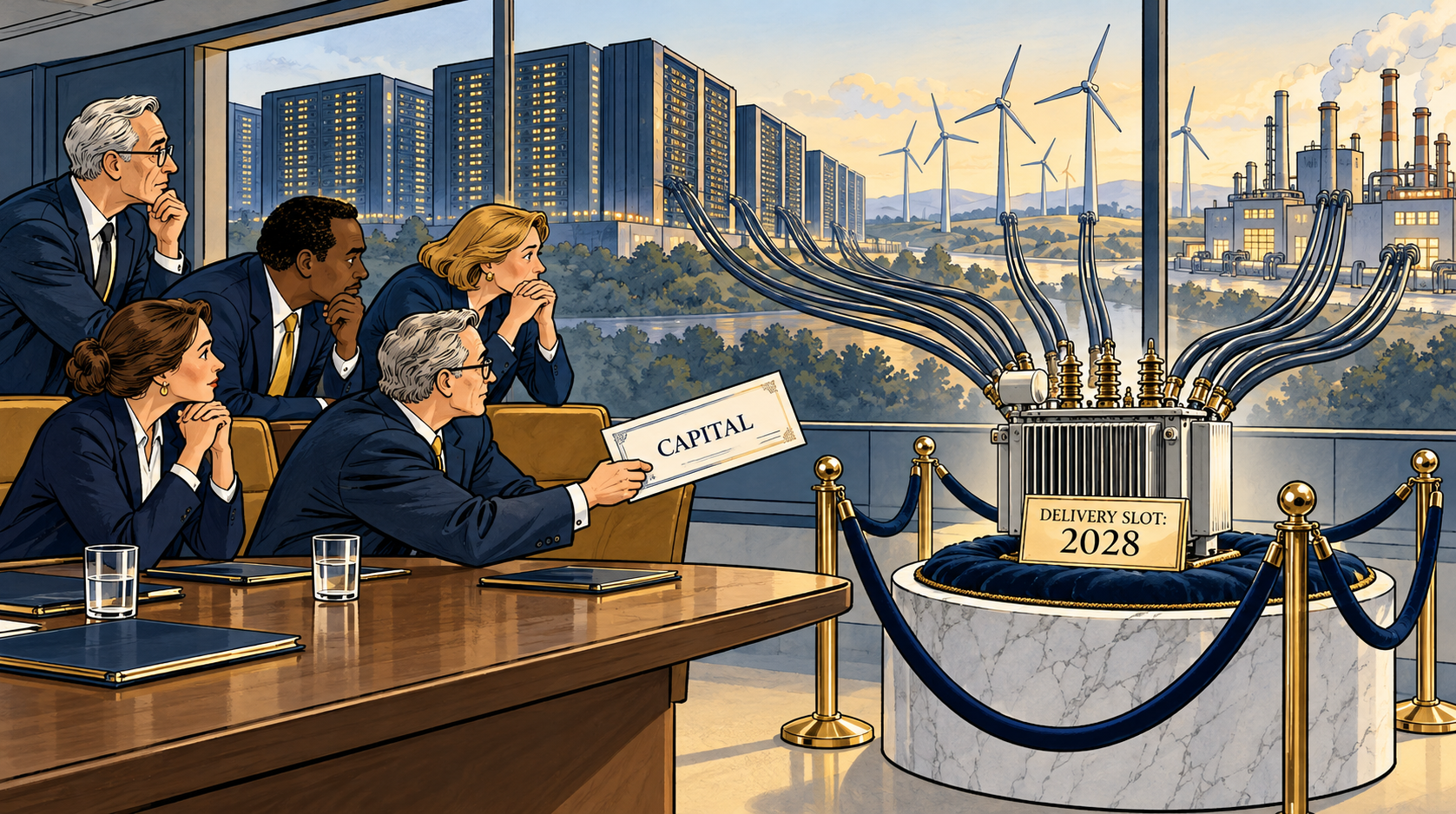
The committee brought capital. The data centres, factories and wind farms brought cables. The transformer brought a reservation book. In infrastructure, the bottleneck often owns the negotiating leverage.