
Good morning. Welcome to the Daily Brief, where the news meets the decisions facing the world’s long-term asset owners.
Watch UAO Live's Latest Episode with Host Ryan Lafield
▶ Watch the latest episodeEnergy and infrastructure, rates, Canada, sovereign and family capital, an expanded governance and stewardship desk, ESG, deep-dive analysis, liquidity, manager diligence, careers and live vacancies, succession, foundations and endowments, scenarios, UAO Live and The Back Page.
Listen & watch
The Universal Owner Follow the podcast | UAO Live at 10 a.m. Toronto Join Ryan live |
Energy capital meets the delivery test
Ara Partners has closed its first energy fund with $1.8 billion in fund commitments and more than $700 million in associated co-investment. The $2.5 billion strategy brings another pool of institutional money to the conventional energy assets expected to keep the system working through the transition. [1]
The portfolio makes the proposition tangible: about three gigawatts of thermal power generation, ethanol production capacity of roughly 400 million gallons a year and an interest in a retail fuel network of about 970 stations. Ara launched the energy business with HF Capital. Its new investors include pensions, insurers, sovereign wealth funds, endowments and foundations. [1]
The opportunity for long-term owners is to improve assets people continue to need. The investment question is how much cash survives the work required to keep those assets useful. Maintenance, fuel, environmental obligations and eventual retirement belong in the same model as demand and pricing. A large financing package can support that work; it cannot demonstrate that the work has been done.
Ara’s announcement describes an operating strategy, including decarbonisation where economically accretive. That wording deserves careful attention. Investors should ask what improvements are planned, how they affect both cash flows and emissions, and which spending is necessary simply to maintain the asset. Existing capacity, additional capacity and lower emissions are separate outcomes. [1]
The constructive case is strong enough to examine on its merits. An experienced owner may extend an asset’s productive life, improve reliability and finance upgrades that a previous owner deferred. The countercase is that the purchase price captures those benefits before they arrive. The committee needs a return bridge from today’s operations to tomorrow’s distributions, with the cost and timetable of each improvement visible.
Blackstone backs the machinery around electricity
Blackstone’s Energy Transition Partners V has reached its $8.7 billion hard cap. The fund began its investment period in June and has financed power generation and transmission platforms alongside businesses serving cooling, utility equipment and infrastructure inspection. [2]
That mix widens the familiar energy conversation. A portfolio can participate through equipment and services as well as through the plant that produces electricity. The economic exposures differ. A manufacturer depends on orders, capacity, labour and margins; an operating asset depends on utilisation, contracts and the cost of remaining available.
For an allocator, the diligence should follow the actual business. Ask whether an equipment company’s backlog carries firm prices, cancellation rights and delivery penalties. Ask how much working capital growth consumes. For a development platform, separate land and permits from projects that are connected, operating and collecting cash.
A successful fundraise is evidence of investor commitments. Investment performance will depend on what the portfolio buys and builds, the prices it pays and the cash it returns. Compare the opportunity with listed suppliers and other infrastructure mandates before deciding how much extra concentration or illiquidity the private structure earns.
Ares agrees to buy Infinity for $2.9 billion
KKR has agreed to sell Infinity Transportation to Ares Infrastructure Equity and Ares Insurance Solutions funds at an enterprise value of approximately $2.9 billion. Infinity owns and manages about 50,000 railcars serving more than 350 lessees across North America. Closing is expected in the first quarter of 2027, subject to customary conditions and regulatory approvals. [3]
The combination of physical assets, leasing relationships and long-term capital is familiar to insurers and pensions. Its resilience still depends on details: lease expiries, customer concentration, maintenance obligations, utilisation and the value of a railcar when its current lease ends.
The enterprise value is a measure of the business being acquired, rather than the equity cheque or cash proceeds to the seller. Keep those distinctions in the comparison with other deals. Then test the investment through a weaker freight cycle and a period when refinancing is less accommodating.
A diversified fleet can spread customer risk and an experienced operator can improve availability. Neither removes the need to match the asset’s cash receipts to the institution’s own obligations. Duration is most useful when the income remains dependable through the holding period.
Cleanaway’s next chapter still needs approvals
EQT Infrastructure VI has signed a binding scheme implementation deed to acquire Cleanaway. The proposed consideration is A$3.095 a share, subject to adjustment for further dividends or distributions and any applicable ticking fee, implying an enterprise value of about A$9.3 billion. The board’s recommendation is conditional on no superior proposal and a continuing favourable independent expert conclusion. [4]
Waste collection, treatment and recovery serve recurring needs. The investment case also carries the operating obligations of a large physical network: permits, site rehabilitation, equipment replacement and the economics of different waste streams. Predictable demand does not make every cost predictable.
Shareholder, court and regulatory approvals remain part of the transaction. The useful question for a prospective owner is which improvements require fresh capital, which depend on contract renewals and which rely on higher recovery values. A more efficient network can create value; the underwriting must show who pays for the transition and when the benefit reaches investors. [4]
Europe’s green spending is an electricity story
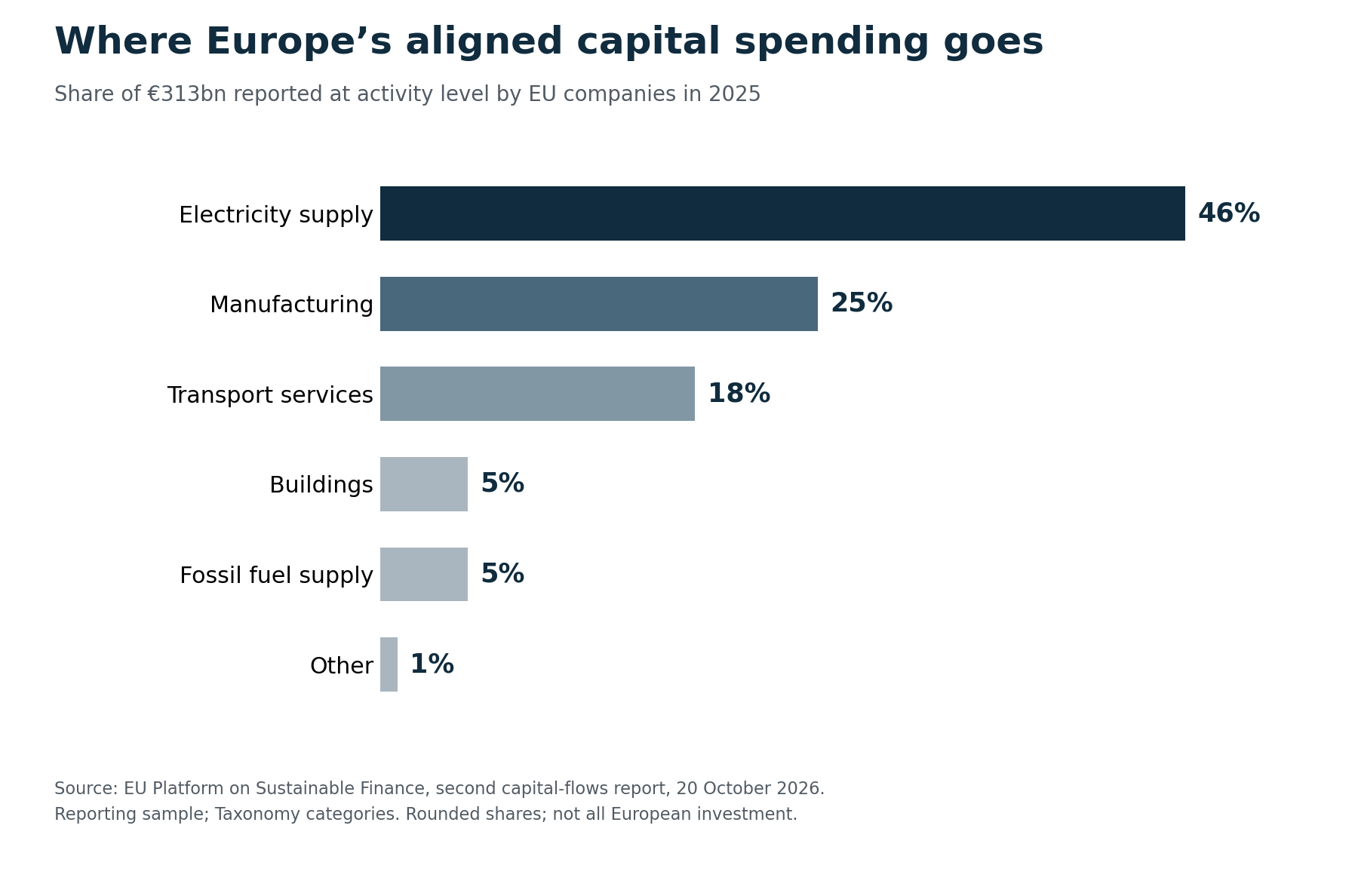
Chart source: EU Platform on Sustainable Finance, capital-flows report, page 15. [5]
The EU Platform on Sustainable Finance’s second capital-flows report puts activity-level Taxonomy-aligned capital expenditure reported by EU companies at €313 billion in 2025. Electricity supply accounts for 46%, manufacturing for 25% and transport services for 18%. [5]
The chart describes a reporting sample and its classification of spending. It is not a total for all European investment, a map of where every project is physically located or a measure of new capital raised by investment funds. The report is advisory analysis, rather than a new binding rule.
Its portfolio implication is the relationship between sectors. Manufacturing and transport investments can depend on electricity being available when a new facility or fleet needs it. A utility holding, an industrial equity and an infrastructure fund may therefore share a construction or connection timetable. Different asset-class labels can conceal the same dependency.
Ask managers to identify the critical project in that chain, the party responsible for completing it and the consequence of a delay. The answer may favour the investment. It may also reveal that several holdings rely on one assumption the committee has only considered once.
Japan puts a price on twenty years
Japan’s 20-year government-bond auction on Tuesday produced a weighted-average yield of 3.723%, with a highest accepted yield of 3.729%. Issue 198 carries a 3.8% coupon and matures on 20 September 2046, according to the Ministry of Finance. [6]
For a yen-based institution, that is a concrete benchmark against which to judge another long asset. For an institution with liabilities in a different currency, the comparison needs the cost of hedging, liquidity, capital treatment and the timing of the cash flows.
A headline yield can sharpen the question without deciding the answer. A private asset promising a premium must justify its fees, financing risk and limited exit options. Conversely, an operating business may offer growth and contractual protections that a nominal bond does not. Set the comparison at the level of the institution’s liabilities and usable cash, then explain the remaining differences.
Business confidence carries a trade qualification
The Bank of Canada’s third-quarter business survey shows an improvement in overall sentiment, alongside soft hiring intentions and a slight easing in investment intentions that remained robust. The share of firms planning or budgeting for a Canadian recession over the next year fell from 17% to 6%. [7]
That last figure is a response to a business-planning question. It is not the central bank’s estimate of recession probability. The Bank also reports that firms surveyed after Canada–US trade talks broke down had weaker sentiment and export expectations than those surveyed earlier. [7]
The distinction matters for portfolios built around a single national outlook. A domestic service company and an exporter facing new trade costs can experience the same economy differently. Ask Canadian managers where their customers earn revenue, which costs can be passed through and how a changed order book affects the investment budget.
Improved confidence can support spending and credit quality. The later deterioration in some responses argues for examining the customer and the contract before assuming that improvement is shared evenly.
Stronger balance sheets, cautious spending
The Bank of Canada’s consumer survey reports improved financial health, helped in part by higher asset values, while already weak spending plans softened further. The combination deserves attention from owners of consumer businesses, lenders and property. [8]
A gain in wealth does not require an immediate increase in purchases. Households can rebuild a buffer, repay debt or remain cautious about income. For a portfolio company, the useful evidence is the route from a healthier customer balance sheet to orders, collections and margin.
The survey also finds that about 40% of workers use AI at work. Users estimate that completing their tasks without it would take roughly five additional hours a week. These are respondents’ estimates, rather than a measured increase in profits or a company’s realised cost savings. [8]
For an investment committee, the next question is operational: how does saved time change output, service quality or costs after training and oversight? An attractive technology story becomes more persuasive when management can connect adoption to a result shareholders can assess.
Measure the partnership as well as the portfolio
Ara’s new energy strategy brings a partner, HF Capital, together with a broader institutional investor base. For sovereign funds and family offices considering similar arrangements, access to a specialist operating team can be as important as access to a transaction. [1]
Define that benefit before committing. What information reaches the investor? Which decisions remain with the manager? Does a co-investment right provide real choice, with time and expertise to assess the asset, or mainly a faster route to the same exposure?
An institutional partnership can build knowledge and improve future decisions. It can also concentrate relationships and create pressure to support follow-on financing. A good mandate specifies the financial objective, governance rights and limits on additional capital. Familiarity should make the risks easier to examine.
Name the person who owns the delay
A project’s return model often contains a date for operations to begin. The committee paper should explain what stands between the investment and that date: equipment, permits, contractors, connections and customers ready to take delivery.
Allocate responsibility for each dependency. A contractual remedy may recover some money after a missed milestone; it may not restore the institution’s expected cash receipt on time. Map the available contingency, the financing that remains available and the person authorised to change course.
This is also a staffing question. NBIM’s open searches span fixed-income investing, compliance, and mandates and real-asset risk; CalSTRS is recruiting a security defence and monitoring manager. Institutions need both investment judgement and the controls that keep operations dependable. Those vacancies describe specific needs, without establishing a wider hiring trend. [9] [10]
Three paths from commitment to cash
Delivery improves. Equipment arrives, projects enter service and operating cash supports distributions. The signposts are commissioned capacity, collections and cash remaining after maintenance. This would strengthen the case for patient ownership and could support further commitments.
Demand grows faster than delivery. Customers still want the service, but construction, equipment or connection delays push receipts back while interest and carrying costs continue. The response starts with liquidity and contract protection, then asks whether the original return remains attractive after the revised timetable.
Demand disappoints. A project arrives on time into a weaker market, or a customer uses less capacity than expected. Test the protection provided by contracts, counterparties and operating flexibility. A successful build does not establish a successful investment.
These are planning scenarios, rather than probability forecasts. Their purpose is to identify evidence that would change the allocation and the decision that should follow.
Four questions for the next mandate
Capital: separate the fund commitment, associated co-investment and purchase price. Ask how much remains available for improvements and which costs sit outside the headline figure.
Operations: reconcile the expected distribution with maintenance, growth spending, financing and taxes. Identify the milestone that first turns a project into a source of cash.
Portfolio: map shared dependence on electricity, equipment and major customers across managers. Compare the proposed holding with the institution’s existing exposure and a liquid alternative.
Governance: agree who can approve additional funding, renegotiate a contract or reduce exposure if the timetable changes. The strongest protection is a decision the institution can make while it still has choices.
The decision rights behind the investment case
Analysis. A board can approve a sound investment and still leave its organisation poorly equipped to own it. The gap usually appears when the original assumptions change. A contractor misses a milestone, a counterparty asks to renegotiate, or management needs more capital before the next scheduled committee meeting. The investment paper should identify those decision points before the institution commits.
Start with the distinction between receiving information and having authority. A board observer may see a problem without being able to stop the next expenditure. A consent right may matter only above a threshold that excludes several smaller decisions. A quarterly report may arrive after an operating choice has become expensive to reverse. Ask the team to describe a plausible difficult month and trace who would know what, when they would know it, and what they could actually do.
Next, examine the process for additional capital. The investment committee should distinguish a contribution needed to protect the existing asset from one intended to enlarge the business. Those decisions can have different risk and return cases. The fact that the institution already owns a stake is a reason to understand the choices carefully; it is not sufficient justification for every subsequent cheque. Record the alternatives, including dilution, restructuring, a partner contribution and an orderly reduction in exposure.
The people making that assessment need access to challenge. Operational specialists should be able to explain a delay without the message passing through several layers of transaction advocacy. Risk teams should see the same cash-flow assumptions as the investment team. Directors should know when they need independent technical advice and how it will be commissioned. None of this requires assuming that a manager is acting badly. It makes a good relationship more useful when the investment becomes difficult.
The board’s practical output is a short decision map: the issue, the information required, the person accountable, the authority available and the date after which choices narrow. For long-term owners, governance earns its value in the interval between recognising a problem and losing the ability to respond.
Ask for evidence that survives a change of owner
Analysis. Engagement has more substance when an investor can identify the operating result it wants to change. In an energy or infrastructure business, that might involve reliability, workforce safety, maintenance, emissions measurement or the credibility of a retirement plan. A meeting count alone cannot show whether any of those outcomes improved.
Set a starting position and a sequence of observable milestones. Specify which results depend on management, which depend on third parties, and which remain uncertain. Where a company claims an improvement, ask whether the same measure was used before and after the intervention. A lower reported footprint after selling an asset answers a different question from a reduction in that asset’s own emissions. Both can be described accurately, but they should not be presented as interchangeable achievements.
The escalation route also belongs in the mandate. A minority public shareholder, a controlling private owner and a lender have different tools. The committee should ask its manager to explain those tools in the context of the actual holding. A promise to engage is more useful when it comes with an objective, a timetable and a decision if progress stalls.
Finally, retain the evidence when personnel change. A new portfolio manager should be able to reconstruct why the institution supported a proposal, what it expected and what happened next. That record helps trustees distinguish a patient strategy from a position that has simply become difficult to explain.
Three ledgers for one asset
Analysis. Energy-transition investing benefits from keeping three accounts side by side: the financial case, the physical outcome and the institution’s stated objective. They can reinforce one another, but none is a substitute for the others. An asset can generate cash while its emissions remain high. A useful physical improvement can disappoint financially. An investment can meet a classification without satisfying every beneficiary’s expectations.
In the financial account, identify the revenue source, maintenance requirement, financing terms and residual obligation. In the physical account, identify what changes: capacity, reliability, fuel consumption, pollution, land use or the timing of retirement. In the institutional account, explain how the investment fits the owner’s mandate and how progress will be reported. Keeping those accounts separate makes an eventual combined judgement more credible.
Ara’s strategy brings this question into focus because conventional energy assets remain part of the portfolio described in its announcement. The relevant test is the asset-specific plan. What is being maintained, what is being improved, what is expected to remain in service, and what would change the timetable? A general transition label cannot answer those questions. Nor should a sceptical committee assume that an existing conventional asset has no useful role without examining the local system and the proposed work. [1]
The same discipline applies to Europe’s capital-spending chart. Classification describes a particular reporting framework and sample. It does not, by itself, establish additional emissions reductions, the return earned on the spending or the absence of other environmental costs. A committee can use the data to ask better questions about concentration and dependencies while preserving those limits. [5]
For beneficiaries and other stakeholders, the clearest explanation is usually specific: what the institution owns, why it owns it, which outcomes it expects and what evidence could cause it to change course. Precision makes room for a serious disagreement about priorities without confusing that disagreement with a dispute over the facts.
The cash waterfall beneath an infrastructure yield
Analysis. A distribution headline can obscure the work required before money becomes available to an asset owner. Start at the customer receipt and follow it through the business: operating costs, maintenance, taxes, financing obligations, required reserves and investment spending. Only then consider the cash that can move to the fund and, after the fund’s own obligations, to its investors.
The first distinction is between cash generated by operations and cash raised against the asset. Borrowing can change the timing of a distribution without improving the underlying business. An asset sale can produce a valuable receipt while reducing future income. A temporary release of working capital can help one period without recurring in the next. None of those receipts is inherently undesirable. The committee needs their origin to understand what it can reasonably expect again.
The second distinction is between maintenance and expansion. In practice, the boundary may require judgement: replacing equipment can both preserve availability and improve efficiency. Ask management to explain the classification and show how the asset would perform if the spending were deferred. A high current distribution can be less attractive if it relies on passing a growing maintenance obligation to the next owner.
The third distinction concerns timing. A project can remain economically promising while its expected distributions move beyond the institution’s planned spending date. That matters for a pension paying benefits, a foundation funding grants and a sovereign institution supporting a fiscal transfer. The useful comparison is between the asset’s cash timetable and the owner’s obligations, with enough detail to show the consequences of a delay.
For an operating business such as a railcar lessor or a waste network, this approach directs attention to replacement cycles, utilisation, customer payments and reinvestment. For a development asset, it begins earlier: permits, construction, commissioning and the point at which revenue can actually be collected. A common infrastructure allocation can contain very different routes to cash.
The diligence request is straightforward: show the historical bridge from operating receipts to distributions and the forward bridge under a less favourable operating environment. Reconcile that bridge with the financial statements and the investment model. The goal is to understand the quality and repeatability of the cash the institution expects to spend.
A long horizon still contains short deadlines
Analysis. An institution’s ability to hold an asset for decades does not remove the need to meet next month’s obligations. Cash calls, currency hedges, benefits, grants and operating expenses can arrive on schedules different from private-market distributions. The relevant question is whether the institution can finance the gap through a difficult period without selling assets on unacceptable terms.
Build the liquidity view around obligations and usable resources. Distinguish cash already held from an expected distribution, a sale requiring market access and a borrowing facility subject to conditions. The same distinction belongs on the spending side: mandatory payments, discretionary commitments and projects that can genuinely be delayed. A facility can be valuable, but its availability should be examined in the environment in which the institution would most need it.
Then connect the managers. A delay at one investment may be manageable. Several managers depending on the same refinancing market, equipment supplier or customer can move cash receipts together. Different fund names and asset classes do not necessarily diversify that dependency. The portfolio team should ask for the operating explanation behind correlated cash-flow revisions, alongside the usual allocation and valuation reports.
The constructive outcome is not automatically a smaller private portfolio. It may be a better commitment pace, more deliberate cash reserves, different financing terms or a clearer sequence of investment decisions. Patient ownership works best when the institution has arranged the resources needed to remain patient.
The comparison that a fundraise cannot answer
Analysis. A fund’s successful close tells an allocator something about demand for the offering. It does not settle whether the next investment is attractive at its purchase price. Separate the strength of the franchise from the economics available to a new investor, and ask what must happen after fees and financing for the promised advantage to reach the institution.
Compare like activities where possible. An equipment supplier, a regulated network and a merchant power business may all appear in an energy portfolio, but their customers, contracts, operating leverage and capital requirements differ. The public-market comparator may provide useful information without being a perfect substitute. Explain which risks the private owner can influence and which it must accept.
Scrutinise the source of any claimed operating advantage. Does the manager have repeatable expertise, privileged access, purchasing scale or a record of improving difficult assets? How much of that advantage is already reflected in the entry price? Ask for examples that include setbacks as well as successes, with the same treatment of fees, leverage and timing across the comparison.
For co-investments, the institution also needs a clear allocation process. Who decides which opportunities are offered, what information is available and how much time the investor has to make a decision? An attractive fee arrangement cannot compensate for a decision the institution lacks the people or evidence to make well. The best mandate fits the investor’s ability to own it.
Four current opportunities at long-term institutions
Employer-listed opportunities, checked on 20 October. NBIM’s official vacancies page lists Portfolio Manager, Fixed Income Asia, with a closing date of 21 October 2026; Global Head of Compliance in Oslo, closing 25 October; and Head of Mandates and Real Asset Risk in Oslo, closing 26 October. The first deadline falls on this edition’s date. Applicants should check the employer’s portal for the submission time and full requirements. [9]
CalSTRS lists a Defense and Monitoring Manager, classified as Information Technology Manager I, in Yolo County, California. This permanent, full-time position is hybrid and reports under the Chief Information Security Officer. Its final filing date is 23 October 2026. The role covers security leadership, threat prevention, detection and incident response. It is a technology and information-security appointment, not an investment-director vacancy. [10]
Application detail matters. CalSTRS requests a résumé and a statement of qualifications, alongside the state application, and specifies examination and eligibility requirements. Its posting says the position is not eligible for visa sponsorship. Candidates should use the employer’s full instructions to assess eligibility and assemble the application; a newsletter summary cannot replace the posting. [10]
Read the NBIM vacancies and CalSTRS posting through the employer links below. These are individual opportunities, not evidence of a market-wide expansion in headcount. [9] [10]
The operating story behind a strong investment interview
Analysis. For investment professionals, a persuasive career narrative connects judgement to a result that can be examined. Explain the decision, the information available at the time, the uncertainty and the outcome. Distinguish your own contribution from the work of the wider team, and include a case in which new evidence changed your view.
For risk and compliance candidates, the equivalent story is a decision improved or a problem contained. Describe how you identified the issue, communicated it and helped the organisation act. A list of policies says less than a clear account of how those policies worked under pressure. Preserve confidentiality: anonymised examples can demonstrate judgement without revealing an employer’s private information.
Operational fluency is valuable across these functions. A portfolio manager should be able to explain why an asset’s cash receipts arrived later than expected. A risk leader should understand how a limit changes the choices available to the investment team. A technology leader should translate an interruption into the decisions and services it affects. The point is to connect professional expertise to the institution’s obligations.
For hiring committees, use the same discipline in reverse. Define the decisions the new colleague will own, the resources available and the evidence of success. A celebrated title cannot repair an unclear mandate. Recruiting becomes more useful when both sides understand the work and the authority that accompanies it.
Build continuity before the handover
Analysis. An asset can outlast several investment teams, boards and operating executives. Succession planning therefore belongs in the ownership model. Identify where essential knowledge resides, which relationships are concentrated in one person and which decisions would be hard to reconstruct after a departure.
A practical handover record includes the original thesis, the reasons for later changes, unresolved disagreements and the evidence expected next. It should capture more than a list of contacts or an updated valuation. A successor needs to know what the institution was trying to achieve and what would invalidate that reasoning.
For trustees and family offices, continuity also includes the capacity to challenge a familiar manager. A long relationship can improve understanding, but it can make the institution reluctant to revisit assumptions. Periodic reviews led by someone outside the original deal team can help distinguish accumulated knowledge from accumulated attachment.
The same principle applies when a manager’s key person changes. Ask which responsibilities move, whether investment decisions or economics change, and how the remaining team will demonstrate continuity. The appropriate response depends on the mandate and the actual transition; a name change alone does not establish either deterioration or improvement.
Keep the mission visible in the capital plan
Analysis. An endowment’s investment horizon can be very long while the organisation it supports faces immediate spending needs. Laboratories, scholarships, grants and service commitments have their own timetables. The investment conversation is more useful when those obligations are visible alongside expected returns and private-market commitments.
Separate essential spending from plans that can be phased. Discuss how a difficult investment year would affect the operating budget before that year arrives. A reserve policy, a disciplined commitment programme and an agreed approach to exceptional draws can make the institution’s choices clearer when markets or donations disappoint.
There is also a governance question about mission-related investments. If an investment is expected to deliver both financial and non-financial results, record both objectives and how trade-offs will be assessed. Avoid explaining an investment primarily as commercial when it is approved and primarily as mission-serving when its returns disappoint.
The benefit is accountability over time. Future trustees should be able to understand why capital was committed, what evidence was considered and how the result will be judged. That clarity protects the institution’s ability to pursue a long mission through changing boards and market conditions.
The next evidence that would change the story
Watch the status of the transactions, not just their announcement headlines. Infinity remains an agreed sale with conditions, and Cleanaway’s proposed acquisition follows a scheme process. A revised term, approval, shareholder document or change in timetable could alter the analysis. Keep enterprise value, equity consideration and fund commitments in their separate columns. [3] [4]
For energy strategies, the next useful evidence is at the asset level: investment announcements, operating plans, commissioning milestones, maintenance requirements and cash returned. A further capital raise would show more available financing; it would not establish that existing projects are delivering on schedule.
For the institution’s own portfolio, review changes in expected receipts before relying on a revised valuation alone. Ask whether an operating delay is temporary, whether it needs more capital and whether other holdings share the same cause. The answer can change the liquidity plan even when the investment thesis remains intact.
For careers, prioritise the near deadline at NBIM and recheck every employer listing immediately before applying. For Wednesday’s discussion, bring one concrete example of a decision that would improve if the board had earlier access to operating evidence. That is the bridge between the day’s headlines and a better allocation process. [9] [10]
Underwrite the work
Energy and infrastructure investment offers a persuasive promise: capital can improve the systems the economy depends on. This week’s fund closes and transactions show institutions willing to finance that promise across power, equipment, transport and environmental services. [1] [2] [3] [4]
The next stage belongs to operations. The return emerges from an asset that stays available, a customer who pays and a cost base that leaves something for the owner. Good underwriting gives those conditions as much attention as the size of the fund or the prestige of its backers.
Patient capital has an advantage when time allows useful work to compound. It needs a clear account of the work, its cost and the evidence of progress. For the next committee meeting, ask for the date of the first dependable receipt and every material assumption standing behind it.
Bring the delivery question to Ryan
Join Ryan Lafield at 10 a.m. Toronto for a discussion of the operating test behind energy and infrastructure investment. The programme connects Ara and Blackstone’s fundraising, Infinity’s railcar business, Europe’s capital spending and Japan’s long-bond benchmark.
The question for the conversation: which dependency could move the date of your portfolio’s next expected receipt? Watch UAO Live, share the programme with a colleague and subscribe to the Daily Brief for the reporting behind the discussion.
Watch UAO LiveThe cheque and the missing part

An investor arrives at a power station with an enormous cheque marked CAPITAL. An engineer points to the gap in the switchgear. The caption: Excellent. Now we need a transformer.
Financing gives the project the means to move forward. The final component gives it a chance to work. The scene and its characters are fictional.
Sources & methodology
Numbered links beside the reporting open the original evidence. Company announcements describe the issuers’ reported transactions and commitments. UAO’s implications, committee questions and scenarios are editorial analysis. Employer listings govern vacancies and may change.
[1] Ara Energy Fund I final close 20 October 2026
Ara Partners, 20 October 2026. Issuer announcement: fundraising, portfolio and HF Capital partnership. Commitments are not deployed capital.
[2] Blackstone Energy Transition Partners V final close 19 October 2026
Blackstone, 19 October 2026. Issuer announcement: fund close, investment period and portfolio businesses.
[3] KKR and Ares Infinity agreement 19 October 2026
KKR and Ares, 19 October 2026. Joint transaction announcement: enterprise value, fleet and conditional closing timetable.
[4] EQT Cleanaway agreement
EQT, 18 October 2026. Scheme terms, conditions and footnotes 1–3. Consideration may include a ticking fee after 31 May 2027.
[5] EU Platform on Sustainable Finance capital flows report 20 October 2026
EU Platform on Sustainable Finance, 20 October 2026, PDF page 15. 2025 activity-level EU reporting-company Taxonomy-aligned capital expenditure; not all European investment.
[6] Japan Ministry of Finance 20-year auction result 20 October 2026
Japan Ministry of Finance, 20 October 2026. Competitive auction results for 20-year JGB issue 198; coupon and accepted yields are different measures.
[7] Bank of Canada Q3 business survey 19 October 2026
Bank of Canada, 19 October 2026. Q3 Business Outlook Survey; interviews 6 August–2 September. Survey responses, not a central-bank recession forecast.
[8] Bank of Canada Q3 consumer expectations 19 October 2026
Bank of Canada, 19 October 2026. Q3 Canadian Survey of Consumer Expectations. Financial health, spending plans and self-reported workplace AI use.
[9] NBIM — vacancies and employer application links
Norges Bank Investment Management. Vacancy index checked 20 October 2026; deadlines 21, 25 and 26 October. Follow each employer listing for eligibility and current status.
[10] CalSTRS — Defense and Monitoring Manager (JC-534274)
CalSTRS / CalCareers. IT Manager I, Yolo County, hybrid; filing deadline 23 October 2026. Employer application requirements and eligibility govern.
[11] UAO Live — The price of an investment promise
Universal Asset Owners. Latest episode supplied by the publisher: Challenger bid, China signals and global risk radar; host Ryan Lafield.
Thank you for reading. If a colleague forwarded this edition, join the Daily Brief for reporting and analysis on the world’s long-term capital.
Subscribe to the Daily BriefThe Editorial Team
Independent intelligence for long-term capital. Sponsored placements are paid advertising selected by our advertising partners and are not endorsed by Universal Asset Owners.