
Good morning. Welcome to the Daily Brief, where the news meets the decisions facing the world’s long-term asset owners.

Watch UAO Live's Latest Episode with Host Ryan Lafield
▶ Watch the latest episodeIn this edition
Retirement income: Challenger receives a new proposal. China: output grows while investment contracts. Forest finance: a broad statement of support faces the next underwriting test.
Listen & watch
The Universal Owner podcast Explore the programme on Spotify. ▶ Listen to the podcast | Universal Asset Owners Live Join Ryan at 10 a.m. Toronto. ▶ Watch UAO Live |
A bid for the retirement balance sheet
TAL Daiichi Life Australia’s proposal for Challenger puts a familiar institutional question into sharp relief: what is the value of a business whose obligations stretch far beyond the life of a transaction?
The conditional, non-binding proposal is A$11.80 a share for the 79.5% of Challenger that the bidder does not already own. Challenger’s board is considering it. Due diligence, an acceptable implementation agreement, regulatory approvals and a board recommendation are among the conditions. There is no certainty that a binding offer or transaction will follow.
The September-quarter operating update gives the story a second dimension. Annuity sales reached A$2.8 billion, 72% above the year-earlier period. Growing demand for retirement income can bring scale and a broader customer base. It also brings promises that must be supported across market cycles.
For a pension fund, insurer or endowment examining the sector, three questions belong in different columns: the price paid for the equity; the resilience of the insurance balance sheet; and the protection attached to each liability. A premium on shares does not, by itself, improve any policyholder’s contract.
The countercase is credible. A strategic owner may bring patient capital, distribution and experience in managing long-duration obligations. The investment case becomes stronger when those benefits can be demonstrated in capital policy, governance and asset management. The transaction headline alone cannot establish them.
China grows. Investment retreats.
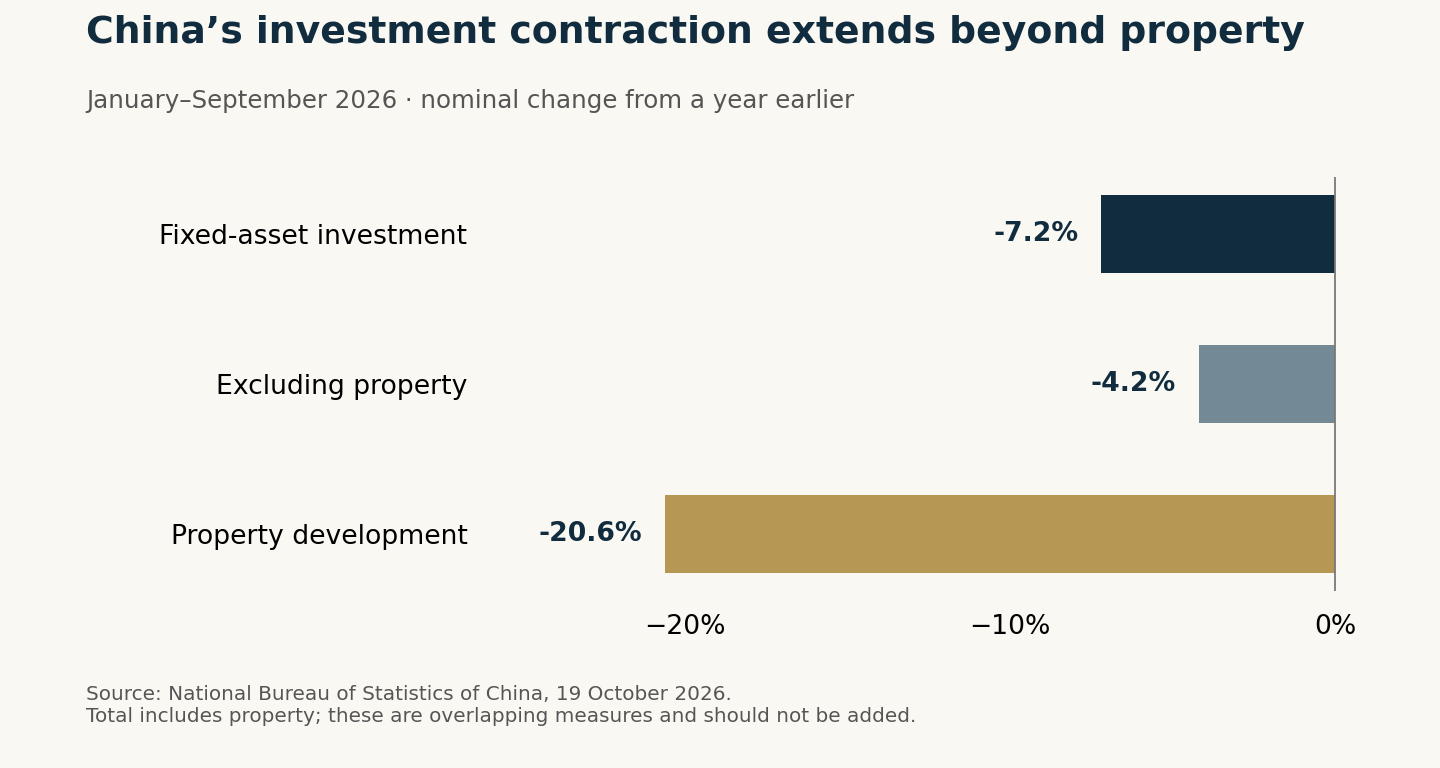
China’s third-quarter GDP rose 4.5% in real terms from a year earlier, following 4.3% in the second quarter. Fixed-asset investment, however, fell 7.2% in the first nine months on a nominal year-on-year basis. Property-development investment fell 20.6%; investment excluding property declined 4.2%.
These are different measures over different periods. Together, they describe an economy in which continued output growth coexists with a deep investment adjustment. They do not support a single, undifferentiated view of every Chinese asset.
The portfolio question is where earnings become distributable cash. Export-oriented manufacturers, domestic services, property-linked lenders and infrastructure projects have different customers, funding structures and collection risks. Committees should ask managers to separate revenue growth from cash conversion and to identify exposure to delayed payments and weak collateral.
There is also a case against reading the investment decline as a complete account of the economy: quarterly real GDP growth accelerated to 1.2% from the preceding quarter. Stronger activity can coexist with weak investment. A disciplined allocation needs evidence about the particular business and its financing, rather than a verdict drawn from one national number.
Support is a beginning. Allocation is another decision.
A statement supporting the Tropical Forest Forever Facility brings together 29 institutional investors and five supporting organisations, representing more than €10 trillion in assets. That is the scale of the signatories’ portfolios. It is not the amount invested in the facility, and the statement is not an investment commitment.
The appeal is clear: connect long-term capital with durable incentives to protect tropical forests. The underwriting questions are equally clear. What generates the investment return? Who takes losses first? How are conservation outcomes verified, and what happens when those outcomes deteriorate?
For an investment committee, safeguards for Indigenous peoples and local communities belong beside the financial structure. A credible nature strategy needs both. The next useful milestone is a structure investors can assess against their mandates, rather than a larger headline number for assets represented.
Canada’s energy split
Canadian consumer-price inflation rose to 3.1% in September from 3.0% in August. Excluding gasoline, the rate eased to 2.2% from 2.4%. The divergence matters more than a simple label of hotter or cooler inflation.
Higher energy prices can support one part of an institutional portfolio while increasing the living costs of its beneficiaries. The effect on liabilities depends on the indexation formula, timing and any caps. A beneficiary’s cash-flow pressure can arrive before the next formal adjustment.
The committee question is practical: which inflation exposures are hedged, which remain in the benefit promise, and which sit outside it? Treat the headline and the exclusion measure as complementary evidence; neither establishes the next interest-rate decision.
Japan’s long-duration test
Japan’s Ministry of Finance plans an offering of about ¥700 billion in 20-year government bonds on 20 October. The scheduled maturity is 20 September 2046.
For long-duration investors, the useful evidence will be the auction’s pricing and demand. For an investor funding liabilities in another currency, the comparison must also account for currency hedging, liquidity and capital requirements. An attractive nominal yield is only the starting point for that calculation.
Watch the clearing yield, the auction tail and the distribution of demand together. A single result may reveal pressure at a maturity; it should not carry an entire strategic allocation decision.
Three decisions, three kinds of evidence
Retirement income: request a clear map from the legal issuer to the assets, capital and liability protections. Keep the equity valuation separate from the promise to policyholders.
China: ask each manager for cash conversion, refinancing needs and exposure to property-linked counterparties. Country weights should be explainable through actual holdings.
Nature finance: separate institutional support, a signed commitment and cash invested. Require an investable structure and verifiable outcomes before treating endorsement as deployment.
What would change the argument?
A stronger outcome would combine a credible long-term owner for retirement obligations, improving cash generation in exposed Chinese businesses and a forest-finance structure with transparent loss allocation. The common benefit would be confidence in promises that can be tested.
A more difficult outcome would combine rapid growth in insurance liabilities, weak collections in investment-sensitive businesses and conservation claims that outrun the legal and financial structure. The common warning would be the same: attractive presentation without a clear path from assets to obligations.
These are analytical scenarios, not forecasts. The useful response is to define the evidence that would move an allocation decision before the next headline arrives.
Buy the promise carefully
Institutional capital is often judged on the transaction it can complete today. Its purpose is usually measured much later: benefits paid, claims honoured, spending sustained, forests protected.
That difference in time is the thread through this edition. A bid is not a completed acquisition. Economic growth is not cash collected. Support is not capital committed. Strong analysis preserves those distinctions while still recognising opportunity.
The best committee paper makes the bridge visible: what the institution owns, what it owes, who carries the risk and what would prove the thesis wrong.
Join the conversation at 10 a.m. Toronto
Ryan leads the discussion on retirement promises, China’s investment adjustment and the next test for forest finance. Bring the question your committee would ask first.
Find the programme at Universal Asset Owners Live. Share this edition with a colleague, and subscribe to receive the Daily Brief.
Join UAO LiveA long promise under the hammer

An auctioneer moves quickly. Retirement income moves at the pace of a lifetime. Today’s cartoon puts the two clocks on the same stage.
The scene is fictional. Challenger’s announced proposal remains conditional and non-binding.
Thank you for reading. Share the Daily Brief with a colleague and join the community at Universal Asset Owners.
Subscribe to the Daily BriefThe Editorial Team