
Good morning. The Daily Brief connects the news to the decisions facing sovereign funds, pensions, insurers, endowments and family offices.
Patience has a payment date
Private credit promises patient capital a premium for waiting. The difficulty begins when the investor’s own obligations stop waiting. The European Central Bank’s warning about renewed redemption gates brings that tension back to the centre of the investment committee’s agenda.
Elsewhere, development banks are preparing a broader route for institutional capital, while Qatar is using a fund partnership to deepen both investment access and local expertise. Together, these stories ask a question that sits beneath every allocation: what, exactly, has the institution bought — a return, a right to cash, or a capability it wants to build?
The answer belongs in the mandate and the cash plan. An attractive asset can still be an awkward source of money. A prestigious partnership can still need a sharper definition of success.
Three stories to carry into the week
Private credit faces the cash test
The ECB describes continuing outflows and renewed gates. Its assessment of limited direct euro-area exposure tempers the systemic warning; it does not settle the liquidity needs of an individual investor.
Development banks prepare a new channel
A proposed joint debt fund could make MDB-originated assets easier for institutions to access. The next important milestone is an investable structure with defined assets, risks and terms.
Qatar pairs capital with capability
Activate Capital joins QIA’s Fund of Funds programme and plans a Doha office. The partnership makes the case for measuring investment performance and local capability separately.
A redemption window is only the beginning
Christine Lagarde’s statement to the International Monetary and Financial Committee describes private-credit funds reporting outflows and reactivating redemption gates. It warns that the growth of semi-liquid vehicles can deepen liquidity mismatches, while judging private credit alone unlikely, for now, to destabilize the euro area because direct institutional exposure remains limited.
For an asset owner, the distinction is between the loan, the fund and the investor’s balance sheet. The borrower may continue paying interest. The fund may retain a stable valuation. Yet the investor may have to wait for a withdrawal. Those are three different facts about the same holding.
A gate can protect remaining investors from hurried sales. That protection has value. It also transfers a timing problem to investors whose benefit payments, collateral calls or new commitments still fall due. The committee needs to know whether it agreed to carry that timing risk, and what resources are available when it does.
Start with the documents. Notice periods, manager discretion, withdrawal limits, payments in kind and the treatment of queued requests determine what a dealing window actually delivers. A forecast should reflect those conditions before it treats a requested redemption as spendable cash.
Then examine the institution’s fallback. A credit line is helpful only on the terms available when it is needed. A liquid reserve cannot quietly support collateral, spending and new commitments at the same time unless it is large enough for all three. The test is whether the whole institution can meet its promises while one source of money waits.
Which payment would force us to change course if a planned receipt arrived later?
Build the cash calendar before the return forecast
Run a simple exercise before adding a market shock: delay a distribution while leaving the investment’s estimated value unchanged. The result isolates the cost of timing. If the institution must sell another holding, borrow or postpone a commitment, the cash plan has revealed a risk that a return forecast may conceal.
1. Payments
List benefits, operating support, debt service, collateral and commitments by date, currency and legal entity. A group-wide total can hide a payment that must be made from one particular account.
2. Receipts
Separate contractual cash from expected exits, refinancing and redemptions. Record the conditions that could move a receipt from one month to another.
3. Fallbacks
Test borrowing and saleable assets under the same circumstances that delayed the receipt. A backup dependent on the same counterparty or market may offer less independence than its label suggests.
4. Authority
Name the person who can act, the approval required and the time available. A reserve offers little comfort if the institution cannot authorize its use before settlement.
Development banks want a wider institutional audience
The heads of the multilateral development banks report progress towards a joint debt fund offering institutional investors access to a diversified pool of MDB-originated assets. The initiative follows market sounding with global asset managers and forms part of a broader effort to mobilize private capital.
For investors, the attraction is a route into assets that can otherwise require considerable origination and servicing capacity. A pooled structure could simplify access. It cannot remove the need to understand the claim the investor owns.
The central questions are structural: which loans or other assets enter the pool; how losses are shared; what obligations remain with the originators; and how currency, fees, valuations and access to cash are handled. The quality of the originating institution matters, but the instrument determines the investor’s rights.
The opportunity also cuts across mandates. A pension may seek dependable income. A sovereign fund may pair financial and development objectives. An insurer will examine the fit with its liabilities and applicable capital rules. Each needs a case built around its own constraints.
A formal launch, offering documents and a defined asset pool will be the milestones that move this initiative from an opportunity to monitor to a proposal that a committee can price. Assigning a diligence owner early is sensible; assuming an allocation before those terms exist is premature.
The investable terms: assets, loss allocation, currency, fees and withdrawal conditions.
Qatar is buying access — and building a team around it
Activate Capital has joined Qatar Investment Authority’s US$3 billion Fund of Funds programme. The growth investor plans its first international office in Doha, with senior investment professionals and a Qatar-focused partner, and intends to recruit local and international talent.
The partnership combines exposure to energy and infrastructure technology with an ambition to strengthen Qatar’s investment ecosystem. The programme’s size is not the amount committed to Activate. The individual commitment was not disclosed.
This is a mandate with two scorecards. The investment scorecard measures risk, fees and realized returns. The capability scorecard asks which decisions are made locally, what expertise is developed and whether the relationship produces durable access to opportunities.
An address is a starting point. The more consequential question is whether a local team has authority, resources and a role inside the manager’s investment process. Without those, a presence can remain administrative. With them, a partnership can help an allocator understand a sector and its opportunities more deeply.
For managers seeking sovereign partnerships, specificity strengthens the proposition: who will be based locally, what will they decide, and how will the institution judge progress? For the allocator, separating the two objectives makes both easier to defend.
One growth engine can sit inside several asset classes
At the IMF’s closing briefing, Kristalina Georgieva pointed to the economy’s resilience and the promise of AI, while warning about reliance on one dominant source of growth. IMFC chair Mohammed Aljadaan emphasized conflict-related risks to energy and food security and the need to rebuild fiscal buffers.
For a diversified institution, the practical issue is common demand. A software equity holding, a lender to a data-centre project and a property investment may all rely on related customers continuing to expand. The portfolio can contain several asset classes and still depend on one spending decision.
Follow the customer’s budget through the chain. Is demand supported by recurring operating income, a new financing round or a planned expansion? What must happen between a signed contract and collection? A business can report strong growth while its owners continue funding working capital and construction.
There is a constructive case to examine with equal care. New capacity can improve productivity and generate durable income. Contract renewals, utilization and cash collections can strengthen that case. A good risk review identifies the evidence that would support more investment as clearly as the evidence that would warrant restraint.
The useful portfolio report follows customers, financing dependencies and cash generation across managers. That is how the committee discovers whether diversification survives a common shock.
A name on a deal is not the size of a cheque
FINTRX’s third-quarter family-office research tracks participation in company financings and distinguishes the disclosed size of a round from the contribution of an individual investor. Those measures answer different questions.
A familiar family name may indicate access to a network or confidence in a business. It does not reveal the terms received, the proportion of wealth at risk or the rights available if the investment disappoints. A small minority position and a controlling investment should not become interchangeable signals of conviction.
For a family office evaluating a direct deal, keep participation, contribution and control on separate lines. Then ask who can challenge the case. Strong relationships can improve access and speed; a disciplined process gives contrary evidence a route into the decision.
The long liability still has a next payment
A pension’s ultimate horizon may span decades. Its benefits, collateral and investment commitments have nearer dates. Those obligations determine how much freedom the plan has to wait for a private asset to realize value.
An insurer must make a similar connection between the asset and the conditions under which its liabilities require cash. Expected return is only part of the fit. Currency, duration, settlement and the reliability of receipts can become decisive when several demands arrive together.
The liquid portfolio’s role should be explicit. If it is the institution’s emergency funding reserve as well as a source of return, its mandate and performance assessment need to recognize that responsibility. Otherwise the reserve can accumulate risks that undermine the reason it exists.
Buffers carry an opportunity cost, so the objective is usable flexibility rather than the largest cash balance. Define what each reserve protects, how its size is justified and which improvement in receipts would allow it to be reduced.
Better disclosure must lead to a different decision
UNEP FI’s Cali-to-Yerevan report card finds progress in the architecture of nature finance alongside a continuing gap in implementation. It calls for financial institutions and governments to turn frameworks into measurable changes in financing.
For an asset owner, that begins with operating exposure. Which activities depend on water, land conditions or ecosystem services? How could a constraint affect production, costs or access? A useful analysis describes the route from an environmental dependency to the investment’s cash flows.
The next question is influence. A controlling owner, minority shareholder and lender hold different rights. The proposed action should identify who can make the change, what it will cost and which result would demonstrate progress.
A board can ask for five connected elements: dependency, exposure, action, authority and result. Better reporting may help establish them. It becomes investment evidence when it changes a decision or shows what an earlier decision achieved.
Decide who can act before the money is needed
A liquidity policy becomes real when someone must sell, borrow, pause a commitment or seek additional information. Broad descriptions of responsibility can leave those decisions unresolved precisely when time matters most.
Review the approval timetable alongside the payment timetable. Which actions sit with staff, which require a committee and which need the board? Are the relevant people available, and does the information reach them in a form they can use?
Keep the decision record short and specific: the assumption accepted, the risk acknowledged and the evidence that would prompt reconsideration. This helps a future reviewer distinguish a sound decision overtaken by events from a weak process rescued by a favourable outcome.
The chair also needs a practical route for challenge. The most useful dissent explains how an investment could disappoint and what supports that concern. It should reach the decision before the deadline.
Change the sequence. Watch the decision.
Three planning cases help reveal where the institution’s freedom of action comes from. They are exercises for the portfolio, not predictions of market outcomes.
Receipts arrive later
Keep estimated asset values broadly unchanged and delay distributions or redemptions. Identify the first payment that needs a different source of funding. The remedy may concern timing and reserve design before it concerns asset selection.
The fallback becomes conditional
Add tighter borrowing terms, weaker collateral or less favourable sale prices. Recalculate usable capacity after applying those conditions. A facility’s headline amount is not always the amount the institution can draw.
Operating cash improves
Specify the collections, exits or recurring payments that would justify resuming commitments or releasing a buffer. A disciplined process should recognize improving evidence as readily as deterioration.
Monday’s releases, and the questions behind them
China · Growth with an uneven domestic recovery
China’s National Bureau of Statistics reports third-quarter GDP growth of 4.5% from a year earlier, following 4.3% in the second quarter. September industrial output rose 5.5% year on year. The nine-month picture remains uneven: retail sales of consumer goods increased 1.1%, while fixed-asset investment fell 7.2%. For allocators, the distinction between industrial strength and domestic demand matters for earnings, commodities and financing exposure.
Canada · Inflation rises to 3.1%
Canada’s annual CPI inflation edged up to 3.1% in September from 3.0% in August, Statistics Canada reports. Gasoline drove the acceleration. Excluding gasoline, annual price growth eased to 2.2% from 2.4%. The split matters for asset owners reviewing indexed liabilities and rate-sensitive holdings: an energy shock and broader price pressure can require different portfolio responses.
Bank of Canada · Surveys at 11:30 a.m. Toronto
The business and consumer surveys will add evidence on pricing, hiring and spending expectations. Compare what firms intend with the demand that households expect to support.
Today’s UAO Live explores the inflation picture and private credit’s cash-flow test.
Open seats at long-horizon institutions
Norges Bank Investment Management
Portfolio Manager, Fixed Income Asia — applications close 21 October. Head of Mandates and Real Asset Risk, Oslo — applications close 26 October.
GIC · Singapore
AVP, External Managers, Portfolio Construction and Risk — Macro, Fixed Income and Credit. The role combines manager evaluation, portfolio construction and investment-risk analysis.
Application details and requirements are available through the employers’ careers pages.
Protect the institution’s right to be patient
A long horizon gives an investor the option to wait. That option is supported by dependable receipts, usable reserves and authority to act. It becomes fragile when several teams rely on the same conditional source of money.
The strongest committee conversation starts with a precise question. Is the concern credit quality, valuation, a withdrawal condition, settlement or the timing of the institution’s own obligations? Each requires different evidence and a different response.
For the next meeting, ask each team to bring one assumption that protects the institution’s freedom of action. Name the receipt, the obligation it supports and the event that would make the assumption change. Reconcile the answers across the whole portfolio. Patience is most valuable when the institution can afford to keep it.
Open for requests
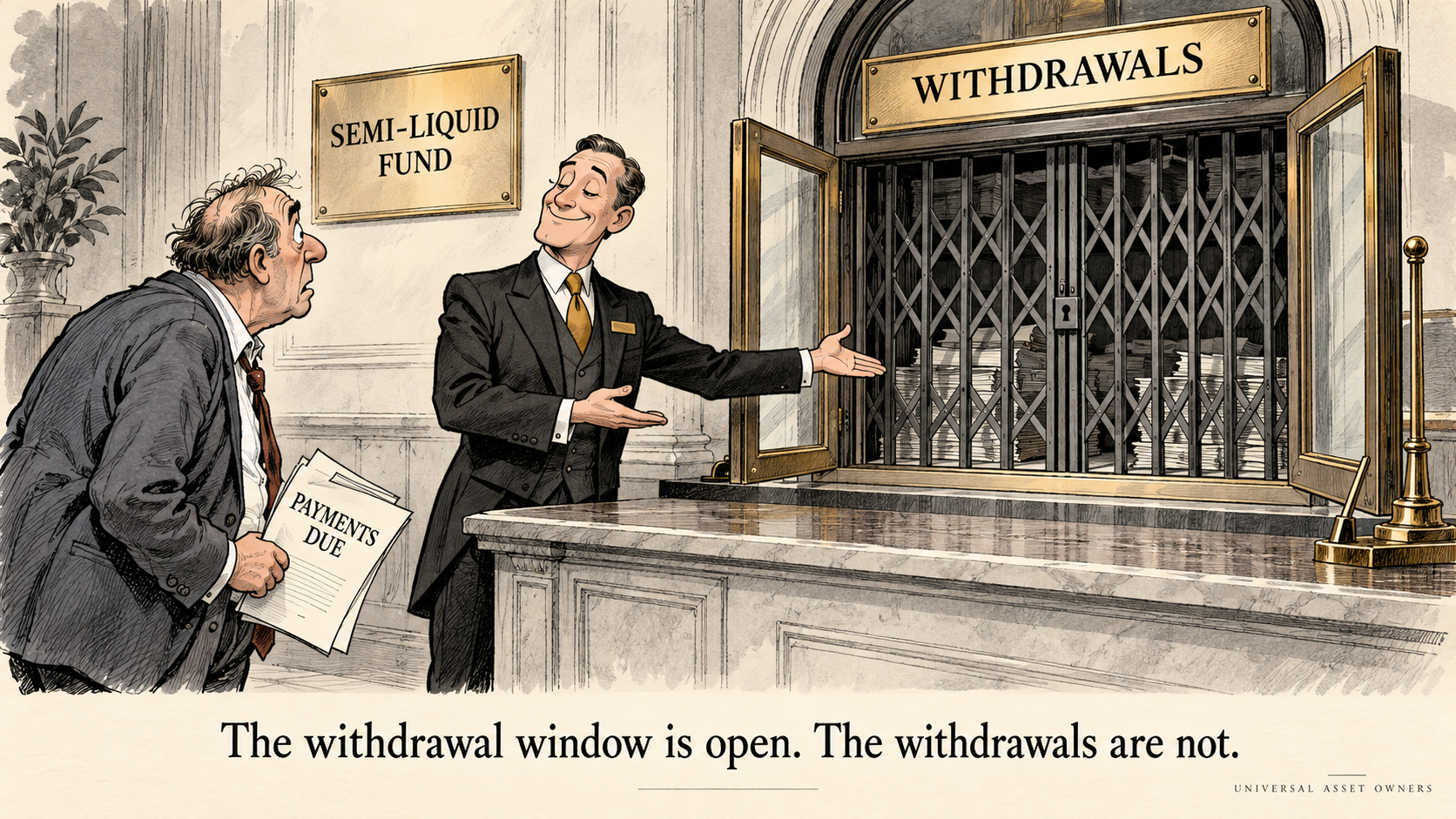
The withdrawal window is open. The withdrawals are not.
An investor brings payments due to a semi-liquid fund. The concierge welcomes him to the open window. The locked gate behind it has other ideas.
The characters and fund are fictional.
Thank you for reading Universal Asset Owners. If this edition was forwarded to you, join the Daily Brief for reporting and analysis on the world’s long-horizon capital.
European Central Bank, IMFC statement, 17 October; joint statement of MDB heads, 17 October; Qatar Investment Authority, Activate Capital announcement, 15 October; IMF closing press briefing, 17 October; FINTRX, Q3 family-office research; UNEP FI, Cali-to-Yerevan report card; National Bureau of Statistics of China, third-quarter activity release, 19 October; Statistics Canada, September CPI, 19 October; Bank of Canada release calendar; NBIM and GIC careers pages.
Universal Asset Owners · Capital at the scale of the world.