
98% of the world’s sovereign wealth funds |
18 of 20 of the world’s largest pension funds |
10 of 10 of the largest charitable foundations |
85% of the world’s largest family offices |
100+ billionaires, every morning |
FOLLOW UAO
|
LISTEN The Universal OwnerToday's episode: Qatar keeps writing cheques, but only big ones, plus US inflation at 3.7% and the UK pension surplus. About 6 minutes. |
TODAY IN 90 SECONDS
|
OPENING THESIS Two numbers frame today. Qatar's government revenue is reported to have fallen 42% in the first half of 2026. Yet Qatar's sovereign fund says it is still deploying. That combination suggests how Gulf capital may behave for the rest of this war: it keeps moving, but in fewer, larger blocks through a handful of trusted partners. The second number is 3.7%, US headline inflation for September. Sticky inflation keeps long yields high, and high yields pull two ways for asset owners. For schemes that discount liabilities at market yields, they shrink the present value of defined-benefit liabilities, which helps explain why UK schemes now sit on a £280.7bn surplus. They also raise the cost of the leverage that private credit and data-centre finance depend on. Put the two together and the opportunity set for patient capital is changing shape. Large platforms get easier to fill. Mid-market fund closes that relied on a Gulf anchor get harder. Funded pensions get more options, including buying out risk altogether. The counterclaim deserves a hearing. Gulf funds have said before that they remain committed, and fiscal pressure has a way of winning in the end. Kuwait has already opened its Future Generations Fund to government borrowing. The test is whether the platform deals turn into deployed capital, and whether the transfers to budgets grow. |
THE LEAD Qatar's wealth fund keeps writing cheques, but only big onesKey takeaway. The Qatar Investment Authority says the war has not slowed its deployment. In its funds programme, new money is going into a few large platform deals with long-standing partners, and no new fund deals are "on the radar," according to its head of funds. For managers who counted on a Gulf anchor, that is the change that matters. What happened. Mohsin Pirzada, QIA's head of funds, told Semafor on 14 October that the war "hasn't impacted our progress." Pirzada said: "We continue to invest, we continue to deploy." Pirzada added that QIA is "very mindful that we manage the surplus wealth for the state of Qatar." QIA manages around $580bn, Semafor reports. Pirzada said no new fund deals are "on the radar." Instead QIA expects "a handful of strategic platform arrangements" with institutions such as JPMorgan and Goldman Sachs. Those two platforms are already on paper. On 21 September QIA and J.P. Morgan Asset Management announced a $20bn strategic partnership. It is a memorandum of understanding with two parts: a $15bn public equities mandate and a $5bn private markets programme providing senior financing to US middle-market companies. In January QIA and Goldman Sachs signed an MoU targeting $25bn of commitments to Goldman funds and co-investments, subject to terms and conditions. The backdrop is severe. Semafor reports that Qatar's government revenue fell 42% in the first half of 2026 (REPORTED; Ministry of Finance quarterly figures put first-half revenue at about QR63.4bn). Qatar's Ministry of Finance says revenue was about QR37.8bn in the first quarter and about QR25.6bn in the second, with deficits of QR10.3bn and QR21.2bn. The IMF's October outlook projects Qatar's economy will contract 15.6% this year, according to press reports of the forecast tables. Why it matters to a universal owner. The interview covered QIA's funds programme, not every deal it makes. But GlobalSWF counts $102bn of deployment by Middle East sovereign investors in the first nine months of 2026, 39% of global state-investor dealmaking. QIA accounted for $10.3bn of that and Mubadala for $26.2bn. The money has not stopped, but its route has narrowed. Platform mandates run through a few global banks and managers. A blind-pool fund that hoped for a Gulf anchor at final close now competes for less money. Pension funds and endowments that co-invest alongside Gulf capital should expect more competition for large deals and more room in mid-market closes. The underappreciated signal. The phrase "surplus wealth" is doing a lot of work. QIA's mandate is to invest money the state does not need. The war has squeezed the state's finances, as the deficits above show. Alhurra reports that, according to S&P, Qatar's government was relying in 2026 on a combination of borrowing and asset drawdowns to finance its deficit (REPORTED, 4 Sep: alhurra.com). Kuwait went further on 1 September, allowing its government to borrow from the Future Generations Fund within set limits. The countercase. This may be the wrong signal to read. QIA's nine-month deployment of $10.3bn is modest for a fund of its size, and GlobalSWF's 2026 MENA Playbook puts the region's total below 2023–25 levels (Khaleej Times). Platform MoUs are targets, not deployed capital. If oil stays high and Hormuz reopens on the IMF's timetable (from March 2027, as reported), the fiscal squeeze eases and fund commitments could return. If the war drags on, the transfers could run the other way. What to watch. Whether the JPMorgan and Goldman MoUs become signed mandates. Whether Qatar's third-quarter budget shows a transfer from QIA. Kuwait's first draw from the Future Generations Fund. And whether other Gulf funds follow the platform-only line. Sources: Semafor, 14 Oct 2026 (REPORTED, on-record interview): semafor.com · J.P. Morgan Asset Management, 21 Sep 2026: am.jpmorgan.com · Goldman Sachs, 20 Jan 2026: goldmansachs.com · Qatar News Agency (Ministry of Finance), 25 May and 8 Sep 2026: qna.org.qa, qna.org.qa · GlobalSWF, 2 Oct 2026: globalswf.com · IMF Qatar forecast (REPORTED, The National, 13 Oct): thenationalnews.com |
TOP STORIES 1. US inflation rises to 3.7% (Macro) Consumer prices rose 0.6% in September and 3.7% from a year earlier, up from 3.4% in August, the Bureau of Labor Statistics said on 14 October. Gasoline rose 9.1% in the month. Core prices, excluding food and energy, rose 0.3% for a second month and 2.6% over the year. Quartz reported that the 10-year Treasury yield rose about 9 basis points to around 5.30% during trading after the release (REPORTED; other outlets reported lower levels, so check the official close). Why it matters: energy is pushing headline inflation up while core is steadier, which keeps long yields high. That lowers the present value of defined-benefit liabilities and raises the cost of leverage. Source: BLS CPI release, 14 Oct: bls.gov · Quartz: qz.com 2. Bowman: "some time to wait" (Rates, REPORTED) Speaking in Bangkok on 14 October, Fed Vice Chair for Supervision Michelle Bowman said: "We have some time to wait and see how financial conditions evolve before we take more action." The Fed raised rates by 25 basis points in September to a range of 3.75–4.00%. The next policy meeting is 27–28 October. Why it matters: the Fed appears willing to let the bond market do some of the tightening. That lowers the odds of an October move but leaves December open. Source: Asianet Newsable, 14 Oct: newsable.asianetnews.com · Fed calendar: federalreserve.gov 3. UK pension surplus reaches £280.7bn (Pensions) The PPF 7800 index, which covers 4,838 UK defined-benefit schemes, shows an aggregate surplus of £280.7bn at end-September, up £7.1bn on the month. The funding ratio rose to 135.0%. Assets were £1,081.9bn against liabilities of £801.2bn; liabilities fell faster than assets. Schemes still in deficit were short a combined £20.5bn. Why it matters: rising yields have turned UK pensions from forced buyers of gilts into owners of a large surplus. The choice between buying out, running on and sharing the surplus is now live. Source: Pension Protection Fund, PPF 7800 index: ppf.co.uk · Professional Pensions, 13 Oct: professionalpensions.com 4. Bank of America's profit falls 17% after a $1.2bn penalty (Banks, REPORTED) Bank of America reported third-quarter net income of $6.93bn, or $0.91 a share, down 17%, after a $1.2bn penalty over anti-money-laundering control failures. Net interest income rose 8% to $16.4bn. Why it matters: bank earnings are strong at the interest line, but compliance costs are rising. For owners of bank equity and debt, conduct risk is a balance-sheet item. Source: Yahoo Finance, 14 Oct: finance.yahoo.com 5. ASML reports record sales and says supply will lag AI demand (AI / semiconductors) ASML reported third-quarter net sales of €11.7bn and net income of €5.0bn, with a gross margin of 57.5%. It guided fourth-quarter sales of €14.2–15.2bn and full-year 2026 sales of €44–45bn. Chief executive Christophe Fouquet said customers keep raising their forecasts, "driven primarily by their views on the size and duration of AI-related investments." Why it matters: the upstream supply chain shows AI capex still accelerating, even as debt investors grow more selective. Source: ASML release, 14 Oct: globenewswire.com 6. China's exports rise 36.3% in September (Trade, REPORTED) China's exports rose 36.3% from a year earlier and imports 31%, according to customs data reported by AP. The monthly trade surplus was $133.5bn, and the January–September surplus reached $938bn. Why it matters: a surplus this large invites trade pressure from Europe and the US, even under the current US–China truce. That is a risk for reserve managers holding renminbi and for Asian equity books. Source: AP via ABC News, 13 Oct: abcnews.com 7. Redemption requests at non-traded BDCs ease but stay above the cap (Private credit, REPORTED) Fitch says redemption requests at 13 of 15 perpetual non-traded business development companies averaged 9.8% of shares in the third quarter, down from 10.3% in the second. Nine funds received requests above their 5% quarterly cap. Why it matters: semi-liquid private credit is still under strain. Institutions that co-invest alongside retail evergreen vehicles face spillover in valuations and deal flow. Source: InvestmentNews, 13 Oct: investmentnews.com |
CHART OF THE DAY Who is still writing the cheques (Middle East sovereign deployment, January–September 2026, US$bn)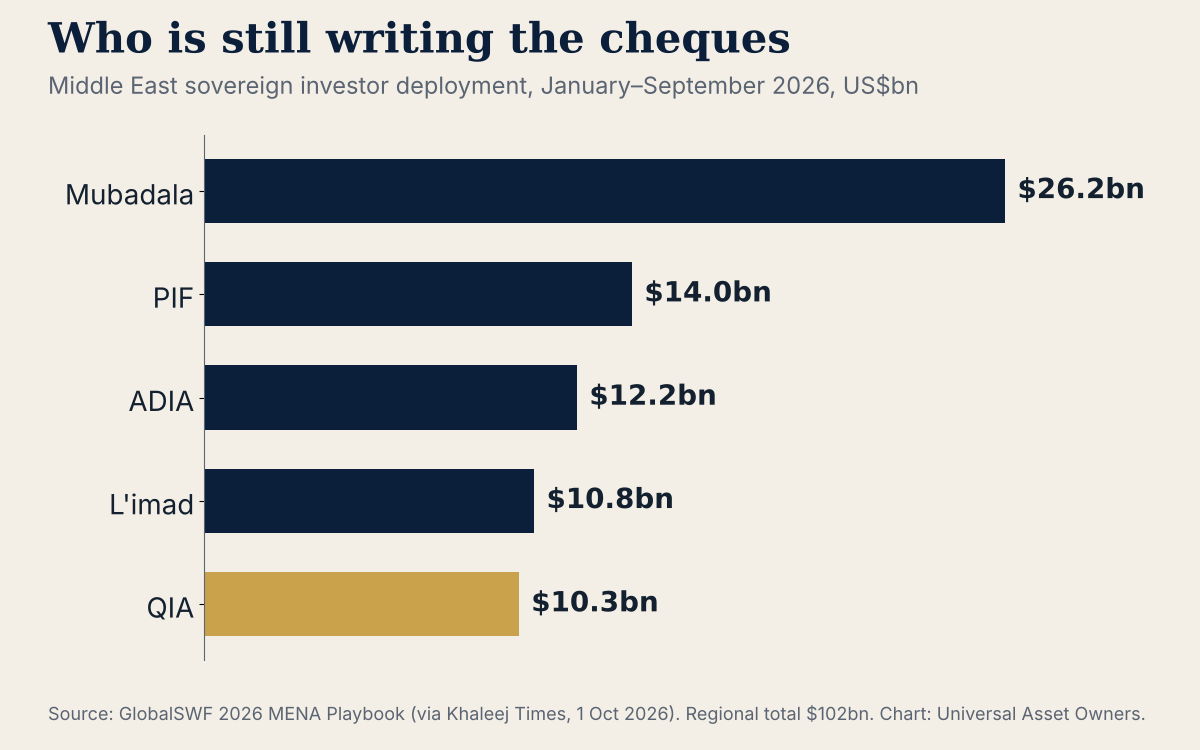 Mubadala deployed more than any other Middle East sovereign investor in the first nine months of 2026. QIA, which says the war has not slowed it, deployed $10.3bn. Source: GlobalSWF 2026 MENA Playbook, via Khaleej Times (1 Oct 2026). Chart: Universal Asset Owners. |
SOVEREIGN WEALTH MONITOR
|
GULF CAPITAL BRIEFING
|
PENSION FUND STRATEGY WATCH
|
DEALS, PRIVATE MARKETS & CAPITAL FLOW WATCH
|
AI AND THE LONG-TERM PORTFOLIO
|
ESG, CLIMATE & ENVIRONMENT
|
GOVERNANCE & STEWARDSHIP
|
FAMILY OFFICE WATCH
|
THE UNIVERSAL OWNER RISK RADAR
|
PEOPLE MOVES
|
JOBS BOARD All checked live on the employer's own careers system, 14 Oct 2026; compensation not listed here by house rule.
|
SCENARIO "Gulf capital under fiscal strain" (DS-20261015-GULF)The question: Over the next 12 months, do Gulf sovereign funds keep deploying abroad at their 2026 pace, or does the fiscal squeeze pull money home? Scenario 1 — Platforms carry on (45%). Oil stays high and Hormuz reopens from March 2027, on the IMF's reported timetable. Gulf funds keep deploying through a few large bank and manager platforms, and fund commitments recover slowly in 2027. For a universal owner: more competition for large co-investments; mid-market closes stay hard for GPs and more open for pensions. Scenario 2 — Quiet transfers (35%). The war drags on. Kuwait draws on the Future Generations Fund and Qatar funds part of its deficit from sovereign assets, while headline deals continue. For a universal owner: Gulf funds sell liquid assets and slow new commitments. Secondary-market supply of Gulf LP stakes rises. Scenario 3 — Retrenchment (20%). A downside oil shock or a longer Hormuz closure forces larger transfers. Gulf deployment falls sharply in 2027 and platform MoUs stall. For a universal owner: a big marginal buyer of US and UK assets steps back. Infrastructure, private credit and late-stage tech pricing feel it first. Signposts: Qatar's Q3 budget release · any Kuwaiti draw on the Future Generations Fund · whether the QIA–JPMorgan and QIA–Goldman MoUs become signed mandates · GlobalSWF's year-end tally against its $136bn projection · oil prices and Hormuz shipping. Probabilities are the editorial desk's judgement, not forecasts. |
DEEP DIVE Gulf capital under fiscal strain: the platform eraFor two decades the Gulf's sovereign funds have been the most dependable buyers in global private markets. They anchored first closes, wrote large co-investment cheques and stayed patient through cycles. The Iran war is testing that role. The evidence so far says the money has not stopped. But it is moving through a much narrower door, and the shape of that door matters to every other long-term owner. What the funds are saying. On 14 October QIA's head of funds, Mohsin Pirzada, told Semafor that the war "hasn't impacted our progress" and that QIA continues "to invest" and "to deploy." QIA's head of funds was equally clear that no new fund deals are "on the radar", and that QIA expects "a handful of strategic platform arrangements" instead. Mubadala has given the same signal from Abu Dhabi. Its deputy group chief executive told Bloomberg on 13 October that UK investment is "its own separate process" from the Manchester City dispute, and its finance chief said on 7 October that the fund plans to keep deploying about $39bn a year, roughly 10% of its portfolio. What the numbers show. GlobalSWF counts $102bn of deployment by Middle East sovereign investors in the first nine months of 2026, 39% of global state-investor dealmaking. Mubadala led with $26.2bn, ahead of PIF ($14.0bn), ADIA ($12.2bn), L'imad ($10.8bn) and QIA ($10.3bn). Some 45% went to the US. GlobalSWF projects $136bn for the full year, which would be the second-busiest on record, Semafor reports. But GlobalSWF's Playbook also notes, per Khaleej Times, that the nine-month figure is below 2023–25 levels in both absolute and relative terms. The Gulf is still buying, but it is no longer setting the pace. What the platforms look like. The QIA–J.P. Morgan Asset Management partnership announced on 21 September is a useful template. It is a $20bn memorandum of understanding split between a $15bn public equities mandate and a $5bn senior lending programme for US middle-market companies. The QIA–Goldman Sachs MoU from January targets $25bn of commitments to Goldman funds and co-investments and will make Doha Goldman's largest regional asset management office. Both are large, both run through global banks, and both are subject to terms. Neither is a blind-pool commitment to an independent manager. Why the door is narrowing. The fiscal arithmetic has changed. Qatar's Ministry of Finance reported revenue of about QR37.8bn in the first quarter and about QR25.6bn in the second, with deficits of QR10.3bn and QR21.2bn. Semafor reports a 42% fall in first-half revenue. The IMF's October outlook, as reported, projects Qatar's economy will shrink 15.6% this year before rebounding in 2027. Kuwait has gone furthest: a decree published on 1 September lets the government borrow from the Future Generations Fund. Annual borrowing is capped at the fund's average returns over five years and outstanding loans at 10% of its net asset value. PIF said in April that major projects would get a reduced financial contribution from the fund (REPORTED, Al Arabiya, 15 Apr: english.alarabiya.net). A sovereign fund that manages "surplus wealth" has a problem when the state's finances tighten. The rational response is to keep the relationships that give the best access and fees, and to stop adding new ones. Platform deals do exactly that. They also concentrate counterparty relationships, which makes future pullbacks quieter and easier. What it means for other universal owners. First, expect more competition for large, bank-led co-investments, where Gulf money is still active. Second, expect less competition in mid-market fund closes, where a Gulf anchor used to set terms. Pensions and endowments with dry powder may find better economics there. Third, watch for secondary supply. If transfers to budgets grow, Gulf LP stakes are a natural source of liquidity, and secondaries buyers will be the first to see it. The countercase. It is possible to read too much into one interview. Gulf deployment remains very large, and platform MoUs can carry more capital than a dozen fund commitments. If Hormuz reopens on the IMF's timetable and oil holds, revenue recovers quickly, and the IMF's own forecast has Qatar's economy rebounding 18.8% in 2027, as reported. On that path, 2026 will look like a pause, not a turn. What to watch. Qatar's third-quarter budget, any Kuwaiti draw on the Future Generations Fund, the conversion of the JPMorgan and Goldman MoUs into signed mandates, and GlobalSWF's full-year count against its $136bn projection. Sources: Semafor (14 Oct, 5 Oct); J.P. Morgan Asset Management (21 Sep); Goldman Sachs (20 Jan); QNA/Qatar Ministry of Finance (25 May, 8 Sep); GlobalSWF (2 Oct); Khaleej Times (1 Oct); The National (7 Oct, 13 Oct); Arab News on Kuwait's Future Generations Fund decree (2 Sep): arabnews.com; The National on Mubadala's annual deployment: thenationalnews.com |
THE TAKE QIA's anchor seat is empty. Good. For years mid-market private equity has leaned on a familiar crutch: a Gulf sovereign at first close, with terms set to suit. QIA's comments this week say that, at least from Doha, the crutch is gone for now. No new fund deals are "on the radar." The money will flow through a few large platforms run by global banks. That should worry managers whose fundraising plan assumed a Gulf anchor. It should please everyone else. Pension funds and endowments have spent a decade competing with sovereign cheques that were bigger, faster and less sensitive to price. With that competition thinning in the mid-market, patient owners with real dry powder can ask for better economics, tighter terms and co-investment rights they rarely got before. The strongest objection is that this is temporary. Oil could recover, Hormuz could reopen and the Gulf could return in force in 2027. That is possible, and the IMF's own numbers point that way. But a fund that has learned to deploy through a handful of relationships instead of dozens is unlikely to rebuild the dozens quickly. Platforms are efficient, and efficiency sticks. The owners who benefit will be the ones who move now, while the anchor seat is empty, and who write the terms they always wanted. — The Deputy Editor |
WHAT TO WATCH (TIMES EDT) Today, Thursday 15 October: - US data: September producer prices and advance retail sales, 8:30. bls.gov - TSMC third-quarter earnings call, 14:00 Taipei time (02:00 EDT). investor.tsmc.com - G20 finance ministers and central bank governors meet in Bangkok during the IMF and World Bank Annual Meetings, which run to 18 October. - Fed balance sheet (H.4.1): 16:30. federalreserve.gov Friday 16 October: Kevin Warsh of the Federal Reserve in a fireside chat with IMF Managing Director Kristalina Georgieva in Bangkok (23:30 EDT on 15 October); US industrial production, 9:15. federalreserve.gov Ahead (sources: Barraud week-ahead, Oklahoma Watch): Baillie Gifford US Growth Trust meeting with Saba, 23 October · FOMC, 27–28 October · Monte dei Paschi shareholder meeting, 29 October · Oklahoma's proxy-adviser law takes effect, 1 November. |
WORTH READING
|
THE BACK PAGE 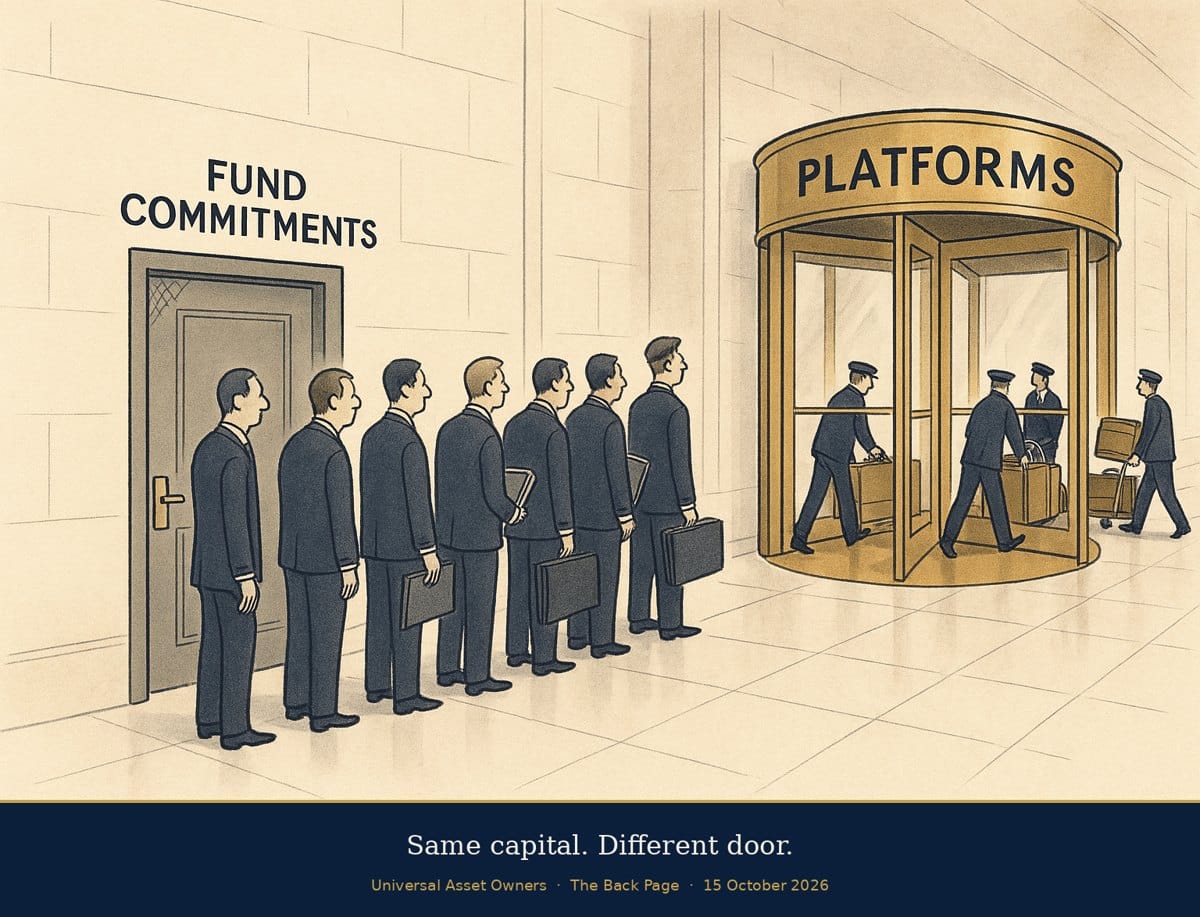 |
Number of the Day: 135.0%. The aggregate funding ratio of 4,838 UK defined-benefit pension schemes at the end of September, with a combined surplus of £280.7bn. Higher yields have done what a decade of contributions could not. Source: PPF 7800 index: ppf.co.uk Quote of the Day: "Even patient capital can be caught up in the fear of missing out." Bill Ringham, RBC Wealth Management–U.S., on family offices and AI (REPORTED, CNBC Inside Wealth, 12 Oct). On This Day, 15 October 2014: the US Treasury "flash rally." Between 9:33 and 9:39 in the morning the 10-year yield fell 16 basis points, and it had reversed by 9:45, with no clear cause. Five US agencies, including the Treasury, the Fed and the SEC, published a joint staff report on the episode in July 2015. It still shapes how owners think about liquidity in their safest asset. Sources: treasurydirect.gov · sec.gov The Question: If the Gulf anchor seat at your managers' next fund close is empty, will you take it, and on what terms? Today's cartoon: a queue of fund managers with pitch books waits at a small door marked FUND COMMITMENTS, while porters wheel trunks through a gleaming revolving door marked PLATFORMS. Same capital. Different door. — The Editorial Team |
The Editorial Team Universal Asset Owners · universalassetowners.com |
Independent intelligence for long-horizon capital. Sponsored placements are paid advertising, chosen by our ad partners, and are not endorsed by Universal Asset Owners. |