
98% of the world’s sovereign wealth funds |
18 of 20 of the world’s largest pension funds |
10 of 10 of the largest charitable foundations |
85% of the world’s largest family offices |
100+ billionaires, every morning |
FOLLOW UAO
|
LISTEN The Universal OwnerToday's episode: nature gets a common yardstick, and the IMF asks how liquid pensions really are. About 8 minutes. |
THE LEAD Nature gets a common yardstickOn 13 October the three bodies that shape how companies measure nature put out aligned guidance in one release. The Taskforce on Nature-related Financial Disclosures (TNFD) issued version 2.0 of its LEAP assessment approach, the first upgrade since version 1.0 in September 2023. The Science Based Targets Network issued its Science-Based Targets for Nature 2.0. The Nature Positive Initiative (NPI) published four core "state of nature" indicators: ecosystem extent, ecosystem condition, species extinction risk and species populations. The numbers behind the indicators show how much they compress. According to the joint release, NPI reviewed more than 600 existing metrics and cut them to four. The work took two years and more than 500 experts, was approved by NPI's 27 core members, and was piloted by 29 companies in six sectors at more than 50 sites in 23 countries. LEAP v2.0 adds state-of-nature measurement, environmental crime and invasive alien species, plus more guidance for financial institutions assessing their portfolios. TNFD chief executive Tony Goldner said the approaches should "work together in a practical and mutually reinforcing way." Why it matters to a universal owner. A fund that owns a slice of nearly every listed company cannot sell its way out of ecosystem decline. That loss shows up as a system-wide cost: lower yields, supply-chain breaks and insurance losses across the whole book. Until now the obstacle has been measurement. Hundreds of incompatible metrics made portfolio-level aggregation close to impossible. Four shared indicators, built into the widely used TNFD process, give stewardship teams a common question to put to every investee and a basis for comparing the answers. The other side. The indicators are voluntary, and the pilot covered 29 companies, not thousands. Site-level ecosystem data remains expensive and patchy, and the US policy climate is hostile to new sustainability disclosure. Sceptics will say a cleaner framework does not by itself produce better data. That is fair. The test is whether the ISSB, which has been researching nature-related disclosure, and national regulators adopt these indicators, and whether companies report against them in 2027. What to do. Ask managers and the stewardship team which of the four indicators portfolio companies in high-impact sectors (food, materials, extractives, utilities) can report now. Map the gaps before the CBD COP17 biodiversity summit in Yerevan later this month sets the policy tone. Source: TNFD / SBTN / Nature Positive Initiative joint release, 13 Oct 2026: tnfd.global |
TOP STORIES 1. The IMF says pensions and insurers are holding more illiquid assets (Risk) Presenting the IMF's Global Financial Stability Report on 13 October at the Annual Meetings in Bangkok, IMF officials said "insurance and pension funds hold more illiquid assets, raising risks in a downturn." They added that private credit faces higher leverage and "growing liquidity pressures, which could restrict lending." IMF officials named three triggers: rising sovereign yields, an AI-related correction, and cyber incidents. Why it matters: this is the official sector naming asset owners as a channel of stress, not only as shock absorbers. Expect supervisors to ask about liquidity coverage under stress. Source: IMF media centre, GFSR, 13 Oct: mediacenter.imf.org 2. IMF sees 3.1% growth and 4.7% inflation, and warns the margins of adjustment are "rapidly narrowing" (Macro) The October World Economic Outlook projects global growth of 3.1% in 2026 and 3.4% in 2027, with global inflation of 4.7% in 2026, driven mainly by energy and food. Deniz Igan, a division chief in the IMF Research Department, said the resilience is "becoming increasingly uneven." Why it matters: growth with inflation at this level is the setting in which stocks and bonds can fall together. Strategic real-return assumptions deserve a fresh look. Source: IMF media centre, WEO, 13 Oct: mediacenter.imf.org 3. JPMorgan builds reserves; Dimon lists "rising interest rates" among the risks (Credit) JPMorgan's third-quarter filing shows net income of $15.3bn ($5.57 a share; $15.8bn excluding $658m of securities losses), a $2.7bn credit provision including a $539m reserve build, and a CET1 ratio of 13.9%. Jamie Dimon cited "large fiscal deficits, sticky inflation, elevated asset prices, rising interest rates and geopolitical conditions." Fortune reported that earnings per share missed consensus (REPORTED). Why it matters: the biggest US lender is adding to reserves even as trading revenue rises, which is a read-across for private credit marks. Source: JPMorgan Q3 2026 earnings release (SEC 8-K, Ex. 99.1), 13 Oct: sec.gov 4. ESMA sets out good and bad practice for "impact" and "transition" claims (ESG regulation) On 12 October ESMA published two thematic notes on sustainability claims: one on impact claims made through funds and bonds, one on climate-transition claims across funds, bonds and benchmarks. ESMA says the notes create no new requirements and do not prejudge the SFDR review. Why it matters: EU asset owners buying or marketing impact and transition mandates now have the supervisor's yardstick for greenwashing. Source: ESMA, 12 Oct: esma.europa.eu 5. PGGM backs a risk transfer on €5bn of ING loans (Pensions / private credit, REPORTED) Bloomberg reported on 13 October that Dutch pension manager PGGM agreed to back a significant risk transfer tied to €5bn of ING loans. Only the headline could be verified. Why it matters: pension capital is taking on bank credit risk directly, a fast-growing corner of private credit. Source: Bloomberg headline, 13 Oct (REPORTED); PGGM's credit-risk-sharing programme: pggm.nl 6. Oil: Brent above $100 as Gulf shipping risk persists (Geopolitics, the day's one item, REPORTED) Brent settled at $105.69 and WTI at $94.14 on 13 October, according to Newsquawk, which also reported Houthi warnings to civilians near Aramco facilities. Why it matters: energy is the main driver of the IMF's 4.7% inflation call. Source: Newsquawk wrap, 13 Oct (REPORTED). |
SOVEREIGN WEALTH & GULF CAPITAL
|
PENSION FUND STRATEGY WATCH
|
ESG, CLIMATE & STEWARDSHIP
|
FAMILY OFFICE WATCH A quiet window: no verifiable family-office transaction in the last 48 hours cleared our sourcing bar. |
CHART OF THE DAY The 2026 Treasury sell-off (2-year and 10-year par yields, %)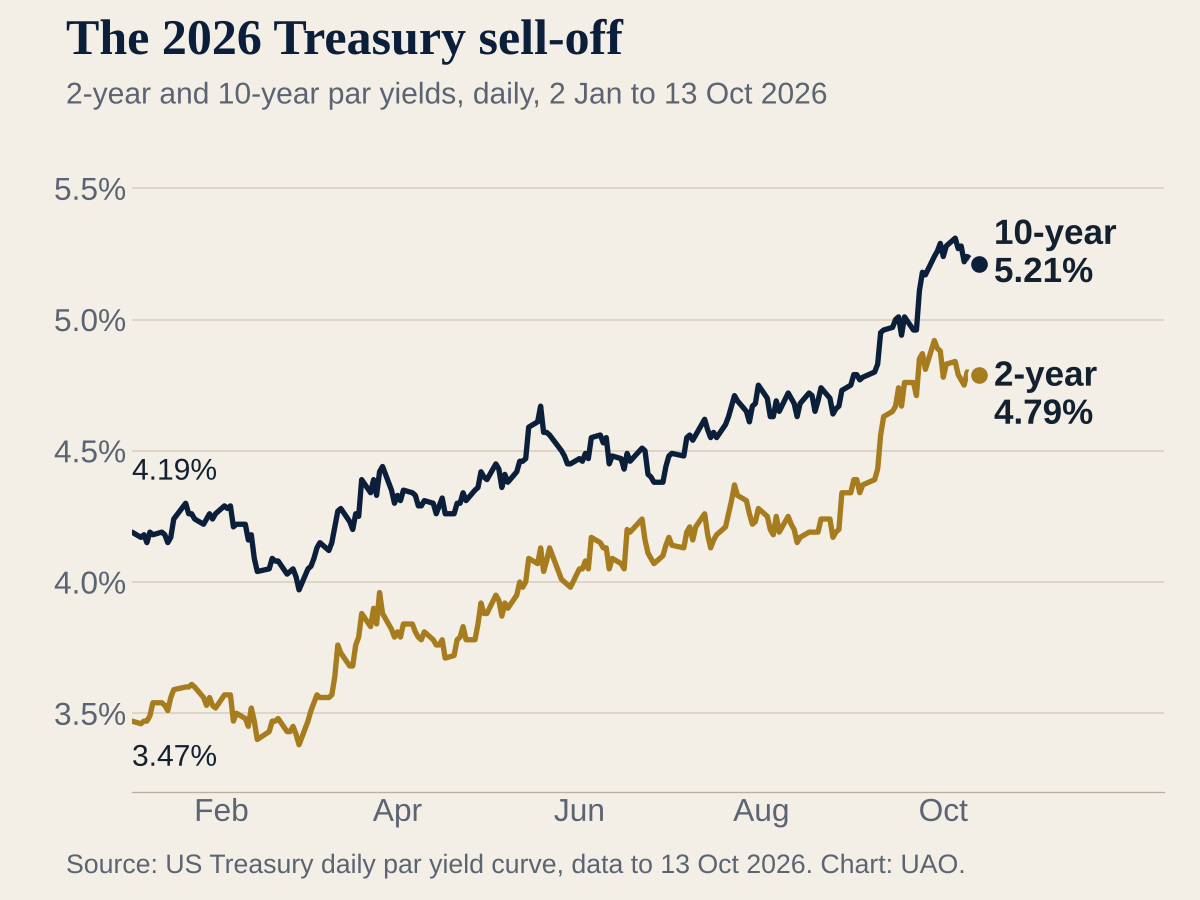 The 10-year is up about one percentage point this year, and the 30-year closed at 5.56% on 13 October. That is the backdrop for the IMF's warning on illiquid pension and insurer balance sheets, and for today's CPI print. Source: US Treasury, Daily Treasury Par Yield Curve Rates (data to 13 Oct 2026). Chart: Universal Asset Owners. |
PEOPLE MOVES
|
JOBS BOARD All checked live on the employer's own careers system, 13 Oct 2026; compensation not listed here by house rule.
|
SCENARIO "Nature metrics go mandatory"Question: what happens to a universal owner's portfolio if a major jurisdiction makes the four NPI state-of-nature indicators part of required disclosure by 2028?
|
DEEP DIVE Liquidity is the new fiduciary questionThe IMF's October Global Financial Stability Report came with a sentence many investment committees will reread: "insurance and pension funds hold more illiquid assets, raising risks in a downturn." For a decade that drift was policy. Low rates pushed long-horizon owners into private equity, infrastructure, real estate and private credit, on the reasoning that an owner with predictable liabilities is paid to give up liquidity it does not need. The reasoning still holds. What has changed is the setting. IMF officials presenting the report also warned of "rising sovereign bond yields on the back of inflation pressures, fiscal imbalances and massive issuance from sovereigns," and said private credit faces higher leverage and "growing liquidity pressures, which could restrict lending." The IMF's World Economic Outlook, released the same day, puts global inflation at 4.7% for 2026. Three mechanisms turn illiquidity from a premium into a risk. First, the denominator. When public markets fall, private marks lag, and allocations to private assets rise as a share of the portfolio. Owners who are already at policy ceilings must stop committing, or sell in the secondary market at a discount. Either way the cost falls on returns. Second, collateral and cash calls. Liability-hedging programmes, currency overlays and derivatives need cash when rates or the dollar move fast. Capital calls on unfunded commitments do not wait for markets to recover. The UK's 2022 gilt crisis showed how quickly a sound long-term balance sheet can face a short-term liquidity squeeze. Third, correlated exits. If many pensions and insurers seek liquidity at once, through the same secondaries market, the same NAV lenders or the same risk transfers, the discount widens for all of them. A universal owner cannot diversify that away, because it holds the whole system. The market is building tools to manage this. Dutch pension manager PGGM is reported to have agreed this week to back a risk transfer on €5bn of ING loans (REPORTED). That deal moves bank credit risk onto a pension balance sheet in exchange for a premium. Bought with discipline, these instruments diversify credit exposure. Bought at the top of a cycle, they concentrate it. JPMorgan's third-quarter reserve build of $539m is a reminder that the banks transferring risk also watch the cycle. What should boards ask?
The other side. Defenders of private markets note that many long-horizon owners kept buying through 2008 and 2020 and earned the premium. Illiquidity is a risk only for owners whose liabilities or governance force them to sell. That is the point: the IMF warning is not that private assets are bad, but that some holders may be less patient than their liabilities suggest. Sources: IMF GFSR (13 Oct); IMF WEO (13 Oct); JPMorgan Q3 8-K (13 Oct); Bloomberg headline on PGGM/ING (REPORTED). Links in the source ledger. |
THE TAKE Nature disclosure has spent five years as a tangle of initiatives. Tuesday's release is the first sign of convergence, and convergence is what universal owners need, because they cannot engage on 600 metrics across 10,000 companies. The four indicators will not fix data quality. But they do give owners one question to put to every company. Owners who start asking it this proxy season will shape what the standard becomes. Those who wait will be measured against it. |
WHAT TO WATCH (TIMES EDT) Today, Wednesday 14 October:
Rest of the week and beyond:
|
WORTH READING
|
THE BACK PAGE  |
|
The Editorial Team Universal Asset Owners · universalassetowners.com |
Independent intelligence for long-horizon capital. Sponsored placements are paid advertising, chosen by our ad partners, and are not endorsed by Universal Asset Owners. |