
The grid bill goes to the voters
Nine states elect utility regulators on 3 November. Who pays for the grid is on the ballot.
TODAY’S AUDIO EDITION — THE UNIVERSAL OWNER
The grid bill goes to the voters — and demand still matters

2 November 2026 · 7:25 · The Universal Owner podcast
Listen on Podbean Show on Spotify
Today’s grid-cost debate, the Bank of Japan’s full-report follow-through, and why infrastructure scarcity does not eliminate demand risk.
LATEST PUBLISHED UAO LIVE
The U.S. Economy Is Growing. So Why Aren’t Americans Feeling It?
Episode 55 · 30 October 2026 · Host: Ryan Lafield

Watch the latest published UAO LIVE episode
UAO LIVE is Ryan’s weekday video show, at 10 a.m. Eastern. This is the published Friday episode, not the upcoming Monday programme.
Overnight update — 2 November
The chokepoint trade has a demand side too.
The Bank of Japan’s full October Outlook, released on 2 November, examines the spread of AI-related demand beyond semiconductors into equipment, industrial robots and power and cooling systems. Its risk discussion also considers how weaker expectations for future profits could affect financial markets and Japan’s economy. This is fresh follow-through from the full report, not a new interest-rate decision or a new thesis: our 25 October edition already covered the Bank of Japan’s AI-shock theme. Source: Bank of Japan, Box 1, printed pp. 56–59.
For a universal owner, the implication is a joint stress test. A fund may own the chip supplier, an equipment manufacturer, a utility, a data-centre landlord and the lender financing the build. Those holdings have different labels but can share one assumption about future compute spending. Scarcity can protect an asset today without protecting its valuation against weaker demand tomorrow. That is our analysis, not a Bank of Japan investment recommendation.
New Zealand: the assurance calendar changes today.
The Treasury’s new investment-assurance regime took effect on 1 November. Its agency implementation checklist starts on 2 November and includes revised risk assessments and mandatory reviews for high-risk proposals. The published timetable asks agencies to allow at least 14 weeks before planned Cabinet consideration. The page was updated 30 October: this is an implementation milestone, not a new funding announcement. Source: New Zealand Treasury.
Watch, not closed.
LXP’s 26 October shareholder announcement expected its acquisition by Brookfield and CPP Investments to close 2 November, subject to remaining conditions. An expected date is not closing evidence. Source: LXP.
TODAY IN 90 SECONDS
- US voters choose 36 governors and seats on state utility commissions in nine states on 3 November (Reuters; Politico; REPORTED). Electricity could be a prominent midterm issue for the first time, Charles Hua of the research group PowerLines told Reuters.
- Household power prices are rising far faster than average in several data-centre states. The US average residential price was 18.16 cents per kWh in August, up 3.4% on a year earlier; Virginia rose 11.3%, Michigan 10.9%, Ohio 10.4% and Pennsylvania 9.2% (US Energy Information Administration).
- The bottleneck is speed to power. Wood Mackenzie counts 201 GW of committed US data-centre connections and puts the wait for a heavy-frame gas turbine at 278 weeks (30 October).
- Aramco has closed on 49% of HUMAIN, the Saudi Public Investment Fund's data-centre company, with about SAR 9.9bn (US$2.6bn) of cash to be paid in during 2026 (PIF and Aramco, 1 November).
- China moves its daily operations to an overnight rate. Xinhua reported on 30 October that the People's Bank of China planned daily overnight reverse repos at a fixed 1.25% from 2 November. The announced start date is 2 November.
- Chips were 49.0% of Korea's October exports, which rose 93.7% to US$115.28bn (Korea's trade ministry, 1 November).
- COP17 closed in Yerevan with nearly 50 decisions and about US$2bn of announced nature funding (Convention on Biological Diversity, 31 October).
OPENING THESIS
For three years the question in the AI power trade was whether the demand was real. That question remains open, even as infrastructure orders grow. Utilities have committed to connect 201 GW of new data-centre load, and the equipment queues are measured in years.
The new question is who pays. A grid is built by regulated utilities and recovered through tariffs that state commissions approve. On 3 November, voters in nine states elect some of those commissioners directly, and 36 states elect governors, who in most states appoint the commissioners.
That puts a political variable at the centre of one of the largest capital programmes in the world. Reuters, citing S&P Global, puts investor-owned utility capital spending at nearly US$1.3trn over five years.
The counterclaim is strong. Commissions are quasi-judicial, campaign pledges fade, and a regulator that starves a utility of returns ends up with higher borrowing costs and a less reliable grid. But a universal owner holds the utility, the hyperscaler and the infrastructure fund at once. It does not need a revolution in rate-setting to feel a shift in who carries the bill.
THE LEAD
The grid bill goes to the voters
Key takeaway: the AI build-out is now constrained less by demand than by who pays for the wires, and that is decided by regulators whom voters elect or governors appoint.
What happened. On 3 November, 36 US states elect governors (Reuters), and voters fill seats on state utility commissions in nine states: Georgia, Arizona, Louisiana, Alabama, Montana, Nebraska, North Dakota, Oklahoma and South Dakota (Politico, 31 October; REPORTED). Charles Hua of the research group PowerLines told Reuters it could be the first midterm to feature electricity as a prominent issue. In Ohio, the Democratic candidate for governor, Amy Acton, would appoint a commission "not beholden to utility companies", her campaign said (REPORTED, Reuters).
The price data explain why. The US average residential electricity price was 18.16 cents per kWh in August 2026, against 17.57 cents a year earlier, a rise of 3.4%. Prices rose far faster in several states with heavy data-centre build-outs or close races: Virginia up 11.3%, Michigan up 10.9%, Ohio up 10.4% and Pennsylvania up 9.2% (CONFIRMED, US Energy Information Administration, Electric Power Monthly). Utilities requested US$23.1bn of rate increases in the first three quarters of 2026, according to the research group PowerLines (CONFIRMED, PowerLines, 7 October).
Why it matters to a universal owner. Wood Mackenzie says US utilities have committed to connect 201 GW of new data-centre load, which would lift US electricity demand by about 30% if all of it is built (30 October). The demand outlook remains uncertain; so does the allocation of grid costs. A commission can hold down household rates, trim a utility's allowed return, or push more of the cost onto large-load customers through special tariffs. Each choice moves value between three things a universal owner holds: regulated utility equity and credit, the equity of the hyperscalers that buy the power, and the infrastructure funds that build around them.
The underappreciated signal. In the utility trade, the jurisdiction may now matter more than the load forecast. Two utilities with the same demand growth can earn very different returns depending on who sits on the commission.
Portfolio transmission. Election result → governor or commission composition → allowed returns and tariff design → utility earnings and credit spreads → the cost of power for data centres → hyperscaler capex returns. Magnitude: DIRECTIONAL. The effect varies by state and will take quarters, not days, to show.
The countercase. Campaign promises often do not survive the commission process. Regulators that suppress cost recovery risk reliability and raise their utilities' cost of capital, which in the end lands on ratepayers too. Pushing costs onto data centres can make utility cash flows safer, not riskier. The industry's trade body makes the point bluntly: "The grid is America's greatest machine, and it doesn't operate on the political calendar," said Drew Maloney, president of the Edison Electric Institute (REPORTED, Reuters).
What to watch. The Georgia Public Service Commission and Arizona Corporation Commission results; the Ohio and Pennsylvania governors' races; then the appointments, new large-load tariffs and any rate case withdrawn or trimmed in the months after. "I do think the real meat will come after the election," said Charles Hua of PowerLines (REPORTED, Reuters).
Sources: EIA Electric Power Monthly, Table 5.6.A · Reuters via Honolulu Star-Advertiser · Politico via Yahoo News · Wood Mackenzie · PowerLines
TOP STORIES
1. China moves its daily operations to an overnight rate. Xinhua reported on 30 October that the People's Bank of China would run overnight reverse repo operations every working day from 2 November, at a fixed rate with quantity bidding. The rate is 1.25%. The seven-day reverse repo becomes a fixed-quantity tender with multiple winning rates, used mainly around tax dates and month-end. Other temporary tools are now priced off the overnight rate, with spreads unchanged (REPORTED, PBOC notice carried by Xinhua, 30 October). This is a previously announced implementation date, not a new announcement or independently verified first operation. Why it matters: owners of Chinese bonds and anyone pricing renminbi carry should now benchmark to the overnight rate. Xinhua
2. Context from 1 November — Chips are now 49% of Korea's exports. Korea's October exports rose 93.7% to US$115.28bn, the second-highest month on record after September. Semiconductor exports were US$56.44bn, up 259.4%, or 49.0% of the total. Electrical equipment exports hit a record US$1.99bn, which the ministry ties to transformers and cables for data centres. The calendar flatters the headline: a holiday fell in October last year. On a working-day basis exports rose 76% (CONFIRMED, Ministry of Trade, Industry and Resources, 1 November). Why it matters: Korean equities, the won and domestic pension portfolios now carry one memory-cycle risk. MOTIR
3. Context from 1 November — Aramco closes on half of Saudi Arabia's compute champion. PIF and Saudi Aramco closed the deal giving an Aramco subsidiary 49% of HUMAIN, with PIF keeping 51%. Aramco will pay about SAR 9.9bn (US$2.6bn) of cash into HUMAIN during 2026 and transfer its own compute and digital assets. HUMAIN targets 3 GW of data-centre capacity by 2030; no valuation was disclosed (CONFIRMED close; cash and target are OFFICIAL CLAIM; PIF and Aramco, 1 November). Why it matters: a sovereign fund is financing its flagship digital platform with a sister state company's oil cash, not outside capital. Aramco
4. Africa gets an energy bank for oil and gas. Afreximbank and the African Petroleum Producers' Organisation formally established the Africa Energy Bank at its first general meeting in Abuja on 31 October, with US$5bn of authorised capital, and appointed Helmy Ghazi as president. Its mandate covers the oil and gas chain from exploration to distribution. The founders put the continent's energy investment need at US$200bn. Subscribed and paid-in capital, a rating and a first loan were not disclosed (CONFIRMED establishment; OFFICIAL CLAIM need). Why it matters: a new lender for projects commercial banks avoid. Watch paid-in capital, not the authorised ceiling. APPO
5. Colombia holds by one vote and buys dollars from its own government. On 30 October Banco de la República held its policy rate at 12.25%, by four votes to three; the minority wanted a 25 basis point rise. September inflation was 6.3%. The board also authorised a direct US$2bn purchase of dollars from the government for the rest of 2026, and said it would offset the effect on peso liquidity (CONFIRMED, Banco de la República). Why it matters: an emerging-market central bank caught between inflation, reserves and fiscal need. Watch how fully it sterilises. Banco de la República
6. The G20's foreign ministers end without the word "climate". The US presidency closed the G20 foreign ministers' meeting in Atlanta on 31 October with a chair's statement rather than an agreed communiqué. It says "Abundant energy is the backbone of a booming economy" and that "Every country is on its own energy path". The words "climate" and "emissions" do not appear (CONFIRMED, G20 Research Group text). Why it matters: the omission may signal weaker political alignment on transition policy; that is our analysis, not a change to existing stewardship obligations. G20 Research Group
7. Washington says Gulf fuel flows have recovered, at a nightly cost. Speaking in Atlanta on 31 October, Secretary of State Marco Rubio said "the amount of fuel getting through there is comparable with what was coming out before the conflict", but added that "we've had to defend these ships from drones and missiles almost every single night". He said talks with Iran "have actually never stopped" (OFFICIAL CLAIM, State Department transcript). Independent vessel data were not available to us. Why it matters: the official account is recovered flows with a continuing security cost. That argues against a quick fall in war-risk premia. US State Department
CHART OF THE DAY
Power prices are rising fast in some data-centre states
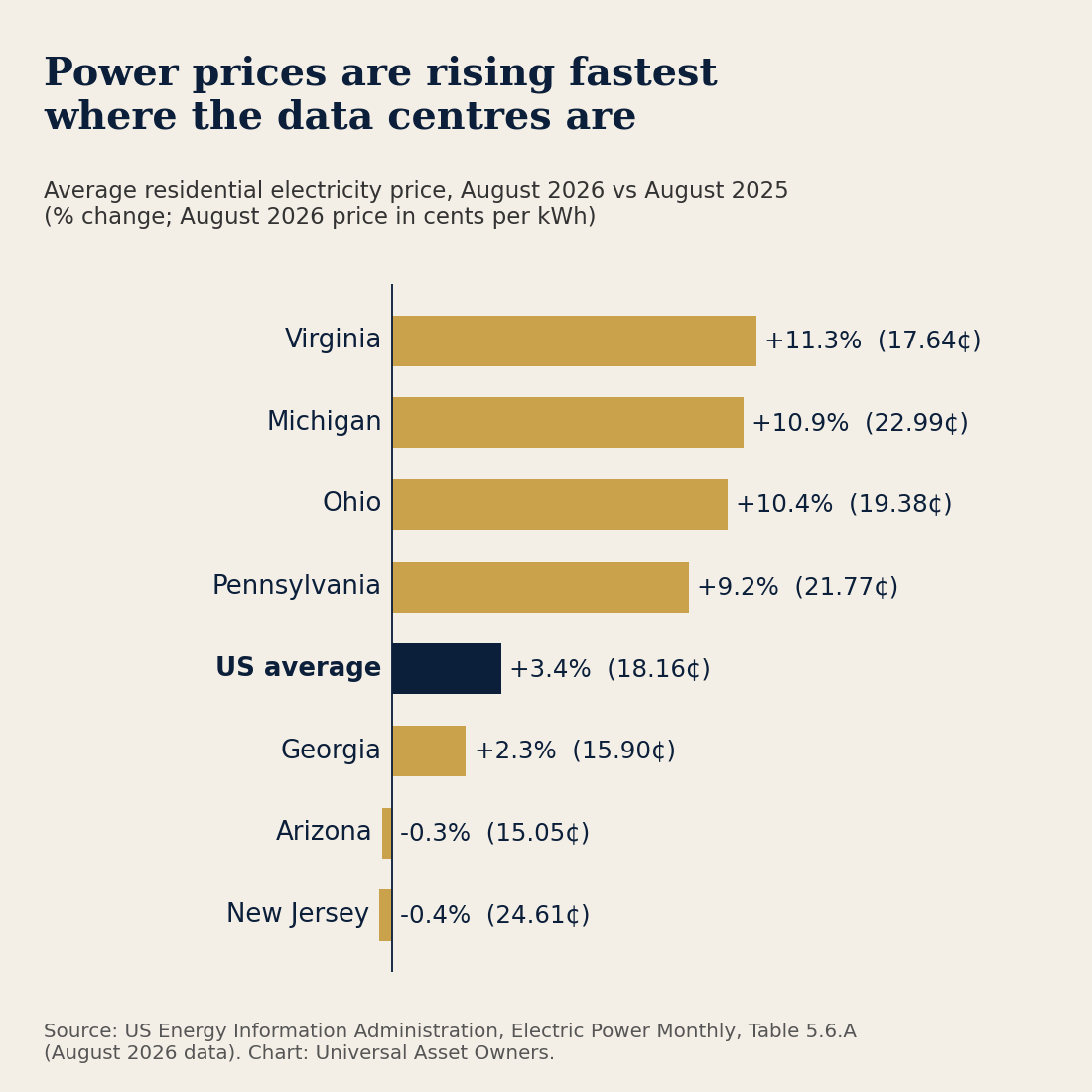
The US average rose 3.4%, to 18.16 cents per kWh. Virginia rose 11.3%, Michigan 10.9%, Ohio 10.4% and Pennsylvania 9.2%. Georgia rose 2.3%; Arizona and New Jersey fell slightly.
Source: US Energy Information Administration, Electric Power Monthly, Table 5.6.A (August 2026 data). Chart: Universal Asset Owners. August figures are preliminary year-on-year prices per kWh, not household bill changes or proof of causation by data centres.
SOVEREIGN WEALTH MONITOR
Aramco closes on 49% of PIF's HUMAIN. The deal closed on 1 November. PIF keeps 51%. The cash, about SAR 9.9bn (US$2.6bn), is paid in during 2026 rather than at closing, and the 3 GW capacity figure is a 2030 target, not capacity in operation. Aramco expects to use HUMAIN's infrastructure for industrial applications. No outside co-investor was named (CONFIRMED close, PIF and Aramco, 1 November). Why it matters: index holders of Aramco now fund part of a state compute build-out. Aramco
GULF CAPITAL BRIEFING
PENSION FUND STRATEGY WATCH
Chile's caps on pension funds' underlying fees take effect. From 1 November, aggregate indirect fees borne by each of Chile's pension funds through underlying investment vehicles are subject to annual caps as a share of fund assets: Fund A 0.56%, B 0.47%, C 0.35%, D 0.19% and E 0.12%. Any excess is charged to the pension fund manager (AFP) itself, not the fund. The Superintendencia de Pensiones set the caps in March; they run through 31 March 2027. New generational funds begin on 1 April 2027 with caps of their own (CONFIRMED, Superintendencia de Pensiones). Why it matters: the caps constrain aggregate indirect costs at pension-fund level; they are not a maximum fee for each individual external manager. Superintendencia de Pensiones
DEALS, PRIVATE MARKETS & CAPITAL FLOW WATCH
Stonepeak completes Estia Health. Stonepeak completed its purchase of Estia Health, one of Australia's larger residential aged-care operators, with Axight Capital as a minority co-investor. Estia runs 97 homes across four states and cares for more than 14,500 residents a year. It is the second investment for Volarae Living, Stonepeak's social-infrastructure platform for Australia and New Zealand. The completion release does not restate the price (CONFIRMED, Stonepeak, 30 October). Why it matters: infrastructure capital is moving into government-funded care, whose cash flows behave like regulated assets. Stonepeak
AI AND THE LONG-TERM PORTFOLIO
The bottleneck is speed to power. Wood Mackenzie counts 201 GW of committed US data-centre connections. Grid-connection waits run to at least 54 months in Virginia and 84 months in Ohio. Lead times are 278 weeks for heavy-frame gas turbines, 162 weeks for transformers and 137 weeks for circuit breakers. Its conclusion: "there are no solutions that deliver new supply at any scale in 2027 or 2028" beyond existing commitments (Wood Mackenzie, 30 October). Why it matters: a secured grid connection now rivals the land or the tenant as the source of a data centre's value. Wood Mackenzie
Nuclear fuel arrives slowly. Centrus has shipped the first newly built centrifuge for its Piketon, Ohio enrichment expansion from Oak Ridge, Tennessee (Centrus, 29 October). First capacity from this expansion is expected in 2029; existing Ohio HALEU production began in 2023. Why it matters: the expansion timetable is not the start date of all U.S. HALEU production. Centrus
ESG, CLIMATE & ENVIRONMENT
Context from 1 November — Yerevan ends with a plan, not a payday. The Convention on Biological Diversity’s closing release reports that COP17 closed in Yerevan with nearly 50 decisions and nearly US$2bn in funding announcements. Announcements are not disbursements. Why it matters: nature-finance strategies should distinguish announced funding from available capital. CBD closing release
GOVERNANCE & STEWARDSHIP
Vail's activist shrinks its slate and opens talks. A revised preliminary proxy filed on 30 October shows Oasis Management and Vail Resorts signed a confidentiality agreement on 26 October "to facilitate discussions regarding a potential settlement". Oasis has cut its slate to two, Robert Chapek, a former Walt Disney chief executive, and M. Ashton Hudson. Oasis and its participants own about 9.6% of the shares. Vail's board recommends its nine nominees (CONFIRMED filings; company and dissident positions are OFFICIAL CLAIM). Nine seats are up at the meeting on 14 December. Why it matters: a settlement can hand over seats without a vote by the wider body of holders. Ask the board to explain any deal. SEC filing
FAMILY OFFICE WATCH
Euclidean Capital joins a US$90m biotech round. Euclidean Capital, the Simons family's investment firm, is among the investors in Setara Biosciences' US$90m Series A, announced on 30 October, alongside Deerfield, Canaan, Droia Ventures, EcoR1, Regeneron Ventures and Jazz Pharmaceuticals. Setara's lead drug candidate targets a rare nerve disorder and overactive bladder. Euclidean's ticket was not disclosed (CONFIRMED participation, company release). Why it matters: family capital is writing patient, clinical-stage cheques next to specialist funds. Business Wire via Yahoo Finance
THE UNIVERSAL OWNER RISK RADAR
- Rates: Treasury supply. The quarterly refunding announcement is on 4 November. In August the Treasury said it expected to keep nominal coupon and floating-rate auction sizes unchanged "for at least the next several quarters". Any signal of larger auctions would push up the term premium and hit long-duration liability hedges (CONFIRMED, US Treasury).
- Macro: imported energy inflation. Korea's trade release reports Dubai crude averaging US$110.7 a barrel in October, up 70.4% from a year earlier (MOTIR, 1 November). Energy importers' terms of trade and core inflation remain exposed. The Bank of England's decision and Monetary Policy Report follow on 5 November.
- Concentration: one memory cycle. With chips at 49.0% of Korean exports and DDR5 memory contract prices up 25% since June (MOTIR), a correction in memory prices would hit the won, Korean equity indices, tax receipts and domestic pension portfolios together (ANALYSIS).
- Demographics: quiet. No new primary release in the window.
PEOPLE MOVES
Uzma Nazir joins Standard Life (Phoenix Group) as senior director and head of pension risk transfer origination, a new role. She spent most of her career at Pension Insurance Corporation (CONFIRMED, Standard Life, 28 October). Why it matters: insurers are adding capacity for larger bulk-annuity deals as UK schemes plan buyouts. Standard Life
Continuing context — Stuart Baldwin. As covered in our 24 October edition, Baldwin joins the investment committee of GLIL Infrastructure, the UK pension-owned infrastructure investor, as an independent member. He spent most of his career at GIC, where he led its infrastructure team, and sat for 18 years on the board of Heathrow Airport (REPORTED; the 29 October Pensions Age roundup is a later reference, not the first announcement). Why it matters: sovereign-fund experience in direct infrastructure for a pension platform as UK pools step up domestic investing. Pensions Age
Sophie White becomes head of the employment, labour and pensions practice group at Eversheds Sutherland from 1 November, succeeding Diane Gilhooley, who retires at the end of 2026 (REPORTED, Pensions Age, 29 October). Why it matters: a leadership change at a major legal adviser to UK trustees and sponsors. Pensions Age
Starting this week: David Lawson becomes chief investment officer of Manitoba's Civil Service Superannuation Board on 5 November, succeeding Peter Josephson (CSSB, announced 22 October). CSSB
CAREERS
Head, Private Asset Operations — CalSTRS. Application deadline: 4 November 2026.
JOBS BOARD
Roles checked as open on 1 November 2026.
- Employees' Retirement System of the State of Hawaii — Chief Investment Officer — Honolulu. Listing expires 2 November. Listing
- Public Employees' Retirement System of Nevada — Deputy Investment Officer — Carson City, Nevada. Listing runs to 12 December. Listing
- Norges Bank Investment Management — Senior Investment Manager, Renewable Energy Infrastructure — New York. Closes 15 November. Apply
- Fonds Souverain de Guinée — Investment Director — Guinea. Search run by Michael Page. Apply
- Austin Police Retirement System — Executive Director — Austin, Texas. Listing runs to 20 November. Listing
SCENARIO — UNWEIGHTED
"After 3 November, who pays for the grid?"
The question: Over the next two years, how will US state regulators split the cost of the grid build for data centres between households, utility shareholders and large-load customers? (Scenario ID DS-20261102-GRID-BALLOT)
Scenario 1 — Business as usual, with louder politics. Commissions keep approving rate cases with allowed returns near today's levels. Large-load tariffs spread slowly, state by state. For a universal owner: utility returns hold; the risk sits in the few states where prices rose fastest.
Scenario 2 — Data centres pay more. New governors and commissioners push more grid cost onto large-load customers through minimum-take contracts, upfront payments and special tariffs. For a universal owner: utility cash flows become safer; hyperscalers' cost of power rises; data-centre sites with secured connections gain value.
Scenario 3 — The return squeeze. In several states, commissions trim allowed returns or reject rate requests to hold down household bills. For a universal owner: utility equity and credit reprice by jurisdiction; capex slows where returns fall, and the grid bottleneck tightens.
Signposts: results of the Georgia and Arizona commission races and the Ohio and Pennsylvania governors' races; commission appointments in early 2027; new large-load tariff filings; allowed returns in the next round of rate decisions. These are unweighted analytical scenarios, not probability forecasts.
DEEP DIVE — ANALYSIS
The wire is the asset
For most of the past three years, investors in the AI build-out argued about demand. Would the chips keep selling? Would the models earn their keep? Would the data centres fill? Those arguments have not gone away. But in the physical economy a different constraint has taken over, and it is far less glamorous. It is the wire, the transformer and the turbine.
Start with the queue. Wood Mackenzie reckons US utilities have committed to connect 201 GW of new data-centre load. If all of it were built, US electricity demand would rise by about 30%. The equipment to serve it is not on the shelf. A heavy-frame gas turbine ordered today takes about 278 weeks to arrive, more than five years. Transformers take about 162 weeks and high-voltage circuit breakers about 137. In Virginia, the world's largest data-centre market, a new grid connection takes at least 54 months. In Ohio it is 84 months. An 84-month wait would put a project starting now into 2033; actual connection dates depend on the project and network.
Wood Mackenzie's conclusion is stark: beyond what is already committed, "there are no solutions that deliver new supply at any scale in 2027 or 2028". That changes where value sits. A data-centre site with a signed, energised grid connection is now scarcer than the land it stands on or the tenant who will lease it. For an infrastructure investor, the connection agreement is the asset.
Then comes the bill. Utilities recover the cost of the grid through tariffs approved by state commissions. The research group PowerLines counts US$23.1bn of rate-increase requests in the first three quarters of 2026. Reuters, citing S&P Global, puts investor-owned utility capital spending at nearly US$1.3trn over five years. Households are already noticing. The average US residential price was 18.16 cents per kWh in August, up 3.4% in a year. In Virginia, Michigan, Ohio and Pennsylvania it rose by 9% to 11%.
This is where the ballot box comes in. In most states commissioners are appointed by the governor; in some they are elected. On 3 November voters in nine states choose utility commissioners directly, and 36 states choose governors. Politico describes once-sleepy commission races turning into political battlegrounds. In Georgia, Democrats won two commission seats in 2025 and are now trying to take a majority. Candidates for governor are campaigning on power bills.
What can a commission actually do? Three things matter for investors. It can set the allowed return on equity that a utility earns on its investment. It can approve, delay or cut the rate increases that recover capex. And it can design tariffs that decide which customers pay for what. The third lever is the one to watch. Utilities have begun proposing large-load tariffs for data centres, built on long minimum-take contracts, upfront contributions and exit fees. Ohio's regulator approved one for AEP Ohio in 2025. These shift the risk of stranded grid assets from households to the companies driving the demand.
For a universal owner, the interesting point is that each of these choices moves value around the portfolio rather than creating or destroying it outright. A lower allowed return hurts utility shareholders and bondholders but helps every company that buys power. A large-load tariff protects utility cash flows and households but raises the cost of power for hyperscalers. A rate freeze helps households in the short run and hurts everyone if it slows the build and tightens the bottleneck.
That is why the jurisdiction matters. Two utilities with identical load growth can face very different futures if one sits under a commission that protects returns and the other under one elected on a promise to cut bills. For investors who hold the whole market, demand risk remains material. A second question is which states will let the grid be built on terms that work for both the people who pay and the people who invest.
The countercase deserves weight. Commissions are quasi-judicial bodies bound by law and precedent. Campaign promises meet the reality of reliability standards and credit ratings. A regulator that starves a utility of capital tends to get a weaker grid and a higher cost of borrowing, which households pay in the end. History suggests that most rate-setting stays technocratic once the campaign is over.
The practical implication of this analysis is that owners should know which of their utility, data-centre and infrastructure holdings sit in states where prices are rising fastest and commissions are changing hands. They should ask managers how large-load tariffs affect their underwriting. And they should treat a secured grid connection as a core part of any data-centre valuation. The wire, for now, is the asset.
FREE TOOL OF THE DAY
US Energy Information Administration: Electric Power Monthly data tables. Free state-by-state electricity prices by customer type, updated monthly, with downloadable history. It is the quickest way to see where household and industrial power prices are rising fastest, and to check the states where your utility and data-centre holdings sit. Free, no registration. EIA
THE TAKE
Price the regulator, not the load.
The AI power trade has been sold as a demand story. Data centres need electricity, utilities will build, investors will earn. The demand part is real. The rest depends on a group of officials most investors cannot name.
State utility commissions decide how much of the grid build is recovered, from whom and at what return. On 3 November voters in nine states elect some of them, and governors elected the same day will appoint more. Power bills are now a campaign issue. That does not mean commissions will tear up the rulebook. It does mean the political cost of approving rate increases has gone up just as the capital needs have peaked.
Long-horizon owners should respond by pricing the regulator, state by state, as carefully as they price the load forecast. Where prices are rising fastest and commissions are changing hands, the allowed return is less secure than the consensus assumes. Where large-load tariffs put the cost on data centres, utility cash flows are safer than they look.
The strongest counter-argument is that regulation is sticky. Commissioners follow law, precedent and reliability rules, and they rarely punish the utilities they need to keep the lights on. That is true, and it is why a crash in allowed returns is unlikely. But markets do not need a crash to reprice. They need a drift, and the drift has begun.
The grid is the largest bet in the build-out. Its odds are set by people on a ballot.
— The Deputy Editor
WHAT TO WATCH (TIMES ET WHERE GIVEN)
- 2 November: ISM Manufacturing index for October; the announced start date for the People's Bank of China's daily overnight reverse repos (announced implementation date); Reserve Bank of Australia board meeting begins.
- 3 November: US midterm elections, including 36 governors and state utility commission seats; Reserve Bank of Australia decision.
- 4 November: US Treasury quarterly refunding announcement; ISM Services index.
- 5 November: Bank of England Monetary Policy Committee decision and November Monetary Policy Report.
- 6 November: US employment report for October (8:30am); Brookfield Asset Management third-quarter results (before 7:00am).
- 9–20 November: COP31 climate talks in Antalya, Türkiye.
- 14 December: Vail Resorts annual meeting, with nine board seats contested.
WORTH READING
- Politico, "Data centers turn sleepy utility races into political battlegrounds" (31 October). A race-by-race guide to the commission contests that will shape who pays for the grid. Politico via Yahoo News
- Wood Mackenzie, "Speed to power" (30 October). The clearest current account of turbine, transformer and connection lead times. Wood Mackenzie
- Convention on Biological Diversity, COP17 closing release (31 October). The official closing account, including decisions and funding announcements. CBD
THE BACK PAGE
The Allocator
A lighter take on institutional investing. Archive replay · 15 October 2026.
THE BACK PAGE
Number of the Day: 278 weeks. The current wait for a heavy-frame gas turbine in the US, more than five years from order to delivery (Wood Mackenzie, 30 October).
Quote of the Day: "I do think the real meat will come after the election." Charles Hua of the research group PowerLines, on utility rate-setting after 3 November (as reported by Reuters, 31 October).
On This Day, 2 November 1907: As the Panic of 1907 spread, the brokerage Moore & Schley neared collapse, and a plan emerged for U.S. Steel to buy the Tennessee Coal, Iron & Railroad Company, the deal that helped end the crisis (Harvard University, Center for History and Economics). More than a century later, the plumbing of the system still matters more than the headlines.
The Question: If you had to pick one state utility commission to sit on for the next five years, which would protect your portfolio most, and why?
The Back Page
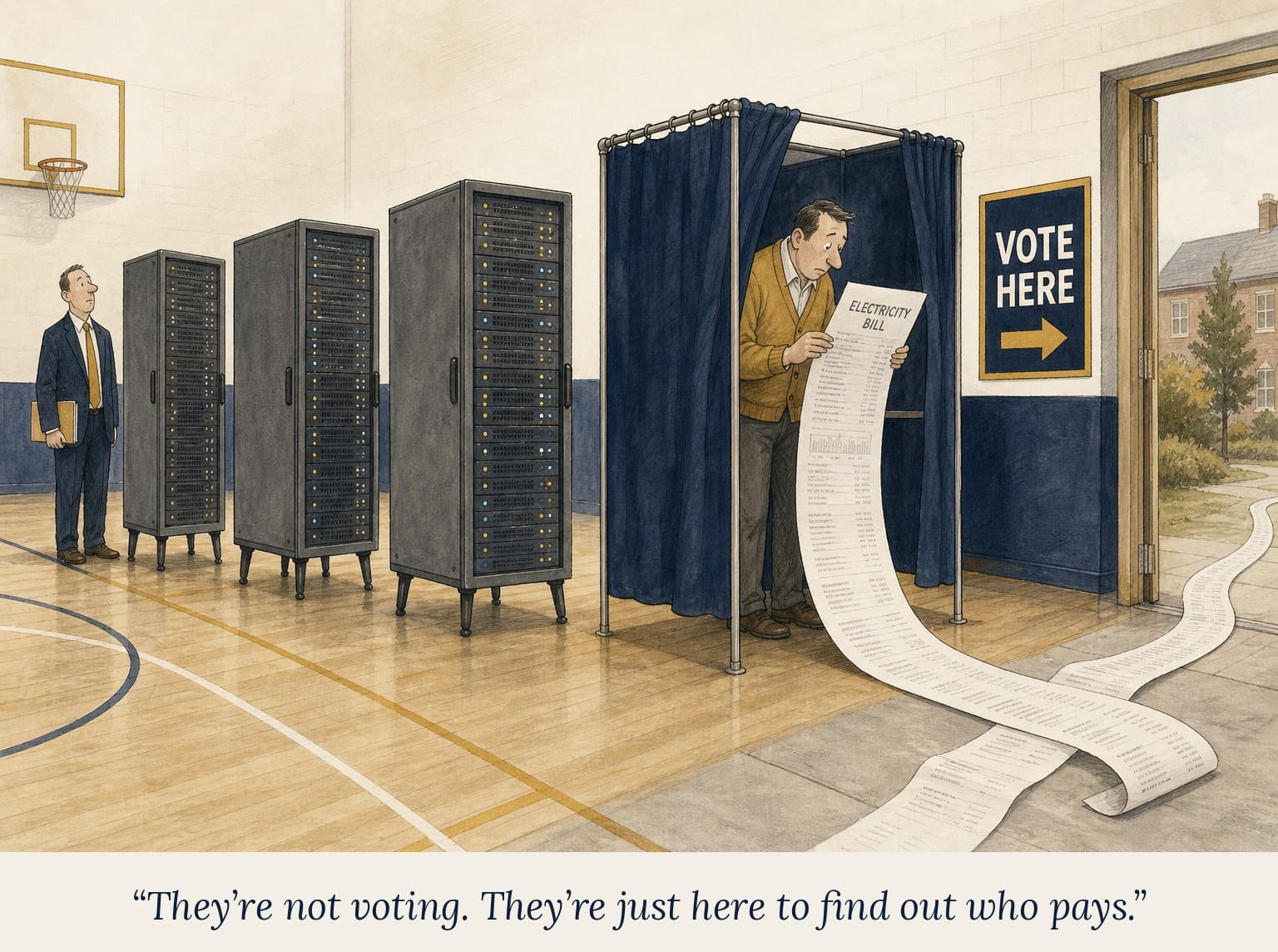
Today's cartoon: in a school-gym polling station, a householder in a mustard cardigan peers out of a navy-curtained voting booth, reading an electricity bill so long it unrolls across the floor and out of the door. Queuing politely behind him are three grey server racks on little legs, and, at the back, a man in a suit holding a folder. A sign on the wall reads VOTE HERE. Caption: “They’re not voting. They’re just here to find out who pays.”
The Editorial Team
Universal Asset Owners · universalassetowners.com