Thursday, 19 November 2026
The Lead | The bottleneck has moved upstream
The European Central Bank's November Financial Stability Review, released on 18 November, connects ambitious AI valuations, rising corporate borrowing and growing sovereign financing pressures. The concern for universal owners is how a shock travels between assets that appear separate in the portfolio. Higher funding costs can coincide with a delay in the physical infrastructure expected to generate the cash flow.
That combination frames today's briefing: newly confirmed European inflation, fresh capital for music rights, and this morning's report on PGGM's total-portfolio governance. Research published by Johns Hopkins on 17 November supplies the physical context. Its conditional high-demand scenario estimates 2030 shortfalls of roughly 15% for transformers and 30% for other grid equipment. These are modelled outcomes, not observed shortages or a certainty about future supply.
Our analysis: ask what happens when a delayed connection and more expensive refinancing arrive together. A financed campus is not an energised campus. The manufacturing slot, delivery evidence and authority to change the plan belong in the investment decision.
ECB · Johns Hopkins research ·
Listen | The Universal Owner
Today in 90 Seconds
Financial stability: the new ECB review highlights connections between AI financing, valuations and sovereign debt.
Pensions: this morning's Oxford conference report highlights trustee engagement in PGGM's total portfolio approach.
Transactions: Litmus announces about US$475 million in new capital commitments from Carlyle and KKR-managed funds.
Prices: Eurostat's final October release confirms euro-area annual inflation of 4.0%.
Profile: Karen Karniol-Tambour and the institutional task of establishing the Canada Strong Fund.
Regional Ledger | North America, Europe and cross-border risk
North America: the physical delivery of power infrastructure is an investment constraint. We examine earlier Johns Hopkins research as context for today's financing discussion, with its conditional assumptions made explicit.
Europe: Eurostat's new final inflation release and the ECB's stability review focus attention on the interaction of energy costs, funding and portfolio risk. October data describe the reference month; they are not a live market quote.
Across regions: our analysis is to test common suppliers and funding counterparties across infrastructure, private credit and listed holdings. Geographic labels alone do not establish independent sources of return.
ECB review · Eurostat release ·
Pensions, Sovereigns & Family Capital
Sarah Rundell's 19 November report from the Fiduciary Investors Symposium at Oxford puts trustee engagement at the centre of PGGM's total portfolio approach. The publisher's report summary identifies PGGM's Jeroen Rijk and WTW's Roger Urwin discussing governance as a foundation for the strategy. This is current conference reporting, not an announcement of a new allocation or a measured investment result.
Our analysis: a portfolio approach needs an agreed objective, a common way to compare risks and authority to move capital across teams. Trustees should know which decisions remain with the board, which are delegated, and what evidence will show whether the change improves the institution's decisions. Organisational agreement is part of implementation, not a ceremony after the model is built.
Sarah Rundell reporting from Oxford ·
Capital Flows & Transactions
Litmus Music announced approximately US$475 million of new capital commitments from Carlyle and KKR-managed funds on 18 November. Carlyle will retain majority ownership. The announcement describes a platform with about US$1.4 billion in assets under management and more than 100,000 copyrights and recordings. The new commitments support future growth and acquisitions; they are not a disclosed purchase price for one catalogue.
Our analysis: royalty assets require evidence of ownership, collection rights, contractual deductions and the durability of listening demand. A large catalogue count does not itself establish diversification. Underwriting should test concentration in individual songs, artists, distribution platforms and collection counterparties, then distinguish gross royalties from cash available to investors.
Credit Support & Balance-Sheet Health
Grid equipment is credit support in operational form. A project with secured land, power contracts and customers can still miss revenue dates when a transformer or switchgear package is late. Lenders and investment committees should require a delivery-slot schedule, supplier concentration map, commodity sensitivity and explicit delay covenants alongside construction milestones.
The ECB’s November review adds the market channel. Elevated long-term sovereign yields can reprice discount rates, collateral and refinancing while U.S. AI financing spills into global duration markets. The correct stress test combines a physical delay with a higher cost of carry: equipment arrives late, revenue starts late and debt remains outstanding longer.
Treasury | Finance the queue, not the press release
Our analysis: equipment reservations can require deposits before a project earns revenue. Treasury should reconcile payment milestones with evidence of production and delivery, and identify cancellation terms and foreign-exchange exposure.
For the new Litmus commitment, distinguish announced financing capacity from funded acquisitions. For construction, distinguish a reserved slot from installed equipment. Each state needs its own cash date, counterparty and decision owner.
Governance & Fiduciary Affairs
Our analysis: project authority must cover supplier substitution, revised delivery dates and the release of deposits. The evidence needed for each decision should be set before a problem occurs.
PGGM's governance discussion offers a related institutional question: has the board agreed the purpose and boundaries of a total portfolio approach? A model can compare exposures, but it cannot supply authority that the institution has not delegated.
Stewardship & Voting
Listed stewardship should connect capital expenditure to delivery evidence. When utilities, data-centre operators or equipment suppliers announce capacity, investors should ask about firm orders, lead times, supplier concentration, deposits, cancellation terms and the percentage of projects with secured interconnection.
Private-market stewardship uses different levers—reserved matters, board rights, information rights and capital-call controls—but the evidence should converge. A board pack should show the same critical-path equipment, cash exposure and delay sensitivity that lenders and public shareholders need.
Climate, Nature & Sustainability
Background — 17 November: TNFD welcomed the ISSB's draft practice statement on nature-related disclosures and stressed the financial relevance of nature-related risks and opportunities. The proposal builds on IFRS S1 and the TNFD framework. A consultation response is not a final new reporting requirement.
Our analysis: the practical issue for infrastructure is evidence. Land, water, biodiversity, permits and community relationships can change a project's delivery path. A procurement timetable that omits these dependencies can be as misleading as one that assumes unlimited equipment supply.
European Prices & Wages
Eurostat confirmed October euro-area inflation at 4.0%, up from 3.8% in September and 2.1% a year earlier. Energy contributed 1.89 percentage points, services 1.55, non-energy industrial goods 0.30 and food, alcohol and tobacco 0.29. Inflation fell in nine member states, was stable in two and rose in sixteen. (Eurostat)
Calendar context: Eurostat schedules an early third-quarter labour-cost estimate for 19 November and its next full release for 17 December. No unpublished third-quarter figure has been inserted.
European Direct Lending
The new ECB review describes how growing external financing for AI links different market segments. Private-market investors should examine where their funds share borrowers, sponsors or financing counterparties.
Our analysis is to combine fund-level facilities and portfolio-company borrowing in the same stress view. Separate labels can conceal a shared refinancing date or a reliance on the same provider of liquidity.
The useful question is operational: can the committee see the concentration before a margin call or refinancing deadline makes it unavoidable?
European Biomethane
The European Commission’s first Biomethane Mechanism matching round is accepting buyer demand from 4 November to 23 December. Suppliers submit from 21 January to 4 March, with matching results scheduled for 18 March 2027. The dashboard covers more than 90% of current EU biomethane production. (European Commission)
Matching discovers counterparties; it does not provide permits, feedstock, certification, grid connection or credit support. Investment approval should therefore treat a match as the beginning of diligence, not the end.
Geopolitics & Chokepoints
The Johns Hopkins trade-disruption case makes industrial policy a portfolio variable. Transformers and grid equipment depend on copper, electrical steel and nickel supply chains. The study says copper could become tight from 2027, while steel and nickel constraints intensify toward 2030 under its assumptions. A universal owner may own miners, equipment makers, utilities, data centres and the lenders to all four; the concentration map should cross asset classes.
Chart | Modeled U.S. grid-equipment shortfalls in 2030
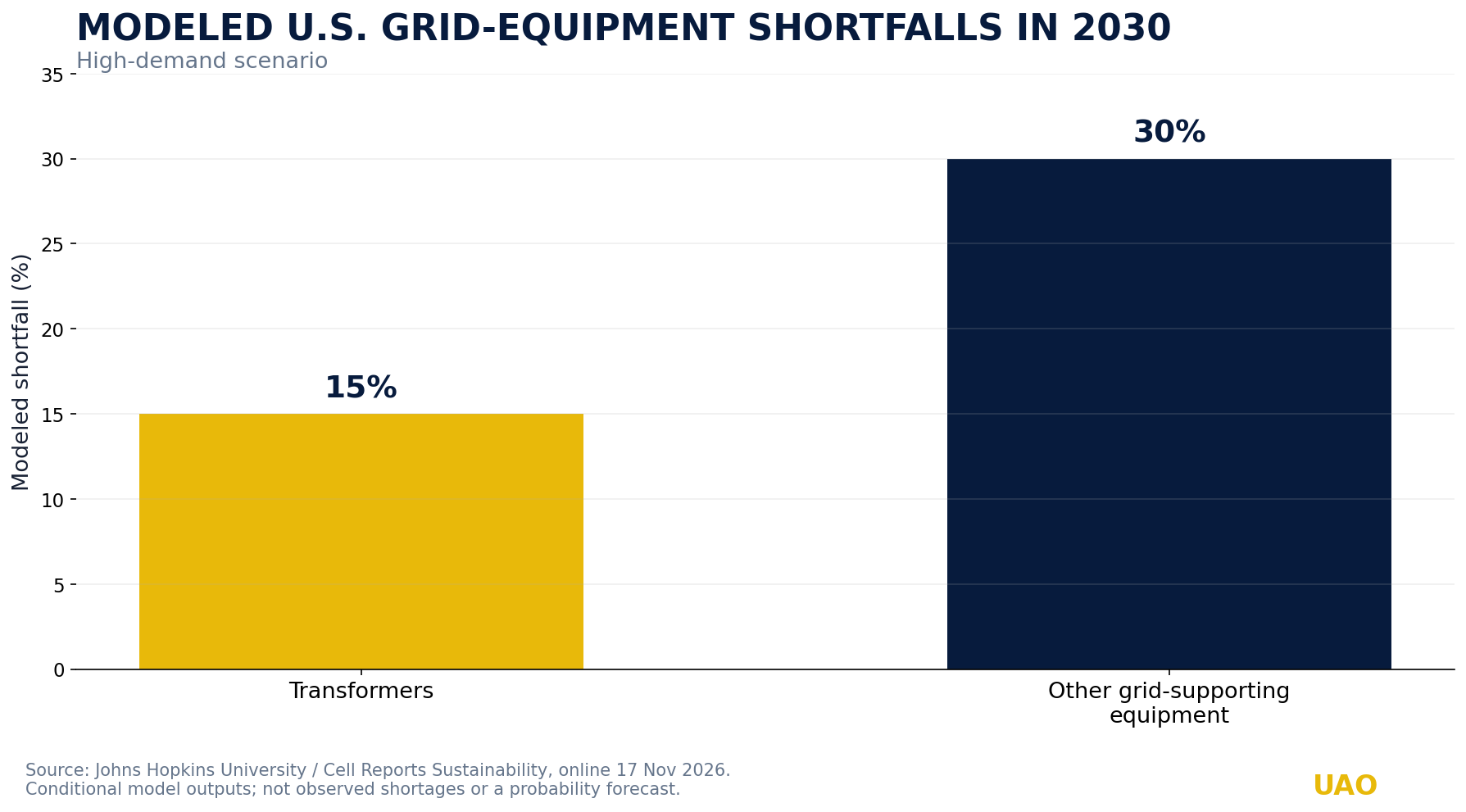
In the Johns Hopkins high-demand scenario, transformer supply is about 15% short and other grid-supporting equipment about 30% short by 2030. Data centres account for up to two-thirds of the projected gap. These are modeled conditional shortfalls, not observed shortages or probability-weighted forecasts.
Risk Radar | Five committee questions
• Equipment: Is each critical transformer, switchgear and breaker package contracted, reserved or merely assumed?
• Cash: What deposits and progress payments are at risk before delivery and energisation?
• Duration: What happens to interest carry, hedges and customer contracts if connection slips 12 months?
• Concentration: Does the institution own the same AI-power thesis through infrastructure, utilities, banks, insurers and equipment suppliers?
• Authority: Who can approve a substitute supplier or revised delivery date, on what evidence, by when?
People | Decisions, not rumours
Karen Karniol-Tambour's selection to lead the Canada Strong Fund was announced on 9 November. Today's profile examines the institutional task ahead, using the government's announcement and Bridgewater's account of her investment responsibilities. It does not present that earlier announcement as overnight news.
For a new public investor, the mandate and the governance arrangements deserve as much scrutiny as the person appointed. The decision framework, conflicts policy and board oversight will shape how the fund translates its stated purpose into investments.
Government announcement dated 9 November ·
Executive Profile | Karen Karniol-Tambour
Karen Karniol-Tambour has been selected to lead the Canada Strong Fund, bringing two decades of global investment experience to a new public institution. The announcement came on November ninth; this is a leadership profile, not a new appointment announced this morning. Prime Minister Mark Carney named her as the fund's inaugural chief executive and set out an initial capital commitment of twenty-five billion Canadian dollars. The government's stated objective is investment on commercial terms, with an independent board and professional management at arm's length from government.
She joined Bridgewater Associates in two thousand six after graduating from Princeton University. The firm's biography describes a role connecting economic research with investment decisions: turning research into trading strategies, developing investment models, designing client portfolios and communicating the firm's market thinking. As co-chief investment officer, she has also been responsible for its Asia strategies, including its China investment-management subsidiary. That experience is relevant to a Canadian fund that will need to understand overseas competition and capital flows while making investments at home.
The proposed fund has two investment streams. It will seek co-investments involving projects and companies already receiving federal support, and it will pursue selected strategic investments independently. Those streams create different questions for an investment committee. A project can have public-policy value without offering an attractive commercial return. Conversely, a commercially attractive investment may require little public capital. The difficult work is to make both assessments explicit and prevent a policy label from deciding an investment question before the analysis is complete.
Our assessment is that the first challenge will be institutional design. A new chief executive must help establish who originates proposals, who challenges them, who authorises commitments and who can stop a transaction. Those responsibilities need to survive pressure from a prominent sponsor, a large co-investor or an approaching announcement. Clear written authority will matter as much as the quality of the initial pipeline. Staff need a way to raise concerns without treating disagreement as a failure to support the fund's purpose.
Her background in systematic investing offers a useful lens for this work. A repeatable process begins with explicit assumptions and evidence that can contradict them. For a project investment, that means identifying the revenue case, construction dependencies, financing terms and conditions under which the fund would decline to proceed. It also means recording how a decision differs from an alternative use of the same capital. An attractive presentation should not obscure how much must go right before investors receive the anticipated cash flows.
Portfolio construction creates another leadership test. Individual projects can appear diverse while sharing exposure to electricity prices, permitting delays, commodity inputs or a small group of contractors. Today's grid-equipment story makes the issue concrete. A fund could support several different industries yet depend on the same scarce transformer supply. Our view is that a common risk inventory should be built early, before separate teams develop incompatible descriptions of the same exposure. It should inform capital commitments and liquidity planning, not merely appear in retrospective reporting.
Public accountability adds a further obligation. Investors should be able to distinguish capital promised from capital deployed, and financing arranged from an operating asset delivering revenue. Reporting should explain changes in assumptions, delays and losses with the same clarity as successful transactions. The government's proposed retail participation makes that distinction especially important. A retail product and the underlying investment portfolio have different protections and risks; public communication must avoid implying that every project is guaranteed merely because the fund has a public sponsor.
Karniol-Tambour's opportunity is to turn research discipline into an institution that can make consistent decisions under scrutiny. Her record at Bridgewater establishes experience in global markets and investment process; it does not establish the future performance of a new fund. The useful test for universal owners will be observable: a credible board, capable staff, clear conflicts policies, commercially intelligible investments and reporting that explains what changed. Those foundations will determine whether an ambitious capital commitment becomes a durable investment organisation.
Government announcement · Bridgewater biography ·
Institutional Careers
Ontario Pension Board is recruiting a Senior Investment Officer in Toronto, Reference 2026-28E, posted 12 November. The permanent role covers investment strategy, portfolio and risk analysis, and oversight of activities undertaken by the plan's delegated investment manager. The official posting remains open until a successful candidate is selected or the competition closes.
The employer's application page is linked below. Candidates should check the current requirements and availability directly with OPB. No salary estimate or endorsement is included.
Apply through Ontario Pension Board ·
Institutional Calendar | Next triggers
19 November: Eurostat's September labour-cost publication schedules an early estimate for the third quarter today. At this edition's research cutoff, no new figure has been used. The next full quarterly labour-cost release is scheduled for 17 December.
23 December: the European Commission's existing biomethane buyer-demand window closes. Suppliers can respond from 21 January to 4 March 2027; the published matching date is 18 March. These are previously announced deadlines, retained as calendar context.
For today's committee agenda, reconcile the final October inflation release with the assumptions used in contracts and cash-flow models. Review equipment delivery evidence, financing carry and the person authorised to act if the construction timetable changes.
Eurostat timetable · European Commission calendar ·
The Take | Own the slot, not just the thesis
The AI-power thesis is no longer a spreadsheet of megawatts. It is a queue of transformers, switchgear, permits, interconnections and skilled labour—each with a counterparty, cash date and failure mode.
Universal owners have an advantage because they can see the entire chain. They also have a responsibility to prevent the same optimistic assumption from appearing in infrastructure, credit, listed equity and insurance at once. The investment case is only as strong as the scarcest component on its critical path.
Watch the Latest UAO LIVE with Ryan Lafield

Latest completed programme — Episode 68, 18 November 2026. Ryan Lafield examines NVIDIA's earnings and leadership questions, Japanese bond yields and other institutional developments. This replay is distinct from today's briefing.
Source Desk
ECB Financial Stability Review 18 November · Eurostat final October inflation 18 November · Top1000funds original Oxford reporting 19 November · Carlyle and Litmus announcement 18 November · Johns Hopkins research 17 November · Eurostat labour cost release and timetable · European Commission biomethane calendar background · TNFD response 17 November background · Canada Strong Fund appointment 9 November background · Bridgewater biography · OPB official vacancy ·
Back Page | The bottleneck has moved upstream
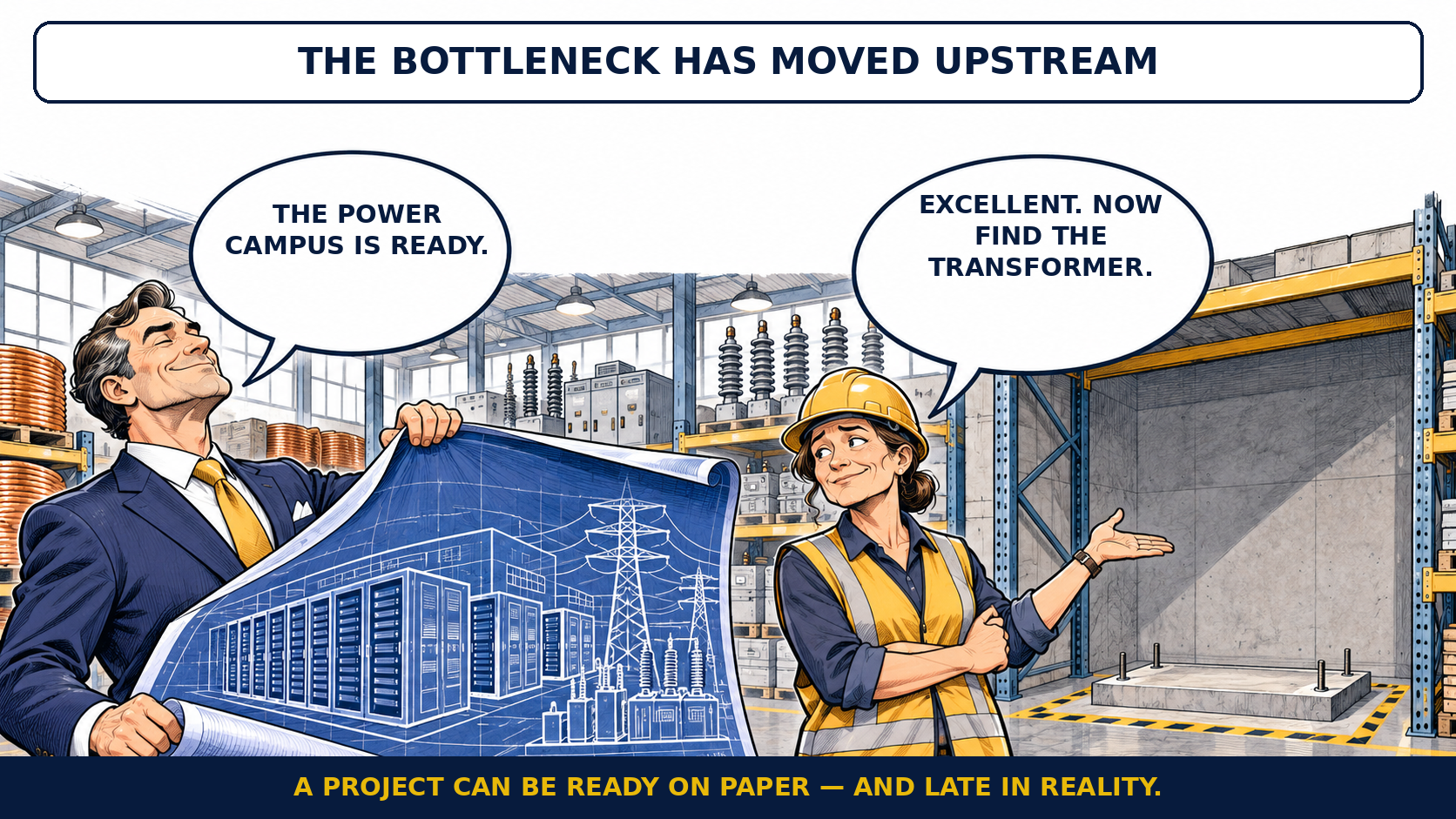
The data-centre campus is ready on paper. The transformer bay is ready in concrete. The transformer is not there. Click the cartoon to watch the animated Back Page.