Listen | The Universal Owner
Today in 90 Seconds
The European Commission confirms that the EU and Indonesia signed their Comprehensive Economic Partnership Agreement and Investment Protection Agreement on 21 November. Signature advances the process; it does not mean every provision has taken effect.
New on 22 November: Singapore Deputy Prime Minister Gan Kim Yong says further agreements between Singaporean and Chinese research centres will be announced at Monday's bilateral cooperation council. The specific agreements and their terms remain to be published.
HarbourVest Global Private Equity reported on Friday that about 67% of its issued shares were tendered into an offer capped at US$400 million. The company expects to announce pricing and the acceptance proportion on Monday.
Friday's Finnish announcement: Nordic Ren-Gas has reached final investment decision on Tampere. Standard Chartered says more than €300 million of financing has been signed, while financial close still depends on conditions being satisfied.
Also from Friday, Teranet named Michael Block as its next chief executive, starting on 1 February. We examine the move from institutional investing to running essential registry services.
And in this week's official regulatory material, Canada's OSFI proposes changes for smaller banks, while the ECB's corrected supervisory results highlight widespread operational and technology-control deficiencies.
ECB 2026 SREP · OSFI draft CAR 2028 · Teranet appointment · Singapore PMO new research-cooperation statement 22 November · Standard Chartered signed project financing 20 November · European Commission EU Indonesia signature 21 November · HarbourVest regulatory tender announcement 20 November
Watch | UAO LIVE with Ryan Lafield
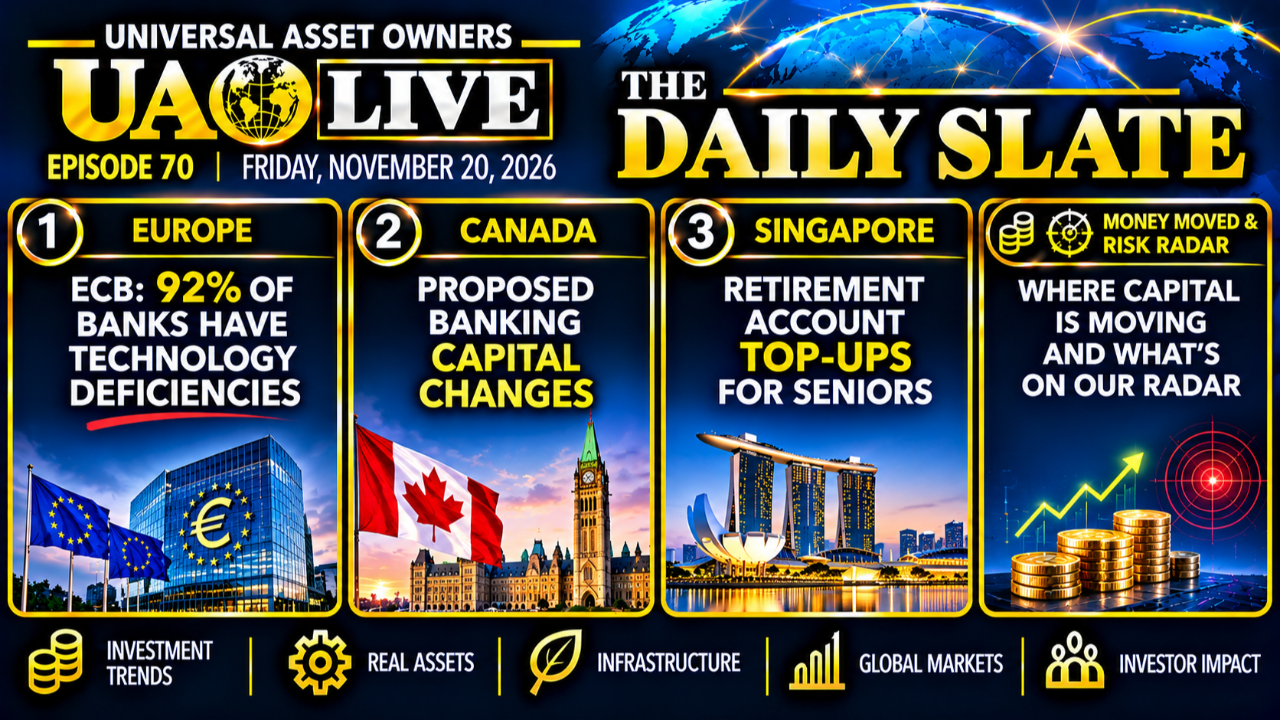
Latest completed programme: UAO LIVE Episode 70, 20 November 2026, with Ryan Lafield. Watch the completed broadcast below.
Lead | Europe and Indonesia sign a new investment framework
The European Union and Indonesia signed their Comprehensive Economic Partnership Agreement and Investment Protection Agreement on 21 November. The European Commission’s confirmation marks a concrete step in a process that now moves toward application and ratification.
For long-term investors, the potential reach extends across manufacturing, logistics, services and energy. The Council’s explanation also identifies cooperation on raw materials and improved access to public procurement. These are opportunities to assess against the implementation timetable, rather than benefits already reflected in every contract.
Provisional application begins after the parties notify each other that their required internal procedures are complete. European Parliament consent and further Council action remain part of formal conclusion. Investors need to establish which provision applies to a particular product, business or investment structure, and from which date.
Our assessment: start with the assets already exposed to this trade corridor. Map suppliers, tariffs and distribution routes, then identify the investments that could become more attractive as the agreements take effect. Keep those scenarios separate from the cash flows supported by current law.
A separate statement published today by Singapore’s Deputy Prime Minister Gan Kim Yong points to further research-centre cooperation agreements at Monday’s council with China. The detailed agreements remain to be announced. Together, the two developments put implementation and commercial rights at the centre of the coming week’s regional investment agenda.
Singapore PMO new research-cooperation statement 22 November · European Commission EU Indonesia signature 21 November · Council EU Indonesia implementation sequence
Asset investment case | From signature to application
Our asset-investment case is the EU-Indonesia package signed yesterday. The Council's explanation identifies trade in goods and services, public procurement, energy and raw materials as areas covered by the agreements.
Provisional application requires the parties to notify each other that the necessary internal steps are complete. European Parliament consent is also needed before formal conclusion. Our assessment is therefore about a developing investment framework, rather than an immediate change to a company's tariff bill.
For a long-term owner considering an Indonesian logistics or industrial asset, the useful next step is to map the relevant product, investment structure and implementation date. A broad trade agreement can improve the setting for a project while leaving its power supply, permits and financing to be resolved individually.
European Commission EU Indonesia signature 21 November · Council EU Indonesia implementation sequence
Credit | Canada consults on smaller-bank capital
In a consultation launched on 19 November, Canada's OSFI proposed changes to capital rules for smaller deposit-taking institutions. One change would remove their separate minimum and supervisory target Tier One risk-based requirement. Common Equity Tier One and Total Capital requirements would remain.
Proposed is the operative word. The comment deadline is 17 February 2027. Credit committees can model the possible effect, but they should not book a regulatory outcome. They should ask what other buffers remain, whether funding costs change and whether governance can keep pace if balance sheets grow.
Credit support is not simply more capital. It is the combined resilience of capital, liquidity, supervision and operating control.
Treasury | The changing demand for long bonds
For this week's research desk, the ECB's November Financial Stability Review identifies changing demand for longer-maturity government debt, including the effect of Dutch pension reform. This is dated research context, rather than a new Sunday policy announcement.
The ECB says insurers hold 10.7% of euro-area sovereign debt and pension funds 4.1%. Roughly half of both sectors’ sovereign holdings mature beyond ten years.
Treasury teams should not assume yesterday’s natural buyer stays tomorrow’s marginal buyer. A weaker structural bid at the long end changes term premium, hedge costs and discount rates across infrastructure and property. Run the curve shock through both assets and liabilities.
ECB November Financial Stability Review page 90
Politics and oil | Trade-route exposure
Today's Singapore statement also addresses trade-route security. Gan calls attention to the Strait of Hormuz and the importance of transit passage. We are reporting his stated concern, not announcing a new closure or a change in shipping conditions.
Our oil-risk analysis starts with the contracts behind the exposure. A delayed shipment can affect working capital and delivery obligations even where the commodity price has been hedged. Check who pays additional freight, what counts as force majeure and when insurance protection begins.
For a diversified owner, the same disruption can reach a port, a manufacturer and an insurer through different channels. Adding the exposures together is more useful than assuming a single oil-price forecast describes all of them.
Singapore PMO new research-cooperation statement 22 November
Pensions | Liability design and market demand
The pension story is liability design meeting market structure. A pension reform can change long-bond demand without shrinking the retirement system. More individualised arrangements and shorter effective liabilities can alter the hedge portfolio.
For boards, the decision is practical. Re-estimate the duration gap. Test collateral needs under higher long-end yields. Check whether private-market allocation has reduced liquid rebalancing capacity. And make sure the treasury view and the investment view are using the same liability assumptions.
A universal owner does not manage assets in isolation. The liability is part of the market footprint.
ECB November Financial Stability Review page 90
Chart | Who owns Europe’s government debt?
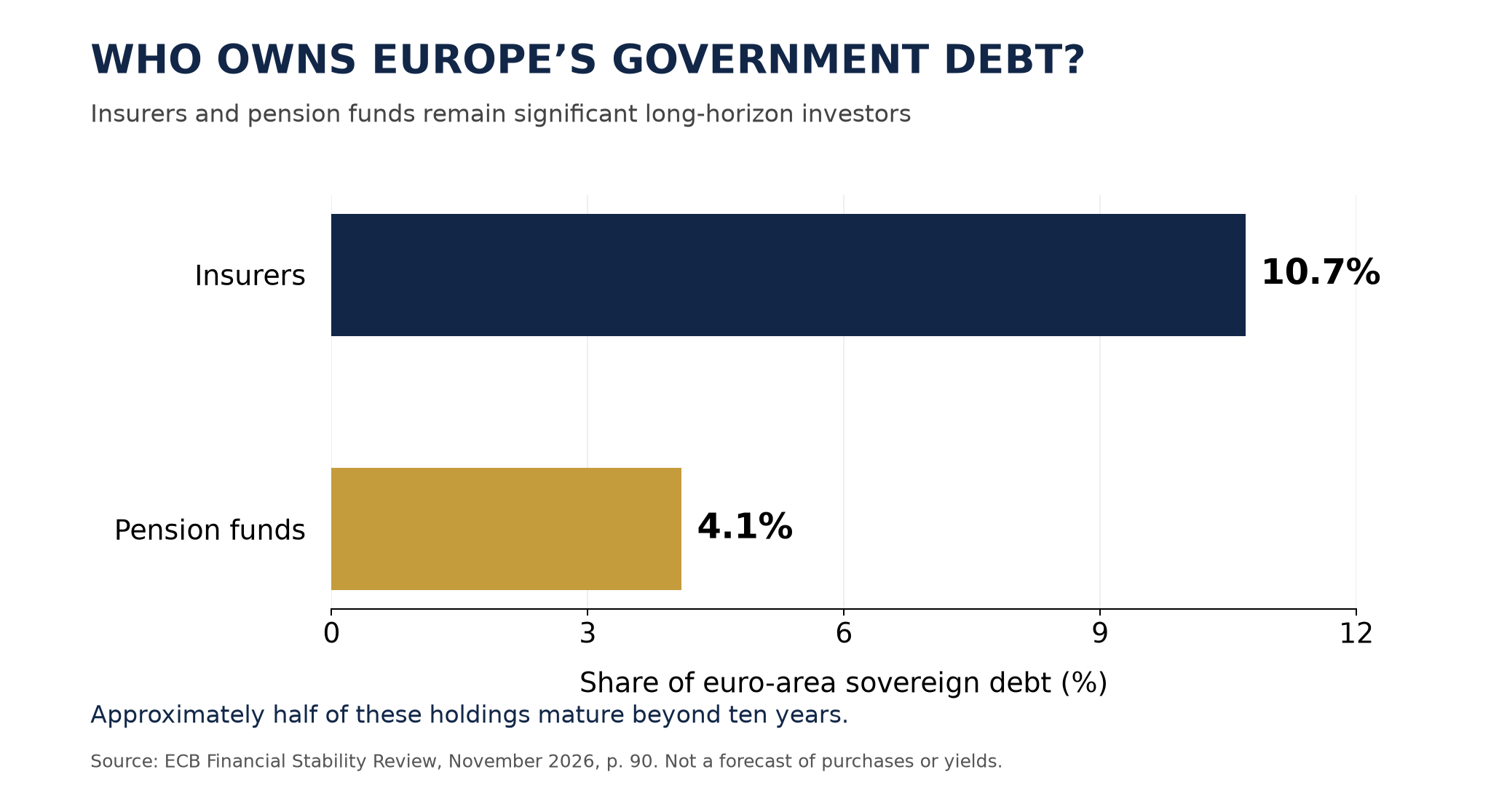
The chart uses the ECB's November review, page ninety. Euro-area insurers hold 10.7% of the region's sovereign debt. Pension funds hold 4.1%. The denominator is outstanding sovereign debt, not each sector's own investment portfolio.
The review says approximately half of these holdings mature beyond ten years. We show that as a separate note, rather than imply that the two sectors have identical portfolios or exact matching duration.
Our interpretation: a change in long-horizon demand can matter to a bond issuer even when the total pool of pension savings remains large. The chart measures ownership shares; it does not predict next week's yields or forced selling.
ECB November Financial Stability Review page 90
European credit | Tampere’s conditional financing
A 20 November financing statement supplies today's project-credit case. Standard Chartered identifies its roles as arranger, lender and hedge provider for Tampere, and explicitly says financial close remains conditional. The EIB has announced a €60 million loan.
The project combines technology, construction, offtake and heat-integration risks in a structured financing package.
For private lenders, the lesson is in allocation. Identify which risk the sponsor retains, which is insured or guaranteed, which is covered by contracts and which remains in the debt. Yield is only meaningful after that map is complete.
EIB Tampere loan · Standard Chartered signed project financing 20 November
Capital and liquidity | HarbourVest’s oversubscribed tender
HarbourVest Global Private Equity's 20 November regulatory announcement reports elections covering about 67% of issued shares, excluding treasury stock, for its tender offer of up to US$400 million. The offer was oversubscribed.
Monday's expected announcement will set out the tender price and the proportion to be accepted. The stated timetable then places purchase on 25 November and account credits on 2 December, subject to changes announced by the company.
Our liquidity analysis is straightforward: an election to sell is not cash received, and a capped tender does not guarantee every elected share will be purchased. For an investor meeting other commitments, the accepted amount and settlement date matter as much as the announced offer size.
HarbourVest regulatory tender announcement 20 November
European prices and wages | The construction budget
For Europe's prices-and-wages lane, today's fresh project case raises a procurement question. Tampere's financing covers a plant due in 2029. Construction costs and contracted revenues will be realised at different times.
Our analysis is to separate fixed-price orders from costs that remain open. Equipment delivery dates, construction labour, power supply and contingency allowances belong in different rows of the budget. A fuel offtake contract does not automatically protect the construction margin.
The practical question for owners is which costs can still change before commissioning and who supplies extra capital if the contingency is exhausted.
Standard Chartered signed project financing 20 November
Renewable gas | E-methane reaches an investment decision
The Tampere project is e-methane, not biomethane, and that distinction matters. Nordic Ren-Gas plans to combine renewable hydrogen with 40,000 tonnes of biogenic carbon dioxide, producing 190 GWh of renewable e-methane annually.
It also targets up to 200 GWh of process heat for the district network. That creates a multi-output system: electricity becomes hydrogen, carbon becomes feedstock, methane becomes fuel and heat becomes a local product.
The announced completion target is 2029. The sponsor's final investment decision and the lender's conditions for financial close are distinct milestones. Production forecasts remain targets until the plant is built and operating.
EIB Tampere loan · Standard Chartered signed project financing 20 November
Climate | Measure the operating outcome
The climate-investment development in today's lineup is Tampere's renewable-fuel financing, announced on Friday. It links electricity procurement, carbon supply, fuel sales and district heating in one project.
A useful environmental review should follow those inputs and outputs through the operating plan. Check electricity sourcing, metering, certification and the basis for any avoided-emissions claim. A project description alone cannot establish its eventual measured performance.
Our original Back Page satire considers the different clocks of policy discussion and physical exposure. It is commentary, not a report that a new climate agreement has been adopted. Any final COP decision needs its own verified text before it changes an investment assumption.
EIB Tampere loan · Standard Chartered signed project financing 20 November
People | Michael Block moves to Teranet
Teranet's 20 November announcement names Michael Block as president and chief executive from 1 February, 2027. He currently heads OMERS Private Capital, with responsibility for a C$13 billion portfolio.
Teranet says his OMERS career covered strategy, asset-liability management, capital markets and private capital. Earlier, at Boston Consulting Group, he advised public-sector, pension and regulated organisations.
Teranet has been owned by OMERS since 2008. The appointment links pension ownership, critical data infrastructure and operating accountability.
Governance | Operational risk remains with the board
The ECB's supervisory release, issued 19 November and corrected the following day, reports operational and technology-control deficiencies at 96% of significant institutions. The corrected figure concerns control weaknesses; it is not a percentage of banks experiencing an outage.
A board can delegate a platform migration or an outsourced service. It cannot delegate the consequence. The control map needs a named executive who can stop a migration, a tested exit from a critical provider and a recovery-time assumption that matches the liquidity plan.
Ask the uncomfortable question: when does an operational incident become a valuation event? If the answer is “after the incident,” the authority map is incomplete.
Executive profile | Michael Block and essential registry services
Michael Block is preparing to move from allocating institutional capital to leading an organisation whose services underpin property transactions. Teranet announced his appointment on 20 November, with the handover scheduled for 1 February. The company operates registries in Ontario and Manitoba and is owned by OMERS. Those facts make the appointment relevant to pension investors interested in how ownership translates into everyday service delivery.
His documented career gives several perspectives on that transition. Teranet identifies his current role as head of OMERS Private Capital, overseeing a C$13 billion portfolio. It describes earlier responsibilities in strategy, asset-liability management and capital markets. Before OMERS, he advised public-sector, pension and regulated organisations at Boston Consulting Group. This is the published career record; it does not establish what operating changes he will make at Teranet.
Our leadership analysis begins with the difference between owning a business and running it. An investor can compare several management teams and allocate capital among them. A chief executive must make decisions inside one organisation, with its existing systems, customers and obligations. Experience evaluating businesses can help, but it needs to be translated into decisions that employees can execute and customers can recognise.
For a registry operator, reliability provides a useful organising principle. A transaction record must be available, accurate and recoverable. The cost of an interruption can extend beyond the operator to people waiting for a transaction to complete. We would therefore ask management how service performance is reported to the board and how the organisation distinguishes an inconvenient delay from a failure requiring immediate executive intervention.
Technology spending creates a related capital-allocation challenge. Some projects improve convenience or open a new service. Others replace ageing components or reduce the consequences of an outage. Comparing them solely through near-term revenue can undervalue essential maintenance. An investment proposal should explain the operational problem, alternatives considered, expected life of the solution and what evidence will establish that the promised improvement actually occurred.
The same discipline applies to suppliers. Outsourcing can provide expertise that would be expensive to maintain internally, but it also creates dependencies. Our proposed questions are about access to data, recovery testing, contractual remedies and the time needed to change a provider. These are general diligence questions for critical infrastructure. We are not alleging a defect in Teranet's current arrangements or attributing an unpublished plan to Block.
A pension owner brings a long investment horizon, but that does not remove the need for timely operating decisions. Management still has to decide which upgrades should proceed now, which can be staged and which should stop. A useful board discussion would connect each decision to a service objective and a budget, then revisit the original assumptions when delivery costs or customer requirements change.
There is also a communication test. Customers and public partners need understandable explanations of service commitments. Employees need priorities that do not change with every presentation. Investors need evidence of sustainable performance. A chief executive can serve all three audiences by using consistent measures and explaining the trade-offs openly, rather than offering each group a different definition of success.
The appointment itself is not evidence that any of these issues has been resolved. The transition period offers an opportunity to establish a clear starting point: current service performance, planned investments, major dependencies and the responsibilities attached to each. Later assessments can then compare progress with that baseline, without confusing a change of leadership with an improvement in results.
For universal owners, the broader lesson is practical. Stewardship of essential infrastructure includes the quality of information reaching the board and the organisation's ability to respond when a service is under pressure. Block's new role will be judged through operating outcomes over time. The useful question today is what those outcomes should be, how they will be measured and how the owner will know when intervention is needed.
Careers | CalSTRS Public Markets
CalSTRS has a current opening for Senior Investment Director, Public Markets, Job Control 538042. The employer page lists Yolo County and a hybrid arrangement, with applications reviewed weekly until the role is filled.
The position oversees global equity, fixed income and risk-mitigating strategies under the deputy chief investment officer.
The employer application link is below. Applicants should follow its submission instructions and check eligibility there.
Decision calendar and risk radar
Monday, 23 November: watch for the research cooperation agreements signalled in today's Singapore statement. Their actual terms, partners and implementation dates are the next things to verify.
Also Monday: HarbourVest Global Private Equity expects to publish its tender price and acceptance proportion. For EU-Indonesia, watch the formal notifications that begin provisional application.
For Tampere, the next lender milestone is satisfying the conditions for financial close, followed by construction and commissioning toward 2029.
1 February brings the announced Teranet leadership change. OSFI's capital consultation takes comments until 17 February, 2027. The CalSTRS public-markets search remains open until filled.
The official 18 November account of Canada–China financial cooperation describes working-group terms and potential local-currency initiatives. That predates today, so we retain it as dated background rather than an overnight agreement.
OSFI draft CAR 2028 · Teranet appointment · Singapore PMO new research-cooperation statement 22 November · Canada China financial cooperation background 18 November · Council EU Indonesia implementation sequence · HarbourVest regulatory tender announcement 20 November
The Take
Today's reporting connects trade access with the practical availability of capital. A signed treaty still has implementation steps. A tender election still needs an accepted amount and settlement. A research agreement still needs a commercial path.
For an investment committee, our practical suggestion is to record the next piece of evidence for each case. That might be the published agreement, a closing confirmation or a service-performance measure.
This keeps attention on what can be checked next, while allowing investment decisions to develop as the information improves.
Source Desk
ECB 2026 SREP · EIB Tampere loan · OSFI draft CAR 2028 · Teranet appointment · CalSTRS career · Singapore PMO new research-cooperation statement 22 November · ECB November Financial Stability Review page 90 · Standard Chartered signed project financing 20 November · Canada China financial cooperation background 18 November · European Commission EU Indonesia signature 21 November · Council EU Indonesia implementation sequence · HarbourVest regulatory tender announcement 20 November
Back Page | Policy overtime
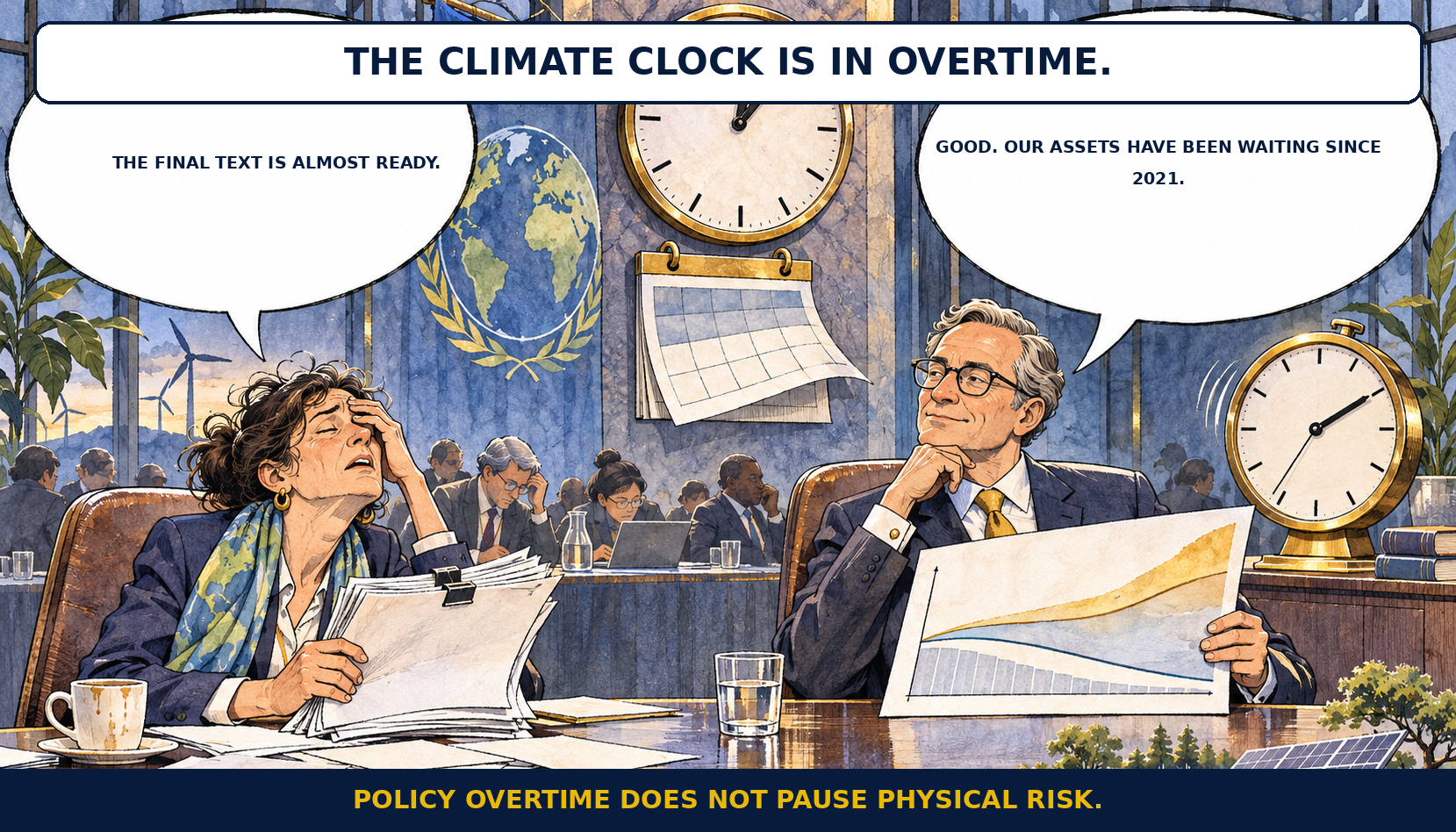
Two clocks frame a negotiator and an asset owner. One waits for the final text; the other carries exposure throughout the delay. Our original cartoon is a satire about the time needed for policy decisions and the continuing demands of asset ownership.