A 25-year high in real yields just broke the buyout math.
Treasury sold 30-year inflation-protected debt at 2.973%, the most since 2001, and primary dealers were left holding 2.10% of it. The same morning a canal cut traffic to 34 ships with its lake at a five-year average. Both are the same story.
UAO EditorialAugust 21, 202623 min read
UNIVERSAL ASSET OWNERS
THE DAILY BRIEF · FRIDAY 21 AUGUST 2026
On Thursday the Panama Canal Authority cut its own daily traffic to thirty-four ships while its lake sat exactly on its five-year average — rationing capacity it still has against a drought five months away. The same day, the US Treasury sold thirty-year inflation-protected debt at the highest real yield since 2001 and had so many buyers that primary dealers were left with 2.10% of it.
One real asset is rationing throughput. The other is being handed money.
Today’s briefing · 2:04
What happened
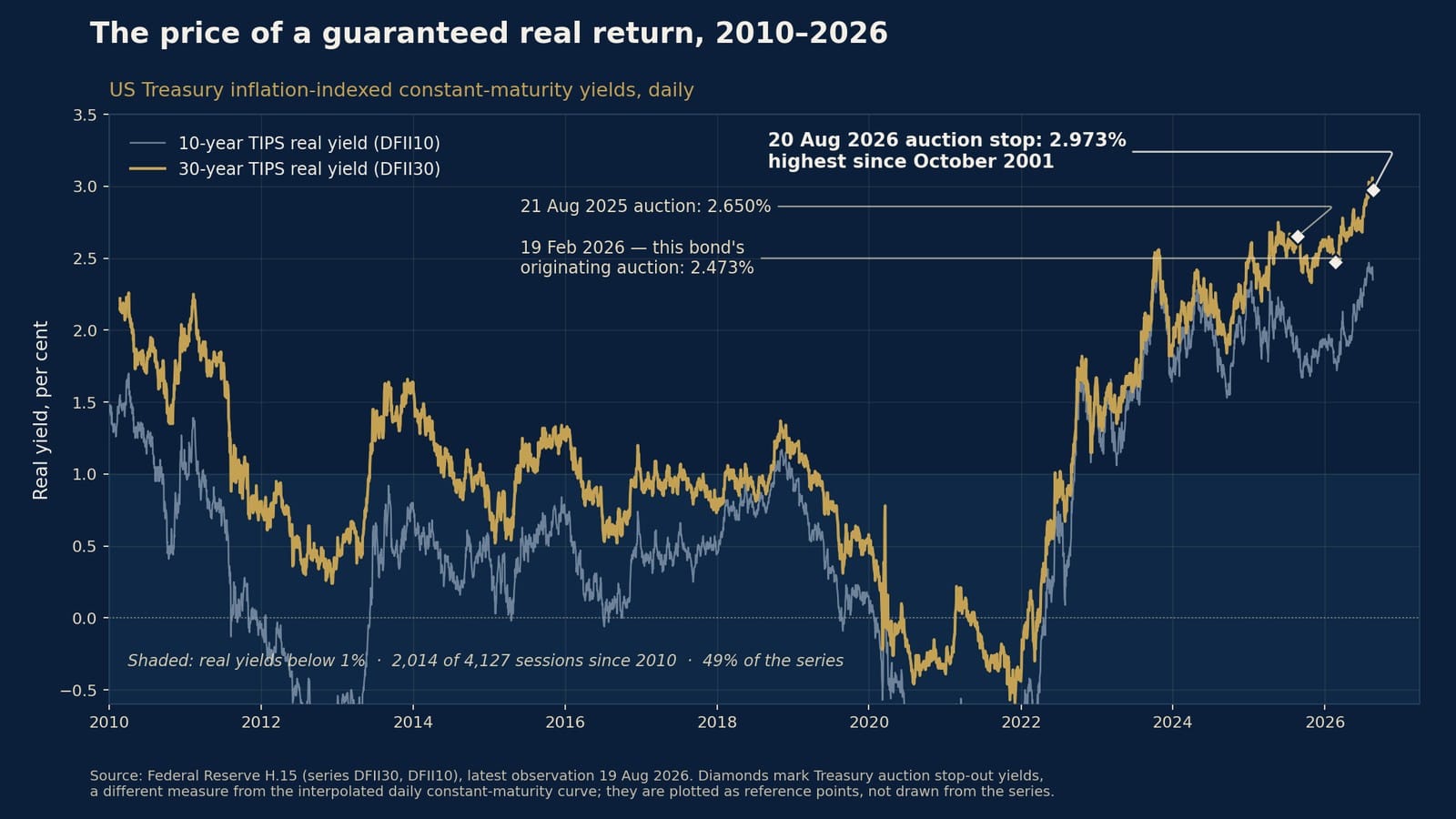
At 1:00 p.m. Eastern on Thursday the United States Treasury reopened the 2.375% Treasury Inflation-Protected Security maturing 15 February 2056. It stopped at a real yield of 2.973% — the highest at this tenor across all forty-two auctions since it was reinstated in February 2010, and the highest since 10 October 2001, when the last of the old series cleared at 3.465%.
The distribution matters more than the level. Bid-to-cover was 2.82. Indirect bidders — the category holding foreign central banks, sovereign funds and pension money — took 84.45%. Direct bidders took 13.45%. Primary dealers were left with 2.10%. Dealers underwrite what nobody else wants. On Thursday there was almost nothing left to underwrite.
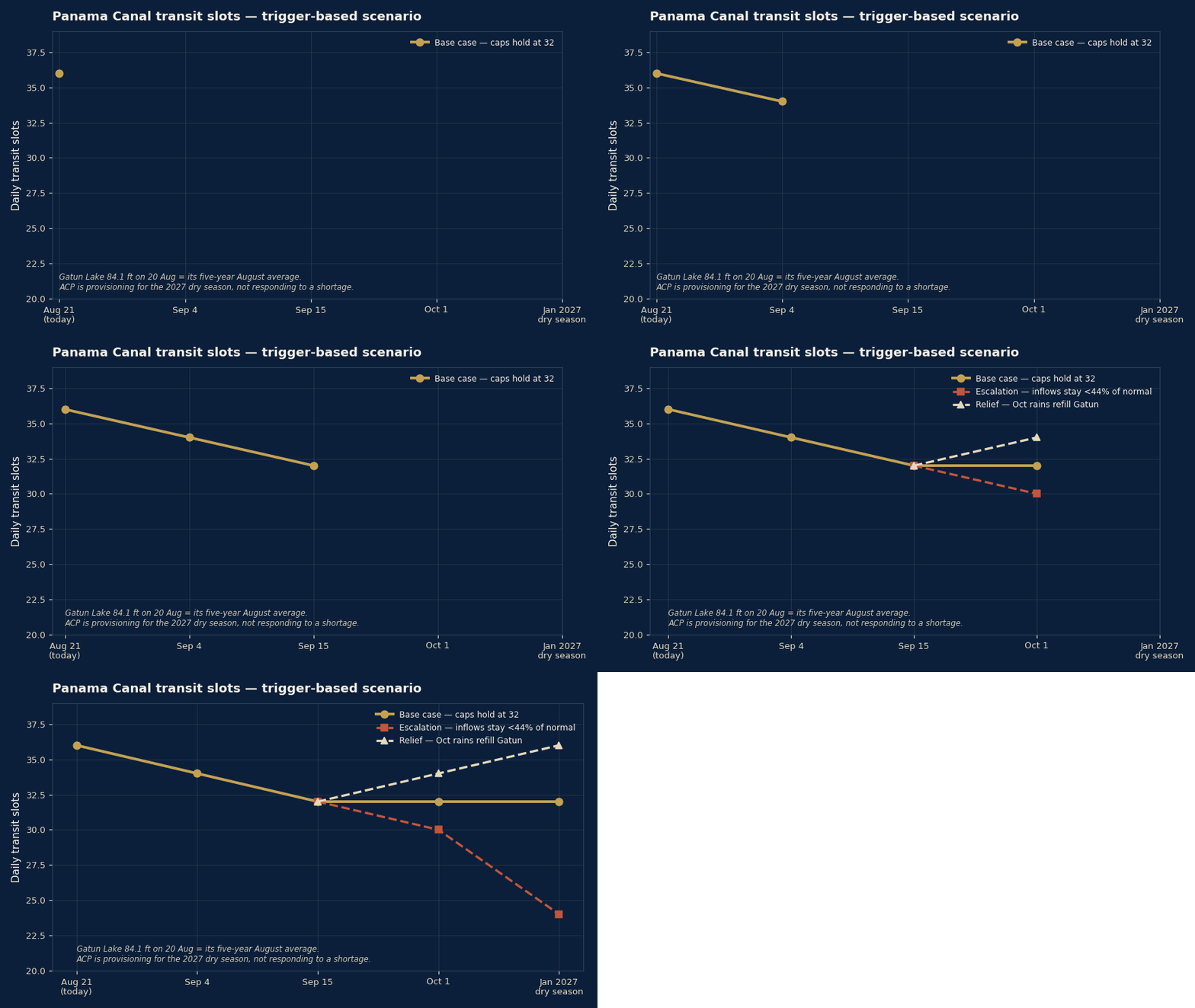
Earlier the same day, the Panama Canal Authority issued Advisory to Shipping A-29-2026. Effective 21 August, for booking dates from 4 September, daily transit slots fall to thirty-four. From 15 September they fall to thirty-two — nine at the Neopanamax locks, twenty-three at the Panamax locks. Cumulative rainfall across the watershed has run 34% below its historical average and inflows 44% below theirs.
And in northwestern Bulgaria, the Kozloduy nuclear plant announced that Unit 5 would cut output by about 120 megawatts from Friday, citing what it called “the continuous unprecedented and critical decline in the Danube River water level.” The plant said the measure had been applied “for the first time in Kozloduy NPP’s 52-year operating history.”
Three assets. One was paid a quarter-century-high real yield to accept capital. The other two announced they could not move as much water, or as many ships, as their design allows.
The number that reprices everything else
A 2.973% real yield locked for thirty years is not a trade. It is a substitute for a business model. Since roughly 2011 a defined-benefit scheme, a life insurer’s annuity book or a sovereign fund’s real-liability sleeve has had to manufacture a return the bond market would not provide: illiquidity premia in private credit, leverage in liability-driven mandates, concentrated exposure to a few very large growth companies, and — for sponsors who could afford it — the option to hand the problem to an insurer.
Every part of that apparatus is priced against the alternative of simply owning the real yield. When the alternative pays nothing, the apparatus is worth a great deal. At 2.97% real for thirty years, most of it is worth considerably less.
The move is unambiguously real rather than inflationary. On 19 August the thirty-year nominal fell nine basis points to 5.19% and the thirty-year real yield fell exactly nine, to 2.94%. The ten-year breakeven did not move at all, holding at 2.30 for a second session. The two-year sat at 4.19% for a third. This was term premium, at the far end of the discount curve, which is precisely where pension and insurer liabilities live.
US Treasury inflation-indexed constant-maturity yields, daily. Source: Federal Reserve H.15 (DFII30, DFII10), latest observation 19 August 2026. Diamonds mark auction stop-out yields — a different measure from the daily constant-maturity curve.
The canal is rationing capacity it still has
The Panama story is not the one the headline numbers imply, and the difference is the whole point. Rainfall is down 34% and inflows are down 44%. But Gatun Lake stood at 84.1 feet on 20 August, and the five-year average for August is 84.1 feet. Daily readings between 12 and 21 August ran between 84.0 and 84.2 — flat, not falling. The lake is exactly where it usually is.
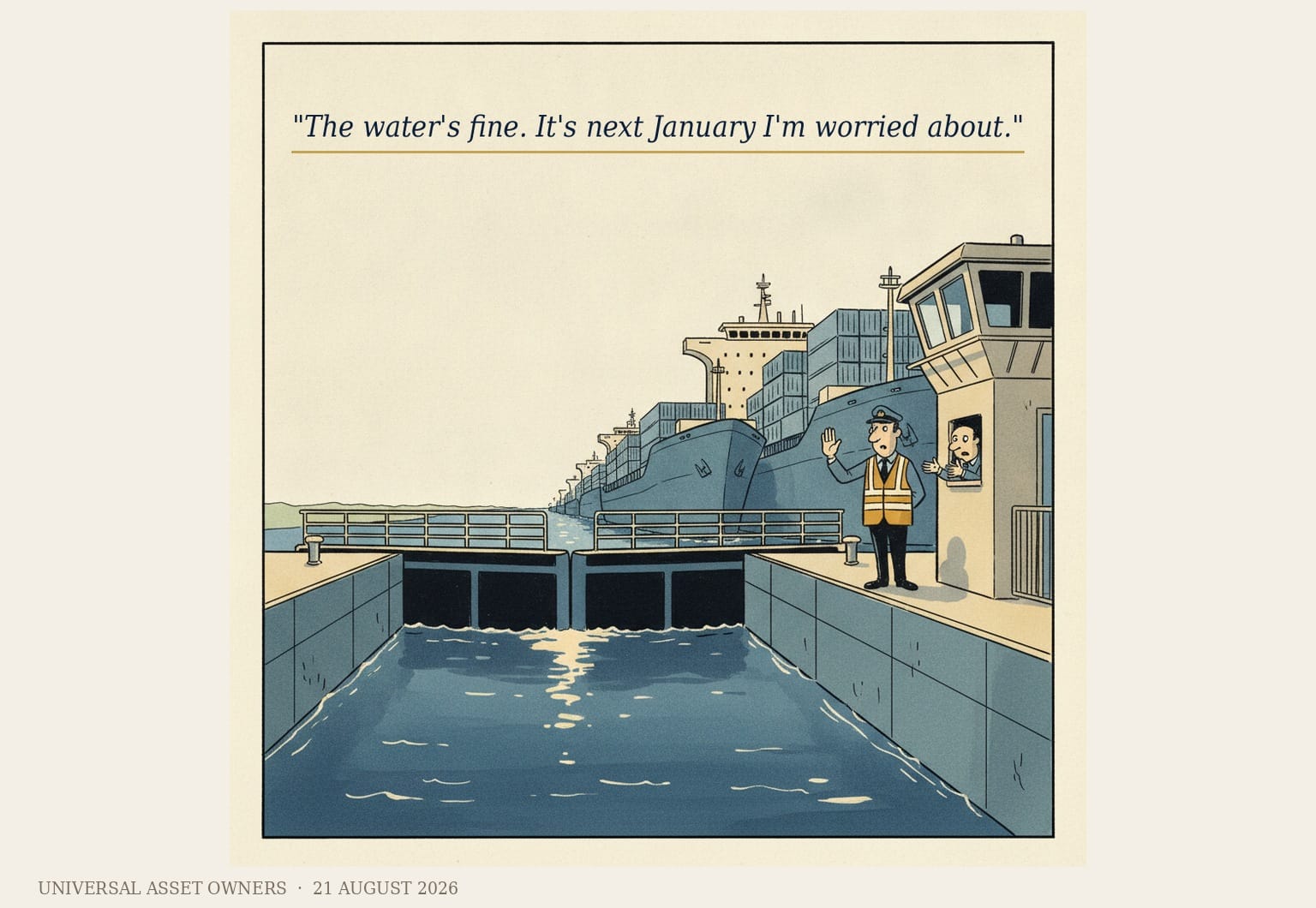
The authority is not responding to a shortage. It says so: the concern is “water availability during the upcoming 2027 dry season, January to April.” This is a reservoir manager spending throughput now to hold water for a drought five months away.
The evidence is in the same document. While cutting transit slots, the authority postponed two scheduled reductions in maximum draft — deferring the 48.0-foot Neopanamax limit from 26 August to 2 September, and the 47.5-foot limit from 3 September to 1 October. A canal in acute distress cuts draft, because draft is what consumes depth. This one deferred the draft cuts and took the ships instead.
Better than 2023, and a worse precedent. Better, because preventive rationing at thirty-four slots against demand in the mid-thirties should avoid the auction premiums and multi-week queues of the last El Niño. Worse, because the canal has now shown it will ration throughput on a forecast. Reliability is no longer a function of today’s water. It is a function of the operator’s view of next year’s.
Trigger-based scenario. Base case, escalation and relief paths are conditional on stated triggers, not forecasts, and carry no assigned probabilities.
A reactor that cannot get cooling water
Kozloduy’s Unit 5 — a VVER-1000 commissioned in 1987 — reduced output by about 120 megawatts on Friday. Kozloduy provides, on the operator’s own figure, more than a third of Bulgaria’s annual electricity generation.
The river reading is worth stating precisely, because this is where reporting on European drought keeps going wrong. Bulgaria’s Danube navigation authority published, for 21 August, a water stage at the Kozloduy gauge, river kilometre 703.90, of −237 centimetres. Downstream at Oryahovo the stage was −112 cm on a discharge of 1,250 m³/s; upstream at Lom, −30 cm on 1,362. These are stages relative to each gauge’s local zero datum, not depths — a distinction that has produced a great deal of nonsense in the past fortnight.
A 120-megawatt derate is small; Bulgaria’s grid will not notice it. Its significance is categorical. Thermal generation has been financed for sixty years on the assumption that cooling water is free, abundant and uncorrelated with anything else in the portfolio. On Friday, at one plant, that assumption produced a derate for the first time in fifty-two years. Every discounted cash flow for a riverside thermal asset contains an availability factor. That factor has just acquired a hydrological beta.
What the physical constraint costs, in three more places
A solar farm that cannot reach the grid. In India, official data cited this week show about 14% of solar output curtailed between April and June because transmission could not carry it. In some cases 70 to 80% of a project’s output could not reach a buyer. Not a generation problem — a delivery problem, falling entirely on debt-service coverage.
A refinery that does not exist yet. On Thursday the US Department of Energy announced seven selections under the infrastructure act’s battery-materials programmes, totalling $500 million: $100m each to a Lilac Solutions entity, Jervois and Nth Cycle, and $50m each to Princeton NuEnergy, Arcanum Ventures, Elevated Materials and Coreshell. The stage language matters more than the money. These are selections to enter award negotiations for “up to” those amounts, and the department’s own condition is that a selection “is not a commitment by DOE to issue an award.” Minimum private cost share is 50%. Two of the seven have no announced location. One is the entity that emerged from a prepackaged Chapter 11 in early 2025.
A pension that can no longer write the ticket alone. Canada Pension Plan Investment Board has been committing to the flagship infrastructure funds of EQT, KKR and Blackstone after building almost US$80bn of energy and infrastructure exposure directly. James Bryce, its global head of infrastructure, put it carefully: “Infrastructure deals are becoming increasingly large… As an investor with [a fund], are we able to open up for both of us deal opportunities that we may not have been able to chase on our own?” That is a question about access, not a statement that a pension cannot underwrite a ticket. Bryce also said CPPIB will still invest mostly through direct holdings — this is an added lane, not a reversal. Note the commitments are older than the story: EQT Infrastructure VI closed at its €21.5bn hard cap in March 2025.
A mine whose liabilities are still being priced eleven years on. Vale disclosed on Thursday that nineteen further municipalities, including Mariana itself, joined the definitive reparation agreement for the 2015 Fundão dam collapse, bringing participation to forty-five of forty-nine. Adhesion is conditional on each municipality waiving proceedings “in Brazil and abroad.” The headline R$170bn is not a lump sum — it is R$100bn over twenty years, R$32bn of Samarco performance obligations and R$38bn already spent; BHP publishes it as about US$32bn. In England the position is further advanced than most coverage suggests: the High Court found BHP liable in November 2025, the Court of Appeal refused permission on all five grounds on 6 May 2026, and the trial running October 2026 to March 2027 is on causation, not damages — damages is a third stage BHP says is unlikely before 2028.
Stewardship & Voting
The external stewardship window was quiet, and the institutions that set the agenda show why: Norges Bank Investment Management’s most recent release is dated 12 August, the IIGCC’s 10 and 12 August, the ICGN’s most recent letter 14 August, the Council of Institutional Investors’ 6 June, and the Financial Reporting Council’s 9 July. No proxy contest, engagement escalation, mandate termination or voting-guideline change falls in the window.
The live governance question is about consent rather than voting, and it appeared in South Korea. Hyundai Motor’s union struck for a full day on Friday — both shifts, sixteen hours of idle lines at Ulsan, Asan and Jeonju, with about 39,000 members participating. It is the first full-day strike since 2016. Alongside conventional demands, the union seeks an extension of the mandatory retirement age toward the national pension eligibility age, and guarantees on employment and working conditions related to the growing use of artificial intelligence. Production-loss figures of 55,200 vehicles and more than ₩2.3 trillion are circulating; those are industry estimates relayed by Yonhap, derived from an assumed 460 vehicles an hour. Hyundai has published no figure.
Strip out the wage dispute and what remains is the first serious bargaining round in a major manufacturing economy where automation and demographics are a single item. An ageing workforce wants to work longer; the employer wants to automate. Those get reconciled in a contract, or in a strike. Every allocator with a robotics thesis and a demographics thesis is long both sides of that table.
Pointed at the allocator rather than the company: on 19 August the Australian Prudential Regulation Authority, which supervises institutions holding about A$9.8 trillion, set out a package to strengthen superannuation investment governance across eight areas, disclosing that it has taken enforcement action against five trustees. Under a separate proposal, APRA would set capital requirements for trustees offering higher-risk investment options — the first regulatory proposal this desk has seen that prices trustee investment choice directly.
The Long Horizon — concentration and index structure
Between 19 and 20 August, MSCI published a run of methodology announcements from its August 2026 Index Review. Individually they are housekeeping. Together they describe a provider moving in two directions at once.
Three separate announcements each cut a single-security capping constraint from 15% to 12%, and each moved to semi-annual application. They cover the MSCI China USA Biotech 65/35 Index, the MSCI Asia Pacific Health Care 65/35 Index and — the one that matters most here — the MSCI China USA Robotics and AI 65/35 Index. Three distinct updates on three distinct indexes, not one joint action.
A capping constraint is how a thematic index refuses to become a single-stock position. Cutting it from 15% to 12% means that when one name runs away from the theme, the index sells more of it and sooner. Semi-annual application means it does so twice as often. For a passive holder this is a small, silent, mandatory rebalancing away from the winner — applied in the same week to biotech, Asian health care, and robotics and artificial intelligence.
In the same review MSCI moved the other way. For the MSCI Journey Select Indexes, the minimum required uplift in weighted-average ESG Industry Adjusted Score relative to the parent was cut from 10% to 5%, while a new constraint requires the weighted-average E, S and G pillar scores each to sit at or above the parent. Effective 1 September.
Index methodology is the largest undiscussed active decision in most institutional portfolios. A provider tightening single-name caps across thematic products while relaxing an aggregate sustainability hurdle is making two judgements — one about concentration risk, one about the cost of the screen — and transmitting both automatically into every mandate benchmarked against them. Neither was voted on. Both take effect on 1 September.
Companion data point: the International Union for Conservation of Nature reported this week that countries have restored 124.3 million hectares against pledges of roughly 1.2 billion — about 10.4% — while the UN estimates as much as 40% of global land is degraded. Restoration commitments and index sustainability hurdles are the same instrument at different scales: a stated intention whose implementation rate is the only number that matters.
ALLOCATOR LENS
What this means for the portfolio
Two things happened on the same Thursday. The price of a risk-free real return hit a quarter-century high, and three separate real assets disclosed that they cannot deliver their rated throughput. Those are the same event seen from opposite ends.
One. Re-run the buyout arithmetic at today’s real curve, not the one in the last strategy paper. Only 10% of UK DB sponsors now target buyout as soon as practical, while 66% have reviewed their long-term strategy and a further 27% are reviewing it. Forty per cent see the scheme as a potential source of value against 22% who see it as a balance-sheet risk. Meanwhile up to £2bn of new capital — £500m of it Standard Life’s own, the balance from a consortium led by CVC and Prudential Financial — is being organised to serve that market, drawn over five years, completing in H1 2027.
Two. Price the illiquidity premium against something with no gate. Sponsors met 53% of second-quarter repurchase requests, against 74% in the first quarter; nine funds prorated. One interval fund’s monthly subscription fell from $190.4m in March to $16.7m in August. One mechanical point: semi-liquid vehicles meet redemptions from cash buffers and credit facilities, not by liquidating loans into a slow settlement process. The risk sits in the facility, not the queue — and it is a bank’s decision to renew rather than a manager’s decision to gate.
Three. The passive concentration exposure is being trimmed for you, on a schedule you did not set — automatically, twice a year, from the September review.
Four — the new one. Add a throughput test to every real-asset holding. For each infrastructure, utility, shipping, port and thermal position, ask what physical input the rated capacity assumes is free and uncorrelated, and what happens to the availability factor when it is not. This week supplied four worked examples: water for cooling, water for transit, transmission for delivery, and consent for construction. None is an ESG overlay. Each is a number inside a discounted cash flow.
Capital flows
20 Aug — US Treasury reopens the 2.375% TIPS of Feb 2056
Cleared, settles 31 Aug. $8.00bn accepted; $9.03bn issued incl. a $1.03bn SOMA add-on. Real yield 2.973%; bid-to-cover 2.82; indirect 84.45%, direct 13.45%, primary dealer 2.10%
20 Aug — DOE battery-materials selections, IIJA §40207
Selected to enter award negotiations for “up to” the amounts — not a commitment to award. $500m across seven; min. 50% private cost share
20 Aug — Standard Life PRT Solutions
Announced; subject to regulatory approval, completion expected H1 2027. Up to £2bn initial over five years, incl. £500m from Standard Life. Consortium led by CVC and Prudential Financial; Standard Life retains 51% of voting rights
20 Aug — Fundão / Mariana municipal adhesion
19 joined; 45 of 49 now participate, conditional on waiving proceedings in Brazil and abroad. R$170bn = R$100bn over 20 yrs + R$32bn performance obligations + R$38bn already invested; about US$32bn on BHP’s figure
20 Aug — Altro Pension Scheme BPA with M&G
Completed — in April 2026, announced 20 Aug. £85m, 740 members
19 Aug — ICAEW-sponsored scheme buy-in with PIC
Completed. £58m, 375 members
20 Aug — Japan 20-year JGB auction
Cleared. Lowest accepted 99.85 = 3.713%; average 3.698%; bid-to-cover 3.98×
19 Aug — Ares Strategic Income Fund July NAV
Disclosed. NAV/share $26.67, second consecutive monthly fall. August private placement $16.7m against $190.4m in March
19 Aug — Apollo Debt Solutions BDC
Declared. NAV/share $23.83 unchanged; 99% first lien. Begins a monthly month-end holdings disclosure
Markets. US equities closed lower on Thursday: the S&P 500 −0.9%, the Dow −1.3%, the Nasdaq Composite −1%. In Friday’s Asian session, intraday rather than at a close: Nikkei 225 66,080.25 (−0.2%), KOSPI 6,914.09 (+0.9%), Hang Seng 25,888.36 (+0.7%), Shanghai Composite 3,903.81 (flat), ASX 200 9,053.90 (−0.3%); dollar at ¥159.01, euro at $1.1694. Oil, as two series, not combined: EIA Europe Brent spot $95.29 on 18 August; ICE Brent October futures near $93.64 intraday Friday. On the spot series the Brent–WTI spread widened to $8.81 on 18 August from $6.39 on 17 August.
Geopolitics & chokepoints
A sanctions re-tagging that changes a screening perimeter. On 20 August OFAC designated 21 individuals, 16 entities and 10 vessels. The item with the widest operational reach is not a new designation: Hizballah’s existing SDN entry was amended to add the [IRGC] and [IFSR] tags and the notation “(Linked To: IRGC-Qods Force).” A re-characterisation of an existing entry propagates through a rules engine differently from a new name, and widens the set of secondary relationships that flag. In the same action, Russia-related General License 131I authorises entry into contingent contracts for the sale of Lukoil International GmbH.
Venezuelan barrels, and the argument about how many. Hunt Oil signed a production participation contract and SLB a framework agreement on 18 August. Venezuela’s oil minister told a Houston audience on 19 August that output has risen from just under 1.0m barrels a day to more than 1.2m over the past year — those figures are the minister’s. The forecasts diverge and both sides are named: Rystad’s Simon Sjøthun puts 3m b/d at 2040; Crossover Energy’s Eric McCrady puts 3.5m within five to ten years.
Brent’s level, without a cause attached. Brent traded at $95.40 a barrel at 06:15 Eastern on 20 August, against $93.60 the previous morning and $67.21 a year earlier. The level is the fact. The Strait of Hormuz has been closed since February — a continuing state rather than a development, not re-reported here as news. No maritime authority published a transit count, war-risk premium or vessel incident for this window, and none is carried.
Signals — not yet confirmed
EMERGING
India may be about to move renewable curtailment losses onto the public balance sheet. Four industry sources say the government is considering seven-to-eight-year low-cost loans for producers whose output has been curtailed for want of transmission. Confirm or kill: a published scheme with appropriated funding, eligibility criteria, a stated rate and a named implementing lender. No ministry has confirmed it.
EMERGING
Texas may have acted on three large-load interconnection exceptions on Thursday, and no record of it can be found. ERCOT brought three “Batch Zero” good-cause exception requests to a Public Utility Commission open meeting scheduled for 20 August, following a 3 August directive to audit a queue standing at about 474 GW, roughly 90% data centres, that expressly requires projected peak water consumption and named water sources. Confirm or kill: an order or minutes in the docket. A scheduled item on an agenda is not a decision.
EMERGING
The CFTC’s Innovation Advisory Committee was scheduled to hold its inaugural meeting at 1:00 p.m. on 20 August, and the Commission has posted nothing since. Comments are open until 27 August on docket CFTC-2026-1717-0001. Confirm or kill: a post-meeting release or a docket entry.
REPORTED
Jefferies Credit Partners is reported to be targeting approximately €1bn for a private credit secondaries fund. Reported by Bloomberg on 19 August. Jefferies has not confirmed it. Confirm or kill: a Form D or a statement from Jefferies. Carried because a secondaries bid is what forms when a primary market gates.
Decisions due
21 Aug (today)
Kozloduy Unit 5 derate takes effect. Watch realised output on the system operator’s data, not the plant’s “real time” page, which is stamped 29 June
24 Aug
UNCCD COP17 Finance Day; ministerial dialogues 24–26 Aug. At the 19 Aug session the EU asked development finance institutions to recognise land and drought resilience as a strategic asset class; Brazil said the draft text “is insufficient to address the finance gap”
25 Aug
Launch of the Drought Resilience Investment Facility; first Assembly of the Riyadh Global Drought Resilience Partnership
26 Aug
Ofgem October–December household energy price cap
27 Aug
Comments close on CFTC docket CFTC-2026-1717-0001
27–29 Aug
Jackson Hole, theme “Financial Innovation: Implications for Payments and Policy.” Not this week — no agenda, papers or Chair address published
31 Aug
The 2056 TIPS and the 19 Aug 20-year bond settle. The real-money buyers who took 84.45% fund it here
1 Sep
MSCI’s revised Journey Select methodology takes effect; new IGPA and IPSA books transition
2 Sep
ACP’s postponed 48.0 ft Neopanamax draft limit now due. 4 Sep: the 34-slot cap begins. UK DB surplus-release consultation closes
Sep
APRA consults on superannuation investment governance
15 Sep
ACP’s 32-slot cap begins; DWP/FCA Value for Money consultation closes; ADQ/L’IMAD tender deadline for AD Ports
1 Oct
ACP’s postponed 47.5 ft draft limit now due
15 Oct
Norway’s ethics-framework committee report. Under interim rules Norges Bank cannot make new exclusion or observation decisions but may revoke earlier ones
Oct 2026 – Mar 2027
English causation trial in the Fundão group action. Not a damages trial — damages is stage 3, unlikely before 2028
Central banks in the window. Banxico’s minutes, released 20 August, record a unanimous 5–0 hold at 6.50%. Bank Indonesia held the BI-Rate at 5.75% on 19 August and extended its 12.5% hedging-swap premium discount to bank external borrowing and foreign direct investment from the second week of September; its published view is that the federal funds rate rises in Q4 2026 — the opposite of what the US front end prices. The Central Bank of Egypt held for a fourth consecutive meeting.
The Universal Owner Risk Radar
Primary dealers took 2.10% of an $8bn thirty-year TIPS reopening; indirect bidders took 84.45%
Real-money demand for long real yield is deep enough that underwriters were not needed
Gatun Lake at 84.1 ft — exactly its five-year August average — while transits are cut to 34
The canal now rations on a forecast, not on today’s water
ACP postponed two draft reductions while cutting slots
Throughput is being traded against load, not simply withdrawn
A nuclear unit derated 120 MW for hydrology — first in 52 years
Cooling-water availability has entered the availability factor
Danube at Kozloduy: −237 cm stage relative to gauge zero
The physical variable behind the derate, from the navigation authority
About 14% of Indian solar output curtailed in one quarter
Delivery, not generation, is the binding constraint on renewable cash flow
DOE selections are “up to” amounts and not a commitment to award
Strategic capacity is being optioned, not bought
Sponsors met 53% of Q2 repurchase requests against 74% in Q1
The gate is being used, not merely disclosed
MSCI cut a single-name cap 15% → 12% on three thematic indexes including robotics and AI
Passive concentration is trimmed automatically, on a schedule you did not set
The 30-year Treasury yield traded 4.64%–5.31% in 2026
Funding-ratio volatility is coming from the discount rate, not the assets
The 10-year breakeven held at 2.30 while the 30-year real yield fell 9bp
The long-end move is term premium, not an inflation view
45 of 49 municipalities in the Fundão agreement, conditional on waiving proceedings abroad
Liability is being resolved by extinguishing claims, not only by paying them
39,000 Hyundai workers struck over pay, retirement age and AI employment guarantees
Automation and demographics are now a single bargaining item
APRA would set capital requirements for trustees offering higher-risk options
A regulator pricing trustee investment choice directly
Philadelphia Fed future capex highest in 53 years
If believed, the dovish front-end repricing is the leg most likely to be wrong
The canal rationed. The bond auction turned buyers away.
Why a 2.973% real yield makes the buyout, the private-credit sleeve and the concentration trade optional — and why a lake sitting on its five-year average is the most interesting number of the week.
Universal Asset Owners · Friday 21 August 2026 · 9:00
The week’s most instructive appointment is a role being abolished rather than filled. The Investment Management Corporation of Ontario, which runs about C$90.7bn, said on 20 August that Rossitsa Stoyanova will leave the chief investment officer role — she remains CIO through January 2027 and then becomes a special advisor. IMCO is not replacing her. It is splitting the mandate three ways, with all three executives reporting to president and chief executive Bert Clark: Nick Chamie becomes executive managing director, total portfolio; Craig Ferguson executive managing director, private markets; and Angus Botterell executive managing director, public equities. For a fund of that size, dissolving a single CIO seat into a total-portfolio role plus two asset-class heads is a statement about where the decision rights are meant to sit.
At the Kresge Foundation, whose endowment stands at about $4.2bn, Jon D. Gentry is named vice-president and chief investment officer and Emily Bertsche deputy CIO, both subject to Board of Trustees approval next month. Gentry has been managing director of investments at Kresge since 2005 and was previously an investment director at the University of Notre Dame; Bertsche joined in 2024 from the UAW Retiree Medical Benefits Trust. John A. Barker, CIO since 2022 and nineteen years at the foundation, is departing.
Antonio Rodriguez
First chief investment officer, Building Service 32BJ Funds ($13bn, SEIU 32BJ). Internal — previously director of investments; before that the NYC Board of Education Retirement System. Reported 18 Aug. Trade-press exclusive; no institutional release located.
Joann Wilkie
Chief executive, Government Employees Superannuation Board (GESB), Western Australia, from the WA Government where she was Under Treasurer. Effective 12 Aug. Paul Taylor returns to CIO having served as interim chief executive.
Martin Noven
Chief executive, Iowa Public Employees’ Retirement System, from the Maryland State Retirement and Pension System. Effective 24 Aug; announced 11 Aug.
Pierre Charette
Chief pension services officer, University Pension Plan (C$13.5bn), from Canadian National Railway. Announced 20 Aug.
De Rui Wong
Head of sustainability, GIC. Internal — at GIC since 2010, in the Sustainability Office since 2019. ⚠ Reported from the appointee’s own LinkedIn post, not a GIC announcement.
Christopher Bean
Head of Canadian alternatives, BMO Private Wealth (C$297.7bn AUA), from Ninepoint Partners. Announced 18 Aug.
Mandy Kaur-Sadler
Head of non-executive trusteeship — a newly created role — at Dalriada Trustees. 19 Aug.
No verifiable senior investment appointment at a Gulf institution — PIF, ADIA, Mubadala, QIA, ADQ or KIA — falls in the 11–21 August window, and no US public-pension CIO appointment does either. Three that looked current on aggregator indexes turned out to be spring announcements resurfacing: New York City’s permanent CIO appointment is dated 31 March, CalPERS’ private-markets deputy CIO promotion June, and the USS chair succession 29 June.
The Job Board
Senior investment roles open at asset owners, verified live on 21 August.
District of Columbia Retirement Board · Washington DC · open until filled
Three San Francisco investment-officer postings are technically live and technically stale — all say “open until filled” but their application-opening dates are April and June 2025. They are not listed above. A Cook County CIO posting still served at a live URL carries 2021 asset figures and a 2022 budget; it is not a current role. Gulf institutions’ careers pages either refuse automated requests or route through gated applicant-tracking systems that publish no dated postings, so the board has no Gulf listing this week.
Email only
The arithmetic, shown. Nine basis points on the thirty-year real rate moves the present value of a liability with fifteen years of real duration by about 1.3% — 0.09% multiplied by a duration near 15. Against a £210bn aggregate UK surplus, a one-per-cent move in liability values is roughly the size of the surplus’s own annual variability. Arithmetic on published inputs, not a forecast.
What a 2.10% dealer award means. Primary dealers are obliged to bid; their award is the residual after everyone else is filled. A 2.10% dealer award on a long-dated real-yield auction means end investors absorbed 97.9% of the issue. In a weak auction that number runs several multiples higher.
Read the canal story carefully. Rainfall is 34% below average and inflows 44% below — and the lake is at its five-year August norm. Both are true. The first pair describes the flow into the reservoir; the second describes the reservoir. A manager who cuts throughput while the tank is full is managing next January, not this August.
A unit warning worth carrying. The Danube figures published this week are water stages relative to each gauge’s local zero datum, which is why they are negative. A reading of −237 cm at Kozloduy does not mean 237 centimetres of water. Several outlets have printed stages as depths this month.
Sources
Every figure in this edition traces to a named document. Primary sources are listed first.
Universal Asset Owners · Daily intelligence for the world’s largest long-horizon investors. Research and analysis only. Not personalised financial advice.