
The Universal Owner · Monday, 24 August 2026 · London / New York / Riyadh
98% of the world’s sovereign wealth funds |
18 of 20 of the world’s largest pension funds |
10 of 10 of the largest charitable foundations |
85% of the world’s largest family offices |
100+ billionaires, every morning |
A fund that is 35.8% cash. Seven exit doors, from 5% to 10%.
On Friday, one American business day produced seven notices telling investors how much of their money they may ask for back this quarter, and four monthly reports showing how much of it is sitting in cash. The two documents belong together, and almost nobody reads them side by side. A fifth filing — reported elsewhere as a launch — turns out to be the fourth attempt to register the same fund since March.
Watch · Today’s briefing Seven doors, and a fund that is 35.8% cash 1 min 55 s with the Deputy Editor. A vertical cut is also available. |
The cash, and the fee base it sits in
Start with the number that does not need interpreting.
At 31 July, EQT Infrastructure Company LLC reported $356.3 million of cash and cash equivalents against a transactional net asset value of $994.2 million. Cash was 35.8% of net asset value. The report was filed on 21 August.
The relevant fact is not that the balance is large. It is where it sits. Read the fund’s own net asset value table from the top: assets at fair value, then cash and cash equivalents, then other assets — and then, as deductions, other liabilities, accrued performance allocation, management fee payable, accrued shareholder servicing fees. The fee is struck against a net asset value that includes the cash. That is not an inference about anyone’s intent. It is the order of the rows in the filing.
At the 1.25% annual rate disclosed for the principal share classes, a $356.3 million cash balance carries roughly $4.5 million a year of gross management fee. That figure is an illustration, not a disclosure: it applies one published rate to one month-end balance. The offering document governs, and class mix, waivers, expense offsets and interest earned on the cash all move it.
The four balances filed the same day do not follow vintage — EQT’s private-equity vehicle is of the same age as its infrastructure sibling and holds the least cash of the four:
| Vehicle | Cash & equivalents | Transactional NAV | Cash share |
|---|---|---|---|
| EQT Infrastructure Company LLC | $356.3m | $994.2m | 35.8% |
| KKR Private Equity Conglomerate LLC | $2,322.0m | $12,524.3m | 18.5% |
| KKR Infrastructure Conglomerate LLC | $1,065.5m | $8,486.7m | 12.6% |
| EQT Private Equity Company LLC | $126.5m | $1,067.9m | 11.8% |
All four struck at 31 July 2026 and filed 21 August 2026. Source: each fund’s Form 8-K Exhibit 99.1.
Whatever explains a 35.8% balance, it is not simply youth. The honest list of candidate explanations is longer and duller: subscription timing, a pending acquisition, a deliberate liquidity reserve against the repurchase obligation, or a deployment pipeline that has not closed. All four are consistent with the filing. None is established by it. What the filing does establish is the fee base, and that is question enough for an investment committee.
A note on the comparison with drawdown structures: most closed-end private funds charge management fees on committed capital through the investment period, called or not. The defensible comparison is narrower and still real: in a drawdown structure the investor keeps the uncalled cash on their own balance sheet and earns the return on it; in a perpetual vehicle the cash sits inside the fund. Who holds the float is the difference — not whether a fee is charged.
Seven doors, and they are not the same size
On the same day, seven funds filed Form N-23C3A notices opening quarterly repurchase offers.
| Fund | Offer | Discretionary | Request deadline |
|---|---|---|---|
| Ellington Income Opportunities Fund | 10% | +2% | 11 Sep 2026 |
| Stone Ridge Alternative Lending Risk Premium Fund | 7.0% | +2% | 11 Sep 2026 |
| Catalyst/Perini Strategic Income Fund | 7% | +2% | 11 Sep 2026 |
| NexPoint Real Estate Strategies Fund | 5.0% | +2% | 22 Sep 2026 |
| Meketa Infrastructure Fund | 5% | +2% | 30 Sep 2026 |
| Primark Meketa Private Equity Investments Fund | 5% | +2% | 30 Sep 2026 |
| AOG Institutional Fund | 5% | +2% | 30 Sep 2026 |
The complete population of Form N-23C3A filings on the EDGAR daily index for 21 August 2026.
The door is twice as wide at one fund as at another. That is a manager choice, disclosed and unremarkable on its own — but it means “quarterly liquidity” describes a range, not a standard, and an allocator comparing two semi-liquid vehicles is comparing two different promises.
What all seven share is the mechanic behind the number: each permits, at the board’s discretion, an additional repurchase of up to 2% of shares outstanding, and each allocates pro rata beyond that. The Meketa and Primark notices are byte-identical because they share a filing agent, but NexPoint’s fund “may (but is not obligated to)” while Meketa’s “may, but is not required to.” The mechanic is common; the drafting is not. The drafting differences matter, because the notices are where the terms live.
The sentence that is substantively common is the warning, quoted in full from NexPoint’s: “There can be no assurance that the Fund will be able to repurchase all the Shares that you tender even if you tender all the Shares that you own.”
One notice does something the others do not. Stone Ridge carves out two named queues ahead of the pro-rata line: an Estate Offer, and a Defined Benefit Plan Offer — additional repurchase capacity for trusts funding tax-qualified defined benefit plans that have terminated or voted to terminate, subject to a floor of “not less than 0.1% of the Fund’s outstanding Shares, depending on available liquidity.” A fund that has drafted a separate exit for winding-up pension schemes has formed a view about who arrives at the ordinary exit, and when.
The fund that has been registering since March
Elsewhere on Friday, Third Point Private Capital Income Fund filed a Form 10 registration statement. It has been widely described as a launch — an activist equity house arriving in private credit. The filing history says something else.
EDGAR’s record for the entity reads, most recent first: 21 August — a Form RW withdrawal and a fresh Form 10, filed the same day. 16 July — the same pair. 18 May — the same pair. 20 March — the original Form 10. Four registration statements and three withdrawals in five months. Under the Exchange Act a Form 10 becomes effective automatically sixty days after filing whether or not the staff has finished commenting; withdrawing and refiling resets that clock.
So Friday was not the day Third Point registered a fund. It was the day Third Point restarted the clock for the third time on a fund it has been trying to register since the spring. Neither reading is a criticism — this is an ordinary and entirely proper way to keep a registration open while a structure is finalised. But “registered on Friday” and “has not yet completed a registration begun in March” are different sentences, and only the second is true.
The filing is worth reading for what it discloses about the platform rather than the vehicle: Third Point managed approximately $24.0 billion at 31 July 2026, of which $17.1 billion sits across credit strategies, run by roughly seventy investment professionals out of about a hundred and seventy staff. The firm the market files under activist equity is, by its own numbers, already predominantly a credit manager. The disclosed economics: a 1.25% management fee on average net assets, waived to 0.50% in years one and two and 0.75% in year three with no recoupment; a 12.50% income incentive fee over a 1.5% quarterly hurdle with a catch-up; and 12.5% of cumulative realised capital gains.
Beside it, a genuine first filing. Angel Oak Residential Evergreen Trust filed its only Form 10 on 21 August — a Maryland statutory trust with a single filing to its name. It intends to elect REIT status, not BDC; the phrase “business development company” does not appear in its registration statement. Its management fee is dual-rate — 0.75% of aggregate net asset value for Series A, 1.25% for Series B — struck on net asset value before fee and performance accruals, with a performance participation of 12.5% over a 5.0% hurdle. It intends to appoint Corbin Capital Partners as sub-adviser on an expected 24-month term. One thing the filing cannot decide is its own age: the narrative says the trust was formed “in July 2026,” the audited note says 7 August 2026. We print the audited date.
These are two different legal animals — a private BDC using capital commitments and drawdowns, and a non-traded perpetual REIT . They are not one wrapper and should not be summed. What they share is narrower and still worth saying: all are perpetual or evergreen, all promise periodic rather than continuous liquidity, and all file documents that disclose exactly how much of that promise is funded.
The marks run on different machinery
Every one of these vehicles must publish how it arrives at a valuation. The disclosures are formulaic, which is precisely why the differences between them are legible.
| Vehicle | DCF weight | Comparables | Disclosed effect of a +25bp discount-rate move |
|---|---|---|---|
| KKR Infrastructure Conglomerate | 95.7% | 0.9% | −2.61% on infrastructure asset values |
| KKR Private Equity Conglomerate | 45.6% | 45.5% | −0.85% on portfolio company values |
| EQT Infrastructure Company | 40% | 25% | −0.84% on infrastructure asset values |
| EQT Private Equity Company | 0% | 88% | Not disclosed — the input is not used |
The same quarter-point does roughly three times as much inside KKR’s infrastructure wrapper as inside its private-equity sibling. That is not our view of infrastructure; it is each manager’s own published sensitivity table.
Three things that comparison does not say. It does not say a 25bp move changes net asset value by 2.61% — the disclosures estimate the effect on marked portfolio assets, and a fund that is 12.6% cash has a denominator the sensitivity never touches. It does not say discount rates will move: a weighted-average cost of capital is set by a valuation committee reviewing an independent adviser’s work, not by the Treasury curve, and not promptly. And it does not say last week was the move.
Over the week — Friday 14 August to Friday 21 August — the 30-year par yield rose from 5.25% to 5.27%, two basis points; the 20-year was unchanged; the 2-year rose seven. The eight-basis-point move came Wednesday to Friday, after the 30-year had first fallen to 5.19% midweek — a round trip inside the week. Friday to Friday the S&P 500 lost 1.43% and the Nasdaq 2.05%.
The Allocator Lens Triple exposure, counted once. A universal owner is likely to meet this three ways. Directly, through drawdown funds run by the same managers. Indirectly, through listed alternative-asset managers whose fee-earning growth is increasingly the wealth channel. And structurally, as the natural bid: a pro-rata queue is ultimately cleared in the secondaries market, where permanent capital is the buyer. That is an opportunity. It is not diversification. Three questions the filings will answer this quarter. What is the management fee rate, and is it charged on cash? What weight does the vehicle put on discounted cash flow, and what sensitivity does it publish? And what happened at the September deadlines — did any of the seven prorate? All three are answerable from documents that arrive on a schedule, cost nothing, and are read by almost nobody. Embedded gas exposure. Any listed-infrastructure or transition mandate holding “storage and renewables” through these structures is likely also long the thermal fleet. At ERCOT’s peak generation instant on 23 August, natural gas was 45.0% of the stack. Check what the sleeve holds before it is reported as transition exposure. |
A framework, correctly attributed
Seven days before those filings, three economists at the Bank of Canada published the clearest public map of who holds private credit.
“Private credit in Canada”, by Wendy Chan, Cameron MacDonald and Geneviève Vallée, dated 17 August 2026, estimates that Canadian investors and Canadian banks together carry about $500 billion of private-credit exposure, most of it in the United States: the three largest life insurers just over $200 billion in Q1 2026 — about 22% of invested assets, concentrated in investment-grade credit with “less than 1% being of higher risk”; large pension funds $215 billion at end-2025, roughly 9%; investment funds $54 billion, up over 60% since 2020 but only about 1.5% of their total net assets; and banks at least $40 billion, roughly 1% of overall lending, structured defensively — loans “secured by capital commitments from the fund’s investors, not by the fund’s assets.”
The authors then set out why they consider these holders well matched to the asset. Pensions and life insurers, they write, are “generally well suited to investing in private credit” because they “mostly lend directly to businesses, which gives them a clearer view of credit risks” and “have long investment horizons and limited reliance on short-term funding, which means they can hold illiquid assets through periods of stress.”
The piece is a Sparks at Bank staff article, and carries an explicit disclaimer: the series is “produced independently from the Bank’s Governing Council” and the views “are solely those of the authors and may differ from official Bank of Canada views.” Three named economists writing in their own names — not a policy statement.
And the comparison that follows is ours, not theirs. The authors describe Canadian institutions lending directly. They do not examine American non-traded vehicles and make no finding about them. Of their three stated conditions, a monthly-priced share class with a quarterly repurchase offer capped between 5% and 10% clearly satisfies the first — these vehicles do lend directly. Its position on the other two is a question rather than a conclusion. A perpetual vehicle has no maturity date, which is a long horizon in one sense; it also carries a standing, if capped, obligation to return capital on ninety days’ notice, which is not the absence of short-term claims. We think that tension is the most useful question an allocator can carry into a manager meeting this quarter. We do not think it has been answered, and we are not going to pretend a central bank answered it.
The authors’ own closing caution deserves the last word, and applies to our analysis as much as theirs: assessing these risks “is challenging because transparency is limited, leverage can be difficult to measure, and links to the broader financial system are still being mapped.”
Markets — Friday 21 August, and the week to it
| 21 Aug close | Week (Fri 14 → Fri 21) | |
|---|---|---|
| S&P 500 | 7,674.37 | −1.43% |
| Nasdaq Composite | 26,180.45 | −2.05% |
| 2-year Treasury (par) | 4.24% | +7bp (4.17%) |
| 10-year Treasury | 4.74% | +6bp (4.68%) |
| 20-year Treasury | 5.25% | unchanged |
| 30-year Treasury | 5.27% | +2bp (5.25%) |
| 10y − 2y | +50bp | 30y − 10y: +53bp |
| Cboe VIX | 15.13 | 16.01 on 20 Aug |
| LBMA Gold PM | $4,582.10/oz | +2.21% on the day. Not a record — 15.2% below $5,405.00 (29 Jan 2026) |
| ICE BofA US HY OAS | 2.75% | latest observation 20 August, not 21 |
Equities fell and the curve flattened at the very long end — the 2-year rose more than the 30-year, and the 20-year did not move at all. Intraweek the 30-year fell to 5.19% on Wednesday and recovered eight basis points into Friday. Two trading days do not identify a cause, and we are not going to supply one.
Not printed because not sourced: the Dow, the dollar index, front-month Brent and WTI. The exchange settlement pages were unreachable, and a wire snapshot is not a settlement.
Chart of the day
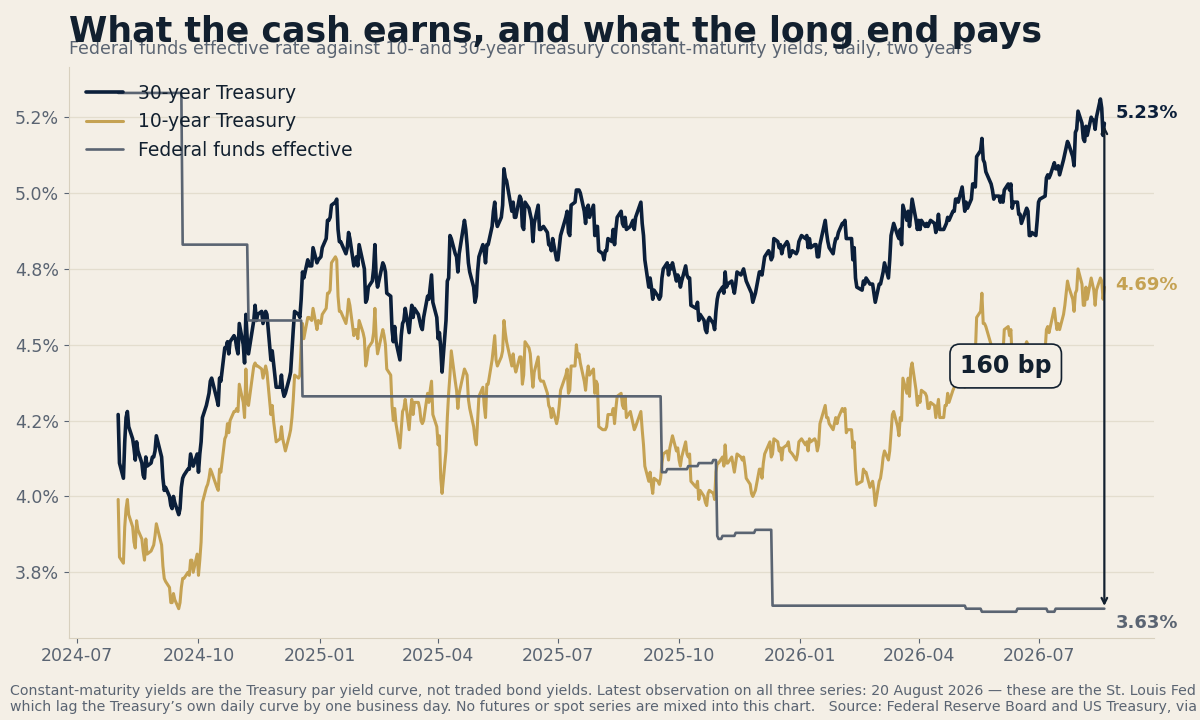
The gap between what an idle balance earns and what the long end pays was 160 basis points on 20 August. Note the vintage: the St. Louis Fed series lag the Treasury’s own daily curve by one business day, so the chart ends 20 August while the market table above ends 21 August. We have not mixed them.
Scenario · Seven doors What happens when repurchase requests exceed the cap 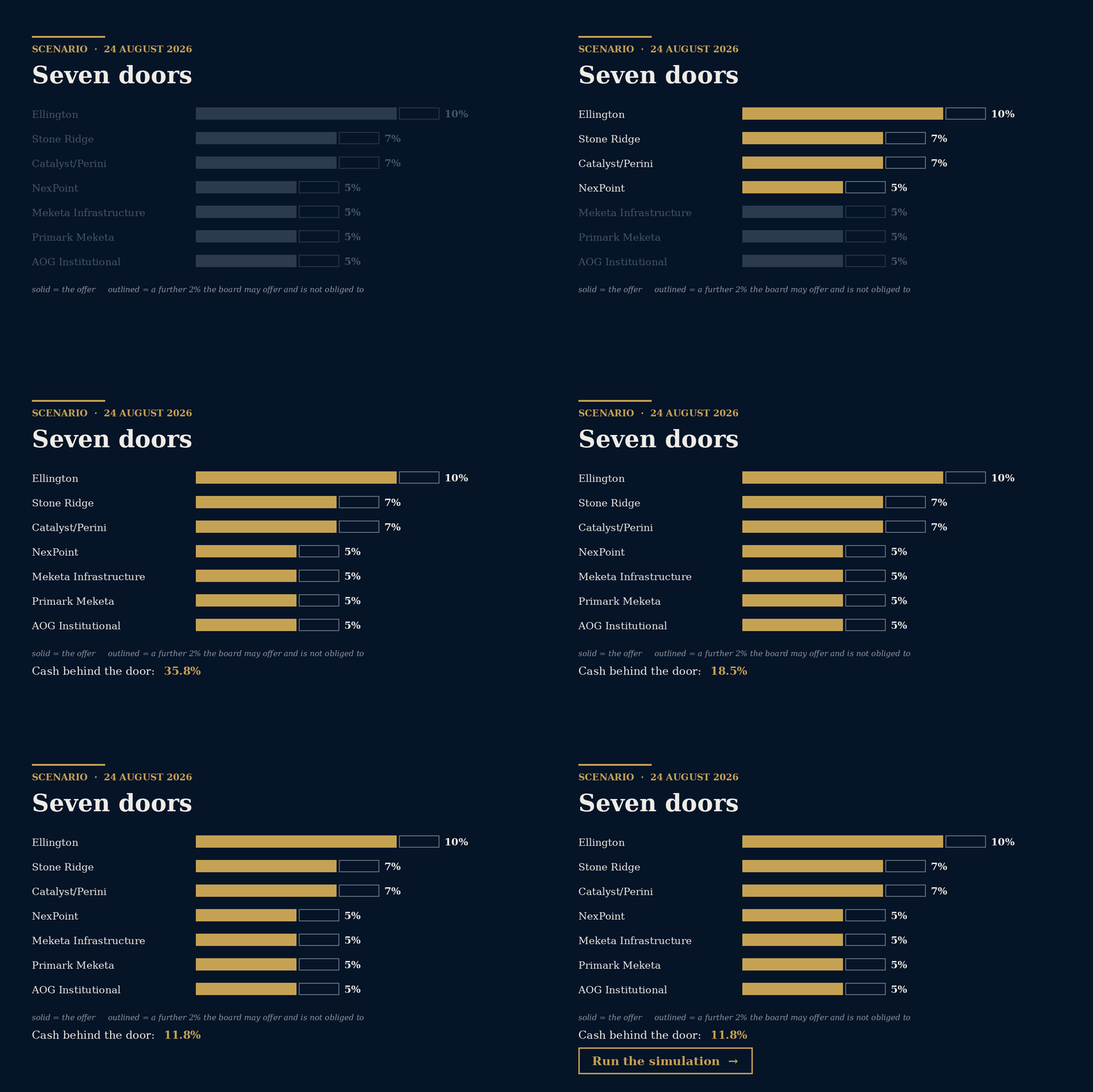 Base case, five escalation triggers and six named agents. No probability is published until its method, timestamp, range and update rule are published with it. |
The physical layer
A federal order keeps two 1960s units alive for a sixth time. On 21 August the Secretary of Energy issued Order No. 202-26-40, directing PJM and Constellation to ensure Eddystone Units 3 and 4 — 380 MW each — remain available from 23 August to 20 November, under Federal Power Act §202(c). The units were “initially scheduled for retirement on May 31, 2025.” This is the sixth consecutive order in the chain. Two provisions matter: PJM is directed to use economic dispatch “to minimize cost to ratepayers,” and the units “shall not be considered capacity resource.” Eighteen months of ninety-day extensions is not a bridge; it is a structure.
Two markets, one technology, two dispatch profiles. On 23 August California’s battery fleet discharged 12,406 MW at 19:10 and had charged 10,808 MW at 08:55; at the 19:00 gas peak of 15,424 MW, batteries were delivering 12,095 MW. In Texas the same day, ERCOT’s generation stack peaked at 90,655 MW at 17:09 — gas 40,815 MW (45.0%), solar 30,100 MW (33.2%) — with power storage at −532 MW, still charging. ERCOT’s storage did not turn until 19:44, reaching 13,252 MW, out of 20,319 MW installed. The same technology is showing two dispatch profiles in markets with different price shapes. We have not obtained CAISO price data, so we draw no conclusion about which fleet earned more.
The Film · Seven doors A promise of liquidity is a piece of architecture 1 min 49 s. |
Regulation and policy
A registration exemption with a reporting consequence. The CFTC’s proposal published 21 August (91 FR 54264) would create Regulation 4.13(a)(4), relieving SEC-registered advisers of commodity pool operator registration for pools limited to qualified eligible persons, and would raise the small-pool limit from $400,000 to $800,000. This is registration relief rather than an exit from the rulebook — specified notice, disclosure and recordkeeping duties are retained. The point for an allocator: the standardised pack that arrives by rule for a registered CPO becomes something an allocator negotiates for. Comments close 5 October 2026.
A comment clock that starts later than the press release. The SEC’s Regulation Crypto Assets proposal (91 FR 54510) offers Securities Act §5 exemptions of up to $5 million over four years and $75 million per twelve months. The press release is dated 18 August; the clock runs from the 21 August publication. Comments close 20 October.
Treasury will at least double long-end buybacks — in September. On 19 August Treasury announced that the maximum per-operation size for nominal long-end liquidity-support buybacks rises from $2 billion to “at least $4 billion” in the 10–20y and 20–30y sectors, effective 9 September. This has been reported as Treasury having doubled buybacks. It has not yet: the published tentative schedule still shows $2 billion, including for the 9 September operation.
A small resolution, and no pattern. The Pennsylvania Department of Banking and Securities closed Tioga-Franklin Savings Bank on 21 August; Second Federal Savings and Loan Association of Philadelphia assumed all deposits. Assets $68m, deposits $67m; estimated cost to the Deposit Insurance Fund about $5.5m.
Tariffs: the chronology, not the number. The United States imposed 50% additional duties on Canadian goods under §338 of the Tariff Act of 1930 — an unusual authority, neither IEEPA nor §232. Proclamation 11056 of 18 August, titled “Temporary Suspension of Additional Duties,” did not suspend them: it moved the effective date from 19 to 22 August (91 FR 54789). Energy, potash, §232 goods, fish and certain critical minerals are excluded; the duties apply regardless of USMCA origin. Prime Minister Carney’s 21 August statement puts coverage at “roughly $28 billion of Canadian goods” — currency unspecified in both the English and French texts — with matching measures in force “the Tuesday after Labour Day” (8 September). A widely circulated “$20 billion” figure appears in no primary document we opened. And no product-level Canadian schedule has been published; Finance Canada’s tariff-response page was last updated 19 June. That absence is the story for anyone modelling input costs.
Concentration and index structure
MSCI’s consultation on selected capped methodologies (dated 5 August) runs to 30 September, results on or before 30 October. Three proposals bite on any capped mandate: a two-business-day notice period for non-compliance rebalances across the 10/40, 20/35 and 35/65 families; removal of non-compliance checks on the live index during the review notice period; and an Extended Capping Framework aligning the concentration threshold with the fixed cap — 5% rather than a separate 10% trigger. The August review makes 55 additions and 92 deletions to MSCI ACWI, implemented at the close of 31 August; a fixed-income consultation closes 23 September.
Stated so absence is not read as silence: MSCI’s public feed was fully readable, so “no MSCI item dated 21–24 August” is a verified nil. FTSE Russell (subscriber-gated) and S&P Dow Jones Indices (refused) are unchecked — with September semi-annual reviews imminent.
Stewardship
The 2026 Proxy Season Review, published through the Harvard Law School Forum on Corporate Governance on 22 August by Ariane Marchis-Mouren and Keil Lapore of The Conference Board, describes a season that shrank and changed shape. Filings fell about 20% to 622. Governance proposals rose nearly 19%, from 257 to 305 — close to half of all filings — while average support fell to 33% from 38%, and only 27 (12%) won majorities against 55 (30%) a year earlier. A single proponent accounted for 70% of governance filings. Environmental proposals fell to 75, half the 2024 level, and none passed. Social proposals fell 33% to 141; none passed, for a second consecutive year. Activism campaigns fell to 95 in the first half, from 254 and a 2024 peak of 376 — down 75% in two years.
Average support for anti-ESG proposals rose to 4.7% across 80 voted proposals, from 2.5% — a figure driven largely by CEO/chair-separation proposals from a single proponent. Excluding those, support for all other anti-ESG proposals averaged 1.7%; the category figures are 0.9% for human capital and 1.3% for environmental.
For an owner of the whole market the implication is procedural: the higher-probability lever is board structure and shareholder rights, exercised year-round. With the SEC withdrawing from substantive Rule 14a-8 review — exclusion requests down nearly half, no-objection responses up to 90% — the gatekeeping has moved from the staff to the courts.
Dated context, not this week’s news. On 14 August CPP Investments began reporting its portfolio on two axes, carbon intensity and a transition-governance indicator: of a C$787 billion portfolio at 31 March 2026 excluding government securities, 86.7% sat below a 40 tCO₂e/$M EVIC threshold. On 18 August Shift Action published Indigenous Rights and Canadian Pension Funds, finding that of 11 pension managers examined, none has publicly disclosed an investment policy citing UNDRIP or free, prior and informed consent. Shift’s finding covers the managers examined, not a ranked “eleven largest.”
Unpolled, not quiet: the PRI’s site serves one application shell to an automated read, and Norges Bank’s voting register renders no rows without a live browser — the likeliest place for a stewardship item to appear. An NBIM chief-risk-officer appointment circulating as current is dated 7 April 2026.
Corporate — and a discount that depended on which exchange you looked at
Alibaba announced on 23 August a proposed Regulation S placing with an aggregate consideration of HK$80 billion, with 100% of net proceeds to “full stack AI capabilities, including to expand and enhance its AI infrastructure.” Its subsequent HKEX announcement prices it: 710,000,000 new shares at HK$112.70, gross HK$80.0bn, net about HK$79.7bn, dilution 3.70% of shares in issue, closing expected 26 August.
The discount is where two widely circulated figures came from, and both had a reason. Alibaba discloses 3.6% against a reference price of HK$116.95 — and that reference is derived from US$119.34 per ADS on the NYSE on 21 August, converted at the eight-to-one ratio. Against the five-day ADS average of HK$123.80 the discount is 9.0%. A Hong Kong placing was benchmarked to a New York closing price. Anyone computing off the Hong Kong close of stock 9988 gets a third number — which is how “3.6%” and “8.4%” ended up in circulation on the same morning. The 8.4% figure appears in no Alibaba document.
Unconfirmed, and carried as such. Claims of a ~US$28 billion book, of oversubscription within hours, and of sovereign wealth funds taking more than 40% of the allocation appear in none of Alibaba’s releases and rest on unnamed sources.
A prospectus that shows where an IPO’s proceeds actually go. Shein’s final Hong Kong prospectus (stock code 00625, dated 24 August) sets out what holders of Series Pre-D, D and D+ preferred shares receive when the company lists below their entry price. Separated, because they are four different instruments: up to US$2,185 million in conversion-adjustment cash — a maximum assuming pricing at the bottom of the range, equal to “approximately 14.7% of the total cash resources of the Company as at 31 March 2026”; 19,622,000 additional Class B shares at nil consideration; approximately US$1.1 billion at a fixed 8% annual rate in three instalments; and US$230.4 million at a fixed 12% rate.
The widely quoted “$3.5 billion” appears nowhere in the prospectus — it is the sum of the cash components, performed by others. And it is cash; the 19.6 million shares are additional to it. Against that, the offering seeks 279,992,500 shares at HK$47.60–49.50, for net proceeds of about HK$13,123 million at the mid-point. The protected holders’ cash entitlement is roughly double the net proceeds of the offering.
The protected classes are held by entities linked to Boyu, Tiger Global, General Atlantic, Thrive, Brookfield and Sanabil; Sanabil holds Series D+ and is a protected holder. Price is determined 28 August, announced 31 August, listing 1 September. The 2022 Series D round valued the company at US$98.2 billion pre-money.
The lesson, which is this edition’s lead in another jurisdiction. A private mark is a number. What an owner holds is a number and a rights stack. Two allocators can report identical exposure at an identical valuation and take materially different losses, because one signed a different document.
Geopolitics
Commercial traffic through the Strait of Hormuz is severely restricted, not halted — selective transits have continued throughout, and Iran granted named exemptions to Iraqi tankers on 22 August. A heavily restricted, permissioned strait is a persistent pricing, routing and insurance regime rather than a single supply event.
Precise transit counts are not carried — the authority feeds required to verify them were unreachable this morning.
Verified, and quieter: OFAC issued Venezuela General Licence 61 (telecommunications items and services) and General Licence 62 (contingent contracts for telecom-sector investment), with FAQ 1266, on 21 August. Two Commerce Entity List revisions took effect the same day — one Turkish entity removed, two Arrow Electronics (Hong Kong) addresses removed. Licence-and-list changes are the screening perimeter moving quietly while everyone watches the announcement.
People and mandates
Verified at first party. China Investment Corporation, 21 August: “As per the decision of the State Council and CIC’s Board of Directors, Mr. WU Wei will take on the role of Vice-Chairman and President of CIC.” The release names no predecessor and does not mention the securities regulator; the widely repeated succession narrative has no first-party support and is not carried. Canada Life UK, 24 August: Dominic Moret appointed Managing Director, Bulk Purchase Annuities, “subject to regulatory approval” — a qualification the trade coverage dropped.
Cut for want of a first-party release: a reported Clifford Capital senior adviser appointment (its media centre’s latest item is 29 July); a reported GIC head of sustainability (its newsroom’s latest is 24 July, and its only 2026 leadership release names three other people); and a reported HOOPP private-equity departure — HOOPP’s own investment-leadership page still lists the executive in post, with no interim co-heads named. When an institution’s own page contradicts the report, the report does not run.
An evidenced negative: Korea’s National Pension Service has announced no chief investment officer appointment; its English news board has published nothing since 23 April. A reported shortlist of four has no first-party support and is not carried.
Risk radar
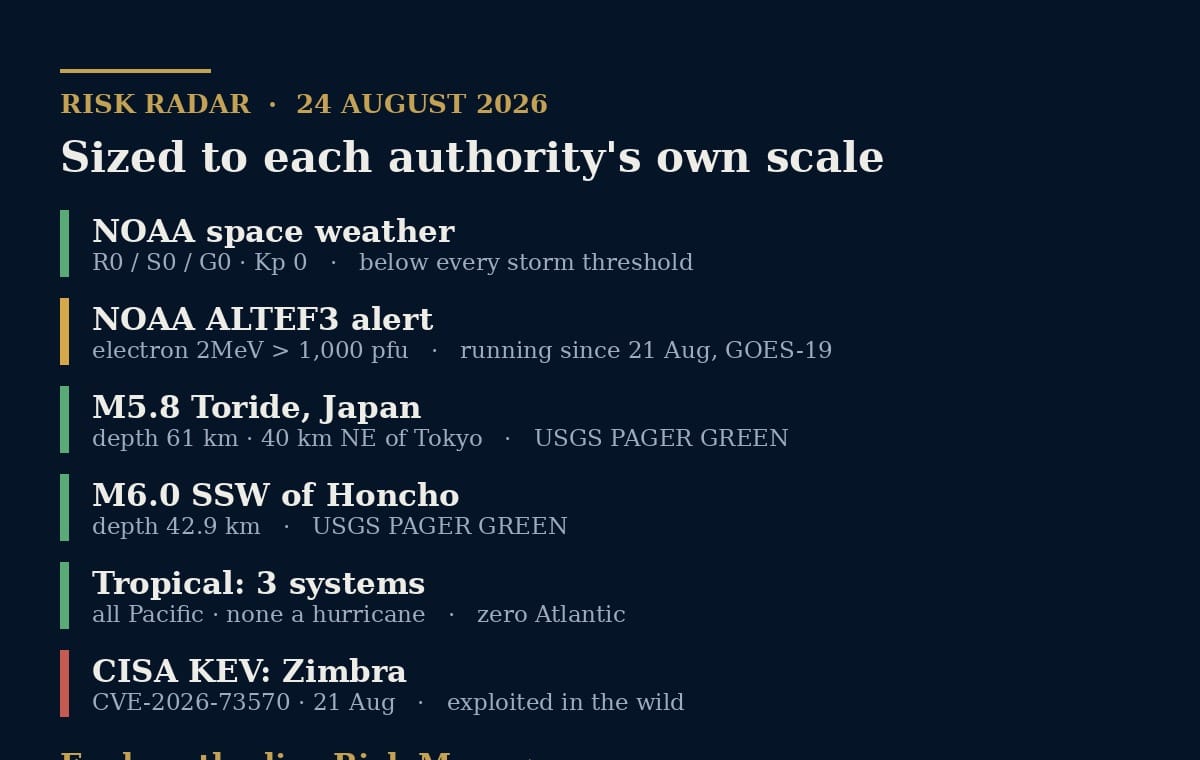
Space weather — quiet on the storm scales, one alert running. NOAA reports R0 / S0 / G0 and a planetary Kp of 0, below every geomagnetic-storm threshold. Separately, the ALTEF3 alert for electron 2 MeV integral flux above 1,000 pfu has run since 21 August 11:05 UTC on GOES-19, continued 23 August 09:21 UTC. That is a satellite internal-charging product, not a grid product. NOAA SWPC
Japan — two moderate quakes, both green. M5.8 near Toride, 22 August 17:00:39 UTC, depth 61.0 km, about 40 km north-east of central Tokyo; M6.0 south-south-west of Honchō, 23 August 13:44:53 UTC, depth 42.9 km. USGS PAGER alert green on both — no significant impact expected, no tsunami. Notable for location, not severity.
Tropical — three systems, all Pacific, none a hurricane, zero Atlantic. TS Iselle 50 kt / 996 mb; TS Lala 55 kt / 988 mb; TD Moke 30 kt / 1004 mb, on advisories issued 24 August 09:00 UTC. National Hurricane Center. GDACS orange alerts, two: flood in China, 31 July to 25 August; tropical cyclone SAUDEL-26, Northern Mariana Islands / Japan / China, 18 to 24 August.
Exploited in the wild. CISA added CVE-2026-73570, an OS command injection in Zimbra Collaboration Suite, on 21 August; TrueConf Server (CVE-2026-72530 / 72529) on 20 August; and an MLflow server-side request forgery (CVE-2026-64849) on 19 August. CISA KEV. The Zimbra and MLflow entries are the ones to check against your managers’ stacks.
Not on the radar, and why: no war-risk premium, no marine-insurance rate, no Hormuz transit count, no European river-gauge reading, no CAISO curtailment figure. None could be sourced.
Week ahead
Jackson Hole runs 27–29 August, themed “Financial Innovation: Implications for Payments and Policy.” The Kansas City Fed has published no 2026 agenda or speaker list — its site navigation still reads “Jackson Hole 2025.” A Warsh keynote has been widely diarised for Friday morning; that is convention, not confirmation, and we are not printing a time. Kevin Warsh took office as Chair on 22 May 2026.
Diarised, all verified: Alibaba placing closes 26 Aug · Shein price determined 28 Aug, announced 31 Aug, lists 1 Sep · MSCI August review implements at the close 31 Aug · Dallas Fed Texas Manufacturing Outlook 31 Aug · Canadian counter-tariffs 8 Sep, product schedule still unpublished · Treasury’s larger buybacks begin 9 Sep · Stone Ridge, Catalyst/Perini and Ellington repurchase deadlines 11 Sep · NexPoint 22 Sep · MSCI fixed income 23 Sep · MSCI capping 30 Sep, plus Meketa, Primark and AOG deadlines · CFTC comments 5 Oct · SEC Regulation Crypto Assets comments 20 Oct · DOE’s Eddystone order expires 20 Nov.
Podcast · The Universal Owner Seven doors — and a fund that is 35.8% cash  8 min 11 s. Two documents, four days apart, asking the same question from opposite ends. |
The Debate Omitted today. The Debate is a two-host argument built from the edition’s most contested question — whether a perpetual fund with a 5–10% quarterly door meets the three conditions those Bank of Canada staff authors set out. The production tool was not reachable this morning, and we do not fill the slot with a look-alike of another audio asset. It is omitted and flagged. |
The Back Page · Meet The Allocator “I read all seven notices this weekend.” 1 min 13 s with The Allocator.  The Cloakroom. Seven hatches, seven widths — and a second, shuttered hatch beside each one. |
Sources
Private markets — Third Point Private Capital Income Fund, Form 10 and Form RW filing history, 20 Mar / 18 May / 16 Jul / 21 Aug 2026, SEC EDGAR CIK 0002122354 · Angel Oak Residential Evergreen Trust, Form 10-12G, 21 Aug 2026 · seven Form N-23C3A repurchase notices, 21 Aug 2026 · EQT Infrastructure Company LLC, EQT Private Equity Company LLC, KKR Private Equity Conglomerate LLC and KKR Infrastructure Conglomerate LLC, Form 8-K Exhibit 99.1, Net Asset Value as of July 31, 2026, all filed 21 Aug 2026.
Framework — Wendy Chan, Cameron MacDonald and Geneviève Vallée, “Private credit in Canada,” Sparks at Bank article, Bank of Canada, 17 Aug 2026, DOI 10.34989/saba-18.
Macro and markets — US Treasury, Daily Treasury Par Yield Curve Rates, 2026 · US Treasury, “Treasury Announces Increased Sizes of Nominal Long-End Liquidity Support Buybacks Beginning September 9,” 19 Aug 2026 · Federal Reserve, H.15 Selected Interest Rates · S&P Dow Jones Indices and Nasdaq closes via the Federal Reserve Bank of St. Louis · Cboe VIX Historical Price Data · LBMA Gold Price PM · ICE BofA US High Yield Index OAS, series BAMLH0A0HYM2.
Regulation — CFTC, 91 FR 54264 · SEC, “Regulation Crypto Assets,” 91 FR 54510 · FDIC, Tioga-Franklin resolution · Proclamation 11056, 91 FR 54789 · Prime Minister of Canada, statement of 21 Aug and remarks of 22 Aug 2026. Index structure — MSCI consultations of 5 and 19 Aug and the August 2026 Index Review Results of 12 Aug. Energy — US Department of Energy, Order No. 202-26-40 · CAISO five-minute fuel-source data · ERCOT fuel-mix interval data. Sanctions — OFAC Recent Actions, 21 Aug · BIS Entity List revisions, 24 Aug. Corporate — Alibaba Group, 23 Aug, and the HKEX placing announcement · Shein, Hong Kong listing prospectus, HKEXnews stock code 00625, 24 Aug 2026. Governance — Marchis-Mouren and Lapore, 2026 Proxy Season Review, 22 Aug · CPP Investments, 14 Aug · Shift Action, 18 Aug · China Investment Corporation, 21 Aug · Canada Life UK, 24 Aug.
Could not be opened, and therefore not used: UKMTO · FTSE Russell index notices · S&P Dow Jones Indices announcements · the PRI · the Norges Bank voting register · cppinvestments.com article paths (the CPP figures above come from CPP’s own wire release) · CME settlement data.
The Universal Owner is written for institutions that own a slice of the whole market. Nothing here is investment advice.