98% of the world’s sovereign wealth funds |
18 of 20 of the world’s largest pension funds |
10 of 10 of the largest charitable foundations |
85% of the world’s largest family offices |
100+ billionaires, every morning |
Private Markets' New Bargain: Less Voice, Limited Exit
An interval fund has asked the Securities and Exchange Commission to let it hire, fire and re-price its managers without a shareholder vote — including affiliated ones. In exchange, shareholders would get the right to leave first. That trade is only as good as the exit, and in the second quarter the non-traded BDC market met 38% of the dollars investors asked to have back. The same question — who controls the terms, and what the owner gets in return — ran through four other filings on Monday, and through a tariff announcement for which no legal instrument yet exists.
|
|
What happened
An interval fund asked the Securities and Exchange Commission for permission to hire, terminate and re-price the managers running its money without a shareholder vote. Primark Advisors LLC and the Primark Meketa Private Equity Investments Fund, a Delaware statutory trust operating under Rule 23c-3, filed a Form 40-APP on 24 August seeking relief under Section 6(c) of the Investment Company Act from Section 15(a). The relief would cover unaffiliated sub-advisers, wholly-owned sub-advisers and — the part that matters — affiliated ones. The applicants say so directly: the relief would extend "to Affiliated Sub-Advisers."
Multi-manager relief of this kind is long established for open-end mutual funds. The applicants state that it is not established here: "the relief requested by this Application has to date not been granted for Unlisted CEFs/BDCs."
The same day, the Financial Conduct Authority closed CP26/20, a consultation covering approximately £567bn of self-invested personal pension assets held for 5.3 million consumers — which the FCA says represents about a third of the assets in FCA-regulated defined-contribution pensions. Among its proposals is a new Pension Scheme Money and Assets regime for firms that hold scheme money and assets through unauthorised trustees.
To be precise about what that £567bn is and is not: it is the FCA's figure for the whole SIPP market. It is not an estimate of assets sitting with unauthorised trustees, and the FCA publishes no such estimate. The proposed regime would apply where a firm uses that structure. What the consultation establishes is the size of the market in which the regulator has decided the custody chain needs a floor — not the size of the gap.
S&P Dow Jones Indices announced at 17:15 ET that TELUS Corp will be deleted from the S&P/TSX Canadian Dividend Aristocrats Index before the open on 1 September, following the monthly dividend review. One deletion, no additions. The deletion will require rebalancing by passive and closely benchmarked strategies tracking the index, though the timing and scale of that trading will vary with mandate design, replication method and manager discretion.
The Asian Development Bank launched its FIELD Initiative at UNCCD COP17 in Ulaanbaatar, targeting at least $2bn by 2035 for land restoration and drought resilience across Asia and the Pacific. The partners named — the UNCCD, the Qatar Fund for Development and the Middle East Green Initiative — are described in ADB's own release as having "expressed initial interest."
And the US Treasury announced Operation Economic Outcast, sanctioning close to sixty individuals, entities and vessels, and signed a determination under Executive Order 13902 applying sanctions to the aviation, digital asset, gold, shipping and technology sectors of the Iranian economy. Alongside it, OFAC issued an updated alert on Iranian demands for Strait of Hormuz passage, warning that engaging with three designated bodies can create exposure "including by accepting insurance or other services or responding to information demands for guarantees of safe passage, even if there is no associated payment or other exchange of value."
Dispatches
Live from our correspondents, on the ground, in their own time zones
One filing today. Some mornings there are four.

Dispatch · Pakistan
Naveed Iqbal
Business and markets correspondent, South Asia. Covers sovereign credit, capital markets and the
institutions that move money across the region.
Moody's upgraded Pakistan's sovereign rating to B3 from Caa1 on Monday, outlook stable — its first action on the credit since August 2025. The agency pointed to foreign exchange reserves of about $17bn at end-July 2026, against $14bn a year earlier, and to interest payments falling to 35% of government revenue in fiscal 2026 from 49% the year before. Dawn
The market did not celebrate. The KSE-100 closed at 176,966.68, down 199.84 points or 0.11%, having climbed to 178,122.87 intraday and given the gain back. Commercial banks took 249 points out of the index; oil and gas exploration put 219 back in. Mettis Global
Pakistan stays below investment grade, and Moody's own text keeps the constraints where they were: a structurally fragile external position, weak debt affordability, a narrow revenue base. The agency concurrently lifted the local and foreign currency country ceilings to B1 and B3, from B2 and Caa1. Dawn
The vote that was not there
The Primark application is not a scandal. It is a carefully constructed document with fifteen conditions: a majority-independent board, independent legal counsel, a requirement that the adviser show the board the profitability effect of every sub-adviser change, and a separate best-interests finding minuted each time. Shareholders receive sixty days' notice, and a fee increase still goes to a vote.
It also contains a structural concession with no analogue in the open-end precedent. Before a new sub-adviser can be appointed, the fund must run a tender or repurchase offer allowing shareholders to leave — and if that offer is oversubscribed, the appointment does not take effect. Exit is offered in place of voice.
That is the interesting part, because exit in this asset class is conditional.
In Robert A. Stanger & Co.'s surveyed universe of non-traded business development companies — approximately twenty funds representing most of that market — second-quarter repurchase requests ran at 12.4% of net asset value, of which 38% were met: $5.9bn returned against $15.6bn requested, leaving roughly $9.7bn unmet. Requests in that universe have run $5.7bn in the fourth quarter of 2025, $13.2bn in the first quarter of 2026 and $15.6bn in the second.
The dispersion matters as much as the average. Eight of twenty funds met every request, while Stanger's table shows Blackstone's BCRED at 50% met and Blue Owl Credit Income at 27%. Blackstone raised its quarterly repurchase limit from 5% to 7% and Blue Owl from 5% to 6.8%, in both cases with affiliated buyers absorbing shares.
Three of the private-market filings dated 24 August sharpen the point. Blue Owl Technology Income Corp reported a Class I total net return of −1.8% year to date against an annualised distribution rate of 9.3%. CNL Strategic Capital's board determined net asset value on 24 August, marking eleven of eighteen portfolio investments up and six down. Golub Capital Private Credit Fund disclosed debt-to-equity of 1.22x against a portfolio that is 96% first-lien and 21% software, across 455 companies.
The applicants state that this form of relief has not previously been granted for unlisted closed-end funds or BDCs. If the Commission grants it, the order could become a closely watched precedent for other private-market vehicles seeking to substitute board oversight and conditional liquidity for shareholder approval.
The announcement without an instrument
The largest number produced on Monday was a tariff, and it is the one an allocator should handle most carefully, because as of this morning it does not legally exist.
President Trump announced on 24 August that tariffs on "all Cars, Trucks, both large and small, Automotive Parts, and Steel" from Canada would rise to 50%, effective 1 January 2027. The announcement is well attested across multiple independent outlets, all dated 24 August, and all tracing to the same social-media post.
There is no proclamation. There is no executive order. There is no Federal Register notice. A search of every Presidential Document published in August 2026 returns seventeen items, the most recent signed on 20 August; a sweep of all 174 documents published on 24 and 25 August returns nothing on the subject. The US Trade Representative has announced no corresponding action. No modification to the Harmonized Tariff Schedule exists, and Customs and Border Protection has been given nothing to collect.
What is in force is a different and earlier measure. Proclamations 11046, 11047 and 11048, signed on 20 July under section 338 of the Tariff Act of 1930, imposed 50% duties on Canadian alcoholic beverages, dairy and motor vehicles. Proclamation 11056 of 18 August moved their effective date, and the duties took effect at 12:01 a.m. eastern time on 22 August. Section 338 caps additional duties at "not to exceed 50 percent ad valorem" — the 50% is the statutory ceiling, not a chosen number.
The Canadian sequence is equally worth dating precisely. Prime Minister Mark Carney suspended trade negotiations on 21 August — Ottawa withdrew, rather than talks collapsing — stating that "the U.S. intends to impose a 50% tariff on roughly $28 billion of Canadian goods" and that "Canada will match those tariffs dollar for dollar." The First Ministers' readout of 22 August set counter-tariffs for "the Tuesday after Labour Day," and it was Finance Minister Champagne, on 24 August, who fixed the date at 8 September. Canada's counter-measures also have no instrument yet: no surtax order, no Order in Council.
So both sides currently stand at the announcement stage, and the gap between an announcement and an instrument is the whole of the analysis. An edition reporting the 1 January 2027 vehicle and steel tariffs as imposed would be wrong. The defensible reading is that a four-month-forward intention has been stated by one party, a counter-measure date has been stated by the other, and neither has yet been written into law that anyone can collect against.
For a universal owner with integrated North American industrial exposure, that distinction governs what can actually be modelled. An announced rate with no instrument is a negotiating position with a deadline attached. A proclamation under section 338 is a cost. Only one of the two is currently on the books, and it is not the one that made the headlines.
One caution we cannot resolve this morning: Canadian steel is separately subject to a section 232 regime, and we could not establish from a primary source what rate it currently carries. Whether the announced 50% represents an increase on steel is therefore not something this brief asserts.
Stewardship & Voting
The window was quiet, and the quiet is itself the story. Polling of the named primaries found nothing dated 22–25 August: Norges Bank Investment Management's last release was 12 August, the ICGN's 14 August, CalSTRS's 4 August, the Church of England Pensions Board's 17 August, CalPERS's and LAPFF's in July, the Financial Reporting Council's on 9 July.
What that polling did surface is a live fact with a dated cause.
Norges Bank Investment Management has announced no exclusion and no observation decision in 2026. The reason is not editorial judgement at the world's largest single equity owner. On 4 November 2025 the Storting adopted interim arrangements; on 7 November the King in Council appointed a review committee and the Ministry of Finance established interim guidelines. The Ministry's words: "The Council will not make recommendations on observation or exclusion… Norges Bank will not make decisions on observation or exclusion."
Under that interim framework the Council on Ethics and Norges Bank cannot make new observation or exclusion decisions, while revocations remain possible. Section 6(2) preserves the power to revoke, and revocations are what 2026 has produced: the exclusion list was last updated on 11 August, removing Evergreen Marine, Korea Line, Pan Ocean and Bombardier. The committee chaired by former Norges Bank governor Svein Gjedrem reports by 15 October 2026.
One point of care for anyone reading the list directly: NBIM's exclusion list shows publication dates of 26 February 2026 against five companies. Those are 2025 decisions disclosed with the annual reporting, not new exclusions.
For a manager running against a Norwegian benchmark, exclusion risk currently runs in one direction only. That assumption has a date attached to it: 15 October.
The Long Horizon · Private markets
The figure worth carrying furthest from Monday's filings is not a return. It is the distance between two quantities that are not required to move together: Blue Owl Technology Income Corp distributed at an annualised 9.3% while reporting a Class I total net return of −1.8% year to date.
That is not, in itself, evidence of anything improper, and the fund does not present it as a contradiction. A perpetual non-traded vehicle can fund a distribution out of investment income while the mark on its book moves against it; total return and distributable earnings are different quantities. But it states the structural question underneath the wrapper cleanly: if the distribution is stable and the value is not, which of the two is the product?
Three features of Monday's filings make that question harder to answer rather than easier.
Valuation is process-determined, not price-determined. CNL's monthly net asset value moved because its board, applying board-approved valuation policies, concluded that eleven of eighteen investments were worth more. Private-asset NAVs are generally determined through such policies, often with input from managers and third-party valuation specialists, rather than through a continuously traded market price. That makes valuation changes slower to observe and harder for an investor to test independently in real time.
The leverage is real and the collateral is concentrated. Golub's 1.22x debt-to-equity is unremarkable for direct lending, and a 96% first-lien book is genuinely defensive on recovery. But 21% of a $9.6bn portfolio in software, across 455 borrowers financed almost entirely at floating rates, is a concentrated sector and rate exposure distributed across many names. First lien is a claim on recovery, not a shield against default.
Liquidity is conditional. Stanger's 38% is the number to keep, and its unit matters: it is the share of the dollar amount requested that was met, not the share of requests or of investors. In that surveyed non-traded BDC universe, for every dollar of net asset value investors asked to have back in the second quarter, roughly sixty-two cents remained in the funds — within limits the sponsors set and, in two of the largest cases, raised, with affiliated capital absorbing shares.
Where the exposure goes at buy-out
The same question arrives in the pension risk transfer market from a different direction. On 20 August, CVC and Standard Life announced a joint venture to build a bulk-annuity platform for large UK corporate schemes, with combined initial commitments of up to £2bn drawn over time, CVC's own share £400m, and a consortium including Prudential Financial. CVC supplies asset-backed lending, structured credit, real-estate credit, infrastructure credit, direct lending and opportunistic credit; its credit and insurance strategy manages over €60bn of fee-paying assets. The release notes that approximately £1.2trn of UK defined-benefit liabilities have yet to transfer to insurers.
A scheme reporting under the UK's climate disclosure regime discloses information about the assets it holds. A buy-out can change which entity bears those disclosure obligations and how much instrument-level information reaches members; the precise outcome depends on the transaction structure and the applicable rules. What is not in dispute is that the promise is thereafter backed by a matching-adjustment portfolio of illiquid private credit.
The due-diligence question follows directly: does that matching portfolio contain transition-sensitive infrastructure, including gas-related assets, and can the sponsor or the trustee obtain disclosure granular enough to assess it? A scheme's own transition plan may have been written to run down precisely the exposures that the insurer's matching portfolio is built to hold. That is a question to put in writing before a quotation is accepted, not after.
Allocator Lens
What this means for the portfolio
The triple exposure. A large asset owner meets Monday's documents three times, and the three exposures are not independent.
As an owner of the vehicles. Capital held in non-traded BDCs, interval funds and perpetual private vehicles now sits inside a governance question the Commission has been formally asked to settle. If the Primark relief is granted, manager selection inside such wrappers could move from a shareholder vote to a board finding — for affiliated managers as well as unaffiliated ones. The compensating right is an exit that, in Stanger's surveyed universe, met 38% of the dollars requested last quarter — a share of value returned, not a proportion of investors served.
As a sponsor of the promise. A UK corporate scheme heading for buy-out transfers its members from its own covenant to an insurer's, and increasingly to an insurer whose matching portfolio is originated by a private-credit manager. The question at the point of quotation is not only who is cheapest. It is who holds the credit risk behind the annuity, what that risk is composed of, and what will be disclosed about it after completion.
As a counterparty to everything else. OFAC's alert expands the compliance question beyond payment flows: accepting certain services, or responding to demands for safe-passage guarantees, can create sanctions exposure even where no payment or exchange of value occurs. The practical implications depend on the facts of each counterparty relationship and the applicable rules. For an asset owner the exposure is less likely to sit in shipping equity than in the marine insurance and reinsurance line inside an insurance-linked sleeve or a listed financials book.
Three questions to put in writing this week.
- To every perpetual private-markets manager: what proportion of repurchase requests did you meet in each of the last four quarters, was any portion met by an affiliate, and did you change the cap?
- To every bulk-annuity counterparty on a live quotation: what is the composition of the matching-adjustment portfolio backing our members, what transition-sensitive infrastructure does it contain, and what will be disclosed to us after completion?
- To the insurance and financials sleeve: which underwriters in the book carry Gulf marine exposure, and what is their position on safe-passage assurances?
Ask who holds the risk before asking who quoted the tightest price.
Capital Flows
Stage language is exact. Nothing below is described as deployed unless a document says it closed.
| Institution | Action | Amount | Stage | Source |
|---|---|---|---|---|
| XPeng Inc. / Dogotix | Series A share purchase agreement for its robotics subsidiary | Approximately US$900m in total, of which US$600m is external. US$200m from XPeng's own wholly-owned subsidiary; US$100m from entities owned by the chairman and co-president — both disclosed as connected transactions. Implied post-money US$6.3bn, pre-money US$5bn; XPeng's holding falls from 100% to approximately 68.41% | Signed, conditional. The announcement states completion "may or may not proceed" | HKEX announcement, 24 Aug |
| CVC / Standard Life | UK bulk-annuity platform joint venture | Up to £2bn initial commitments drawn over time; CVC's own £400m | Announced 20 August, subject to regulatory approvals | CVC |
| Asian Development Bank | FIELD Initiative — land degradation and drought resilience | Target of at least $2bn by 2035; 1m hectares under sustainable management | Launched. Named partners have "expressed initial interest." No capital committed in the release | ADB, 24 Aug |
| Granite Asia | Libra Hybrid pan-Asia private credit | "Surpassed the USD 500 million target." No total disclosed | Manager-reported. The release does not describe a final close, and none of the named anchor investors has published confirmation | Granite Asia, 25 Aug |
| Qiddiya Investment Company | Three theme parks, Cergy-Pontoise region | €6bn projected; 22,000 jobs expected. The Élysée figure covers parks, accommodation, dining and housing | Protocole d'accord signed 24 August — a framework agreement, not deployed capital. The Élysée text names no financier and no location | Élysée, 24 Aug · PIF on Qiddiya ownership |
| China — policy-based financing instrument | 2026 tool, enlarged from RMB500bn | RMB800bn (~$119bn), an increase of RMB300bn on 2025 | Implementation plan issued to localities; project submission under way as of 17 August. Not disbursed | NDRC, 14 Aug · Xinhua, 17 Aug |
| AFC Capital Partners | Launch of the Infrastructure Climate-Resilient Fund Nigeria (ICRF Nigeria), an SEC-registered closed-end fund to mobilise Nigerian pension and institutional capital | Parent ICRF carries a US$253m first-loss commitment from the Green Climate Fund — $240m junior equity plus a $13.755m grant. ACP expects to mobilise up to US$3.7bn through ICRF, the pan-African vehicle, not through the Nigeria fund | Launched 24 August. No first close and no committed Nigerian capital is claimed. ⚠️ The GCF commitment is not new: the board approved it on 16 March 2023 and the bulk was disbursed in December 2024 | AFC, 24 Aug · GCF FP205 |
| Globe Investimentos (private vehicle of Joesley and Wesley Batista) | Acquisition of 100% of Avibras Aeroco — the carve-out holding the assets, plant and technology portfolio of Avibras Indústria Aeroespacial, constituted within that company's judicial recovery | Consideration not disclosed. Shares currently held by Brasil Crédito Gestão FIP Multiestratégia | Contract signed 21 August; notified to CADE on 24 August with a request for summary review. Closing conditional on CADE approval | Company statement, 21 Aug; CADE notification, 24 Aug |
| Asian Development Bank | 2025 private-sector operations | Financing $9.5bn (+38%); private capital mobilisation $4.7bn (+31%); own account $5.5bn (+14%) | Reported 2025 result, published 25 August | ADB, 25 Aug |
One ratio from that table. ADB reports mobilising $4.7bn of private capital against $5.5bn of its own account — approximately 0.85x. That is a measured exchange rate between multilateral balance sheet and private money in Asian development finance, and it sits a long way below the "billions to trillions" framing the sector has used for a decade. Set it beside the FIELD Initiative's $2bn target, in which the named partners have expressed initial interest: an announcement and a commitment are different things, and only one of them has a document behind it.
Geopolitics & Chokepoints
The US Treasury's 24 August package has three distinct components, and only one of them is a designation list.
The designations. Operation Economic Outcast sanctioned close to sixty individuals, entities and vessels across multiple jurisdictions, with five vessels identified as blocked property and five corresponding shipping companies designated. Treasury attributed more than $100m of cryptocurrency payments since 2023 to a single facilitator of IRGC-Qods Force oil sales.
The sectoral determination. OFAC signed a determination under Section 1(a)(i) of Executive Order 13902 applying sanctions to the aviation, digital asset, gold, shipping and technology sectors of the Iranian economy. Treasury's stated rationale for the gold limb: "As Iran's formal financial sector collapses, the regime is increasingly attempting to stabilize the rial with gold to hedge against rampant inflation."
The determination authorises Treasury to sanction persons determined to operate in those sectors. It does not, by itself, block every participant or transaction in them, and Iranian gold dealings already carried exposure under other sanctions authorities. What changes is that the sector is now named in its own right under this authority.
For a reserve manager or a gold-ETF trustee, the consequence is more likely to appear on the custody side of a gold allocation than the price side. Counterparties with physical chains running through Emirati, Turkish or Hong Kong refiners should expect provenance documentation requirements to tighten, and should expect that to carry a cost.
The alert. OFAC's updated Hormuz alert names three designated bodies — the Persian Gulf Strait Authority, the Persian Gulf Marine Insurance Company and HormuzSafe Marine Services Authority — and warns of exposure for engaging with them "including by accepting insurance or other services or responding to information demands for guarantees of safe passage, even if there is no associated payment or other exchange of value." The prohibited forms of payment it enumerates include fiat currency, digital assets, offsets, informal swaps and in-kind transfers.
Note the second-order effect. If the compliant response to a toll demand is refusal, war-risk and freight premia on Gulf transits may reprice whether or not any vessel is stopped.
And the same afternoon, in the opposite direction. The Secretary of State rescinded Syria's designation as a State Sponsor of Terrorism following the mandatory 45-day Congressional notification period, and delisted Hay'at Tahrir al-Sham as a Specially Designated Global Terrorist; OFAC removed HTS from the SDN list and revoked Syria General Licence 25 as no longer necessary. Syria now falls outside 31 CFR part 596 and 22 USC 7205(a)(1).
It is not a clean lifting, and the primary documents say so. On the same day OFAC designated two former HTS affiliates — Sa'd Bin Sa'd Muhammad Shariyan al-Ka'bi and Jamal Husayn Zayniyah — under Executive Order 13224, and Treasury stated that the action "does not change Treasury's posture with regards to countering global terrorism." Two opposite-signed sovereign-risk events in one afternoon: Syria moves from uninvestable toward merely difficult, while Iran-adjacent counterparty risk widens into four additional sectors.
On the status of the Strait of Hormuz itself, this brief takes no position. Two dated official documents are unreconciled: the IEA's Oil Market Report of 12 August refers to an "ongoing closure," while OFAC's alert of 24 August is written in the language of continuing transits subject to demanded tolls. Neither institution is a navigational authority, and the discrepancy is not resolved on the public record.
Signals — not yet confirmed
REPORTED — The SEC is said to have subpoenaed the prime brokers of an AI-focused hedge fund. Fortune reported on 24 August, citing people familiar with the matter, that the Securities and Exchange Commission has sent subpoenas to major Wall Street banks regarding Situational Awareness LP, and noted that The New York Times reported the subpoenas earlier. Fortune reported that the fund faced margin calls during July's decline in AI shares and that Citadel purchased the bulk of its public equity positions. Neither the SEC nor any of the named banks has confirmed this, and the SEC has published no press release, litigation release or administrative proceeding naming the fund. On the public record: Situational Awareness LP is an SEC-registered investment adviser, its adviser record carries no disclosure events, and its most recent Form 13F reports $20.24bn across 26 positions as of 30 June 2026 — before the events described — in names including Cerebras, CoreWeave, Micron, Nebius and TSMC. A subpoena is an information-gathering step and is not an allegation of wrongdoing. What would confirm or resolve it: an SEC filing or public statement naming the adviser, or a formal response from one of the named banks.
EMERGING — China's enlarged policy-finance instrument is entering project selection. Established: the 2026 tool is RMB800bn, an increase of RMB300bn on 2025, per NDRC officials quoted by Xinhua on 17 August; and the NDRC convened the three policy banks and provincial development commissions on 14 August to accelerate deployment and increase support for private investment. Not established: the widely repeated account that the instrument went unused in the first half because eligible projects were scarce — the implementation plan reached localities only in August. The bankable-project constraint is a forward-looking analyst view, attributed to Caitong Securities, along with an estimate that RMB800bn could support around RMB10 trillion of investment at roughly 13x leverage. That is a scenario, not a target. What would confirm or resolve it: the first approved project list and the policy-bank allocations against it.
EMERGING — The US long end is being managed as a market-functioning question. Established to primary source: total public debt outstanding stood at $40,032,876,505,819.31 on 21 August 2026 — $32.28trn held by the public, $7.76trn intragovernmental. Reported but not established here: that Treasury has increased long-dated buybacks, with an expanded operation in September for 10- and 20-year securities, while maintaining the regular auction schedule. What would confirm or resolve it: Treasury's own buyback announcement and operation results.
Decisions due / Week Ahead
The week's coupon slate prices before the policy signal. Per Treasury's tentative auction schedule, the 2-year note is auctioned today, 25 August; the 5-year note and the 2-year FRN reopening on 26 August; the 7-year note on 27 August. The Federal Reserve Board's calendar places the Chairman's keynote at the Jackson Hole Economic Policy Symposium on Friday 28 August, the symposium running 27–29 August on the theme of financial innovation and payments. Dealers absorb every front-end and belly auction of the week ahead of that address. The sequencing is worth watching independently of any individual auction tail.
Capex commentary. The Dallas Fed's Texas Manufacturing Outlook Survey does not report today. Its August release is Monday 31 August at 09:30 CT, because 31 August is the last Monday of the month. The regional read on tariff pass-through and factory pricing arrives six days from now.
Rates. The Federal Reserve's H.15, released 24 August, carries data through Friday 21 August — the 30-year Treasury at 5.27%, the 30-year TIPS at 3.00%, the 10-year at 4.74%, the 2-year at 4.24%, and the effective federal funds rate at 3.63%. No Monday close had been published at the time of writing, and none is quoted here.
Insurance advisories. OFAC's Hormuz alert directs maritime service providers to ask counterparties whether any safe-passage fees were or will be paid to Iran, and whether any services, including insurance, were accepted from Iran. That question can reasonably be expected to appear in renewal documentation.
The decision with a date on it. The Gjedrem committee reviewing the ethical framework of the Government Pension Fund Global reports by 15 October 2026.
The Universal Owner Risk Radar
| Item | Dated observation | Why a universal owner cares |
|---|---|---|
| Iranian gold sector added to sectoral determination | OFAC determination under E.O. 13902 §1(a)(i), effective 24 Aug 2026 — determination | Provenance and documentation cost falls on the custody side of a gold allocation |
| Safe-passage assurances can create exposure without payment | OFAC updated alert, 24 Aug 2026, naming PGSA, PGMIC and HormuzSafe — OFAC | Compliance perimeter widens across marine insurance and reinsurance |
| Syria delisted; two former affiliates designated the same day | US Department of State, 24 Aug 2026 — release | Legal access can improve ahead of the underlying asset; targeted measures remain live |
| Gulf output 8.3 mb/d below pre-war levels | IEA Oil Market Report, published 12 Aug 2026 — IEA | Global observed stocks down 410 mb since the war began; emergency releases have slowed, not concluded |
| Electron flux above 1,000 pfu, continuing alert | NOAA SWPC, latest 24 Aug 2026 10:36 UTC, running since 21 Aug — SWPC | Sustained satellite charging risk across communications and positioning infrastructure |
| M6 earthquake, Timor Leste | USGS event 24 Aug 2026 14:10 UTC — USGS | GDACS also carries an orange alert on an M4.9 in Afghanistan, 25 Aug 01:18 UTC |
| Orange flood alert, China, running since 31 July | GDACS, current to 25 Aug 2026 — GDACS | A month-long event; agricultural and logistics exposure |
| Oracle HTTP Server / WebLogic Proxy Plug-in exploited in the wild | CISA KEV addition 24 Aug 2026, CVE-2026-21962 — KEV | Middleware sitting in the transaction path of many financial institutions |
| ERCOT weekend demand record | 89,891 MW, Sat 22 Aug 2026 — preliminary, unofficial until settlement — ERCOT | A weekend record is a cleaner read on structural base-load growth than a weekday peak |
| Total public debt outstanding | $40,032,876,505,819.31 at 21 Aug 2026 — Treasury Fiscal Data | The denominator beneath every long-end duration argument |
Explore the live Risk Map →
Chart of the Day
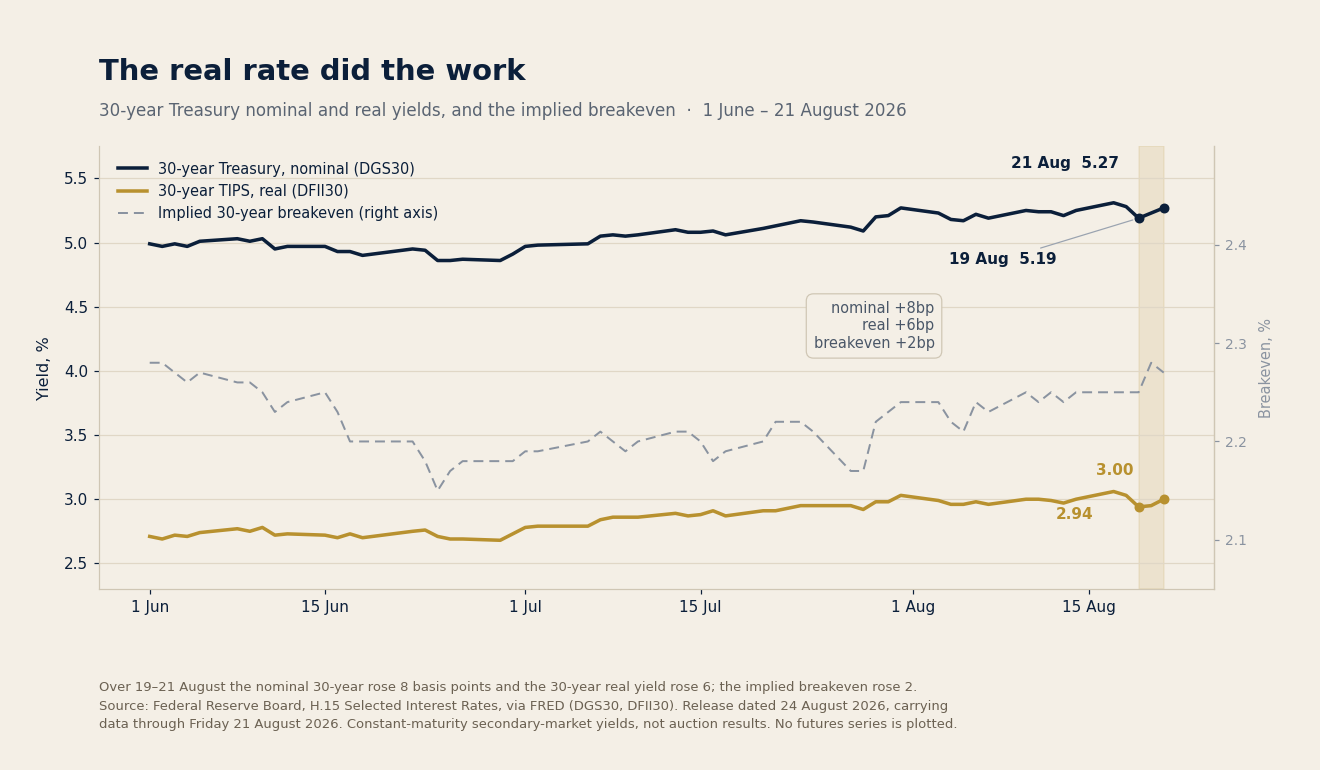
The real rate did the work. 30-year Treasury nominal, 30-year TIPS and the implied breakeven, 3 June – 21 August 2026.
Over 19–21 August the nominal 30-year rose from 5.19% to 5.27% and the 30-year TIPS from 2.94% to 3.00%. The implied breakeven was unchanged to within a basis point. The move was in the real rate.
At a liability duration of 15, that is a modest improvement in funded status rather than a deterioration: a higher discount rate reduces the present value of a long-dated promise.
Source: Federal Reserve Board, H.15 Selected Interest Rates, release dated 24 August 2026, carrying data through Friday 21 August 2026. Constant-maturity yields are secondary-market readings, not auction results. No 24 August close is included because none had been published at the time of writing. No futures series is plotted and no futures settlement is quoted elsewhere in this edition.

Careers
No verified institutional appointment cleared the window.
The Back Page
Sources
Universal Asset Owners provides institutional research and editorial analysis. It is not investment advice.
The Editorial Team · Universal Asset Owners