
98% of the world’s sovereign wealth funds |
18 of 20 of the world’s largest pension funds |
10 of 10 of the largest charitable foundations |
85% of the world’s largest family offices |
100+ billionaires, every morning |
What matters today
Across minerals, insurance and energy infrastructure, institutions are increasingly paying for control over the bottlenecks that determine whether an asset can deliver cash flow, capacity or strategic supply.
- Britain took equity, a board nomination right and veto powers in a tungsten mine — and a negotiation, not a contract, for the metal itself.
- CPP Investments’ reinsurer will assume US$1.7 billion of American life liabilities while Sun Life’s alternatives manager runs the assets behind them.
- CalPERS’ head of sustainable investing says the fund has moved away from the term “ESG” while shifting capital toward grid, firm power and data-centre infrastructure.
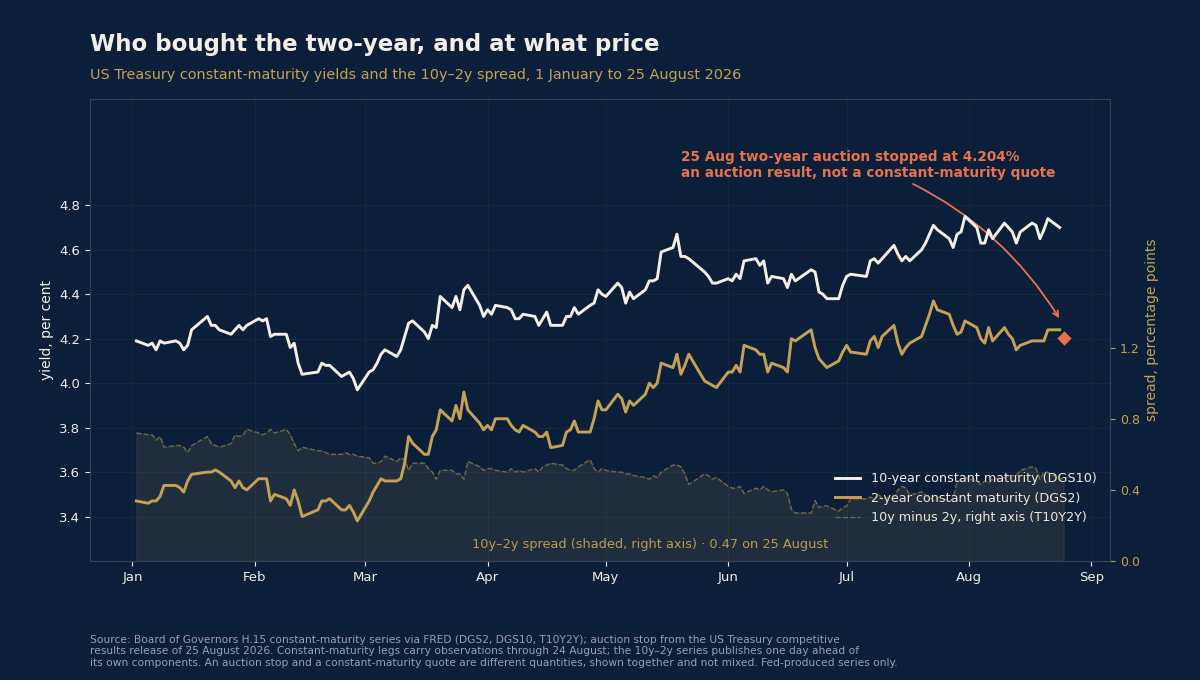
- Separately, the US two-year Treasury auction cleared at 4.204% with a weaker cover ratio and a markedly stronger buyer mix — a market-structure signal in its own right.
Hemerdon: the deal’s four instruments
Britain’s National Wealth Fund has agreed to invest £36 million in Tungsten West, the company seeking to restart the Hemerdon tungsten and tin mine in Devon. The fund will receive 100 million new shares at 36 pence — approximately 7.42% of the enlarged voting share capital — together with a board nomination right, board-observer status until an appointment is made, information rights and limited veto powers over changes to the business plan and the issue of equity. It may also provide a £25 million secured facility, although no definitive loan agreement has been signed. A further £10 million accordion is uncommitted. The subscription is conditional on admission of the new shares to AIM, expected on or around 27 August.
The transaction matters less for its headline size than for what it leaves unresolved. The fund has bought influence over a mine that could become strategically important to Western defence supply chains. It has not bought tungsten.
The National Wealth Fund’s own announcement describes the arrangement as an exclusive negotiation period for an offtake agreement covering up to half of projected output. Tungsten West’s AIM announcement, which gives the more specific description of the proposed arrangement, uses more cautious language: a limited period to negotiate, for up to 50% of the tungsten production projected in Hemerdon’s 2025 feasibility study. No price, volume, quality specification, transport obligation or force-majeure provision has been disclosed. No offtake has been signed.
That distinction is the investment case. Equity creates participation. Debt creates urgency. Governance rights create visibility and leverage. Only an offtake creates contracted supply.
Read as four separate purchases, the package is unusually legible. The equity is a small position: 7.42% of the votes in a company whose enlarged capital runs to 1.35 billion ordinary shares alongside 257 million B shares, priced at a 7.5% discount to the 20-day volume-weighted average to 19 August. The debt is priced to make delay expensive — SONIA plus 5.5 percentage points, roughly 9% at filing, rising by a further 1.0 percentage point each quarter, over a 366-day term beginning at a definitive agreement that does not yet exist, secured by a fixed and floating debenture and effective only once an existing short-term facility announced on 21 May is repaid. The governance rights close the distance between a shareholder in Whitehall and a mine in Devon, and they expire: the protections run twelve months, and the whole relationship agreement lapses if the fund’s holding falls below 50 million shares — half of what it is buying.
| Headline ceiling | Up to £71m — £36m conditional equity, £25m proposed facility, £10m uncommitted accordion |
| Equity (conditional on admission) | £36.0m, 100,000,000 new shares at 36p, 7.42% of enlarged voting capital |
| Discount | 7.5% to the 20-day VWAP to 19 August 2026 |
| Debt | SONIA + 5.5% (~9% at filing), +1.0 percentage point each quarter, 366 days from a definitive agreement |
| Governance | Board nomination, observer status, information rights, veto over business-plan changes and equity issuance, 12 months; lapses below 50m shares |
| Offtake | A limited period to negotiate for up to 50% of 2025 feasibility-study tungsten production. Not signed |
| Admission | Expected on or around 27 August 2026 |
| Employment | 350 direct jobs once fully operational |
| Steady-state output | 332,000 mtu WO₃ a year, years 2–11 — about 3,320 tonnes of tungsten trioxide, roughly 2,633 tonnes of contained tungsten |
Sources: Tungsten West plc, “Strategic Investment by the UK Government NWF”, RNS, 25 August 2026; National Wealth Fund, 25 August 2026; Tungsten West, “Development and Economic Plan for Hemerdon”, RNS, 30 May 2025.
Why the missing offtake matters to co-investors
Tungsten is not a scarce element. It is a concentrated one. China accounted for roughly 79% of world tungsten mine production in 2025 — an estimated 67,000 tonnes of an estimated 85,000-tonne total, on US Geological Survey figures, which are the most recent available and are published as estimates. American import reliance has exceeded 50% of apparent consumption every year since 2021, and tungsten has not been mined commercially in the United States since 2015.
That concentration now has a date attached to it — for one class of buyer. Under 10 U.S.C. §4872, implemented through DFARS clause 252.225-7052, a contractor may not deliver, under a Department of Defense contract above the simplified acquisition threshold, tungsten metal powder or tungsten heavy alloy melted or produced in China, Russia, North Korea or Iran. The restriction flows down to subcontracts at any tier, but it is bounded: commercially available off-the-shelf items are exempt unless 50% or more tungsten by weight, electronic devices are exempt by default, and the rule yields to nonavailability determinations and to a national-security waiver.
Two qualifications matter for anyone reading this as a supply-chain thesis. This is defence procurement, not an economy-wide prohibition, and it does not restrict tungsten in commercial supply chains. And as things stand today it reaches only melting and production. From 1 January 2027 the clause extends to material “mined, refined, separated, melted, or produced” in a covered country, capturing tungsten ore and feedstock — including recycled material — for the first time. The rule is not arriving. Its reach is moving upstream, and it is doing so in four months.
The structure of Tuesday’s package suggests that private capital may have demanded materially different pricing, security or control terms for a commissioning-stage asset with a short operating history in a commodity whose price has moved several-fold in six months. A private lender prices commissioning risk. A state also prices the cost of having no domestic feedstock when traceability rules tighten. Those are different calculations, and only one of them appears in an internal rate of return.
For a private co-investor, the question is not whether the state has validated the project’s strategic importance. It plainly has. The question is whether the state’s strategic objectives — and its superior governance and financing rights — alter the economics available to minority capital. The state is underwriting financial risk while seeking a strategic return that ordinary shareholders do not share.
Follow the sequence and the position becomes concrete. A new holder arrives with 7.42% of the votes, a veto over changes to the business plan and over the issue of equity, a claim that ranks ahead of the equity and grows more expensive each quarter, and a live negotiation to purchase up to half the output. Each is disclosed and defensible on its own. Together they mean that the most important commercial contract this company will sign in the next five years will be negotiated with a counterparty that sits on its board, can block its financing plans, and is owed money at an escalating rate.
The exposure runs in the other direction too. If the offtake negotiation fails — on price, on volume, on quality specification, on transport, on force majeure — the fund still owns 7.42% of a mine and the United Kingdom still has no contracted domestic tungsten, with the DFARS mining-stage restriction taking effect on 1 January 2027 regardless.
Triple exposure. A universal owner meets this structure three times, and the three do not net. As an owner of the market, it holds the defence and industrial users who lose Chinese tungsten feedstock on 1 January 2027 without a contracted alternative. As a potential co-investor, it may be offered equity alongside a state that already holds veto rights, a board seat, a senior escalating claim and a negotiation for up to half the output. As an institution in its own jurisdiction, it is watching a template that other governments may copy — one in which sovereign procurement rights sit ahead of minority economics.
Six questions to put in writing before any co-investment beside a national vehicle. How much of the headline ceiling is drawable today, and against what conditions? When does the interest escalation begin and end, and what is the refinancing plan at day 366? How will price, volume, quality, transport and force majeure be set if the government takes up to half the output — and how does that change the cash available to other customers? Which corporate decisions require the state’s consent? What separates first concentrate from commercial production from nameplate capacity, and on what dates? And does the project underwrite at a normalised commodity price rather than this summer’s?
Embedded exposure to flag. A critical-minerals or listed-infrastructure mandate expressing this theme also carries embedded thermal exposure. The refining step that converts concentrate to ammonium paratungstate remains concentrated outside the United Kingdom, and the processing and compute assets clustered around this thesis are sited where firm generation is cheapest. A domestic mine does not create an independent supply chain if the refining stays where it was, and a “critical minerals” line item is not a low-carbon line item.
Capital flows
Sun Life and Wilton Re build a balance sheet on both sides. Sun Life Financial and Wilton Re signed a definitive agreement on 25 August under which Wilton Re will establish Windsor Life Re, a US- and Bermuda-domiciled reinsurer it will manage. The partnership is expected to deploy approximately US$900 million of capital, with Sun Life and Wilton Re each contributing approximately one-third of the total equity capitalisation; the remaining third has not been identified, and neither company disclosed the size of the equity base. Windsor Life Re will reinsure an initial in-force block of about US$1.7 billion from Wilton Re, with future business ceded on a quota-share basis. SLC Management, Sun Life’s institutional alternatives manager, will be lead asset manager. Both companies say the vehicle is anticipated to reach roughly US$10 billion in assets at scale — language the announcement itself identifies as forward-looking. Launch is expected in the first half of 2027, subject to regulatory approvals. No capital has been deployed.
The structure matters because of who owns the reinsurer. Wilton Re is owned by CPP Investments, which acquired it in 2014. CPP Investments is not itself a pension fund — it is the arm’s-length manager of the Canada Pension Plan’s assets — so what is being assembled here is a vehicle in which the manager of Canadian retirement capital owns the reinsurer taking on American life risk, while a partner’s asset manager runs the collateral behind it.
It is worth being precise about what that is and is not. It is not CPP Investments hedging its own liabilities: SLC Management, not CPP, is slated to manage the assets, and US life liabilities are not a mirror of Canadian pension obligations. What the structure builds is a fee-and-capital partnership — Sun Life gains a route to fee-bearing insurance assets without owning the whole risk platform; Wilton Re gains a capital partner and a vehicle for expanding its in-force book. The question for each side is whether underwriting return, asset-management fees and capital efficiency adequately compensate the risk it actually assumes.
Granite Asia passes $500 million with three sovereign anchors. Granite Asia announced on 25 August that it has surpassed the US$500 million target for its pan-Asia private credit strategy, Libra Hybrid, with new commitments from a leading insurer, DBS Private Bank and other institutional investors joining anchor investors Temasek — through its private credit platform Aranda Principal Strategies — Khazanah Nasional Berhad and the Indonesia Investment Authority. The firm reports eight transactions and two exits since the strategy launched in 2025, against a first close of over US$350 million in December 2025. This is a fundraising milestone above target, not a final close.
Two live processes, neither concluded. ADQ’s voluntary conditional cash offer for the remaining 24.58% of AD Ports Group at AED 6.25 a share runs to 15:00 UAE time on 15 September. The offer document sets no minimum acceptance threshold, contains no squeeze-out mechanic and requires the shares to remain listed; ADQ states it intends to maintain its shareholding. And BNP Paribas and KB Kookmin are reported to be in separate talks over a stake of at least 15% in Vietnam’s Techcombank.
Stewardship & voting
The label moved. The exposure did not.
Peter Cashion, CalPERS’ managing investment director for sustainable investing, told Chief Investment Officer on 25 August: “When it comes to language and taxonomy, we have moved away from the term ‘ESG’. We are looking at it as sustainability integration. So that’s our nomenclature change.” He also said the fund is making fewer investments in electric-vehicle charging networks and offshore wind, and more in solar power, data-centre build-out, electrical-grid improvements and geothermal energy. CalPERS has published no document of its own recording either change; its website still carries a page headed “Environmental, Social & Governance Integration”. Cashion’s framing of the rationale: “We see sustainability as both an opportunity set and an important risk mitigation tool.”
Read the two halves together. The vocabulary retreats; the capital moves toward grid, firm power and the physical enablers of compute. That is not a fund leaving the transition. It is a fund buying the part of the transition that has a delivery system attached.
Other funds are having the choice made for them. Ballotpedia counted 14 ESG-related bills enacted across US states in 2026 on 24 August — the fewest since 2021 — two of them over a governor’s veto, in Kansas and Kentucky, both proxy-advisor disclosure measures. Oklahoma, Mississippi and Tennessee enacted or expanded sole-interest fiduciary standards. Oklahoma’s HB 4428 requires public retirement-system boards to vote company and proxy proposals “solely based on pecuniary factors”, and defines a pecuniary factor to exclude “the promotion, furtherance, or achievement of environmental, social, or political goals”. It takes effect 1 November 2026. A companion act, HB 4429, imposes a proxy-advisor disclosure duty.
The direction of travel in Europe runs the other way on transparency. IPE reported on 24 August that the investigative group WAV is taking legal action against CPEG, the Caisse de prévoyance de l’État de Genève, over its refusal to disclose its investment holdings. CPEG reports assets of CHF 23.9 billion, a funding ratio of 78.6%, 57,338 active members and 29,334 beneficiaries.
On the record: Market Forces on AustralianSuper and Whitehaven
Our 18 August edition carried Market Forces’ modelling of AustralianSuper’s stake in Whitehaven Coal, marked REPORTED pending the fund’s response. Market Forces has now answered on the record, and the underlying position has moved.
The holding is larger than the figure we published. A Form 604 change-of-substantial-holding notice lodged with the ASX on 19 August records AustralianSuper Pty Ltd (ACN 006 457 987) moving from 11.80% of Whitehaven Coal to 13.66% — 97,493,131 shares to 112,346,150 — with the relevant change dated 17 August. The shares are registered to JPMorgan Nominees Australia. Market Forces put the new figure to us as 13.7%; the filed number is 13.66%.
Annexure A itemises daily on-market buys and sells running from February, so this is net accumulation rather than a block trade. One qualification we should make ourselves rather than leave implied: Whitehaven ran a continuous on-market buy-back across the same period, and implied shares on issue fell from roughly 826.2 million to 822.4 million. On our arithmetic that accounts for about 0.06 of the 1.86-point rise; the remaining 1.80 points is AustralianSuper buying. The split is our derivation, not a filed figure.
On whether it is the largest holder. It is the largest disclosed beneficial holder: the only other substantial holders on the register are Vanguard Group at 6.024% and the Dimensional entities. It does not appear in Whitehaven’s twenty-largest-shareholders table, which lists custodians — HSBC Custody Nominees heads it at 22.65% — and AustralianSuper’s shares sit inside the JPMorgan Nominees line.
The comments below are attributable to Brett Morgan, Investor Campaigns Manager at Market Forces, supplied to this publication in writing.
“Our modelling concludes that Whitehaven’s proposed coal developments only create value for shareholders in a world that fails to meet its climate goals, which would be catastrophic for the global economy and universal owner portfolios.”
“AustralianSuper claims to use its ownership rights to seek effective management of issues that impact investment value and our modelling highlights a crucial opportunity for Whitehaven Coal’s biggest shareholder to demonstrate responsible stewardship.”
Asked what disclosure would settle the question:
“Whitehaven must demonstrate that investing in coal growth is a better use of capital than additional shareholder distributions, something the company has not provided adequate evidence for.”
“As Whitehaven’s largest shareholder, AustralianSuper must challenge the company’s risky growth strategy, seeking an end to new coal and protecting its members’ retirement savings.”
And on whether this is one fund or a pattern:
“Most Australian pension funds aren’t taking effective stewardship escalation measures at companies with fossil fuel expansion plans, such as seeking board accountability for inadequate climate transition plans through director elections.”
Whitehaven’s answer, which it gave before the results. In an ASX announcement of 18 August the company disclosed that it had received a notice from Market Forces on behalf of shareholders representing 0.0017% of shares on issue, approximately 13,850 shares, requisitioning two resolutions for the annual meeting on 5 November. It added that this is “the sixth occasion that Market Forces has promoted resolutions at the Company’s AGM” and that “none of the previous resolutions have been passed by shareholders”. Whitehaven also cited a five-year total shareholder return of 448%, which it says ranks it in the top five of the ASX 100 — the company’s claim, sourced by it to Bloomberg, which we have not independently checked. The board’s formal response comes in the notice of meeting, which has not been issued.
The second resolution is the one universal owners should read. It asks Whitehaven to disclose, by no later than its 2027 annual report, how it assesses whether surplus capital deployed to development projects delivers greater value than returning that capital to shareholders. That is the same question this edition’s lead puts to a British tungsten mine, arriving from the opposite direction: not whether the state should own the asset, but whether the company should be building at all.
What the numbers now say. Whitehaven reported FY26 on 19 August: revenue A$5,401m, down 7%; underlying NPAT A$227m, down 29%; statutory NPAT A$385m, down 41%, including A$158m of post-tax non-recurring gains; net debt A$1,327m, more than double the prior year. It declared a final dividend of 6.0 cents fully franked and put total capital return in respect of FY26 at up to A$159 million, against FY27 capital expenditure guidance of A$390–490 million. The ratio of growth capital to shareholder distributions is, on the company’s own guidance, roughly three to one.
One distinction the exchange turns on. AustralianSuper’s net-zero commitment is expressly to the scope 1 and scope 2 emissions of its portfolio investments. The emissions from burning Whitehaven’s coal are scope 3, and the commitment does not extend to them. The fund manages over A$430 billion for more than 3.6 million members, as at 30 June 2026, and has no fund-level thermal coal exclusion; screening applies only in its opt-in Socially Aware option.
Right of reply. AustralianSuper has published no response to the August modelling, to the requisitioned resolutions, or to its move to 13.66%. It has been approached for comment, and this section will carry its response when it comes.
The Long Horizon: market structure and forced flows
FTSE Russell published its indicative September review of the FTSE UK Index Series on 25 August. On capitalisation data as at the close of Friday 21 August, easyJet and Ithaca Energy are indicatively promoted to the FTSE 100 and Entain and Persimmon indicatively relegated. The FTSE 250’s indicative additions are Entain, Persimmon, Pinewood Technologies Group and Seraphim Space Investment Trust; its deletions are Aston Martin Lagonda, easyJet, GB Group, Ithaca Energy and Volex. The review proper uses data at the close of 1 September and confirmed changes are announced after the close on 2 September. Under the FTSE UK Index Series ground rules, constituent changes are implemented after the close of business on the third Friday of the review month — 18 September — following expiry of the ICE Futures Europe contracts, and take effect at the open on Monday 21 September.
Nothing in that paragraph is an investment judgement, and for a part of the market that is the point. A fully replicating FTSE 100 fund may hold Entain not because of a fundamental view but because a benchmark requires it, and will sell at the September effective close for the same reason.
The compulsion is narrower than it first appears, and the distinction is worth holding. A broad-market mandate may simply reclassify the holding rather than sell it, and a FTSE 250 tracker will buy much of what a FTSE 100 tracker sells. The forced trade sits in mandates tied to the affected benchmark, and the net exposure depends on a portfolio’s full index architecture. What is unambiguous is the timing: between the indicative announcement and the effective date sits a four-week window in which every mandate concerned knows precisely what it must do and precisely when.
That timing is the measurable cost of owning the market rather than picking it, and it raises practical governance questions: which mandates must trade at the effective close, whether crossing between internal portfolios can reduce market impact, and who owns the implementation shortfall — the manager, the transition manager, or the asset owner.
It is also why index methodology consultations deserve the same scrutiny as manager changes. S&P Dow Jones Indices and MSCI opened a joint GICS consultation on 17 July; the classification that emerges will move more of a diversified portfolio, more mechanically, than most manager-selection decisions taken this year.
The Film
“The Negotiating Window” · 1:02
Geopolitics & chokepoints
Qatar. Reuters reported that Qatar shipped 18 LNG cargoes in the six months since the conflict with Iran began, against 509 a year earlier, with roughly US$24 billion of lost gas sales. The calculation relies on ICIS shipping data that are not publicly reproducible, while more recent reporting indicates that Ras Laffan loadings had improved from earlier lows — Bloomberg put them at their highest since March on 11 August, still around 60% below a year earlier. The cumulative figure is therefore a measure of the disruption’s scale, not a real-time gauge of current flows.
The size of the exposure is firmer. Qatar exported 81.51 million tonnes of LNG in 2025, 18.7% of global exports, second to the United States, on International Gas Union figures. The frequently quoted “almost 20%” is the IEA’s number for Qatar and the UAE combined, and it is an annual trade share rather than a daily flow. QatarEnergy has put the revenue effect of the Ras Laffan strikes at about US$20 billion a year.
The Strait. IMF Managing Director Kristalina Georgieva, briefing reporters on 25 August, said global growth “has weathered the energy shock caused by the closure of the Strait of Hormuz better than we feared”. The United Nations’ International Trade Centre, in analysis published 4 August, describes “reduced commercial passage” with traffic “far below normal levels”, and the IMO refers to seafarers “confined within the Gulf region”. Official characterisations of the Strait’s status diverge, and no navigational authority has published a closure notice.
The transmission channel is European storage. EU underground storage stood at 62.99% of capacity at the end of the gas day on 24 August, against 75.7% a year earlier, on Gas Infrastructure Europe data. The IEA puts LNG shipments from Qatar and the United Arab Emirates through the Strait of Hormuz at about 19% of global LNG trade in 2025.
The implication is not a directional gas call. It is a resilience test: infrastructure, utilities and sovereign exposures should be run against prolonged disruption, partial recovery and renewed closure, rather than a single base case. And lost export revenue is not a dollar-for-dollar draw on the Qatar Investment Authority — the fiscal response depends on cash buffers, spending choices, borrowing and transfers, and the fund flow should not be inferred from the export number alone.
Sanctions. The US Treasury’s Iran action of 24 August made five sectoral determinations that create the authority to impose secondary sanctions on Iran’s digital assets, technology, gold, aviation and shipping sectors. That authority has not yet been exercised. US Treasury Secretary Scott Bessent told reporters a major financial institution could be designated by the end of the week; none has been, and the package deliberately spared large Chinese financial institutions. Oil prices fell despite the announcement, suggesting that investors focused on what the measures did not yet include.
Signals — not yet confirmed
EMERGING — Spain moves to make grid access conditional on what a data centre consumes. The Council of Ministers’ reference for 25 August records an agreement authorising urgent administrative processing of a draft Royal Decree “regulating the energy sustainability, environmental, resilience and digital sovereignty requirements applicable to data centres.” That title is published; the text is not. Government sources have briefed that the draft will apply above 1 MW, require renewables to cover at least 80% of consumption in every hour of operation, require every new megawatt of demand to be matched by renewable capacity installed in the preceding 18 months, and that non-compliance could cost grid-connection rights. No Spanish institution has confirmed those figures.
Confirms or kills it: publication of the decree text, in the BOE, in a consultation, or in a TRIS notification. Watch whether the 80% floor survives as briefed — the reported version is conditional, holding only until renewables exceed 90% of Spain’s electricity mix.
REPORTED — BNP Paribas and KB Kookmin in separate talks over at least 15% of Techcombank. Reuters reports a transaction potentially worth about US$2 billion at roughly twice book value. Techcombank and BNP Paribas declined to comment; KB Kookmin said it does not comment on market rumours. No agreement has been reached and neither institution has confirmed the talks. Vietnam generally caps foreign bank ownership at 30% and Techcombank’s foreign ownership is reported near 20.5%, which is why scarcity could carry a premium at all.
Confirms or kills it: a company announcement, or a filing with the State Bank of Vietnam.
REPORTED — a major financial institution to be designated “by week’s end”. US Treasury Secretary Bessent said it at a press briefing on 24 August; it does not appear in his prepared remarks or in either Treasury release. Two days have passed with no designation.
Confirms or kills it: an entry on OFAC’s Recent Actions page.
Week ahead · decisions due
Capex commentary. Tungsten West’s admission to AIM is expected on or around Thursday 27 August. The equity subscription, the relationship agreement and the negotiating window all take effect at admission.
Oil, volatility and credit are not agreeing. Tuesday’s settles: NYMEX October WTI $82.36, down 3.1%; ICE October Brent around $88.5, roughly 4% lower, against Monday’s settle of $92.17. Against that, VIX at 15.85 and the US high-yield option-adjusted spread at 2.69% on 24 August, with the St Louis Fed Financial Stress Index at −0.83. Energy is repricing. Credit and equity volatility are not confirming it.
Physical advisories. The Panama Canal Authority’s Advisory A-29-2026 of 20 August reduces daily transit slots from 36 to 34 for booking dates from 4 September, and to 32 from 15 September, citing rainfall 34% below the historical average and inflows 44% below. Draft relaxations have been postponed rather than advanced.
Also dated. In the United States, the $70 billion five-year note and $28 billion two-year floating-rate reopening today, and the $44 billion seven-year note tomorrow · Jackson Hole, 27–29 August, theme “Financial Innovation: Implications for Payments and Policy”, with the Federal Reserve chair’s keynote at 10:00 on Friday 28 August · the G20 finance ministers and central bank governors in Asheville, North Carolina, 31 August to 1 September · FTSE UK review changes confirmed after the close on 2 September, implemented after the close on 18 September and effective at the open on 21 September · Canada’s counter-tariffs at 12:01 a.m. on 8 September on about $27.6 billion of US goods at 15, 25 and 50% · the first enlarged US Treasury buyback operation on 10 September · the AD Ports offer closing 15 September · the Bank of Japan’s next policy meeting on 17–18 September.
Published this morning. The default tariff cap set by Ofgem, Britain’s energy regulator, for October to December sets the typical direct-debit figure at £1,723 a year, up £60 or 4%, with the wholesale allowance up 11% and now 47% of the cap; Ofgem cites “continued conflict and geopolitical instability in the Middle East” among the drivers. The figure is an annualised illustration based on typical consumption, not a cap on any household’s total bill. VAT on electricity falls to zero from 1 October to 31 March; VAT on gas remains at 5%.
Market structure: the two-year auction
The US Treasury sold $69 billion of two-year notes on 25 August at a high yield of 4.204%. The bid-to-cover ratio slipped to 2.60 from July’s 2.66. The buyer mix moved the other way, and by more: indirect bidders took 65.16% of the $69 billion offered against 55.59% in July, a rise of 9.57 percentage points, while primary dealers were left with 10.8%.
One clarification is worth carrying, because the category is routinely misread. The US Treasury’s own auction guidance states that “indirect bidder” describes a customer bidding through a primary dealer or direct submitter, and “does not indicate the domicile of the bidder (foreign or domestic)”. The category includes domestic asset managers, pension funds and insurers. What Tuesday establishes is that non-dealer demand absorbed more of the issue even as headline coverage eased — not that foreign official demand did.
Chart of the day
Podcast · The Universal Owner
| Apple Podcasts | Spotify | Podbean |
Careers and people
Two of the most visible long-horizon mandates in the world are looking for a chief.
Australia’s Future Fund announced on 26 August that Raphael Arndt will leave at the end of the year after almost two decades at the fund — the last six as chief executive from 1 July 2020, and six before that as chief investment officer from 2014. He is the longest-serving chief executive in the fund’s twenty-year history. The announcement arrived with the portfolio update to 30 June: a 14.8% return for the year against a one-year target of 8.0%, adding A$37.4 billion and lifting the Future Fund itself to a record A$289.7 billion. Across the seven funds the Board of Guardians oversees, assets reached A$356 billion, up from A$205 billion when Arndt became chief executive. Australian equities rose to A$30.4 billion, though their portfolio weight slipped to 10.5% from 10.8%. Over ten years the fund has returned 9.0% a year against a mandate target of 7.1%; the mandate itself is CPI plus 4 to 5 per cent over the long term, and the 8.0% is a derived one-year benchmark rather than a standing hurdle. Chair Greg Combet told a media briefing the Board was “well advanced” in its process. Chief investment officer Richard Brandweiner, who started on 1 July 2026, remains in post.
Korea Investment Corporation posted a public recruitment notice for chief investment officer on 24 August. Applications close at 18:00 KST on 7 September; the term is three years. KIC reports assets of US$232.0 billion as at the end of 2025. An earlier process this summer narrowed to four candidates and closed without an appointment.
The Universal Owner Risk Radar
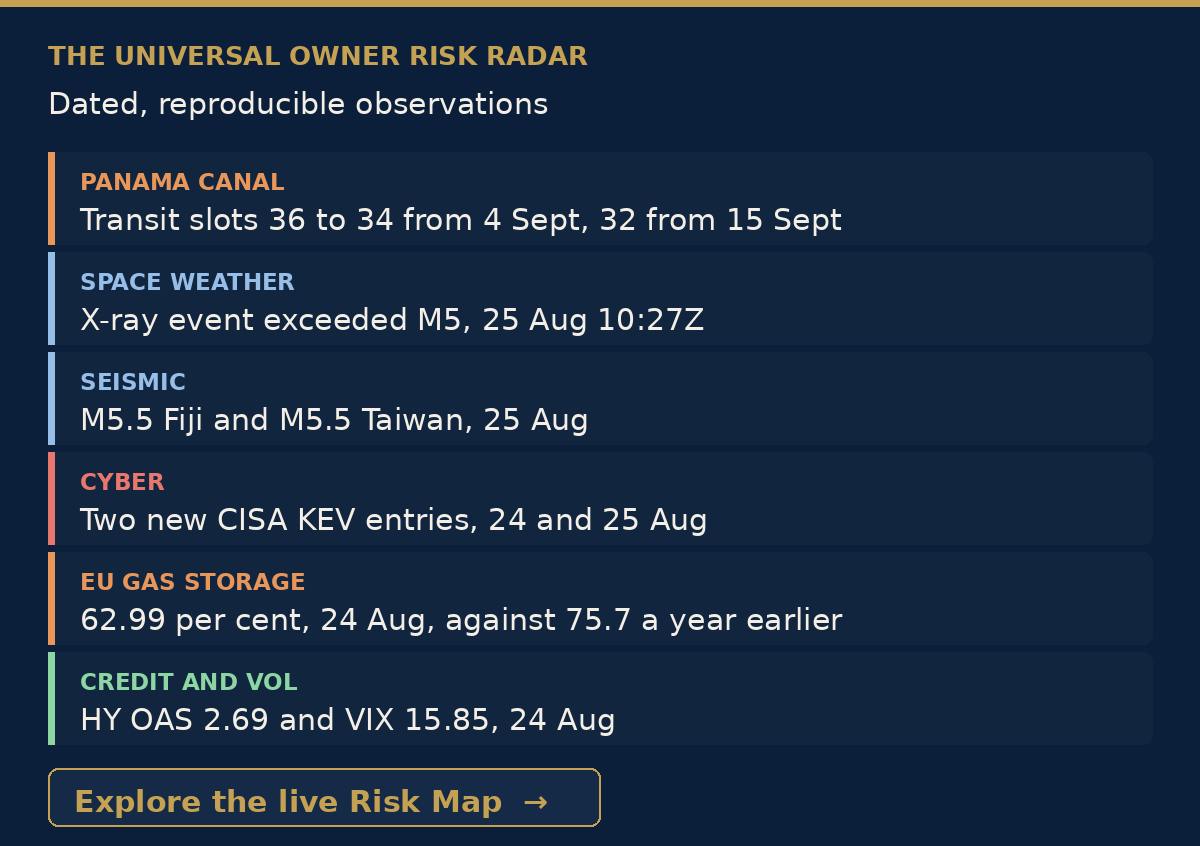
- Panama Canal transit slots cut to 34, then 32. ACP Advisory A-29-2026, 20 August: rainfall 34% below the historical average, inflows 44% below. Booking dates from 4 September. Source ›
- X-ray event exceeded M5. NOAA SWPC alert, 25 August 10:27Z, with a 10cm radio burst at 10:20Z. Below storm-level thresholds. Source ›
- M5.5 south of the Fiji Islands, 25 August 12:12Z. And M5.5 108km north-east of Hengchun, Taiwan, 25 August 07:00Z. No damage reported. Source ›
- Two exploited vulnerabilities added to CISA’s catalogue. CVE-2026-60004, Gitea code injection, 25 August; CVE-2026-21962, Oracle HTTP Server and WebLogic proxy plug-in, 24 August. Source ›
- European gas storage 62.99% on 24 August. Against 75.7% a year earlier, on Gas Infrastructure Europe data. Source ›
- High-yield spread 2.69% and VIX 15.85 on 24 August. Ten-year/two-year Treasury spread 0.47 on 25 August. Source ›
Scenario
Track the triggers in the Command Center →
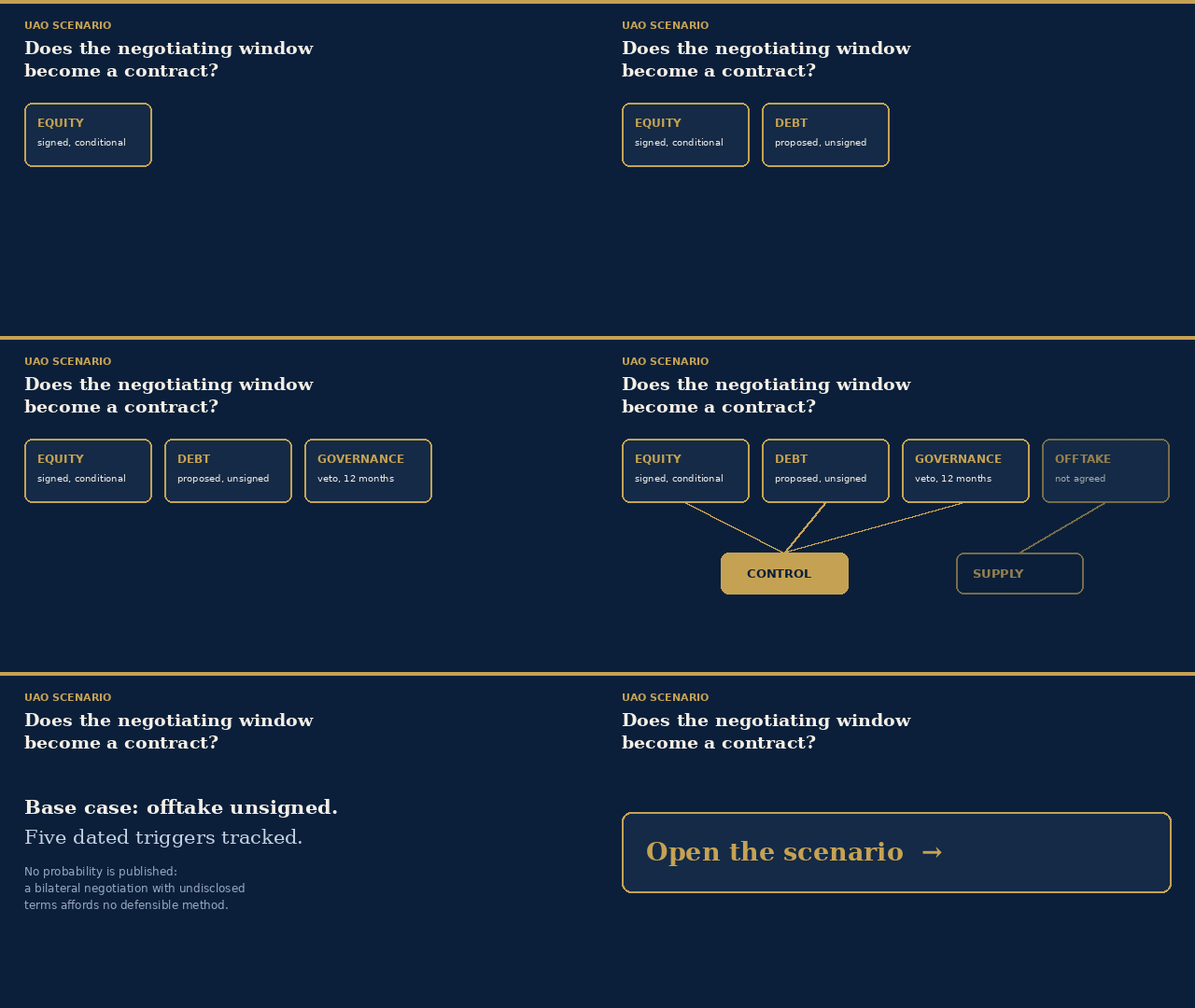
Base case: the offtake is unsigned. Five dated triggers are tracked. No probability is published — a bilateral negotiation with undisclosed terms affords no method that would survive scrutiny.
The Back Page
Meet The Allocator
The Allocator owns a small piece of nearly everything, is pitched by everybody, and is rarely surprised — though frequently disappointed by the footnotes.
Today’s cartoon

Sources
Tungsten West plc, “Strategic Investment by the UK Government NWF”, RNS, 25 August 2026 · National Wealth Fund, “National Wealth Fund backs Tungsten West to unlock critical UK tungsten supply”, 25 August 2026 · Tungsten West plc, “Development and Economic Plan for Hemerdon”, RNS, 30 May 2025 · US Geological Survey, Mineral Commodity Summaries 2026, “Tungsten” · DFARS 252.225-7052 · 10 U.S.C. §4872 · Sun Life Financial and Wilton Re, joint announcement, 25 August 2026 · CPP Investments, “CPPIB to acquire Wilton Re Holdings”, 2014 · Granite Asia, “Granite Asia surpasses USD 500 million target”, 25 August 2026 · AD Ports Group, offer document, 18 August 2026 · Chief Investment Officer, “Labels Are Changing, Goals and Risks Are Not”, 25 August 2026 · Ballotpedia, “States enact 14 ESG-related bills in 2026, the fewest since 2021”, 24 August 2026 · Oklahoma HB 4428, enrolled text · IPE, “Geneva pension fund faces court battle over investment disclosure”, 24 August 2026 · LSEG, “FTSE UK Index Series – Indicative Quarterly Review Changes September 2026”, 25 August 2026 · FTSE UK Index Series Ground Rules v17.2, rule 8.1.1 · US Department of the Treasury, releases sb0613 and sb0614, 24 August 2026 · TreasuryDirect, competitive results, two-year note, 25 August 2026 · US Department of the Treasury, Auction FAQs · International Gas Union, World LNG Report 2026 · International Energy Agency, “Strait of Hormuz” factsheet · UN News / International Trade Centre, 4 August 2026 · Ofgem, “Summary of changes to the energy price cap, 1 October to 31 December 2026”, 26 August 2026 · Panama Canal Authority, Advisory to Shipping A-29-2026, 20 August 2026 · Department of Finance Canada, 25 August 2026 · Federal Reserve Economic Data (DGS2, DGS10, T10Y2Y, BAMLH0A0HYM2, VIXCLS, STLFSI4) · Future Fund, “CEO to depart the Future Fund Management Agency” and “Portfolio update as at 30 June 2026”, 26 August 2026 · Korea Investment Corporation, CIO recruitment notice, 24 August 2026 · Gobierno de España, Consejo de Ministros reference, 25 August 2026.
Universal Asset Owners provides institutional research and editorial analysis. It is not investment advice.
— The Editorial Team