
Liquidity Is Becoming Policy
Treasury is enlarging scheduled long-end buybacks as private-credit funds enforce contractual limits. The useful lesson is not that public bonds have a new backstop; it is that quoted liquidity and contractual access are different things.
98% of the world’s sovereign wealth funds |
18 of 20 of the world’s largest pension funds |
10 of 10 of the largest charitable foundations |
85% of the world’s largest family offices |
100+ billionaires, every morning |

Two minutes. What Treasury actually changed, and what it did not.
Treasury’s larger operation is not a backstop
The US Treasury on Wednesday made a precise change with an imprecise political shadow. It said it would increase, by at least double, the maximum size of scheduled liquidity-support buybacks in two nominal-coupon sectors: securities with 10 to 20 years remaining and those with 20 to 30 years remaining. The present maximum is $2 billion per operation. The larger maximum is effective 9 September through 4 November, when each scheduled operation will carry a maximum of at least $4 billion.
That is a meaningful adjustment to market maintenance. It is not a standing bid. Treasury runs price-sensitive reverse auctions on announced dates and can accept less than the maximum — or nothing — if offers are unattractive. The purchases are financed through other issuance, so Treasury does not describe the programme as a way to reduce net marketable borrowing. Nor has it promised a price, an unlimited balance sheet or intervention in acute stress.
The distinction matters because the long end was already strained. The 30-year yield touched 5.337% on Tuesday, Reuters reported, its highest level since 2007. It settled Wednesday at 5.194%, down nine basis points, according to Dow Jones Market Data. Some of the decline preceded Treasury’s announcement, so the full move cannot be assigned to the policy. The cleaner conclusion is that investors valued the prospect of larger future operations after a sharp selloff.
The announcement also arrived beside a fiscal milestone, but not on the date widely asserted. Treasury data released Wednesday showed gross federal debt at $40.05 trillion as of 18 August. Gross debt is not the same thing as marketable Treasury securities or debt held by the public. It supplies scale; it does not by itself prove impaired liquidity or force a view on duration.
The Fed record contains both stress and resilience
Minutes released Wednesday elaborated on the Federal Reserve’s 29 July decision to hold the federal funds range at 3.50% to 3.75%. The 9–3 vote, including quarter-point dissents by Beth Hammack, Neel Kashkari and Lorie Logan, had already been disclosed three weeks earlier. It was not a second policy move on 19 August.
The minutes’ account of the manager’s market briefing said nominal Treasury yields had risen 25 to 30 basis points during the intermeeting period, mostly through real yields. It also said gains in artificial-intelligence infrastructure shares had stalled, hyperscaler credit spreads had widened relative to investment-grade debt, and redemption requests at business development companies had continued to rise in the second quarter.
Separately, the staff review said corporate bond spreads remained very low by historical standards and defaults in the private credit market were little changed. That counterevidence is not a footnote. It prevents a set of market signals from being turned into a generalised solvency call.
Private credit supplies the contractual test
Fitch publishes a defined trailing-12-month US private-credit default rate, which reached 6.0% in the second quarter and 6.1% in July, both records for that series. Its readings are not directly comparable with the minutes, which provide no private-credit metric or underlying universe. Investment committees should require managers to reconcile definitions and denominators instead of citing whichever observation supports the preferred narrative.
Final second-quarter filings from two Blue Owl vehicles show why access terms deserve the same attention as credit marks. At Blue Owl Credit Income Corp., repurchase requests equalled 18.8% of shares, or about $3.6 billion; the vehicle purchased 5% of shares outstanding, about $955.0 million, filling 26.6% of shares tendered. At Blue Owl Technology Income Corp., requests equalled 38.1%, or about $1.1 billion; it purchased 5% of shares outstanding, about $140.1 million, filling 13.1%. These were prorated tender offers under disclosed limits — not evidence that a named pension had been “gated”. The filings reviewed for this brief do not identify CalPERS, OMERS or BCI as redeeming shareholders.
Allocator lens
- Rebuild the cash calendar from legal terms, notice periods and tender caps — not manager liquidity labels.
- Reconcile each manager’s default rate to the exact universe, look-back period, amendment treatment and denominator.
- Stress price, funding and contractual liquidity separately; a tradable security and a redeemable vehicle can fail in different ways.
- Treat Treasury’s updated operation schedule as evidence when it is published. Until then, do not annualise the new maximum or assume full take-up.
Grid access moves from queue to contract
The week’s more durable infrastructure story is not that governments have turned against data centres. It is that public authorities are converting power, interconnection and local approval from background assumptions into explicit project conditions. Pennsylvania, PJM and Ontario are moving in the same broad direction, but through different instruments and at different legal stages.
| Jurisdiction | Stage | Scope | What changes |
| Pennsylvania | Executive order · 18 Aug | Fast Track: all projects. DEP paths: new applications above 25 MW | Fast Track removed; DEP review path depends on GRID status and local and water approvals. |
| PJM | FERC filing · 13 Aug | Large load of at least 50 MW at a site | Proposed IRAS for unsupported new loads; state and utility curtailment plans remain essential. |
| Ontario | Consultation · 13 Aug | Illustrative new class above 1 MW | Possible separate class, ICI exclusion and ministerial connection approval; thresholds not final. |
Pennsylvania: a final order with a narrower scope
The Department of Environmental Protection review provisions in Governor Josh Shapiro’s Executive Order 2026-05 apply to permit or authorisation applications submitted after 18 August for data-centre projects with peak demand above 25 megawatts. Separately, the order removes all existing data-centre projects from PA Permit Fast Track and makes future projects ineligible, with no stated megawatt floor for that bar. It also bars agencies under the governor’s jurisdiction — not every municipality or private participant — from signing non-disclosure agreements.
The order does not close the permitting door to applicants outside the state’s GRID programme. GRID-committed applicants may receive rolling review, but permits still depend on local-plan consistency and approvals. For non-GRID applicants, the department waits for local approvals and any required water-withdrawal or wastewater authorisation, then reviews a complete package outside the PAyback and Permit Decision Guarantee programmes.
The pipeline is large enough to explain the intervention. The order cites reports of more than 100 proposals. The governor’s release says 58 projects had engaged with the department, 15 had filed applications and five had all permits for a first phase. Those are administration counts, not a census of funded construction. The order directs special counsel to advocate for tariffs and rules that allocate backstop and interconnection costs; it does not itself set those charges.
PJM: a reliability proposal awaiting federal action
PJM filed its Interim Resource Adequacy Service proposal at the Federal Energy Regulatory Commission on 13 August in docket ER26-3515-000. Comments are due at 5 p.m. Eastern on 3 September, and PJM proposed a 12 October effective date. The filing defines a large load as at least 50 megawatts of cumulative peak demand at one site, including delivery points within a mile; it is not limited to data centres.
For new large loads that have not brought equivalent new capacity by 1 June 2027 or secured supply through PJM’s backstop procurement, the proposal creates a service pathway conditioned on interruption during stressed periods. PJM would allocate the necessary reduction to affected zones and utilities; states and utilities would identify and curtail retail customers. In plain terms, unsupported new large loads could be interrupted before traditional demand — but only if FERC accepts a framework that still relies on local implementation. PJM forecasts 32 gigawatts of load growth from 2024 through 2030, 30 gigawatts of it from data centres.
Ontario: a large queue, but policy still in draft
Ontario’s Data Centre Playbook is a consultation, not an enacted rate. The province floated a new Class C for new data centres — facilities not already participating in the Industrial Conservation Initiative — above an illustrative one-megawatt threshold, exclusion from the ICI, full cost recovery and a future ministerial connection-approval process under authority already in law. Current participating sites would remain in their existing classes. The class, threshold and rates are not final.
The queue gives the proposal weight. Ontario estimates that data centres currently participating in the conservation programme account for 100 to 200 megawatts; the Ministry of Energy and Mines estimates that current proposals could total more than 10,000 megawatts cumulatively, against a recent provincial peak near 25,000 megawatts. That ratio is an argument for triage. It is not evidence that all proposed projects are financeable, mutually exclusive or likely to connect.
Chart of the day
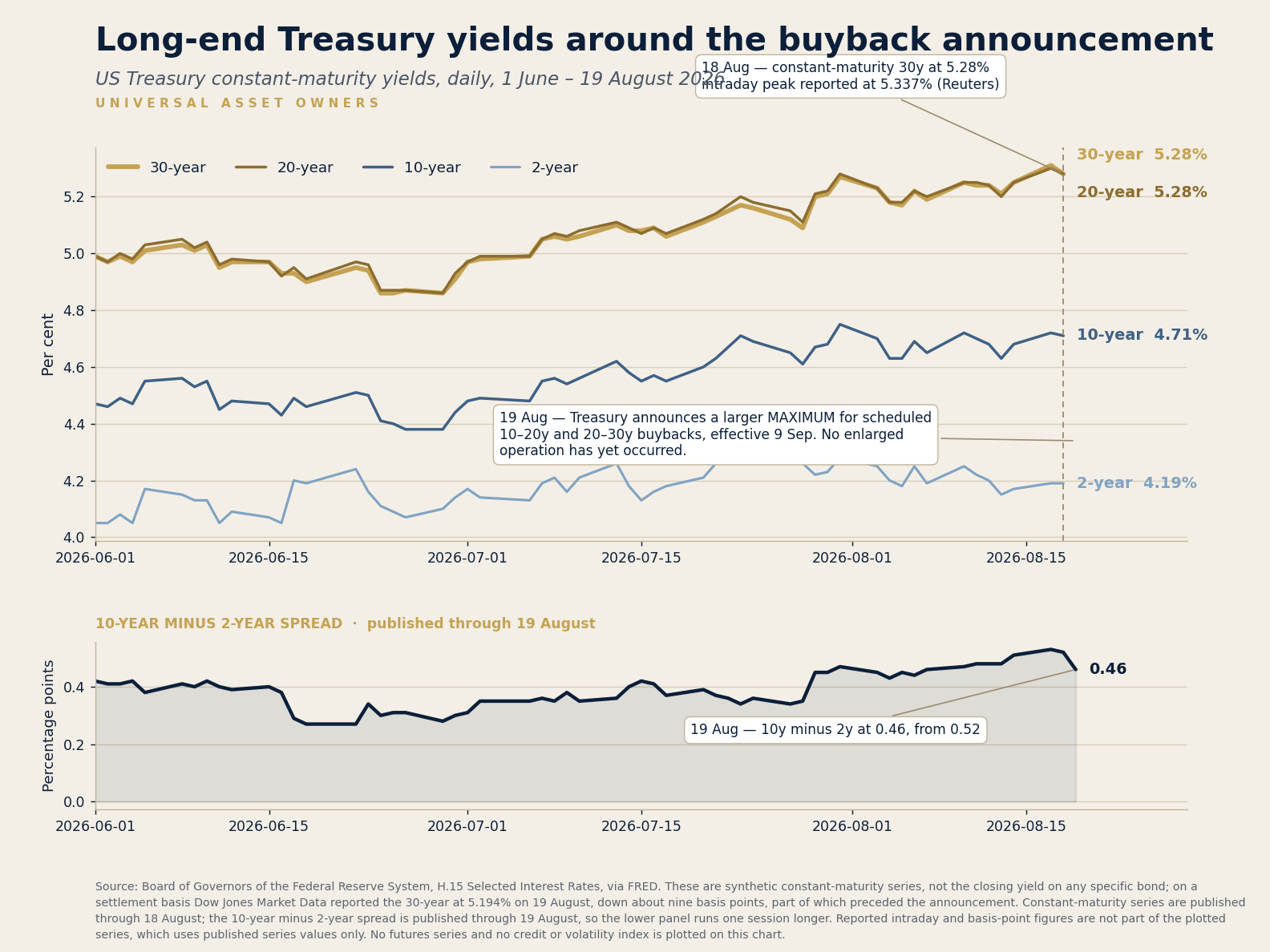
Source: Board of Governors of the Federal Reserve System, H.15 Selected Interest Rates, via FRED. These are synthetic constant-maturity series, not the closing yield on any specific bond. Constant-maturity series are published through 18 August; the 10-year minus 2-year spread is published through 19 August, so the lower panel runs one session longer.
Two rulebooks still being written
Compute derivatives: consultation before contract
The Commodity Futures Trading Commission on 19 August opened a request for comment on the potential listing and trading of standardised contracts tied to compute resources. It asked about cash-market size and liquidity, manipulation and oversight, customer protection, perpetual futures, and settlement and reference-price design. The comment window will run for 60 days after publication in the Federal Register.
No compute contract was approved or listed. The investable implication is therefore conditional: if standardised and sufficiently liquid contracts emerge, operators and capital providers could obtain a reference price for future compute capacity. Before that happens, the Commission would need to resolve whether the underlying service is sufficiently fungible across chip type, location, power source, latency and delivery period to support a robust contract.
ISSB: an operating plan with one constitutional proposal
IFRS Foundation trustees approved a five-year operating and financing plan on 18 August. The plan gives the International Sustainability Standards Board a seat in Geneva and calls for an office there in 2027 while retaining operations in Beijing, Frankfurt, Montreal and Tokyo. A separate constitutional amendment would reduce each standard-setting board to 10 members from 2028; that proposal is open for comment through 16 November.
For cross-border owners, the useful signal is institutional rather than immediate. A durable funding and governance structure can lower the risk that a disclosure baseline fragments. It does not prove that information costs will fall in every adopting market, and it does not determine US disclosure policy.
Six minutes forty-three. Market liquidity, contractual liquidity, and why the two moved in opposite directions.
The Long Horizon · land has a financing gap, not yet an asset class
At the UN Convention to Combat Desertification’s COP17 in Ulaanbaatar, running 17–28 August, the financing arithmetic is severe. UNCCD estimates that meeting land-restoration targets and addressing degradation, desertification and drought requires about $355 billion a year from 2025 through 2030. Current annual flows are about $77 billion, leaving a $278 billion gap. The agency estimates the cost of inaction at $878 billion a year and potential benefits at $1.8 trillion a year.
Those numbers identify a public-policy need; they do not create a uniform investable product. Restored watersheds, soil carbon, drought resilience and grazing productivity generate different cash flows, property rights and beneficiaries. Many benefits are diffuse or avoided losses, which means blended finance, public procurement, insurance and verified outcome payments may be more realistic than a single natural-capital allocation sleeve.
A universal owner should ask four questions before treating the gap as opportunity: who owns the land and consent rights; who pays for the outcome; how permanence and additionality are verified; and who bears reversal risk. COP17’s Finance Day on 24 August is a useful test of whether governments and institutions move from aggregate need to replicable transaction structures.
Capital flows
Long-dated Alphabet credit finds an Australian-dollar market
Alphabet raised A$5.5 billion, or about US$3.9 billion, in its first Australian-dollar bond sale, Reuters reported. The offering spanned three-, five-, 10- and 20-year tranches, drew orders above A$18 billion and set a 6.9% coupon on the 20-year tranche. The deal gives Australian-dollar investors direct access to long-dated Alphabet credit without taking currency exposure to a dollar bond. Reuters did not report buyer allocations or use of proceeds, so the transaction does not establish that pension portfolios funded a specific AI project.
A $100 million facility is not $900 million of committed capital
Clearco said on 18 August that it had secured a $100 million asset-backed facility from Macquarie’s New York fixed-income and currencies team. Clearco says the facility is expected to support roughly $900 million of customer funding over two years. That larger number is a business projection, not the size of Macquarie’s commitment, proceeds received on day one or expected revenue. The announcement did not disclose borrowing-base mechanics, advance rates, covenants or utilisation.
Ontario Teachers’: separate performance from funded status
Ontario Teachers’ Pension Plan reported a 9.5% total-fund net return for the six months ended 30 June and C$303.2 billion in net assets. Its 111% funded position and C$31.2 billion preliminary surplus refer to the 1 January 2026 valuation, which the sponsors elected to file. The distinction matters: first-half investment performance supported the balance sheet, but it did not create the funded-status measure reported for the start of the year.
Water and power are now access constraints, not externalities
The grid rules above have a physical twin, and it ran through Europe this month. Treating it as an environmental footnote misreads what it does to an industrial balance sheet: water is not an overlay on an infrastructure position, it is the infrastructure position.
The Rhine at Kaub — the shallowest point of the Middle Rhine and the effective governor on how much a barge may load — set a record low this month, beneath the 2018 drought benchmark, with barges reported loading at 10 to 20% of normal payload. Diesel, heating oil, coal, grains and cocoa are among the cargoes affected. This brief does not publish a gauge reading: the centimetre figures in circulation for the same dates differ by a factor of three, and the official gauge was not reached.
On the Danube, between 10 and 15 August, three of the four reactor units at Hungary’s Paks nuclear plant were shut down as the river fell to a historic low, leaving a single turbine running. A second was restarted as levels recovered, helped by emergency works — two sunk barges and a submerged riverbed sill — producing a backwater effect of roughly ten to fifteen centimetres. Those dates are given precisely because the episode is a fortnight old and the situation has since moved.
The macro version of the same problem
The European Central Bank put the structural case in writing earlier this month. In a blog published on 7 August, ECB economists Daniela Arlia and John Hutchinson observed that although renewables generated a record 47% of EU electricity in 2024, electricity still accounts for only around 23% of Europe’s final energy use, against an indicative target of 46% by 2040. Because end-use conversion in transport, heating and industry has not kept pace with the cleaning of the generation mix, the continent stays exposed to imported energy shocks. Their formulation is the useful one: “the less dependent the economy is on volatile imported fossil fuels, the less frequently monetary policy will be confronted with this kind of supply shock.”
Generation capacity is not delivery. Until end-use conversion catches up, every energy shock keeps arriving at the central bank’s door — which is where this edition began, at the long end of the curve.
And the bridge fuel is being underwritten by sovereign balance sheets
On 12 August, six days before the Pennsylvania order, NextEra Energy executed definitive agreements with the US Department of Commerce and the Government of Japan, reaching a funding milestone that releases an initial $3.3 billion toward up to 10 gigawatts of natural-gas-fired generation in Texas and Pennsylvania. The money funds developmental activity — deposits on long-lead equipment such as turbines, and selection of engineering and construction contractors — not construction itself. The two named projects, South Mon and Project Anderson, would together add roughly 9.5 gigawatts on a combined $33 billion investment, with first power possible at end-2028 and completion targeted for 2032, all subject to permitting. The capital sits inside Japan’s $550 billion investment commitment to the United States.
Two days earlier, on 10 August, Singapore’s GIC and Macquarie Asset Management announced Theseus Infrastructure with Anthropic — a platform in which funds managed by Macquarie, together with GIC, will own the vehicle and fund the majority of the equity for each purpose-built American data centre, with Anthropic as anchor tenant under long-term leases.
Where the AI build is actually going
JLL data published on 19 August show European hyperscale campuses planned for 2026 to 2028 will sit an average of 175 kilometres from a major hub, against 46 kilometres for those delivered between 2022 and 2025. Greenfield sites rise to 39% of the pipeline from 8%. Developers are following electricity, land and grid-connection timing rather than end users — the same constraint the Pennsylvania, PJM and Ontario instruments are all responding to.
Signals — not yet confirmed, and being monitored
Nothing in this section is established. Each item carries named provenance and the single fact that would confirm or kill it. Where a thing is merely scheduled, it is not treated as decided.
| Signal | Status | Named provenance | What would confirm or kill it |
| Treasury extends the enlarged maximum beyond the quarter | REPORTED | Treasury’s own 19 August release says it will give more information at the 4 November refunding, and that an updated tentative schedule follows later | The 4 November refunding statement. Until then no quarterly total can be derived |
| The enlarged operations are actually taken up | EMERGING | The maximum rises 9 September; Treasury may accept less, or nothing | The first operation results after 9 September — offered versus accepted, and pricing |
| A regulated reference price for compute emerges | EMERGING | CFTC request for comment, 19 August, RIN 3038-AF77 | Whether the comment file produces a deliverable definition that survives chip type, location, power source and latency |
| Data centres become the grid’s shock absorber | EMERGING | PJM’s IRAS filing at FERC, 13 August, docket ER26-3515-000 | FERC’s disposition, and whether on-site generation counts as qualifying new capacity. Comments close 3 September |
| UK schemes use the new defined-benefit surplus power at scale | REPORTED | Draft regulations and The Pensions Regulator’s statement; threshold moves from buyout to low dependency | The final threshold and certification standard after the consultation closes 2 September |
| The UAE measure becomes a banking reality rather than a statement | EMERGING | UAE Ministry of Foreign Affairs statement, 19 August | Central-bank and customs implementing circulars, and treatment of legacy letters of credit. None had been published at our cutoff |
| A second evergreen vehicle gates | EMERGING | Two Blue Owl vehicles ran prorated tenders at their disclosed 5% limit in Q2 | A third manager filing a prorated tender, or a Fitch print above the 6.1% July reading |
Scenario — the tender cap holds, or it does not

The question. Does the enlarged Treasury maximum hold the thirty-year below its August high through the 4 November refunding — while private vehicles keep returning five per cent of what their holders ask for?
Base case. The larger maximum takes effect on 9 September and operations clear at or below it. Execution in off-the-run long paper improves at the margin. The thirty-year trades beneath the 18 August intraday high. Nothing about the structural bid for duration changes, because nothing in the announcement was designed to change it.
Triggers that would move it — each observable, dated and public
- The thirty-year closes above 5.28% on any day after 9 September. That would establish the facility changed the plumbing and not the level. Observable at FRED DGS30.
- The ten-year minus two-year spread widens back through 0.52 percentage points while the thirty-year is rising. Observable at FRED T10Y2Y.
- An operation clears materially above $4 billion, or the updated schedule adds operations rather than resizing them. Observable at Treasury’s buyback results page.
- The FOMC tightens on 15–16 September, or those minutes record more than three votes to move. Observable at the FOMC statement and minutes.
- A second major evergreen vehicle runs a prorated tender, or Fitch prints above the 6.1% July reading. Observable at manager filings and Fitch commentary.
- The 4 November refunding does not extend the enlarged size. Observable at the quarterly refunding statement.
Scenario Lab note: today’s scenario is published here in full. It is not yet available as a deep link in the Lab — the Lab’s index currently stands at 18 August and its write endpoint is returning an authorisation error, so no new scenario can be pushed to it. The Lab link is deliberately omitted rather than pointed at a stale entry.
The rest of the curve, and the rest of the world
The American long end was not alone this week, and the pattern outside it matters for anyone discounting liabilities in more than one currency.
Germany is pricing the cost of resilience
Germany’s finance ministry linked borrowing costs at a 15-year high to a fundamentally changed security environment. The country plans €838.2 billion of borrowing between 2027 and 2030, supported by an infrastructure fund and relaxed constraints for defence. The ministry projects annual interest payments rising from €41.9 billion in 2027 to €80.7 billion in 2030 — close to a doubling. On 18 August Germany sold 30-year paper at its highest yield since 2011.
The institutional point is not that security spending is unwise. It is that resilience creates an asset and a liability at the same moment, and the second one raises the discount rate applied to the whole economy. Judge strategic public investment on both ledgers: resilience added, and interest burden incurred.
Japan approaches a level its own budget assumes away
Japan’s benchmark 10-year yield touched 2.945% on 18 August, its highest since September 1996. This brief does not publish the debt-service figures circulating alongside that number — the ¥31 trillion provision and the ¥41 trillion 2029 projection could not be traced to a finance ministry document at our cutoff. The yield itself is the observation, and it is enough: a 30-year fiscal plan built on a lower assumed cost of borrowing gets harder every basis point.
Iceland is the small case of the same argument
The Central Bank of Iceland raised its seven-day term deposit rate 25 basis points to 8.00% on 19 August, a third consecutive increase, with July headline inflation at 5.3%. The Monetary Policy Committee said that in light of high inflation and inflation expectations it considered it appropriate to raise rates to ensure sufficient monetary restraint. Small open economies are where the tension between imported price shocks and domestic restraint shows up first and most plainly.
The tape, on a single convention
| Series | Level | As of | Source |
| 30-year Treasury constant maturity (DGS30) | 5.28% | 18 Aug | Board of Governors, H.15, via FRED |
| 20-year (DGS20) | 5.28% | 18 Aug | Same |
| 10-year (DGS10) | 4.71% | 18 Aug | Same |
| 2-year (DGS2) | 4.19% | 18 Aug | Same |
| 10-year minus 2-year (T10Y2Y) | 0.46pp | 19 Aug | Federal Reserve Bank of St. Louis |
| 30-year settlement | 5.194%, down about 9bp | 19 Aug | Dow Jones Market Data — a settlement, not a constant-maturity series |
| 30-year intraday peak | 5.337%, highest since 2007 | 18 Aug | Reuters — a reported extreme, not a close |
| CBOE Volatility Index (VIXCLS) | 15.84 | 18 Aug | Cboe via FRED — quoted in text only, not reproduced on a hosted chart |
| ICE BofA US high-yield OAS | 2.75% | 18 Aug | ICE Benchmark Administration via FRED — text only, not redistributable on a chart |
| St. Louis Fed Financial Stress Index | −0.83 | week to 14 Aug | Federal Reserve Bank of St. Louis |
| Brent — Europe spot (DCOILBRENTEU) | $95.29 | 18 Aug | US Energy Information Administration via FRED |
| ICE Brent front month | about $91.86, fourth consecutive gain | 19 Aug | Trading Economics — a futures quote, a different instrument from the spot series above |
The two oil series are named separately, dated separately and are not combined. Equity volatility at 15.84 and a high-yield spread at 2.75% are benign readings sitting beside a thirty-year that had just printed a nineteen-year high. That gap is the week’s cleanest single observation, and it is an observation, not a forecast.
Stewardship — the model, and the people who run it
No new asset-owner vote or manager termination cleared the window. What did clear it is governance of the instruments an owner uses to see risk at all.
Nest asks whether the standard scenario is adequate
Nest, the United Kingdom’s largest workplace pension scheme, has put out a tender for analysis of how climate tipping points affect portfolio resilience. Nest told Environmental Finance it wants to understand how such tipping points could affect its asset allocation and portfolios under different pathways; the tender was separately reported by Responsible Investor.
The reason it matters is what the tender concedes. The scenarios most institutions rely on — including those published by the Network for Greening the Financial System — generally do not include tipping points at all: the abrupt, often irreversible changes to the earth system. The NGFS itself acknowledges that its long-term scenarios do not account for tipping points, adaptation, migration or nature-related risks, and says an updated methodology will be used for the next release at the end of 2026.
This is a more interesting act than it looks. A pension fund is not commissioning research into the climate. It is commissioning research into the adequacy of its own instruments, and saying in public that the standard model omits the part of the distribution that would actually hurt. For an owner that cannot diversify away from systemic risk, the scenario framework is itself a rail — and Nest has just said the standard one does not reach far enough.
A consent gap with a capital consequence
A report published this month by Shift found that none of eleven large Canadian pension managers reviewed has a publicly disclosed investment policy aligned with the United Nations Declaration on the Rights of Indigenous Peoples, or with free, prior and informed consent. That gap arrives precisely as Canadian governments press those same funds toward domestic energy and resource projects. Consent is not a reputational overlay on a pipeline or a transmission line; it is a condition precedent, and an unpriced one.
And the private-equity bench is moving
Lori Hall-Kimm, Senior Managing Director and Head of Global Private Equity at the Healthcare of Ontario Pension Plan since 2022, is departing to pursue another opportunity, according to an internal memo seen by Bloomberg and reported on 19 August. The private equity arm’s net assets climbed to C$24.2 billion, about $17.5 billion, from roughly C$20 billion during her tenure. She previously spent six years at the Canada Pension Plan Investment Board. Managing directors Mark Cormier and Roman Gula succeed her as acting co-heads on an interim basis, reporting to Chief Investment Officer Michael Wissell.
One line of interpretation and no more: an experienced operator becomes available in the same month the industry default rate set a record and the largest evergreen vehicles were returning five cents on the dollar of what holders asked for.
The Universal Owner Risk Radar
Every item carries a dated, reproducible observation and links out to the authority that published it. Nothing here is a forecast.
| Item | Dated observation | Authority |
| Sovereign duration | 10-year minus 2-year spread narrowed from 0.52 to 0.46 percentage points between 18 and 19 August | FRED T10Y2Y |
| Monetary policy | FOMC held 9–3 on 29 July with three votes for a quarter-point increase; minutes released 19 August | Federal Reserve |
| Grid access | PJM filed IRAS and a Large Load Registry at FERC on 13 August, docket ER26-3515-000; comments close 3 September | PJM |
| Permitting | Pennsylvania Executive Order 2026-05, effective immediately, 18 August | Commonwealth of Pennsylvania |
| Seismic — Flores, Indonesia | M5.8 at 22:45Z on 19 August, 25km north-north-east of Ruteng, followed by M5.7 at 02:46Z on 20 August | USGS event page |
| Space weather | Warning issued 18 August 20:43Z for a K-index of 5; extended K-index 4 warnings 18 and 19 August. Relevant to satellite operations, GPS-dependent logistics and grid operators | NOAA SWPC |
| Cyber — exploited in the wild | CVE-2026-64849, MLflow server-side request forgery, added 19 August; VMware vCenter, SharePoint and macOS entries added 18 August | CISA KEV Catalog |
| Natural hazards | All active alerts at Green as of 20 August 04:52Z; Tropical Cyclone LALA-26 tracked over the United States 12–20 August | GDACS |
| Chokepoint sea state | Calm at all seven monitored passages, 20 August: Hormuz 22.7 km/h wind and 0.38m wave; Bab-el-Mandeb 10.8 km/h and 0.44m | Open-Meteo marine |
| Financial stress | St. Louis Fed Financial Stress Index at −0.83 for the week to 14 August — below average, and unchanged in character despite the long-end move | FRED STLFSI4 |
New research — the denominator under every long-horizon projection just moved
A working paper published this month by Jesús Fernández-Villaverde and Patrick Norrick, Terra Incognita: The Economics of a Shrinking World, prepared for the Annual Review of Economics, argues that humanity is already at or below replacement fertility as of 2026 — something that has not happened before, in war or pandemic. Fitting a single-factor model to 236 countries and territories since 1950, the authors find the common global component peaked in 1978; what drives fertility down now is country-specific, and of those trends 219 are negative and not one is levelling off. The decline is concentrated not in rich countries but in low- and middle-income ones, and among poorer and less-educated women. On unchanged trends, world population peaks at roughly nine billion around 2056 and then falls. The authors decline to attribute it to any of the usual mechanisms and offer a conjecture instead: modernity itself, which makes a third child expensive and childlessness cheap.
This is a working paper published within the last fortnight, and a challenge to the United Nations projections rather than a replacement for them. Treat it accordingly. But note what it puts in question for an institution discounting liabilities over fifty years: the population path is an input to the long-run growth assumption, to the peak in energy and commodity demand, to the dependency ratio behind every pay-as-you-go system, and to the labour-supply assumption underneath the automation thesis many of the same institutions are funding. A peak in 2056 rather than the 2080s does not change next quarter. It changes the terminal value of almost everything on a thirty-year book.
Decision calendar
| File | Next event | Date | Evidence to collect |
| Treasury buybacks | Updated tentative schedule | Before 9 Sep | Sector, operation dates, actual accepted amount and pricing. |
| PJM / FERC | Comments due | 3 Sep, 5 p.m. ET | State and utility implementation, load definition and FERC response. |
| Ontario | Consultation outcome | After 30-day process | Final threshold, rate design, ICI treatment and approval rules. |
| CFTC | Federal Register publication | Pending | Start of 60-day comment period; product and settlement questions. |
| IFRS Foundation | Constitution consultation | 16 Nov | Board-size proposal and funding and governance feedback. |
| UNCCD COP17 | Finance Day | 24 Aug | Named instruments, payors, risk sharing and repeatable structures. |
Questions for the investment committee
- Which cash obligations depend on quoted market liquidity, and which depend on a vehicle’s tender terms?
- What definition and denominator sit behind each private-credit default rate presented to the committee?
- For data-centre exposure, who bears interconnection, backstop and curtailment risk under the actual contract?
- Which policy inputs are final, which are proposed, and what dated event would move the underwriting case?
- For land restoration, who pays for the outcome and who bears permanence or reversal risk?
The Back Page

One minute. Why the tender cap, not the liquidity label, is the number that binds.

Sources and methodology
Primary sources govern policy stage, dates and programme mechanics. Market closes and transaction details are attributed to the named reporting service when no timely primary close was available. This edition distinguishes announcement from implementation, proposal from final rule, and a vehicle’s repurchase limit from the proportion of tendered shares it actually accepted.
- U.S. Treasury · buyback announcement, 19 August 2026
- TreasuryDirect · buyback FAQ
- U.S. Treasury · Quarterly Refunding Statement, 5 August 2026
- Federal Reserve · FOMC minutes, 28–29 July 2026
- Federal Reserve · FOMC statement, 29 July 2026
- Treasury Fiscal Data · Debt to the Penny
- Fitch Ratings · US private credit default rate, Q2 2026
- Fitch Ratings · US private credit default rate, July 2026
- Blue Owl Credit Income Corp · final tender amendment
- Blue Owl Technology Income Corp · final tender amendment
- Commonwealth of Pennsylvania · Executive Order 2026-05
- Commonwealth of Pennsylvania · executive order release
- PJM · Interim Resource Adequacy Service proposal
- CFTC · request for comment on compute derivatives, 19 August 2026
- IFRS Foundation
- UNCCD · COP17
- Ontario Teachers’ Pension Plan · first-half 2026 results
- FRED · DGS30, DGS20, DGS10, DGS2, T10Y2Y
Universal Asset Owners provides institutional research and editorial analysis. It is not investment advice.