
98% of the world’s sovereign wealth funds |
18 of 20 of the world’s largest pension funds |
10 of 10 of the largest charitable foundations |
85% of the world’s largest family offices |
100+ billionaires, every morning |
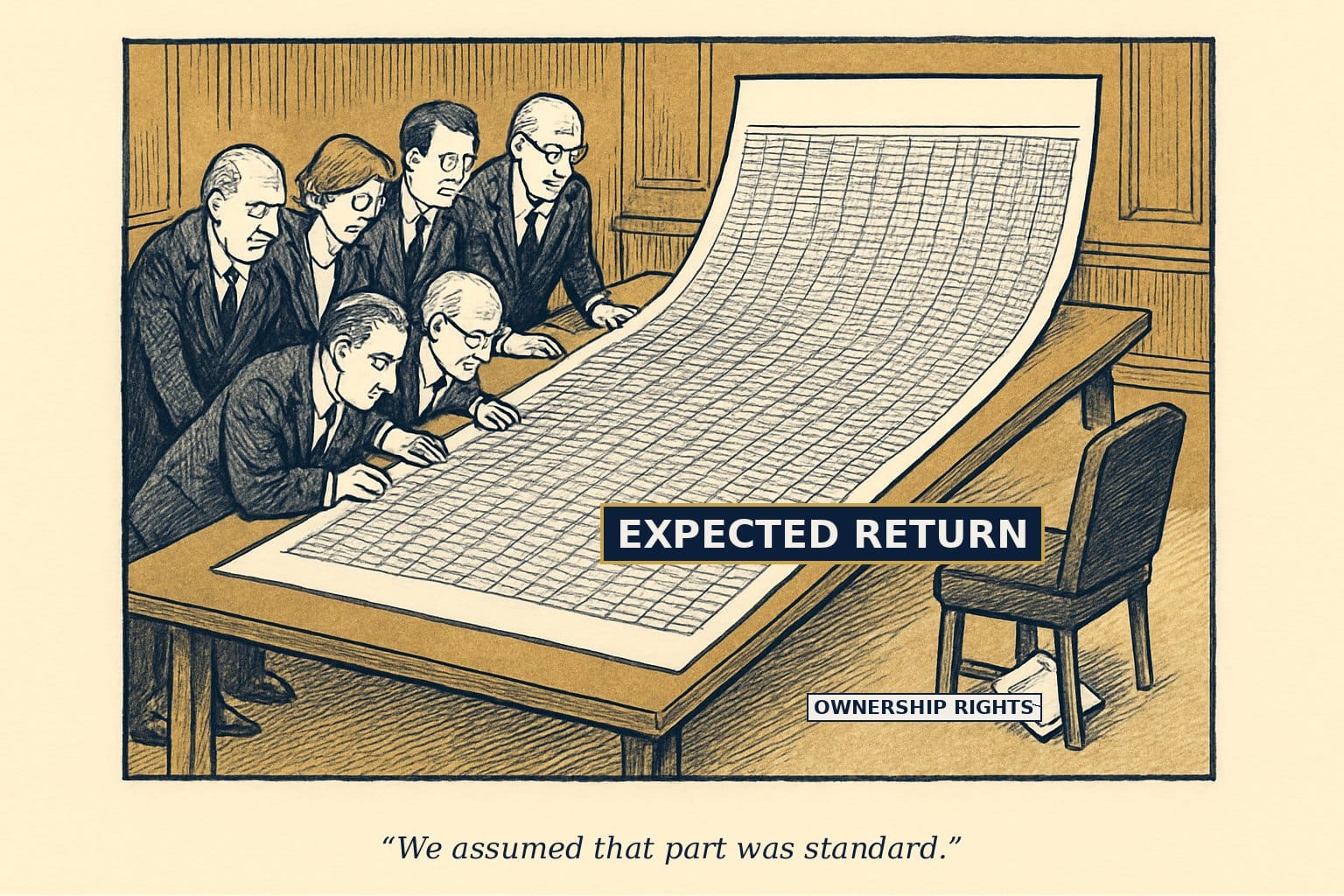
The rights are the risk. The tape kept buying.
Norges Bank Investment Management says shareholder rights are weakening in many markets. In the same window, universal-owner capital kept writing tickets into the assets those rights govern. Every ticket below carries its stage.
On 29 September the largest single owner of listed equity published a signed view that the rights attached to its shares are weakening, and named competition for listings as the cause. The passage that should land hardest is about index providers: their inclusion rules shape the governance features that index-tracking investors are exposed to. For a benchmark owner, the deterioration arrives inside the benchmark by default. [1]
In the same window, CPP Investments put INR 30 billion into Indian hotels. Five energy companies took a final investment decision to double LNG Canada. An Abu Dhabi Investment Authority subsidiary joined a US$2.34 billion grocery-anchored real-estate transaction as a strategic investor. New York Life agreed to buy a majority of a residential-credit manager. The European Investment Bank and BNP Paribas put up to €700 million of guarantees behind the companies that make grid components. [5], [6], [7], [8], [10]
None of that capital waited for the governance question to be settled. It rarely does. That is why the question belongs in the underwriting, not only in the stewardship report.
7,000+ listed companies in which Norges Bank Investment Management is a minority shareholder; it says the rights attached to them are weakening | INR 30 bn CPP Investments into Prestige Hospitality Ventures for about 27%; definitive, not closed | 14→28 mtpa LNG Canada Phase 2 final investment decision; approval, not funding; no operator cost figure | 5.59% US 30-year par yield, 29 September; the September high so far |
For each policy benchmark, what governance minimum does the index provider apply, and who at the fund engages the provider rather than the company?
Today in 90 seconds
- Governance: Norges Bank Investment Management says shareholder rights are weakening in many markets and that index providers’ inclusion rules shape what index-tracking investors are exposed to. It is a minority shareholder in more than 7,000 listed companies. [1]
- The US mechanism: The SEC has proposed rescinding Rule 14a-8, the rule that puts shareholder proposals on a company-funded proxy card. Comments close 20 November. The connection to the Norwegian warning is our synthesis, not either party’s. [2]
- Capital in motion: CPP Investments, INR 30 billion for about 27% of Prestige Hospitality Ventures. An ADIA subsidiary alongside Everview in the Slate Grocery REIT transaction. New York Life Investment Management, a majority stake in Invictus Capital Partners. [5], [6], [7]
- Energy and grids: LNG Canada Phase 2 reaches a final investment decision, 14 to 28 million tonnes a year. The EIB and BNP Paribas sign up to €700 million of guarantees for grid-component manufacturers. [8], [10]
- People: Susan Wagner joins Temasek’s board, and GIC’s two new deputy group chief investment officers take their seats, both on 1 October. [21], [22]
- Rates: The US 30-year par yield was 5.59% on 29 September, the September high so far. 30 September has not printed. [11]
The rights are the risk
Norges Bank Investment Management published Shareholder rights under pressure on 29 September, signed by Carine Smith Ihenacho, Chief Governance and Compliance Officer; Snorre Gjerde, Policy Lead; and Deena Elmeged, Senior Investment Stewardship Manager. [1]
The thesis, in its words: “We are concerned that shareholder rights are weakening in many markets, putting investor confidence and long-term value creation at risk.” The cause it names: “Across many markets, competition for listings has led to changes to the frameworks that protect minority shareholders.” And on dual-class shares: “An increasing number of jurisdictions permit structures with unequal voting rights. These can incentivise founders to list their companies, but over time voting rights should reflect economic stakes.” [1]
It sets out four pillars: access to timely, material and reliable information; a vote on fundamental decisions; equitable participation in economic benefits; and legal recourse. [1]
The paragraph that turns this from a stewardship matter into an index-construction exposure: “Index providers aim to represent investable markets, but their inclusion rules also shape the standards companies must meet, and the governance features that index-tracking investors are exposed to. Given the scale of index-tracking today, how providers set these rules, and the weight they give to governance standards in doing so, matters for investor protection at scale.” [1]
UAO analysis. An index owner’s options are costly rather than absent. Changing a benchmark carries tracking error, transition cost and approval requirements. If listing competition lowers protections and inclusion rules admit the result, the deterioration is imported into the benchmark automatically. That makes it an exposure, not an activity, and in most funds no mandate line item covers it.
Norges Bank Investment Management describes protection as “a shared responsibility for regulators, stock exchanges, index providers, companies and investors.” Its own stated actions are narrower: engaging companies and key market stakeholders, voting to its global guidelines and working with academics. The two lists should not be read as one. [1]
The question for the committee has a named addressee, and it is not the company. For each policy benchmark: what governance minimum does the index provider actually apply, and who at the fund engages the provider rather than the issuer? Most stewardship teams are resourced for the second and have never been asked the first.
The countercase: This is owner advocacy, not a regulatory finding. Dual-class structures can coincide with strong long-run returns, and index providers already publish consultation processes that owners can use.
Earlier coverage: 17 September: Norway and Abu Dhabi bought · 18 September: the vote and the ballot · Norges Bank Investment Management in the UAO Registry
People moves and open seats
Temasek’s board. Susan Wagner joins the Temasek board on 1 October. She co-founded BlackRock in 1988 and was its Vice-Chairman until 2012; earlier she was Chief Operating Officer and oversaw the 2009 merger with Barclays Global Investors. Temasek’s chairman: “Sue brings deep global investment expertise, capital markets and governance experience, together with a strong track record of building and scaling businesses across diverse markets and sectors.” [21]
Read next: Dilhan Pillay, the institution builder of Temasek · Temasek in the UAO Registry
GIC’s new deputy group CIOs. From 1 October, Choo Yong Cheen, currently CIO for Private Equity, becomes Deputy Group Chief Investment Officer overseeing private equity, real estate, infrastructure and the Integrated Strategies Group. Liew Tzu Mi becomes Deputy Group Chief Investment Officer overseeing total portfolio research and strategy; she steps down as CIO for Fixed Income & Multi Asset and keeps the Portfolio Execution & Solutions Group. Liang Jiajie, Deputy CIO for Fixed Income & Multi Asset and Head of Global Macro, becomes CIO for Fixed Income & Multi Asset. All three report to the Group CIO. GIC announced the changes on 10 July. [22]
Read next: Lim Chow Kiat, the quiet custodian of GIC · GIC in the UAO Registry
Open seats. France’s Fonds de réserve pour les retraites is appointing one or two transition managers for five years; bids close 4 November. [15] For individual roles at the sovereign funds, pensions and endowments we track, see Universal Owner Careers. Roles are listed only once confirmed at the employer’s own site; set an alert there to receive them in this brief. Considering a move? Why senior investment hires fail in the first year.
The US mechanism is already proposed for deletion
This section is our synthesis. The Norwegian paper does not mention the SEC, and the SEC release does not mention Norges Bank Investment Management. Both documents are real; the connection is ours.
The federal mechanism a US-listed shareholder uses to put a governance question on a company-funded proxy card is Rule 14a-8. On 16 September the Commission issued Release No. 34-106383, published in the Federal Register on 21 September, proposing “to rescind Rule 14a-8 under the Securities Exchange Act of 1934 … and leave determinations about the role of shareholder proposals to State law and company governing documents.” The regulatory text is one line: “Remove and reserve § 240.14a-8.” [2]
It travels with a Rule 14a-4 amendment widening company discretionary voting on omitted matters, offset by “a check box on company proxy cards that would provide shareholders an option to prohibit the company from exercising discretionary voting authority.” [2]
Comments close on 20 November. The rule remains in force; a proposal has no legal effect until a final rule takes effect, and nothing published so far settles what will govern the 2027 proxy season. We first covered the proposal on 17 September. What is new is that the largest owner of listed equity has now described, in its own name, the condition that would make its removal consequential.
What to do before 20 November. Build a bylaw watch-list for US holdings where a shareholder proposal was the only escalation path actually used in the last three seasons: advance-notice provisions, written-consent and special-meeting restrictions. If the answer is “most of them,” the comment file is portfolio maintenance, not advocacy.
The countercase: A proposal is not a rule. Rule 14a-8 may survive comment in modified form, and bylaws can reproduce inclusion rights by private ordering.
The rate the tickets are underwritten against
Stated once, because it was the 29 September edition’s material.
The Reserve Bank of Australia raised its cash-rate target 25 basis points to 4.60% on 29 September, naming AI-related demand for technology goods alongside a broadened Middle East conflict and higher assumed energy prices. The statement adds: “Today’s policy decision was unanimous,” and “The three increases in the cash rate target since the beginning of the year have tightened financial conditions and the economy appears to be slowing.” [3]
Federal Reserve Governor Lisa Cook, speaking on 28 September, described the same price pressure and argued the opposite about the response: “Attempting to fight sector-specific inflation with monetary policy could be a mistake. Our tools are too blunt to target narrow sectors, and addressing relative price shifts is not our role.” She expects productivity gains to “provide modest disinflation within the next few years.” Those are her views, not an FOMC forecast. [4]
Why it belongs here rather than in the lead. The two officials disagree about what to do, and the disagreement is unresolved. Every ticket in the next section was underwritten against a discount rate that depends on which view prevails.
The strongest case against a higher discount-rate assumption is Governor Cook’s own. If she is right, the capital cycle behind today’s tickets is disinflationary on a three-to-five-year view, and an owner that raises its discount-rate assumption now is selling duration near the bottom.
Earlier coverage: 29 September edition · 28 September: the long end
Five tickets, and the stage is the story
CPP Investments into Indian hotels. Stage: definitive, not closed. On 29 September CPP Investments announced “a INR 30 billion (C$441 million) investment in Prestige Hospitality Ventures Limited (PHVL), the hospitality platform of Prestige Estates Projects Limited,” acquiring an “approximately 27% stake in PHVL, with the majority of the capital supporting the platform’s continued expansion.” CPP calls it its “first direct investment in India’s hospitality sector.” Prestige’s binding framework agreement with CPP dates to 10 August; 29 September is the definitive documentation. [5]
Hari Krishna, Head of Real Estate India, CPP Investments: “We see compelling opportunities in India’s hospitality sector, driven by rising travel and a demand for quality accommodation.” [5]
An ADIA subsidiary in a grocery-anchored take-private. Stage: definitive; closing expected in the first quarter of 2027. Brixmor Property Group and Everview Partners agreed to acquire Slate Grocery REIT in what Brixmor calls “a transaction valued at $2.34 billion.” Slate prices it at US$13.00 per unit in cash, “representing a total enterprise value of approximately US$2.3 billion.” Brixmor takes 23 centres for $636 million; a joint venture takes the remaining 92 assets for $1.71 billion, 20% Brixmor and 80% Everview, with Brixmor adding about $174 million of 9% preferred equity. And: “a wholly owned subsidiary of the Abu Dhabi Investment Authority (ADIA) will act as a strategic investor alongside Everview in the transaction.” No ADIA amount is disclosed. Closing needs at least two-thirds of votes cast and a majority excluding the manager and its affiliates. [6]
New York Life buys the manager, not the loans. Stage: signed; closing targeted for the first quarter of 2027. New York Life Investment Management agreed to acquire a majority stake in Invictus Capital Partners, “a leading U.S. single-family residential credit investment manager with more than $20 billion in gross assets under management,” which operates Verus Mortgage Capital. Price not disclosed. Invictus leadership retains “a significant ownership stake.” The $20 billion is assets under management, not the purchase price. [7]
LNG Canada Phase 2. Stage: approval, not funding. Shell, PETRONAS, PetroChina, Mitsubishi Corporation and KOGAS took a final investment decision on 28 September, doubling capacity from 14 to 28 million tonnes a year. The release gives two workforce figures: “up to 4,000 new construction jobs in Kitimat, alongside approximately 2,100 jobs required to build new compressor stations along the CGL pipeline.” MNT Investments LP, owned by the economic development organizations of five neighbouring First Nations, holds an option for “an investment of up to $1 billion (CAD)” in the entity that will buy a future LNG storage tank. The release gives no project cost and no start date. An option is not equity until exercised. [8]
The EIB guarantees the supply chain, not the project. Stage: signed. On 29 September the EIB and BNP Paribas signed a programme of up to €350 million from the EIB, matched by BNP Paribas, “supporting a portfolio of bank guarantees of up to €700 million” for European manufacturers of electricity-grid components. The release says the leverage “is expected to stimulate up to €2.8 billion in investment in the real economy.” That is an expectation, not a cheque, and no beneficiary manufacturer is named. [10]
Earlier coverage: 16 September: Canada’s delivery ledger · Registry profiles: CPP Investments · Abu Dhabi Investment Authority
What the stage label actually means
| Institution | Counterparty | Amount | Stage | Date |
|---|---|---|---|---|
| CPP Investments | Prestige Hospitality Ventures | INR 30bn / C$441m for ~27% | Definitive, not closed | 29 Sept (framework 10 Aug) [5] |
| Brixmor, Everview, ADIA subsidiary | Slate Grocery REIT | $2.34bn transaction value; ADIA share undisclosed | Definitive; close Q1 2027 | Agreed 27 Sept, announced 28 Sept [6] |
| New York Life Investment Management | Invictus Capital Partners | Majority of the manager; price undisclosed | Signed; close Q1 2027 | 28 Sept [7] |
| Shell, PETRONAS, PetroChina, Mitsubishi, KOGAS | LNG Canada Phase 2 | No cost figure published | Final investment decision | 28 Sept [8] |
| MNT Investments LP (five First Nations) | LNG Canada storage-tank entity | Up to C$1bn | Option | 28 Sept [8] |
| Clara-Pensions | Arco Group pension scheme | About £135m, 1,281 members (reported) | Agreed, not completed | 29 Sept [9] |
| EIB and BNP Paribas | Grid-component manufacturers | Up to €700m of guarantees | Signed | 29 Sept [10] |
| Temasek | FSI SGR (the manager) | 9%; consideration undisclosed | Closed | 28 Sept; covered 29 Sept [20] |
How to read the stage column. A final investment decision is an approval, not a funding date. An option is not equity. A guarantee ceiling is not a commitment. A signed agreement to buy a manager is not a purchase of the assets it manages. A board paper that reads “announced this morning” as “committed this morning” double-counts.
Clara and Arco. The transfer of the Arco Group Pension and Life Assurance Scheme to Clara-Pensions is structured inside the sale of the sponsor, Arco Limited. It is reported as Clara’s seventh transaction; what is new is the setting, a scheme leaving through an M&A process rather than a funding one. Richard Wellard of Hymans Robertson: “The superfund market is demonstrating an increasing ability to deliver solutions in a wide range of situations. In this case, to support an M&A transaction.” The amount and member count are as reported by trade press. [9]
Disclosure lag is a feature, not a glitch. Public-plan commitments often surface in board reports covering periods that ended months earlier. Two US public-plan commitments circulating in trade reports this week are not on this tape because we could not match them to a board document. A peer-pacing model built on trade-press dates will place last quarter’s decisions in this quarter.
Mandates. France’s Fonds de réserve pour les retraites has retendered transition management: one lot for one or two providers at most, a five-year term, bids closing 4 November at 12:00 Paris time. Transition management is implementation capacity, but it is the contract that decides what a manager-roster change costs. [15] The FRR in the UAO Registry
Physical capacity, not compute
UAO analysis. Read the rate debate as a debate about supply: whether the physical inputs the build-out needs arrive fast enough to turn a price shock into a productivity dividend. That makes the scarce thing, and therefore the pricing power, physical.
A model does not produce a grid connection, a transformer, a gas turbine, transmission rights, water allocation, a substation queue position, a commissioning crew, or a creditworthy counterparty for a twenty-year power contract. An owner that underwrites data centres as a digital theme may be underwriting the wrong risk.
Where bargaining power accrues
- Owners of generation, transmission, cooling and land with an existing interconnection position. Queue position is becoming the asset; the building is the commodity.
- Holders of contracted, creditworthy demand: offtake that survives diligence, not a letter of intent.
- Equipment supply with delivery certainty. That is exactly what the EIB programme targets: the manufacturers’ ability to post bonds and take orders, not the projects. [10]
Where the capital stack gets more expensive
- Developers relying on uncontracted power or optimistic commissioning dates.
- Projects whose returns assume grid-access timing that no contract secures.
- Private-credit lenders whose models capture compute demand but not the cost and timing of interconnection.
The double count to look for. The same electricity can appear twice in a portfolio: as upside in the infrastructure sleeve, and as an unmodelled operating cost in the industrial, real-estate and utility holdings competing for it. Governor Cook’s observation that “electricity and water costs are each up around 5 percent over the past year” is a first number on that second exposure. [4]
The timing of the offset. A BIS Bulletin published on 24 September, Old workers, young machines, by Iñaki Aldasoro, Sebastian Doerr and Daniel Rees, finds that “AI and robots substitute most readily for jobs in industries with younger workforces (eg finance), while older, high-employment industries (eg agriculture, health) have less scope for automation.” The authors caution that exposure “captures technical feasibility … not whether they substitute for workers or augment them.” Read with the rate debate, it is a reason to stress when the productivity offset arrives, not to bet against it. The views are the authors’. [14]
One rate move, four balance sheets
The long end. US Treasury par yields for 29 September: 10-year 5.26%, 20-year 5.64%, 30-year 5.59%. The 30-year print is the highest in the September table so far; the month’s low was 5.24% on 4 September. 30 September has not printed, so this is not a month-end close. [11]
Pension plan, market-linked discounting. A higher long yield lowers the present value of liabilities and lowers the long bonds held against them. The reported funding ratio improves while asset returns fall. Where a hedge sits between the two, collateral calls can arrive before the accounting benefit. The first problem in that sequence is liquidity, not solvency.
Corporate plan on an accounting discount rate. The same improvement appears in the sponsor’s accounts, which can change contribution policy and accelerate a buy-out or superfund decision.
Insurer. Higher reinvestment yields improve future income, but asset valuations, capital treatment, policyholder behaviour and private-borrower credit quality all need separate assessment. A rate move that flatters a pension can tighten an insurer’s capital position in the same quarter.
Sovereign fund or endowment. No fixed liability stream, but the exposure is still material: the fund may own the beneficiaries of the build-out, finance its infrastructure through private credit, hold utilities facing heavy capital spending, and own companies whose power costs are rising. Four positions on one variable, often underwritten by four teams.
Canada makes a backstop usable before anyone needs it. On 29 September the Bank of Canada and OSFI issued a joint statement that “Overnight SLF advances are non-discretionary in Lynx and are a normal part of a participant’s daily payment system activity, not a sign of liquidity stress.” The supervisor and the central bank saying it on the same day is the event. No amount or usage figure was published. The value of a backstop is what it does to a bank counterparty’s behaviour in the week before stress. [12]
The oil reserve is being tested for a market. On 29 September the US Department of Energy opened a solicitation to lend up to 40 million barrels of crude from the Big Hill and Bryan Mound sites. It is an exchange, not a sale: “Participating companies will return the 40 million borrowed barrels with additional premium barrels.” Bids close at 11:00 a.m. Central Time on 6 October. Forty million barrels is offered capacity; take-up is the number that matters. [13]
Three questions for the investment committee 1. A stress test, not a forecast: on a +50 basis-point discount-rate path driven by input costs rather than growth, where do asset values, liability values, collateral calls and portfolio-company operating costs move in opposite directions, and in what order? 2. Which of our infrastructure underwriting cases assume timely power, transmission, water, construction labour or equipment without binding contractual evidence? 3. If Rule 14a-8 is rescinded, which specific US holdings lose the only escalation path we have used in the last three seasons, and what replaces it?
Treasury par yields: September 2026 to date

Podcast · The Universal Owner
| Apple Podcasts | Spotify | Podbean |
Next triggers
- 5 October: US Supreme Court oral argument, Suncor Energy v. County Commissioners of Boulder County. [16]
- 6 October, 11:00 a.m. Central: Bids close on the US Department of Energy’s 40-million-barrel crude exchange. Take-up is the test. [13]
- 23 October: EFRAG’s survey on the draft list of datapoints for the revised ESRS closes. [17]
- 4 November, 12:00 Paris: France’s reserve fund closes bids for transition management. [15]
- 10 November: The revised ESRS, Commission Delegated Regulation (EU) 2026/1563, enters into force, applying to financial years beginning on or after 1 January 2027. [18]
- 11 November: EFRAG’s consultation on the draft ESRS XBRL taxonomy closes. [19]
- 20 November: SEC comments close on the proposal to rescind Rule 14a-8 and amend Rule 14a-4. [2]
The question for the top of a board paper: Who governs the assets our capital bought this week, and which of our rights still let us ask?
For ongoing research and briefings for your investment team, explore UAO membership. To receive the Daily Brief, subscribe at Universal Asset Owners.
The Back Page — meet The Allocator
Sources & citations
More from Universal Asset Owners
- The previous edition (2026-09-29)
- Every daily brief, newest first
- Chart of the Day archive
- The Probability Desk — scenario trees and base rates
- Watch — the daily briefings and The Back Page
- The Registry — Top 100 asset owners and their people
- Universal Owner Careers — open seats at the funds we track