
98% of the world’s sovereign wealth funds |
18 of 20 of the world’s largest pension funds |
10 of 10 of the largest charitable foundations |
85% of the world’s largest family offices |
100+ billionaires, every morning |
The money is going round in a circle, and someone has measured it
The Bank for International Settlements has put a number on how much of the money going into AI firms comes from other AI firms: 55.2% of the investment value between 2021 and 2025, concentrated in the largest deals. On the same day the Reserve Bank of Australia named the vehicles, put hyperscalers’ obligations to them at an estimated US$1 to 1.5 trillion, and flagged debt of 20 to 30 years financing chips and cooling systems with uncertain economic lives.
For an owner who holds a slice of everything, the exposure arrives through four doors at once: listed equity in the chipmakers, private credit buying the lease paper, infrastructure funds holding the vehicles, and the power assets built to serve the load. No single manager report shows all four.
The Reserve Bank also supplies the countercase: in aggregate, it says, leverage is contained and balance sheets remain healthy at present. Today’s question is not whether to sell anything. It is whether you can see the whole trade.
55.2% of the investment value flowing into AI firms, 2021–2025, came from other AI firms (BIS Bulletin 137) | 46.4% of AI-to-AI deal value also carried a supply-chain relationship, against 16.1% by count | US$1–1.5tn estimated hyperscaler obligations to off-balance-sheet AI projects (RBA, October 2026) | 20–30 yrs maturities of some hyperscaler debt financing chips and cooling with “uncertain economic lives” (RBA) |
Can we produce, from the manager reporting we already receive, one number for our exposure to AI compute hardware across listed equity, private credit, infrastructure and power — and if not, which manager would have to change their reporting for us to get it?
Today in 90 seconds
- The Bank for International Settlements published the first measured account of circularity in AI finance. Between 2021 and 2025, 55.2% of the investment value flowing into AI firms came from other AI firms. Of all AI-to-AI deals in that window, 16.1% by count — but 46.4% by value — also carried a commercial supply-chain relationship between investor and target.
- The Reserve Bank of Australia, publishing its Financial Stability Review the same day, named the mechanism — off-balance-sheet special purpose vehicles and vendor financing — and put a size on it: hyperscalers’ obligations to these projects are “becoming significant, with estimates ranging from US$1 to 1.5 trillion”.
- The RBA also named the mismatch: hyperscalers have issued debt with maturities of 20–30 years that can finance “hardware with uncertain economic lives, such as chips and cooling systems”.
- Reuters, citing Anthropic’s IPO filing, reports Broadcom has agreed to lend Anthropic up to $42bn against a $125.2bn five-year commitment to tensor processing units, chips Broadcom co-develops with Google. Separately, Amazon is reported to be in talks to move about $8bn of Nvidia processors into a vehicle and lease them back, offering outside investors up to 10% of the equity.
- Nvidia has said some deals under its $500bn financing initiative could carry no more than a 25% residual-value guarantee. On the record, Impax describes banks depreciating the same hardware over three to four years; S&P’s Andrew Chang told Reuters that evidence so far supports the chips working beyond five years.
- The long end repriced and then stepped back. The US 10-year closed at 5.24% on 1 October, down five basis points from 5.29% on 30 September. The cycle high was 30 September.
- The Office for National Statistics recorded UK private-sector defined-benefit scheme assets falling £46bn to £1,091bn in the six months to 31 March 2026, while private defined contribution and public-sector schemes together rose £50bn to £1,051bn. The two books are now within £40bn of each other.
- Norges Bank Investment Management reorganised its Governance and Compliance area and moved active ownership inside active management, effective January. Two days earlier, on 29 September, it had warned publicly that shareholder rights are weakening in many markets.
- Ten senior seats are open with dated deadlines, including two chief-investment-officer roles closing inside a fortnight. The full board is on the site →
The money is going round in a circle, and someone has measured it
The argument about circular financing in artificial intelligence has been conducted, for about a year, in anecdotes. One firm invests in another, which buys the first firm’s chips; a third guarantees a lease on hardware it also manufactures. Each instance was arguable. The aggregate was not measured.
On 1 October the Bank for International Settlements measured it. Bulletin No 137, Circular relationships among AI firms, by Frost, Kansal, Rishabh, Shreeti and Zhang, matches deal data for 1,246 AI firms across five layers of the supply chain — compute, infrastructure, data tools, models and applications — against commercial-relationship data. Two findings carry the paper.
The first is the direction of the money. Between 2021 and 2025, 28.7% of the deal value invested by AI firms went to targets that were themselves AI firms. Read from the other side, 55.2% of the investment value flowing into AI firms came from other AI firms. That asymmetry is the structure: the sector is a larger share of its own funding base than it is of its own investment destinations.
One thing the bulletin does not publish, and a board will ask for it: an absolute dollar figure. Bulletin 137 reports shares of deal value within its own matched universe of 1,246 firms, not a total. So 55.2% is a share of the investment value flowing into that sampled population — a large and well-defined set, but not “all AI funding”, and it cannot be turned into an exposure in dollars from the paper alone.
The second finding is the overlap with trade. Of all AI-to-AI investment deals in the window, 16.1% by deal count also involved a commercial supply-chain relationship between investor and target — but 46.4% by deal value did. The difference between those two numbers is the finding. Circularity in this sector is not a widespread habit among small transactions; it is concentrated in the largest ones.
A footnote supplies the context, and it needs reading carefully. Citing Fee, Hadlock and Thomas (2006), the BIS notes that direct equity stakes in trading partners accounted for only 3.3% of more than 10,000 US customer–supplier relationships. In certain AI submarkets — compute, cloud and related infrastructure — it finds that 15.2% of customer–supplier relationships also involved a financing relationship, which in this paper means equity or debt. Those are different measures across different samples, and the BIS sets them side by side only to illustrate that financing your trading partners is unusual. It draws no multiple between them, and neither should anyone else.
The BIS states the consequence in one line: “these circular arrangements tend to be opaque, making monitoring and supervision difficult.”
The same day, a central bank named the vehicle. The Reserve Bank of Australia released its October 2026 Financial Stability Review on 1 October. In a box titled Funding the AI investment boom, it writes that “off-balance sheet financing through special purpose vehicles is becoming an increasingly common way to fund large AI infrastructure projects, which could create hidden exposures and opaque interlinkages”, and that “some companies are engaging in vendor financing arrangements where large AI technology firms facilitate funding opportunities for their customers”. Then it puts a size on it. These arrangements “predominately reside outside of hyperscalers’ balance sheets at present, however their financial obligations to these projects are becoming significant, with estimates ranging from US$1 to 1.5 trillion” — a range the RBA draws from Moody’s, Goldman Sachs and BIS research.
And it names the mismatch that matters most to a liability-driven reader. Hyperscalers, the RBA writes, “have issued debt with longer maturities, including 20–30 years, to finance their AI projects. However, this can finance capital expenditure on hardware with uncertain economic lives, such as chips and cooling systems, which may become obsolete as technologies advance rapidly, and substantially depreciate the value of the collateral before the debt matures.”
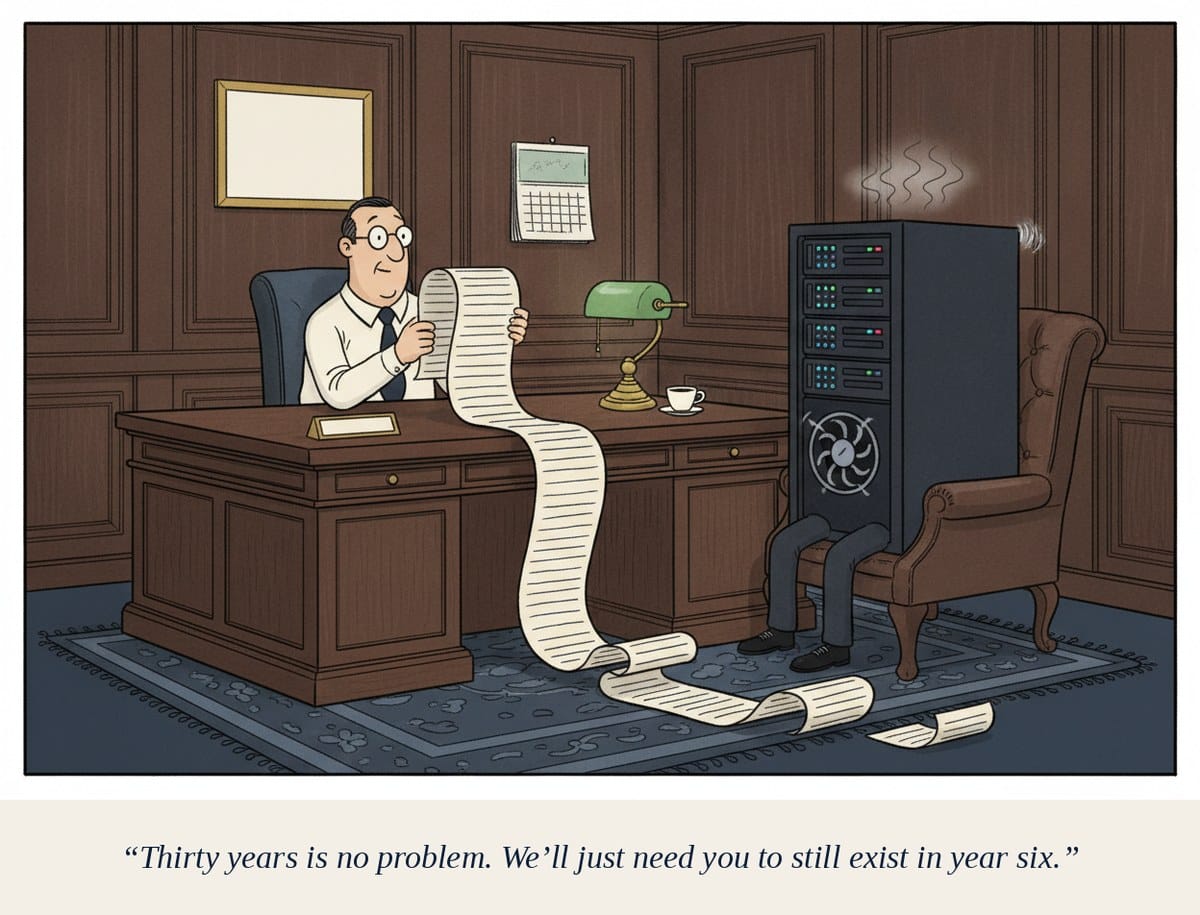
That is a duration mismatch: thirty-year paper against an asset that may not see five. Its conclusion is conditional and should be read that way: “if returns fall short of expectations, several features of the AI investment boom could potentially lead to losses among lenders and investors.”
The countercase is in the same box. The RBA also says that, in aggregate, “leverage is contained and balance sheets generally remain healthy at present”, and that large AI-related firms such as hyperscalers are generally viewed as lower risk because they have alternative revenue streams. A strong customer with diversified income can matter more to repayment than the resale value of the chips. The warning is about opacity and maturity, not about solvency today.
And within 24 hours, two transactions of those two shapes were reported — one agreed, one in talks. Reuters reports that Broadcom has agreed to lend Anthropic up to $42bn, in a convertible note, financing roughly a third of the $125.2bn Anthropic has committed for a five-year lease of Broadcom’s tensor processing units. Anthropic is expected to become Broadcom’s largest compute customer in 2027. That is vendor financing in the RBA’s sense: a chip designer lending to a customer so it can lease the chips it helps build. Two qualifications matter. The notes are a ceiling, not a drawdown, and Anthropic’s filing says none are expected to be sold before its listing. And this edition has not inspected the filing itself: every term here is Reuters’ account of it.
Separately, Amazon is reported — by the Financial Times, relayed by Reuters on 2 October — to be in talks to place about $8bn of Nvidia Grace Blackwell processors into a special purpose vehicle, lease them back, and offer outside investors up to 10% of its equity, with the hardware sited in more than a dozen US data centres across five states including Nevada and Virginia. That is the RBA’s first shape. Neither Amazon nor Nvidia commented. Nothing is signed.
Where the collateral argument actually stands. Nvidia announced a $500bn financing initiative in August with Blackstone, Apollo and KKR, structured around chip-backed lending, and said at the time it was designed to address concerns about circular financing. Nvidia has said some of those deals could carry no more than a 25% residual-value guarantee. Reuters reports that bankers and asset managers want more — but those are unnamed sources, and the 25% is Nvidia’s own stated ceiling for some transactions, not a term a lender has rejected in a named deal.
The on-record testimony is narrower and more useful. Tony Trzcinka of Impax describes banks running depreciation schedules of three to four years on the hardware. Andrew Chang of S&P Global Ratings told Reuters the agency takes a conservative view of the chips’ value, while the evidence so far supports them working beyond five years. Loren Moran of Wellington Management and Brian Gelfand of TCW are also on the record. The distance between a four-year depreciation schedule and Nvidia’s view, reported by Reuters, that some equipment can earn revenue for up to a decade is the whole credit question, and it is not yet settled by evidence on either side — the fleet is not old enough.
What this is, for an owner. A universal owner cannot diversify away from this. The exposure arrives through at least four doors simultaneously: index equity in the chip and hyperscale names; private credit and infrastructure funds buying the lease paper; the power and grid assets being built to serve the load; and, increasingly, the vehicles themselves, sold as core-plus digital infrastructure. The BIS finding does not say the buildout will fail. It says the arrangement’s visibility is poor and that it is concentrated in the largest deals — and poor visibility is a look-through problem, which is the one problem a diversified owner is structurally worst at solving. The RBA adds the second half: whoever holds the long debt is holding the duration mismatch.
Three honest limits on the paper, stated because a board will ask. The 2025 data are, in the BIS’s own words, “provisional and incomplete”, so the terminal year of the window is the weakest. The deal values do not show how a transaction was allocated across multiple investors, so the value-weighted share overstates any single investor’s circular exposure. And the definition of an “AI firm” is inherited from a separate 2026 classification paper; the 55.2% is only as good as that boundary.
The two central-bank documents, and every source behind this section →
The decisions that matter
1 · A central bank quantified circular AI financing, and another named its vehicle. What changed: BIS Bulletin 137 measured AI-to-AI investment at 55.2% of incoming value, 2021–2025, with supply-chain overlap at 46.4% by value against 16.1% by count. The RBA’s October Financial Stability Review named special purpose vehicles and vendor financing, sized hyperscalers’ obligations to them at an estimated US$1–1.5 trillion, and flagged 20–30-year debt financing hardware of uncertain economic life. Why it matters: the exposure reaches a diversified book through index equity, private credit, infrastructure and power simultaneously, and the BIS’s stated problem is visibility. What decision it could affect: whether look-through reporting on digital-infrastructure and private-credit sleeves is specified tightly enough to identify vendor-financed and SPV-held hardware as one exposure rather than four unrelated ones.
2 · The long end stepped back, and the front end did not follow it up. What changed: on the US Treasury’s own par yield curve the 10-year closed at 5.24% on 1 October, down from 5.29% on 30 September; the 30-year at 5.61% from 5.64%; the 2-year at 4.78% from 4.88%. 2s10s widened to 46 basis points from 41. Why it matters: the three tenors are in different decades. The 2-year at 4.78% was last there in June 2024; the 10-year at 5.24% in June 2007; the 30-year at 5.61% in December 2001. The move is largest, in historical terms, at the very long end, which is precisely where liability duration sits. One day’s change does not say how much came from policy expectations and how much from the compensation investors demand for holding longer bonds. What decision it could affect: whether a hedging programme calibrated to policy expectations is calibrated to the thing that is actually moving.
3 · The UK’s two pension books are converging, and the private DB book is shrinking. What changed: the ONS bulletin of 1 October records private-sector DB and hybrid market value falling from £1,137bn to £1,091bn — down 4% — between 30 September 2025 and 31 March 2026, while private DC and public-sector DB and hybrid together rose from £1,001bn to £1,051bn, up 5%. Private DB holdings of insurance policies fell from a peak of £190bn to £178bn. Why it matters: the two books are now within £40bn. A £46bn fall in DB asset value over a period in which long yields ended modestly higher is consistent with liabilities falling faster — it is not, on its own, evidence of a funding deterioration, and should not be reported as one. What decision it could affect: buy-out pacing, and the assumption that the insurance route absorbs the run-off at a predictable rate. The insurance line is now £12bn off its peak.
4 · Norges Bank Investment Management moved stewardship inside its investment function. What changed: effective 1 January 2027, active ownership — including voting and sustainability — moves inside Active Strategies under Caroline Eriksen, reporting to co-chief Daniel Balthasar. Under what NBIM calls a wider reorganisation of the Governance and Compliance area, its components go to Active Strategies, Communications and External Relations, the Chief Risk Officer and the Deputy Chief Executive. Carine Smith Ihenacho leaves at the end of 2026 after nine years; her departure was announced separately on 1 September, and the 1 October release names no successor to that title. NBIM’s stated rationale is “shorter decision-making lines”. Why it matters: the largest single owner of listed equity has removed stewardship from its executive table. Two days earlier, on 29 September, it published a view titled Shareholder rights under pressure, warning that shareholder rights are weakening in many markets, “putting investor confidence and long-term value creation at risk”. What decision it could affect: for co-filers and engagement coalitions, who to approach and at what level from January.
5 · A $2.6 trillion manager was created, and two voting policies have to become one. What changed: Nuveen completed its acquisition of Schroders on 1 October — $2.6tn of assets under management as at 30 June 2026, a $400bn private-markets platform, Schroders operating separately for 12 to 18 months with Richard Oldfield reporting to Nuveen chief executive William Huffman. Saira Malik is CIO of the combined firm; Johanna Kyrklund is CIO for public markets and solutions. The £9.9bn figure is the equity value of Schroders’ entire issued and to-be-issued share capital on a fully diluted basis, at 590p a share in cash plus up to 22p of permitted dividends. A “$13.5bn” figure is that same number in dollars. Why it matters: manager concentration rises in a market already short of genuinely independent mandates; fee leverage shifts in private markets specifically; and two stewardship and voting policies now have to converge across $2.6tn, so an owner holding mandates on both sides inherits a 2027 voting record it did not select. What decision it could affect: whether a manager-concentration limit expressed in dollars is still the right constraint when the binding scarcity is independent voting policies — and whether the 12-to-18-month separation window is the moment to ask for the combined voting policy in writing.
6 · A €26bn Dutch fiduciary book changed hands, and a wealth fund went into wind-up. What changed: Aegon Asset Management will transfer its €26bn Dutch fiduciary business to Van Lanschot Kempen, effective Q3 2027 and phased through mid-2028, with around thirty staff moving; Pensioenfonds KPN and APF Stap, together €21bn at 30 June 2026, responded positively. Separately, St. James’s Place suspended its KKR-managed Diversified Assets Fund and applied to the FCA to wind it up, with KKR waiving management fees for the remainder of the fund’s life. Why it matters: a fiduciary transfer carries LDI, governance and voting with it, and client consent is outstanding. A suspension-and-wind-up is a withdrawal, and withdrawals deserve the same prominence as wins.
Stewardship moved inside the investment function
One of the world’s largest shareholders moved stewardship inside the investment function — two days after warning that shareholder rights are weakening. NBIM frames this as a redesign and its stated reasons are coordination and speed. The verifiable change is narrower and harder: a chief-officer-level governance function has been spread across four reporting lines, and the release names no successor to its chief. Whether that is a downgrade or an upgrade is an argument. A fund can reasonably judge that ownership work has more leverage next to portfolio managers than next to compliance — that is NBIM’s own case, in NBIM’s own words. NBIM says its responsible-investment ambition is unchanged; its 2027 voting record will be the test.
The FCA moved listed-company climate disclosure onto UK standards, and dropped its proposal to make them mandatory. Policy Statement PS26/19, published 30 September, applies a comply-or-explain approach across the UK Sustainability Reporting Standards framework, replacing the TCFD-aligned rules with a requirement to report against UK SRS S2, including Scope 3, on that basis. Accounting periods begin 1 January 2027, first reports in 2028; one year of transitional relief for Scope 3 and two for the wider UK SRS S1 disclosures. The consultation record is strong: over 90% of respondents who answered the relevant question supported replacing the TCFD-aligned rules with UK SRS, and 94 of 110 supported the proposed scope.
One correction to the way this has been reported. The FCA never proposed mandatory IFRS S2. Its consultation proposed mandatory UK SRS S2 — the UK-endorsed version. What was dropped is the mandatory basis, not the standard.
For an owner underwriting climate risk inside a strategic asset allocation, the operative consequence is that the “explain” population becomes the dataset. The issuers that choose to explain rather than comply are, by construction, where the modelling gap will sit. That population is knowable from 2028 and worth pre-building a watchlist for now.
Nest moved its entire emerging-market equity book from index to concentrated active. Nest — styled by the scheme itself as Nest, not NEST — announced on 1 October that it has appointed Wellington Management to run its emerging-market equity strategy, moving the £3.5bn allocation from a portfolio of more than a thousand holdings to a fundamental one of 100 to 150. Rachel Farrell, Director of Public and Private Markets at Nest Invest, frames the rationale as control: the change “gives us greater control over how mandates are implemented and greater confidence in managing governance, sustainability, climate and market-specific risks”.
That framing is the story. More than 80% of Nest’s assets are held in segregated accounts — on the scheme’s own account, one of the most extensive segregated-mandate programmes in the UK defined contribution market. Segregation is what makes implementation and voting controllable at scale in a DC book, and the emerging-market reallocation is one instance of it rather than the point.
Sixty-two investors asked the FTSE 100 for a vote on transition plans; four companies offered one last season. A letter led by the Local Authority Pension Fund Forum and CCLA, signed by 62 investors representing around £3.8 trillion, asks FTSE 100 chairs to put their transition plans to an advisory shareholder vote at least once every three years. During the 2026 annual meeting season, four FTSE 100 companies did so. No primary release from either organisation could be located, so these figures are carried on trade-press authority and attributed accordingly.
The mechanism worth noting is that a vote is the governance instrument that survives comply-or-explain. If disclosure becomes elective at the issuer’s discretion, the shareholder resolution is what remains non-elective.
Vanguard’s proxy-choice programme grew more than sixfold, and the age split is the finding. Vanguard reported on 29 September that participation in Investor Choice rose from 82,000 investors in 2025 to 507,000 in 2026, with participating assets rising from $9bn to $151bn. Around eighty retirement plan sponsors are enrolled, representing more than a million underlying participants. No single voting policy accounts for more than 38% of selections, and the leader at that level is the company board-aligned policy.
The cohort split is separate and is the finding: investors under 30 selected the Glass Lewis ESG policy at more than twice the rate of investors aged 62 to 80 — 38% against 16%. Investor Choice is currently available across approximately $4 trillion of assets; the 2027 extension to all US equity index funds takes the eligible pool to around $8 trillion. A preference distribution that is dispersed today becomes the default-voting profile of a DC book as cohorts age. It is not, and this edition does not present it as, evidence for changing a default now.
Caisse des Dépôts will stop new debt financing to oil producers from January 2027, a restriction its coverage says will apply to companies including TotalEnergies. This is an exclusion applied at the instrument level by a state financial institution rather than a pledge, which is the version of this story that has a mechanism. Reported by IPE; no primary release located.
The long end is in a different decade
The long end gave five basis points back, and the shape of the move is the information. On the US Treasury’s own par yield curve, 1 October closed at 4.78% on the 2-year, 5.24% on the 10-year and 5.61% on the 30-year, against 4.88%, 5.29% and 5.64% on 30 September. Every tenor fell. The 10- and 30-year had peaked on 30 September; the 2-year on 28 September, at 4.92%.
The comparison dates show where the asymmetry actually is, and it is narrower than the headline suggests. The 2-year at 4.78% was last at that level on 11 June 2024 — well within the last cycle. The 10-year at 5.24% was last there on 12 June 2007. The 30-year is further back still: at 5.61% it reaches back to 17 December 2001, and the 30 September close of 5.64% to 13 July 2001 — with an important caveat. Treasury suspended the 30-year bond between 19 February 2002 and 8 February 2006, so that series carries a four-year hole and the comparison is gapped rather than continuous.
The repricing is therefore concentrated at the very long end, which is where liability duration sits, and the curve shape says the same thing: 2s10s widened to 46 basis points from 41. For a liability book, that distinction decides which instrument hedges it.
See the full curve, 2000–2026, with the suspension gap drawn →
Canada’s defined-benefit funded ratio rose because the discount rate rose, and the sign matters. Aon reported on 1 October that the aggregate funded ratio of DB plans sponsored by S&P/TSX Composite companies reached 123.3% at 30 September 2026, from 117.6% a quarter earlier, with the discount rate up 58 basis points to 5.22%. Aon’s own words: “higher discount rates reduced the value of pension liabilities.”
State the direction explicitly, because it is routinely inverted. A lower yield raises the present value of liabilities and lowers a funded ratio. A higher yield lowers liabilities and raises it. The arithmetic here only works one way round: plan assets returned minus 1.5% in the quarter, and the funded ratio still rose 5.7 percentage points. Liabilities fell faster than assets.
The UK’s private DB book shrank by £46bn and its two pension systems nearly converged. The ONS bulletin Funded occupational pension schemes in the UK: October 2025 to March 2026, published 1 October, records private-sector DB and hybrid market value down from £1,137bn to £1,091bn over the six months to 31 March 2026; private DC together with public-sector DB and hybrid up from £1,001bn to £1,051bn. Private DB holdings of insurance policies fell from their peak of £190bn to £178bn.
Read this with the Aon sign rule in hand. Over a period in which long yields ended modestly higher, a fall in DB asset values is what a hedged book looks like when liabilities are falling faster. It is not a funding deterioration and must not be reported as one. The convergence is the durable fact: two books within £40bn of each other, one running off and one accumulating, with different governance, different liquidity needs and — after the FCA’s comply-or-explain decision — different disclosure regimes to underwrite.
France set out a 2027 financing programme of €340bn, and the interest line has two different numbers. The Council of Ministers minute of 1 October sets the 2027 general-government deficit target at 5.0% of GDP against a revised 5.4% for 2026, with public debt reaching 119.3% of GDP in 2026, growth assumptions of 0.5% and 1.0%, €43bn of new consolidation measures within a total effort of €54bn, and full revaluation of small pensions up to €1,260 a month.
Agence France Trésor puts the 2027 State financing requirement at €339.7bn against €311.7bn revised for 2026 — up €28.0bn — with medium- and long-term issuance net of buybacks at €340.0bn, State debt service at €72.9bn against €62.6bn revised, and €8.0bn of expected issuance discounts. The 2026 programme was 85% complete at end-September, covered 2.5 times on medium and long-term issuance and 3.5 times on bills. The 2026 weighted average yield is 3.55%, against 3.14% in 2025.
Those two documents contain two different interest numbers and they are not interchangeable. The Élysée minute’s figure — rising from €79.2bn in 2026 to €91.2bn in 2027 — is the general-government interest charge. AFT’s €72.9bn is State debt service. The 2027 gap between the two aggregates is €18.3bn; the increments differ too, €12.0bn against €10.3bn. Neither is “France’s interest bill” without saying which one it is.
France’s own constant-maturity 10-year reading for 1 October was 4.90%, on Agence France Trésor’s TEC 10 index — the French analogue of a constant-maturity print, interpolated from the two bonds straddling exactly ten years. It is the figure to use for a French liability discount reference.
And the inflation leg did not cooperate. The ISM manufacturing index read 54.5% for September, a ninth consecutive month of expansion, but the Prices index read 77.9%, up 6.8 points from August’s 71.1% — a twenty-fourth consecutive month of rising prices, with no commodity reported down in price and negative respondent comments citing pricing volatility at 46%, tariffs at 34%, the Iran conflict at 30% and lengthening lead times at 21%. For a scheme with inflation-linked benefits, a falling nominal discount rate and a rising input-price index are the two halves of the liability moving apart.
One in four rated private-credit borrowers is under operating pressure. Morningstar DBRS reported on 30 September that around a quarter of actively rated private-credit borrowers are under operating pressure, and that dollar exposure to stressed credits is climbing faster than the count of companies. The second half of that is the part that matters for a pacing model: stress is concentrating in larger facilities.
Stage named on every item
Stage is named on every line. An agreement is not a completion; a close is not a drawdown; a listing is not a final investment decision; a board approval is not a capital call.
CPP Investments → Transurban · A$4.5bn · AGREED, regulatory approval outstanding. CPP has agreed to sell its 25% interest in NorthWestern Roads Group and its 10.5% interest in the WestConnex holding vehicle — which Transurban’s own announcement calls Sydney Transport Partners, the same entity under its formal name — for gross proceeds of approximately A$4.5bn, which CPP reports as approximately C$4.5bn, the two currencies being close to parity at the event date. Transurban’s ASX announcement states the A$4.5bn is inclusive of stamp duty, takes it to 75% of NorthWestern Roads Group and 60.5% of Sydney Transport Partners, and is subject to ACCC clearance with completion in calendar 2027. Two details the coverage has not carried: a valuation date of 31 March 2027, an economic cut-off nine months before completion, and funding from committed debt facilities with no equity funding required.
SoftBank → OpenAI · $10.0bn · EXECUTED AND FUNDED. SoftBank Group executed the third and final tranche on 1 October: $10.0bn, ¥1,579.6bn, through Vision Fund 2, funded from foreign-currency senior notes issued in September. Cumulative investment now totals $64.6bn for approximately 13%. This completes a $30.0bn three-tranche follow-on begun in April 2026, and SoftBank cancelled the remaining $10.0bn of undrawn bridge capacity. The highest stage on today’s tape — capital actually moved.
Oaktree Asset-Backed Finance Fund I · $2bn · FINAL CLOSE AT TARGET. The $2bn is commitments across the fund and related investment vehicles, not the fund alone. Investors include US public pension plans and sovereign wealth funds, unnamed. Committed is not drawn.
Eni / Ares → Plenitude · €1.56bn · COMPLETED, and the governance is the deal. A non-proportional capital increase of €1.56bn, after which the register reads Eni 65.03%, Ares Alternative Credit 26.24% and EIP 8.73%, at an equity value of €10.75bn and an enterprise value of about €13.1bn. The mechanism of joint control, which the coverage has largely skipped: the nine-member board is five Eni including the chief executive, three Ares including the Chairman, and one EIP, and material decisions require at least one Ares-appointed director. Plenitude is deconsolidated from Eni, with Eni retaining direction and coordination under Article 2497. A 26.24% minority with a chair and a veto is not a passive stake.
Aegon Asset Management → Van Lanschot Kempen · €26bn · ANNOUNCED, intended transfer. Effective Q3 2027, phased through mid-2028. VLK’s fiduciary assets stood at €98bn at 30 June 2026; around thirty Dutch staff are expected to transfer. The deal is reciprocal: on the same day, Aegon AM becomes VLK’s strategic partner for alternative fixed income.
St. James’s Place / KKR · SUSPENDED; WIND-UP PROPOSED, FCA approval pending. KKR has waived management fees for the remainder of the fund’s life and will oversee the wind-up; the annual management charge is reduced to zero and SJP absorbs all direct closure costs. No size figure is published anywhere in SJP’s release. Its only quantification is a ceiling: the fund “contained less than 0.6% of SJP’s overall AUM on 31 August 2026”. That is what this edition prints.
Wafra → Liberty Development Partners, Gulf Inland Logistics Park, CMC Railroad · consideration undisclosed · COMPLETED. Wafra Inc., a New York-headquartered alternative investment manager with approximately $30bn under management, acquired Liberty Development Partners and invested into the Gulf Inland Logistics Park — an approximately 3,900-acre rail-served industrial development at Dayton, Texas, grown from about 1,150 acres since Liberty’s 2022 acquisition — and into CMC Railroad. Wafra’s own release names no parent and no sovereign or pension sponsor, so this edition attributes the capital to Wafra and to nobody else.
Alaska Permanent Fund Corporation · board approvals, and three private sleeves underweight. At its annual meeting in Nome on 30 September and 1 October the board adopted an updated Investment Policy Statement and established a Benchmark Review Committee. Audited FY2026 closed at $91.9bn — $73.8bn of principal and $18.1bn in the Earnings Reserve — on a return of 12.42% net of fees, with $8.2bn of realised statutory net income. Against targets, private equity sits at 16% versus 18%, real estate at 9% versus 11% and private income at 8% versus 10%: all three private classes underweight. Creating a benchmark committee in the same meeting as that allocation picture is the signal.
Global SWF’s MENA print: $102bn across 245 transactions, and the report says the pace fell. Global SWF’s 2026 MENA report records MENA sovereign investors deploying $102bn across 245 transactions in the first nine months of 2026, 39% of all dealmaking by state-owned investors globally — and, in the publisher’s own words, “below the levels of 2023-25 in both absolute and relative terms”. Mubadala leads at $26.2bn, ahead of PIF at $14bn, ADIA at $12.2bn, L’IMAD — Abu Dhabi’s fourth sovereign fund, established January 2026 — at $10.8bn, and QIA at $10.3bn. Regional AUM is put at $6.1tn, projected to $8.8tn by 2030.
Two disciplines on this figure. It is a vendor estimate of recorded transactions, not capital confirmed by the institutions, and it covers January to September — a rear-view print carrying no information about deployment after the Strait disruption hardened. And it must never be summed with the deal values elsewhere in this section. One operating datapoint nobody has carried: PIF is now described as the world’s largest sovereign fund by personnel, with 3,321 staff, 86% Saudi nationals, within a regional cohort of 170 state investors employing more than 12,000 people.
Also on the tape. The Reserve Bank of India finalised amendments, effective 1 October, permitting a discretionary one-time approval for subsequent major acquisitions of bank shareholdings up to 10% by qualifying mutual funds, insurers and pension funds, with crossings of the 5% threshold reportable within three working days.
Diesel, not crude, is the binding constraint
One section, sized as a section.
Diesel, not crude, is the binding constraint — and the request to Europe has a history. Reuters reports Washington has told Germany and France to draw down emergency diesel inventories or face a potential US diesel export ban. No ban has been issued. A further figure, that the US asked the EU to release 120 million barrels over six months, rests on a single source.
The context that reframes the request, and which no coverage has supplied: the IEA already ran a collective release this year. On 19 March 2026 it confirmed member contributions to a 426 million barrel collective action — of which the United States was 172.2 million barrels, Germany 19.5 million and France 14.6 million. The two countries being asked have already contributed roughly a fifth of what Washington itself put in, and the German economy ministry’s position that the IEA has not asked Germany to release stocks is compatible with that history rather than a denial of it.
China’s October export pause is source reporting, not a published measure. Reuters, citing four people briefed on the matter, reports Chinese refiners have suspended oil-product exports for October beyond Hong Kong and Macau; PetroChina cancelled a handful of gasoline and jet cargoes, and Zhejiang Petrochemical scheduled no shipments during the holiday week. There is no published Chinese government measure. The NDRC did not respond to a request for comment — it did not decline, which is a different thing. Whether permitting resumes after 7 October is, in the reporting’s own words, not clear. Kpler’s Zameer Yusof puts commercial gasoil and diesel inventories at around 20 million barrels below pre-war levels, with gasoline about 9 million short.
Russia renewed the narrow ban, and the wide one runs to January. Government Resolution No. 1252 of 29 September, published 30 September, extends the temporary export ban on diesel, marine fuel and gas oils by direct producers through 31 October 2026 inclusive. The newsworthy fact, which the coverage inverts: the broader ban covering non-producers already runs to 31 January 2027. Moscow is renewing the narrow instrument month by month while the wide one sits four months out.
At Valdai, the president restated doctrine; the nuclear sentence is in a different document. Speaking on 1 October, Vladimir Putin dismissed a reciprocal energy-strike pause — “We are told: ’Let them stop striking your refineries, and you will stop striking their ships.’ It is simply ridiculous” — and said Russia had lost “about 1% of the GDP” to refinery strikes. On Kaliningrad he said a direct attack would put “all the weapons at our country’s disposal” on the agenda immediately.
He did not say “including nuclear” at Valdai. That phrase belongs to a separate diplomatic note delivered to NATO around 29 to 30 September, which Reuters has seen, stating Russia would be ready to use “the entire arsenal of forces and capabilities at its disposal, including nuclear weapons, in order to defend its territory”. Two documents, two registers; conflating them manufactures an escalation neither contains. The Kremlin’s own English transcript ends before the passage containing these remarks, so they are attributed to the wire services that reported them.
Five incidents in the Strait, and none of them is attributed. UKMTO issued warnings 143-26 through 146-26 covering incidents on 28 and 29 September, and a fifth, 147-26, on 1 October at approximately 1750 UTC. Warnings 144-26 and 146-26 were read directly, and their language is precise: a vessel “has been struck by an unknown projectile”, reported by “a verified source”, “time-late”, with “authorities investigating” and the incident date itself marked to be confirmed. Those quotations come from those two advisories. Warnings 143-26, 145-26 and the 1 October strike are carried on trade report rather than read first-hand. None of the five carries an attribution. A commercial risk vendor has separately named three vessels; that is vendor attribution, a different evidentiary class, and is not merged with the UKMTO numbering. UKMTO depends on voluntary reporting, so an incident count is not a complete accounting of the waterway.
The flow numbers, stated once. Kpler data reported on 30 September put crude transiting Hormuz at a seven-day average of 13.5m barrels a day as at 28 September, matching the pre-war baseline, and refined products at 677,000 barrels a day against 3.6m before the war. The frequently quoted “about 3m barrels a day of products missing” is arithmetic off that same pair, not an independent statistic. Five incident reports in one advisory series is a frequency, not a throughput measure.
The tape, with the contracts named — because the contract is the story. On 30 September Brent November settled at $103.50 on expiry, while December, the new front month, settled at $98.03. The roll mechanically removed about $5.50 from the headline Brent number, so a “Brent above $100” framing across these two days is partly a calendar artefact rather than a move. On diesel, EIA’s on-highway survey for the week ending 28 September reads $6.382 a gallon, against $6.529 the week before: the series fell. No exchange-published 1 October settlement for either crude grade could be obtained, so no 1 October close is given.
Elsewhere, with the stage named. Saudi Arabia’s Ministry of Finance published its FY2027 pre-budget statement on 30 September, projecting expenditure of about SAR1,392bn, revenues of about SAR1,202bn and a deficit of around 3.6% of GDP, with preliminary 2026 real GDP declining 3.6% — two different 3.6% figures, a deficit share and a growth rate, not a transcription collision. Canada listed the West Coast oil pipeline, now Pacific Link, as a project of national interest under the Building Canada Act on 1 October, conferring a single federal regulatory review process, with equal Canada–Alberta ownership proposed, a minimum 10% interest offered to Indigenous communities, and government projections of an additional one million barrels a day, 140,000 jobs, over $20bn of annual GDP and $100bn of government revenue by 2060. Pembina Pipeline is the named private investor and Trans Mountain Corporation leads project development. A listing is a regulatory designation — not a final investment decision and not a construction approval.
Demographics, longevity and liabilities
Two NBER working papers published in September attack the same assumption from opposite ends, and together they are an input to a discount-rate committee rather than a macro aside.
The first, by Coffey, Geruso, Spears and Vyas, finds no robust evidence either of a fertility rebound or of a stable low-fertility equilibrium. The absence of the second is the more consequential half: a stable low-fertility steady state is what most long-horizon liability projections implicitly assume when they hold a terminal fertility rate constant.
The second, by Fernández-Villaverde and Norrick, puts humanity below replacement as of 2026, finds the common global fertility component peaked in 1978, and reports 219 of 236 country-specific trends negative, with none levelling off.
Put them together and the instruction to a liability model is specific. If the common factor peaked nearly fifty years ago and what remains is country-specific trends that are almost uniformly negative, then geographic diversification of a liability book buys less protection than the common-factor story implies — not because the process is global, but because the direction is the same nearly everywhere. A terminal assumption that holds fertility constant is assuming the one thing neither paper can find.
And the allocation consequence is already measurable. SUERF Policy Brief No 1580, by Ding of MIT, Fang of the University of Hong Kong, Hardy of the BIS and Lewis of the University of Pennsylvania — drawing on BIS Papers No 172, a panel of 87 countries from 1980 to 2023 — finds that pension funds have shifted away from directly holding debt securities towards mutual fund shares, and quantifies the sensitivity: when government bond yields fall by one percentage point, the bond share falls by one percentage point, while mutual funds rise 1.3 and foreign assets 3.0. The authors’ own conclusion is that indirect bond exposure does not rise enough to offset the direct decline, so “retirement portfolios are ultimately riskier”.
That is a two-decade shortening of duration, taken in the opposite direction to the liability — and the authors are explicit that it is risk-additive. Read against the term-premium repricing in section 05, it is a structural reason why the sector’s duration position may be shorter than its own reporting implies.
Ten senior seats, with closing dates
| Institution | Role | Location | Closes | Band | Link |
|---|---|---|---|---|---|
| Employees’ Retirement System of the State of Hawaii | Chief Investment Officer | Honolulu | 10 Oct 2026 (priority; review continues until filled) | $300,000–$400,000 | Kumabe HR, JOB-2241 |
| City & County of San Francisco, Treasurer & Tax Collector | Chief Investment Officer (0953) | San Francisco | 13 Oct 2026, 11:59pm PT | Range A $200,538–$255,996 · Range B $256,022–$296,322 | careers.sf.gov |
| Cincinnati Retirement System | Senior Management Analyst (Investment Officer), unclassified | Cincinnati | 7 Oct 2026, 11:59pm ET | $74,547.20–$113,339.20 | governmentjobs.com/careers/cincinnati |
| Northern LGPS | Senior Investment Officer, 12-month FTC | Bradford / Droylsden | 8 Oct 2026, 17:00 (early close reserved) | Grade F £37,563–£47,665 | jobs.bradford.gov.uk |
| Norges Bank Investment Management | Trader / Senior Trader, Fixed Income | New York | 11 Oct 2026 | not published | nbim.no vacancies |
| Norges Bank Investment Management | Summer Internship 2027 | Oslo | 18 Oct 2026 | not published | nbim.no vacancies |
| Norges Bank Investment Management | Portfolio Manager, Fixed Income Asia | not stated | 21 Oct 2026 | not published | nbim.no vacancies |
| Austin Police Retirement System | Executive Director | Austin | no stated deadline | $183,000–$295,000 | ausprs.org/about-aprs/careers |
| Ontario Teachers’ Pension Plan | Investment Director, Infrastructure & Natural Resources — Latin America | Toronto | no stated deadline | CAD $195,000–$215,000 base | otppb.wd3.myworkdayjobs.com |
| LGPS Central | Head of Investment Centre of Excellence | Wolverhampton | no date published | not published | lgpscentral.co.uk/careers |
Careers, moves and mandates
Every move below is sourced to the institution’s own release. Moves that could only be sourced to trade press or a professional-network profile are not published here.
Moves · effective 1 October 2026
- GIC created two Deputy Group Chief Investment Officer posts, announced 10 July. Choo Yong Cheen becomes Deputy Group CIO, overseeing private equity, real estate, infrastructure and the Integrated Strategies Group. Liew Tzu Mi becomes Deputy Group CIO, stepping down as CIO of Fixed Income and Multi-Asset while retaining her role as Director of the Portfolio Execution and Solutions Group, and takes on total-portfolio research and strategy. Liang Jiajie, previously Deputy CIO of Fixed Income and Multi-Asset, becomes CIO of Fixed Income and Multi-Asset and continues as Head of Global Macro. Both deputy posts are new; GIC’s release uses no succession language for any of the three.
- Temasek appointed Susan Wagner to its board, announced 25 September. Wagner co-founded BlackRock in 1988 and served as Vice Chairman and Chief Operating Officer; she remains a BlackRock director. Separately, Chia Song Hwee has been Chairman, Middle East and Africa since 1 September, alongside his role as Chief Executive of Temasek Global Investments.
- Aviva appointed Mark Thompson Chair of its UK Life and Pensions Independent Governance Committee, subject to the applicable fitness and propriety checks. He succeeds Colin Richardson after eight years. Thompson was previously CIO of the HSBC UK Pension Scheme.
- REI Super appointed Michelle Boucher Chief Executive, an internal promotion from Chief Member Officer. She succeeds Jarrod Coysh, who left in September after seven years.
Moves · effective 1 January 2027, and departures already announced
- Norges Bank Investment Management. Caroline Eriksen leads Active Ownership, which moves inside Active Strategies reporting to co-chief Daniel Balthasar. Under a wider reorganisation of the Governance and Compliance area: Policy Engagement to Marthe Skaar; Compliance and Operational Risk and Control to Patrick du Plessis; Legal and Tax to Trond Grande. Carine Smith Ihenacho leaves at end-2026 after nine years. The release names no successor to her title.
- Future Fund. Chief Executive Raphael Arndt departs, remaining through the end of 2026; the agency’s own release refers to the appointment of a new Chief Executive and does not describe a global search. Richard Brandweiner joined as Chief Investment Officer in July 2026.
- Nuveen. On completion of the Schroders acquisition, Saira Malik is CIO of the combined firm and Johanna Kyrklund is CIO, Public Markets and Solutions. Richard Oldfield continues as Group Chief Executive of Schroders, reporting to William Huffman.
Capability signal
The GIC change is the one to read as strategy rather than personnel. Creating two deputy group CIO posts — one covering the whole private-asset complex, the other covering total-portfolio research and strategy while keeping portfolio execution — splits the group CIO function along the seam between what we own privately and how the whole portfolio is constructed and implemented. Institutions do that when the private book has grown large enough that its oversight no longer fits inside a single investment seat.
Against that, section 04’s reading of NBIM: the two are the same movement in opposite directions. GIC is adding a layer of senior investment oversight; NBIM is removing one of governance. Both are decisions about where seniority buys the most control.
The full open-seat board, with deadlines →
What is established, and what would move it
Each open signal carries one status. These are monitoring judgements, not probabilities.
| Signal | Status | What would move it |
|---|---|---|
| Circular AI financing has moved from assertion to measurement | Confirmed on the measurement; early observable on transmission to owners | A residual-value outcome on a chip-backed loan near the four-year mark; drawdown of the Broadcom facility |
| Stewardship is changing shape at the largest owners | Early observable | Whether NBIM names a successor governance executive; the number of transition-plan votes offered in the 2027 AGM season |
| Disclosure flexibility and fiduciary control are diverging | Developing | The size of the first “explain” population under UK SRS in 2028; APRA’s SPS 530 submissions, closing 3 February 2027 |
| Private-credit stress is concentrating by size, not count | Early observable | A sponsor- or vintage-level breakdown from Morningstar DBRS or a named allocator |
Evidence against the lead signal. The BIS measures incidence and opacity, not loss. Most AI capital spending is funded from operating cash flow and ordinary bonds. The RBA says aggregate leverage is contained. S&P’s Andrew Chang told Reuters the evidence so far supports the hardware working beyond five years.
Evidence against the stewardship signal. NBIM’s stated rationale is closer coordination between ownership work and portfolio managers, a credible case for more influence rather than less. FTSE Russell’s 2026 survey of 402 asset owners ranks governance, tax and shareholder rights as their top sustainability priority, at 32%.
Four sleeves, one trade
Read classification: SYSTEM-WIDE on the circularity finding; ARCHETYPE-CONDITIONAL on the liability consequences, which depend on hedge ratio.
The cross-owner pattern. Three unrelated institutions did versions of the same thing in the same forty-eight hours: Nest concentrated a £3.5bn book with one active manager to tighten control over how it is run; the Alaska Permanent Fund created a committee to review its benchmarks while three private sleeves sat underweight; and Eni’s new partner took a board chair and a veto for a 26.24% stake rather than a passive minority. None is an allocation decision. All three are control decisions — over implementation, over measurement, over governance. That is what allocators do when they are less confident in what they can see through than in what they can influence.
Second-order effects. If AI-to-AI investment and trade are as entangled as the BIS finds — and concentrated in the largest deals — the consequence for a diversified owner is not valuation, it is correlation between sleeves that are reported as uncorrelated. The index equity holding in the chip manufacturer, the private-credit fund holding the lease paper, the infrastructure fund holding the vehicle and the power asset serving the load are, under stress, one trade. A manager-level risk report will not show that, because each manager sees one leg.
Contrary evidence, actively sought. The strongest case against this reading is a denominator argument. Bulletin 137 measures investment deals — equity and debt transactions between firms, counted at full deal value. It does not measure the funding of compute capex as a whole, most of which comes from operating cash flow and from straightforward corporate bond issuance. On the bond leg alone, four hyperscalers had issued approximately $194bn through 7 July 2026 against roughly $108bn in all of 2025, on LSEG data analysed by Reuters. If the great majority of the buildout is funded from cash flow and public debt with visible recourse, then a 55.2% share of that far smaller pool of deals is a statement about one financing channel rather than about the system. The BIS does not claim otherwise.
The second case against is that the collateral question is genuinely open rather than adverse. S&P’s on-record position is that the hardware has worked beyond five years so far; Nvidia’s own 25% residual-value ceiling is a conservative term, not an aggressive one; and the $500bn initiative was publicly framed as a response to circularity concerns. Calling vendor financing a systemic risk requires more than showing it has become common. Separately, the demand side of the governance argument is moving the other way: the FTSE Russell survey puts governance, tax and shareholder rights as asset owners’ top priority at 32%, up from 18%.
The Investment Committee Question. Can we produce, from existing manager reporting, a single number for the portfolio’s exposure to AI compute hardware across index equity, private credit, infrastructure and power — and if we cannot, which of our four managers would have to change their reporting for us to get it?
The long end is in a different decade

Podcast · The Universal Owner
| Apple Podcasts | Spotify | Podbean |
Next triggers
24 hours — 2 October, 08:30 EDT, US Employment Situation for September: scheduled, not released at the time of writing; the most recent published report remains August, issued 4 September, with payrolls up 162,000 and unemployment at 4.1%. · 2 October, S&P Global Ratings scheduled review of Romania at BBB-/A-3 negative; no action published.
7 days — 5 October, EIA on-highway diesel survey. · 7 October, Cincinnati Retirement System investment officer closes. · 7 October, China’s holiday week ends; export permitting undetermined. · 8 October, Northern LGPS senior investment officer closes. · Window ~5–10 October, Escondida mandatory mediation expiry — listed as a window because no source publishes the start date. · 10 October, Hawaii ERS chief investment officer priority deadline.
30 days — 11 October, NBIM fixed income trader closes. · 13 October, San Francisco chief investment officer closes. · 18 October, NBIM summer internship closes. · 18 October, Graham Act statutory deadline for initial determinations and sanctions; first business day following is 19 October, and no roll-forward rule was found, so both dates are stated. The Act also extends the Iran Sanctions Act of 1996 by five years to 2031. · 21 October, NBIM portfolio manager fixed income Asia closes. · 28 October, FCA feedback on GC26/6. · 30 October, Apollo asset-level pricing expected available across its approximately $850bn credit platform. · 31 October, Russian producer fuel export ban expires; the broader ban runs to 31 January 2027. · 19 November, Financial Policy Committee meeting, record 26 November. · Later in 2026, Canada’s final sustainable-finance taxonomy methodology. · 1 September 2027, Major Projects Office to finalise Pacific Link conditions.
One date deliberately absent. No French parliamentary budget vote date is printed. The only verifiable marker on that calendar is the constitutional seventy-day point of 15 November, which is not itself a vote date.
The Back Page — A thought on thirty years
Sources & citations
More from Universal Asset Owners
- The previous edition (2026-10-01)
- Every daily brief, newest first
- Chart of the Day archive
- The Probability Desk — scenario trees and base rates
- Watch — the daily briefings and The Back Page
- The Registry — Top 100 asset owners and their people
- Universal Owner Careers — open seats at the funds we track