
98% of the world’s sovereign wealth funds |
18 of 20 of the world’s largest pension funds |
10 of 10 of the largest charitable foundations |
85% of the world’s largest family offices |
100+ billionaires, every morning |
The barrels came back. The long end had already moved.
Preliminary Kpler estimates put September Gulf crude exports at 12.8 million barrels a day — about two-thirds of February’s level. Separately, and earlier, the US 30-year yield rose nine basis points while the policy rate sat still. These are two observations on two clocks, not a market verdict on a shipping corridor.
12.8m b/d September Gulf crude exports, preliminary (Kpler via Reuters); 18.8m in February | 5.49% US 30-year par yield, 25 September; 5.40% on 23 September | 3.75–4.00% Federal funds target range since 16 September; SEP median 4.1% through 2027 | 149 bp 30-year above the top of the policy range at Friday’s close |
Are our inflation, duration, liquidity and collateral assumptions still coherent if oil flows keep improving and the long end stays exactly where it is?

Six items, one discipline
The barrels. Kpler data reported by Reuters on 28 September put September Gulf crude exports at 12.8 million b/d, about 7.4 million through Hormuz — the highest since the war began, and still 6.0 million b/d below February’s 18.8 million. Preliminary; crude only.
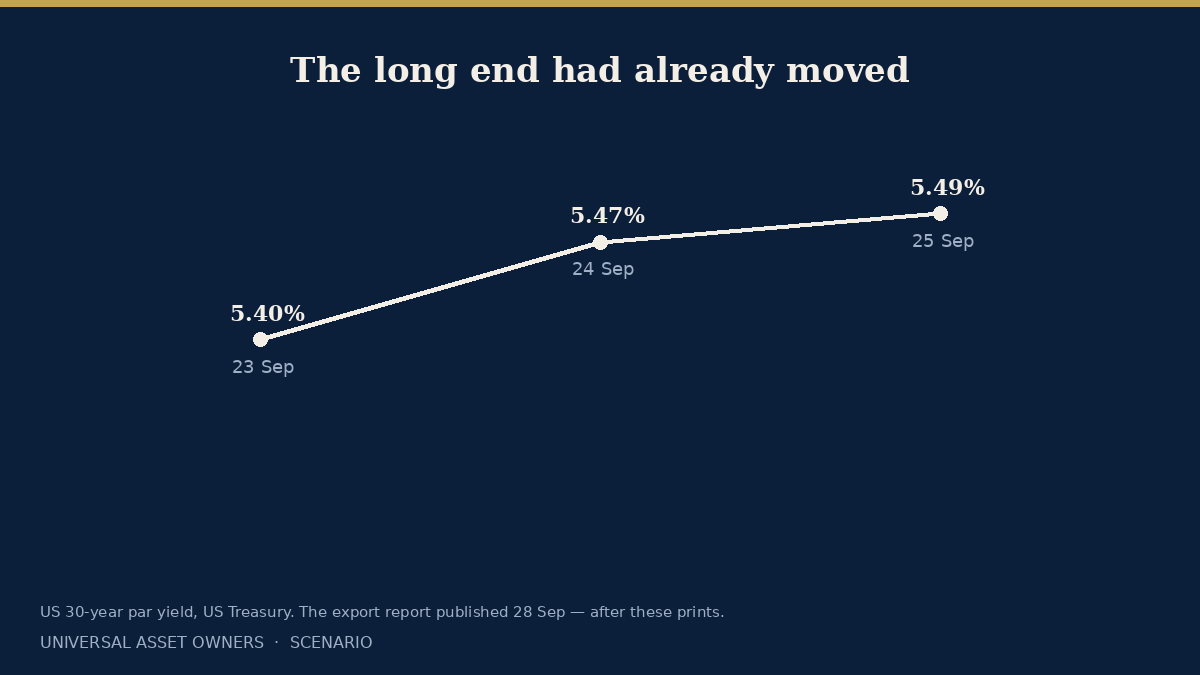
The long end. On the Treasury’s par curve the 30-year was 5.40% on 23 September and 5.49% on 25 September. Funds sit at 3.75–4.00%. The Fed’s own projections hold a 4.1% median through 2027.
The clock. The yield observation is 25 September. The export report published 28 September. The curve did not shrug off the barrels — it had not seen them.
The archetype. A higher discount rate lowers nominal liability value. It helps an underhedged DB plan; it does nothing to a US public plan discounting at the assumed return; a sovereign fund has no liability at all.
Hong Kong. Eight ETFs listed into a new Southbound door for mainland insurers. Huatai’s RMB400bn is a 1% scenario. The busiest fund traded HK$1.36m and fell 5.6%. Capacity is not flow.
The Fed’s stablecoin rules. Two proposals, 24 September: full reserve backing in HQLA including T-bills. Barr: stable only if “reliably and promptly redeemed at par in a range of conditions.”
Two numbers, three days apart
Two numbers landed this week, three days apart, and almost everyone is about to join them up.
The first is physical. Kpler data reported by Reuters on 28 September put September crude exports from Saudi Arabia, the UAE, Iraq, Oman, Qatar, Kuwait and Iran at 12.8 million barrels a day, with about 7.4 million b/d routed through the Strait of Hormuz — the highest monthly rate since the war began on 28 February. Saudi shipments recovered to about 5.4 million b/d from 2.446 million in August, as barrels forced off Yanbu by attacks on the East–West pipeline moved back toward Ras Tanura. Nineteen very large crude carriers left Hormuz last week.
Three qualifications travel with that number. It is preliminary — September is not over. It excludes vessels running with transponders off. And it is crude only: it says nothing about LNG, containers, war-risk insurance capacity, or whether a payment cleared a sanctions screen. Regional exports remain 6.0 million b/d below February’s 18.8 million. A recovery to 68% is a recovery, not a return.
The second number is financial, and it came first. On the US Treasury’s own par curve the 30-year was 5.40% on 23 September and 5.49% on 25 September; the 10-year moved from 5.11% to 5.17%. The federal funds target range has been 3.75–4.00% since the Federal Open Market Committee raised it on 16 September on a 12–0 vote. The 30-year sits 149 basis points above the top of that range, and the Committee’s own projections hold a 4.1% median at the end of both 2026 and 2027 — a plateau, not a round trip.
Here is the discipline. The Treasury observation is 25 September. The export report published 28 September at 00:17 UTC. The yield move happened before the report existed. The curve did not decline to react to those barrels; it had not seen them. Anyone telling you this morning that the market “shrugged off” the export recovery is describing a reaction that could not have occurred.
What moved the long end is not established. A nominal long yield contains expected short rates, expected inflation and a term premium, and it is pushed by issuance, fiscal risk, foreign demand, liquidity and positioning. Separating those requires a decomposition this desk has not run; the honest test is whether real yields or breakevens did the work between the 23rd and the 25th, and that is public data. What can be said is narrower and sufficient: the policy rate did not move in those two sessions, the long end did, and the improvement in crude flows had not yet been published.
The OECD, in its Interim Economic Outlook of 23 September, had written the other story: the energy shock so far absorbed; global growth revised to 2.9% for 2026 and 3.0% for 2027; energy prices assumed to ease into 2027. Its named residual downsides were a more persistent disruption to Middle East exports — or a further rise in long-term sovereign yields. Five days later the second of those is the live one.
What it means — by archetype, not in general
Be careful here, because this is where most coverage gets the direction wrong. A higher discount rate lowers the present value of nominal liabilities. For an underhedged defined-benefit plan, a long-end sell-off improves funded status. It is not the disaster the framing usually implies.
But that is one mechanism among several, and the archetype decides which reach you. For a corporate plan marking to a high-quality curve, a UK scheme on a buyout basis, or a Japanese life book matching annuities, the discount rate moves the liability directly. For a US public plan discounting at the assumed return, it does not — the curve reaches funded status through asset returns and through what the sponsor can afford to contribute. For a sovereign fund there is no liability; the move reaches the spending rule and the long-duration sleeve. Three archetypes, three mechanisms, three different board questions.
For scale — a generic duration approximation, not a statement about any named fund — a 10 basis-point parallel move on a 15-year effective liability duration is roughly 1.5% of liability present value, before convexity, curve shape, hedges, benefit design, accounting and sponsor effects.
Where the long end actually bites is not private credit. Most direct lending is floating-rate, priced off a front end anchored at 3.75–4.00%. What a 5.49% thirty-year reaches is fixed-rate, long-duration, project-financed paper: regulated utilities, contracted infrastructure, core real estate, and the data-centre build-out underwritten when the 30-year was two full points lower.
Japan is the same shape at a different level. The Bank of Japan raised its call-rate guideline to around 1.25% at its 17–18 September meeting on a 7–2 vote, effective 24 September. The Ministry of Finance reference print for the 30-year JGB was 4.115% on 24 September; market reporting put an intraday high of 4.223% the following session, the highest since Japan first sold the maturity in 1999. A Japanese institution buying US duration hedged into yen is paying away more of the pickup than it was in June — a bid-side channel that lands on the same US 30-year and has nothing to do with Hormuz.
The policy rate and the long bond stopped agreeing

The off-ramp was refused
On 26 September the President said on the record that he had rejected Iran’s proposal, transmitted through Qatar: reopen the Strait within seven days and restart nuclear talks in exchange for lifting the US naval blockade, easing oil sanctions, releasing frozen assets, and a ceasefire including Lebanon. In an interview published by Axios on 27 September: “I expect more talks with Iran this week. They want to make a deal, but it is not the deal that I want to make.” Foreign Minister Araghchi told NBC the same day that Tehran had not received an official reply through the mediators and remained ready for diplomacy.
Status of the waterway: transit-passage rights remain the legal baseline; parts of the lane are in use; the corridor is commercially impaired. Insurance remains the operational gate.
Hong Kong listed the door. It did not list the flow.
Eight ETFs offering South Korean chips, US technology and Malaysian large caps listed in Hong Kong on 28 September, after China’s financial regulator allowed mainland insurers to buy Hong Kong-listed ETFs through Southbound Stock Connect, effective 21 September. The binding constraint is the eligibility rule: a fund needs at least 60% exposure to Hong Kong equities to qualify, so “global” exposure stays inside a Hong Kong-heavy wrapper.
Huatai Securities estimated that a 1% allocation from mainland insurers could exceed RMB400 billion. That is a scenario, not an inflow. The most-traded of the eight, the Hang Seng AI Advancement ETF, turned over HK$1.36 million in the morning session and fell 5.6%.
Capacity, intended allocation and observed flow are three columns. Regulators can build the pipe in a month. Capital moves only after governance, liquidity, tracking and relative value align.
The Fed put Treasury bills underneath tokenised cash
On 24 September the Federal Reserve Board requested comment on two proposals for Board-supervised payment stablecoin issuers under the GENIUS Act: full reserve backing in specified high-quality liquid assets including short-term Treasury bills, capital and risk-management standards, custody rules for reserve safekeeping, and a tailored application path. Comments run 60 days from Federal Register publication.
Governor Michael S. Barr: “Stablecoins will only be stable if they can be reliably and promptly redeemed at par in a range of conditions.” He said it would be important that universal redemption rights are clear in the final rule.
Whether this creates net new demand for bills or moves existing bill-holding money between wrappers depends on where the funds come from. It is a proposal. Do not book a new asset class until there is a final rule and a live supervised issuer.
ABP wrote a €250 million European scale-up cheque
On 24 September ABP committed €250 million to the Scaleup Europe Fund — EQT as manager, the European Commission a founding investor, €5 billion target, sectors spanning AI, quantum, energy, space and medtech — and stated an intention to invest about €1 billion in European venture capital over three years, subject to market conditions and investment opportunities. The €250 million is a commitment, not drawn NAV.
The context is a live legislative question, not a law. Under the IORP II review, a European Parliament amendment would require EU pension funds above €1 billion of assets to put at least 2% into venture capital — reported by IPE as more than €11 billion for ABP alone. The amendment is not adopted; a compromise vote is pending and Council negotiation is not expected before late 2026 or 2027.
Capital flows — what stage is it at?
ABP — €250m — Scaleup Europe Fund (EQT). Commitment, not drawn NAV.
KKR → unnamed institutional buyer — JPY ~200bn (attributed) — 16 Japan hotels. Closed sale; KKR’s own words: “a leading global institutional investor”; buyer not on the record.
DEWA — US$2.70bn — Noor Energy 1 refinancing. 950 MW CSP+PV with 15 hours of storage. Refinance, not new owner capital.
EIF + six CEE partners — €360m — Three Seas infrastructure fund of funds. €180m from BGK, BID, ILTE, JEREMIE Bulgaria, HBOR and SID Kapital, matched by €180m from the EIF. Commitment; at least €2bn mobilisation target.
NYCERS / TRS / BERS — US$5bn opportunities — private-markets climate. Proposed to three boards, each with independent review. Not an allocation.
EIB / EIF — €11.5bn — new financing approvals, 23 September. Approved; concurrent with the PATH 2 framework, live January 2027.
Mainland insurers → Hong Kong ETFs — Huatai 1% scenario, >RMB400bn. Capacity, not flow.
A commitment is authorised capital, not drawn NAV. A recommendation to a board is not an allocation. A refinancing is not new owner capital. A 1% scenario is not an inflow.
Sources: ABP; KKR, 24 September; WAM, 27 September; EIF, 24 September; NYC Comptroller, 23 September; EIB, 23 September; Reuters, 28 September; Cayman OTP; FSI / Temasek; H Capital / Koncenton; Harvey; DTCP; Alaska ARMB; PenCom; NSIA / Africa50; Global SWF.
Governance overtook climate as the top owner priority
Governance overtook climate as the top owner priority. The ninth FTSE Russell / LSEG Sustainable Investment Asset Owner Survey, published 22 September, covers 402 asset owners across 24 countries. Adoption recovered to 84% from 73%. “Governance, tax and shareholder rights” is now the most-cited priority at 32%, up from 18%. Physical climate risk rose to 26% from 19%. Greenwashing concern fell from 37% to 22%; corporate reporting quality is the leading barrier at 33%. Owners did not become less worried about climate; they moved governance to the top because rights are the tool they still control.
Glass Lewis and Clarity AI closed an all-share combination on 23 September, announced 24 September — more than 900 professionals across 20 offices, serving more than 1,300 managers and pension funds, Madrid as the global centre for sustainability and data. No financial terms disclosed.
EU Directive 2024/825 became applicable on 27 September: generic environmental claims, offset-only carbon-neutrality claims and uncertified sustainability labels are now restricted. National enforcement will vary, and the Commission’s own guidance allows proportionate treatment of existing stock. It is consumer law, not SFDR, and it reaches portfolio companies selling into EU consumer markets.
ISSB’s digital-taxonomy consultation closes 28 September. TNFD reports more than 1,000 organisations across 56 jurisdictions with TNFD-aligned disclosures, 802 formal adopters, and financial institutions representing US$26.6 trillion. Norway’s Gjedrem committee reviewing the Government Pension Fund Global’s ethical framework reports 15 October; Carine Smith Ihenacho leaves NBIM at the end of 2026.
Six exposures, each with its trigger
Long end decouples further from the policy rate. Live. Trigger: 30 September PCE; 2 October payrolls; 27–28 October FOMC.
Hormuz commercially impaired into winter despite volume recovery. Live. Trigger: October liftings; war-risk quotations.
JGB 30-year sustained above 4.20%. Live. Trigger: MoF prints; GPIF and life ALM disclosures.
Stablecoin reserve rules concentrate demand in bills. Developing. Trigger: Federal Register text.
GPFG exclusion authority restored, narrowed or buried. Dated. Trigger: 15 October.
Hurricane Polo. Active hazard. NHC had a Hurricane Warning for mainland Mexico from Guaymas to Huatabampito and for segments of Baja California Sur as of Advisory 29, 27 September; Category 3, 125 mph. A warning is not a loss.
| Open the live Risk Map → |
Future Signals · Signal Ledger
Status: live. Evidence: Kpler September exports 12.8m b/d, ~7.4m via Hormuz, against 18.8m in February; Yanbu-to-Ras Tanura diversion; 19 VLCCs last week; AIS-off excluded. Conviction: High on the observation; medium on corridor-wide interpretation. Confirms if: October liftings hold and war-risk premia fall. Kills it if: Cargoes fail to discharge or attacks resume. Decision owner: CIO / CRO. Window: 30 days. Change since prior edition: new.
Status: live. Evidence: US 30-year 5.49% with funds at 3.75–4.00% and SEP medians 4.1%/4.1%; JGB 30-year 4.115% MoF print with the call rate at 1.25%. Conviction: High on the US leg (Treasury primary); medium-high on the JGB leg. Confirms if: PCE firm on 30 September and the 30-year holds above 5.45%. Kills it if: A soft core month pulls the long end in with the front. Decision owner: ALM. Window: To 27–28 October. Change since prior edition: new.
Status: live. Evidence: NFRA insurer-ETF route effective 21 September; eight listings 28 September; 60% Hong Kong-equity rule; Huatai 1% scenario >RMB400bn; first-day turnover HK$1.36m. Conviction: High on the plumbing; low on the flow. Confirms if: Southbound prints over a quarter look like a material sleeve. Kills it if: The first month looks like the first morning. Decision owner: Public markets / China. Window: One quarter. Change since prior edition: new.
Status: live. Evidence: ABP’s €250m against a live IORP II 2% proposal; EIF’s €360m Three Seas vehicle. Conviction: Medium-high. Confirms if: A second large pension writes a governance-gated European scale-up ticket before year-end. Kills it if: The Parliament amendment dies and voluntary tickets stop. Decision owner: Board. Window: To the Parliament compromise vote. Change since prior edition: new.
Status: live. Evidence: FTSE Russell 32% governance-first; Glass Lewis–Clarity AI vertical integration. Conviction: Medium. Confirms if: Shareholder-rights clauses appear in manager guidelines this proxy season. Kills it if: The priority flip does not reach side letters. Decision owner: Stewardship. Window: Proxy season. Change since prior edition: new.
Three questions for the investment committee
- Are our inflation, duration, liquidity and collateral assumptions still coherent if oil flows keep improving and the long end stays exactly where it is?
- On any newly opened market route, do we require a stage ledger — eligible, approved internally, funded, traded, scalable — before treating a regulator’s permitted universe as deployed capital?
- If public policy asks us to fund domestic innovation, what governance rights, return hurdles and liquidity terms make the ticket fiduciary rather than performative?
What to watch
30 September, 08:30 EDT — BEA: August personal income and outlays including PCE; Q2 GDP third estimate. Tests inflation persistence.
2 October, 08:30 EDT — BLS: September employment. Tests the rate path.
15 October — Gjedrem committee report on the GPFG ethical framework.
27–28 October — FOMC. 8–9 December — FOMC with projections.
Two observations. Two clocks.
Two observations on two clocks. The barrels recovered to two-thirds of February and the long end rose before that number existed. Nobody yet knows what moved the curve, and the honest position is to say so. What the week poses is a question, not a verdict: once the export estimate reaches the tape, does the long end care? For a liability book the answer runs through the discount rate — with the sign the right way round, and by archetype.
The Barrels Came Back
Proposition. The US 30-year closes at or above 5.75% on any day before 31 December 2026 while Kpler’s published monthly Gulf crude export figure for the month containing that close still shows Hormuz throughput at or above 7.0 million b/d. One close, one month, one print. Base case. Physical supply keeps improving while realised inflation stays firm enough that the market extends the policy path written into the September projections. It escalates if August core PCE prints firm on 30 September, payrolls show no loosening on 2 October, the October FOMC hikes, and the JGB 30-year holds above 4.20%. It fails if a soft core-PCE month pulls the long end in with the front, the Iran file produces a mediated agreement, or the September export recovery proves to be timing and inventory rather than sustained liftings.
Podcast · The Universal Owner
| Apple Podcasts | Spotify | Podbean |
Global — Nigeria dispatch

|
Nigeria · Friday 18 September 2026
Dan Agbo
Filed Friday 18 September 2026 (reporting Thursday 17 September). Nigeria’s Dangote Petroleum Refinery and Petrochemicals IPO — a 4.1-billion-share, roughly $1.6 billion raise on the NGX that opened 14 September and closes 13 October — drew enough retail demand on 17 September that several digital investment platforms suffered outages, according to a Reuters report carried by CNBC Africa; neither Dangote nor the underwriters disclosed formal demand figures. Leadership reported Minister Jumoke Oduwole saying NGX market capitalisation rose by roughly ₦1.665 trillion over the three trading days to 16 September as investors positioned around the offer; some analysts projected the eventual listing could add as much as $60 billion to exchange capitalisation once shares list (expected around November). In Kaduna, APC and ADC supporters clashed through the week, including a 17 September incident on Waff Road reported by Sahara Reporters; both parties called for police investigations ahead of the 2027 elections. The naira closed at ₦1,329.56/$ on NAFEM on 17 September (Arbiterz), with the parallel market around ₦1,375–1,390/$. In Ondo State, a suspected methanol-poisoning outbreak tied to locally brewed alcohol had killed 49 people with roughly 170–182 affected by Thursday, per the state health commissioner — a subnational governance and consumer-safety signal, not a market-moving print. |
|
Nigeria · Wednesday 16 September 2026
Filed Wednesday 16 September 2026 (reporting Tuesday 15 September). J.P. Morgan added Nigeria to its Government Bond Index–Emerging Markets Edge (GBI-EM Edge) with a 7.40% weighting on naira FGN bonds — near the 8% country cap — exposing roughly $17.47 billion of eligible FGN debt to index-tracking funds for the first time since Nigeria left J.P. Morgan’s flagship bond benchmark in 2015, per J.P. Morgan Global Index Research dated 14 September and public confirmation by Finance Minister Taiwo Oyedele. Separately, subscriptions opened Monday for Dangote Petroleum Refinery and Petrochemicals’ IPO seeking up to $1.6 billion (potentially $2.1 billion with greenshoe) via 4.1 billion shares at ₦525, open through 13 October. Both developments landed days ahead of FTSE Russell’s scheduled reclassification of Nigeria from Unclassified to Frontier Market status, effective 21 September. Kaduna State said it recovered more than 500,000 hectares of farmland from bandit control over three years (state self-assessment). Police issued a nationwide alert warning of possible coordinated attacks on schools, NYSC camps and places of worship; a Plateau bus attack on Sunday had killed nine passengers per state police. |
The Back Page — meet The Allocator

Three links worth your time
- US Treasury — Daily Par Yield Curve, September 2026. The primary. 23 September 5.40%, 24 September 5.47%, 25 September 5.49%. No print exists for the 26th or 27th.
- OECD — Interim Economic Outlook, 23 September. Read the residual-downsides paragraph. One of the two named risks is now the live one.
- Federal Reserve — Governor Barr’s statement on the stablecoin proposals. The redemption-at-par sentence, in his own words.

Careers, moves and mandates
Nebraska Public Employees Retirement System — Executive Director Thomas Pfeifle has resigned effective 31 October, roughly four months after his employment was approved on 15 June following an 18-month search. The board’s special meeting is 30 September at 1:00 p.m.; the agenda lists consideration of the resignation and possible appointment of an interim director.
Border to Coast Pensions Partnership (£120bn) — Luke Baker joined 1 September as Portfolio Manager, Local Investment, reporting to Head of Alternatives Ian Sandiford; announced 22 September. Chris Cooper joins as Head of Real Estate.
GIC — effective 1 October: Choo Yong Cheen and Liew Tzu Mi become Deputy Group CIOs; Liang Jiajie becomes CIO, Fixed Income & Multi Asset. Temasek — Susan Wagner joins the board 1 October. First Super — Tim Kennedy becomes CEO 5 October. Guardians of New Zealand Superannuation — Michael McNee becomes Head of Portfolio Completion 19 October, from QIC.
Open chief seats: Teacher Retirement System of Texas CIO (Jase Auby retiring, through 31 January 2027) · Future Fund CEO (Raphael Arndt departing, through end-2026) · Hawaii ERS CIO (open since 24 March) · PensionDanmark CIO (Claus Stampe retiring; successor from 1 February 2027).
IPERS reported 12.88% for FY2026 against a 7% assumed return and kept its allocation unchanged; private equity is a 17.0% policy weight from 1 January 2026.
The Job Board · Open Seats
| Institution | Role | Note |
|---|---|---|
| Teacher Retirement System of Texas | Chief Investment Officer | Incumbent retires 31 January 2027 |
| Future Fund | Chief Executive Officer | Incumbent departs end-2026 |
| Employees’ Retirement System of the State of Hawaii | Chief Investment Officer | Open since 24 March 2026 |
| PensionDanmark | Chief Investment Officer | Successor from 1 February 2027 |
| All open seats → |
The stage-of-commitment map — a recurring UAO device
| Status | Meaning | The institutional question |
|---|---|---|
| Proposed | Policy intent or recommendation | Is it politically credible, funded and legally authorised? |
| Announced | Publicly stated plan | What is the implementation path, and who has authority? |
| Signed | Contract executed | What approvals, conditions, financing or closing risks remain? |
| Committed | Capital promised | What are the capital-call, pacing, concentration and manager risks? |
| Closed | Legally completed | What has transferred, and what now sits on the balance sheet? |
| Deployed | Capital in assets | What are the operating, valuation, liquidity and governance exposures? |
Applied to today’s tape: ABP is committed. KKR’s Japan sale is closed with the buyer unnamed. DEWA is a refinancing of a deployed asset. The NYC pipeline is proposed. The Hong Kong insurer channel is authorised capacity with observed flow of HK$1.36 million.
The archetype table — what a 9 basis-point long-end move does to whom
| Reader archetype | Exposure | Mechanism | Decision question |
|---|---|---|---|
| Corporate DB / UK buyout basis / Japanese life | Liability marked to a high-quality curve | A higher discount rate lowers liability PV directly; hedge ratio decides the net | Is the duration hedge still calibrated to long-end volatility and funded-status sensitivity? |
| US public plan | Discounts at the assumed return | The curve does not touch the liability; it reaches funded status through asset returns and sponsor capacity | Do asset-return assumptions survive a 5.49% risk-free long rate? |
| Sovereign fund | No liability | The move reaches the spending rule and the long-duration sleeve | Is a higher oil price improving fiscal capacity faster than global duration losses reduce it? |
| Endowment / foundation | Spending rule; private-asset liquidity | Inflation persistence and a higher discount rate press real spending capacity and private-market pacing | Does the capital-call pace still work if private marks lag public duration? |
The generic scale — a 10 basis-point parallel move on a 15-year effective liability duration is roughly 1.5% of liability present value — applies only to the first row, and only before convexity, curve shape, hedges, benefit design, accounting and sponsor effects.
Open questions this edition does not resolve
- Did the 23–25 September long-end move come from breakevens or real yields? Public data can answer this.
- Is Kpler’s 12.8 million b/d corroborated by a second tracker? One provider, relayed by one wire, carries that leg.
- Was the 4.223% JGB print a traded level or a quoted one? The MoF reference print is 4.115%.
- Who bought the sixteen KKR hotels? Trade press says GIC; GIC declined. Unattributed until someone signs.