
98% of the world’s sovereign wealth funds |
18 of 20 of the world’s largest pension funds |
10 of 10 of the largest charitable foundations |
85% of the world’s largest family offices |
100+ billionaires, every morning |
Private assets: the price, the cash and the control
An SEC staff statement sharpens the questions investors should ask about private-asset valuations. Temasek and Samsung show why the answers also depend on what, exactly, an institution has bought.
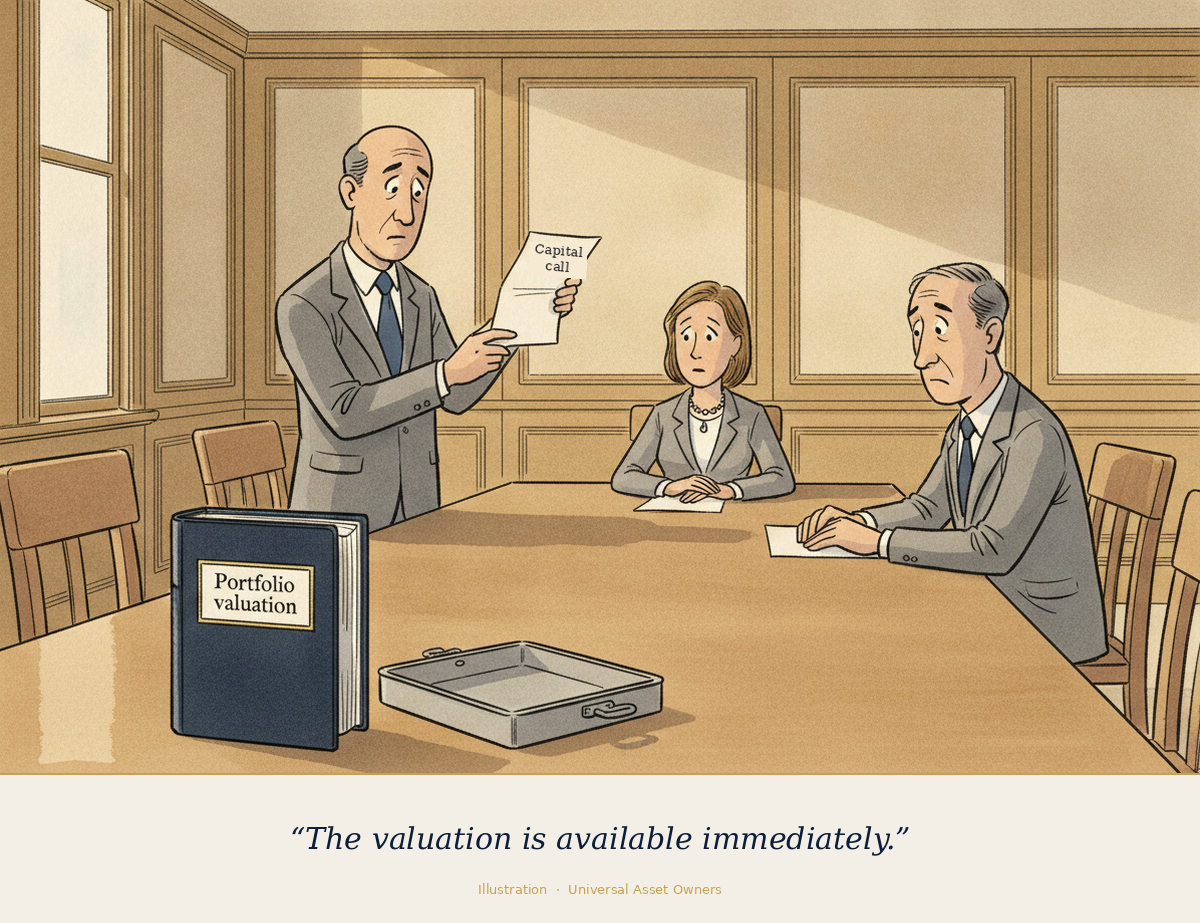
An investment committee can approve a valuation, a distribution and a new commitment in the same meeting without establishing whether the first can finance the other two.
That is the practical question running through today’s developments. SEC staff have revisited how private assets are valued. Temasek has acquired part of an investment manager. Samsung and its affiliates are committing capital to an infrastructure business. Australia has raised interest rates while identifying AI demand as one source of price pressure.
The common issue is the relationship between reported value, future cash and the rights an investor can exercise when conditions change. Those relationships deserve separate underwriting.
9% of FSI’s management company acquired by Temasek; further capital to future funds | US$1 bn committed to Helix by six Samsung entities; US$500 m from Samsung Electronics | 4.60% Reserve Bank of Australia cash-rate target after a 25 basis-point rise, 29 September | 5.56% US 30-year par yield, 28 September; 5.49% on 25 September |
What do we own, when does it pay, and which rights protect us if the plan changes?
Today in 90 seconds
- Private valuations: SEC staff reiterate existing standards and discuss the evidence behind private-credit marks and the use of fund NAV. A secondary-market indication matters; it is not an automatic instruction to replace NAV. [1]
- Sovereign capital: Temasek has acquired 9% of FSI’s management company and will commit additional capital to future funds. Ownership of the manager and investment in its funds create different exposures. [2]
- AI infrastructure: Six Samsung entities are committing US$1 billion to Helix. A consequential detail in KKR’s release: strategic investors may have priority or first-look rights to supply its investments. [3], [4]
- Rates: Australia raised its cash-rate target to 4.60%. U.S. Treasury par yields for 28 September were 5.24% at ten years and 5.56% at thirty years. The effect on an asset owner depends on its liabilities, hedges and cash needs. [5], [7]
Ask what connects the mark to the money
The SEC’s chief accountant, Kurt Hohl, and investment-management director, Brian Daly, issued a statement on 28 September addressing valuation and disclosure for private assets. It creates no new obligations. Its importance lies in the questions it puts back in front of management, boards and auditors. [1]
The staff discuss relevant market information, payment-in-kind interest and the conditions for using another fund’s net asset value as a valuation shortcut. They identify secondary-market evidence as relevant to the assessment. A probable sale at an amount different from NAV prevents use of the practical expedient; a secondary indication alone does not automatically do so. [1]
UAO analysis. For an allocator, three questions should travel together: Is the reported value defensible? What could the position realize in an orderly transaction? What cash can it provide within the period in which the owner needs money? A satisfactory answer to one does not settle the others.
Consider an investment committee deciding whether to renew a private-credit allocation. A quoted yield can be attractive while the portion actually received in cash is insufficient for the owner’s spending plan. An indicative bid can be below NAV because of its terms, size or liquidity conditions; it still deserves a documented reconciliation. Neither observation, by itself, proves that the underlying borrower has deteriorated or that the valuation is wrong.
The practical improvement is a bridge from reported income to cash received, alongside a bridge from reported value to the best relevant transaction evidence. Where payment-in-kind interest is present, the committee should distinguish an original contractual feature from a later concession to a borrower. Where the manager rejects a price indication, it should explain the differences that make the indication unrepresentative.
This produces a more useful conversation than asking whether private credit is “safe.” The head of private markets and the finance team can request those reconciliations for the next valuation review, with the valuation committee resolving material differences. For each exposure, establish the applicable reporting framework and investor rights; the SEC statement does not automatically impose U.S. registered-fund requirements on every pension or family-office account.
The countercase: Better evidence may validate the existing mark. It may also show that a discount compensates a buyer for illiquidity rather than a deterioration in the assets. The statement establishes neither a coming wave of write-downs nor a timetable for enforcement.
What changes the decision: A persistent failure to explain the difference between reported income and cash, or between a valuation and relevant transaction evidence, is a governance problem the owner can address now. The appropriate response depends on the contract: additional reporting, a valuation challenge, revised commitment pacing, or no change where the evidence is satisfactory.
A stake in the manager requires a second investment case
Temasek has acquired a 9% strategic minority stake in FSI’s management company, whose team manages approximately €5 billion. It will also commit additional capital to future FSI funds. The release does not disclose the purchase price or the specific economic and governance rights attached to the stake. [2]
This expands an established relationship. Temasek says its investment in FSI’s funds began in 2018. The partnership emphasizes growth and international expansion for Italian mid-market businesses, including founder- and family-owned companies. [2]
UAO analysis. A manager stake should have its own investment case. A strong fund can coexist with an expensive management company. Attractive management-company economics can coexist with a successor fund that does not meet the investor’s allocation needs.
The diligence therefore has two columns. In the manager column: the contractual share of earnings, expenses, incentive compensation, dilution, succession and exit rights. In the fund column: fees, investment selection, concentration, co-investment allocation and the ability to decline a future commitment. The announcement alone does not settle those terms.
There is a specific commercial angle for family offices with operating businesses. A partnership that combines local relationships with international networks may offer an alternative route to growth or succession. The negotiation still turns on control: reserved matters, dividend policy, follow-on capital and the route to an eventual exit. Patient capital is a description of an investor’s intention; contractual rights determine how that patience works in practice.
The countercase: A minority stake can deepen a productive partnership without transforming the economics of either party. Without the purchase price and shareholder agreement, no conclusion about the investment’s expected return is justified.
The committee question: Would we buy this manager at these terms if we were free to decline its next fund—and would we buy the next fund if we did not own the manager?
The supplier may also be an investor
Samsung Electronics and five affiliates, including Samsung Life and Samsung Fire & Marine, announced a combined US$1 billion investment in Helix. Electronics accounts for US$500 million; the five affiliates supply the balance, without an individual split in Samsung’s announcement. [3]
KKR describes the commitment as being through Helix’s long-duration capital fund. It adds to more than US$10 billion committed at launch. This is committed capital, not evidence that the money has been deployed or that infrastructure is operating. [4]
The disclosure worth reading closely sits in KKR’s notice to readers: strategic investors may hold priority or first-look rights to provide goods or services to Helix investments. The release does not establish which rights each investor has, whether they have been exercised, or the terms of any contract. [4]
UAO analysis. Industrial partners can help solve difficult execution problems. They can also sit on both sides of a commercial negotiation. An institution investing alongside them needs to understand how supplier selection, pricing and conflicts are governed.
For the infrastructure team, the useful diligence document is a map of counterparties and contracts. Who provides the power? Who guarantees completion? Who bears construction inflation? When does the customer begin paying? What happens if grid access arrives after the equipment? Which investor has an economic interest in the contractor or supplier?
For a participating insurer, a long holding period is only one part of the fit. The team also needs the instrument, expected cash flows, capital treatment, currency exposure and funding obligations. It would be premature to infer that a particular insurance liability is matched merely because the platform describes its capital as long-duration.
The countercase: Strategic relationships can improve supply reliability and lower coordination costs. First-look rights do not establish preferential pricing or misconduct. Transparent procurement, independent approval and credible alternatives could make the arrangement attractive for all investors.
What changes the decision: Actual contracts that allocate delay, cost and customer risk. A growing commitment total cannot substitute for those protections.
Timing is the investment problem
Australia’s central bank raised its cash-rate target by 25 basis points to 4.60% on 29 September. Its statement named AI-related demand, higher energy prices and domestic capacity pressure among the inflation concerns. [5]
In Oakland on 28 September, Federal Reserve Governor Lisa Cook described near-term price pressure associated with AI investment. She also made an important distinction: monetary policy is a blunt response to sector-specific price changes, and broader productivity gains could eventually ease inflation. Her speech is one policymaker’s assessment, not a new collective Fed decision. [6]
UAO analysis. An infrastructure investment can experience construction inflation before it produces revenue. An operating business can pay more for technology before productivity gains reach its margins. A diversified owner can hold both exposures while also financing them through credit portfolios.
The underwriting question is therefore about sequence. If costs arrive early and productivity arrives late, which balance sheet bridges the gap? A sponsor with committed liquidity and enforceable customer contracts is in a different position from one relying on refinancing and optimistic utilization assumptions.
This is also a portfolio aggregation problem. Public technology stocks, data centers, power assets and private credit may be held by separate teams but depend on some of the same customers and spending plans. The risk team can test that overlap without assuming every AI-related position has identical economics.
The countercase: Supply can expand, technology can become more efficient, and productivity can diffuse beyond the companies building the infrastructure. Those developments could improve cash flows while moderating costs. Neither speech establishes how much AI contributed to a particular bond-market move.
The next test: Evidence of realized productivity, cost pass-through and funded customer demand. Another enthusiastic announcement is less informative than a contract becoming revenue.
Higher yields are not a universal pension windfall
The Treasury’s dated par-curve observations show the following changes: [7]
| Maturity | 25 September | 28 September | Change |
|---|---|---|---|
| 2 years | 4.81% | 4.92% | +11 basis points |
| 10 years | 5.17% | 5.24% | +7 basis points |
| 30 years | 5.49% | 5.56% | +7 basis points |
These are Treasury curve estimates. The Federal Reserve’s H.15 release dated 28 September carries observations through 25 September; its 5.49% thirty-year reading is a different observation date, not a contradictory price. [8]
UAO analysis. For a pension whose liability discount curve rises, the present value of fixed promised payments falls, all else equal. Whether its funding position improves depends on what happens to its assets and hedges at the same time. A closely matched portfolio is designed to reduce that sensitivity. Liquidity can nevertheless become more demanding if derivatives require collateral. The Pensions Regulator explicitly distinguishes these risks. [9]
For an investment committee, the useful output is a reconciliation of assets, liabilities and available cash under the same scenario. A Treasury yield is not automatically the discount rate used by a pension in another jurisdiction. Nor does a higher long yield mechanically reduce every private loan’s value: contractual cash flows, floating-rate resets, credit spreads and borrower performance also matter.
For a family office with operating businesses, test the combination of business cash needs, investment commitments and spending. For a sovereign investor, establish the actual funding and withdrawal mandate before assuming that a long investment horizon protects it from a near-term call on capital. Neither category has one universal liability structure.
A useful discipline: Ask for the funding result and the liquidity result on separate lines. A better-looking balance sheet can coexist with less cash available when it is needed.
Separate commitments, acquisitions and cash returned
| Development | Verified stage and scale | The question behind the headline |
|---|---|---|
| HICL / Hector Rail | Agreement for about £68 million and a 42% stake, alongside other InfraRed-managed funds; completion expected by 31 December, subject to consents. [10] | HICL describes inflation-linked contracts and substantial cost pass-through. How much demand and reinvestment risk remains after those protections? |
| FirstGroup pension | Completed buy-in covering approximately £90 million of Group Section liabilities; £17.5 million returned to the company from escrow. The total insurance premium is not disclosed in the release. [11] | How do risk reduction and sponsor liquidity interact? Liability coverage, premium and released cash are three different measures. |
| Euroports / A.P. Møller Capital | Agreement for 53.35% of holding company Thaumas signed on 25 September. Regulatory approvals expected in Q1 2027. [12] | The price depends on FY2026 EBITDA. The signing does not establish either final consideration or completed deployment. |
| Greater Manchester Pension Fund / Circle Square | Sale of its 50% residential interest to Vita Group reported completed on 28 September; consideration undisclosed. [13] | An exit demonstrates realization, but without proceeds and invested capital it does not establish the return. |
| ADIA / Slate Grocery REIT | Brixmor–Everview take-private at about US$2.34 billion enterprise value (28 Sep). SPA; close guided Q1 2027; ADIA ticket size undisclosed; unitholder vote still required. | Strategic capital on a grocery REIT take-private is not the same as a closed ADIA cheque — what is disclosed versus what remains contingent? |
| NYLIM / Invictus Capital | New York Life Investment Management majority of Invictus (SFR credit factory), 28 Sep. Close guided Q1 2027; GA multi-year commitment size not disclosed. | Majority control of a credit factory versus LP exposure in the underlying loans — which cash and control rights travel with the stake? |
| Achmea IM × ILX | EM MDB/DFI loan impact vehicle announced 28 Sep. Product launch — no named LP and no first close disclosed. | A product announcement is not committed capital. When does a first close and a named allocator ticket appear? |
| Nscale / ADIC / Apollo | Nscale US$3.36 billion pre-IPO convertible (25 Sep; counsel 28 Sep). ADIC in the book; Apollo also named. Conversion at IPO. ADIC is not ADIA. | Convertible book participation is not a closed equity ticket — what converts, when, and at whose valuation? |
| Investcorp — U.S. industrial | About US$800 million U.S. industrial pacing (28 Sep): PHL/BNA acquire >US$225 m GTV plus multi-city liquidation >US$550 m. No named UAO LP on the release. | Manager pacing and liquidations are not the same as a named allocator commitment — who is on the ticket? |
| Michigan Retirement ~US$265 m | Real-assets slate reported via IPE 29 Sep: BGO Europe V / BGO Industrial II / ECP VI / Ullico add (~US$265 m). Board minutes still a watch — not yet a closed primary confirmation. | IPE secondary versus board minutes: which commitments are authorised and which are still agenda items? |
Recent context, not fresh announcements: Ontario Teachers’ announced the acquisition of seven Danish residential assets on 25 September. Harvey announced Teachers’ Venture Growth’s US$50 million investment on 24 September, extending its funding round to US$600 million. Their value here is the comparison between income-producing property and growth capital—not a claim that both transactions happened today. [14], [15]
Five requests worth making
| Exposure | Request | Decision it informs |
|---|---|---|
| Private credit | Reconcile income recognized, cash received and capitalized interest; explain material valuation differences. | Whether the allocation serves the owner’s income and liquidity needs. |
| Manager ownership | Separate management-company economics from each fund commitment and document conflicts. | Whether the ownership stake stands on its own merits. |
| AI infrastructure | Map customers, suppliers, investor rights and who absorbs delays or cost overruns. | Whether apparent diversification survives a common customer or construction shock. |
| Market-sensitive pension liabilities | Show asset and liability sensitivities alongside collateral and cash needs. | Whether an improvement in measured funding also improves financial resilience. |
| Sovereign or family capital | Reconcile committed investments with possible withdrawals, operating needs and spending. | How much capacity is genuinely available for another illiquid commitment. |
These are diligence requests, not instructions to sell. If the existing reporting already answers them, the development may require better documentation rather than a change in allocation.
Treasury par yields: 25–28 September 2026

Podcast · The Universal Owner
| Apple Podcasts | Spotify | Podbean |
Governance and people
A review is not a rule change. ESMA’s 2027 work programme includes reviewing ESG and sustainability fund-name guidelines in light of the outcome of Sustainable Finance Disclosure Regulation negotiations. It also describes 2027 as its first year supervising ESG rating providers. For fund selectors, the practical issue is whether mandate language, underlying holdings and reported characteristics remain consistent as the framework evolves. The programme does not itself enact new naming requirements. [16]
Ontario Teachers’: Bruce Cooper and Margaret Stuart will join the board on 1 January 2027. Cathy Cranston becomes chair on the same date. The appointments matter for oversight; they are not evidence of a new investment strategy. [17]
Ontario Pension Board: President and CEO Darwin Bozek plans to retire at the end of January 2027, and the board says a search for his successor is under way. [18]
Next triggers
- 30 September, 8:30 a.m. Eastern: BEA’s August Personal Income and Outlays release and scheduled national-accounts updates. Examine revisions as well as the newest monthly number. [19]
- 2 October, 8:30 a.m. Eastern: The U.S. employment report for September. [20]
- 27–28 October: The next scheduled Federal Open Market Committee meeting. [21]
- The next reporting cycle: Look for better evidence connecting valuations, cash income and transactions. Silence is not proof that portfolios are sound—or impaired.
The recurring question is simple enough to fit at the top of a board paper: What do we own, when does it pay, and which rights protect us if the plan changes?
For ongoing research and briefings for your investment team, explore UAO membership. To receive the Daily Brief, subscribe at Universal Asset Owners.
The Back Page — meet The Allocator
Sources & citations
More from Universal Asset Owners
- The previous edition (2026-09-28)
- Every daily brief, newest first
- Chart of the Day archive
- The Probability Desk — scenario trees and base rates
- Watch — the daily briefings and The Back Page
- The Registry — Top 100 asset owners and their people