
98% of the world’s sovereign wealth funds |
18 of 20 of the world’s largest pension funds |
10 of 10 of the largest charitable foundations |
85% of the world’s largest family offices |
100+ billionaires, every morning |
The discount rate moved in public. The assets moved in private.
Two machines priced the same balance sheet this week, and only one of them shows its working. On 1 October the 30-year gilt traded above 6% for the first time since 1998, and the US 10-year closed its sharpest quarterly rise since 1994. The private book repriced behind closed doors: in Sydney, three listed funds run by a A$40 billion credit manager were suspended while their auditor finished work on revised valuations; in London, a wealth manager sold the whole of one fund’s private-market sleeve — under a quarter of the fund — before suspending it, and disclosed neither buyer nor price. Neither side is necessarily wrong. But a funding ratio is the quotient of those two numbers, and collateral does not wait for a valuation committee.
The public half is easy to see. The 30-year gilt traded as high as 6.029%, which Reuters, citing LSEG, called the highest since January 1998; other accounts put the level at about 6.01% and the comparison at a different month — the level is not in dispute, the anniversary is. The 10-year gilt reached about 5.51%, the highest since July 2007. Across the September quarter the US 10-year rose 87.1 basis points on LSEG’s series, which Reuters called the sharpest since 1994; the Federal Reserve’s own constant-maturity series shows a smaller move. [1]
The private half looked nothing like it. In Sydney, the responsible entity for three listed funds managed by Metrics Credit Partners suspended publication of net asset value, applications and redemptions in the underlying funds, with no end date, while expected net tangible assets were revised in reports the auditor had not yet signed. In London, St. James’s Place accepted an offer on 29 September for the whole of one fund’s private-market sleeve — under a quarter of the fund — and suspended the fund the next day, publishing neither buyer nor price. [3]
Both revisions are legitimate. Only one of them is checkable. That is the edition.
6.029% 30-year gilt intraday high, 1 October; Reuters, citing LSEG: highest since January 1998 | 87.1 bp US 10-year rise over the September quarter on LSEG’s series; the Fed’s constant-maturity series shows less | 12.16% revision to Metrics Real Estate Multi-Strategy Fund’s expected net tangible assets; audit opinion not yet issued | <¼ of one St. James’s Place fund: the private-market sleeve sold in a day, buyer and price undisclosed |
When our funding ratio is next reported, which leg was marked by a market and which by a valuation committee — and if we had to post collateral in the same month a private vehicle suspended, where would it come from?
Today in 90 seconds
- The lead: Liabilities are priced off a market curve that moved through a 1998 line in a morning. Private assets were repriced by committee, once, behind a suspension. A funding ratio that improved this week may have one leg marked by the market and the other by judgment. [1]
- Metrics: Three ASX-listed Metrics funds remain suspended. Reuters reported on 30 September that Metrics said KPMG disagreed with assumptions in the preliminary reports, including how fair value was calculated for unlisted commercial real estate equity. The ASX notices themselves say only that KPMG “would not be in a position to provide its audit opinion on the financial report by 30 September 2026” and that an unmodified opinion is still expected. Hold both. [3]
- People: GIC’s leadership changes take effect today. Rita Bajaj joins the USS Investment Management board as a director today and, subject to FCA approval, becomes chair on 1 January 2027. Irish Life’s group chief investment officer will retire in March 2027, according to the Irish Times. [30]
- Capital in motion: CPP Investments agreed to sell its 10.5% of WestConnex and 25% of NorthWestern Roads Group to Transurban for about A$4.5 billion gross; ACCC clearance outstanding, completion guided for calendar 2027. Nuveen completed its acquisition of Schroders. Audax closed a $5.4 billion direct-lending fund at its hard cap. [7]
- Balance sheet: The BEA’s annual revision moved July core PCE from 3.3% to 3.0%; the August print is 3.0%. There is no disinflation in that string. LCP and Hymans Robertson each put first-half UK buy-in volumes at about £10.2 billion. [17]
- Stewardship: Two SEC staff letters on the same day — one to Tesla, one to the Mutual Fund Directors Forum — allow standing retail voting instructions aligned with board recommendations. The FCA finalised comply-or-explain sustainability disclosure; APRA proposed member-level limits on higher-risk investments. [23]
The discount rate moved in public. The assets moved in private.
What changed. On 1 October the 30-year gilt traded as high as 6.029%, which Reuters, citing LSEG, called the highest since January 1998. Other accounts put the level at about 6.01% and the comparison at a different month of that year; the level is not in dispute, the anniversary is. The 10-year gilt reached about 5.51%, the highest since July 2007. The US 10-year rose 87.1 basis points over the September quarter on LSEG’s series, which Reuters called the sharpest since 1994; the Federal Reserve’s own constant-maturity series shows a smaller move. [1]
These are vendor prints, not an official close: quotations for the same US maturities differed by six to ten basis points on the same morning, and the Treasury par curve had not published. This edition prints ranges and names the vendor.
Why it matters, with the sign stated. A lower yield raises the present value of liabilities; a higher yield lowers it. On the liability side this week was, mechanically, relief — and that is exactly what makes it dangerous. A scheme that is unhedged books a funding-ratio windfall large enough to mask an asset-side revision happening at the same moment. A scheme that is fully hedged books no rate windfall at all and is left holding the asset-side revision alone. Either way, the liabilities were priced off a market curve, and the private assets were repriced through judgment — and in neither case can anyone outside the valuation committee check the price.
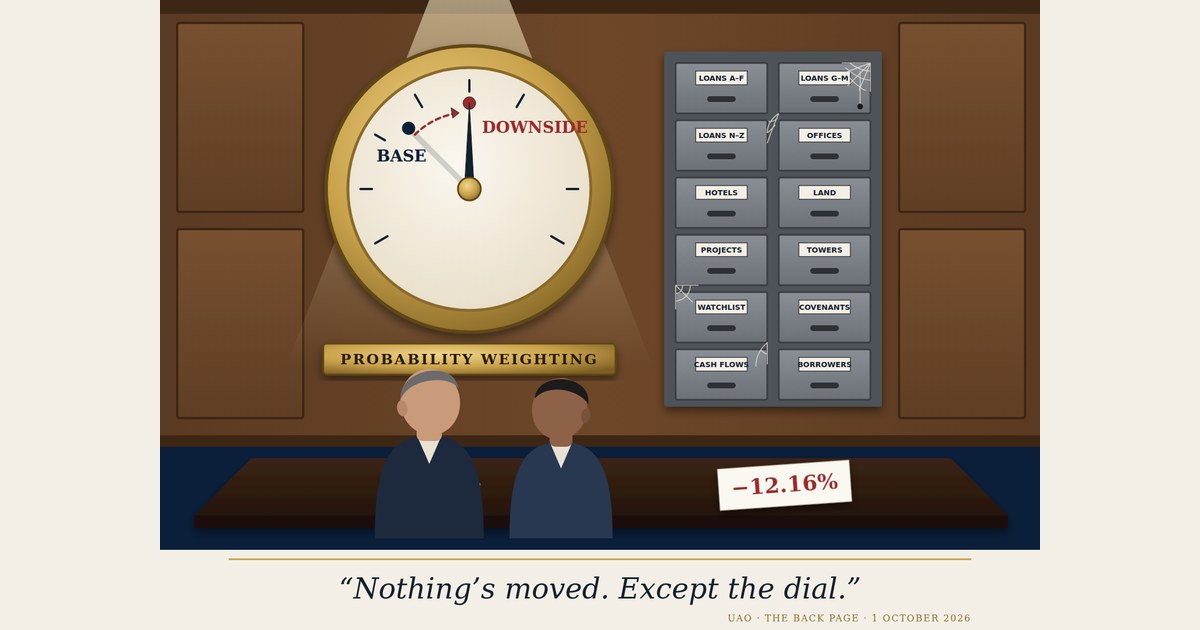
The private side, as the documents record it. The three Metrics funds — Metrics Master Income Trust, Metrics Income Opportunities Trust and Metrics Real Estate Multi-Strategy Fund — were suspended from quotation on 28 September at their own request. On 30 September each lodged a notice that KPMG “would not be in a position to provide its audit opinion on the financial report by 30 September 2026”, and from 1 October the ASX continues the suspension until the audited financial statements are lodged and reinstatement is “otherwise appropriate”. Against the preliminary reports lodged on 31 August, expected net tangible assets as at 30 June were revised by 12.16% at the real estate fund, 10.08% at the income opportunities trust and 1.99% at the master income trust — the first two driven by commercial real estate and private equity fair value, the third by loan expected credit loss only. [3]
Reuters reported on 30 September that Metrics said KPMG disagreed with assumptions in the preliminary reports, including how fair value was calculated for unlisted commercial real estate equity. The ASX notices themselves say only that KPMG “would not be in a position to provide its audit opinion on the financial report by 30 September 2026” and that an unmodified opinion is still expected. Hold both. [1]
The responsible entity’s own explanation is that “greater weight was given to downside scenarios than in the Preliminary Final Report”. Nothing in the notices says a borrower stopped paying; watchlist exposures were “unchanged” at all three. This is a valuation event, not a credit event — and the same notices suspended publication of net asset value, applications and redemptions in the underlying funds, with no end date. [3]
In London, St. James’s Place suspended the St. James’s Place Diversified Assets (FAIF) Unit Trust on 30 September and is applying to the Financial Conduct Authority for approval to close the fund. The fund “has been and continues to be managed by KKR”, which will manage it through the wind-up and has waived its fees. The sequence is SJP’s own: “On 29 September, an offer was accepted to sell all the Fund’s private market exposure” — a sleeve that was “less than a quarter” of the fund — leaving publicly traded bonds and cash. SJP names no buyer, discloses no price, and gives no discount to carrying value. Its stated reason for selling the sleeve in one block is price rather than speed. [4]
The trade happened, it cleared a diversified private sleeve in a day, and it will never appear in anyone’s comparable-transactions file.
Collateral. For schemes that hedge rates, a sharp long-end move can generate collateral demands even while the accounting value of liabilities improves. Whether that becomes a liquidity problem depends on hedge design, collateral buffers, asset liquidity and the timing of private-market cash flows — and those differ enough between schemes that no general claim is available.
What can be said is narrower and still worth a board’s time. The Financial Policy Committee, meeting 25 September, recorded gilt repo dealer net cash lending to key non-bank financial sectors rising “from around £100 billion to around £200 billion” since 2023 — a figure that sits in the record’s discussion of hedge-fund leverage. That is the pipe through which collateral demand travels, and the Committee has just said the likelihood of interconnected vulnerabilities crystallising has risen. The same record says “most liability-driven investment funds continued to operate with substantial buffers”. In the same week, two private vehicles suspended dealing or pricing. No document connects those facts, no scheme has disclosed a collateral action, and neither suspended vehicle is UK-pension-facing at any disclosed scale. The connection is a question to ask at the next investment committee, not an event to report. [2]
The structural number underneath. An OECD Economics Department working paper by Yvan Guillemette, published 29 September, estimates that the median country in a 35-country set would require a fiscal adjustment of 4.7 percentage points of GDP between 2027 and 2060 to hold debt ratios near current levels if service standards and benefit entitlements are maintained, with ageing named as the driver. That is a conditional model, not a budget — but it is the fiscal arithmetic sitting under a 30-year gilt at a 1998 high, and a long-horizon owner is on both sides of it. [6]
What decision it could affect. Whether your collateral waterfall assumes access to vehicles that can suspend — and whether anyone has asked what the waterfall looks like if the rate move and the valuation revision arrive in the same month.
People moves and open seats
GIC. The changes GIC announced on 10 July take effect today. Choo Yong Cheen, CIO for Private Equity, is concurrently appointed Deputy Group Chief Investment Officer, overseeing private equity, real estate, infrastructure and the Integrated Strategies Group. Liew Tzu Mi is appointed Deputy Group CIO with responsibility for total portfolio research and strategy, retaining her leadership of PESG and stepping down as CIO, FIMA. Liang Jiajie becomes CIO for FIMA while remaining Head of Global Macro. The group CIO role is not vacated: what changes is the coverage map, with a named cross-private-markets deputy now sitting above real estate, infrastructure and Integrated Strategies. [30]
USS Investment Management. Rita Bajaj joins the USSIM board as a director on 1 October and, subject to FCA approval, becomes chair on 1 January 2027, succeeding Sarah Bates, who stands down at the end of 2026. Dame Kate Barker stands down as chair of the trustee company in July 2027. The directorship starts today; the chair does not, and it remains conditional. [31]
Irish Life Group. Kieran Dempsey, chief investment officer for Irish Life Group and Canada Life Europe, will retire in March 2027, according to the Irish Times, which reported that staff were told on 29 September. There is no company release and no successor has been named. [32]
Future Fund. The search is for a chief executive, with Raphael Arndt departing at the end of 2026. The chief investment officer is Richard Brandweiner, in post since 1 July; that seat is not open.
Open seats.
| Institution | Seat | Close |
|---|---|---|
| Northern LGPS | Senior Investment Officer, Bradford — one of twelve roles posted together on the council portal | 8 October 2026, 17:00 |
| OPTrust | Director, Value Creation, Private Markets, Toronto (two postings) | 2 October 2026 |
| Hawaii Employees’ Retirement System (about $26 billion) | Chief Investment Officer — recruitment in process | Not stated |
| LGPS Central | Head of Investment Centre of Excellence, Wolverhampton — vacancy live, no further details published | Not stated |
Northern LGPS is the one worth a second look: a pool “creating an FCA authorised investment management company” and posting twelve roles together is building an institution, not filling a vacancy. Still open: the chief-executive search at the Future Fund and the chief-investment-officer searches at TRS Texas and PensionDanmark. [34]
Stage named on every item
Stage named on every item. An MoU is not capital; a framework is not a commitment; a filing date is not a launch date.
CPP Investments → Transurban · about A$4.5 billion · SIGNED, NOT CLOSED. CPP Investments has agreed to sell its 10.5% interest in WestConnex (held through Sydney Transport Partners) and its 25% interest in NorthWestern Roads Group — Westlink M7 and NorthConnex — for “gross proceeds of approximately A$4.5 billion (C$4.5 billion)”, subject to closing adjustments, taxes and costs. Transurban states “total cash consideration” of A$4.5 billion, “inclusive of any stamp duty”; neither issuer reconciles the two. Both acquisitions remain subject to Australian Competition and Consumer Commission clearance, completion is anticipated during calendar 2027, and the valuation date is agreed as 31 March 2027. On completion Transurban rises to 60.5% of Sydney Transport Partners and 75% of NorthWestern Roads Group. CPP discloses no gain, no return and no holding period. [7]
La Caisse, the other Canadian holder in the same concession, has not commented. An incumbent operator rising to 60.5% of the holding vehicle changes the buyer set for every other limited partner in that concession.
Nuveen completes its acquisition of Schroders · 1 October · CLOSED. Combined assets are stated as $2.6 trillion as of 30 June 2026. Decided: completion; Schroders operating separately within Nuveen for 12 to 18 months under Richard Oldfield; London as non-US headquarters. Intended: a unified investment platform “over time” led by Saira Malik as Chief Investment Officer, and a $400 billion private markets platform — a figure with no footnote, date or basis given. The release says nothing about client mandates, guidelines or fees. [9]
Nest → Wellington · £3.5 billion · REPORTED MANDATE, NOT NEW CAPITAL. Reuters, 1 October: Nest has moved its entire £3.5 billion emerging-market equity allocation from Northern Trust passive management to Wellington. A manager change on an existing book, not an allocation. [11]
Ohio PERS · $800 million · ALLOCATED, NOT DRAWN. According to IPE Real Assets, citing a board document: $400 million to an Ohana Real Estate Investors separate account, $200 million to Axonic Commercial Real Estate Fund III, $200 million to Affinius Tactical Partners IV. An allocation is not a drawdown. [12]
Athora Netherlands → Zwitserleven · €1.3 billion · REPORTED COMPLETE. According to Financial Investigator, the Dutch section of BP’s Belgian-domiciled pension fund, with about 5,000 participants, has transferred to the insurer with indexation linked to European inflation. Indexation and longevity move from sponsor to insurer only if the register confirms it. [13]
Audax Private Debt · Direct Lending Solutions Fund III · FINAL CLOSE. $5.4 billion in equity commitments at the hard cap, against a $4 billion target, with “$10 billion of investable capital” including targeted leverage and co-investing vehicles. The predecessor raised $3 billion of equity in 2022: equity in direct lending nearly doubled fund-on-fund, into the asset class whose retail-channel redemption pressure the Financial Policy Committee could describe only qualitatively five days earlier. [14]
CPP Investments → Prestige Hospitality Ventures · INR 30 billion · 29 September. About 27% of the platform, with the majority of the capital supporting expansion; CPP names no conditions and no completion date, so the stage is unstated. [15]
Temasek · Riyadh and Abu Dhabi · INTENTION, SUBJECT TO APPROVALS. NO CAPITAL. Offices expected to open in the first half of 2027 subject to statutory approvals. No capital commitment is announced and no Doha office is announced. [16]
The yardstick was replaced, and the number did not move
The yardstick was replaced, and the number did not move. The Bureau of Economic Analysis released Personal Income and Outlays for August 2026 on 30 September, carrying the annual update of the national accounts with revisions back to January 2021. The PCE price index rose 3.4% on the year; core 3.0%. The figure that matters is July’s: at the prior vintage July core was 3.3%; on the revised series it is 3.0%. On the current series core PCE has printed 3.0% for three consecutive months. There is no disinflation in that string. “Core cooled from 3.3% to 3.0%” is an artefact of comparing two vintages. Next release 29 October. [17]
The Federal Reserve Bank of New York. John Williams, 29 September: “With the policy action we took at our September meeting, there is no need for urgency.” And: “If the economy evolves in a manner broadly consistent with my forecast, one further upward adjustment of the federal funds target range may be appropriate late this year” — “But that is just my forecast.” The September meeting raised the target range to 3.75–4.00%; the September projections put the median at 4.1% for end-2026, which implies one more increase by December. Next meeting 27–28 October. [19]
UK bulk annuities — two houses, one number. LCP, 22 September: first-half buy-in volumes of £10.2 billion across 135 transactions, with only one deal above £1 billion; Rothesay the largest writer at £2.8 billion, a 28% share, over 14 transactions; deals under £100 million around 80% of transactions by number, up from about 55% five years ago; pricing “3% better than at the start of the year”. PIC appears in LCP’s table at 3%, ranked ninth. Hymans Robertson, 28 September: 138 buy-ins in the half, also about £10.2 billion, at an average of about £74 million. The two houses count different things, and the figures are not reconciled here. [21]
The retail vote was rewired twice on the same day
The retail vote was rewired twice on the same day. On 29 September the SEC’s Division of Corporation Finance told Tesla, Inc. it “will not recommend enforcement action” in respect of an Issuer Voluntary Retail Voting Program: voluntary enrolment, a preset standing instruction applied at future meetings, override and opt-out at no cost, annual reminders. The letter’s own language makes it a market-structure event: “The Division position expressed above applies to any issuer operating an IVRVP in the same manner described in your letter.” It provides nowhere for a standing instruction against a board recommendation, and it cites no precedent. [23]
A second letter on the same day reaches a different population. The Division of Investment Management responded to the Mutual Fund Directors Forum, taking the position that staff would not recommend enforcement if a registered fund or business development company operated a directed voting program under which a retail holder may give a revocable standing instruction to vote with recommendations approved by the board, including every independent director. Its limits are real: contested elections and changes to the primary advisory agreement sit outside the relief. Neither letter is a Commission rule; neither went through notice and comment. [24]
Why it reaches a fiduciary: institutional influence at a meeting is a ratio, and a standing instruction converts part of the retail non-vote into reliable, board-aligned turnout. A rising retail participation statistic at a fund with such a programme is evidence of enrolment, not of independent oversight.
Set beside the other direction: 62 investors representing around £3.8 trillion wrote to the chairs of 90 FTSE 100 companies — excluding investment trusts and REITs — asking for an advisory vote on climate transition plans at least once every three years. Four companies held one in 2026; 13 in the last three years. A mechanism that reliably delivers board-aligned votes was created by staff letter in a day; a request for a non-binding vote once every three years is in its sixth year. [28]
Disclosure flexibility and fiduciary control are diverging. Two regulators moved on the same day, and the temptation is to call it a split. It is not, because they are not regulating the same thing. The FCA sets what issuers must disclose. APRA is proposing how trustees must govern what they put in front of members.
In the United Kingdom, the FCA’s PS26/19 preserves flexibility in how issuers explain sustainability risk: UK SRS on comply-or-explain across S1, S2 and Scope 3, for accounting periods beginning 1 January 2027, where the consultation had proposed mandatory S2. A comply-or-explain regime reduces the issuer’s burden and raises the owner’s. Comparability is no longer automatic, and an “explain” can mean three different things: immaterial exposure, material exposure with a credible account of it, or a gap the issuer would rather not describe. Telling those apart is now the owner’s job, not the regulator’s — which moves disclosure minimums into mandate guidelines, manager-selection criteria and voting policy. The change underneath: international commercial companies with a secondary listing and depositary-receipt issuers must now report against UK SRS rather than signpost home-jurisdiction disclosures; the FCA’s own cost-benefit analysis counts 89 such issuers. [25]
In Australia, APRA published a discussion paper and a marked-up draft of Prudential Standard SPS 530 proposing member-level limits on higher-risk investments, stronger management of investment-related conflicts and oversight resources matched to menu size and complexity, written against the Shield and First Guardian failures. APRA’s preliminary view is that a maximum limit of 20 to 30% may be appropriate — a percentage of a member’s own superannuation interest, capping the limit a trustee sets, written in square brackets in the draft standard, and posed as an explicit consultation question. Submissions close 3 February 2027; commencement of 1 January 2028 is conditional on the consultation. [27]
An owner operating across both systems does not face less scrutiny. It faces more uneven evidence, and a heavier burden of proving its own governance where the issuer’s disclosure gives it less to work with.
Three warnings, no names, no attribution
On 30 September the UK Maritime Trade Operations centre issued delayed warnings 144-26, 145-26 and 146-26, classifying as attacks three incidents of 29 September in which tankers in the Strait of Hormuz were struck by “unknown projectiles”, with a separate late report covering a vessel struck late on 28 September and a fire subsequently extinguished. UKMTO names no vessel and attributes nothing. [29]
The owner-level read is narrow and it is about insurance, not barrels. Throughput can recover while war-risk cover on the southern corridor tightens or withdraws. Windward put 16 transits on 30 September, six of them dark. The variable to watch is whether a laden vessel on that corridor can still get hull and cargo cover, and at what rate.
What is verified, what is this desk’s
SIG-20261001-D · Collateral demand meeting suspended vehicles. Status: early observable. Verified: the 30-year gilt traded as high as 6.029% on 1 October (Reuters, citing LSEG); the FPC recorded gilt repo dealer net cash lending to key non-bank financial sectors rising from around £100 billion to around £200 billion since 2023; two private vehicles suspended dealing or pricing in the same week. Evidence against: UK LDI collateral practice has been rebuilt since 2022 with materially higher headroom; the FPC records resilience, not stress, and says most LDI funds operate with substantial buffers; higher yields reduce liability values. The join is this desk’s, and no document makes it. Analytical conviction: low. Next catalyst: FPC meeting 19 November, record 26 November. [1]
SIG-20261001-E · Disclosure flexibility and fiduciary control diverging. Status: confirmed on both instruments; developing on the divergence. Verified: FCA PS26/19 on comply-or-explain; APRA’s SPS 530 consultation. Evidence against: these address different problems — issuer disclosure versus trustee product governance — and the FCA says the change is not significant against the TCFD status quo. Analytical conviction: medium. Next catalysts: 28 October, FCA feedback on GC26/6; 3 February 2027, APRA submissions close. [25]
Which leg was marked by a market
Read classification: system-wide.
This week a funding ratio was revalued from both ends by machinery that has nothing in common. The denominator — liabilities — was priced off a market curve that quotes continuously, adversarially and in public, and that moved 87 basis points in a quarter and through a 1998 line in a morning. The numerator — assets, or at least the private part of them — was repriced by a committee, once, behind a suspension, in a process whose disclosure names no actor and whose clearing price, where one existed, was not published.
The question is not whether the private valuations are wrong. It is whether a board can explain the evidence, the timing and the governance behind a funding-ratio improvement when the two sides of the balance sheet have been repriced by different mechanisms — one continuously and visibly, the other periodically and through judgment.
On the funding ratio, with the sign stated. A lower yield raises the present value of liabilities; a higher yield lowers it. An unhedged scheme books relief this week large enough to obscure an asset-side revision arriving at the same time. A hedged scheme books no relief and carries the asset-side revision alone. The governance failure available here is not mispricing — it is netting: reporting a funding ratio that improved without saying that one leg was marked by the market and the other by a valuation committee.
On the marginal buyer. The SEC’s “responsible retailization” package would move the marginal buyer of private assets toward vehicles carrying a periodic repurchase obligation; on the same day APRA proposed member-level limits on higher-risk investments. An owner operating in both systems is being asked to underwrite two different theories of who should hold this risk. [35]
Contrary evidence, actively sought. The collateral join is this desk’s, not any document’s. Higher yields are, on balance, good news for most funding ratios; the argument here is about measurement asymmetry, not direction. And the yield levels themselves are contested — six to ten basis points of vendor disagreement on the same morning, and no Treasury par close.
The Investment Committee Question. When our funding ratio is next reported, which leg was marked by a market and which by a valuation committee — and if we had to post collateral in the same month a private vehicle suspended, where would it come from?
The yardstick moved. The number did not.

Podcast · The Universal Owner
| Apple Podcasts | Spotify | Podbean |
Two papers, one argument at two horizons
OECD Economics Department working paper, Yvan Guillemette, published 29 September 2026. The median country in a 35-country set would need a fiscal adjustment of 4.7 percentage points of GDP between 2027 and 2060 to hold debt ratios near current levels if service standards and benefit entitlements are maintained; ageing is the named driver and the model is conditional. The finding that changes an allocator’s understanding is the horizon: a 2060 adjustment path is inside the liability duration of every open defined-benefit scheme in the set, which makes it an input to the discount-rate assumption rather than a macro aside. [6]
Fernández-Villaverde and Norrick, “Terra Incognita: The Economics of a Shrinking World”, NBER working paper w35809, September 2026. The common global fertility component peaked in 1978; what drives fertility now is 236 country-specific trends, “219 of them negative and not one leveling off”. Diversifying a liability book across countries buys less protection than the common-factor story implies — not because the process is global, but because the direction is negative everywhere. [33]
Put the two together and they are the same argument at two horizons.
Next triggers
- 1 October 2026 — the three Metrics audited financial reports remain unlodged; ASX requires lodgement and that reinstatement be “otherwise appropriate”. Both conditions undated. [3]
- 2 October 2026, 08:30 EDT — US September employment report; the single most likely source of a second leg in the long-end move.
- 8 October 2026, 17:00 — Northern LGPS, twelve roles close.
- 27–28 October 2026 — FOMC; no Summary of Economic Projections. [20]
- 28 October 2026 — FCA feedback on GC26/6 closes. [26]
- 29 October 2026, 08:30 EDT — BEA Personal Income and Outlays, September: the first clean month-on-month comparison on the revised series. [17]
- 19 November 2026 — FPC meeting; record 26 November. [2]
- 1 January 2027 — FCA PS26/19 applies to accounting periods beginning on or after this date; USSIM chair transition, subject to FCA approval. [25]
- 3 February 2027 — APRA submissions close on SPS 530. [27]
- 31 March 2027 — agreed valuation date on the CPP–Transurban transaction; completion guided for calendar 2027. Booking A$4.5 billion as 2026 dry powder double-counts. [8]
For ongoing research and briefings for your investment team, explore UAO membership. To receive the Daily Brief, subscribe at Universal Asset Owners.
The Back Page — meet The Allocator
Sources & citations
More from Universal Asset Owners
- The previous edition (2026-09-30)
- Every daily brief, newest first
- Chart of the Day archive
- The Probability Desk — scenario trees and base rates
- Watch — the daily briefings and The Back Page
- The Registry — Top 100 asset owners and their people
- Universal Owner Careers — open seats at the funds we track