
98% of the world’s sovereign wealth funds |
18 of 20 of the world’s largest pension funds |
10 of 10 of the largest charitable foundations |
85% of the world’s largest family offices |
100+ billionaires, every morning |
Canada’s pension fund sold. Norway and Abu Dhabi bought. The price is the news.
India’s National Stock Exchange placed ₹6,746 crore of shares with anchor investors on Wednesday 16 September. Norway’s sovereign fund and the Abu Dhabi Investment Authority were among the buyers; the filed prospectus names CPP Investments among the sellers, exiting part of a stake at about five and a half times its cost. The price sits below where NSE shares were quoted in India’s unlisted market — and on the same day, the Federal Reserve raised rates and signalled they stay up.

India’s National Stock Exchange allocated 37,793,739 shares to 189 anchor investors at ₹1,785, the top of its ₹1,700–₹1,785 band, for ₹6,746.18 crore, according to the exchange’s regulatory filing on Wednesday, 16 September. The public offer opened this morning and closes on 21 September.
Life Insurance Corporation of India — NSE’s largest shareholder — took the largest single allocation, about ₹400 crore. The filing shows Norway’s Government Pension Fund Global allocated about ₹250 crore, and the Monetary Authority of Singapore and the Abu Dhabi Investment Authority about ₹200 crore each. Foreign portfolio investors took roughly 43% of the anchor book.
(Dollar translations of the anchor book are circulating at about US$703 million and about US$760 million. They imply exchange rates roughly eight rupees apart — defensible on different conversion dates, but not interchangeable. The rupee figure is the one the exchange reported, so it is the one we print.)
The offer is entirely an offer for sale. NSE receives nothing. Every rupee goes to existing shareholders — and the prospectus names them.
CPP Investments is one. NSE’s offer document lists Canada Pension Plan Investment Board as a corporate selling shareholder offering up to 11,874,060 shares, at a weighted average acquisition cost of ₹324.13 a share. The prospectus shows CPP holding 39,580,200 shares, or 1.60% of the exchange, before the offer — so it is selling 30% of its position. At the top of the band that is about ₹2,120 crore for shares that cost about ₹385 crore: roughly 5.5 times cost. The other large sellers are Indian state institutions — State Bank of India, Bank of Baroda, General Insurance Corporation, New India Assurance — alongside MS Strategic (Mauritius) and Aranda Investments (Mauritius), a Temasek-linked vehicle.
So one of the world’s largest pension funds sold, and two of the world’s largest sovereign funds bought, the same asset, on the same day, at the same price.
What the price says — and what it doesn’t
At ₹1,785, NSE is valued at about ₹4.42 lakh crore, roughly 43 times its FY2026 earnings per share of ₹41.62. That is below where NSE shares have been quoted in India’s grey market: one unlisted-share platform showed ₹2,059 on 16 September.
That distinction is the useful one. The public book cleared below the informal market — and far above what the seller paid. Both statements are true. Which one matters to an owner depends entirely on which reference price its appraisal was anchored to.
Why the discount may be earned. NSE’s own prospectus says FY2026 transaction-charge revenue fell as trading volumes dropped across cash, options and futures following SEBI’s measures to tighten the equity-derivatives framework; futures transaction revenue alone fell 14.31%. A discount to grey-market enthusiasm may simply be an accurate price for a regulated, derivatives-dependent exchange whose largest revenue line just shrank.
And the public bid is not always there. On the same Wednesday, Holtec Nuclear suspended a US IPO that had sought up to US$900 million, citing market conditions — as recent nuclear listings Standard Nuclear and X-Energy traded about 21% and 37% below their offer prices. A private mark can meet a public bid. It can also meet no bid at all.
Notice what the usual objection cannot do here. The comfortable reading of a repricing is that sophisticated money took advantage of someone. That reading is unavailable. The seller is one of the most capable institutional investors in the world. So are the buyers. This is not smart money repricing dumb money. It is the same money, repricing itself, in public, with everyone watching.
The rate underneath it
Hours later, the Federal Open Market Committee voted 12–0 to raise the target range a quarter point to 3.75%–4.00%, its first increase since 2023, with a statement that inflation “remains elevated” and that uncertainty is elevated “owing, in part, to geopolitical developments.” The median participant now puts the policy rate at 4.1% at the end of 2026 and 4.1% again at end-2027, up from June medians of 3.8% and 3.6%. The 2028 median rose to 3.9% from 3.4%.
Go one level below the median and the picture sharpens. Today’s midpoint is 3.875%. For end-2027, eight of 18 participants project 4.375%, six project 4.125%, and only four project anything below today’s rate. No one projects today’s rate itself. That is a statement about where the rate sits at year-end, not a count of who expects a cut during 2027 — rates could rise and then fall, and anonymous annual dots cannot be joined into individual paths.
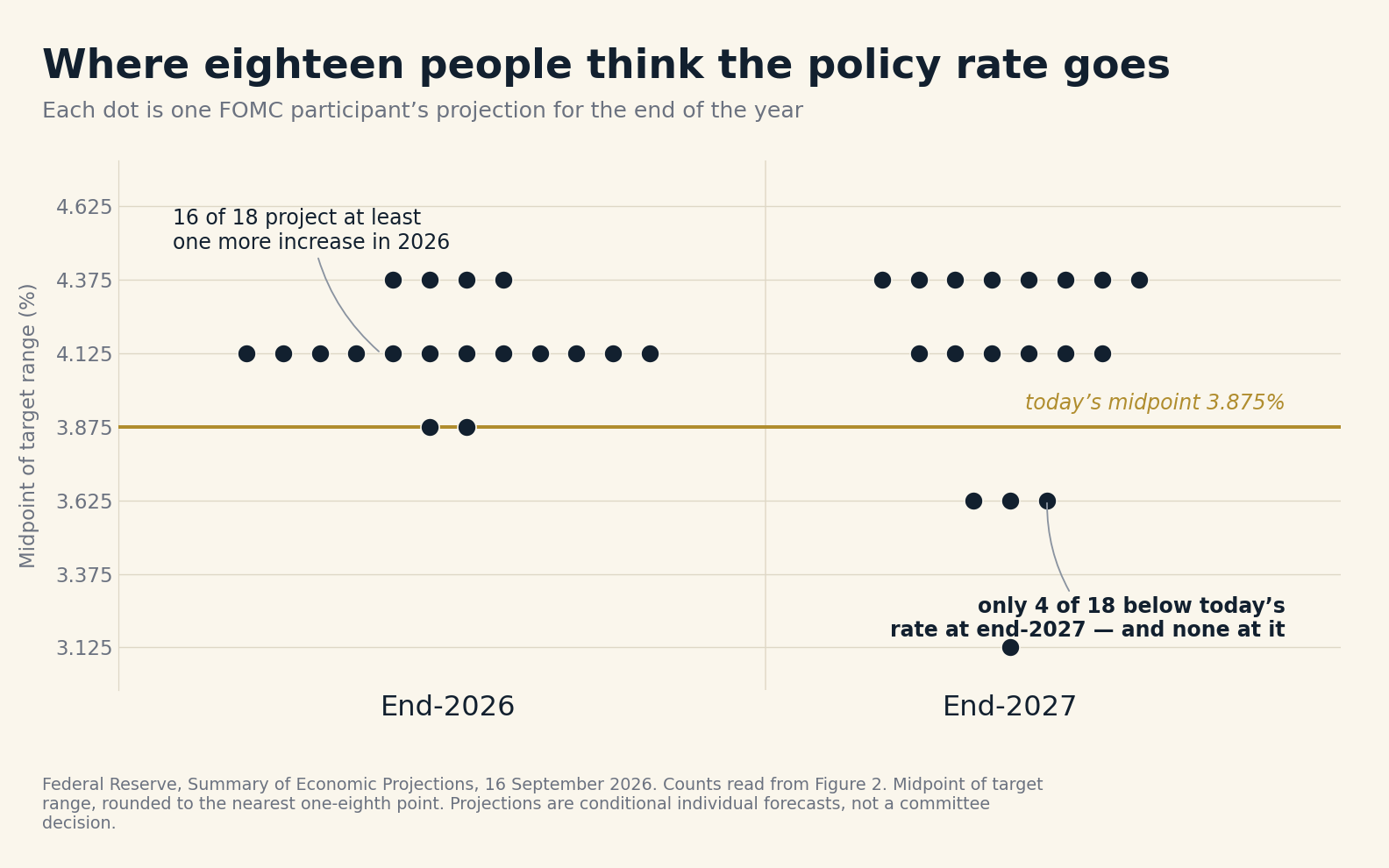
The dots are conditional individual forecasts, not a commitment; they have been wrong in both directions. But they tell an investment committee which assumption now carries the burden of proof. An asset whose equity case needs refinancing at materially lower rates in 2027 is making a forecast shared by four of 18 central bankers.
Put the two together. A public book priced a long-held private stake on the same day the discount rate beneath every private stake moved up and was projected to stay up. For CPP Investments, the exit crystallised a large gain on a low-cost position. For owners holding private assets bought at recent marks — not decades-old cost — the same arithmetic runs the other way.
NSE is one asset, and a particular one: a regulated, concentrated, derivatives-dependent exchange whose largest revenue line just contracted. Nothing here suggests a forced seller. Rotating out of a mature holding at a price you chose, into a public book you helped open, is what a disciplined owner does.
Know your reference price. A “discount” means nothing until you name the comparator: cost, last appraisal, last secondary trade, or a grey-market quote. The NSE book was a discount to one and a 5.5x multiple of another. Ask your valuation team which reference each private mark is anchored to.
Separate cash-flow cases from exit cases. Assets underwritten on contractual cash flows survive a 4% plateau. Assets underwritten on a refinancing or exit event are carrying a rate view. Run the second list against the 2027 dot distribution — eight at 4.375% — not the median.
Price discovery is lumpy. NSE cleared with 189 anchors; Holtec did not price at all. Exits into public markets are available on the market’s terms and timetable, not the seller’s.
The question for this week’s investment committee: Which of our private marks needs the cost of money to fall — not merely to hold — before it is defensible, and what reference price is it really anchored to?
Four of eighteen
The median dot moved. The distribution beneath it moved further — and the private-credit data published the same week show where that bites.
There is a habit in reading the Summary of Economic Projections that costs institutional investors money: reading only the median.
The median is the ninth-and-tenth projection of eighteen, compressed into one decimal. For a trading desk that is often enough. For an institution setting a discount rate, running an asset-liability study or approving a refinancing assumption three years out, it is not — because what a long-horizon owner needs is the shape of the distribution.
Here is the shape the Fed published on 16 September (Figure 2, midpoints rounded to the nearest eighth).
End-2026: four participants at 4.375%, twelve at 4.125%, two at 3.875%. With today’s midpoint at 3.875%, sixteen of eighteen project at least one more increase this year and two project none. No one projects a cut.
End-2027: eight at 4.375%, six at 4.125%, three at 3.625%, one at 3.125%. The median is again 4.1% — hence the fair “no easing in 2027” headline.
But the median flattens something. The largest single cluster — eight participants — sits a quarter point above the 2026 median. Six hold at one-more-hike. Nobody sits at today’s rate. Only four are below it. This is not a committee expecting a normal easing cycle; it is a committee that mostly expects the rate to rise and then sit, with a small minority expecting relief and no one in between.
For a pension plan this cuts two ways, and they do not net.
On the liability side, a higher discount rate helps. The present value of promised payments falls as the discount rate rises, so funded ratios improve mechanically. (The sign is routinely printed backwards: lower yields raise liabilities; higher yields lower them.)
On the asset side, the same rate is a cost. Leveraged buyouts refinance at it, private-credit borrowers service at it, real estate caps against it, and infrastructure hurdles clear over it. A plan can post a better funded ratio and a weaker portfolio in the same period, and both numbers are honest.
Where the pressure is already visible. Fitch Ratings reported on 14 September that its US private-credit default rate reached 6.3% on a trailing-twelve-month basis through August — the highest in a series it began in 2024 — with 14 default events in the month, against three in July. Stressed maturity extensions were the most common default type.
That is worth holding next to the Bank for International Settlements’ September Quarterly Review, which traces how far private credit has moved toward technology. Using loan-level data on US direct lending, BIS economists Puriya Abbassi, Iñaki Aldasoro and Sebastian Doerr find tech borrowing rose from about US$22 billion (22% of private credit) in 2010 to over US$1 trillion (44%) by 2025. Their deeper finding is about underwriting: after 2020 the share of tech borrowers with negative EBITDA nearly doubled, from 23% to 46%, median leverage among profitable borrowers tripled, and spread dispersion narrowed — the interquartile range fell from 3.25 to 1.75 percentage points — even as lenders moved senior (first-lien share up from 77.6% to 92.2%). The authors conclude spreads may no longer fully account for borrower fundamentals.
Read together: today’s defaults are concentrated in old-economy sectors, while the fastest-growing slice of the asset class was underwritten more loosely and priced more uniformly. The software book is not where the losses are. It is where the untested assumptions are — and a rate path that stays near 4% through 2027 is precisely the test.
The third thing has no print. Public curves repriced on Wednesday afternoon. Private marks will not for a quarter or more, because appraisal is deliberately smoothed. That lag is a feature of the accounting, but it is often reported as diversification when it is measurement timing. An asset that has not been remarked is not an asset that has not moved.
The useful work is not to guess the discount. It is to know, asset by asset, which marks depend on a rate path that four of eighteen central bankers are forecasting.
The SEC proposes to delete the federal ballot
The Securities and Exchange Commission proposed on 16 September to rescind Rule 14a-8, the rule first adopted in 1942 that requires public companies to include qualifying shareholder proposals in their own proxy materials. The Commission says the rule exceeds its statutory authority and intrudes on state law; rescission would leave shareholder proposals to state law and company governing documents. Comments are open for 60 days after Federal Register publication. (Release 34-106383.)
The less-covered pieces matter more to a large owner. A companion amendment to Rule 14a-4(c) addresses proposals for which companies may seek discretionary proxy voting authority. A separate modernization release would eliminate the requirement to deliver an annual report to security holders, eliminate the requirement and ability to file Notices of Exempt Solicitation, and shorten the minimum broker search period from 20 business days to five.
Read together, the package changes the unit economics of stewardship rather than its legality. Rule 14a-8 is the cheap, scalable way one institution puts a question on many ballots in a season. Replace it with state law, charters, bylaws and litigation, and the cost per question rises — hardest on smaller owners. Notices of Exempt Solicitation are how owners address a shareholder register without a full solicitation; removing them removes the cheap microphone alongside the cheap ballot. The state-of-incorporation field in a listed-equity book becomes portfolio data.
The countercase: the federal process imposes costs on all shareholders, a share of proposals are repetitive or immaterial, and state corporate law is not a vacuum. Rescission would not touch fiduciary duties, antifraud rules, voting rights or direct engagement. The real question is whether the replacement is a usable right at a proportionate cost — an empirical question a comment letter can inform.
The AI capital stack grows a bank layer
A group of 10 banks is providing a US$22 billion loan to Crux AI, the Blackstone–Alphabet cloud venture, to buy Google tensor processing units, Bloomberg News reported on 16 September, citing people familiar with the matter. The debt is backed by the chips’ value and Crux AI’s customer contracts; certain banks are also providing a US$1 billion revolver, and the loan could later be refinanced in the investment-grade bond market. Reported lenders include Goldman Sachs, SMBC, Barclays, BNP Paribas and Scotiabank. Blackstone committed US$5 billion of equity when the venture was announced in May.
Three disciplines: this is reported, not a filed or closed facility. The US$22 billion and US$5 billion have different purposes and timing, so dividing one by the other says nothing about leverage. And the collateral is the interesting part — accelerators with uncertain residual value, and customer contracts whose assignability is undisclosed. If the takeout works, the end holders of AI compute credit are pension funds and insurers.
Alongside it, a different structure with the same instinct. Generac disclosed in an 8-K that on 16 September it issued Amazon a warrant over up to 1,693,745 shares at US$200.9266, with 307,954 vesting immediately and the rest vesting as Amazon’s payments for data-centre generators rise toward US$8 billion. Initial deliveries under a new long-term supply agreement are expected to total US$2.4 billion in 2027–28. The US$8 billion is a vesting ceiling, not an order — several outlets reported it as the deal value. The strike sits about 15% above Generac’s US$175.11 close that day; the warrant is roughly 3% of shares outstanding.
The pattern: the anchor customer becomes buyer, financier and shareholder at once. For a universal owner holding both the customer and the supplier, value is moving between two holdings on terms negotiated by the larger one.
Pricing the storm that did not happen
On the centenary of the 1926 Great Miami Hurricane, Swiss Re Institute estimated on 16 September that a Category 5 hurricane striking Miami or Tampa Bay today could cause US$300 billion or more in insured losses — larger than any single insured event on record. A repeat of the 1926 Category 4 storm would cause around US$200 billion; Hurricane Andrew on its 1992 track, close to US$100 billion. The Institute’s trend puts global insured nat-cat losses at about US$148 billion in 2026 even without a Florida major.
At the Rendez-Vous de Septembre in Monte Carlo last week, Fitch Ratings’ Brian Schneider said property-catastrophe reinsurance pricing could fall another 10%–15% on a risk-adjusted basis at 1 January if major losses stay limited. KBW’s analysts heard executives broadly resigned to decreases of about 10%, and warned that 1/1 pricing usually lands worse than Monte Carlo expectations.
These are not in contradiction; the gap is the point. The market prices the cycle — last year’s losses and today’s capital. The Institute measures the exposure stock — how much insured value sits in the path. Only the second compounds. KBW cited broker modelling suggesting that turning an expected ~10% rate cut into a 7% increase would take roughly US$200 billion of catastrophe losses, a 200-basis-point rise in interest rates and meaningful adverse reserve development — a reminder that rates, too, sit inside reinsurance pricing.
For an owner, the exposure is less the insurance book than the property, infrastructure and municipal credit in the same footprint, and the public balance sheets that absorb what is uninsured.
DFC approves more than US$8 billion, and a number gets corrected
The US International Development Finance Corporation’s board approved more than US$8 billion in new investments on 16 September, including a counter-guaranty to IFC’s Global Trade Finance Program; financing for Vodafone Ukraine; a 200MW/400MWh battery storage portfolio across six sites in Ukraine developed by DTEK with Fluence technology; a loan to Jordan’s National Carrier Project Company desalination and conveyance project, with political risk insurance for equity investors Meridiam and Suez; an equity investment in WIOCC Group; and a critical minerals project in West Africa. DFC says some transactions remain subject to further steps before commitment and closing, including congressional notification.
417–3, and the bill does not say “data centre”
The House passed the Ratepayer Protection Act (H.R. 9340) on 16 September by 417–3, on a motion to suspend the rules and pass as amended (roll call 312). It is not law; the Senate has not acted.
The bill is widely described as a data-centre bill. The introduced text never uses the term. It defines a “large-load customer” as a non-residential consumer with peak demand of 100 megawatts or more at a single site or campus, and adds a PURPA standard that rates to such customers be designed to recover “the full, incremental cost of any generation, transmission, or distribution upgrade necessary to serve the load,” with financial assurances required before upgrades. (We cite the introduced text; the House passed an amended version and the engrossed text has not been posted, so the final definition may differ.)
The distinction is not pedantry. A 100MW threshold catches large industrial and electrolysis loads as well as hyperscale computing, and PURPA standards oblige state commissions to consider them, not to adopt a tariff. A 417–3 vote supplies political cover to commissions already minded to act. For regulated-utility owners the asset at risk is the stranded upgrade; for owners of compute, the marginal cost of power.
Capital in motion
- Cohere and Aleph Alpha signed a definitive merger on 16 September; the combined company will operate as Cohere with headquarters in Toronto and Berlin. Schwarz Group is investing €500 million and supplying compute through STACKIT. The roughly US$20 billion figure dates from the April announcement; updated terms were not disclosed. Regulatory approval required.
- PSP Investments and an Ares Real Estate fund formed a joint venture to invest up to US$2.4 billion in US logistics, seeded with 14 properties totalling 5.2 million sq ft in California, Texas and New Jersey; Marq Logistics will source and manage. Equity split not disclosed.
- Brookfield signed a binding scheme implementation deed for Reliance Worldwide at US$3.38 a share in cash (A$4.75), implying an enterprise value of about US$2.9 billion — an enterprise value, not a deal or equity value. Go-shop to 15 October; implementation expected in Q1 2027. AustralianSuper and Aware Super hold about 20.2%; AustralianSuper voted against Brookfield’s Origin Energy bid in 2023. Signed, not closed.
- Mubadala-backed Aldar acquired Masdar City Square, a nine-building commercial campus of about 47,000 sq m, for AED918 million, reporting about 99% occupancy. Occupancy is not yield; the capitalisation rate was not disclosed.
- Brazil’s Copom cut the Selic 25bp to 13.75%, its fifth consecutive reduction, on the day the Fed hiked; its reference scenario still projects 5.2% IPCA inflation for 2026. Hong Kong’s base rate moves to 4.25% under the HKMA’s formula (Fed lower bound plus 50bp), importing US policy through the currency peg.
- Holtec Nuclear suspended a US IPO that had sought up to US$900 million (50 million shares at US$15–18), citing market conditions.
Risk Radar
| Signal | Status | Evidence | Confirms | Kills |
|---|---|---|---|---|
| Private-to-public valuation reset | Live | NSE anchor book at ₹1,785, below unlisted quotes; Holtec IPO suspended | NSE lists below issue on 24 Sep; more IPOs pulled | NSE aftermarket holds well above issue |
| Higher-for-longer policy rates | Live | FOMC SEP, 16 Sep — 4 of 18 below today’s rate at end-2027 | A further hike this year, as 16 of 18 project | Inflation undershoots the 2026 PCE median |
| Shareholder-rights fragmentation | Proposed | SEC release 2026-89 | Final rule adopted; state-law replacements litigated | Proposal withdrawn or narrowed |
| Large-load cost allocation | House-passed | Roll call 312, 417–3 | Senate action; state dockets open | No enactment |
| Catastrophe exposure vs soft pricing | Standing | Swiss Re Institute, 16 Sep; Monte Carlo 10–15% guidance | A peak-peril loss before 1/1 | 1/1 renewals soften as guided |
| Hardware-backed AI credit | Reported | Crux AI US$22bn loan (Bloomberg, 16 Sep) | Facility closes, refinances into IG | Residual values or contract assignability fail diligence |
| Private-credit underwriting drift | Live | BIS QR, 14 Sep: tech 44%, negative-EBITDA borrowers 46%; Fitch default rate 6.3% | Software defaults rise from 0.6% as maturities arrive | Software defaults stay low through 2027–28 maturities |
The Job Board · Open Seats
Careers — moves
- Lori Heinel will retire as global CIO of State Street Investment Management in March 2027 after 12 years at the firm, staying in the role until then; no successor named. SSIM reported US$6.28 trillion in AUM at 30 June. For pensions and sovereigns using it as an index, ETF or transition-management counterparty, this is a manager-diligence item now, not in March.
- Creative Planning agreed on 15 September to acquire RVK, an institutional consultant advising just over 200 clients, expected to close in January 2027. RVK’s “$4.3 trillion” is assets under advisement — non-discretionary advice. Its regulatory AUM is about US$828 million per Form ADV. It is not an AUM number and should not be added to one.
Long Horizon — the contribution base moves before the headline does
Beat 8: demographics, longevity and liabilities.
A plan’s solvency has two engines. One is the return on assets, which gets the attention. The other is the flow of contributions, which depends on how many people are employed, in which occupations, at what wages — and which is projected decades out on an employment path that is rarely revisited.
Forecasts now circulate that put occupational employment well off official baselines, with declines concentrated in clerical and financial-specialist roles that sit at the centre of many contribution bases. We are not printing them: they are exposure estimates, not causal labour-demand models, and the historical record of new-task creation is the serious counterargument.
The point does not depend on any of them being right. An actuarial valuation contains an employment assumption, and it is far less often stress-tested than the assumptions beside it. Discount rates are debated for months and mortality tables are updated on a cycle, while projected covered payroll typically inherits a government baseline. Actuarial Standard of Practice No. 51 already asks plans to assess contribution risk — the risk that actual contributions differ materially from expected — which is the doorway this walks through.
The long-horizon work is to run the valuation twice: once on the baseline, once with covered payroll in the plan’s own occupational mix growing two points slower. Over five years that compounds to about 9.3% less covered payroll than baseline ((1.01÷1.03)5 − 1). That is a payroll figure, not a funded-ratio decline. If the amortisation schedule still closes, the assumption was not load-bearing. If it does not, the plan has a second solvency engine it has never modelled.
Week Ahead — the high-signal three
- NSE’s listing, 24 September (tentative). The first aftermarket print tells owners whether the grey market or the anchor book had the better read — and sets the reference for every Indian market-infrastructure stake still held privately.
- Large-load disclosures. After a 417–3 House vote, listen for the first company to disclose a connection deposit, financial assurance or minimum bill — the language the bill’s “financial assurances” clause points toward.
- Reinsurance renewal advisories. Monte Carlo guided 10–15% softer for January; Swiss Re sized a single Florida landfall above US$300 billion. The first broker advisory that reconciles the two — or refuses to — is the document worth reading.
- And one that lands before you read this: the Bank of England decides at 07:00 EDT today. This edition closed before that, and nothing here should be read as knowing the outcome.
The Back Page

Sources
- Federal Reserve — FOMC statement, 16 Sep 2026 — www.federalreserve.gov
- Federal Reserve — Summary of Economic Projections, 16 Sep 2026 — www.federalreserve.gov
- NSE — Draft Red Herring Prospectus (selling shareholders, weighted average acquisition cost) — www.bseindia.com
- ANI — NSE mobilises ₹6,746 crore from anchor investors — aninews.in
- SEC — Release 2026-89, rescission of the shareholder proposal rule — www.sec.gov
- DFC — More than $8 billion in investments — www.dfc.gov
- DFC — Public Information Summary, DTEK BESS — www.dfc.gov
- Clerk of the House — Roll Call 312, H.R. 9340 — clerk.house.gov
- GovInfo — H.R. 9340 as introduced — www.govinfo.gov
- BIS Quarterly Review — Financing the digital economy: the role of private credit — www.bis.org
- Generac Holdings — Form 8-K, 16 Sep 2026 — www.sec.gov
- Artemis — Swiss Re Institute on a Cat 5 Florida hurricane — www.artemis.bm
- Business Insurance — Reinsurance buyers set to see lower prices at renewals — www.businessinsurance.com
- Ares / PSP Investments — logistics joint venture — www.stocktitan.net
- Reuters via The Globe and Mail — Reliance Worldwide agrees to Brookfield buyout — www.theglobeandmail.com
- Reuters — Cohere and Aleph Alpha combine — finance.yahoo.com
- CIO — State Street global CIO to retire — www.ai-cio.com
- PR Newswire — Creative Planning to acquire RVK — www.prnewswire.com
- ADVFN — Copom reduz a taxa Selic para 13,75% ao ano — br.advfn.com