
Executive Profile · Researched and edited by the UAO editorial desk · Saturday, 4 July 2026
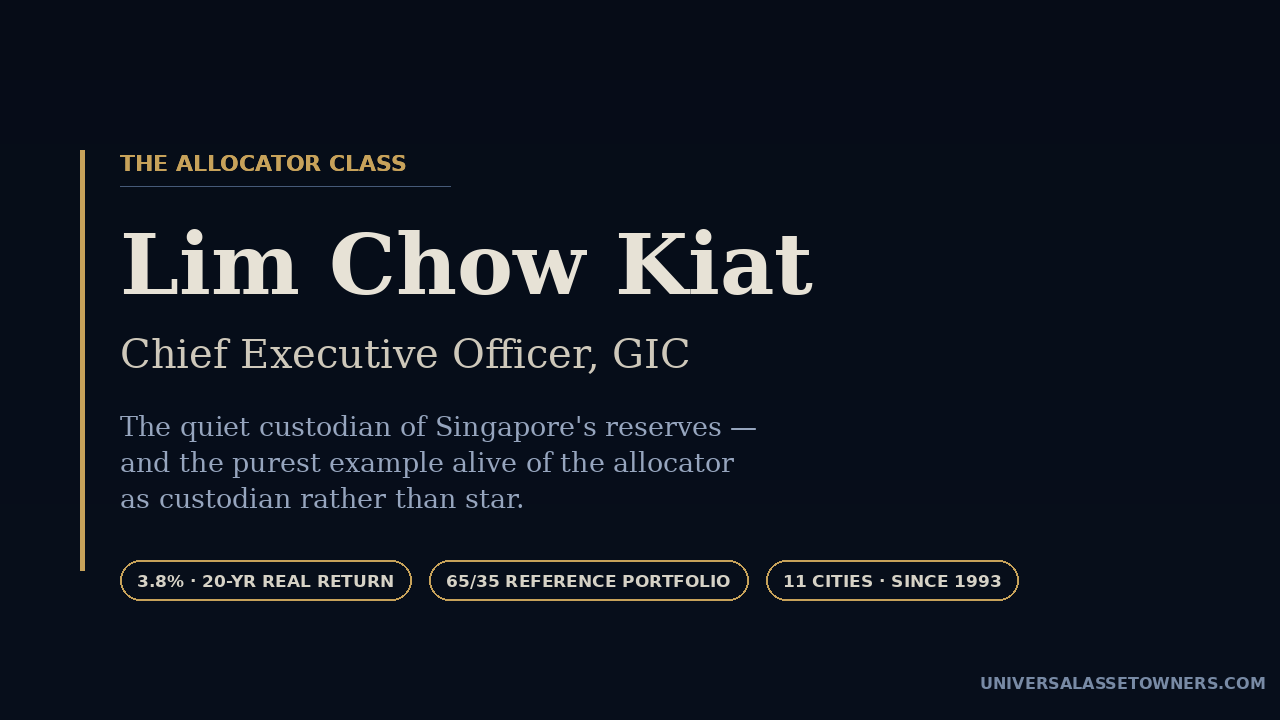
3.8% — GIC's 20-year annualised real return above global inflation (FY2024/25) · 65/35 — the equities/bonds Reference Portfolio that anchors its risk · ~US$936bn — third-party estimate of assets (GIC discloses none) · 11 cities · 2,300+ people · 1993 — the year Lim Chow Kiat joined, and never left
The Quiet Custodian
There is a paradox at the centre of Singapore's financial machine. The country runs one of the largest and most respected pools of long-term capital on earth — the manager of the nation's foreign reserves, an investor of global consequence — and yet the man who runs it is almost invisible. He gives interviews at a rate of roughly one a decade. He does not court the press, does not headline the conference circuit for its own sake, and describes himself, without a trace of false modesty, as "a piece of furniture." His name is Lim Chow Kiat, and he is the Chief Executive Officer of GIC.
The self-effacement is not a pose. It is a philosophy — the same philosophy that governs how he invests. When Lim finally sat down with Euromoney in 2019, in what the magazine billed as a genuinely rare interview, he noted that the distance "from Euromoney's first request for a chief executive interview to this morning's meeting is eleven years." The reticence is deliberate, and it is institutional. GIC does not publish how much money it manages. It does not report a one-year return, or a return in Singapore dollars. It measures itself, publicly, on a single number: the annualised real rate of return, above global inflation, over a rolling twenty years. That is a long time to ask to be judged over. It is also, Lim would argue, exactly the point.
To understand Lim Chow Kiat is to understand a particular kind of allocator — one whose entire professional identity is organised around patience, discipline, and the refusal to be interesting for its own sake. He has spent his whole working life inside one institution, rising from a fresh accountancy graduate on the fixed-income desk to the top of the house. He is the custodian of money that belongs, in the end, to Singaporeans not yet born. And he guards it the way you might expect a man to guard something he was given rather than something he earned: carefully, gratefully, and with a horizon measured in generations.
From Malaysia, by Way of Gratitude
Lim Chow Kiat's story does not begin in Singapore. It begins in Malaysia. "I was originally from Malaysia," he told Euromoney. "I came here as a teenager and had my education here, so I felt like the country had really helped me a lot." It is an unusual origin for a man who now stands guard over Singapore's national reserves — a story of arrival rather than birthright — and it supplies the emotional spine of everything that follows. The migrant's debt, repaid through public service, is a thread he returns to when he explains why he joined GIC in the first place: there, he thought, "I could have some impact."
His exact birth year is not published; GIC's own newsroom described him as "42" in a January 2013 release, which places his birth around 1970 or 1971. Little else of his private life is on the public record, and that is by his own design as much as the institution's. What is documented is the education Singapore gave him, and the use he made of it. He read Accountancy at Nanyang Technological University and graduated, in GIC's own words, with "First Class Honours." He would later add the Chartered Financial Analyst charter and complete the Stanford Executive Program. But the through-line from the beginning was the discipline of the accountant: a respect for the balance sheet, for what a number actually means, for the difference between a story and a result.
That temperament — careful, unshowy, allergic to hype — is not incidental to how Lim invests. It is the source of it. The man who audits a claim before he believes it grows into the investor who remains "disciplined on price" when everyone around him is chasing a theme.
The Accountant Who Became a Chief Investment Officer
Lim joined GIC in 1993, straight out of NTU, as a portfolio manager. There is no pre-GIC employer on his record. He is, as he cheerfully admits, an institution man in the most literal sense: "I'm like a piece of furniture here. We are fortunate that we continue to have people who stick around. We are very careful and conscientious in succession planning, making sure one generation passes to the next in a fairly deliberate manner." He was describing GIC's culture. He was also describing his own career, which is a case study in exactly that deliberate, generational succession.
The ladder is worth tracing, because it explains the man. He began in markets — fixed income, currencies, commodities — the plumbing of a reserve manager's portfolio. By 2003 he headed the Fixed Income, Currency and Commodities department. In 2008 he became Deputy President of GIC Asset Management. From 2009 to 2011 he ran GIC's investments across Europe as President, based in London — a formative posting that placed him inside Western capital markets during the wreckage of the global financial crisis, watching in real time how the largest institutions behaved when their models failed. In July 2011 he was named President of GIC Asset Management; in April 2012, Deputy Group Chief Investment Officer.
Then, on 1 February 2013, he succeeded Ng Kok Song as Group Chief Investment Officer — the man responsible for how Singapore's reserves are actually invested. Ng was a legend inside the institution, a custodian who had managed the reserves for more than four decades and who would later, in 2023, run for the Singaporean presidency. To inherit the CIO chair from Ng was to be handed the keys to the vault. And it was as CIO, in that same window, that GIC implemented the three-portfolio investment framework that still governs the fund today — the intellectual architecture Lim helped usher in as he rose.
In January 2017 he became Chief Executive Officer, succeeding Group President Lim Siong Guan — himself a towering figure, the former Head of the Singapore Civil Service and once Lee Kuan Yew's Principal Private Secretary. When Lim Siong Guan retired, Prime Minister Lee Hsien Loong paid tribute to the platform he had built, saying he had "groomed a new generation of professional leaders, built up a fit and flexible organizational structure, and imbued the GIC team with sound values and ideals." Lim Chow Kiat was that new generation. As CEO he chairs the Group Executive Committee, which "governs and reviews all key investment, risk, and business decisions," and is, in GIC's plain phrasing, "overall responsible for the performance of GIC."
The arc is almost unfashionably linear: one house, three decades, patient promotion, a bloodless and orderly handover at each rung. In an industry that prizes the star manager who jumps firms for a bigger book, Lim is the opposite archetype — the insider who became the institution. That, too, is the point. GIC does not want a star. It wants a custodian.
What GIC Is — and Why It Guards Its Silence
GIC was established in 1981 to secure Singapore's financial future as the manager of its foreign reserves. It was, in GIC's own telling, "the brainchild of Dr Goh Keng Swee," then Deputy Prime Minister and Chairman of the Monetary Authority of Singapore; Lee Kuan Yew served as its founding chairman from 1991 to 2011. It is often described as the world's first non-commodity sovereign wealth fund — a state that had no oil to bank chose instead to invest the surpluses of prudent government. The founding was famously spartan: the first managing director, Yong Pung How, is said to have turned up in 1981 to no staff, no secretary, no working telephone, and no chair.
Four decades on, GIC is one of the largest investors in the world — and it will not tell you how large. This is not oversight; it is policy, and Lim defends it as a matter of national security. GIC's own FAQ is unusually blunt about the reasoning: "revealing the assets under management of GIC will, taken together with the published assets of MAS and Temasek, amount to publishing the full size of Singapore's financial reserves… it is not in the national interest to publish the full size of the reserves for it will make it easier for markets to mount speculative attacks on the Singapore dollar during periods of vulnerability." So the world guesses. The research firm Global SWF estimates GIC's assets at around US$936 billion, while candidly noting that its "AuM continues to be a mystery." Euromoney's own reverse-engineered "educated guesswork" landed near US$857 billion — and flagged how wide the error bars are, citing a rival estimate as low as US$398 billion. Any figure you read is an outsider's approximation, and should be treated as one.
GIC does not stand alone. It is one of three entities that together manage Singapore's reserves, alongside the Monetary Authority of Singapore and Temasek. GIC positions itself carefully between the two: "MAS and Temasek are at the opposite ends of the risk spectrum — MAS is the most conservative… while Temasek aims to maximise shareholder value over the long term. GIC is a fairly conservative investor, with a globally diversified portfolio." The returns from all three flow back to the country through the Net Investment Returns Contribution, which helps fund the national budget — an estimated S$28.5 billion in the 2026 budget. This is the deepest source of the discipline that runs through Lim's every public utterance: GIC is not managing money for a client who wants a good quarter. It is managing the endowment of a nation, and paying a dividend to the government every year while doing so.
The one number GIC does publish is its yardstick. In the GIC Report for FY2024/25, the fund disclosed a twenty-year annualised real rate of return of 3.8% above global inflation — "the primary metric for evaluating GIC's investment performance." In nominal US-dollar terms the twenty-year figure was 5.7%. GIC deliberately does not report a single-year number, on the grounds that a genuinely long-horizon investor should not be judged, or tempted, by any one year's weather. The metric drifts with time as strong and weak years roll in and out of the twenty-year window — it stood at 4.3% real to March 2021, for instance — which is itself a lesson in the humility the fund preaches: even your headline number is a moving average of a very long game.
The Three Portfolios
The machinery beneath that headline number is elegant, and it is worth understanding because it encodes GIC's entire philosophy of risk. The fund runs what it calls a three-portfolio framework.
At the base is the Reference Portfolio: a simple, passive mix of 65% global equities and 35% global bonds. It is not a benchmark GIC tries to beat; it is, in the fund's words, an expression of "the risk the Client is prepared for GIC to take" — the Government's own statement of how much volatility it will tolerate. Above that sits the Policy Portfolio, GIC's long-term asset-allocation strategy, which "seeks to harvest risk premia in a balanced manner" across equities, fixed income and real assets, at a level of systematic risk consistent with the Client's appetite, and which is approved by the GIC Board. On top of that sits the Active Portfolio: "a group of investment strategies that adds value to the Policy Portfolio from our teams' skills and competitive advantages, while broadly maintaining the same level of systematic risk," constrained by a Board-set risk budget.
Lim's description of how GIC decides whether to bother being active at all is a small masterpiece of allocator discipline: "Our starting point is beta… So for us to be out of that, we would need the alternative to be better… It's not enough that you do better than beta. You have to deliver something risk-adjusted to account for the additional risk you have taken on." In other words: the passive, low-cost 65/35 portfolio is the thing to beat, and every deviation from it — every clever active bet, every private-market position, every underweight or overweight — carries a burden of proof. This is the opposite of the swashbuckling stock-picker's instinct. It is an accountant's framework for humility, institutionalised.
As of 31 March 2025, GIC's actual asset mix had drifted meaningfully toward risk: equities 51%, fixed income 26%, real assets 23%, with private equity alone accounting for around 18% of the whole. The reserve manager built for prudence has, on Lim's watch, migrated steadily into private and real assets — a shift we will come to. But the framework holds the line. Every one of those positions has to justify itself against the quiet, cheap alternative of simply owning the market.
An Anchor in a World in Flux
If you read Lim's annual letters and conference remarks across a decade, what strikes you is how little the core message changes. The world convulses — a pandemic, a war, an inflation shock, an AI mania — and the letter says, in effect, the same thing every year: the mandate has not changed, and the mandate is the anchor.
He put it precisely at GIC Insights in New York in November 2024: "our mandate remains the same — to deliver good, long-term returns above global inflation. This clarity is a critical anchor that helps us to avoid hypes, identify dislocations, and focus on long-term winners." The word he keeps reaching for is anchor — something fixed to hold to when everything around you is moving. His FY2024/25 Letter from the CEO frames the temptation and the refusal in a single breath: "Faced with these profound changes, it is tempting to chase the short-term hype or retreat in the face of the unknown. At GIC, we do neither. We focus on long-term value, with an emphasis on avoiding permanent loss."
That last phrase — "avoiding permanent loss" — is the hinge of the whole philosophy, and it is not the same as avoiding volatility. A long-term investor can live with prices falling and rising; what it cannot recover from is capital that is impaired forever. And the most underrated way to impair capital permanently, in Lim's telling, is not to buy a bad asset but to pay too much for a good one. "Situations like the Nikkei bubble in the late 1980s, the Nasdaq collapse in the early 2000s, and the periodic bursting of meme stock bubbles all illustrate the dangers of valuation overshoot," he wrote. "Long horizons offer little help in such situations… This is why we remain disciplined on price." It is a striking admission from a man who runs one of the most patient portfolios on earth: patience does not save you from overpaying. Only discipline does.
His method for coping with a genuinely unknowable future is not prediction but preparation. "Our response relies on two pillars," he wrote, "top-down portfolio construction and bottom-up asset selection. We diversify with intent, deploy with granularity, act with agility, and invest in partnerships, always taking the long view, protecting against permanent impairment, and preparing rather than predicting." And at GIC Insights in November 2025, under the title "History Awaits," he distilled it to a sentence any allocator could pin above a desk: "Resilience is built by preparing for a range of outcomes, not by betting on a single future. This also means diversification, which is the only free lunch in finance."
He is not, for all this discipline, an optimist about returns. As far back as 2019 he was warning that a decade of falling interest rates had, in effect, borrowed prosperity from the future: "Beta has done great for the last ten years… But that also means going forward is a lot harder, because yields are so low." It is the rare institutional voice that tells its stakeholders to expect less, precisely because it is being judged over twenty years and cannot afford the comfortable lie.
Signature Shifts on His Watch
For all the constancy of the message, GIC has changed a great deal under Lim — quietly, as is the house style, but substantially. The clearest shift is the migration into private and real assets. Over the year to March 2025, GIC's equity exposure as a group rose from 46% to 51%, fixed income fell from 32% to 26%, and private equity crept up to around 18% of the portfolio. The reserve manager has been steadily trading the liquidity and predictability of bonds for the illiquidity premium — and, crucially, the inflation resilience — of real assets. GIC has said repeatedly it will lean into stable-return real estate and infrastructure precisely to protect the portfolio against a stickier inflation regime.
The deals of this era show the strategy in the concrete. In September 2025 GIC and a subsidiary of Abu Dhabi's ADIA committed roughly US$1.6 billion to an Asia-Pacific data-centre platform with Vantage Data Centers — a bet on the physical infrastructure of the digital economy. GIC and Brookfield completed a record A$6.7 billion acquisition of Australia's National Storage REIT. In Brazil, GIC deepened a transmission-infrastructure partnership with Neoenergia for the third time. This is the texture of a long-horizon investor building durable, cash-generating, inflation-linked assets around the world, one patient transaction at a time.
On inflation itself, GIC has been early and consistent. In 2022 it declared that the world had "entered a high-inflation regime"; in 2023 it warned of a "potential structural shift to a regime of higher interest rates" and described inflation as easing at the headline but "sticky" beneath — "higher for longer" — and prioritised resilience accordingly. This was not consensus at the time. It was the view of an investor whose twenty-year yardstick forces it to think about regimes, not quarters.
The other defining shift is geographic and technological, and the two are entangled. GIC has tilted hard toward the United States, lifting its Americas exposure from 44% to 49% between March 2024 and March 2025, on the thesis that the artificial-intelligence build-out will benefit the American economy most. It established an internal AI Council in 2023 and has spoken of building a "virtual investment committee member." Reported positions include co-leading a funding round for the data-and-AI company Databricks and backing the likes of Ramp and Atlan; in 2026 GIC was among the backers of an Anthropic-led enterprise-AI venture assembled with Blackstone, Hellman & Friedman and Goldman Sachs. Correspondingly, GIC's overall Asia exposure fell to roughly 26% by March 2024 — a decade low — even as Lim remained pointedly bullish on India, where GIC has "doubled its India exposure over the past five years" and where, marking the fifteenth anniversary of its Mumbai office, he pointed to "strong momentum."
Yet even here, the discipline reasserts itself. Lim has been unusually candid, for a large AI investor, about the risk of getting carried away. At GIC Insights in 2025 he named the mood directly: "we are seeing clear signs of an AI-driven emotional cycle… Hence, we hear many pondering if 'This time it is different' — the five most dangerous words in finance." It is a remarkable thing for the head of a fund that has just tilted toward America's AI economy to stand up and quote the oldest warning in the book against himself. That is the tell of the man: he will make the bet, and he will refuse to believe the story he is betting on.
On sustainability, Lim's framing is characteristically pragmatic rather than crusading. He treats long-termism and sustainability as near-synonyms — "Long-termism and sustainability are almost interchangeable, as what is long term tends to be sustainable, and what is sustainable will last for a long time. Thus, sustainability is naturally quite aligned to GIC's mandate" — and GIC invests directly in decarbonisation solutions, from "batteries, hydrogen, carbon capture and storage, and nuclear fusion." Honesty compels a note here: unlike some peers, GIC has not made a dated, portfolio-wide net-zero-by-2050 pledge. Its posture is engagement and transition-enablement rather than a hard commitment — a stance critics read as insufficiently ambitious and admirers read as characteristically unwilling to promise what it cannot control.
The Bank Bets, and the Honesty of a Long-Term Investor
No admiring profile earns its keep by skating past the failures, and Lim's institution has a famous one. In the opening act of the global financial crisis, GIC took two enormous stakes in troubled Western banks: roughly 11 billion Swiss francs into UBS in early 2008, and US$6.88 billion into Citigroup in January 2008 — framed at the time as "a rare chance to take major stakes in the international banking sector." It was a bold, contrarian, deeply GIC-flavoured bet: buy quality institutions when the world is selling in a panic.
The UBS half of the bet did not work. On 16 May 2017 — under Lim, in his first months as CEO — GIC cut its UBS holding from 5.1% to 2.7%, crystallising a loss on roughly half the position. What is instructive is not the loss but how GIC spoke about it. There was no spin. GIC "is disappointed that the UBS investment resulted in a loss," the fund said flatly, while explaining the decision to move on: "conditions have changed fundamentally since GIC invested in UBS in February 2008… it makes sense now for GIC to reduce its ownership of UBS and to redeploy these resources elsewhere." The defence GIC offered was not that the trade was secretly fine, but that the portfolio was: it had earned a positive return on Citigroup, and "the combined return on the UBS and Citigroup investments has been positive in mark-to-market terms." Judge us on the whole, over the long run, was the message — the same yardstick GIC applies to itself in good years and bad.
That is worth sitting with, because it is the character of the man in miniature. A short-horizon investor hides a loss or explains it away. A long-horizon investor books it, states it plainly, redeploys the capital, and keeps the score at the portfolio level over a period long enough for skill to show through noise. The UBS loss is not an embarrassment GIC buried; it is, in a strange way, evidence that the philosophy is real. You cannot claim to be a disciplined, long-term, permanent-loss-avoiding investor and then flinch from admitting when you paid too much for a bank in a crisis.
Secrecy by Design
The most persistent criticism of GIC is not about any single trade. It is about the silence. A fund of this scale, managing public money, that will not disclose its assets, its annual returns, or its returns in its own currency, is a legitimate target for the argument that public capital owes the public transparency. The consequence is real: because GIC will not say how big it is, every figure attached to it — including the ones in this profile — is an outside estimate, and those estimates range from under US$400 billion to over US$900 billion.
GIC's answer, which Lim consistently defends, is the national-security rationale set out in its FAQ: publish the full size of the reserves and you hand speculators a target for an attack on the Singapore dollar. On the returns question, GIC argues that reporting a single year would invite exactly the short-term judgment its twenty-year mandate is designed to resist. Both the criticism and the rationale are legitimate, and a fair account presents them side by side rather than choosing a winner. What is not in dispute is that the silence is a choice, made and defended at the top, and that it is of a piece with everything else about the institution: a fund that would rather be underestimated than exposed, and that treats being uninteresting as a form of security.
The Man and the Method
What kind of leader emerges from all this? A deliberately reticent one, running a deliberately reticent house. Lim rarely gives interviews; when he does, the self-deprecation is disarming and the substance is dense. The "piece of furniture" line is not humility for its own sake — it is a statement of belief that the institution matters more than the individual, that continuity is the asset, and that a good custodian is one you do not notice.
Ask him where GIC's real edge lies, and he does not point to a strategy or a model. He points to the governance: "the unique thing is not what most people see. The most unique thing is the governance arrangement. The government makes it very clear and is very disciplined about that — to leave GIC alone to just focus on making money. It is hard for a lot of governments to do that." It is a revealing answer. The head of a sophisticated global investor attributes his advantage not to cleverness but to being left alone to be patient — to a political culture disciplined enough not to raid the reserves or micromanage the portfolio. Long-termism, in Lim's account, is not merely a strategy GIC chose; it is, as he told an FCLTGlobal audience, "our national ethos in Singapore."
He inherited that ethos from a specific lineage. His predecessor as CIO, Ng Kok Song, had guarded the reserves for forty-two years. His predecessor as chief executive, Lim Siong Guan, had run the entire Singapore Civil Service. GIC's chairmanship has run through the country's premiership — Lee Kuan Yew, then the sitting prime minister; today the Chairman is Senior Minister Lee Hsien Loong and the Deputy Chairman is Prime Minister Lawrence Wong. Lim Chow Kiat sits inside that chain of custody, one link among many, which is precisely how he seems to want it. On culture, he is unsentimental about what holds it together: "everyone is watching. Good behaviour will be rewarded. And bad behaviour will be punished." And on why talented people stay: "GIC-ans share a lot of what you might call noble purpose. That is a very powerful recruitment tool for us. And not just with Singaporeans."
Beyond GIC, Lim's institutional roles map the same terrain — long-term capital, its stewardship, and the country that entrusts it to him. He chairs the Wealth Management Institute, sits on the board of Singapore's National Research Foundation, advises France's Agence France Trésor through its Strategic Committee, belongs to the World Economic Forum's International Business Council, and serves as a Strategic Advisor to FCLTGlobal, the organisation dedicated to lengthening the horizons of finance itself. He is a former trustee of Nanyang Technological University and a former board member of Enterprise Singapore, and in 2012 he was inducted into the Fixed Income Analysts Society Hall of Fame — a nod to the bond-desk craft where he began.
What the Allocator Class Can Learn
Lim Chow Kiat is instructive for the world's universal owners in a way that has nothing to do with a single trade and everything to do with temperament. He runs a fund large enough that it effectively owns a slice of the whole global economy, and he behaves accordingly: he cannot pick his way around systemic risk, so he prepares for a range of futures rather than betting on one. He treats the passive market portfolio as the thing to beat, and forces every active decision to justify its risk. He tilts toward the biggest theme of the age — American AI infrastructure — while quoting, against himself, the five most dangerous words in finance. He books his losses plainly and keeps score over twenty years. And he insists that his real edge is not brilliance but governance: a mandate that is left alone long enough to compound.
Three lessons run through it all. The first is that long-termism is a discipline, not a slogan — it shows up as price discipline, as the refusal to chase, as a twenty-year yardstick that removes the temptation of a good quarter. The second is that resilience beats prediction: you cannot know the future, so you build a portfolio that survives several of them. The third is the quietest and the hardest: that the best custodian is often the least visible one, and that an institution built to outlast any individual is worth more than any individual's genius. In an industry addicted to the star, Lim Chow Kiat has spent thirty-three years proving the opposite case — that the highest form of stewardship is to become, faithfully and by design, a piece of the furniture.
The Career Timeline
- c. 1970–71 Born in Malaysia; moves to Singapore as a teenager and is educated there
- Education Bachelor's in Accountancy, First Class Honours, Nanyang Technological University; later CFA charterholder and Stanford Executive Program
- 1993 Joins GIC as a portfolio manager, straight out of NTU
- 2003 Head, Fixed Income, Currency & Commodities Department
- 2008 Deputy President, GIC Asset Management
- 2009–2011 President (Europe), based in London
- Jul 2011 President, GIC Asset Management
- Apr 2012 Deputy Group Chief Investment Officer
- 1 Feb 2013 Group Chief Investment Officer, succeeding Ng Kok Song; the three-portfolio framework is implemented in this era
- Jan 2017 Chief Executive Officer, succeeding Lim Siong Guan
- 2017 As CEO, GIC pares its crisis-era UBS stake at a loss; states the combined UBS+Citigroup position remained positive
- 2022–2023 GIC calls a "high-inflation regime" and "higher for longer"; tilts toward real assets
- 2023 GIC establishes an internal AI Council
- Mar 2025 Americas exposure lifted to 49%; private equity ~18% of the portfolio
- Jul 2025 GIC Report FY2024/25: 20-year real return of 3.8% above global inflation
What to Watch
Three questions will define the next phase of Lim's stewardship. The first is the AI bet: GIC has tilted decisively toward the United States and the compute-and-power build-out of the artificial-intelligence era, even as Lim himself warns of an "emotional cycle" and quotes the five most dangerous words in finance against his own positioning. Whether that tilt earns a GlobalFoundries-style vindication or proves to have been made near a top will shape GIC's twenty-year number for a decade. The second is the regime question: GIC bet early that the world had shifted to structurally higher inflation and rates, and reorganised the portfolio toward real assets accordingly — a call that looks prescient today but will be tested if disinflation and easier money return. The third is succession and continuity: Lim is the custodian of an institution designed to outlast any custodian, and the deliberate, generational handovers that produced him — Ng Kok Song to Lim, Lim Siong Guan to Lim — are themselves part of GIC's edge. How the next passing of the baton is managed will say as much about GIC's future as any allocation decision.
Whatever the answers, Lim Chow Kiat will meet them the way he has met everything else: quietly, patiently, and over a horizon most investors will never allow themselves. For anyone trying to understand how the world's great pools of long-term capital actually think — how a universal owner behaves when it cannot outrun systemic risk and must instead endure it — he is not an optional subject. He is one of the purest examples alive of the allocator as custodian rather than star.
Sources: GIC official executive biography of Lim Chow Kiat and GIC "Who We Are," "How We Invest / Our Policy Portfolio," FAQs, board and contact pages (gic.com.sg); GIC newsroom release on Lim's 2013 appointment as Group CIO; The Edge Malaysia on his 2017 appointment as CEO; the Fixed Income Analysts Society (FIASI) Hall of Fame biography; the Euromoney interview "Lifting the lid on Singapore's GIC" (9 May 2019); GIC Report FY2024/25 news release and Letter from the CEO "Invested in the Long Term" (25 July 2025); GIC Report FY2024/25 interactive Investment Report; GIC Insights opening remarks "Invested in a Global Future" (2024) and "History Awaits" (2025); GIC / FCLTGlobal "Going Long" conversation (2021); GIC's 2017 statement on reducing its UBS stake, with CNBC and SCMP reporting; CNBC coverage of GIC's 2022 and 2023 results; GIC releases on the Vantage Data Centers, National Storage REIT (Brookfield), Neoenergia and Anthropic-venture transactions; GIC's India 15th-anniversary keynote; Global SWF and reporting by P&I, PitchBook, Hubbis and Business Standard; Mingtiandi on the 2016–17 leadership transition. Researched and edited by the UAO editorial desk, July 2026. This is an editorial profile compiled from public sources, not an interview. GIC does not disclose its assets under management; all size figures are third-party estimates. Corrections: info@universalassetowners.com.