
Universal Asset Owners · Daily Brief
Friday, September 18, 2026
|
Who reads this
Before the market opens, this brief is read at the desks that direct more than $50 trillion in permanent capital.
Circulation is narrow by design. The capital behind it is not.
|
In one week, two U.S. agencies took three actions on parts of equity ownership that long-term investors have treated as inseparable: voting rights, shareholder access and the market venue itself. For sovereign funds, pension plans and family offices, the implications extend well beyond Hollywood or tokenization.
Watch · Today's briefing

Today's briefing — 1 min 40 sec. Tap to watch.
The vote, the ballot and the market
The vote, the ballot and the market
In one week, U.S. regulators acted on three parts of equity ownership that long-term investors have treated as inseparable: voting rights, shareholder access and the market venue itself. For sovereign funds, pension plans and family offices, the implications extend well beyond Hollywood or tokenization.
A share is more than a claim on future cash flow.
It is also a vote. It offers a mechanism, however imperfect, for shareholders to place questions before fellow owners. And it trades in a market whose rules determine how prices are formed, transactions are settled and ownership is recorded.
For the world's largest long-term investors, those rights are not peripheral. Sovereign wealth funds, pension plans, endowments and multi-generational family offices cannot easily exit every company whose strategy they question. Their scale and time horizon make stewardship, voting and market integrity part of the investment case.
Over the past week, two U.S. agencies took three separate actions that bear on those functions.
Foreign capital without votes
On Sept. 17, the Media Bureau of the Federal Communications Commission approved Paramount's request to exceed the customary 25 percent foreign-ownership threshold in connection with its proposed transaction with Warner Bros. Discovery.
The actor matters. The decision was a staff ruling issued under delegated authority in MB Docket 26-93, not a vote of the full Commission.
The order approves an expected foreign holding of 49.5 percent of the company's equity, entirely in non-voting Class B shares. That figure is the expected cap table, not the authorization ceiling: the Bureau separately found it in the public interest to permit up to 100 percent aggregate indirect foreign equity. The distinction is the legal substance of the ruling. Saudi Arabia's Public Investment Fund would hold 15.1 percent; L'imad Holding Company and three related vehicles, 12.8 percent through the holding chain; and the Qatar Investment Authority, 10.6 percent. Together, those named Gulf investors would own 38.5 percent of the economic interest. Each has advance approval to increase its position to 20 percent.
The Ellison family and RedBird would retain the voting shares.
The entity named in the order is L'imad Holding Company. It is not the Abu Dhabi Investment Authority, and several summaries of the decision have conflated the two. An investor updating an exposure file on that basis would be tracking the wrong counterparty.
The distinction between economics and control is central. The Bureau's conditions prohibit foreign investors from holding voting stock, influencing management or content decisions, or accessing nonpublic personal data belonging to U.S. citizens. The order is, on one reading, a straightforward national-security compromise: foreign capital is permitted, while control remains domestic.
But it also demonstrates the value of an ownership structure that separates economic participation from governance. Deal reporting — not the order itself — puts the Gulf commitment at roughly $24 billion, with about $10 billion from the Public Investment Fund and $7 billion each from the Qatar Investment Authority and L'imad. If those figures hold, they establish a price for the economic half of a share stripped of its vote.
For private-market investors, the logic is familiar. Limited partners routinely accept economic exposure without direct control over portfolio companies, though their contractual rights vary considerably by agreement. In a regulated public company, however, the same separation is unusually visible: a large bloc of sovereign capital may participate in the economics of a major media asset while possessing none of the formal voting rights associated with those shares.
Not everyone at the agency was persuaded. Commissioner Anna Gomez argued that an economic interest of that size confers influence whether or not it carries a vote, and objected to the process — a decision of this consequence issued at staff level, without a public Commission vote. Because there was no vote, her statement is an objection rather than a dissent. The legal conclusion runs the other way. Both are likely to be cited.
The transaction has not closed. Twelve states and the Writers Guild have challenged it, and a no-close order remains in place. Paramount has asked a court to set a bond of about $1.88 billion; the company noticed a hearing for Sept. 21, while later coverage places it on Sept. 24. Neither date should yet be treated as settled.
From Oct. 1, if the transaction remains uncompleted, Paramount would owe Warner Bros. Discovery shareholders a contractual ticking fee of about $650 million a quarter. That is a term of the merger agreement, not a condition imposed by the Bureau, and it has not begun to run.
It nonetheless turns legal delay into an explicit cost — a financial exposure embedded in the transaction's capital structure rather than a governance abstraction.
Shareholder access under review
A day earlier, as this publication reported on Thursday, the Securities and Exchange Commission proposed rescinding Rule 14a-8, the federal rule that allows qualifying shareholders to place proposals on corporate proxy statements.
The SEC said the rule "exceeds the scope of the Commission's statutory authority and intrudes into matters of state law." If adopted, the change would shift more of the law governing shareholder proposals to state statutes and corporate charters.
The proposal is not in force. Rule 14a-8 remains available to shareholders, and the comment period will run for 60 days after publication in the Federal Register — a clock that has not started. A companion proposal would expand company discretion over proxy voting authority, eliminate Notices of Exempt Solicitation and shorten the minimum broker search period from 20 business days to five.
The potential shift matters disproportionately to large indexed investors.
A pension plan or sovereign fund with holdings across thousands of public companies benefits from a common federal process. Moving shareholder-proposal rights into a patchwork of state laws and company-specific governing documents would not necessarily eliminate shareholder action. It would, however, make it more costly, less standardized and more dependent on legal resources.
That is a material change for institutions that regard stewardship as a portfolio-wide responsibility rather than a campaign directed at a handful of companies.
The policy debate is real. Supporters of rescission argue that corporate governance should be governed more by state law, and that the federal proxy process has sometimes imposed costs disproportionate to its value. Most proposals fail; many are filed by holders of very small positions. But for universal owners, the operative question is practical: what would it cost to exercise comparable influence across a portfolio if the common federal mechanism disappeared?
Trading moves to a new venue
On Sept. 17, the SEC also issued temporary, conditional relief for "Tokenized Securities Venues," allowing them to trade tokenized National Market System stocks without registering as conventional exchanges. This was an issued order, not a proposal.
The relief, described by SEC Chairman Paul Atkins as an "Innovation Exemption," is limited and conditional. Tokenized shares must provide holders with the same rights and privileges as the corresponding conventional securities. Smart contracts must be auditable, public and deployed on a public, permissionless ledger. Trading must halt when the underlying stock is halted on its primary listing exchange. Issuers must receive notice when a third party tokenizes their shares and must have an opportunity to object. Symbols and volumes are capped.
The exemption lasts five years and remains subject to public comment. Liquidity providers supplying proprietary capital to those venues receive parallel conditional relief from the definition of "dealer."
The order preserves an important principle: the rights associated with a share are meant to travel with its tokenized form.
What it does not preserve is the familiar market structure surrounding those rights. Price formation, liquidity provision, settlement, custody, transfer-agency reconciliation and best-execution obligations could increasingly operate across systems that do not resemble the traditional exchange-and-custodian model.
That may create efficiencies. It may also introduce new operational and fiduciary questions for institutional investors: Who is the holder of record? Which price governs when markets diverge? How are voting, corporate actions and beneficial ownership reconciled across a permissioned trading venue, a public ledger and a traditional transfer agent?
A broader change in ownership
Two agencies took three actions under different statutes and toward different policy goals. The Media Bureau decision concerns foreign ownership in a regulated media company. The SEC proposal concerns shareholder rights. The SEC exemption concerns market structure. Only one of the three is in force today.
They should not be treated as a coordinated policy program.
Yet, from the perspective of a long-term owner, they point to a common development. The economic claim on an asset is becoming easier to separate from the mechanisms through which investors exercise influence, submit proposals and transact in regulated markets.
That separation is not inherently harmful. It may expand access to capital, protect sensitive industries, reduce regulatory burdens or modernize market infrastructure. The Bureau's conditions are arguably more protective than the diffuse foreign ownership already present in any index fund. The federalism argument behind the 14a-8 proposal is not frivolous. And the Innovation Exemption is a more investor-protective form of tokenization than the offshore synthetic products it is designed to compete with.
But it changes the work of ownership.
For sovereign funds, pension plans and family offices, the question is no longer simply whether an asset produces the desired return. It is whether the institution understands which rights accompany that return, which rights have been surrendered, and what operational or governance costs will arise when those rights are no longer bundled together.
Questions for fiduciaries
Three questions belong in investment-committee materials this quarter.
Stewardship. If Rule 14a-8 is repealed, what would it cost to maintain an equivalent shareholder-engagement program across the portfolio? The answer should be broken down by state of incorporation and charter exposure.
Control premiums. What return premium does the institution require when it accepts economic exposure without voting rights or governance influence? Most investors make this trade in private markets; few price it explicitly.
Market infrastructure. If a tokenized representation of a listed security begins trading, who reconciles custody, beneficial ownership, voting rights, corporate actions and price discrepancies across the on-chain and conventional markets?
The critical issue is not whether ownership will become more flexible. It already is.
It is whether institutions whose liabilities and mandates stretch across generations are adapting their governance, stewardship and operating models to match.
Private capital is scaling. Frontier finance is not.
Private capital is scaling. Frontier finance is not.
The World Bank says it mobilized $112 billion in private capital in fiscal 2026, more than three times the amount recorded four years earlier. But low-income countries received about $3 billion — roughly unchanged. The next test is whether development finance can build investable portfolios rather than simply announce larger totals.
The World Bank Group has made real progress in attracting private capital to developing economies.
It reported $112 billion of private capital mobilized in fiscal 2026, up from $35 billion in fiscal 2022. It also issued more than $25 billion in guarantees, exceeding a $20 billion annual target set for 2030. Including the Bank Group's own financing, total financing and mobilization exceeded $200 billion.
Those gains reflect years of institutional work that rarely attracts headlines: more integrated country strategies, expanded guarantee capacity, additional local-currency financing, greater attention to foreign-exchange risk and a closer alignment between the Bank's public and private-sector arms.
For institutional investors, that work matters. Guarantees, standardized documentation, credible servicing arrangements and repeatable transaction structures are not administrative details. They are the infrastructure that determines whether a project is investable at scale.
But the distribution of capital tells a less encouraging story.
| Private capital mobilized | FY22 | FY26 | Change |
|---|---|---|---|
| Total | $35 billion | $112 billion | More than tripled |
| Lower-middle-income countries | $14 billion | $37 billion | Nearly tripled |
| Upper-middle-income countries | $12 billion | $50 billion | More than quadrupled |
| Africa | About $9 billion | $22 billion | About 150% |
| Low-income countries | About $3 billion | About $3 billion | Essentially unchanged |
Source: World Bank Group, Sept. 17, 2026. The Bank's own language for the final row is that mobilization was "maintained at about $3 billion."
Two cautions on the table. The three income-group rows do not sum to the total in either year — $29 billion against $35 billion in FY22, $90 billion against $112 billion in FY26 — and the release does not explain the residual. The Africa row is a regional figure that overlaps the income groups and cannot be added to them. The table is a distribution, not a reconciliation.
The aggregate number rose sharply. Capital reaching the poorest countries did not.
That is not evidence that investors ignored a ready supply of bankable projects. In the lowest-income markets, political risk, currency volatility, weak legal enforcement, construction risk and uncertain offtake often arrive together — the correlation that defeats a diversification argument. The problem is not simply a shortage of capital. It is a shortage of transactions that can survive institutional underwriting.
The Bank's proposed answer, named in the same release, is an originate-to-distribute model: originate and structure exposures, standardize them, retain risks that public institutions are better equipped to manage, and distribute seasoned cash flows to pension funds, insurers and other long-term investors.
The ambition is sensible. The model has potential to create diversified portfolios, lower due-diligence costs and expand the investable universe beyond a handful of flagship projects.
But it also presents familiar risks.
Public institutions could retain nearly all of the difficult risk while private investors acquire only the protected tranche. Pools could appear diversified while remaining exposed to the same currency shock, commodity cycle or political rupture — twenty frontier projects that fail together are one position with twenty names. And reported mobilization could be measured at commitment rather than at financial close, disbursement and sustained performance.
The measurement that matters is therefore not the headline total. It is conversion: how much of the capital described as mobilized reaches financial close, is disbursed, remains invested, and performs through a stress period. No institution currently publishes that ratio.
For pension plans, sovereign wealth funds and family offices, the prudent approach is not to dismiss the first generation of these structures. It is to demand transparency before committing capital.
The disclosures should include the full first-loss layer, maximum public contingent liability, currency exposure by project, realized default and recovery data, and evidence that private capital is genuinely additional rather than refinancing assets that were already bankable.
There is also an argument for patience. An institution whose liabilities run thirty years is rarely punished for arriving second, after a structure has seasoned through one currency shock.
The opportunity is large. So is the risk of confusing a successful financing announcement with a durable asset class.
Chart of the day
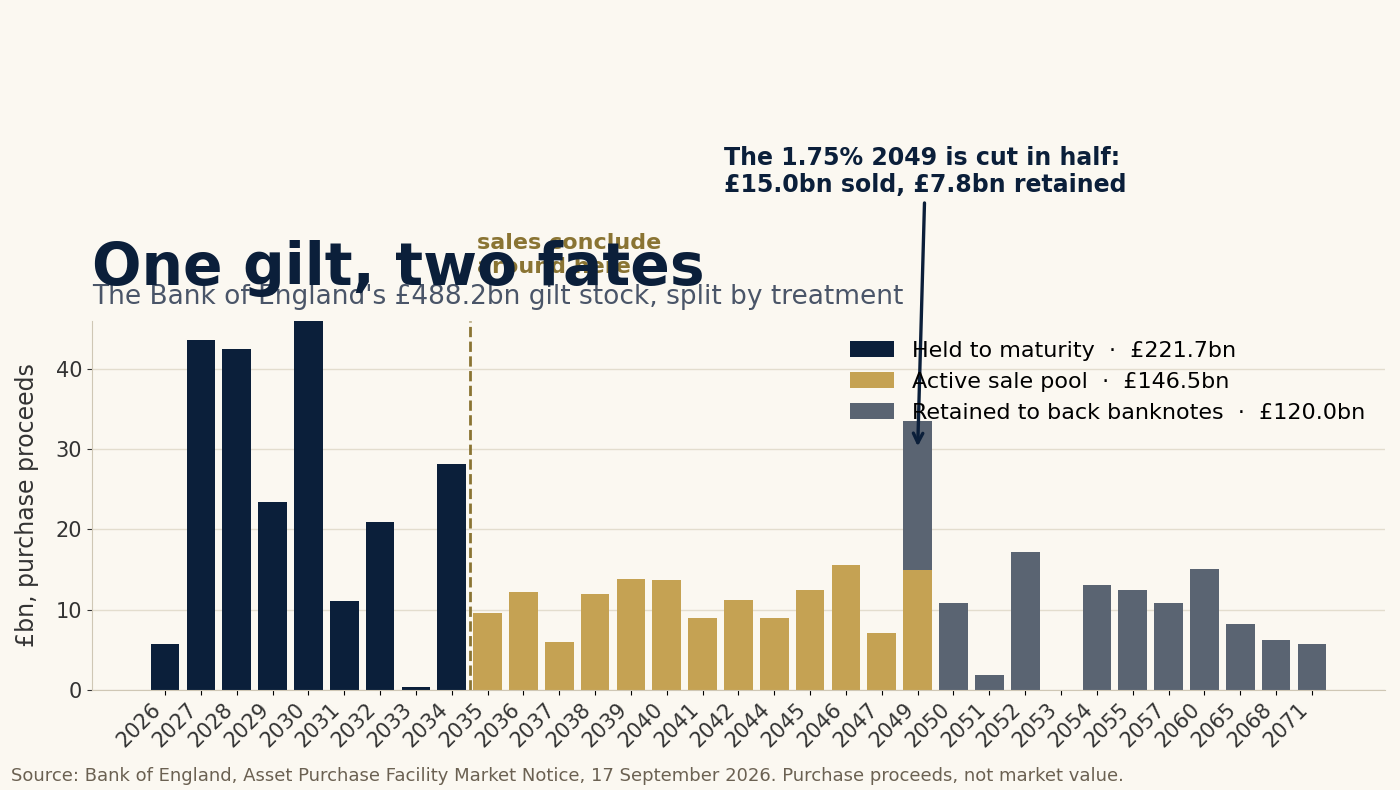
The Bank of England's £488.2bn gilt stock, split three ways. Source: Bank of England Market Notice, 17 September 2026. Purchase proceeds, not market value.
The Film
The Film · The Unbundled Share — 1 min 8 sec.
3 · Monetary policy — Tokyo moved. The funding currency did not pay.
At the meeting held 17–18 September, the Bank of Japan's Policy Board decided by a 7–2 majority to encourage the uncollateralised overnight call rate to remain at around 1.25 per cent. The complementary deposit facility rate goes to 1.25 per cent and the basic loan rate to 1.5 per cent. All of it takes effect on 24 September, not today. (Bank of Japan, 18 September)
Asada Toichiro and Sato Ayano dissented. Asada's reasoning is on the record: with CPI excluding fresh food running below 2 per cent recently, the economy could not necessarily be called strong. Sato's: developments had not substantially accelerated, so this was not the moment.
The dissent did not shrink. It inverted — and that is the part the wires missed. On 31 July the Board held at 1.00 per cent on an 8–1 vote, with Takata Hajime the lone member arguing for 1.25 per cent. Today Takata is inside the seven, and two different names are outside it. The man who was alone six weeks ago won the argument; the committee that outvoted him eight-to-one produced two new objectors instead. A vote count tells you the margin. The composition tells you the direction, and this one has turned over.
Read the Bank's own text rather than the headline. Two sentences carry the edition:
Japan's economy "has recovered moderately, although some weakness has been seen in part, partly due to the impact of the situation in the Middle East." And producer-price inflation has stayed high "reflecting the impact of the expansion in AI-related demand, in addition to high crude oil prices and the depreciation of the yen."
That is a central bank putting an energy war and an AI capital cycle into the same inflation paragraph, as inputs, in an official policy statement. Not as risks in an appendix.
Separately and unanimously, the Bank moved its climate-response funds-supplying operation to a floating rate with loan caps.
The yen weakened after the decision. Twenty-five expected basis points delivered with two dovish dissents and no forward commitment does not force a funding trade to cover.
Why it matters. GPIF-scale portfolios, Japanese life companies and every global book that has used yen funding for a decade now have a dated official act, a stated intention to keep going — the Bank says it "will continue to raise the policy interest rate" — and an explicit list of what it is watching: the Middle East, AI-related demand, and the exchange rate. The question is not whether 1.25 is high. It is whether domestic yields have crossed the level at which marginal Japanese capital comes home.
Watch: the Governor's transcript. The next long JGB auction — bid-to-cover and tail, not the stop-out alone. Insurer hedge ratios. USD/JPY against 160.
3b · The Bank of England turned QT into a maturity map
The more structural central-bank act of the week happened in London, and it is unusually legible because the Bank published the security-by-security table.
At the meeting ending 16 September — the act is the MPC decision, not the following day's market notice — the MPC set a multi-year path to take the monetary-policy gilt stock to zero through £20 billion of annual sales alongside maturities. Bank Rate was held at 3.75% by 6–3, with three members preferring a quarter-point rise to 4%. (Bank of England Market Notice, 17 September; Monetary Policy Summary and Minutes)
The £488.2 billion stock now splits three ways:
| Bucket | Amount | Treatment |
|---|---|---|
| Gilts maturing before 2035 | £221.7bn | held to maturity |
| Gilts maturing 2035–2049 | £146.5bn | sold at £20bn a year, concluding around 2034 |
| The longest-dated gilts | £120.0bn | retained to indirectly back banknote issuance |
The precision worth having is in the footnote. The banknote-backing bucket is not "everything past 2049." It is part of the APF's holding of the 1.75% 2049 gilt and all gilts maturing after it — and the Bank has split that single line, retaining £7.8 billion of the 2049 and selling £15.0 billion of it.
A central bank has cut one gilt in half and sent the two halves to different fates. That is liability management, not monetary policy in the textbook sense.
APF auctions are paused. The Bank is reviewing a model under which HM Treasury would instruct the DMO to buy the gilts the Bank is selling, at market prices, pre-announced. A decision comes before April 2027.
Why it matters. The longest gilts are the liability-matching asset for UK pensions and insurers, and they have just been removed from the active-sale pool. That is one known source of ultra-long supply withdrawn, at the long end, permanently. It does not end UK duration supply — the government still issues — but it changes which maturities the market must absorb. Rebuild the sterling supply assumption by bucket, not by a single QT number.
4 · Market structure — a daily redemption promise met a two-day market
Turkey supplied the week's cleanest lesson in the difference between contractual liquidity and economic liquidity.
The central bank raised repo funding to a reported 300 billion lira and lifted banks' interbank borrowing limits tenfold. The Capital Markets Board suspended dealing and ordered the liquidation of funds managed by seven firms. Those managers are reported to have held a combined 891 billion lira — about $21.4 billion — for roughly 353,000 investors. Authorities also cut the minimum equity-maintenance ratio for margin trading from 35% to 20% until 2 October.
Those totals come from wire reporting citing a person with direct knowledge, not from an audited regulatory disclosure. The official interventions are independently observable; the fund-level figures are not. Reuters reported on Sept. 18 that the Capital Markets Board had appointed Isbank and Ziraat to liquidate 131 funds with assets above 890 billion lira.
Do not add the numbers together. 300 billion lira is central-bank liquidity. 891 billion lira is reported fund assets, not a loss. The margin change is temporary relief on leverage, not new equity.
The sequence is the point. August rule changes pushed some funds to adjust holdings in thinly traded equities. Prices fell. Exits got harder. Redemptions created cash needs. Funds sold their liquid positions — because that is what you can sell — and transmitted the pressure into the broad index. Broker margin and bank liquidity joined in.
Turkey's Financial Stability Committee called it isolated, temporary and manageable. It may be right. The lesson travels regardless.
The allocator translation. A daily redemption promise is a liability, and it must be underwritten against the cash and genuine market depth available on the worst plausible day, not the average one. For any open-end small-cap, concentrated or semi-liquid strategy on your list, ask for three numbers: assets saleable within one day without moving the market materially; assets financeable but not saleable; and assets whose observable price would simply disappear in stress. A manager who cannot produce those three is offering contractual liquidity, not economic liquidity.
5 · AI and the long-term portfolio — sovereign capital is now funding the electrons
Crusoe announced the initial closing of an anticipated $3.9 billion Series F at a $30.9 billion post-money valuation, oversubscribed, co-led by Atreides Management, Mubadala Capital and Valor Equity Partners. GIC, the Qatar Investment Authority, NVIDIA, Founders Fund, Radical Ventures and TPG are named; Oman Investment Authority, Clal Insurance, StepStone, Baillie Gifford, Fidelity and accounts advised by T. Rowe Price appear further down the list. (Crusoe, 17 September)
Keep the company's three numbers in three separate boxes, because the company does: more than $140 billion of total contracted value, more than 6GW of gross contracted capacity, and 1GW delivered and operational today. Contracted value is not revenue. Contracted capacity is not energised capacity. A $30.9 billion valuation rests on the conversion between them — permits, power, construction, financing, and customers performing.
What is genuinely new for a universal owner is the shape of the thing being bought. This is not a software position. It is an integrated claim on power development, data-centre construction and cloud services in one balance sheet — the company's own framing is "from electrons to tokens." That captures the margin between the two. It also concentrates every execution risk in the same place.
Set it against what owners told Morningstar in the same week. In the fifth annual Asset Owner Perspectives survey — 500-plus pensions, sovereign funds, endowments and family offices, roughly $20 trillion combined — the three most material global investment issues came back as inflation (76%), the generative AI landscape (71%), and energy and supply-chain disruption (66%). Nearly six in ten said AI-driven energy demand could raise energy costs and inflation.
So: the same institutions that rank AI as their second-most-material risk because of its power demand are writing the growth equity that builds the power. That is not hypocrisy. It is what a universal owner looks like when it is doing its job — it cannot hedge a systemic exposure by avoiding it, so it owns both sides and tries to govern the outcome.
Whether it is actually governing the outcome is a different question. CalPERS' board president asked this week whether America's largest public pension should say something publicly about AI risk, and staff confirmed a review of how the fund holds AI, uses AI internally, and invests in the infrastructure behind it. No policy was voted. No allocation changed.
Score AI as governance plus physical environmental risk, not as a thematic sleeve. An investment policy statement that still treats AI as a growth allocation and ESG as a separate overlay is mis-specified for what its own owners just said they believe.
6 · People and mandates — the talent market is a circuit, not a set of local markets
Daren Smith is reported to be leaving Abu Dhabi Investment Council, where he ran global equities and sat on the investment committee, to become CIO of the National University of Singapore's roughly $11.5 billion endowment from 1 October. Reported by DealStreetAsia on Sept. 16 and Caproasia on Sept. 17. Neither NUS nor ADIC had published a statement, so this is well-attributed reporting rather than a confirmed appointment.
The career is the signal: University of Toronto Asset Management, thirteen years, five as President and CIO → Gulf sovereign platform → Asian university endowment. Three stops, all asset-owner, no general-partner conversion anywhere in it.
Read with the rest of the window: Mellon Foundation promoted its deputy, Abigail Kahn Archibald, to CIO of its $7.8 billion endowment after a national search. Railpen rotated the trustee chair of its ~£36 billion schemes to Richard Murray. NZ Super hired Michael McNee from QIC to run Portfolio Completion from 19 October.
Two patterns fall out. Gulf platforms have become net exporters of senior investment talent as well as importers — the pipe that carried Ben Samild from Future Fund and Lori Hall-Kimm from HOOPP into Abu Dhabi just ran the other way. And endowments and occupational schemes are filling seats from inside, or from adjacent asset-owner platforms, rather than from private-equity megafunds.
Pay is now a strategy variable, stated plainly. Hawaii's $25 billion retirement system is still searching for a CIO in a $300,000–$400,000 band. Open CIO or CEO searches also sit at the Future Fund (Raphael Arndt leaves end-2026), PensionDanmark (Claus Stampe retires end-January 2027) and Korea Investment Corporation, still vacant after the first process collapsed.
Any board writing a CIO specification this quarter is choosing between three things: match the circuit, promote internally, or accept a thinner bench. There is no fourth option.
And the number a trustee should hold onto: NZ Super returned 14.17 percent after costs for the year to June 30, ending at NZ$94.4 billion, against a long-term expected return it had already reduced to 7.2 percent from 7.8 percent earlier in 2026. Its chief executive said out loud what most annual reports leave in the appendix: recent US equity returns are close to double the twenty-year annualised figure, so some reversion should be expected. One of those numbers is last year's market. The other is the assumption an ALM committee can defend in front of a regulator.
7 · Geopolitics — two chokepoints, one statute on a desk
Three dated acts, in ascending order of how long they will matter.
The statute. On 16 September the House passed the Lindsey O. Graham Sanctioning Russia and Iran Act of 2026 by 262–159, after the Senate passed it 86–11 in August. It is on the President's desk. It authorises — it does not mandate — tariffs of up to 100 per cent on the largest buyers of Russian oil and gas and on leading facilitators of sanctions evasion, and extends Iran energy and weapons sanctions authority by five years.
The discretion is the whole instrument. Markets will be tempted to fade it as leverage rather than policy, and that is the wrong frame. A signed statute changes the payoff to every subsequent escalation: Washington would no longer need a new act of Congress to reach the offtakers. For a book with large India or China listed energy, refining, shipping or trading exposure, that is a sanctions-tariff scenario, not a generic emerging-market overlay. Note also that UAE and Singaporean shipping and trading nodes sit inside the facilitator language — which places several sovereign funds inside the statute rather than watching it.
The water. Visible commodity-vessel transits through the Strait of Hormuz printed as low as three on 16 September against a ten-day average near seventeen, on preliminary tracking data that excludes vessels not transmitting AIS — so it is a floor on traffic, not a count of it. The IRGC said on 17 September that it struck and detained the Togo-flagged tanker Trend for "illegal passage"; UKMTO logged a security incident sixteen nautical miles north-east of Khasab without naming a hull, and independent confirmation that these are the same vessel had not appeared at the time of writing. It is an official Iranian claim.
Saudi Arabia's East-West pipeline — the principal Hormuz bypass — is damaged, and the extent and the outage duration are genuinely contested among the reports reviewed: multiple industry sources put full repair at five to six weeks, while same-window market reporting indicates Riyadh has signalled roughly half of capacity could return within days. We are not resolving that today and we are not printing a repair date.
Crude has held above $100 through the episode. No Brent price appears in this edition.
Three different figures for the same benchmark circulated in the same week: a vendor-reported front-month close near $104.82 for Sept. 17, a second vendor's $103.61 for the same session, and an EIA Europe spot price of $130.80 for Sept. 15 — a different series altogether. None was read from an exchange settlement page. Until a synchronized settlement price is available, the level is described qualitatively.
The magazine. The State Department notified Congress of a possible sale of 48 F-35A aircraft and 49 F135 engines to Saudi Arabia, valued at up to $24.3 billion, opening a thirty-day congressional review. In the same week, regional officials report Riyadh appealing to other capitals for air-defence help because interceptor stocks are depleted. The aircraft is a 2030s capability. The magazine is a winter problem. A notification is not a contract.
The number that makes this a portfolio fact is freight, not crude. On Sept. 16, Kpler put Middle East Gulf–China VLCC freight at about $24 a barrel and Gulf of Oman loadings at about $12, or roughly 25 percent of the MEG f.o.b. price.
The denominator matters. Twenty-five percent of the f.o.b. price is about 20 percent of f.o.b. plus freight — 25/125 — before any other delivered cost. It is not a quarter of the delivered barrel. Either way, transport has become a materially larger share of what a cargo costs than it was before February.
Elsewhere in the politics file. Sweden changed government on 17 September: four left-wing parties took 176 seats to 173 in the 349-seat Riksdag, a three-seat majority on roughly 50,000 votes in a country of 10.6 million. Ulf Kristersson resigned; Magdalena Andersson opens talks; the earliest vote on a prime minister is 29 September. A Nordic defence-and-fiscal posture now depends on a margin thinner than a mid-sized town.
The through-line for a long book. The scarce asset in this complex is not oil beta. It is interceptor production and certified integration — and that behaves more like regulated infrastructure than like a cyclical industrial. Meanwhile the reason $100 crude is not $145 is a buffer: strategic reserves and a large cut in Chinese crude imports after years of stockpiling. Buffers are policy tools and wasting assets at the same time. Price the communiqué from the coming summit week. Do not price the peace.
8 · Energy and transition — the counterfactual moved, not the technology
Moeve broke ground on the Onuba green-hydrogen project in southern Spain, a build costing more than €1 billion, of which more than €300 million is EU subsidy. Moeve holds 51%; Hy24 and Spain's COFIDES hold the remainder. It is the first phase of a planned 2GW electrolyser programme.
The project is under construction. It is not operating. And green hydrogen did not get cheaper this week — grey hydrogen got more expensive, because gas did, while subsidy absorbed part of what remained.
That is the underwriting question in one line: does Onuba still work if both supports fade — gas normalises and the subsidy ends? The answer sits in the power contract, the electrolyser performance, the offtake and the cost per kilogram. It does not sit in the groundbreaking.
Alongside it, Brookfield committed up to $600 million through its Global Transition Fund strategy to ACME's green-ammonia and green-methanol platform across India and Oman, against offtake agreements with Yara, IHI and Mitsubishi Gas Chemical among others. "Up to" is a ceiling. It is not cash deployed on announcement, and valuation and ownership are expected to be finalised by year-end.
The four desks
Four standing sections covering the institutions this publication is written for. Where a desk found nothing material, that is stated rather than filled.
9 · SOVEREIGN WEALTH
Gulf institutions pursued sharply different ownership strategies this week: minority economic exposure in a regulated U.S. media asset, and near-complete control of a domestic logistics company. The contrast illustrates how political and regulatory constraints shape the form of capital as much as its destination.
The Paramount waiver is the lead and is not repeated here. What belongs on this desk is the pattern around it.
Abu Dhabi's L'imad, through ADQ, lifted its AD Ports holding to about 98.5 percent. Acceptances reported at 23.08 percent, on 75.42 percent already held, sum on those rounded inputs to exactly 98.50 percent — not demonstrably beyond it. The offer price was AED 6.25 a share; the 24.58 percent not previously owned is worth roughly AED 7.82 billion ($2.13 billion) against a headline equity value near AED 31.8 billion. Settlement is due by Oct. 9. The same institution expected to hold 12.8 percent of a US broadcaster without votes is consolidating a listed national logistics company at home.
Mubadala Capital co-led Crusoe's $3.9bn initial close, with GIC, the Qatar Investment Authority and Oman Investment Authority all on the register. QIA appears in both Thursday tickets — non-voting Hollywood equity and growth equity in the power-to-compute stack.
NZ Super reported provisional results for the year to June 30: NZ$94.4 billion, up NZ$9.3 billion, a return of 14.17 percent after costs and before New Zealand tax — 10 basis points behind a Reference Portfolio that is 80 percent equities. Over twenty years the Fund reports 9.68 percent against 8.19 percent for that passive benchmark, about NZ$22 billion of added value, with first withdrawals not due until 2054. Its long-term expected return had already been cut to 7.2 percent from 7.8 percent earlier in 2026; the results release reiterates that assumption rather than announcing it.
Developing, not confirmed: a reported EQT Infrastructure / NBIM consortium for Acciona Energía at an enterprise value near €11.9bn including debt, EQT ~75% and NBIM ~25%, against Ardian, with binding prices expected in October. Both houses declined to comment. A 25% slice would be among NBIM's largest infrastructure commitments. Treat as a process, not capital deployed.
And a platform that is not a fund: CIC, Thailand's GPF, INA, Khazanah, KWAP and SOFAZ announced a China–ASEAN Joint Investment Council on 16 September. A council. No ticket, no capital, no mandate. Announced structures are not allocations.
Allocator note. The comparison is not evidence of a unified Gulf strategy. It is, however, a reminder that the same institutions can accept non-voting exposure abroad while seeking full control in markets where ownership rules permit it. Map your co-invest and GP relationships with PIF, QIA, ADIA and ADQ/L'imad against every sector that carries a US or allied control test. The governing document is now a non-voting term sheet, not a partnership press release.
10 · PENSION FUNDS
No standalone pension-fund development met this edition's reporting threshold in the 24 hours to 01:00 Toronto. The more significant pension news emerged through adjacent transactions, governance decisions and portfolio disclosures.
CalSTRS disclosed roughly $5bn across fifteen real-estate commitments for the first half of 2026. The largest is a $682m BlackRock residential separate account in which the pension keeps control of acquisitions and disposals — plus $500m in REITs, a $500m CBRE core-industrial separate account, further CBRE office sleeves, a FidCal retail joint venture and a Starwood account. These are commitments and pacing, not capital wired this week.
The structure is the story, not the size. CalSTRS paid for additional complexity specifically to keep the buy/sell button in-house. Set that against the Gulf funds accepting zero votes for a reported $24 billion of economics, and the same decision — how much governance is worth paying for — was answered in opposite directions on the same day.
PSP Investments and Ares announced a joint venture to invest up to $2.4bn in US logistics real estate, seeded with 14 assets and 5.2 million square feet across California, Texas and New Jersey.
CalPERS awarded its chief executive a first seven-figure incentive of about $1.15m, with base salary lifted to the top of the band at $641,250, after a 14.8 percent year on a book near $637bn. Reported accounts of the board vote differ, and no tally is given here.
CalPERS' 14.8 percent one-year return should be read alongside a longer record much closer to its actuarial assumption: 6.83 percent over five years and 6.81 percent over twenty, against a 6.8 percent assumed rate of return. For trustees, the longer series is the more consequential of the two. It is also why NZ Super's decision to cut its long-term expectation from 7.8 percent to 7.2 percent carries more information than any single year's result.
Governance and stewardship: Railpen rotated the trustee chair of its ~£36bn schemes. The Net-Zero Asset Owner Alliance — 85 owners, $9.2 trillion — issued its first updated call to private-market managers since 2022, conceding that four years on, "significant gaps remain."
Allocator note. If your plan still writes 7.5–8.0% into its valuation, you are now off a published, high-quality peer by half a point or more. The question is not which year just printed. It is which forecast is the honest one.
11 · FAMILY OFFICES
This desk's scan surfaced two material items in the window, both governance and neither involving new capital. That is a statement about what the scan found, not a claim that no family office anywhere transacted.
At Tata Sons, the question of a public listing was reopened — and, on the controlling shareholder's own account, reopened in a direction that shareholder wanted.
In a statement issued on Sept. 17, Tata Trusts said its chairman, Noel N. Tata, had reiterated the Trusts' position at that day's Tata Sons board meeting. The Trusts said plainly that they "have not agreed to listing of Tata Sons," and that a communication received from the Reserve Bank of India on Sept. 11 was discussed at the meeting.
The outcome, as the Trusts describe it: "The Board agreed that all available options, and not listing alone, should be thoroughly explored and assessed on an immediate basis, with the findings and recommendations presented to the Board." A separate board meeting is to be convened to consider that assessment.
The Trusts also noted that the Tata Sons board had reached a unanimous conclusion in March 2024 that the company should remain unlisted, and that two of the Trusts passed resolutions to the same effect in July 2025. They described their position as "consistent and unchanged" and said they support "a constructive, informed, and lawful process."
No listing has been launched. No capital has been raised. This account is the Trusts' own; Tata Sons has not been quoted here.
The scale is the reason it matters beyond India. Tata Group companies generated about $185 billion of revenue in the latest financial year, and the group's 26 listed companies carried a combined market capitalisation of roughly $277 billion at March 31. A listing of Tata Sons itself has been reported as potentially valuing the holding company above $120 billion.
Read it against the lead.
In Washington, foreign sovereign capital was cleared to hold 38.5 percent of the economics of a US broadcaster and none of the votes, by design. In Mumbai, a charitable shareholder holding roughly 66 percent is arguing that its purpose — not its percentage — is what the structure exists to protect.
Those are the same question approached from opposite ends. Ownership and control are related but not identical. In family enterprises, the difference is often determined by articles of association, board rights, trust structures, succession arrangements and regulatory constraints rather than by the headline ownership percentage.
The lesson for a multi-generational holding structure is narrower than "ownership equals control." Mr. Tata's argument to the board was that Tata Sons' majority shareholder is a charity, that the dividends fund hospitals, universities and research, and that a listing "will destroy its character." Whatever one makes of that, it is an argument about institutional purpose and constitutional documents rather than about voting arithmetic — and it is the form most succession disputes in family enterprises actually take.
Several items were reviewed and set aside: a reported 2002 agreement involving an Hermès heir, as historical litigation rather than a new capital action; an operating-company memorandum in Pakistan, as commercial; and a reported sale exploration at an energy company, as unfinalised. A newly published estimate of the aggregate Australian family-office market was not treated as an allocation shift at any named office.
Watch: the separate board meeting convened to consider the options review; the content of the Reserve Bank of India's Sept. 11 communication; and whether the Ellison-family voting structure is cited as a template when a family holding company next takes outside capital into a licensed business.
12 · ULTRA-HIGH-NET-WORTH
The expansion of evergreen private-market products is moving private wealth from a distribution channel to a central source of demand for alternative assets.
Amundi closed its purchase of a 9.9% economic interest in ICG for about €620 million. The stake is not the story. The pipe is: a ten-year exclusive to distribute ICG's evergreen products through the wealth channel everywhere except the United States, Australia and New Zealand. The first joint vehicle is a private-equity LP-secondaries evergreen, still "coming weeks" and not launched.
The English primary release describes a 9.9 percent economic interest; a separate report adds 4.9 percent of voting rights. The economic figure is the one used here.
Amundi distributes about €2.6 trillion. ICG is an alternatives manager at $126bn as at 30 June. Put those together and the shape is clear: secondaries and private credit are being packaged for private wealth — and, by imitation, for defined contribution — while the underlying assets still resolve on private-market clocks.
Why a universal owner should care about a wealth product. Because of what sits underneath it. The BIS Quarterly Review published 14 September records direct lending to technology and software firms rising from roughly $22 billion in 2010 to more than $1 trillion by 2025, on a private-credit book the BIS puts near $2.5 trillion. (The share figures quoted alongside those levels do not reconcile cleanly against that denominator — $1tn on $2.5tn is 40%, not the 44% cited — so we print the levels and leave the percentage until the BIS table is opened. One quantity, different denominators: show the arithmetic.)
The institutions reading this already own the AI equity build-out. They are increasingly also the limited partners behind the loan book financing it. An evergreen structure does not eliminate underlying concentration or illiquidity. It changes the investor base, the redemption terms and the operational challenge of matching private-market assets with more frequent liquidity expectations.
Elsewhere on the UHNW file: Beretta launched a partial tender for Sturm Ruger at $44.80 a share, up to roughly $108m, which could lift a family-controlled strategic holding from 9.93% to 25% — open to 15 October. A minority that buys blocking influence without buying control is the same instrument as the lead, at one-thousandth the size.
Excluded, and correctly: a newly published aggregate estimate of the Australian family-office market was not treated as an AUM shift at any named office. An aggregate is not an allocation.
Allocator note. Ask which evergreen or wealth-channel private-market sleeves in your own book share a sponsor or a lender with the technology loan concentration the BIS has just measured. The wrapper is new. The credit is not.
Also on the tape
• Amundi closed its roughly €620 million purchase of a 9.9% economic interest in ICG, with a ten-year exclusive to distribute ICG evergreen products through the wealth channel outside the US, Australia and New Zealand. First product: a private-equity LP-secondaries evergreen.
• CalSTRS newly disclosed roughly $5 billion across fifteen real-estate commitments for the first half of 2026, including a $682 million BlackRock residential separate account in which the pension retains control of buys and sells. The structure is the story: separate accounts with the button kept in-house.
• L'imad, through ADQ, took acceptances covering 23.08% of AD Ports on top of 75.42% already held, putting it past 98.5% and onto a squeeze-out path, with settlement due by 9 October. The same vehicle taking a non-voting Hollywood slug is taking a listed national logistics champion private at home.
• The Reserve Bank of India sold 500 billion rupees (about $5.21 billion) of government bonds — its first net outright sale since November 2017 — and scheduled 250 billion rupees in each of the following two weeks. Durable liquidity withdrawal ahead of any confirmed policy-rate move.
• Tata Sons' board reappointed N. Chandrasekaran as chairman for five years and moved toward considering a public listing, over the objection of Tata Trusts, which owns roughly 66% of the company and has called the reappointment illegal under the articles. A 66% shareholder losing a board vote belongs in the same edition as the FCC order.
Scenario

Run the triggers in the scenario lab ›
Podcast · The Universal Owner

| Apple Podcasts | Spotify | Podbean |
Week ahead
The high-signal three.
1. Capex commentary, not capex. The BoJ has now put AI-related demand into an official inflation paragraph. What company guidance says about power availability and cost over the next fortnight matters more than the capex numbers themselves — it is the first place the constraint shows up.
2. The oil / vol / credit divergence. Crude is holding above $100 on an impaired-chokepoint regime, while the Fed and BoJ both tightened this week. Watch whether credit spreads and equity volatility start pricing the energy path independently of the rate path. They have been moving together; a divergence is the tell.
3. Insurance advisories. War-risk, P&I and hull guidance around Hormuz and Bab el-Mandeb is the earliest honest read on whether the traffic suppression is a fortnight or a season. Advisories move before freight rates do.
Dated, this week and next:
• 21 September — Paramount bond hearing. NSE India public offer scheduled close. UN fact-finding mission presents to the Human Rights Council, Geneva.
• 24 September — BoJ rate change takes effect. Xi–Trump meeting in Washington.
• UNGA High-Level Week — Iranian delegation speeches.
• 2 October — Turkish margin relief lapses.
• 9 October — AD Ports settlement.
• 15 October — Gjedrem / NBIM ethics framework. Beretta / Sturm Ruger tender closes.
• October — Acciona Energía binding prices. SFDR 2.0 trilogues.
• Before April 2027 — BoE decision on the DMO gilt-sale model.
• Undated but running — Federal Register publication of the 14a-8 proposing release, which starts the 60-day clock and which nobody will announce.
Sources
Article titles, never bare domains.
1. Bank of Japan — Change in the Guideline for Money Market Operations, 18 September 2026. https://www.boj.or.jp/en/mopo/mpmdeci/mpr_2026/k260918a.pdf
2. World Bank Group — World Bank Group Mobilizes Record Private Capital for Developing Countries, Driving Job Creation, 17 September 2026. https://www.worldbank.org/en/news/press-release/2026/09/17/world-bank-group-mobilizes-record-private-capital-for-developing-countries-driving
3. Bank of England — Asset Purchase Facility: Gilt Sales – Market Notice 17 September 2026. https://www.bankofengland.co.uk/markets/market-notices/2026/asset-purchase-facility-gilt-sales-market-notice-17-september-2026
4. Bank of England — Bank Rate maintained at 3.75% — September 2026 Monetary Policy Summary and Minutes. https://www.bankofengland.co.uk/monetary-policy-summary-and-minutes/2026/september-2026
5. US Securities and Exchange Commission — SEC Proposes Rescission of Shareholder Proposal Rule and Reforms to Proxy Solicitation Process (2026-89), 16 September 2026. https://www.sec.gov/newsroom/press-releases/2026-89-sec-proposes-rescission-shareholder-proposal-rule-reforms-proxy-solicitation-process
6. US Securities and Exchange Commission — SEC Issues "Innovation Exemption" to Facilitate the Trading of Tokenized NMS Stock and Request for Comment (2026-90), 17 September 2026. https://www.sec.gov/newsroom/press-releases/2026-90-sec-issues-innovation-exemption-facilitate-trading-tokenized-nms-stock-request-comment
7. SEC — Proposed Rule: Rule 14a-8 and 14a-4(c) (Release 34-106383). https://www.sec.gov/files/rules/proposed/2026/34-106383.pdf
8. Crusoe — Crusoe Raises $3.9 Billion Series F for its Vertically-Integrated AI Infrastructure Platform, 17 September 2026. https://www.crusoe.ai/resources/newsroom/crusoe-announces-series-f-funding
9. Variety — FCC Approves 49.5% Foreign Ownership of Paramount-Warner Bros., 17 September 2026. https://variety.com/2026/film/news/fcc-approves-49-5-foreign-ownership-paramount-warner-bros-1236866217/
10. Deadline — Paramount-WBD Merger Clears FCC Foreign Ownership Review, 17 September 2026. https://deadline.com/2026/09/fcc-foreign-ownership-paramount-warner-bros-discovery-1237106980/
11. The Wrap — FCC Approves Paramount-Warner Bros. Merger Foreign Investment, 17 September 2026. https://www.thewrap.com/industry-news/deals-ma/fcc-paramount-warner-bros-merger-foreign-investment-approved/
12. FCC — Paramount Global Seeks Foreign Ownership Ruling (DA-26-411A1), 27 April 2026. https://docs.fcc.gov/public/attachments/DA-26-411A1.pdf
13. Insurance Journal — AI's Climate Footprint Draws Growing Concern From Asset Owners, 18 September 2026. https://www.insurancejournal.com/news/international/2026/09/18/885465.htm
14. Morningstar — Morningstar Survey: Asset Owners Increase U.S. and Private Market Exposure as AI Risks Rise, 16 September 2026. https://www.financialcontent.com/article/bizwire-2026-9-16-morningstar-survey-asset-owners-increase-us-and-private-market-exposure-as-ai-risks-rise
The Back Page — meet The Allocator
Our columnist on why the discomfort about non-voting sovereign equity may be misplaced — and what it says about the way institutions already buy private markets.
The Allocator
The Allocator — 49 sec. Tap to watch.
Editorial cartoon

“Just the economics, please. I’m not really using the rest.”