Who Stands Behind It
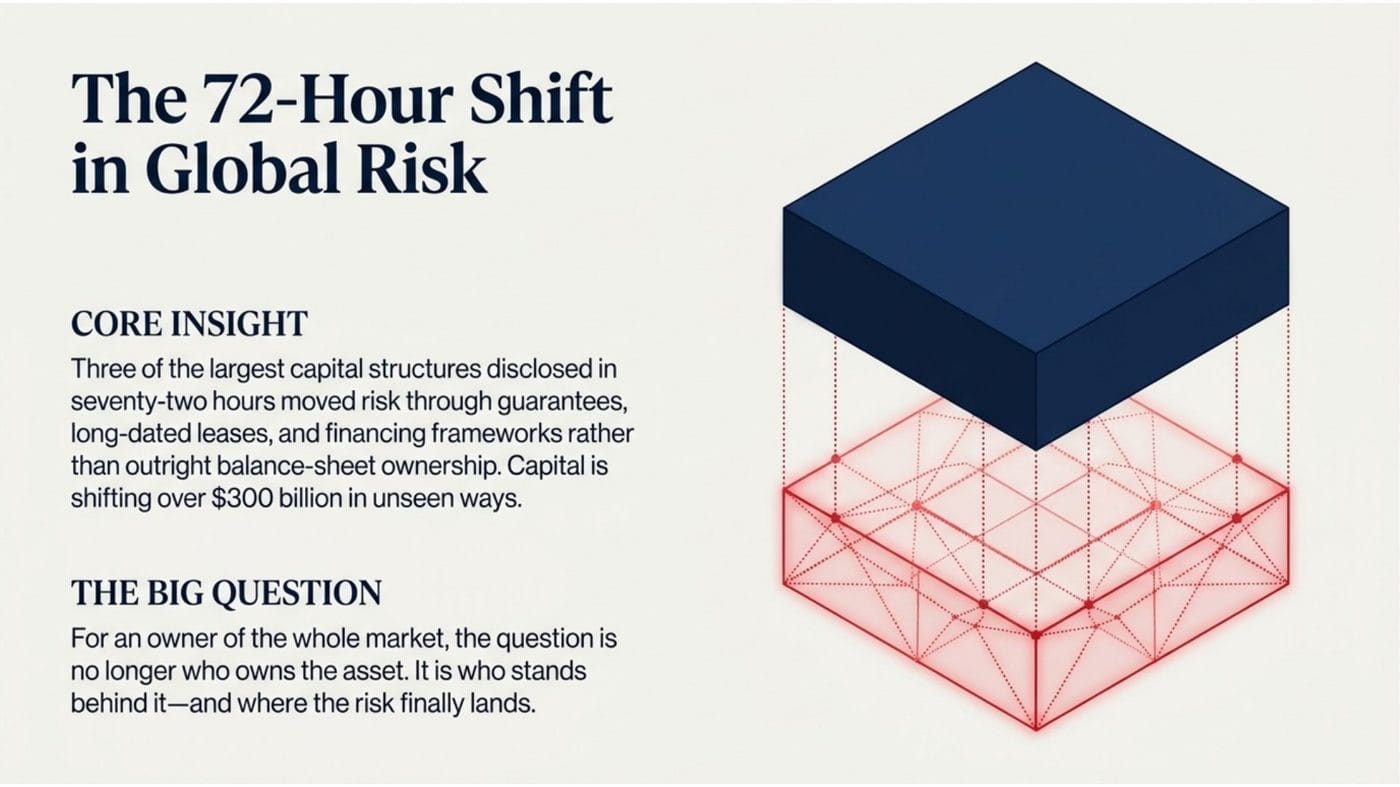
Three of the largest capital structures disclosed anywhere in seventy-two hours moved risk through guarantees, long-dated leases and financing frameworks rather than outright balance-sheet ownership. At the same moment, the oldest guarantee business on earth has repriced its own guarantee to ten to fourteen million dollars a voyage.
The Lead
Nobody wanted to own it.
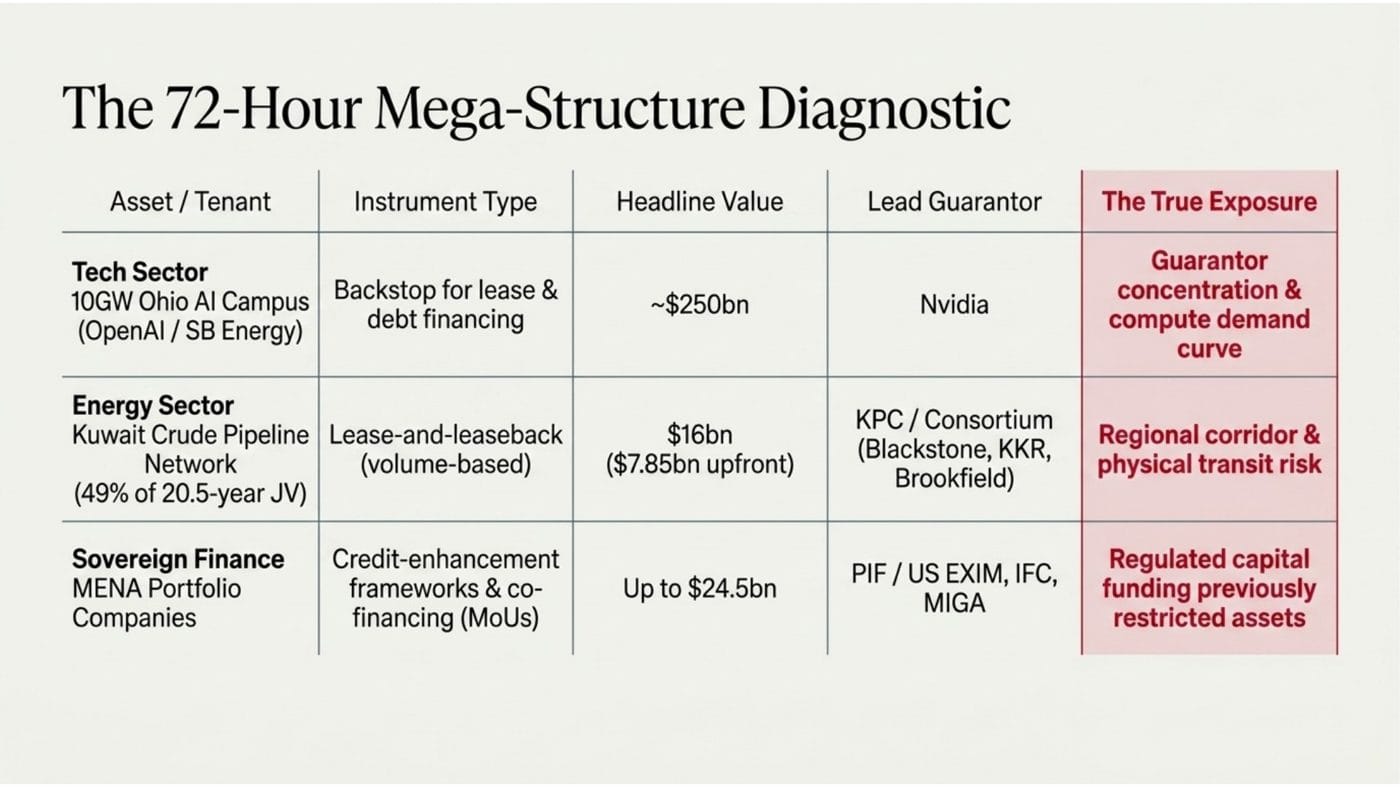
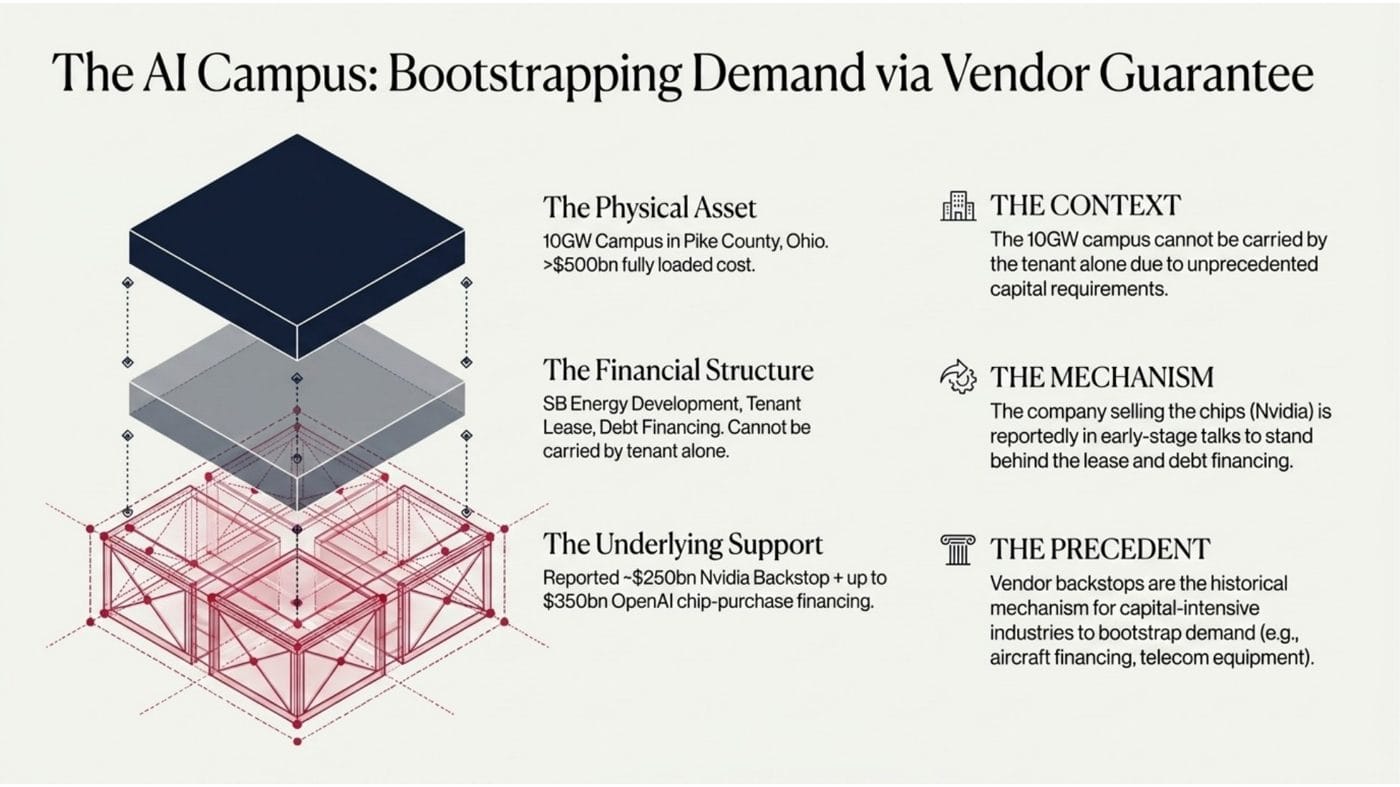
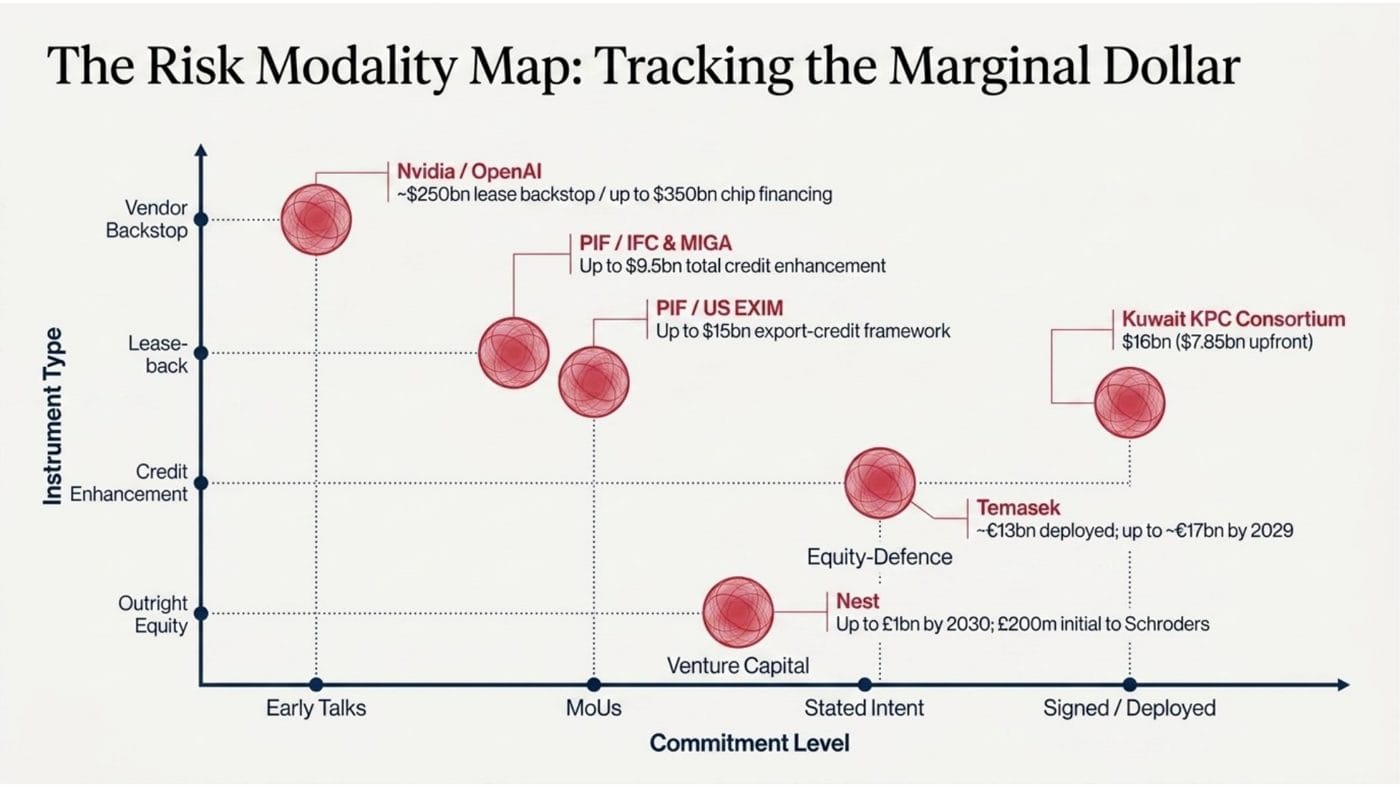
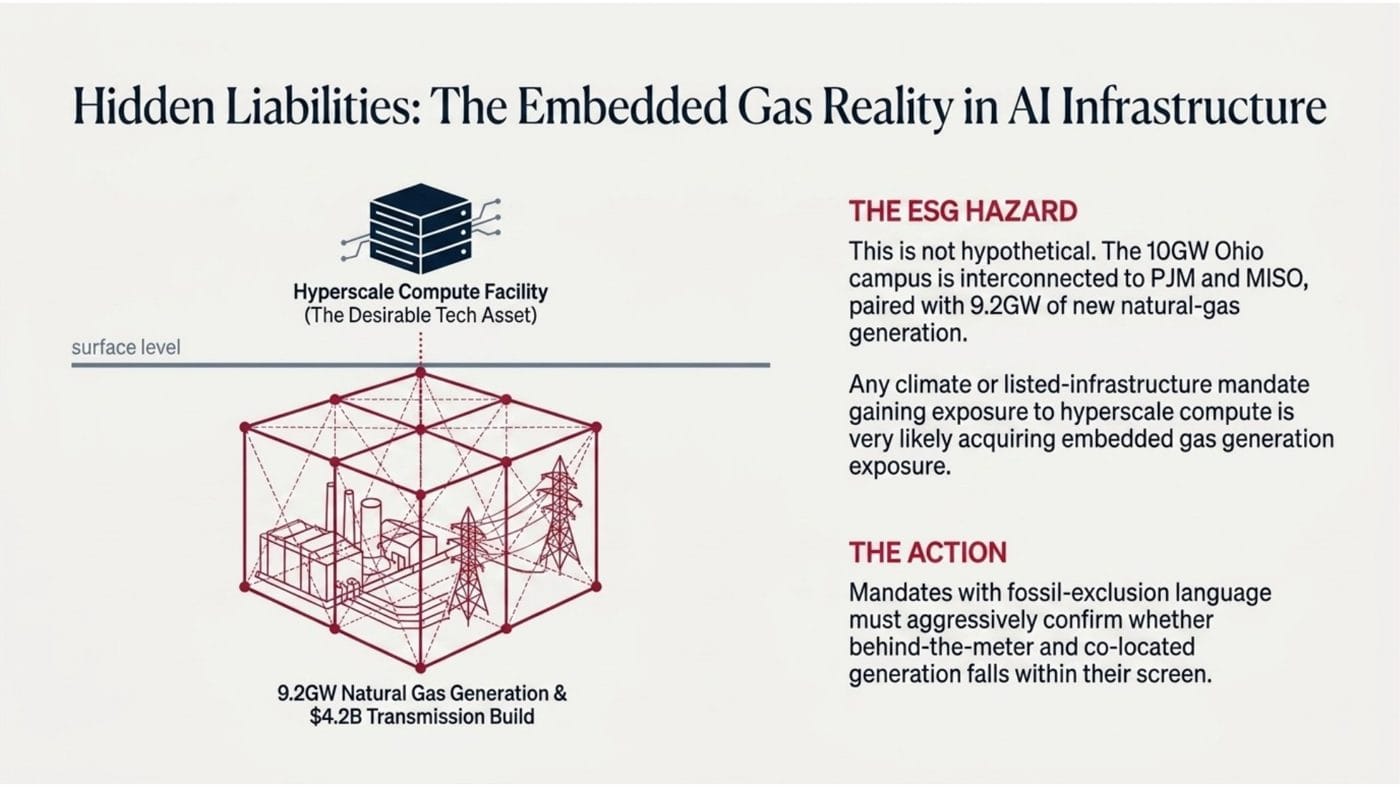
Not the campus in southern Ohio. Ten gigawatts, and a reported cost above $500bn once the chips are counted. The tenant could not carry that alone, so the company selling the chips is reportedly discussing standing behind the lease instead. Bloomberg, carrying a Wall Street Journal report of 26 July, put the backstop at roughly $250bn — covering the lease and the debt financing, not the Nvidia chips inside. Nvidia is separately said to be discussing financing up to $350bn of OpenAI's chip purchases. Reporting notes that the guarantee would help OpenAI secure favourable financing despite the company lacking an investment-grade credit rating — which is the cleanest statement of what a backstop is actually for. The site is being developed by SoftBank's SB Energy at the former Portsmouth uranium enrichment complex in Pike County, Ohio. It is not a neutral box of servers: SB Energy is developing 10GW of new generation to serve the 10GW campus load, of which 9.2GW is natural gas, alongside $4.2bn of transmission investment with AEP Ohio, on a site interconnected to both PJM and MISO. The talks are early. Reuters, carrying the same report, noted it could not independently verify it, and the parties did not comment. They may collapse. The terms may change.
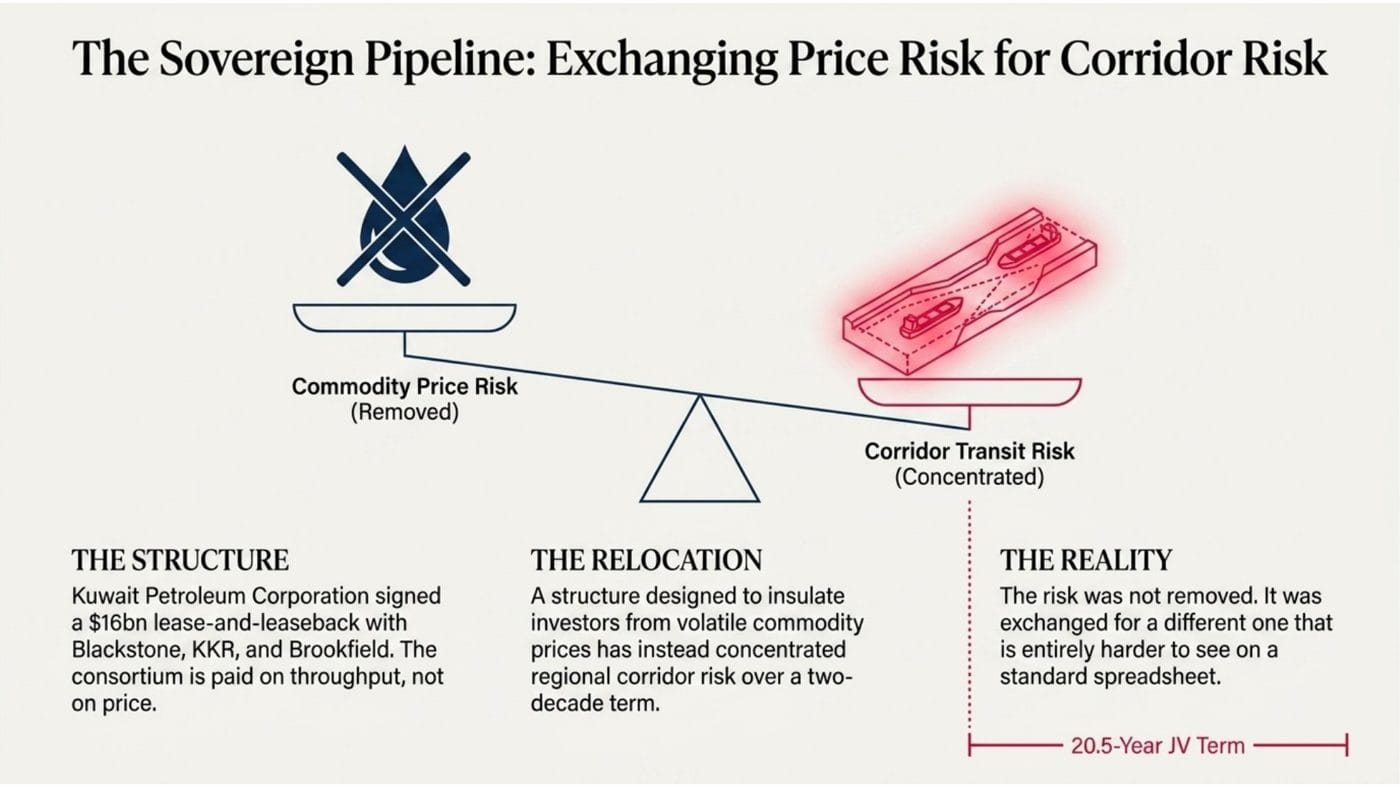
Not the pipelines either. On 25 July, Kuwait Petroleum Corporation signed a $16bn lease-and-leaseback of its crude pipeline network with Blackstone, KKR and Brookfield. The three managers take 49% of a 20.5-year joint venture; Kuwait Oil Company keeps 51%. Kuwait is expected to receive about $7.85bn in proceeds at closing, and the venture is paid on the volume of crude moving through roughly 320 kilometres of pipe. KPC calls it the largest foreign direct investment in the country's history.
And on 24 July, Saudi Arabia's Public Investment Fund signed memoranda worth up to $24.5bn: up to $15bn with US EXIM for portfolio companies procuring American goods and services, and up to $6bn with the IFC and up to $3.5bn with MIGA — the last of those explicitly for credit-enhancement guarantees across MENA.
Three enormous structures, and not one of them a straightforward purchase of the asset — though the Kuwait consortium does acquire a 49% interest in the joint venture and its economics.
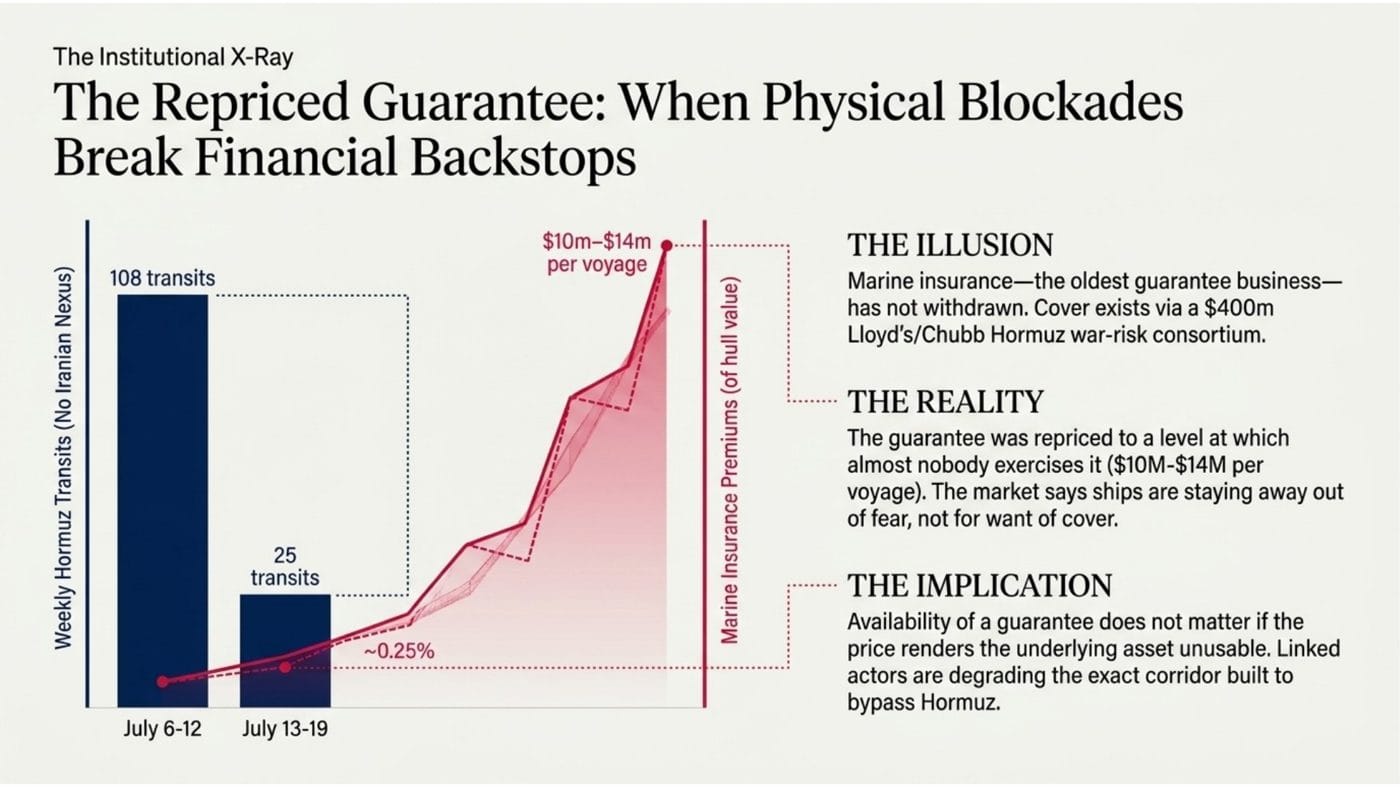
Now hold that against the corridor. USNI News, citing Lloyd's List Intelligence, counted 78 total vessel transits of the Strait of Hormuz between 13 and 19 July, against 174 over 6–12 July. Eastbound transits fell from 101 to 44; westbound from 73 to 34. On a narrower cut — vessels with no Iranian nexus by trade, ownership or sanctions — Lloyd's List Intelligence counted 25 transits over the same week, against 108 the week before. Which measure you use changes the severity; both point the same way. Linked conflict actors have, in USNI News' description, declared a maritime blockade against Saudi-linked ships and ports. Traffic slowed sharply and some voyages rerouted, but the strait remained in use — this is a degraded corridor, not a closed one, and that distinction matters for anyone modelling Saudi export optionality.
And here the guarantee story turns, in a way worth stating carefully. Marine insurance — the first guarantee human beings ever wrote down — has not withdrawn. Lloyd's and Chubb launched a dedicated Hormuz war-risk consortium on 19 June, roughly $200m of primary hull and P&I capacity plus $200m for cargo. The Lloyd's Market Association has said plainly that safety concerns, not insurance availability, are driving the fall in traffic, and Lloyd's List has separately rebutted reports that P&I clubs cancelled war-risk cover. Cover exists. It costs $10m to $14m for one Hormuz voyage, against roughly a quarter of one per cent of hull value before the escalation. That is the more unsettling fact, and it is this edition's thesis turned inside out: the guarantee was not withdrawn. It was repriced to a level at which almost nobody exercises it.
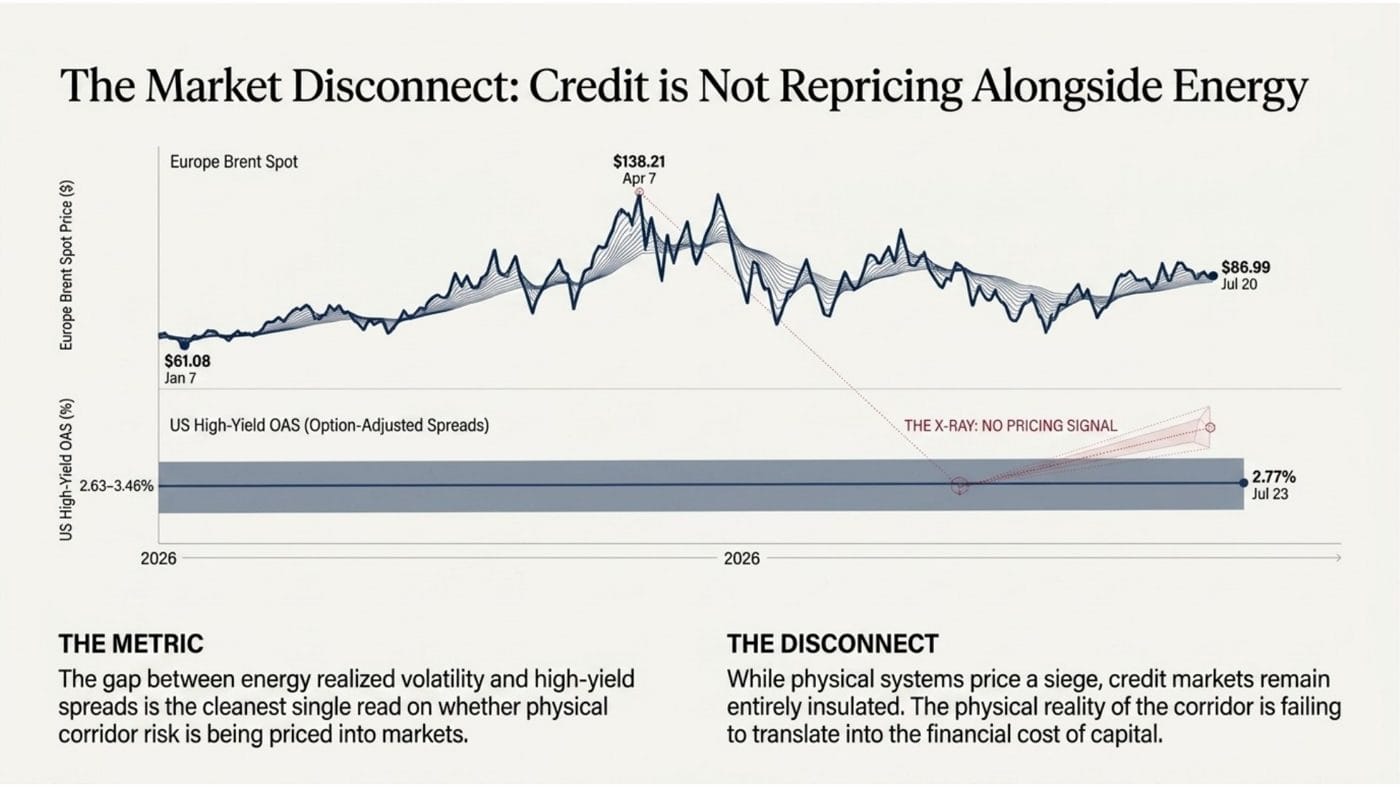
Brent still fell nearly 4% on Friday, closing at $96.78 a barrel on reports that Pakistan, with Chinese backing, was seeking to revive US–Iran talks; WTI settled at $89.31. The honest qualifier: that fall sat inside a week in which Brent still rose nearly 10%. The tape gave one day back to a conversation that had not happened. The physical system is still pricing a siege.
The honest case against reading these as one story: they are three unrelated transactions with three unrelated motives. Kuwait is monetising a mature asset at an attractive multiple — sale-and-leaseback of core infrastructure is decades old and unremarkable. PIF's memoranda are frameworks that commit nothing and may never be drawn. And a vendor backstop is simply how capital-intensive industries have always bootstrapped demand, from aircraft financing to telecom equipment. Friday's move may also owe more to profit-taking after a week in which Brent rose nearly 10% than to the diplomatic headline itself. Each objection is reasonable on its own. What is harder to dismiss is the aggregate — that the marginal dollar of infrastructure risk is increasingly being carried by a guarantor rather than an owner, and that guarantor concentration is not a standard reported exposure.
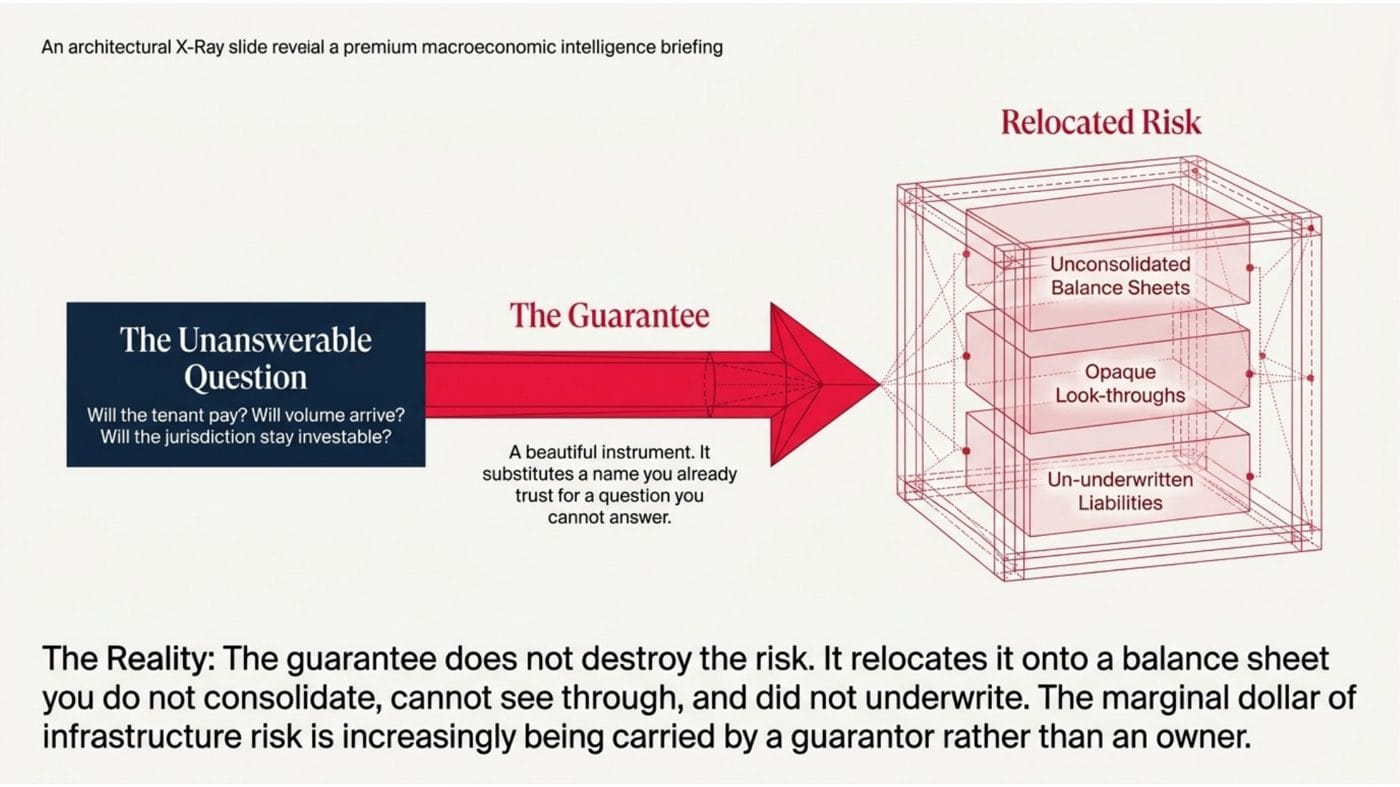
A guarantee is a beautiful instrument. It takes a question you cannot answer — will this tenant pay for ten years, will this volume arrive, will this jurisdiction stay investable — and substitutes a name you already trust. But it does not destroy the risk. It relocates it, usually onto a balance sheet you do not consolidate, cannot see through, and did not underwrite.
For an owner of the whole market, the question is never who owns the asset. It is who stands behind it — and where the risk finally lands.
Deep Dive · The Guarantee Economy
One bet wearing four costumes
Consider what a pension fund or an insurer would actually own if it bought senior debt against the Ohio campus.
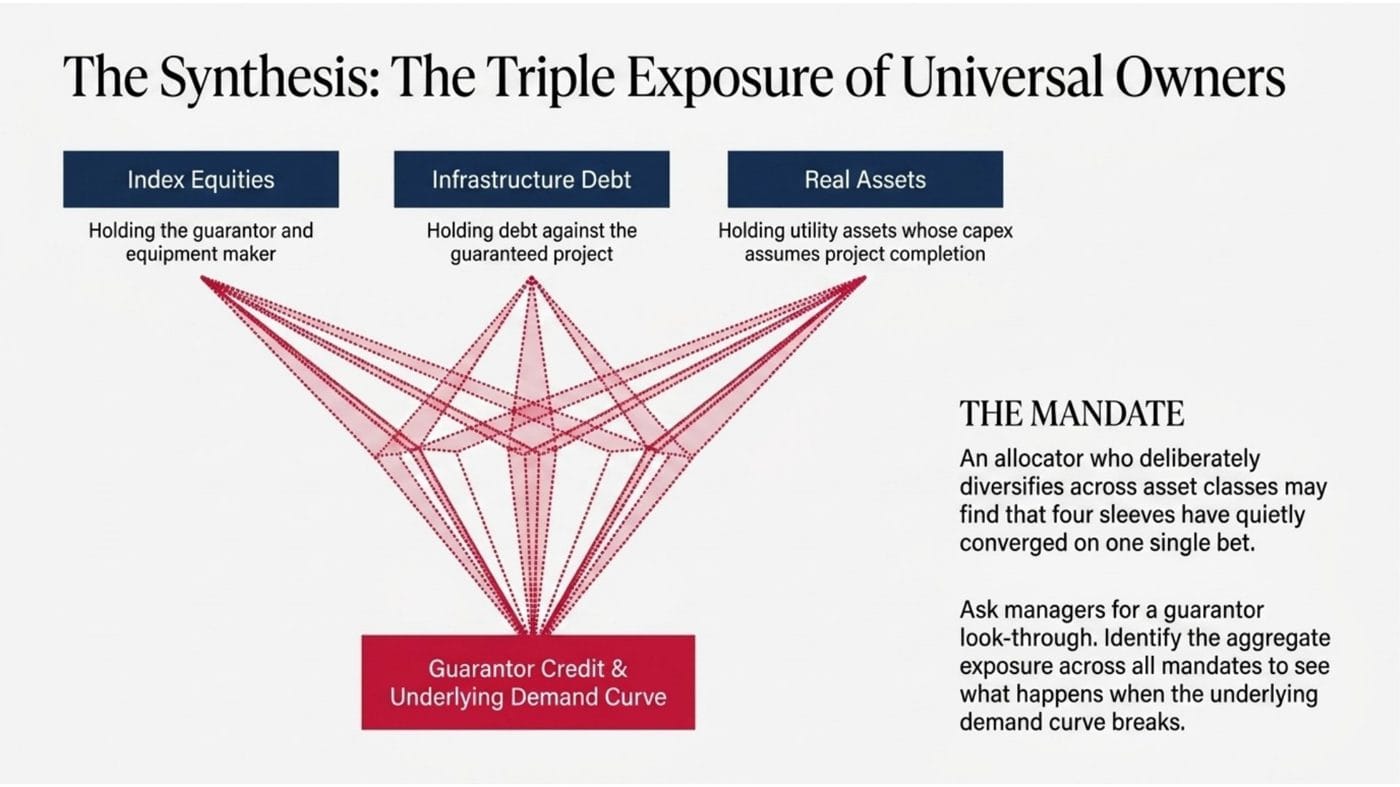
It would own a claim on a lease. The lease is supported by a guarantee. The guarantee is written by a company whose own equity value depends on the same demand curve that is supposed to fill the building. The tenant's ability to pay rent depends on that curve too. So does the residual value of the asset, and so does the market for the chips inside it. Four apparently distinct exposures — tenant credit, guarantor credit, asset value, and the equity you may already hold in both counterparties through a global index — resolve to a single underlying variable.
This is the specific hazard for universal owners. An allocator who deliberately diversified across public equity, infrastructure debt, private credit and real assets may find that four sleeves have quietly converged on one bet. Conventional mandate reporting may not show whether the same guarantor stands behind exposures held through several managers and asset classes. The question worth asking is whether that is aggregated anywhere at total-fund level.
Kuwait is the cleaner case, and instructive for a different reason. The consortium is paid on throughput, not on price. That is normally the conservative structure — you are insulated from the oil price, which is the volatile variable. But the region's throughput is exactly what is being contested right now. A structure designed to remove commodity-price risk has concentrated corridor risk instead, and it has done so on a twenty-and-a-half-year term at a moment when weekly transit counts through the neighbouring strait have fallen by more than half. That is not a criticism of the deal, which may prove very well priced. It is an observation that the risk was not removed. It was exchanged for a different one, and the different one is harder to see on a spreadsheet.
PIF's frameworks illustrate the third variety: the guarantee that has not been given yet. MoUs worth "up to" $24.5bn are options, not commitments. MIGA's $3.5bn is explicitly credit enhancement, which PIF describes as intended to facilitate financing for portfolio companies investing across MENA. In practice such guarantees are often what lifts a project into the band where regulated institutional money is permitted to buy it. That is a legitimate and long-established development-finance function. It is also, in aggregate, a mechanism by which a great deal of capital that is constitutionally required to be conservative ends up funding assets it would not otherwise have been allowed to touch.
The counterweight is worth stating plainly: guarantees demonstrably lower the cost of capital and get real assets built. Export credit agencies and multilateral guarantors have decades of loss data, and it is good data. The problem is not that any single guarantee is unsound. It is that it is not clear who, if anyone, is adding them up.
Triple exposure. A universal owner is likely to hold this same risk three ways at once: as index equity in the guarantor and the equipment maker; as infrastructure or private-credit debt against the guaranteed project; and as a beneficiary of the utility, grid and power assets whose capex plans assume the project completes. A common demand shock could impair all three at once.
Practical tilt. Ask managers for a guarantor look-through: for every credit position, who provides the credit support, and what is the aggregate across mandates? The answer will show whether guarantor exposure is measured consistently across mandates. We have not established how common that aggregation is. Where possible, price recourse — a guarantee with unclear recourse provisions and no named lending syndicate should not be underwritten as investment grade because a large name is attached to it.
Embedded gas. This is not hypothetical today. The Ohio campus at the centre of the lead is paired with 9.2GW of new natural-gas generation and $4.2bn of transmission build. Any climate or listed-infrastructure mandate gaining exposure to hyperscale compute is very likely acquiring embedded gas generation exposure. Mandates with fossil-exclusion language should confirm whether behind-the-meter and co-located generation falls within the screen.
Chart of the Day
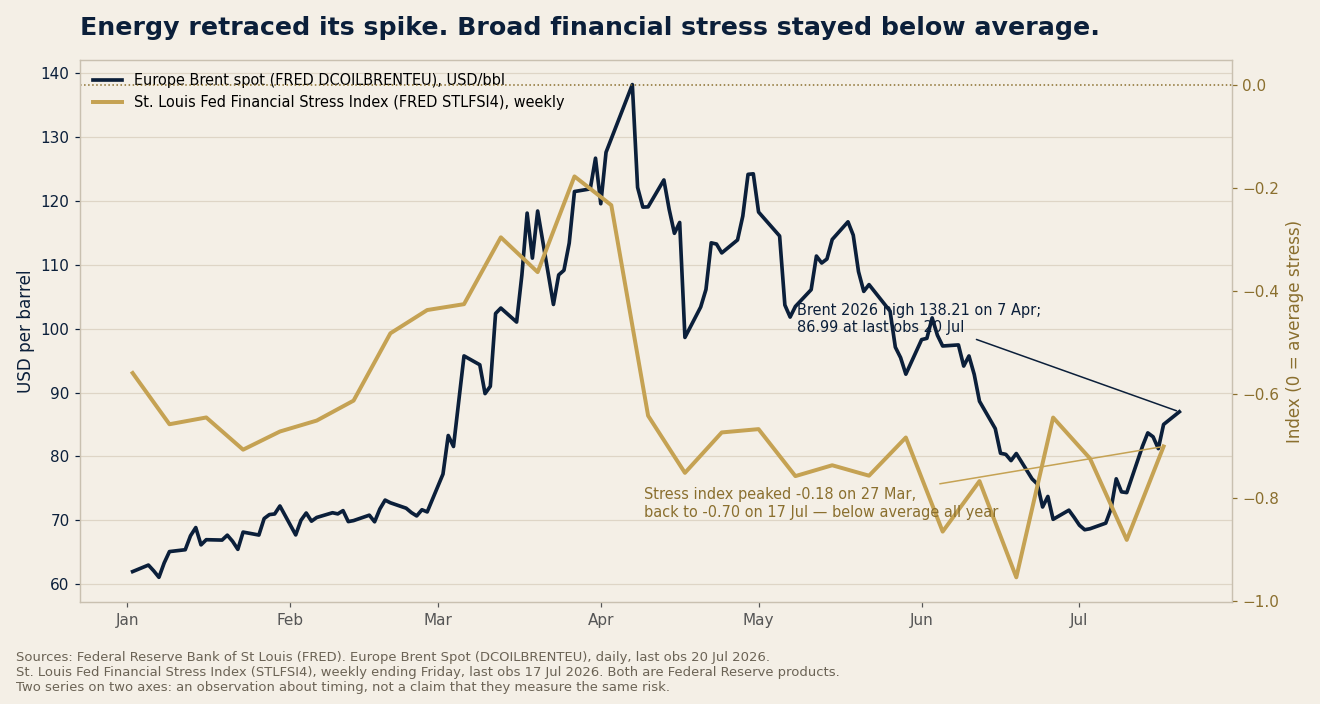
Europe Brent spot ran from $61.08 on 7 January to a 2026 high of $138.21 on 7 April, and stood at $86.99 at the last observation on 20 July — still well above where the year began. Over the same period the St. Louis Fed Financial Stress Index peaked at −0.18 on 27 March and was back to −0.70 by 17 July, below its zero average all year. Sources: FRED DCOILBRENTEU and FRED STLFSI4, both Federal Reserve products. Two different series on two axes: an observation about timing, not a claim that they measure the same risk. The spot series is not the ICE Brent front-month contract, which settled at $96.78 on 24 July.
Capital Flows
| Institution | Action | Amount | Status |
| Kuwait Petroleum Corporation / Blackstone, KKR, Brookfield | Crude pipeline lease-and-leaseback; 49% of a 20.5-year JV | $16bn; ~$7.85bn upfront | Signed 25 Jul; proceeds at close |
| Public Investment Fund / US EXIM | Export-credit framework for portfolio companies | Up to $15bn | MoU, 24 Jul — not committed |
| Public Investment Fund / IFC and MIGA | Co-financing; credit-enhancement guarantees across MENA | Up to $6bn; up to $3.5bn | MoUs, 24 Jul — not committed |
| Nvidia / OpenAI / SB Energy | Backstop for a 10GW lease; separate chip-purchase financing | ~$250bn; up to $350bn | Reported early-stage talks |
| Temasek | EMEA deployment, shifting toward defence and dual-use | ~€13bn deployed; up to ~€17bn by 2029 | Stated intent, 24 Jul |
| Nest | Entry into venture capital; initial mandate to Schroders Capital | Up to £1bn by 2030; £200m initial | Allocation ambition |
Sources: The National; PIF; Bloomberg/WSJ; Reuters; Pensions Expert.
And a fourth, quieter one. Bloomberg reported on 26 July that UK pension providers — including Railpen and Nest, working with the British Business Bank — are planning a roughly £1bn fund to back British science and technology companies. It is at the planning stage, not a closed commitment. Separately and additionally, Nest is entering venture capital with an ambition of up to £1bn by 2030, beginning with £200m to Schroders Capital. Two distinct things, often merged in weekend write-ups. Note the shape: a national scale-up vehicle is another structure in which patient capital is asked to stand behind an outcome the market will not underwrite alone.
The Universal Owner Risk Radar
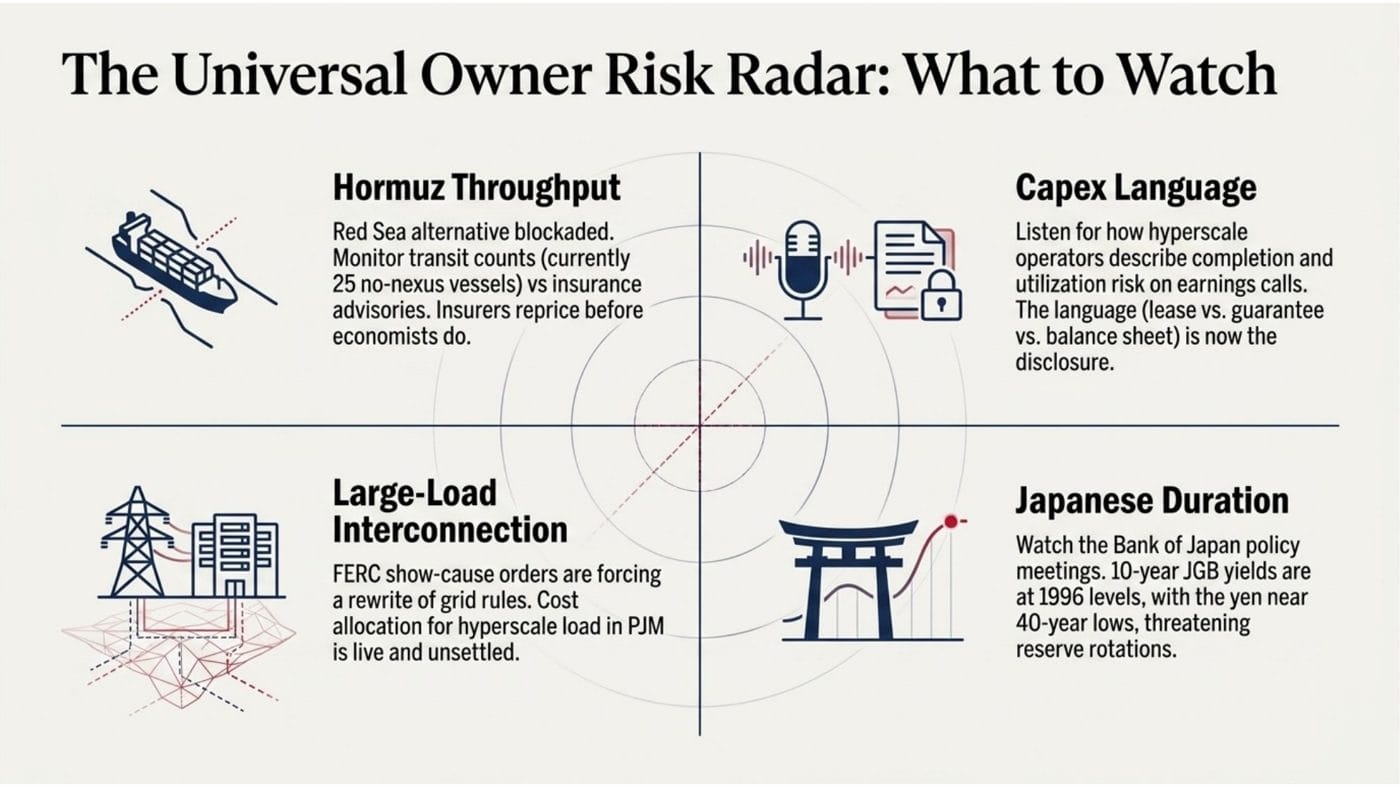
| Hormuz throughput stays impaired even as diplomacy advances. 78 total transits 13–19 July against 174 the prior week; 25 against 108 on a no-Iranian-nexus basis. → USNI News transit report, 24 Jul · Lloyd's List Intelligence Hormuz brief, 21 Jul |
| A declared blockade has degraded the Red Sea alternative — traffic slowed and some voyages rerouted, though the strait remained in use. Saudi export optionality is impaired, not eliminated. → USNI News, 24 Jul |
| Large-load interconnection rules are being rewritten under FERC show-cause orders of 18 June. Cost allocation for hyperscale load is live and unsettled. → Utility Dive on the PJM co-location order · Orrick analysis of the show-cause orders |
| Japanese duration is repricing into the 30–31 July policy meeting. Ten-year JGB yields at levels last seen in 1996; the yen near 40-year lows. → Bank of Japan release calendar · Nikkei preview |
| Standing observation feeds we check daily. → GDACS global disaster alert feed · NOAA SWPC 3-day forecast · CISA Known Exploited Vulnerabilities catalog |
Scenario Lab
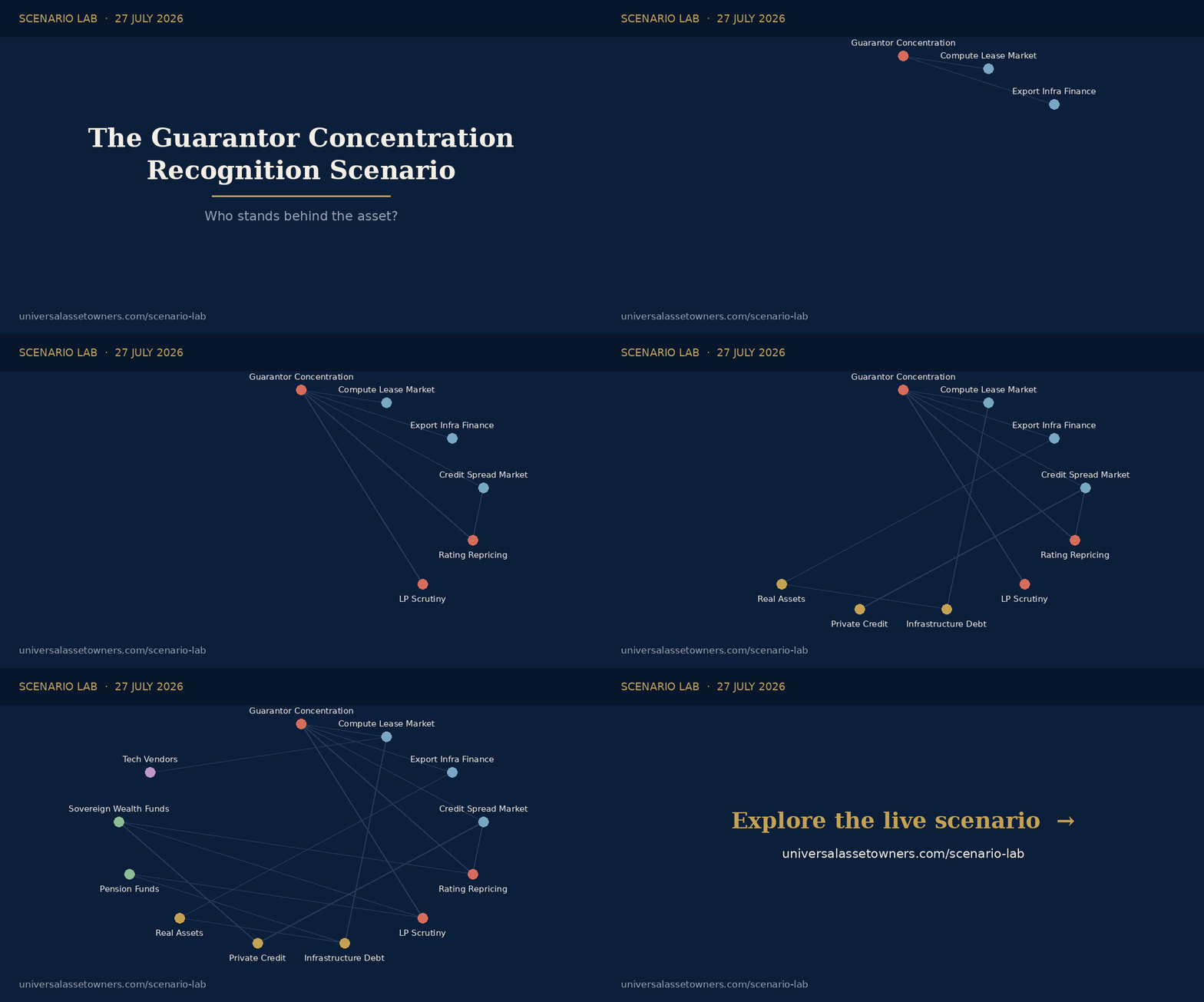
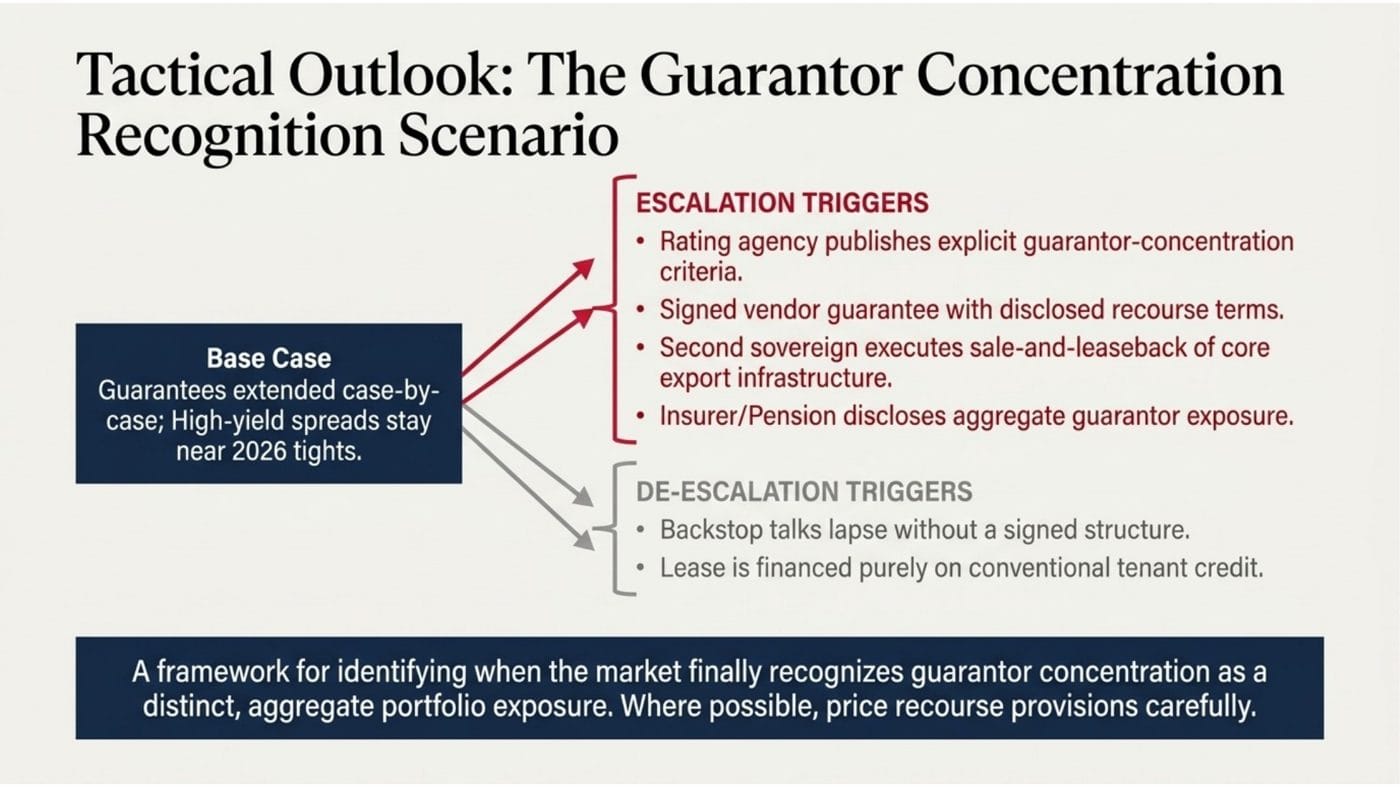
The Guarantor Concentration Recognition Scenario. Base case: guarantees continue to be extended case by case; rating agencies and limited partners do not yet isolate guarantor concentration as a distinct exposure.
Escalation triggers: a signed vendor guarantee with a named lending syndicate and disclosed recourse terms; a rating agency publishing explicit guarantor-concentration criteria for lease-backed compute infrastructure; a second sovereign executing a sale-and-leaseback of core export infrastructure; an insurer or pension disclosing aggregate guarantor exposure across mandates.
De-escalation trigger: the reported backstop talks lapse without a signed structure, or the lease is financed on conventional tenant credit.
Open today's scenario in the Scenario Lab →
Podcast · The Universal Owner
Six minutes thirty-eight. Opens on the contradiction: cover for a Hormuz voyage is available at $10m–$14m, and the market says ships are staying away out of fear, not for want of it.
The Film
A short cinematic essay on the week's structures — the campus, the substation, the pipeline, the empty sea lane, and the underwriting room. One minute thirty-six.
Also on the Desk
A state investor underwrites another state's rearmament
Temasek said on 24 July that it has deployed roughly €13bn into Europe, the Middle East and Africa over the past two years and is targeting up to about €17bn in the region by 2029, with a stated shift toward defence and dual-use technology and larger deals. Read it alongside the day's other structures and a pattern appears: sovereign capital is increasingly the party willing to hold exposures that private balance sheets price as too political, too long or too binary. Defence is simply the most explicit version. For allocators with exclusion policies, dual-use is the harder category, because the same component can sit in a logistics contract and a targeting system.
The oldest guarantee nobody signed
The Bank of Japan meets on 30–31 July and consensus reporting expects a hold at 1%, after June's 25bp move took the policy rate to a 31-year high. Ten-year JGB yields have been trading at levels last seen in 1996 and the yen sits near 40-year lows against the dollar.
This belongs in today's edition rather than a rates column, because the yen carry trade is itself a guarantee — an unwritten assumption that cheap Japanese funding is permanent. No counterparty signed it, no rating agency assesses it, and no allocator holds a position labelled "short Japanese funding costs." Yet a great deal of levered global exposure depends on it holding. It is the purest example of the thing this edition is about: a support that everyone relies on and nobody has underwritten.
Under Investigation — Not Yet Confirmed
Items we are tracking that do not yet meet our sourcing bar. We publish these so readers can see what we are working on, and what we have deliberately not asserted.
| Recheck within 48 hours — does the Nvidia backstop become a structure? Right now this is a Wall Street Journal report carried by Bloomberg describing early-stage talks, and we have written it that way throughout. Three things would convert it from reporting into a fact an allocator can underwrite: a named lending syndicate, disclosed recourse and priority terms, and a rating treatment for the project debt. Any one of them appearing changes what the paper is worth. If the talks lapse instead, the lease presumably reverts to conventional tenant credit — which would tell you the market was never willing to fund it on OpenAI's covenant alone. Either outcome is informative. Silence past this week is itself mildly bearish for the structure. |
| Unresolved — nobody agrees how many mines are in the Gulf, or how long clearance takes This matters more than it looks, because the reopening timeline sits underneath every number in this edition. The public estimates do not converge. President Trump has said US forces destroyed all 28 Iranian mine-laying vessels; one account cited by Al Jazeera put the number sown at roughly ten, while CNN has reported "a few dozen". Clearance estimates run from two to three weeks to several months. DefenseScoop reported the Navy bringing underwater drones into the effort in April, and Military.com covered a further push to hunt mines and reopen the strait. NPR reported experts questioning whether the Navy's mine-countermeasures capability is adequate to the task at all. We are not printing a mine count or a reopening date, because choosing among these would be picking a number rather than reporting one. What we will report is the transit data, which is observable. |
| Degraded verification environment — the commercial satellite record of this conflict has been restricted This is the item that quietly conditions everything above, so it is worth being specific about what happened. Planet Labs announced on 4 April that it would indefinitely withhold imagery of Iran and parts of the Middle East at the request of the US government — high-resolution SkySat and medium-resolution PlanetScope data pulled from public-facing platforms, under a "managed access" model, retroactive to 9 March and replacing an earlier 96-hour delay that had already been extended to fourteen days. Vantor, formerly Maxar, has separately applied enhanced access controls over parts of the region, while stating it was not asked by the government to do so. The stated rationale is preventing adversaries from using commercial imagery for targeting, which is a serious and defensible reason. The consequence for readers is unavoidable regardless of the rationale, and newsrooms have documented it: independent verification of strike damage, port and terminal condition, vessel positioning and mine-laying activity is now substantially harder than it was in February. That lowers our confidence in every conflict claim in this region — including well-sourced ones, and including claims that support our own argument. It is also why this edition leans on vessel-transit counts and insurance pricing, which are commercial records rather than imagery, and why we will keep saying so. |
| Watching — whether a second sovereign follows Kuwait The Kuwait lease-and-leaseback is one transaction. One transaction is an anecdote about Kuwait's balance sheet. A second sovereign monetising core export infrastructure on similar terms — long-dated, throughput-linked, minority stake to private managers, cash at closing — would make it a template, and templates are what allocators actually have to plan around. The Gulf producers with comparable pipeline and terminal assets are the obvious candidates. We will name one only when there is a signed agreement, not a mandate rumour. |
The Institutional X-Ray
Twelve slides taking the week apart: the 72-hour mega-structure diagnostic, the anatomy of the Ohio campus, the sovereign pipeline as an exchange of price risk for corridor risk, and a map of where the marginal dollar of infrastructure risk actually sits by commitment level.
Use the arrows or your keyboard. Twelve slides.
The Long Read, on Screen
The Guarantee Economy: The Unpriced Siege. Three minutes eleven. The full argument, with the structures drawn out.
The Debate
Two hosts argue the week out at length — whether guarantor concentration is a real and unpriced exposure or a category error, whether Kuwait swapped one risk for a worse one, and whether the corridor numbers support the conclusions we drew from them. Twenty-two minutes, and it does not simply agree with the edition.
Long-form listening for the commute.
The Risk, in One Frame
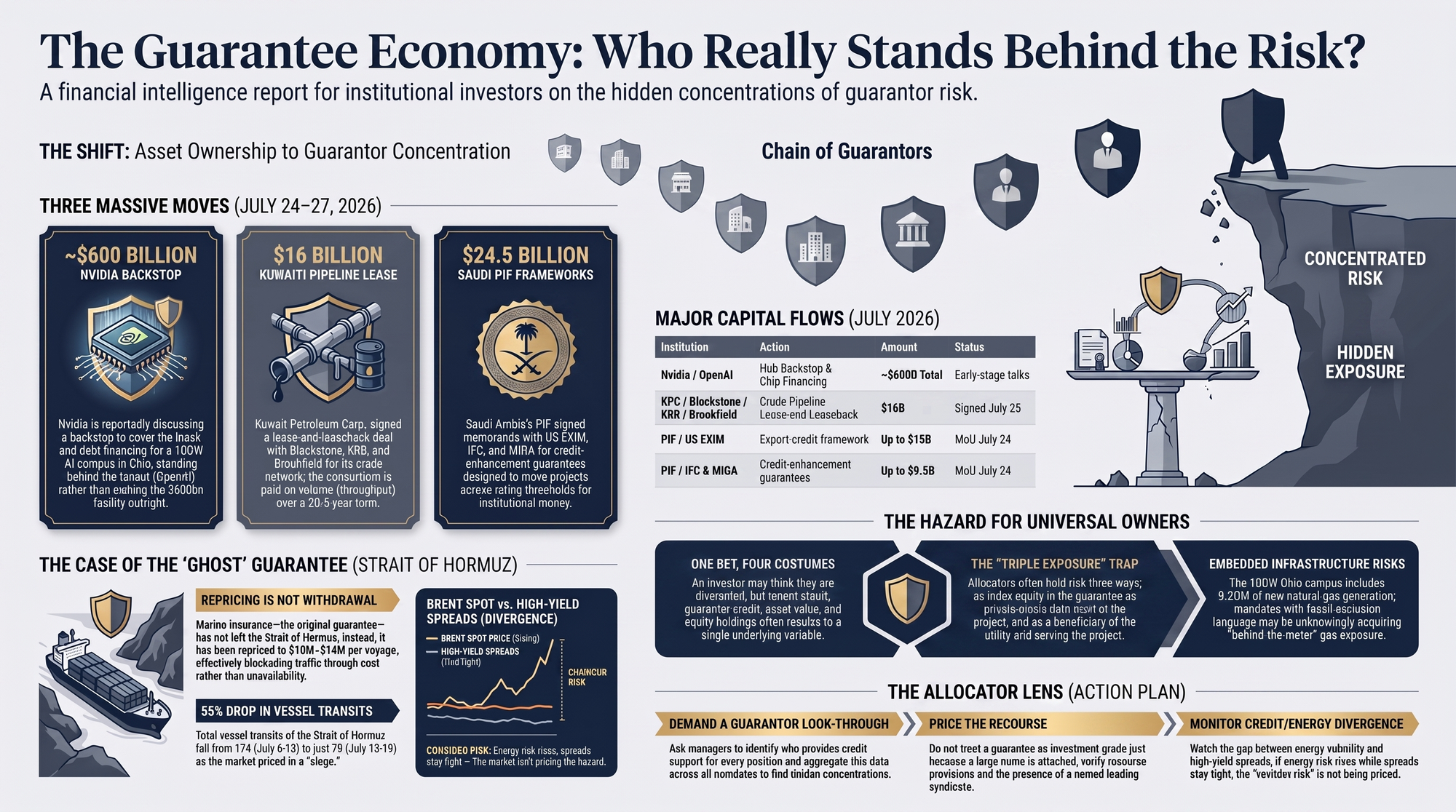
Where the marginal dollar of infrastructure risk sits, by instrument and commitment level.
From the Newsroom
When the State Joins the Cap Table
Today's edition is about who stands behind an asset. This piece asks the sharper version of the same question: what happens when the party standing behind it is the state itself, and it is also the regulator. It opens on reporting that OpenAI held early discussions about a possible 5% US government stake — on the 31 March financing valuation of $852bn, an interest worth roughly $42.6bn on paper, and politically contingent rather than a completed transaction. From there it works through what changes for universal owners when governments take equity, underwrite demand and back strategic projects in sectors they simultaneously regulate: the state becomes shareholder, customer and rule-maker at once, and the usual separation between policy risk and counterparty risk stops holding.
 | Naveed Iqbal Contributing Journalist — Digital Assets & Web3 Digital-assets and Web3 journalist covering crypto markets, blockchain infrastructure and tokenisation since 2018 — and where they meet institutional capital. |
Week Ahead
| Capex commentary. Listen for how hyperscale operators describe who carries completion and utilisation risk — lease, guarantee or balance sheet. The language is now the disclosure. |
| Oil, volatility and credit divergence. The gap between energy realised volatility and high-yield spreads is the cleanest single read on whether the corridor is being priced at all. |
| Insurance advisories. Watch marine war-risk circulars and any change in cover for Gulf and Red Sea lanes. Insurers reprice before economists do. |
The Back Page
Meet The Allocator
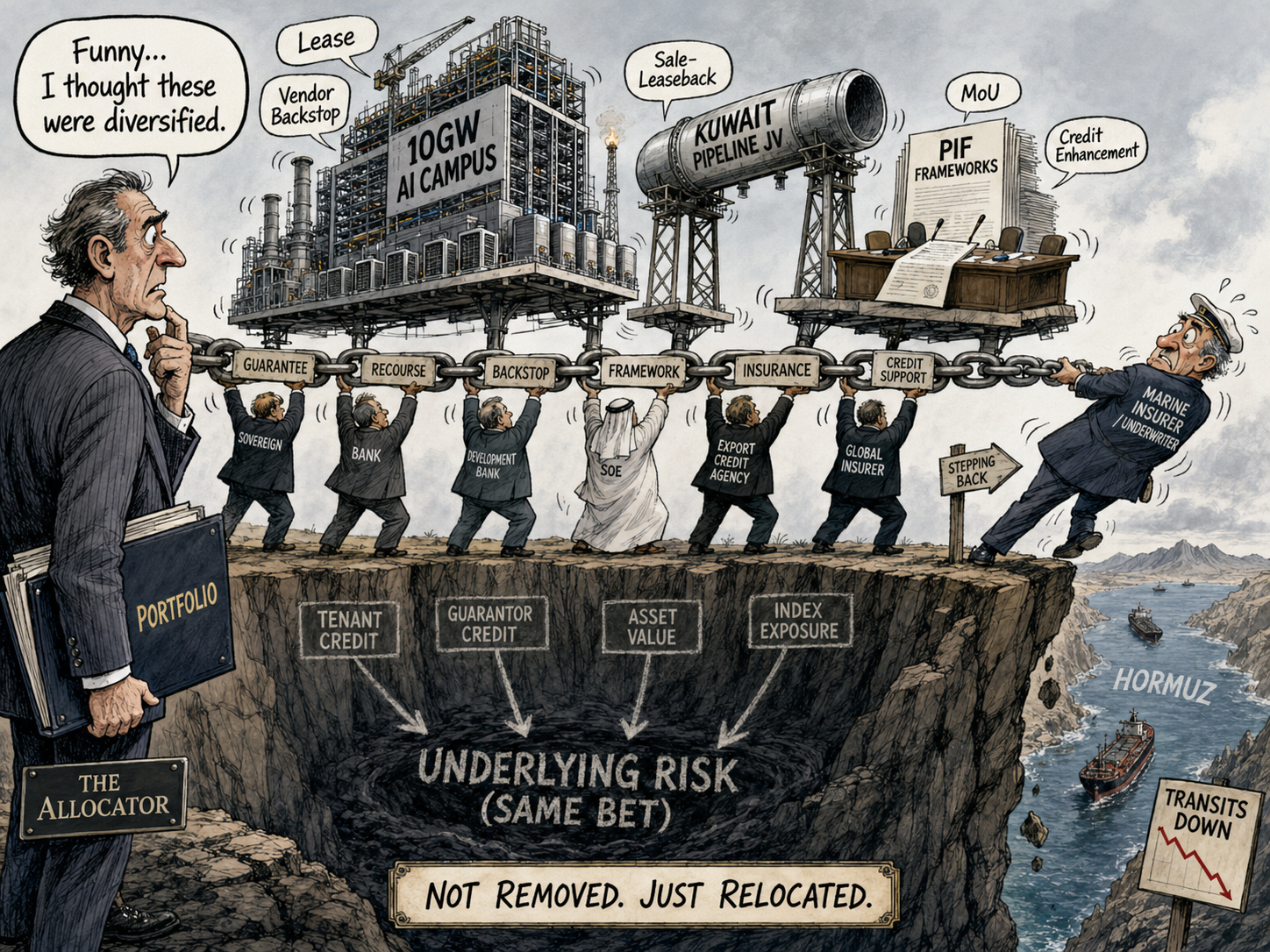
Not removed. Just relocated.
Careers
Verified open this morning against each employer's own system.
PSP Investments — Associate, Natural Resources Investments
Montréal · posted 2 days ago
PSP Investments — Senior Analyst, Public Markets Solutions
Montréal · posted 2 days ago
PSP Investments — Analyst, Portfolio Management — Infrastructure & Private Equity
Montréal · 12-month term · posted 2 days ago
PSP Investments — Senior Director, Total Fund Integration and Insights
Montréal · posted 18 days ago
PSP Investments — Intern, Private Equity
London · Sep 2026–Feb 2027 · posted 2 days ago
Browse: Norges Bank Investment Management · CPP Investments