98% of the world’s sovereign wealth funds |
18 of 20 of the world’s largest pension funds |
10 of 10 of the largest charitable foundations |
85% of the world’s largest family offices |
100+ billionaires, every morning |
Watch · The Universal Owner
Canada announced nearly half a trillion dollars. The documents say “up to.” Eighty-three seconds on what that means for the people who own the whole market.
Listen · The Universal Owner
Today in 90 seconds
- Canada: The government reports nearly $500 billion in summit commitments. That aggregate combines different forms and stages of capital; it is not a measure of cash already invested.
- Energy: Reports of Saudi cargo cancellations now sit alongside offers to deliver more crude through offshore transfers near Oman. Repair expectations and replacement supply remain separate questions.
- Climate: Brussels has announced an insurance alliance. The investment question is how its eventual contracts would divide losses among owners, insurers and taxpayers.
- Rates: The U.S. 10-year Treasury yield briefly reached 5.041% on September 15. Pension funding and cash liquidity can move in opposite directions.
- Today’s clock: The Fed’s decision is scheduled for 2 p.m. EDT; the press conference follows at 2:30 p.m. A market expectation is not a policy decision. This edition precedes that statement.
The lead | What turns a pledge into an asset?
The Canada Investment Summit’s near-$500 billion headline is the government’s characterization of the announcements, not an independently reconciled deployment total. Its bank component alone is nearly C$325 billion of financing and mobilization across different horizons. The three named banks (TD C$150 billion, Scotiabank more than C$100 billion, BMO C$70 billion) sum to C$320 billion, with CIBC C$2 billion and RBC roughly C$1.5 billion making up the rest; BMO’s is a ten-year figure beside five-year ones. That distinction matters before an investment committee treats the summit as a new pool of equity.
The clearest example is the Maple Fund. CPP Investments and Brookfield describe a cooperation framework targeting up to C$50 billion of equity over five years, shared equally. They will assess and approve individual investments separately, with a focus on projects requiring more than C$5 billion in equity. The release also permits other investors to participate in individual transactions. It does not establish that the headline sum has been funded or deployed.
The Prime Minister’s Office release drops the “up to” and prints “launched the $50 billion Maple Fund,” counting the full face value inside its “nearly $100 billion in new capital” line. That is the mechanism of the overstatement.
PSP Investments’ $25 billion has no PSP document behind it; it is the PMO’s midpoint of a stated “30 to 40%” uplift. Deborah Orida, President and Chief Executive Officer of PSP Investments, told The Logic on September 10 that this is “not a top-down geographic allocation decision, but rather a reflection of the good investment opportunities,” that there is “no fixed timeline,” and that PSP’s role in organising the summit “does not mean the pension manager is committed to investing in the projects promoted there.”
Take out Bell’s capped, un-sited $52.5 billion and the headline total is $439 billion.
The distinction between a fresh announcement and an existing intention matters too. Ontario Teachers’ announced its C$10 billion Canada objective on September 11, before the summit concluded. The target runs through end-2027, remains subject to its return objectives, and is explicitly described as forward-looking rather than binding.
| Announcement | What the evidence establishes | What an allocator still needs |
| Maple Fund | A project-by-project cooperation framework | Approved transaction, definitive agreements, financing and execution plan |
| Ontario Teachers’ Canada objective | A multi-year investment intention | Qualifying opportunities that satisfy its return requirements |
| Bank financing and mobilization | Capacity across lending and other activities | Contracted facilities, actual drawdowns and treatment of overlapping activity |
| Bell’s Saskatchewan expansion | A phased development proposal | Customers, commercial agreements, power, permits and financing |
Bell illustrates why project boundaries deserve their own column. Its September 14 announcement is a non-binding memorandum for up to 900 MW of additional capacity, creating a pathway to 1.2 GW. Bell says total associated capital at full buildout could exceed C$50 billion, including tenant computing equipment and related generation. ISED uses an estimate of up to C$52.5 billion. Those are project-scale estimates, not Bell’s own irrevocable spending commitment.
For an infrastructure or climate mandate, that means underwriting the computing customer and the power arrangement together.
Two changes that deserve more attention than the headline
The government also announced permanent immediate expensing across a broader set of assets under its Productivity Mega Deduction. It estimates a reduction in the marginal effective tax rate on new investment from roughly 13% to 6.4%. That is a government estimate of investment taxation, not a new statutory corporate income-tax rate.
Separately, Ottawa intends to seek private investment through long-term operating concessions at its four largest airports while retaining ownership of the underlying land and assets.
Use a project ledger with distinct fields for authorization, signed equity, contracted debt, financial close, drawdowns and operations. Do not divide deployed equity by a denominator that mixes bank financing, mobilized capital and total project costs.
Energy | The bypass needs a bypass
U.S. Energy Secretary Chris Wright expected Saudi Arabia’s damaged East-West pipeline to resume flows within days, Reuters reported on September 15. Other sources in the same report gave longer repair estimates or envisaged an earlier partial restart. These are competing forecasts, not confirmation of recovery. Nameplate capacity on the line is about 7 million barrels a day; Kpler measured August flow at roughly 2 million, the lowest since January, and the 4–5 million barrels-a-day figure in circulation is a wartime peak, not current throughput.
Reuters separately reported suspended Yanbu loadings and cancellations of some European cargoes, while noting that it could not determine the duration or full extent. Its September 16 reporting describes additional Saudi crude offers for ship-to-ship transfer off Sohar, Oman; Aramco declined comment.
The near-term task for risk teams is to distinguish a brief interruption from a multi-week delivery shortfall. The useful confirmation is sustained throughput and fulfilled cargoes; an optimistic repair estimate should not close the risk item.
Climate | An insurance gap is also a question about who pays
Ursula von der Leyen announced an EU climate insurance alliance on September 16. Reuters reports that the Commission puts insured climate-related economic losses at about one-quarter of the total. The initiative is intended to expand coverage and develop risk-transfer tools. The report does not establish a capitalized public guarantee.
Before treating the alliance as an investment opportunity, establish who supplies capital, which losses trigger payment, who absorbs the first loss and whether resilience improvements affect pricing.
Rates | Better funding can coexist with a cash squeeze
Reuters reported that the U.S. 10-year Treasury yield reached 5.041% on September 15, its highest since 2007, before retreating. A higher nominal yield alone does not establish greater sovereign default risk.
The liquidity question is different. Some derivatives positions can require collateral while falling public-asset prices reduce liquid resources. Private assets may also need revaluation as discount rates and financing costs change.
A useful treasury exercise is an illustrative one-percentage-point rate shock, plus a scenario in which longer yields rise more than shorter yields. Show collateral needs and benefit payments beside the funding estimate. This edition closed before the 14:00 EDT FOMC statement. Do not treat a priced hike as a decision already taken.
Private credit | A default measure is not a loss forecast
Fitch’s trailing U.S. private-credit default rate rose from 6.1% in July to 6.3% in August. The number should prompt questions about a manager’s actual borrowers, definitions and recoveries. It does not mean that a portfolio lost that percentage of capital. The dispersion underneath matters: healthcare at 9.9%, software at 0.6%, on Fitch’s figures.
Set against it, the Bank for International Settlements published its Quarterly Review on September 14 under the title “Yields climb, yet risk appetite holds firm.” Its article on private credit and the digital economy, by Abbassi, Aldasoro and Doerr, finds technology-firm borrowing “rose from around $22 billion (22%)… to over $1 trillion (44%) by 2025,” against a market of “almost $2.5 trillion.” The realised losses are in the half of the book with hard assets; nearly half of it is lent against intangibles.
Stewardship & Duty Watch
Korea, NPS — At a briefing on September 14 at the Korea Exchange, convened by the Ministry of Health and Welfare and the first of its kind, the National Pension Service set out an inspection of its external managers on stewardship in October and November, by written review, on-site inspection and interview, with results “linked to manager selection and the allocation and recovery of entrusted funds.” A Stewardship Code 2.0 is targeted for the first half of 2027. The scoring weights, the rule connecting a grade to money and the effective date were not in the materials; that absence is the point. Separately, Lee Kyu-hong took the chief investment officer’s seat on September 15 on a two-year term running to September 14, 2028, renewable by one year on performance; he was chief investment officer of the Korea Teachers’ Pension from 2019 to 2023. The fund stood at ₩1,866 trillion at June 30, 2026.
United States, EPA — Administrator Lee Zeldin announced on September 14, at the G20 Energy Abundance Ministerial in Houston, the final repeal of most of the 2024 Carbon Pollution Standards, with projected savings of $310 billion. A separate, not-yet-final proposal “would save an additional $370 million in direct compliance costs.” The two numbers measure different things and are not nested. Comment runs 45 days; a hearing falls 15 days after Federal Register publication.
Private equity and fossil assets — Investors put $190.4 billion into 145 largely wound-down private-equity oil and gas funds and received $192.9 billion back, according to a scorecard from the Private Equity Stakeholder Project, Americans for Financial Reform Education Fund and Global Energy Monitor. The median fund returned about 2% nominal, a real-terms loss. The 2026 scorecard expanded its scope, so its 1.5 gigatons is not comparable with 2024’s 1.2 and should not be read as growth.
Pensions | A 14.8% year that changed nothing
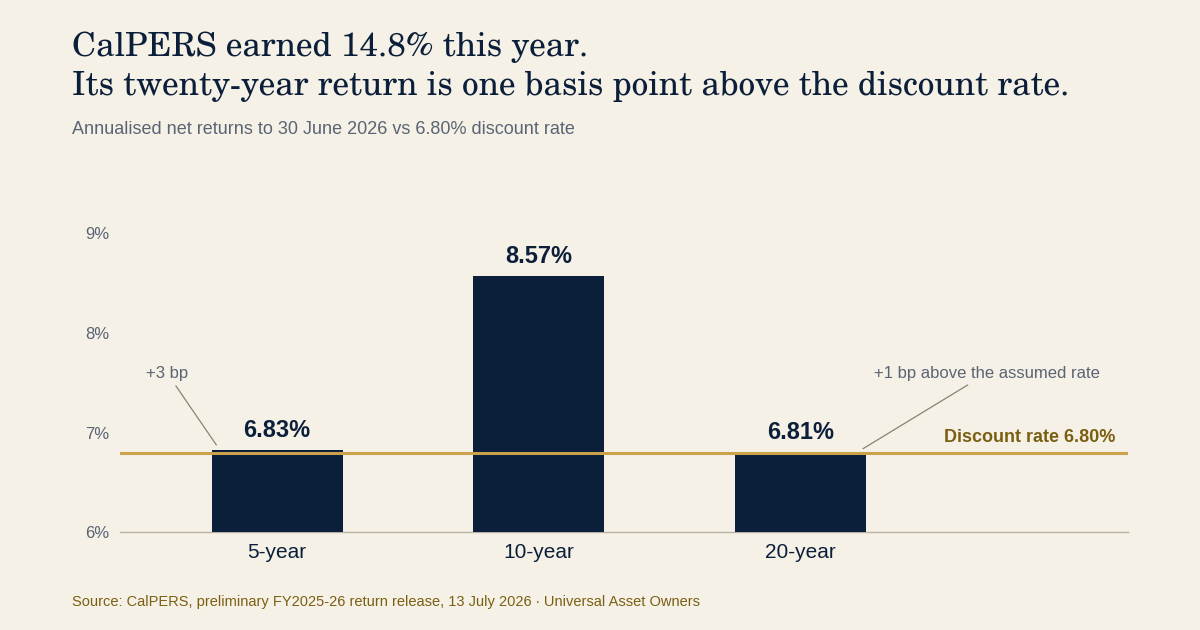
CalPERS’ Finance and Administration Committee took up Item 5a, a Funding Risk Mitigation Event, on September 15 as an action item, following a 14.8% fiscal-year return against a 6.80% assumed rate. Staff recommended making no changes. The reduction contemplated by the policy is 0.10 percentage points. No minutes have been published; they go to the November 17 committee, and nobody should write that the board decided anything.
In CalPERS’ own July reporting, the five-year return is 6.83% and the ten-year 8.57%; the twenty-year return is 6.81 per cent — a single basis point above the 6.80 per cent assumed rate. The five-year clears it by three. A 14.8% year is a distribution, not a trend; the twenty-year is the trend a funding policy is built on, and it has no margin.
The same week, San Diego showed the mechanism from the other side: a proposal to lift the discount rate from 6.5% to 6.75% carried 6–4 on September 11 and still failed, because seven votes were required. It would have cut city contributions by more than $30 million.
Capital and transaction watch
Goldman Sachs Alternatives — The reported US$11.7 billion comprises US$9.6 billion for West Street Capital Partners IX, US$1.6 billion for the Asia strategy and US$500 million in co-investment vehicles. More than one-third invested applies to WSCP IX only, not the full aggregate.
PSG Europe III — final close above €4.4 billion hard cap. Fundraising completion is not invested capital.
AD Ports — acceptances would take L’imad’s holding through ADQ above 98.5%, settlement expected by October 9. High acceptance is not itself evidence that shares have transferred.
Acciona Energía — Reuters, citing Expansión, reports an EQT–NBIM consortium. Approximately €11.9 billion is enterprise value including debt, not an agreed equity purchase price. Parties did not confirm.
NSE India — CPP Investments among selling shareholders (anchors 16 Sep; public 17–21 Sep). Proceeds go to selling holders. No evidence links sale proceeds to Maple Fund investments.
Safaricom — Kenya’s High Court ordered return of the government’s sold 15% stake; government and Vodacom intend to appeal. That does not establish an executed reversal or repayment.
Three questions for the next investment meeting
- Can we identify the same dollar twice? Reconcile project costs, equity, debt and mobilization before setting domestic investment targets against headline totals.
- Which contingency fails alongside the asset it protects? Test backup transport routes, insurance and public support against shared physical or fiscal constraints.
- Can we fund the transition between valuations? Put collateral, distributions, operating cash and benefit payments on one calendar, including a scenario with delayed exits.
The investment committee question
Which projects advanced a stage, what remains conditional, and what price are we being asked to pay?
Ask sponsors for a project ledger, not summit totals. Separate Maple’s C$50bn ceiling from approved deals. Distinguish repair forecasts from fulfilled cargoes, and insurance announcements from capitalized guarantees. The FOMC statement is still ahead of this cutoff.
Named question: which announcements change an investable project’s economics, approvals or financing—and who bears the risk until it starts earning?
Editorial cartoon

“Excellent. When can we cross it?”
A fictional Canadian scene about the distance between an investment announcement and an operating asset.
Before the committee treats a summit total as deployed capital, put the project ledger on the same page: authorization, signed equity, contracted debt, financial close, drawdowns and operations.
Then ask which contingency fails alongside the asset it protects—and whether the treasury can fund the transition between valuations.
CalPERS made 14.8%. Its five-year is 6.83. — Tuesday Daily Brief (15 Sep).
Ottawa's C$1tn rests on C$280bn. Enable isn't close. — Monday Daily Brief (14 Sep).
Higher rates put funding and liquidity on the agenda — Friday Daily Brief (11 Sep).
Scenario Lab — scenario workspace.
Daily Brief archive — weekday intelligence.
UAO Fiduciary — Wednesday ESG edition.
UAO Careers — live seats at asset owners.
Universal Asset Owners is institutional research and discussion, not investment advice. Figures are quoted from the sources named in the edition; where a figure could not be confirmed at a primary source it has been labelled or withheld. Frameworks, allocation targets, financing capacity and project plans are not deployed capital. Attributed and trade reporting on East-West and Yanbu is not a claim of permanent Hormuz closure. UAO analysis is identified separately from reporting.