98% of the world’s sovereign wealth funds |
18 of 20 of the world’s largest pension funds |
10 of 10 of the largest charitable foundations |
85% of the world’s largest family offices |
100+ billionaires, every morning |
~90 sec — ECB rates, funding and cash on the same agenda. Source: Revised Broadcast Scripts (hed-first).
The decisions that matter
The ECB decision puts pension funding and liquidity on the same agenda
The European Central Bank decided on September 10 to raise all three policy rates by 25 basis points, citing inflation pressure from the Middle East conflict. From September 16, the deposit facility rate will be 2.50%, the main refinancing rate 2.65% and the marginal lending rate 2.90%. Staff project headline inflation of 3.0% in 2026, 2.5% in 2027 and 2.1% in 2028. They also raised their growth forecasts for this year and next, while judging the risks to growth to be on the downside.
For a pension fund with euro liabilities, the decision calls for a balance-sheet calculation. The short policy rate does not determine the movement in the long-term curve used to value benefits. If the relevant discount rates rise, the present value of fixed future payments falls, other things equal. Bonds and derivatives also change in value, while inflation-linked benefits introduce another sensitivity. The net funding result depends on the scheme’s exposures and valuation basis.
An improvement in economic funding can coincide with pressure on cash. A scheme using derivatives to receive fixed interest payments may face collateral calls as rates rise, even while its liabilities fall in value. Selling liquid assets to meet those calls can leave less capacity for benefit payments or private-market capital calls. That possibility warrants a treasury review; it does not establish that any named fund is under stress. The Bank of England’s account of the 2022 gilt episode describes the mechanism linking falling bond values, margin calls and asset sales.
The useful instruction for the next investment-committee meeting is to ask for the funding calculation and the collateral schedule together. Compare adverse curve and inflation moves with cash available over the next quarter, including settlement dates and calls from managers. If existing liquid resources cover those demands, maintaining the hedge may be preferable to paying to alter it. If they do not, the decision is about liquidity capacity, hedge size and execution costs before it becomes a forced sale.
Treasury bought less than the announced ceiling
The US Treasury bought $5.2 billion of bonds in its latest liquidity-support operation, against a $6 billion maximum and $10.5 billion offered, Reuters reported on September 11. Its report also put the ten-year Treasury yield at 4.97% in early Asian trading that day. The purchase amount and market price are separate observations; neither establishes that the buyback caused the wider sell-off.
For a dollar-based pension or insurer, higher yields can improve the return available on new investment while reducing the market value of existing bonds. Liability duration, cash needs and the applicable reporting basis determine the institutional result. An endowment without contractual pension liabilities faces a different calculation: prospective income must be weighed against the liquidity needed to sustain spending during a drawdown.
Pension conversion and portfolio protection
Pensioenfonds Detailhandel illustrates why a strong funding ratio can coexist with a decision to hedge. The Dutch retail-sector scheme reports long put options covering roughly 80% of its developed-market equity portfolio. Its July funding ratio was 143.7%; the policy ratio, a twelve-month average, was 136.3%.
At March 31, equities represented 32.2% of the portfolio, with 84% in developed markets. Applying the disclosed hedge coverage to those earlier weights gives an illustrative exposure equivalent to 21.6% of the portfolio. Actual loss protection depends on option terms; that calculation does not measure risk eliminated.
Detailhandel targets January 1, 2027 for conversion, subject to regulatory approval. Existing pension rights will become personal pension capital, while investments and risks remain shared. A solidarity reserve and adjustments to pension payments spread over several years will continue to moderate fluctuations.
UAO analysis. The valuation at conversion can affect the capital allocated to members, giving trustees a reason to examine losses around that date. The investment question is whether the protection is worth its cost. The fund’s disclosure does not provide strikes, premiums or expiries sufficient to judge that trade-off. A board assessment should compare hedging with retaining the exposure or reducing it, and model assets, liability discount rates and existing hedges together. An equity put cannot establish the net funding result.
Liquidity supports a long investment horizon
The UK’s Nuclear Liabilities Fund offers a different portfolio lesson. Its stated structure uses National Loans Fund holdings for current and near-term payments, allowing the mixed-assets portfolio to remain invested. The liquid pool is expected to be used up in the mid-2040s, a timetable sensitive to liability estimates and investment performance. Total fund assets were approximately £20.9 billion in March 2026.
The assets are already restricted to relevant nuclear liabilities and protected from use for general government spending. The fund explicitly links its appetite for illiquid investments to substantial holdings in the liquid pool.
UAO analysis. A useful board test aligns expected payments, available liquidity and plausible investment realisations. Bring spending forward while delaying private-market distributions: does the institution still have time to wait?
Comparing UK pension allocations
Nest’s 2025/26 annual report provides useful context for domestic-investment discussions. At March 31, almost 20% of assets were illiquid; it separately states an ambition for private markets to reach 30% by 2030. About £13 billion of its £62.9 billion in net assets was invested across the UK. Total domestic investment, illiquid assets and private markets are different measures; the first cannot establish the amount invested in UK private markets.
For trustees comparing institutions, consistent definitions, valuation dates and member liquidity needs belong beside the headline percentage.
Dispatches
Filed this morning by our correspondents, in their own time zones — park stub only where a full Friday fold is not on disk.
 | KARACHI · NAVEED IQBAL UAO Correspondent · parked filing (Fri 4 Sep) |
Pakistan stocks (parked). KSE-100 175,384 (+0.26%); rupee ~Rs277.41/$. Source Doc dated Fri 4 Sep — not rewritten beyond park facts. Full dispatch copy held.
Capital this week
Dates below refer to announcements or reporting. Fund commitments, investment deployment and an acquisition agreement describe different stages.
| Announcement | Capital and stage | Detail for allocators |
| 8 Sep — Clean Growth Fund | Fund II second close: £81.5m vs £150m target | Border to Coast £22.5m; Strathclyde +£10m (Fund II total £30m). Four UK climate-tech investments; 20% net IRR is a target. |
| 9 Sep — ICG | Europe Fund IX final close: €12bn | 22% deployed across six investments. Commitments total, not corporate purchases that day. |
| 7 Sep — Alternative Credit Investor | BNP Paribas AM Alts junior infra debt II: €1.2bn final close (reported) | Close to ten investments since Aug 2024. |
| 8 Sep — Clarion Partners | Agreement to acquire majority of Stoneshield Capital; price undisclosed | Expected Q4 close, subject to conditions; co-founders retain strategy/ops under announced arrangement. |
UAO analysis. These announcements offer specific diligence questions: deployment pacing, underlying collateral, manager incentives and continuity of decision-making. Different vehicles may share sensitivity to refinancing costs or energy prices, but measuring overlap requires holdings and cash-flow terms. Neither fundraising success nor a change in manager ownership establishes the investment outcome.
Three ballots, not one signal — different electorates and denominators. Compare each vote to the mandate’s stewardship objectives.
Governance and fiduciary affairs
The Nike filing separates three voting signals
Nike’s September 10 filing supplies the final counts from its September 8 annual meeting. The environmental-targets proposal received 10.6% support; executive compensation received 67.8% support. Both percentages use votes for and against, excluding abstentions and broker non-votes. Thasunda Duckett received 38.5% withheld in her Class B director election, calculated from votes for and withheld. That ballot had a different electorate: Class A shareholders elected eight other directors.
Green Century had sought additional reporting on how Nike intended to achieve its emissions targets. The board argued that existing and planned disclosures were sufficient and that its target was being assessed as methodologies and regulations evolved. CEO Elliott Hill’s reported fiscal 2026 compensation was US$36.34 million, including grant-date equity values; the advisory pay resolution covered executive compensation more broadly.
For asset owners: ask managers to explain each vote against the mandate’s stewardship objectives. The aggregate results cannot reveal why an investor withheld support from a director, or establish the financial materiality of the climate issue. The useful comparison is between a manager’s stated policy, its voting record and its next engagement step.
The UK reporting consultation preserves some investor rights
The UK’s September 7 corporate-reporting consultation considers removing the annual advisory vote on directors’ remuneration reports while retaining the binding triennial remuneration-policy vote. It also proposes deleting a duplicate requirement to disclose voting results in the remuneration report; the Companies Act requirement to publish results would remain. Certain related Corporate Governance Code provisions would continue on a comply-or-explain basis. These are proposals, not enacted changes.
The government argues that simplifying reporting can reduce duplication and make disclosures more useful. Investors have a competing concern: losing an annual accountability mechanism or comparable information they use to assess management. A focused response would identify which disclosures affect an investment or stewardship decision, whether an equivalent requirement survives, and the cost of replacing any lost information. Responses close November 30 at 23:59 UK time.
Jordan, implementation ahead: the Securities Commission announced on September 9 that ASE20 companies must apply a new ESG code from financial 2027. Petra reports an apply-and-explain approach and standalone sustainability reports aligned with IFRS S1 and S2. For investors with relevant holdings, the next test is how consistently issuers implement those requirements.
Energy and the long horizon
The oil recovery forecast depends on the routes remaining usable
The US Energy Information Administration’s September outlook estimates that Middle East crude-production shut-ins averaged 6.7 million barrels a day in August. It projects 5.7 million barrels a day in the fourth quarter. Its assumptions imply that most production and trade flows return to pre-conflict averages in the second quarter of 2027; some producers are expected to remain below earlier output through the forecast period.
The timing matters. The outlook was released on September 9 using inputs finalized on September 3. It is a conditional forecast, not an assessment of every subsequent incident. The next scheduled edition is October 6.
For an owner with energy-intensive infrastructure or inflation-sensitive benefit payments, the stress test should distinguish crude prices from product costs, transport charges and the ability to obtain insurance. A gain on an oil holding need not offset a project’s higher fuel bill or beneficiaries’ higher living costs. Conversely, more reliable export routes, weaker demand or substitution could ease the pressure before the forecast’s recovery date.
The immediate task is to identify which contracts absorb those costs and which can pass them on, then test the timing of the resulting cash flows. A maritime investment label does not establish exposure to a particular route. Insurers’ actual terms and the underlying vessel, borrower and contract records are needed before assigning that risk to a portfolio.
The Long Horizon
Separate the demographic assumptions
Two summer papers offer useful context for pension assumptions, with limits that matter as much as their findings.
In a July NBER working paper, Daron Acemoglu, David Autor, Keelan Beirne and Andrew Scott associate lower historical birth rates with faster growth in GDP per working-age adult across countries and wages across US local labour markets. Their evidence is consistent with a labour-saving technology response, but the authors call that evidence indirect and caution against extrapolating into a more extreme demographic future.
An August preprint by Silvio C. Patricio and Annette Baudisch studies female life expectancy at birth at the best-practice frontier—the highest national level each year. Its model finds stronger evidence of changes in the variability of annual gains than in their expected pace. The authors caution that this does not dismiss slowdowns in particular countries, ages or cohorts and is not a direct forecast for a pension population.
For investment committees: use these papers to challenge assumptions, not substitute for member-specific actuarial evidence. Test contributor numbers, wages, migration, retirement ages, benefit rules and retiree longevity separately. Higher productivity can support earnings without resolving every pension funding pressure; a funded plan and a pay-as-you-go system will transmit those effects differently.
Signals to carry into next week
GPIF continues routine portfolio verification
Japan’s health minister said on September 8 that the investment environment had not substantially departed from the assumptions underlying GPIF’s basic portfolio. He described continuing annual verification, recalled the March conclusion that a revision was unnecessary, and said changes would be considered if needed. The statement does not announce a reopening of the strategic allocation.
For scale, 1% of GPIF’s own end-June assets of ¥317.7596 trillion is approximately ¥3.18 trillion. That arithmetic measures exposure; it does not predict purchases or sales. The broader allocation table also includes the Pension Special Account, so its denominator differs.
Allocator question: what evidence would change your assessment—a revised policy mix, implementation instructions or observed flows? A routine review alone supplies none of those answers.
NEXTDC sets out its construction funding capacity
In its August 27 results, NEXTDC guided to A$5.25–5.75 billion of FY2027 capital expenditure, against A$3.397 billion in FY2026, an increase of approximately 55–69%. Its results also describe A$8.7 billion of pro forma liquidity, comprising cash and facilities, and say operating cash flow and that liquidity are expected to fund the programme. These disclosures do not establish that financing is constraining construction.
Allocator question: do cash availability, facility conditions and the timing of customer billings accommodate the construction schedule if delivery slips? The useful stress test follows cash through completion and occupancy; a headline liquidity total cannot answer it alone.
NATS investigates the system failure
NATS said its September 8 system issue was resolved that evening and reported stable operations on September 9, while announcing a full investigation. Its audited accounts record cash dividends of £171.0 million in FY2025 and £69.2 million in FY2026. Those distributions do not establish that underinvestment caused the outage.
Allocator question: what do the findings imply for redundancy, recovery time and future expenditure? Infrastructure owners should connect resilience spending to identified failure modes before assigning a cause or revising a valuation.
Opportunities and the week ahead
GEPS, Korea — global bond ETF manager search. Two managers; approximately ₩100 billion planned per fund. Overseas-bond ETF portfolios under a global mandate. Combined scale about ₩200 billion if both funds receive that amount; selection and funding remain conditional. Foreign firms need an investment organisation based in Korea. KFR submissions due September 14 at noon; GEPS submissions due September 16 at 16:00 (in-person; no postal).
NBIM, New York. Investment Manager, Real Estate — closing September 11; Associate Portfolio Manager — September 17. No closing hour on the vacancy page.
LAPP, Edmonton. Two Managers, Investment Oversight and Research (hybrid). Linked notice does not specify an application deadline.
September 14–15 — Canada Investment Summit, Toronto. Federal government with CPP Investments and PSP Investments. Follow through on investable projects, approval milestones, counterparties and financing terms — convening is not itself a commitment.
The investment committee question
Which obligations in the next thirty-six months could require cash before the portfolio can provide it on acceptable terms?
Ask the CIO, risk team and treasury function to map those dates together. Include benefit payments or institutional spending, derivative collateral, committed capital calls and any legally required transfer. Compare the current portfolio with more liquid assets, revised hedges or a different pace of future commitments. The reason to act should be an identified exposure and a feasible improvement after costs.
Three signposts to carry forward are September 16, when the ECB’s rates take effect; October 6, the next scheduled EIA outlook; and November 30, the UK reporting-consultation deadline.
Funding improvement that coincides with a cash demand. Base case: rates rise; liability present value falls; derivative collateral still calls. Escalates if liquid assets are sold into the call, private-market pacing slips, or benefit dates cannot move.
The Job Board
Live openings at asset owners, each with its closing date, taken from the institution’s own careers portal. Today’s board was not re-verified against the source portals before this draft, so standing roles are summarised rather than carrying a stale closing date. All current roles →
Standing (from today’s Opportunities): GEPS Korea global-bond ETF manager search (KFR noon 14 Sep; GEPS 16:00 16 Sep); NBIM New York Investment Manager, Real Estate (closing 11 Sep) and Associate Portfolio Manager (17 Sep); LAPP Edmonton Managers, Investment Oversight and Research (deadline not specified on linked notice).

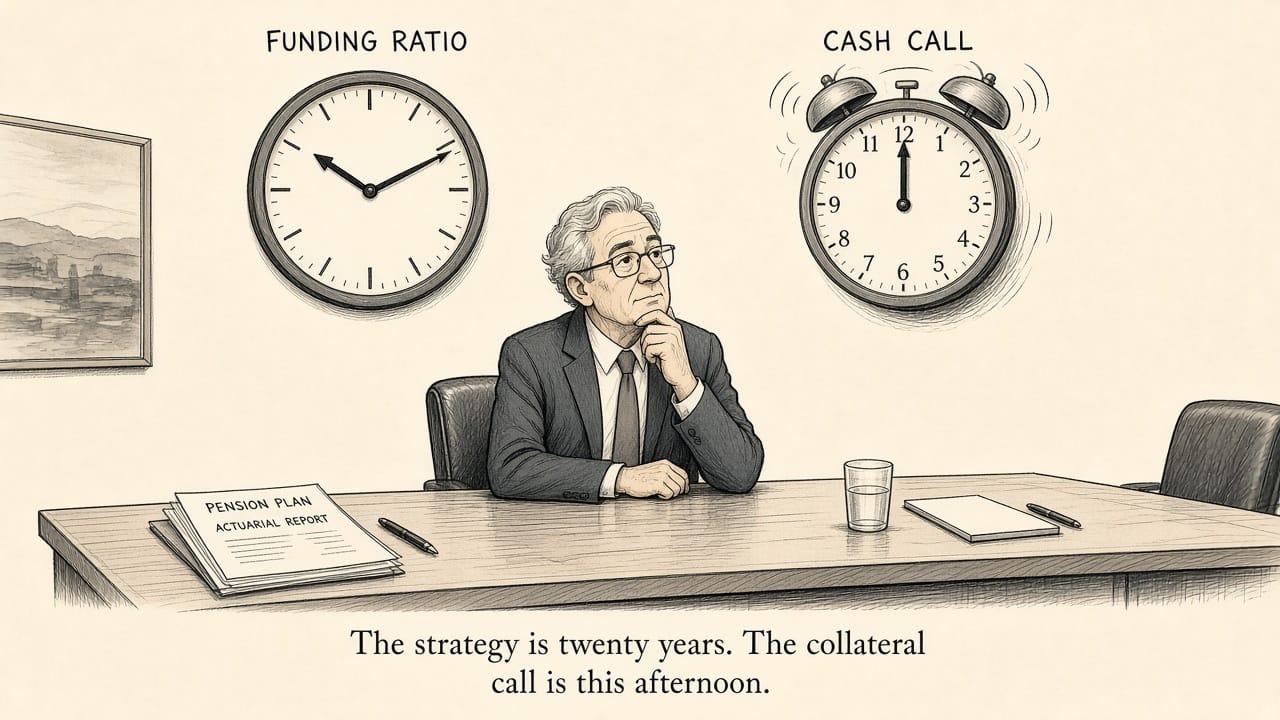
The investment committee has approved a twenty-year strategy. Its next collateral call may allow rather less time for reflection.
Before the meeting closes, put the funding ratio and the cash schedule on the same page. Ask who can authorize a transfer, how quickly assets can settle, and what happens if distributions arrive late.
If the answers are comfortable, patience may be the right investment decision. If they are not, the next agenda item has already written itself.
The Editorial Team · Friday, 11 September 2026
Universal Asset Owners is institutional research and discussion, not investment advice. Figures are quoted from the sources named in the edition; where a figure could not be confirmed at a primary source it has been labelled or withheld.