|
Who reads this
Before the market opens, this brief is read at the desks that direct more than $50 trillion in permanent capital.
Circulation is narrow by design. The capital behind it is not.
|
The Bank for International Settlements put a share on how much technology now sits inside private credit. In Vienna, Christine Lagarde put a number on how much of Europe’s savings is already financing America’s. In Toronto, a prime minister spent thirty-six hours asking the world’s largest allocators to bring their capital to Canada. And in Sacramento, a board decides today whether its best year in five should raise its own liabilities. Four rooms moved the same portfolios. None of them was an investment committee.
Watch · Today’s briefing
The Lead
The allocation nobody voted on
On Monday the Bank for International Settlements published the clearest official account yet of how the digital build-out was financed — and told a great many pension funds something about their own balance sheets that their own managers had not.
The paper is Financing the digital economy: the role of private credit, by Puriya Abbassi, Iñaki Aldasoro and Sebastian Doerr, in the September BIS Quarterly Review. Its finding is a share, not a forecast: private credit financed the post-2020 shift to the digital economy by lending against cash flows and intangible assets, and in doing so a market bought for diversification acquired a sector.
Two numbers inside it matter more than the headline. The first is quality. Among technology borrowers in the post-2020 cohort, the proportion with negative EBITDA rose from 23% to 46%. Nearly half the new borrowers do not generate operating earnings. Among the profitable ones, median debt-to-EBITDA tripled.
The second is price. Over the same period the interquartile range of spreads compressed from 3.25 percentage points to 1.75 — a narrower band of prices. Set that beside the borrower mix in the same cohort — negative EBITDA rising from 23% to 46% — and the reading we draw is that price dispersion narrowed while credit dispersion widened.
And here is the pair that makes the argument. Over exactly the same window, the first-lien share on those loans rose from 77.6% to 92.2%.
Seniority rose as quality fell. Nine in ten of these loans now sit at the top of the capital structure — while nearly half the borrowers have no operating earnings and the price band for taking that risk has narrowed by almost half. Risk did not leave the system. It changed shape, and it moved into a vehicle that reports quarterly, marks privately, and sits in the column of the asset allocation labelled “diversifying”.
And first lien is not safety when recovery is a cash-flow story and the cash flow is not there. Seniority determines the order of a claim. It does not create the thing being claimed.
The sample is PitchBook US-borrower deals, about 14,000 of them from 2010 to 2025. Associations with local technology employment are not causal, and the authors say the financial-stability question remains open. Fifty-five per cent of funds now lend to technology, up from 40% in 2010.
The counter-case, which is a good one. Work by Matvos, Piskorski and Seru (NBER Working Paper 34991) finds these funds have not copied bank leverage: they remain overwhelmingly equity-financed, against roughly 10% equity-to-assets at US banks. Losses stay with the limited partner. They do not automatically become somebody else’s funding crisis. Manage it as a concentration, not as a 2008 funding-run analogue.
Why this is not a private-credit story: the institutions holding the loans are the institutions holding the equity. A large plan owns the technology complex through its index allocation, which it chose. It owns hyperscaler paper in its credit sleeve, which it chose. It now owns a further claim on the same revenue assumptions through direct-lending funds bought because they were supposed to behave differently from the equity. Nobody presented that third exposure to an investment committee as a technology allocation. It arrived as diversification.
Europe has the savings. It does not have the market.
The most useful sentence of the day was spoken in Vienna. Christine Lagarde addressed Hofburg im Dialog on 14 September under the title “A new age of capital: growth, sovereignty and AI”. Her historical frame was the Gründerzeit: European savings financed American railways, and after 1873 the growth stayed in the United States.
Then the numbers. Euro-area households save around €1.4 trillion a year and hold about €440 billion in US technology firms. Europe hosts about 5% of the world’s AI computing capacity; the United States hosts roughly three-quarters. Closing the data-centre gap over a decade could cost as much as €600 billion including chips — an upper bound she flagged herself.
“Most European savers’ exposure to US tech giants runs through investment funds, which would have to sell into a falling market to meet redemptions.”
That is why the €440 billion is not a patriotism statistic. It is a redemption channel. A US technology drawdown is a European household event before it is a European policy event — and the selling would arrive precisely when a European build-out needed equity most.
“In the United States the whole of the capital market has been drawn in to make the buildout possible: bonds, private credit and securitisation alongside traditional lending. Europe is still relying largely on its banks.”
The BIS, publishing the same morning, describes exactly that market — and measures it at its most permissive. Europe is not missing a virtue. It is missing an instrument.
Announced capacity is not contracted capital
Four rooms produced a great many numbers in thirty-six hours. Most describe what an institution is able to do. A very small number describe what an institution has agreed to do. Almost every error in this week’s coverage comes from moving a figure across that line.
Do not add capacity. A syndicated facility has several lenders. A pension can finance a project that also appears inside a bank’s facilitated total. Summing the seven Canadian bank envelopes produces roughly C$250bn of “new capital” that does not exist — the horizons differ, the activities overlap, and none of it is equity.
Room size is not a budget. The C$120 trillion that came to Toronto belongs to thousands of clients and mandates across dozens of jurisdictions. It is a measure of who accepted an invitation.
A useful scoreboard has three columns: financing made available, financing contracted, and money actually drawn. Nobody publishes the third. It is the only one that builds anything.
The same discipline applies to risk. A concentration that arrives without a decision is still a concentration; an insurance exclusion is still an exposure; a liability that rises because a discount rate fell is still a liability. The developments here that carry no announcement at all are the ones that will move a funded status.
Toronto, thirty-six hours: the shop window is open, the book is not
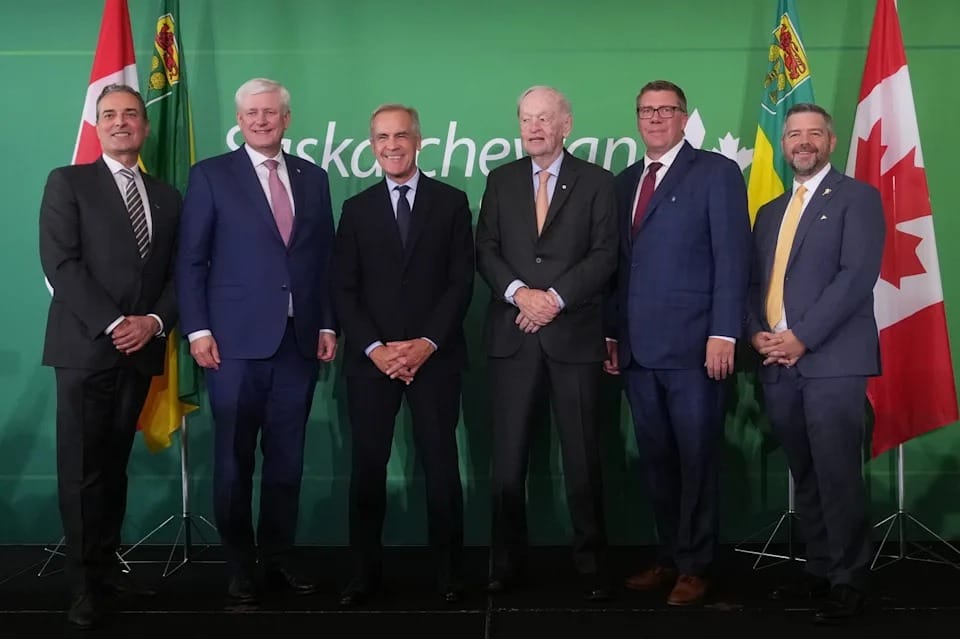
Mark Carney’s first Canada Investment Summit ran 14–15 September, co-hosted with CPP Investments and PSP Investments. The official purpose is to catalyse C$1 trillion of investment over five years, against about C$280 billion of government capital and incentives “expected to enable” the rest. That is enable language. It is not a close.
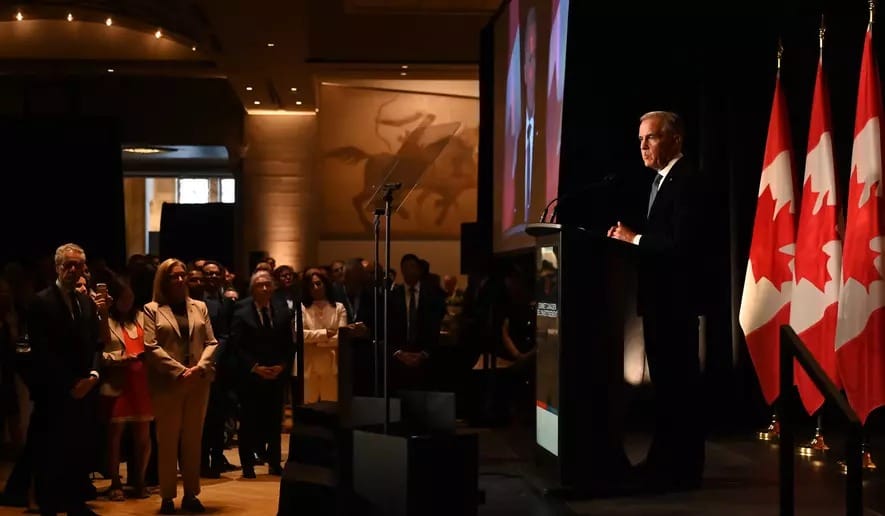
Carney’s own line at Sunday’s reception was the honest one: funds managing “over C$120 trillion” had come to “peer into our shop window”. A government source told Reuters that major deals could take twelve to eighteen months. Industry minister Mélanie Joly told CBC to expect “good deals and MOUs” with impacts in three months to a year. That is the conversion clock, from the hosts themselves.
Who was in the room. PMO readouts confirm six bilaterals: Larry Fink (BlackRock), Jonathan Gray (Blackstone), Shemara Wikramanayake (Macquarie), Dilhan Pillay (Temasek) and Sheikh Saoud Salem Abdulaziz Al-Sabah of the Kuwait Investment Authority. AP separately lists Apollo’s Marc Rowan and KKR co-chief executive Joseph Bae. On the Tuesday programme, Annette Mosman of APG joins Fink, Gray and Pillay on the only confirmed foreign-allocator panel; Stephen Harper, now chair of AIMCo, closes.
What actually moved on Monday. A tax queue, two bank envelopes, a non-binding memorandum and a provincial sales-tax waiver. The Canada Revenue Agency will now prioritise advance income-tax rulings on investments of C$1 billion or more, in force 14 September; the 90-business-day standard is retained for files that do not qualify, and CRA met it on 91% of rulings in the year to March 2025. That is genuine friction removal — a binding answer on tax treatment before capital moves. It is not a tax cut.
TD announced C$150 billion over five years of lending, underwriting and advisory activity; Scotiabank more than C$100 billion over five years. BMO’s figure is up to C$70 billion over ten years. RBC’s is a C$1.4 billion technology growth fund. These are capacity, on different horizons, and they overlap.
Bell and Saskatchewan signed a non-binding memorandum for up to 900 megawatts of additional capacity, a path to a 1.2 gigawatt hub. Bell says total capital “could exceed $50 billion”; ISED says “up to $52.5 billion”. Both figures include tenant compute and related generation — and the additional 900 MW is bring-your-own-power natural gas. For any climate or listed-infrastructure mandate that is an explicit embedded gas exposure inside a project marketed as digital sovereignty. Job figures do not reconcile across the three official sources: ISED says 4,500; Saskatchewan says 500 permanent plus about 3,000 and 100 headquarters roles; Bell says 800–1,200 construction and up to 600 permanent.
The Maple Fund. The Globe and Mail reported on 14 September that CPP Investments and Brookfield are launching a C$50 billion Canadian vehicle — up to C$25 billion each over five years, minimum tickets of C$5 billion, 50/50 equity, and no fees or carry between the partners, with other investors able to join case by case. John Graham and Connor Teskey are both quoted. A first-party release from either house has not been published at the time of writing, and the reported structure — two principals, no economics between them — is not how a commingled fund is built. Whether that is the legal form the documents describe is a question the documents will answer.
This is not Maple Infrastructure Trust, the Indian toll-road InvIT in which Macquarie’s MAIF4 completed an acquisition of units from La Caisse on 11 September: seven roads, about 3,328 lane-kilometres, US$450 million committed including US$150 million for future acquisitions, with a further US$150 million from La Caisse. Different country, different counterparties, different transaction.
What did not happen. No sovereign-wealth cheque. No project final investment decision. No published Ontario project list. No confirmation that any of the 167 lines in the circulated prospectus moved from seeking financing to financed. The only foreign conditional in public print is IFM Investors’ interest in up to C$10 billion over a decade, “if conditions are right”.
Outside, more than a thousand people marched from Nathan Phillips Square to a police line near the Art Gallery of Ontario as the closed gala loaded, behind a banner reading “The Many vs. The Money”. Inside, dinner was smoked Arctic char, bison short rib and roasted pear. Housing minister Gregor Robertson arrived by rental bicycle.
A 14.8% year. A 6.83% five-year. A board that chooses.
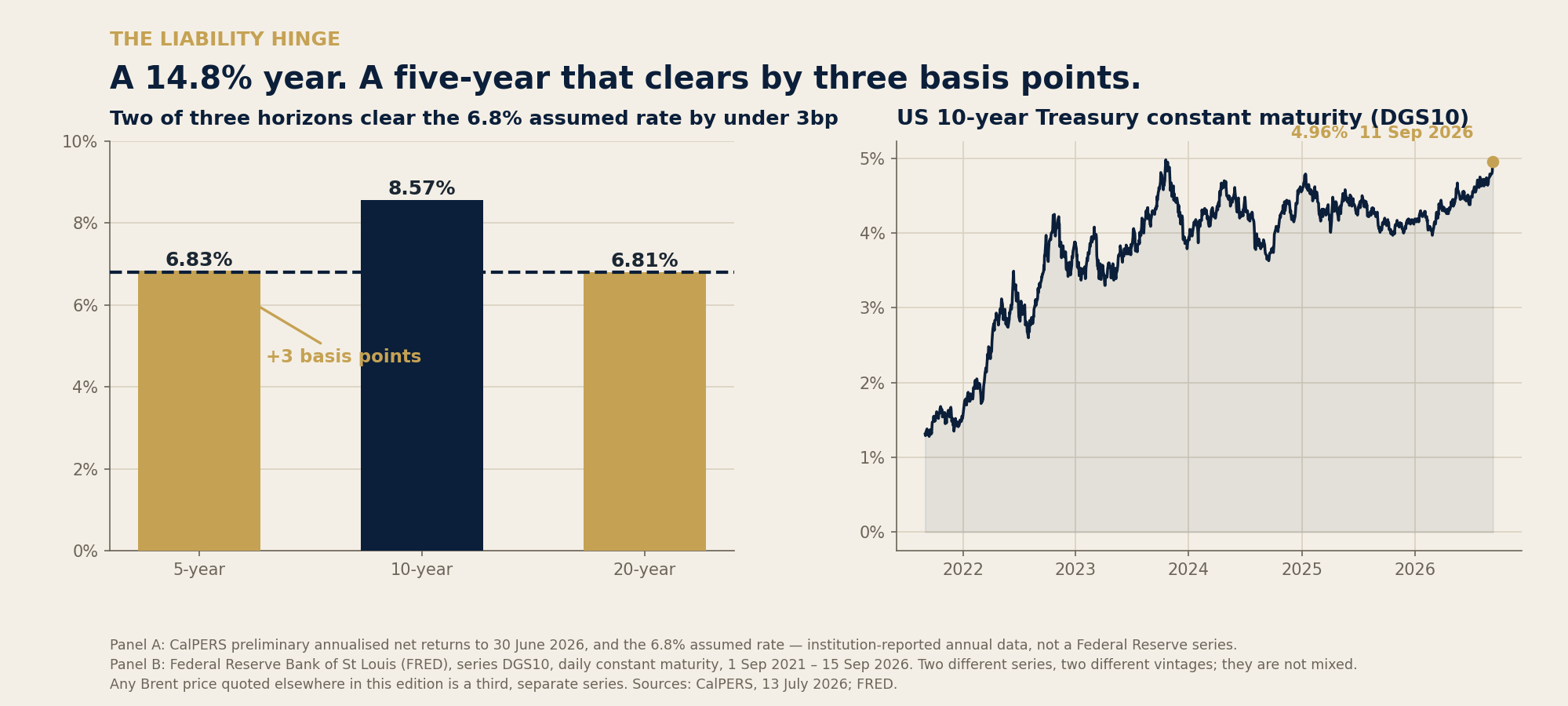
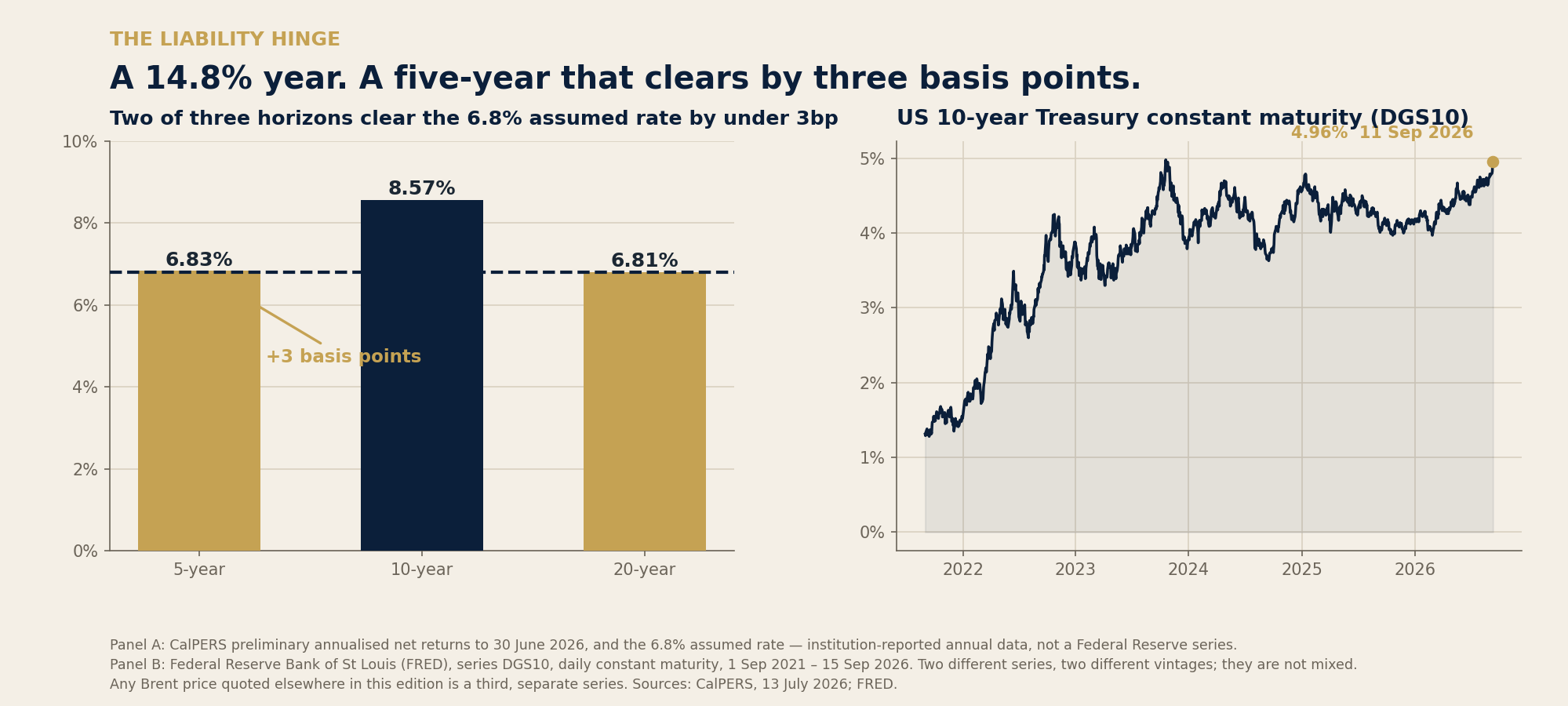
CalPERS posted a preliminary net return of 14.8% for the twelve months to 30 June 2026 — above the prior year’s 11.6% and well above the 6.8% assumed rate. The fund held US$637.1 billion; funded status rose to 85% from 79%. Public equity returned 24.1%, private equity 17.0%.
Now the number almost nobody printed. The preliminary five-year annualised return is 6.83%. The assumed rate is 6.8%. Three basis points. The ten-year is 8.57%. The twenty-year is 6.81% — clearing the assumption by a single basis point.
Two of the three horizons that price this liability beat the assumption by less than three basis points, after the best headline year in five.
Under the Funding Risk Mitigation Policy, a return above the discount rate gives the board the option of lowering that rate. It is an option rather than a mechanism because the automatic trigger was removed in April 2024. The Finance and Administration Committee takes the item today at 09:30 Pacific; the full Board sits on 16 September and can take a committee recommendation. A committee item is not a board decision, and this edition does not record one.
State the direction, because it is routinely reversed: lowering the discount rate raises the measured liability. A board that responds to a 14.8% year by cutting its rate converts an investment gain into a larger reported obligation and, in time, higher employer contributions. It is not a victory lap. It is the purchase of a more honest liability with part of this year’s return.
Set that beside the corporate system. The Milliman 100 Pension Funding Index (31 August data) shows the corporate sample funded at 112.2% — assets US$1.299 trillion against a US$1.158 trillion obligation, a US$141 billion surplus, at a 6.0% discount rate. Buyouts were available in June at about 99.6% of accounting liabilities, yet first-quarter pension-risk-transfer volume was US$3.8 billion, down 47% year on year. Sponsors can afford to transfer and are not transferring.
The UAO Signal Ledger
Six statuses. Every open signal carried forward until it is resolved.
Private-credit technology concentration becomes a supervisory object — early observable. Verified: the BIS has published the share, the negative-EBITDA cohort at 46%, and spread compression from 3.25 to 1.75 points. Unknown: whether any national supervisor takes it up. Evidence against, actively sought: these funds remain overwhelmingly equity-financed and have not adopted bank leverage. Evidence strength moderate; analytical conviction medium. Confirms or kills it: a supervisor citing the share, or a 2026 vintage showing amendment activity clustered in software.
NPS stewardship scoring moves mandate money in 2027 — developing. Verified: the 14 September Korea Exchange briefing to 105 listed holdings. Unknown: final criteria and whether redemption is used or only selection. Confirms or kills it: the published inspection protocol, or the first manager to lose a sleeve on a stewardship score. Next catalyst: October–November inspections.
The Maple Fund is a co-underwrite rather than a commingled fund — developing. Verified: reported terms of 50/50 equity, minimum tickets of C$5 billion, no fees or carry between the partners. Unknown: the legal form, who holds the strategic-sector veto, and the first asset. Confirms or kills it: a first-party release, or the first named asset and its unlevered entry yield.
Insurability withdrawal reaches the credit underwriting — early observable. Verified: state commissioners have approved more than 80% of carrier requests to exclude AI-related damages; the California FAIR Plan has grown from about 127,000 policies in 2018 to more than 668,000 at the end of 2025. Confirms or kills it: January 2027 renewals adding affirmative AI cover would weaken it materially.
European savings acquire a domestic instrument — early observable. Verified: Lagarde’s Vienna speech and its figures. Evidence against: capital-markets union has been the stated answer for a decade without delivery. Confirms or kills it: a large European pension or insurer announcing an AI-infrastructure equity or offtake sleeve.
Carried forward. The EU individual-listings regime was bridged by seven days to midnight on 22 September after ambassadors failed to agree the usual six-month renewal; the dispute concerns a single delisting. Re-dated, not resolved. The CalPERS funding-risk item resolves today at committee stage only. The AD Ports residual offer closes today at 15:00 UAE.
Future Signals · what would change our mind
A clean default series showing technology sleeves performing no worse than the rest of direct lending through a full cycle. January renewals that add affirmative AI cover rather than excluding it. Technology borrowers refinancing into public markets, reducing the private share. Any one of those weakens the lead materially, and we would say so.
Against that: a supervisor citing the 44% share in a financial-stability review would convert a measurement into a capital or disclosure requirement, and that is the single development most likely to reprice the sleeve.
Next triggers
Within 24 hours. CalPERS Finance and Administration Committee, today 09:30 Pacific. The L’IMAD/ADQ residual offer for AD Ports closes today at 15:00 UAE, with the result expected on 16 September. The Canada Investment Summit closes today. The FOMC statement, vote and Summary of Economic Projections land tomorrow at 14:00 Eastern, and the full CalPERS Board sits the same day.
Within seven days. NSE India’s anchor book on 16 September and public issue 17–21 September. Canada Growth Fund / Generation Mining equity close on or about 21 September. The EU listings regime expires at midnight on 22 September — unanimity required. That is the date.
Within thirty days. GIC’s deputy group chief investment officers in seat on 1 October. Suncor v. Boulder County at the US Supreme Court on 5 October. Dangote’s offer closes 13 October. NPS external-manager stewardship inspections through October and November. China’s rare-earth control pause expires 10 November.
The Job Board · open seats
Korea Investment Corporation, Chief Investment Officer — approximately US$232 billion. Search restarted; applications closed 7 September. Future Fund, Chief Executive — Spencer Stuart retained; Raphael Arndt through end-2026. PensionDanmark, CIO — Claus Stampe retires end-January 2027 after 23 years.
Hawaii Employees’ Retirement System, CIO — US$300,000–400,000; closes 10 October; Anthony Goo interim. OMERS, CIO — Jonathan Hutcheson acting after Ralph Berg’s move to Temasek London, in seat 1 September. NBIM, Chief Governance and Compliance Officer — Carine Smith Ihenacho through 31 December; successor unnamed.
Reproduced from the People and Mandates desk. Each seat is a lead, not a verified vacancy register, and a profile change is not a confirmation.
Careers · moves and capability signals
Lee Kyu-hong became Chief Investment Officer of South Korea’s National Pension Service this morning — ₩1,866 trillion, about US$1.4 trillion — on a two-year term to 14 September 2028, renewable annually on performance. He replaces Seo Won-joo, in post since December 2022. At Korea Teachers’ Pension from 2019 to 2023 he returned 11.15%, 11.49% and 11.95%.
Divyangi Anchan joins TIAA as Chief Risk and Compliance Officer for Technology and AI Risk, reporting to Mike Cowell, from Google. The read is the seat, not the person: AI risk has been placed in a named C-suite risk function rather than an innovation team. It will not move a portfolio weight this quarter. It changes who owns model risk when the board asks.
Pay dispersion: nothing qualified in this window.
The bypass is shut. The nameplate is not the flow.
Saudi Arabia’s East–West pipeline remains shut. The Energy Ministry, via SPA on 11 September, said attacks on the morning of Thursday 10 September in the Riyadh and Madinah regions led to a shutdown “as a precautionary measure”. The Foreign Ministry, on 12 September, said the drones were “coming from Iraq”, that there were injuries and “some damage that is currently being addressed”, and that at Iraq’s request the Kingdom “opted not to respond at this stage”. Iran denied responsibility. Iraq dismissed its commander in Maysan and later said it had seized a launch platform.
Separate the nameplate from the flow. The figure of about 7 million barrels a day is what SPA used on 12 April 2026 when it announced full pumping capacity restored after an earlier strike. It is a restoration nameplate, not observed 2026 throughput. Wartime loadings have been running 2.6–4.0 million barrels a day on Rystad’s estimate, with Yanbu cover in the low single days. Capital Economics’ “as much as 4% of world supply” is conditional on the high end of that range, not an observed outage.
ICE Brent settled at $105.68 on 14 September. Lloyd’s Joint War Committee has not issued a new circular; JWLA-034, dated 29 July 2026, remains current and Saudi Arabia remains a listed area. That absence is itself a reading: the body that prices war risk for hulls has not moved in seven weeks, through a pipeline shutdown and a vessel-list announcement.
Not established: Iran’s Persian Gulf Strait Authority has announced a list described as covering 77 vessels, with warnings extended to insurers, P&I clubs and classification societies. The announcement is confirmed via Reuters. The vessel identities, the alleged violations, the legal reach and any insurer response are not, and no detention has been documented.
The question for the next committee
Not “what is our technology exposure”. You will be shown the equity number and it will be wrong.
Ask instead: which bodies outside this room can change the composition of this portfolio without our consent — and what is the most recent date on which we measured that?
A central bank can do it with a chart. A government can do it with a calendar. And an asset owner on the other side of the world can do it to your business by grading how you vote.
Sources checked through 15 September 2026. Material claims are linked to named sources; primary or first-party sources are used where available. Editorial analysis for long-horizon owners. Not investment, legal or actuarial advice.
Scenario · The allocation nobody voted on
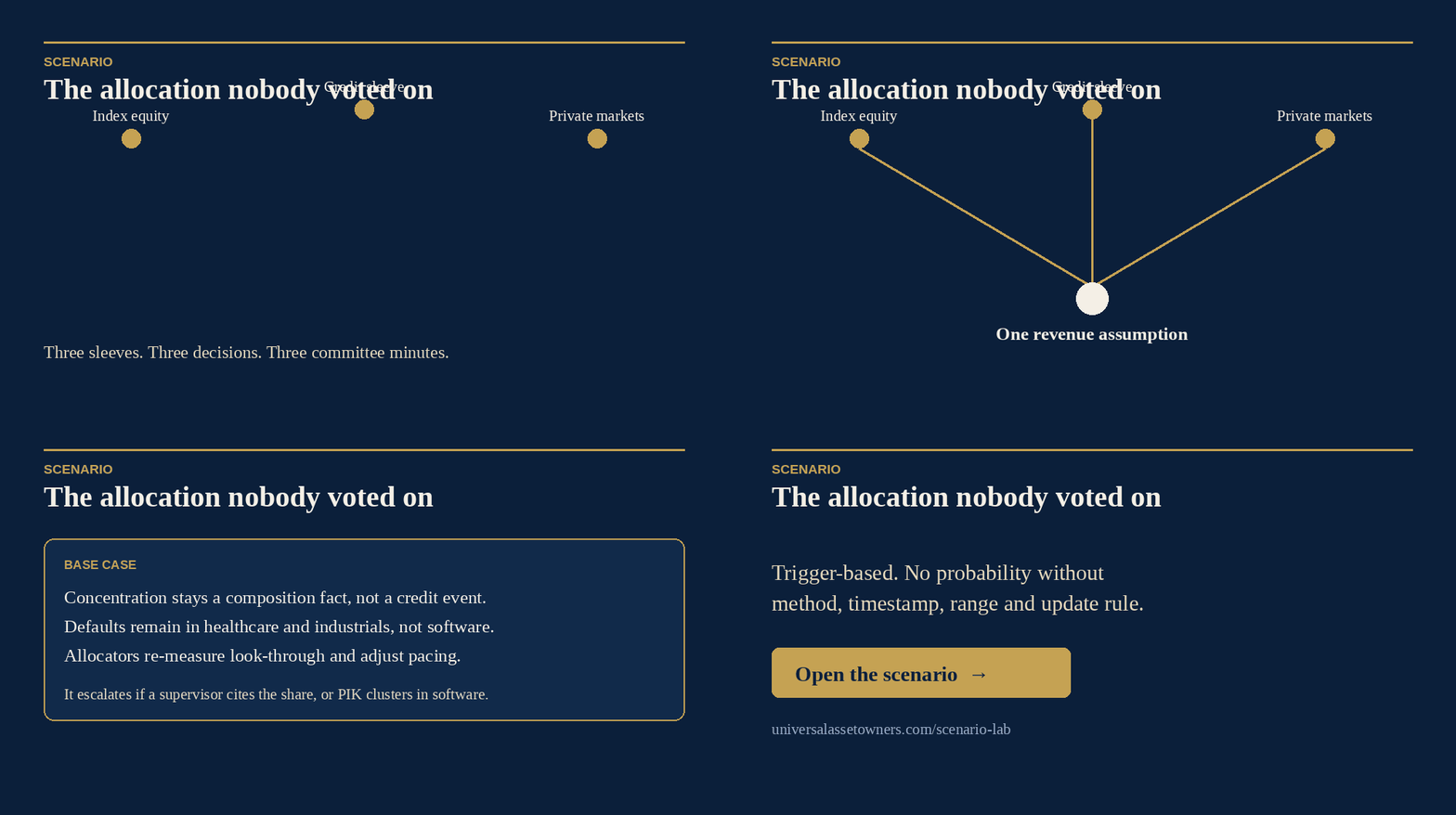
Open today’s scenario — base case, escalation triggers, and what would change our mind →
Podcast · The Universal Owner
The Back Page
Meet The Allocator — our columnist, who reads the board pack so you do not have to.