
The Daily Brief of the Universal Owner Written for the desks that steward the world’s long-horizon capital — sovereign wealth funds, public pensions, endowments, insurers and family offices, an institutional class managing more than $50 trillion. One edition a day. Every claim carried to its source. The second-order read the headlines don’t give you. If this was forwarded to you, you are reading what the largest allocators read before the market opens. |
Friday, September 4, 2026 · The Daily Brief · The Editorial Team
98% of the world’s sovereign wealth funds |
18 of 20 of the world’s largest pension funds |
10 of 10 of the largest charitable foundations |
85% of the world’s largest family offices |
100+ billionaires, every morning |
A sitting Federal Reserve governor said this week that the premium the world used to pay for the safety of US Treasuries has gone. On the same three days, Kuwait wrote itself a legal facility to borrow from the sovereign fund that holds assets like them, and Lloyd's of London put a number on what a Gulf war costs an insurance market. Three different institutions, one question: what happens to a portfolio built on the assumption that somewhere in it sits a pool of money that does not have to behave like a balance sheet?
Watch · Today’s briefing
Ninety-three seconds: the premium that disappeared, the fund that wrote itself a route to borrow, and the insurer that put a number on a war.
The opening thesis
For thirty years the architecture of long-horizon investing has rested on a single load-bearing assumption: that US Treasuries are the risk-free asset, that they are cheap for the issuer because investors pay for their safety, and that they rise when equities fall. On Thursday, Federal Reserve Governor Christopher Waller told a Reuters NEXT Newsmaker event that the second of those is no longer true — and cited a paper arguing that the third has failed as well. "There's no more premium for safe, liquid U.S. government debt," he said. "And that has been leading me to raise my neutral rate estimate, which means higher policy rates for any given rate of inflation — maybe you're not as restrictive as you thought you were."
He was not speaking from intuition. He cited work by Stanford Graduate School of Business finance professor Hanno Lustig, published in August by the Aspen Economic Strategy Group. This desk opened that paper. It sets out four observable predictions that defined the safe-asset model through the late 2010s, and documents that all four have failed since 2020: Treasuries are no longer expensive relative to close substitutes; the stock–bond correlation has turned positive; Treasuries did not produce a flight to safety in the 2025–2026 stress events; and foreign reserve managers are diversifying away from dollar assets. The single cleanest number in it: the Du et al. Treasury Premium — US Treasuries measured against currency-hedged G10 sovereign bonds, a construction that strips out currency risk entirely — averaged minus 18 basis points at five years and minus 22 basis points at ten across the 2017–2025 sample. Global investors, at long maturities, now prefer the foreign bond.
The thesis. The instrument that universal owners use to hedge their longest liabilities is being repriced as an ordinary credit, and the institutions that hold the world's designated safe pools are being asked to behave like ordinary balance sheets. Kuwait's Decree-Law 81/2026, gazetted on 1 September, is the same movement in a different jurisdiction: a state with among the strongest external balance sheets Fitch rates has legislated a route from its Future Generations Reserve into its General Reserve. Lloyd's is the third instance — £1.4bn of losses from a war reported against a market that had been priced for a softening cycle. None of these is a crisis. All three are the same category of event: a buffer being converted from an assumption into a line item.
The central contradiction. The safe-asset model is failing precisely where it is most heavily relied upon and least easily replaced. A pension fund cannot hedge a forty-year liability with anything other than long-duration sovereign debt at scale. If the paper is right that the hedging property failed at the long end and through the Treasury-premium channel — a finding Lustig carries from Acharya and Laarits (2026), and the discriminating point in the paper — then the failure is concentrated exactly where liability-driven investors have no substitute. The paper's worked example is the September 2022 UK gilt episode, in which pension funds running leveraged liability-driven-investing positions were forced into cascading gilt sales by mark-to-market losses on the very instrument that was supposed to be their hedge.
The strongest counterclaim, stated fully. Three of them, and they are not weak.
First, Waller is one governor, not the FOMC. He said "leading me to raise my neutral rate estimate." There is no Committee position on this, and none should be implied.
Second, Waller's own near-term posture cuts against a hawkish reading. In prepared remarks the same day he said that if the data confirm cooling inflation he is inclined to argue for keeping rates steady at the next meeting, and that he was inclined to be patient: "Give disinflation a chance." Waller's near-term patience limits the immediate policy inference, but it does not contradict a higher estimate of the long-run neutral rate. The convenience-yield point is a structural claim about the long run, not a policy call about September.
Third, the correlation flip may be a shock-mix artefact rather than a repricing. The stock–bond correlation is determined by the mix of shocks hitting the economy; a run of supply shocks — energy, tariffs — flips the sign without anything changing about what a Treasury is. Lustig addresses this directly and argues the correlation evidence is "consistent with the risky-debt regime but is not definitive," resting the case instead on the currency-hedged relative price and on identified fiscal-announcement events. That is an honest concession by the author, and it should be carried into any allocation decision rather than filtered out of it.
Today in 90 seconds
Nine things to know
- Fed Governor Christopher Waller: "There's no more premium for safe, liquid U.S. government debt." He is raising his own neutral-rate estimate on that basis, and says policy may therefore be less restrictive than it looks. This is one governor's view, not an FOMC position — and in the same appearance he argued for holding rates steady. (3 September, Reuters NEXT Newsmaker event.)
- Minus 18 and minus 22 basis points. Measured against currency-hedged G10 sovereign bonds across 2017–2025, the US Treasury premium averaged −18bp at five years and −22bp at ten. The sign has reversed. (Hanno Lustig, Aspen Economic Strategy Group, August 2026 — opened and read.)
- 72% to 42%. The foreign-official share of total foreign holdings of US Treasuries fell from a peak of roughly 72% in 2010 to roughly 42% at the end of 2025. The marginal foreign buyer of Treasuries is no longer a central-bank reserve manager. (Same paper, from US Treasury International Capital data.)
- Kuwait has enacted a facility, not moved capital. Decree-Law 81/2026, published in the official gazette on 1 September, allows the government to borrow from the Future Generations Reserve, managed by the Kuwait Investment Authority. Annual borrowing is capped at 100% of the reserve's average returns over the last five audited fiscal years; outstanding loans at 10% of audited net asset value. No draw has been announced.
- Lloyd's reported £1.4bn ($1.9bn) of Middle East conflict losses in H1 against £34.7bn of gross written premium and £48.4bn of capital, with a 90.8% combined ratio and pre-tax profit down to £3.5bn. The figure is net, and chief financial officer Jim Bichard said on 4 September that it is "a very initial estimate", "heavily based on exposures and estimates as opposed to really hard numbers", with "a lot of it" incurred-but-not-reported. Chief executive Patrick Tiernan: "we do not currently expect the situation to constitute a capital event for the Lloyd's market."
- India's banking system is holding a record ₹9.70 trillion (about $102.7bn) liquidity surplus after the Reserve Bank of India's special dollar-deposit scheme drew a larger-than-expected $127.23bn. The RBI has not said which instrument it will use to drain it.
- Asian millers are paying $30–70 a tonne more for Australian and Argentine wheat to replace Black Sea cargoes that have not arrived — at least 500,000 tonnes booked over seven to ten days, after a 31 August drone strike that ADM confirmed damaged its UEP grain terminal at Odesa.
- Japan raised the interest rate it assumes it will pay, and ¥5.36 trillion appeared. The Ministry of Finance said on Friday that fiscal 2027 budget requests total ¥143.1 trillion (about $917.78bn), and that it has lifted the assumed rate used to calculate interest payments to 3.8% from 3.0% after the ten-year government bond yield reached 3% for the first time since 1996. Requested debt-servicing costs hit a record ¥36.64 trillion — ¥5.36 trillion more than this year. These are requests, not an enacted budget.
- $31.6 trillion, and one pension fund's share of it. PwC, modelling with Oxford Economics across 46 countries, projects that cumulative data-centre capital expenditure reaches US$31.6 trillion by 2050 — from about $800bn a year now to $1.8trn a year — with equipment, not buildings, taking 93% of it by the end. On the same day the study published, CPP Investments and Equinix completed their US$4bn acquisition of the Nordic operator atNorth, CPP committing US$1.3bn for about 51%. A projection and a closed transaction, published within hours of each other. (Both 2 September.)
The Lead
The safe asset stopped behaving like one, and a Fed governor said so out loud
What happened
On Thursday 3 September 2026, Federal Reserve Governor Christopher Waller told a Reuters NEXT Newsmaker event in Washington that there is no more premium for safe, liquid US government debt, and that this is pushing the neutral level of interest rates higher. Reporting by David Lawder and Howard Schneider was published at 1:46 p.m. Eastern.
His stated reasoning had three strands. Yields have been rising because of concerns about the US fiscal position; because of competition for capital from infrastructure investment tied to artificial-intelligence buildout; and because of what he called growing evidence that the safety premium which had pushed Treasury prices up and held yields down has largely disappeared. For the third strand he cited recent research by Stanford Graduate School of Business finance professor Hanno Lustig.
In his own words: "There's no more premium for safe, liquid U.S. government debt. And that has been leading me to raise my neutral rate estimate, which means higher policy rates for any given rate of inflation — maybe you're not as restrictive as you thought you were."
Asked whether the United States can grow its way out of a $40 trillion debt load — the position US Treasury Secretary Scott Bessent has advocated — Waller said it was possible "if you can get the structural deficits down closer to zero." The deficit was 5.9% of GDP in fiscal 2025, down from 6.3% in fiscal 2024; Bessent has acknowledged fiscal 2026 will be larger because of tariff refunds following the Supreme Court decision striking down the emergency-powers tariffs. Waller added that even 3% real growth with 2% inflation would not reduce the deficit in real terms as a share of GDP, and that inflating the debt away, as happened after the Second World War, is "not a good outcome."
He was also dismissive of the Treasury's enlarged buyback programme for longer-dated securities. The size increase — from a $2bn maximum to at least $4bn per operation in the 10-to-20-year and 20-to-30-year sectors — takes effect on Wednesday 9 September; the first long-end operation after that date on the last-published schedule is a 10-to-20-year operation on Thursday 10 September (the 20-to-30-year sector's first operation follows on 24 September) (Treasury, 19 August; tentative buyback schedule, 5 August, which Treasury says will be updated). "I've never believed as an economist, not a policymaker, that these kind of short-run interventions do much," he said. "But you know, if you want to do them, that's Bessent's — that's his — prerogative."
Treasury yields fell on the remarks. The benchmark ten-year traded down to 4.74% after touching 4.818% on Wednesday, its highest since 1 November 2023.
The underlying research — which we opened
The paper is "America's Risky Debt: What Markets See That Policymakers Don't," by Hanno Lustig, published August 2026 as a chapter in The American Economy in a New Era (Aspen Institute; editors Melissa S. Kearney and Luke Pardue), based on joint work with Roberto Gómez-Cram, Howard Kung and David Zeke.
It sets out four observable predictions that characterised the pre-2020 safe-asset benchmark, all of which held in the data:
- Treasuries were expensive relative to close substitutes — AAA US corporate bonds after adjusting for default risk, and G10 sovereign bonds once converted into dollars.
- The stock–bond correlation was reliably negative.
- Treasuries exhibited a flight to safety in stress: LTCM in 1998, the 2008 crisis, the 2011 European debt crisis, the 2015 China devaluation, the first leg of March 2020.
- Foreign reserve managers treated Treasuries as the dominant safe asset, holding more than 70% of allocated world FX reserves in dollar-denominated assets.
The paper documents that all four have failed since 2020. The measured evidence:
| Measure | Historical level | Post-2020 level |
|---|---|---|
| Credit risk-adjusted AAA–Treasury spread (Mota 2023) | ~30–60bp pre-crisis; ~300bp at the 2008 peak; ~240bp in March 2020 | Compressed toward zero post-2022, and at points reversed |
| Treasury Premium vs currency-hedged G10 sovereigns (Du et al. 2018) | Large positive premia through the 2000s and early 2010s | −18bp at 5y, −22bp at 10y (2017–2025 average) |
| Stock–bond correlation, 252-day rolling | Reliably negative through 2020 | Positive |
| Foreign-official share of total foreign UST holdings | ~72% peak in 2010 | ~42% at end-2025 |
| Leveraged Funds' net short in Treasury futures (CFTC TFF) | — | Approximately $1 trillion notional |
Total foreign holdings of US Treasuries grew roughly ninefold between 2000 and 2025, from $1.0 trillion to $9.3 trillion — but foreign-official holdings grew only about 6.5 times, from around $0.6 trillion to around $3.9 trillion. The gap is private money. Lustig's conclusion on that point is unambiguous: "The marginal foreign holder of US Treasurys is no longer a central-bank reserve manager but a private, yield-sensitive investor."
Why it matters to a universal owner
Because the transmission is not to a trading book. It is to the liability side.
A universal owner's discount rate, its hedge ratio, its solvency coverage and its rebalancing rule are all built on properties of long-duration sovereign debt that this paper says have stopped holding. Three of those properties matter more than the rest:
The hedge. If the stock–bond correlation is positive, a 60/40 or a liability-hedging overlay does not do in a drawdown what its risk model says it does. That is not a marginal calibration issue; it is the assumption the risk model is built around.
The buyer. A reserve manager is a price-insensitive holder with a policy mandate. A hedge fund running a basis trade is a price-sensitive holder with a margin clerk. Substituting the second for the first at the margin does not change the average level of yields so much as it changes the behaviour of yields under stress — which is precisely the state in which a liability hedge is supposed to earn its keep.
The issuer. A lost convenience yield means the same fundamentals require a larger yield concession. That is a permanent transfer from the taxpayer to the bondholder, and for an owner holding the debt of many sovereigns simultaneously, it is a systematic re-rating of the whole sovereign complex, not a US idiosyncrasy — Lustig notes the parallel across gilts, OATs and bunds.
The underappreciated signal
It is not the level of yields. It is where the hedging property broke.
The most discriminating result Lustig carries — attributed in the paper to Acharya and Laarits (2026), who apply the same yield decomposition to the April 2025 tariff episode — is that the hedging property failed at the long end and through the Treasury-premium channel, not through expected inflation and real rates across the curve — while the short end retained both its Treasury premium and its hedging behaviour. A change in the macro shock mix does not explain why the ten-year should stop hedging while the two-year continues to.
For an allocator that distinction is the whole story. It means the failure is concentrated in exactly the maturity bucket that liability-driven investors are structurally forced to hold, and it means that the standard defence — "shorten duration" — is not available to a fund whose liabilities are forty years long. The short end still works. The short end does not hedge a 2065 pension payment.
Portfolio transmission
- Liability hedging and LDI. Re-test hedge effectiveness on post-2020 data only. A hedge ratio calibrated on a sample that includes the 2010s is calibrated on a regime the paper says ended.
- Reserve portfolios and central-bank-adjacent mandates. The foreign-official share falling from 72% to 42% is consistent with diversification by the peer group, and it is visible in TIC data. The most recent release makes the same point in levels rather than shares, and this desk read it off the Treasury's own table rather than off a wire's summary of it. At end-June 2026 mainland China held $633.4bn of Treasury securities, against $659.3bn in May and $731.4bn in June 2025 — down $98bn in twelve months. Total foreign holdings stood at $9,299.0bn; the foreign official component was $3,778.1bn, against $3,892.5bn a year earlier. The stock grew; the official sector's contribution to it did not.
- Solvency and capital. Prudential frameworks still treat government debt as unambiguously safe. Lustig's central complaint is that regulators' models have not adjusted. Where a capital regime assigns a zero risk weight to something the market has re-priced as risky, the mismatch accrues to the balance sheet, not to the regime.
- Stress-testing. Any scenario that assumes a sovereign-bond rally in an equity drawdown is now an assumption requiring defence rather than a default.
- Private credit and mortgages. A higher neutral rate for a given inflation rate re-prices every floating and refinancing exposure underwritten against the old one.
And a warning label on the data itself, which is the part an allocator should carry. The notes under that Treasury table say the figures come from US-based custodians and broker-dealers, that securities held in overseas custody accounts may not be attributed to their actual owners, and that the table therefore may not provide a precise accounting of individual country ownership. A country line in TIC is a floor on custodial exposure, not a measure of economic ownership. That cuts in both directions at once: the fall in the mainland line is solid as a custodial fact and unproven as a statement about how much US government debt China owns, and anyone using the series to argue either that Beijing is selling or that it quietly is not is using a dataset whose publisher says it cannot settle the question. What the series does support is the narrower claim the lead rests on — that the official sector's share of a rapidly growing stock has been falling for fifteen years, and was still falling in the latest month on the record. Reporting that circulated this week about mainland commercial banks rebuilding Treasury exposure off balance sheet rests on unnamed market sources, is not visible in the published table, and is not asserted here.
The countercase
Carried in full in the opening thesis, and it is genuine: this is one governor's estimate, not a Committee position; Waller in the same appearance argued for patience and steady rates; and the correlation evidence is, in the author's own words, "not definitive." Add a fourth: the paper is an argument for a policy change — that the Fed should commit to a small balance sheet and stop intervening in bond markets — and arguments written to support a prescription deserve the scrutiny that any advocacy document deserves, however good the underlying data.
What to watch
- 9–10 September: the enlarged long-end Treasury buyback (at least $4bn per operation, up from a $2bn maximum) takes effect on Wednesday the 9th; the first long-end operation after that on the last-published schedule is the 10-to-20-year operation on Thursday the 10th. Waller has already said he doubts it does much. Whether it moves the long end is a clean test of the plumbing-versus-repricing question.
- The September FOMC longer-run projections. If the Committee's longer-run dot drifts up, Waller is no longer alone.
- Long-duration auction tails and foreign-official demand in the next monthly TIC release, which will carry July data. The June table already shows the official component down year on year; the official line has already fallen in May and June; a third consecutive monthly fall would make it a trend rather than a print.
- The next genuine risk-off. The single cleanest test of whether Treasuries still hedge equity risk is whether they rally when equities fall. Everything else is inference.
Sources for the lead
- "Fed's Waller says safety premium for Treasuries is gone, pushing neutral rate higher," David Lawder and Howard Schneider, 3 September 2026 — reuters.com
- "America's Risky Debt: What Markets See That Policymakers Don't," Hanno Lustig, Aspen Economic Strategy Group, August 2026 — economicstrategygroup.org
Deep Dive
What a broken hedge actually costs, and the one number that survives it
The temptation with a story like this is to treat it as a yield forecast. It is not one. Lustig makes no yield forecast; Waller made none. What both describe is a change in the joint distribution — how Treasuries behave relative to equities, relative to substitutes, and relative to fiscal news — and joint distributions are what asset owners' models are made of.
Start with the arithmetic of the premium itself. A convenience yield is a discount the issuer receives for supplying something the world wants to hold for reasons other than return. When it is 30 to 60 basis points on the AAA-adjusted measure, as it averaged before the 2008 crisis, the US government funds itself that much below the price its fundamentals would command, and every holder of that debt accepts that much less yield in exchange for the safety. When the measure compresses toward zero and at points reverses, both sides of that bargain unwind simultaneously. The issuer pays more. The holder gets more. And the thing the holder was paying for — the insurance — is what they stop receiving.
That is why the Du et al. measure is the load-bearing one and the correlation is not. The correlation can be moved by the shock mix. The Treasury Premium is a relative price between US Treasuries and currency-hedged G10 sovereigns; a common global change in the shock mix differences out of it by construction. When that relative price sits at −18bp at five years and −22bp at ten across an eight-year sample, global investors are telling you, in the one measure that cannot be explained away by macro regime, that at long maturities they would rather own the foreign bond.
Now put the September 2022 UK gilt episode next to it, as the paper does. Chancellor Kwasi Kwarteng announced an unfunded £45bn tax cut; gilt yields jumped; the Bank of England intervened at the long end, citing a material risk to UK financial stability from pension-fund LDI unwinds. The mechanism was that pension funds had hedged long-duration liabilities using leveraged gilt positions, and the yield move generated mark-to-market losses that forced cascading margin calls — funds selling the hedge to fund the hedge. Lustig's point is that under a safe-debt reading this looks like a plumbing failure requiring intervention, and under a risky-debt reading it is price discovery about fiscal capacity that the intervention suppressed. The two readings imply opposite responses to the same event.
For an owner, the practical consequence is uncomfortable and specific: the more effectively you hedge a long liability with leveraged long-duration sovereign exposure, the more your solvency depends on that sovereign's fiscal news flow. That was always true. What has changed is the size of the yield response to fiscal news, and the disappearance of the offsetting equity hedge that made the position self-stabilising.
So what survives? One number, and it is the one this desk keeps coming back to: the short end still works. The paper is explicit that in the 2025 stress episode the short end retained both its Treasury premium and its hedging property. That is not a solution for a forty-year liability. But it is a real, measured, non-zero piece of the old architecture still standing, and it is the honest place to start rebuilding rather than a wholesale abandonment of sovereign duration that no liability-matched investor could execute anyway.
Allocator Lens The triple exposure. A universal owner meets this story three times, in three different books, and the three do not net out — they compound. As a liability hedger. Your discount curve and your hedge overlay are both functions of long-duration sovereign debt. If the equity hedge is gone, the overlay's contribution to funded-ratio stability in a drawdown is smaller than the model says, and the shortfall shows up in the worst quarter rather than the average one. As a holder of the sovereign complex. You hold gilts, OATs, bunds, JGBs and Treasuries simultaneously. Lustig notes the fiscal-sensitivity parallel runs across the major advanced economies. A universal owner cannot diversify away from "developed sovereigns" by buying more developed sovereigns — you already own the correlation. As a counterparty to the new marginal buyer. The foreign-official share of foreign Treasury holdings has fallen from about 72% to about 42%, and the Leveraged Funds category now carries roughly $1 trillion notional of net short Treasury futures. Your prime broker, your repo counterparty and your basis-trade-adjacent managers sit on the other side of that. Liquidity in a stress event is now supplied by a leveraged, margin-sensitive population rather than a policy-mandated one. The practical tilt — four things that can be done this quarter, none of which require a market call.
What this lens does not say. It does not say sell Treasuries. No liability-matched investor of size can, and the paper does not recommend it. It says stop treating the hedging property as a free good. |
Sovereign Capital
Kuwait writes a legal route to borrow from its own future
Kuwait Decree-Law 81/2026 — an enacted facility, not capital moved
Kuwait issued Decree-Law No. 81 of 2026, amending Decree-Law No. 106 of 1976, which governs the Future Generations Reserve. The decree was published in the official gazette on 1 September 2026. It creates a regulated mechanism for the government to borrow from the reserve — managed by the Kuwait Investment Authority — in support of the State's General Reserve.
The conditions, as reported from the decree and its explanatory memorandum:
- Borrowing is permitted only as an exception, and requires approval by both the Council of Ministers and the KIA board of directors, with specific conditions on the amount, purpose, repayment period and returns of each loan.
- Annual cap: total loans in a single fiscal year may not exceed 100% of the average returns generated by the reserve over the last five audited fiscal years.
- Stock cap: the outstanding balance of accumulated loans may not exceed 10% of the reserve's net asset value, based on audited financial accounts for the most recent fiscal year.
- New loans are prohibited whenever either cap is breached, and the prohibition lifts only once the ratio falls back inside the limits.
- Principal and returns are recorded as an asset owed to the Future Generations Reserve, with priority for repayment from state revenues when the General Budget Account records a surplus following approval of the state's final account.
- A loan may not be written off or reduced except by a law issued specifically for that purpose.
- The KIA was separately granted power to use the financial, investment and financing tools necessary to manage the reserve's assets, with investment returns added to the account.
Status language, stated precisely: this is ENACTED, not DRAWN. No borrowing has been announced. An enacted facility is not capital moved. Kuwait has previously tapped the fund once — in 1990, after the Iraqi invasion — and withdrawals require legislative authority. What changed on 1 September is that a standing, capped, repayable route now exists where before each withdrawal needed its own statute.
Why it matters to a universal owner
Three reasons, in ascending order of importance.
First, the direction of a very large pool. The KIA manages more than $1 trillion. Fitch Ratings affirmed Kuwait at AA- with a stable outlook in August, forecasting sovereign net foreign assets at 668% of GDP in 2026, up from an estimated 652% in 2025 — more than ten times the median for AA-rated sovereigns, and among the strongest external balance sheets of any Fitch-rated sovereign. Most of those assets sit in the Future Generations Fund. A fund of that size does not need to liquidate to change the world's marginal flows; it only needs to change its net purchase rate.
Second, the design is unusually disciplined, and that is the story. Read the caps again. Annual borrowing limited to the income of the fund over five audited years; stock limited to a tenth of audited NAV; no write-off except by a fresh law; repayment senior in the budget surplus. This is not a raid. It is a deliberately constrained credit line, drafted by people who anticipated exactly the criticism that a future-generations fund opened once is opened forever. Whether the constraints hold is an empirical question with a five-year answer, not a rhetorical one.
Third — and this is where it meets the lead. Kuwait is doing on a sovereign balance sheet what Lustig describes markets doing to sovereign debt: converting a buffer that was treated as categorically different into an asset with a stated price, a stated seniority and a stated cap. The Future Generations Reserve used to be politically outside the budget. It is now inside it, with brackets around it. The direction of travel in both stories is the same — the abolition of the category "money that does not behave like money."
The countercase
The obvious one, and it is fair: nothing has been drawn, the caps are real, and Kuwait's external position is extraordinarily strong by any measure Fitch applies. A state with net foreign assets at 668% of GDP that legislates a capped, repayable, board-approved borrowing route from its own savings is arguably demonstrating fiscal seriousness rather than fiscal stress. The reading that this is a warning sign requires a draw, and there has not been one. Watch for the first Council of Ministers and KIA board approval; until then this is architecture, not action.
The GCC's $2.1 trillion investment cycle
The BlackRock Investment Institute estimates the GCC's cumulative strategic-investment envelope — spanning public, sovereign, state-owned-enterprise, PPP and private capital, not government or sovereign-fund spending alone — at roughly $2.1 trillion by 2030, inside a $1.6–2.5 trillion range, driven by a resilience-and-diversification agenda across energy, connectivity infrastructure, digital infrastructure, urban development and healthcare/food/water/waste. The report, by Ben Powell and Ehsan Khoman, published on or around 26 August 2026, argues the marginal Gulf dollar increasingly stays in the region rather than recycling into US Treasuries, developed-market equities and trophy real estate.
Put beside Kuwait and beside the lead, the three make one sentence: less GCC capital flowing outward, more Gulf sovereign wealth pledged against domestic fiscal need, and a US Treasury market whose price-insensitive foreign-official buyer base has already shrunk from 72% to 42% of foreign holdings. Every one of those is a small negative for the marginal bid on US duration, and they are not independent of one another.
Sources: "Kuwaiti government to borrow from Future Generations Fund," Arab News (Asharq Bloomberg), 2 September 2026 — arabnews.com · "Kuwait amends Future Generations Reserve law, sets strict borrowing limits," Times Kuwait — timeskuwait.com · "Kuwait ends ban on borrowing from wealth fund," MEED — meed.com
Insurance
Lloyd’s puts a number on a war, and it is not the number the pictures suggested
The published results, from Lloyd's own release
From Lloyd's own release, published 3 September 2026:
| HY2026 | HY2025 | |
|---|---|---|
| Gross written premium | £34.7bn | £32.5bn |
| Underwriting result | £1.9bn | £1.5bn |
| Combined ratio | 90.8% | 92.5% |
| Underlying combined ratio | 84.0% | 82.1% |
| Investment return | £1.8bn | £3.2bn |
| Profit before tax | £3.5bn | £4.2bn |
| HY2026 | FY2025 | |
|---|---|---|
| Total capital, reserves and subordinated loan notes | £48.4bn | £49.8bn |
| Return on capital | 21.6% | 22.0% |
| Central solvency coverage ratio | 503% | 496% |
| Market-wide solvency coverage ratio | 199% | 200% |
Gross written premium rose 6.9%, driven by 15.8% volume growth from new and existing syndicates, offset by adverse FX of 2.2% and a market-wide price change of −6.7% — nearly double last year's 3.5% rate of decline. The major claims ratio fell to 6.8% from 10.4%. Prior-year reserve releases contributed 3.5 percentage points, partly offset by reserve strengthening on the Baltimore Bridge loss and updated Ukraine estimates. The investment return fell to £1.8bn from £3.2bn as yields widened and unrealised fixed-income losses bit — the same widening the lead is about, arriving on an insurer's balance sheet.
Ratings held at A+ (AM Best) and AA- (Fitch, KBRA, S&P Global).
The war number, and exactly how solid it is
The sourcing is stated openly. Lloyd's half-year report — as quoted by Insurance Business, which this desk opened — states that underwriting profitability "remained robust despite £1.4bn of losses arising from the Middle East conflict." That is £1.4bn ($1.9bn) tied to six months of fighting in the Gulf, against £34.7bn of premium and £48.4bn of capital.
Two qualifications that matter and are not decoration:
It is a net number. Lloyd's chief financial officer Jim Bichard told Insurance Business: "That's a net number. Gross number would obviously be bigger." Reinsurance recoveries sit between the two, and their size is not disclosed.
It is an early estimate, not a booked claims figure. On 4 September Bichard added that the £1.4bn "is a very initial estimate that's not going to be based on a lot of hard reporting because there's still not a lot of really detailed information coming out of that region, so a lot of it would be IBNR ... it's still heavily based on exposures and estimates as opposed to really hard numbers," and that it is "not all marine business" but a mix of marine war and, for physical damage on land, political violence and terrorism losses. Insurance Business, "Lloyd's £1.4bn Iran war loss estimate is largely based on exposures, CFO says," Bryony Garlick, 4 September 2026
Lloyd's does not break the £1.4bn down by class of business. This is the point on which the published record and the secondary accounts of it diverge, and the divergence is worth stating plainly. A Financial Times interview with Lloyd's chief executive Patrick Tiernan, published 3 September, is reported to attribute the losses mainly to onshore infrastructure damage under political-violence and terrorism policies rather than to attacks on shipping, and to identify a claim connected to the Saudi petrochemicals company Sabic as among the largest single items. That framing is carried as a reported chief-executive claim attributed to Tiernan via the Financial Times. Lloyd's published results do not carry a Gulf breakdown by class or country. What the published record supports is narrower: that marine, energy and political violence lines have been hit hardest across the wider London market, tracing back to the escalation of 28 February.
Tiernan on the market impact, quoted directly: "Based on exposures and damage observed to date, we do not currently expect the situation to constitute a capital event for the Lloyd's market or to have a material impact on the P&L." On the outlook: "We see the outlook weighted to the downside from this current high point in performance. Underwriting discipline and innovation are the keys to maintaining outperformance and quality of earnings." He described the environment as "structurally disorderly" rather than a temporary spike in volatility.
Why it matters to a universal owner
A universal owner meets Lloyd's from at least two directions: as an owner of listed insurers and reinsurers whose earnings this describes, and as a buyer of the political-violence, marine and energy cover that sits under Gulf-adjacent infrastructure holdings.
The buyer's read is the sharper one. If the loss is concentrated in fixed assets rather than hulls, the capacity that tightens first is political violence and terrorism cover on industrial sites — not marine war-risk on ships. That is a different renewal conversation, a different broker, and a different line in an infrastructure fund's cost base. It is also, if it holds, the first insurance signal that a missile-and-drone conflict prices differently from a freedom-of-navigation conflict. That claim rests on the FT-attributed CEO framing and not on Lloyd's published disclosure, and should be treated accordingly until a syndicate-level or class-level number appears.
On marine war-risk pricing, publish levels and never a multiple. Howden Re data cited by Insurance Business puts Hormuz transit pricing at roughly 0.10–0.125% of vessel value before the conflict, rising to around 2–3% by March. An earlier account in this publication cited a Marsh pre-war hull war-risk baseline of roughly 0.25% and an S&P post-war range of 1–3%; the two baselines are not the same number and are not reconciled here. Both are published, both are attributed, and an allocator should treat the pre-war baseline as broker-dependent rather than settled. No multiple is computed here.
One further published fact worth an allocator's attention: the US Development Finance Corporation's $40 billion maritime reinsurance programme — backed by Chubb, AIG, Berkshire Hathaway, Travelers, Liberty Mutual and Starr, and presented as the fix that would restore energy flows through the Strait of Hormuz — has not insured a single voyage. New marine war facilities led by Chubb and Beazley, launched in the following months, have been used. The distinction between a facility that exists and a facility that writes business is the same distinction Kuwait's decree invites, in a different currency.
Sources: "Lloyd's market delivers solid first half performance, despite softening rate environment and rising geopolitical tensions," Lloyd's of London, 3 September 2026 — lloyds.com · "Lloyd's puts a $1.9bn number on the Iran war. Washington's own fix has written nothing," Matthew Sellers, Insurance Business, 3 September 2026 — insurancebusinessmag.com
The Film
A category that quietly became a calculation
Forty-two seconds. The three things a Treasury was supposed to do, and the year each one stopped.
Climate and Disclosure
A potentially record-strength El Niño builds in the year the audit trail was made optional
The forecast
The World Meteorological Organization said on 3 September 2026 that the developing El Niño is forecast to become "very strong" and, per WMO Secretary-General Celeste Saulo at the agency's Geneva press conference, "may be stronger than anything since our monitoring began" roughly four decades ago. The WMO put the probability of El Niño persisting through February 2027 at close to 100% — the highest confidence level it has expressed in an El Niño/La Niña update, according to UN News, which reports that the agency has never before issued so unequivocal a forecast for either El Niño or La Niña. No numeric strength index was given in the WMO's own release; its qualitative language is quoted rather than converted into a ranking.
The part that belongs in the thesis, not in a separate ESG box
Here is the uncomfortable pairing. In the same season the WMO issued its highest-confidence extreme weather forecast on record, four jurisdictions reached the first mandatory year of ISSB-adjacent climate reporting and every one of them lowered, or moved to lower, the evidential floor beneath it — the assurance requirement in California and Brazil, by consultation and case-by-case relief in Australia, and the mandatory datapoint set itself in the European Union.
| Jurisdiction | First mandatory cycle | What happened to assurance |
|---|---|---|
| California (SB 253) | FY2025 data, first reports due 10 November 2026 | The California Air Resources Board will accept submissions with or without the limited assurance the regulation requires, will accept prior-fiscal-year data, and will accept a statement of non-reporting on company letterhead from firms that were not collecting the data in 2024 |
| Brazil (CVM) | Was to be FY2026 — the world's first ISSB mandate | Resolution CVM 244 revoked the general obligation; comply-or-explain from 1 January 2027 |
| Australia (Group 1) | December 2025 and June 2026 year-ends; statutory deadlines 30 September / 30 October 2026 | Government consulting on deferring reasonable assurance; ASIC ruling on individual relief applications |
| European Union | Revised ESRS adopted 3 July 2026, effective FY2027 with early adoption | Mandatory datapoints cut by 61% versus the 2023 standards |
Four political economies, four legal instruments, one direction: the evidential floor was lowered, or is being lowered, in the same year the filing obligation arrived. The obligation to file is politically cheap to keep. The obligation to verify is the expensive one, because it has a named accountant on the other side of it.
The mechanism for an owner is precise and it connects straight back to the lead. A physical-risk model is only as good as the vintage and assurance status of the data underneath it — and in 2026 that data acquires a property it did not have when the mandates were designed: legal compulsion and evidential quality have decoupled. The 2026 California file will contain assured current-year data, unassured prior-year data, and formal non-reports, arriving together under the same statutory label. CARB says every uploaded report and statement of non-reporting will be made public; its guidance encourages, but does not require, filers to state methodology, data year and assurance status. Unless the public file separates those, it falls to the owner to build that field. A portfolio emissions figure computed across that file will read as a single number and will not be one. A blind spot and a compliant zero read the same.
So: a near-certain, potentially record El Niño arriving into 2027, meeting a catastrophe and transition dataset whose first mandatory vintage is partly unassured, partly a year stale, and partly absent. That is not an ESG sidebar. That is a data-quality problem sitting directly underneath every insurance-linked-securities attachment point, every agricultural stress test, and every sovereign food-security screen an owner runs.
The same week, a G7 government reclassified climate finance as an investment
On 3 September 2026 the UK's Department for Energy Security and Net Zero announced its intention to invest £400m in the Tropical Forests Forever Facility via a loan rather than a grant. Take the stage precisely, because the wire headlines did not. The department's own words are an announced intention, "subject to the finalisation of the Tropical Forest Forever Facility's governance and operational arrangements, completion of our usual due diligence and our conditions being met," and the investment "remains subject to final due diligence, including a review of the facility's final size, crediting arrangements, structure and the terms of the loan." No money has moved, and the terms of the loan do not yet exist. (The $541m figure carried in wire headlines is a currency conversion by the wire; the government publishes only the sterling number.)
What is decided is the accounting treatment, and that is the part that matters to an owner. By lending rather than granting, the UK funds the facility from a financial-transaction budget line instead of from aid — which is what allows the same release to record that the switch supports the £2 cap on single bus fares announced on 22 July. The government's framing is explicit: the loan structure "demonstrates the UK's new approach to climate finance, acting as an investor instead of a donor." As a condition of investing, the UK is seeking participation in the facility's oversight mechanisms, and names the City of London among the interests it intends to represent there.
The structure underneath deserves stating plainly, because it is not a normal loan. Forest countries are not expected to repay. The facility is designed to earn a return on its own portfolio and to pay both its lenders and its participating countries out of that return. The UK is therefore a provider of capital to a vehicle whose ability to repay rests on portfolio performance rather than on sovereign forest borrowers. The World Resources Institute records the announcement as following pledges from Brazil, Indonesia, France, Germany and Norway and several philanthropic institutions.
This belongs here rather than in a climate box because it is the substitution the assurance table describes, running the other way. Converting a grant into a loan does not reduce the verification the world needs; it moves that verification onto an investment committee, a due-diligence file and a set of loan terms, and it attaches a repayment expectation to an instrument that used to be a transfer. Concessional and philanthropic capital is arriving with a return requirement bolted on. Any owner underwriting alongside sovereign money in blended structures should read the instrument rather than the headline number — and should not book an announced intention as committed capital in a pipeline.
Read at source. CARB's own 2026 reporting guidance, published this week, confirms each of those specifics in the regulator's words: enforcement discretion for the first report due in 2026 allows entities to submit prior-fiscal-year Scope 1 and 2 emissions "whether or not the data received limited assurance"; entities that were not collecting data when the December 2024 Enforcement Notice was issued are "not expected to submit" and are asked for a statement of non-reporting on company letterhead; the deadline is 10 November 2026. Enforcement discretion is a prosecutorial posture, not an amendment to the regulation, and CARB can narrow it. California Air Resources Board, "2026 SB 253 Reporting Guidance" (PDF); Ropes & Gray, "CARB Publishes Additional 2026 Reporting Guidance and Opens Voluntary Reporting Platform," 2 September 2026
Allocator Lens Insurance-linked-securities and catastrophe-bond books should be re-underwriting attachment points against a near-certain, potentially record El Niño rather than a base-rate assumption. Agricultural and softs exposure should be stress-tested for a dual drought/flood scenario, since El Niño's historical footprint is bifurcated — drought in parts of South and Southeast Asia and Australia, flooding risk in parts of the Americas. And any mandate constraint, exclusion screen or transition-alignment metric set in Q4 2026 should carry a vintage-and-assurance stamp as a stored field, not a footnote in a methodology PDF. An owner who cannot answer "which reporting year, assured or not" for its own headline climate number in six months will not be able to explain a 2027 discontinuity to its board. |
Geopolitics
Iran strikes Kuwait; the UAE claim is disputed from two directions
Iran says it fired missiles and drones at Kuwait's Ahmad al-Jaber Air Base on 3 September 2026, and separately claims a drone strike on the UAE's Al Minhad Air Base targeting US forces and helicopters. The attack on Kuwait is confirmed by the target: Kuwait's military confirmed its air defences were "confronting hostile" missile and drone attacks and told residents that any explosions heard were interceptions rather than impacts — sourcing that is stronger than the UAE claim. The UAE denied Al Minhad was hit, and an unnamed US defence official separately disputed that Iranian strikes affected US bases at all. The claim is contested from two directions, not merely unconfirmed, and is written that way.
The strikes follow a US bombing campaign against southern Iran across 30 August – 2 September that Iran's Health Ministry says killed at least 18 people and wounded 142, including 61 women and 44 children among the wounded and two women and one child among the dead. This is a ministry figure relayed by multiple outlets, not an independently adjudicated count; it is carried as attributed. A separate, widely covered strike on a wedding gathering in Kuhestak, Sirik County, which Iranian officials say killed four to five people and wounded dozens, is a distinct incident within the same window and is not an addition to the 18/142 total. Iran's foreign ministry spokesman Esmaeil Baghaei called it a war crime; the Iranian Red Crescent Society has asked the International Criminal Court to investigate; US CENTCOM spokesperson Tim Hawkins said CENTCOM is aware of the reports, which "originated from Iranian state media," and maintains it does not target civilians.
Hormuz is not closed. Sea-state readings at the strait at 06:21 UTC on 4 September (Open-Meteo marine data: wind 32.9 km/h, gusting 43.2; wave height 0.76m) are elevated for small craft, not a closure signal. Commercial transit continues under US escort: US officials told Axios that around 40 ships transited in and out on 1 September, and that several anti-ship missiles and drones fired toward them were intercepted. Axios, 1 September 2026
Two accounts, one detail. The "roughly 100 IRGC targets, including two Iranian government tankers, on 1 September" detail is carried on two accounts: GlobalSecurity.org's Day 187 tracker and Axios, citing US officials, which adds that the two tankers were anchored off Iran's coast north of the US naval blockade line and were hit in their engine rooms by drone-launched missiles. Axios, "U.S. strikes Iran tankers under new 'tanker for tanker' policy," 1 September 2026
Allocator Lens The direct transmission channel is insurance pricing, and the insurance section above carries the published levels. The second-order channel is the one to watch: this conflict has now run through multiple ceasefire-and-resumption cycles since 28 February. An allocator with tanker, LNG-carrier or Gulf port and terminal exposure should price continued elevated war-risk premia as a running cost, not a one-time shock that mean-reverts on a ceasefire headline. |
Capital Markets
The market still isn’t pricing any of this
Federal Reserve first-party series. Vintages are disclosed because they differ.
| Series | Level | As-of | Read |
|---|---|---|---|
| St. Louis Fed Financial Stress Index | −0.8526 | 2026-08-28 | Below the historical average (>0 = above-average stress) |
| 10y–2y Treasury spread | +0.43 | 2026-09-03 | Positively sloped — not inverted |
| US high-yield OAS | 2.66% | 2026-09-02 | Historically tight credit-risk premium |
| VIX | 15.2 | 2026-09-02 | Low, calm-regime equity volatility |
| Broad USD index (Fed) | 118.7479 | 2026-08-28 | — |
These are not same-day readings and must not be described as "as of today" collectively.
Two things now sit in tension inside this table. The ten-year traded at 4.818% on Wednesday, its highest since 1 November 2023, before falling to 4.74% on Waller's remarks (CNBC, 3 September 2026) — a long end doing real work — while the Financial Stress Index, high-yield spreads and the VIX all read calm. That combination is exactly the risky-debt signature Lustig describes: fiscal-sensitive movement at the long end, no systemic stress signal, no flight to safety. It is also entirely consistent with a market that has simply priced the news and moved on. This desk takes no view on which. The gap between what is happening and what is priced is where the risk lives, and holding both in view at once is the job.
Capital Flows
Nine capital-flow markers, three allocator moves, one pattern
- Kuwait — ENACTED, NOT DRAWN. Decree-Law 81/2026 opens a capped, repayable, board-approved borrowing route from the Future Generations Reserve into the General Reserve. Annual cap: 100% of five-year average audited returns. Stock cap: 10% of audited NAV. No draw announced.
- GCC — ESTIMATED, NOT COMMITTED. BlackRock Investment Institute's $2.1 trillion central estimate (range $1.6–2.5 trillion) for the GCC strategic-investment cycle through 2030 is a forecast of an envelope spanning public, sovereign, SOE, PPP and private capital — not a committed programme and not sovereign-fund spending alone.
- Foreign official demand for US Treasuries — MEASURED. Foreign-official share of total foreign Treasury holdings down from roughly 72% in 2010 to roughly 42% at end-2025; foreign-official holdings grew ~6.5× against ~9× for total foreign holdings over 2000–2025.
- US Treasury buyback programme — SCHEDULED. Size increase to at least $4bn per long-end operation effective Wednesday 9 September; first long-end operation after that on the published schedule is Thursday 10 September (10-to-20-year sector).
- India — RECORD. ₹9.70 trillion (about $102.7bn) banking-system liquidity surplus after a $127.23bn special dollar-deposit intake. Sterilisation instrument not yet chosen.
- Lloyd's — RETURNED. Underlying capital generation in H1 was offset by the return of capital to members, reflecting the strong performance of the closing underwriting year of account; total capital, reserves and subordinated loan notes fell to £48.4bn from £49.8bn.
- La Caisse — FULLY DEPLOYED, THEN RE-SIZED. La Caisse (formerly CDPQ) and SMBC Aviation Capital announced on 3 September that they are doubling Maple Aircraft Company Holdings (MACH), their joint aircraft financing and leasing platform, to USD 3 billion, and extending the investment period through December 2029. The distinction matters and the press release makes it: the initial USD 1.5 billion commitment, made at MACH's launch in 2024, is fully deployed ahead of schedule, against a portfolio of 21 aircraft leased to 13 airline customers across 10 markets. The second USD 1.5 billion is committed capacity, not capital moved. SMBC Aviation Capital continues to source transactions and act as servicer. La Caisse held CAD 552 billion in net assets at 30 June 2026.
- Arizona State Retirement System — AWARDED. ASRS has awarded BNP Paribas Asset Management Alts a further USD 600 million significant-risk-transfer mandate, taking its total commitment to that manager's SRT strategy to USD 1 billion; the first USD 400 million was allocated in April 2024. A significant risk transfer gives the investor exposure to a bank's core performing loan book while giving the bank an efficient way to manage its regulatory capital requirement. The manager reports that around 40 banks issued SRT transactions in the first half of 2026, with issuance of roughly $15 billion, more than 70% of it from European banks.
- CPP Investments / Equinix — CLOSED. CPP Investments and Equinix completed their acquisition of atNorth, the Nordic data-centre platform, on 2 September, at an enterprise value of US$4 billion. The equity is split CPP Investments approximately 51%, committing US$1.3 billion; Equinix approximately 34%, committing US$895 million; and Partners Group approximately 10%, committing US$260 million, having elected to re-invest on behalf of its clients. A separate US$4.1 billion (€3.6 billion) debt package underwritten by European and Canadian lenders funds the transaction and the platform's expansion. atNorth operates eight data centres across all five Nordic countries, with sites under development in Sweden, Finland, Norway and Denmark. Two stage points that the coverage of this deal has consistently blurred. First, the transaction was announced on 27 February 2026; what happened on 2 September is completion, and the two are six months apart. Second, the three disclosed equity commitments total about US$2.46 billion; the remainder of the equity — roughly 5% — is held by atNorth's internal stakeholders, who rolled over a substantial portion of their holdings. The US$4.1 billion financing package is not the arithmetic balance of the US$4 billion enterprise value: Equinix says it funds the transaction, the platform's growth and the capital required for expansion. The equity figures should not be read as the price.
What the three have in common, and it is not the asset class. An aircraft leasing platform, a bank capital-relief trade and a Nordic data-centre operator look unrelated. Structurally they are the same trade: a long-horizon asset owner supplying balance sheet into a place a regulated bank, or a public market, is finding expensive to occupy, and being paid for the illiquidity and the capital rather than for a view on the underlying. All three were sized this week by institutions that name their stage precisely — La Caisse says deployed, then doubled in size; ASRS says awarded; CPP Investments and Equinix say completed. None is a forecast, and none should be read as one.
Chart of the Day
Calm markets, moving long end

Chart of the Day. 10-year and 2-year Treasury constant-maturity yields (Board of Governors H.15 daily readings, not intraday highs), VIX (CBOE via FRED) and US high-yield OAS (ICE BofA via FRED) to 2 September 2026; St. Louis Fed Financial Stress Index (weekly) to 28 August 2026, scaled ×10 for display. Series vintages differ and are not same-day readings. No futures contract is plotted. Source: Federal Reserve Bank of St. Louis (FRED), pulled 4 September 2026.
Future Signals · Signal Ledger
Signals
India: a currency defence that produced a monetary-control problem in under a week
The imbalance is established; the sterilisation choice is not made. The Reserve Bank of India's special dollar-deposit scheme drew a larger-than-expected $127.23 billion. Those deposits, swapped by banks directly with the RBI, pushed the banking system's liquidity surplus to a record ₹9.70 trillion (about $102.70 billion). The RBI has not said how it will absorb it.
The menu, and what each costs someone:
- Longer-tenor variable rate reverse repos, with an option for banks to reverse early. A trader at a primary dealership told Reuters this format "saw reasonable success at the start of the calendar year, so it could offer a win-win solution for all parties."
- Dollar-rupee sell-buy swaps. By selling dollars or taking delivery of part of its forward book, the RBI drains rupees. Madhavi Arora, economist at Emkay Global, said the RBI may be comfortable taking delivery of around $32 billion from its forward book maturing within a year.
- A revived market stabilisation scheme, last used in 2017 — shorter-tenor Treasury bills absorbing liquidity for up to a year. The government dislikes it because it pays the interest.
- A cash reserve ratio increase. The CRR is currently 3%. Market participants estimate a 50bp increase would withdraw around ₹1.4 trillion, and 100bp around ₹2.8 trillion. The cost lands on bank margins.
- Open-market bond sales. Upasna Bhardwaj, chief economist at Kotak Mahindra Bank: "OMO sales could mitigate the risks associated with narrowing interest rate differentials," with sales likely concentrated in the three-year to ten-year segment. The cost lands on the sovereign curve.
The read for an owner. This is the lead's mechanism in an emerging-market register. An expanded FX buffer — the thing that is supposed to be pure insurance — generated a domestic monetary-control problem almost immediately, and every route out of it transmits the cost to someone: to bank margins, to the sovereign curve, or to the government's interest bill. Reserves are not free optionality. They are a position with a funding cost, and the cost shows up on a different page of the accounts from the one where the reserves are recorded.
Source: "How India's RBI could tackle a liquidity deluge triggered by dollar deposits," Business Recorder, 3 September 2026 — brecorder.com
Wheat: the warning is contractual non-performance, not a futures rally
Direction and terminal damage are established; precise volumes rest on trade sources. Asian wheat importers booked at least 500,000 tonnes of Australian and Argentine wheat over roughly seven to ten days, replacing Ukrainian and Russian cargoes that failed to arrive on time after attacks on vessels and grain export infrastructure — including a 31 August drone strike that ADM confirmed damaged its UEP grain terminal at Odesa.
The replacement cost is the number:
| Origin | Price |
|---|---|
| Australian Premium White | ~$315–330/t C&F |
| Argentine | ~$310–315/t |
| Displaced Black Sea cargoes (booked for Aug–Sep arrival) | ~$260–280/t |
That is $30–70 a tonne more. Regional processors had booked roughly 2.0–2.5 million tonnes of Black Sea wheat for July–September shipment, covering approximately 30–50% of their import demand. Indonesia — the world's second-largest wheat importer — is the most exposed; Bangladesh, Vietnam, Malaysia, Thailand and Sri Lanka are the other major Black Sea buyers. Some millers have turned to smaller containerised shipments to cover immediate needs while avoiding large-volume purchases at current prices. Chicago wheat futures have risen roughly 35% since late June and reached a three-and-a-half-year high this week.
The read for an owner. Containerised purchases and double-digit replacement premiums are what buyers do when they need prompt physical supply and cannot wait — a contract-performance signal, not a price signal. It shows up in millers' and retailers' margins, in Australian and Argentine basis, in dry-bulk and container freight, and eventually in food-inflation and subsidy lines across Indonesia, Bangladesh and Southeast Asia. Official import and food-inflation data will register it last.
Stated openly: the tonnage, the price ranges and the share-of-demand figures originate with trade sources, not with customs documents, bills of lading or tender awards. Contract identities, full cancellation volumes and shipment performance are not established. The ADM terminal damage is confirmed by ADM.
Source: "Asia replaces Black Sea wheat with more expensive Australian and Argentine grain," UkrAgroConsult, 3 September 2026 — ukragroconsult.com
Japan: the same repricing, run through a second sovereign — and this one published the invoice
From the Ministry of Finance's own announcement on Friday 4 September, and the Finance Minister's news conference the same day. Budget requests from Japanese government agencies for fiscal 2027 totalled ¥143.1 trillion (about $917.78 billion), the Ministry of Finance said on Friday, under a new framework that folds initial and supplementary budget spending into a single figure. The total exceeds the ¥140.61 trillion combined package finalised during Prime Minister Sanae Takaichi's first year in office — an ¥18.3trn supplementary budget for fiscal 2025 plus a ¥122.3trn initial budget for fiscal 2026.
The headline is not the number that matters. This is:
| Item | Fiscal 2026 | Fiscal 2027 requests |
|---|---|---|
| Assumed interest rate used to calculate interest payments | 3.0% | 3.8% |
| Requested debt-servicing costs (interest plus redemption) | — | ¥36.64trn — a record, and ¥5.36trn more than the current year |
| New investment programme for strategic sectors (AI, semiconductors, economic security) | — | ¥12.2trn |
The Ministry raised the assumed rate after the ten-year Japanese government bond yield reached 3% for the first time since 1996. Finance Minister Satsuki Katayama disputed at a news conference that the budget had risen sharply, putting the increase over Takaichi's first year at about ¥2.5trn, and said the requests would be examined during drafting. On the bond market she was direct: higher interest rates raise debt-servicing costs "for the government, households and businesses alike," while boosting interest income, and "fiscal spending and bond issuance will be scrutinised in line with the goal of steadily lowering the debt-to-GDP ratio." The government aims to keep new bond issuance around ¥40 trillion, roughly in line with the fiscal 2025 budget.
The read for an owner. This is the lead's argument with the arithmetic already done, published by a finance ministry rather than inferred from a paper. Nothing defaulted in Japan and nothing broke. An assumption buried in a budget line — the rate at which a sovereign assumes it will fund itself — was revised by 80 basis points, and ¥5.36 trillion of additional debt service appeared on the request sheet as a direct consequence. That is the lead's claim in its most legible form: when the price of sovereign safety changes, the change does not stay in the bond market. It becomes a budget line, and it competes with everything else on the page — here, with a ¥12.2trn request for AI, semiconductors and economic security. For a global bond allocator the operative number is not the request total but next year's issuance plan, which is where the fiscal arithmetic meets supply.
Stated openly, because the distinction is the whole story: these are requests, not an enacted budget. The draft budget is compiled by the end of the year and requires Cabinet approval, and the Ministry itself notes the figure could rise, because several items — including defence spending, while the government reviews its defence strategy — were requested without specified amounts. A request is not an appropriation. Note also the sequencing: Kyodo News reported an approximately ¥143 trillion tally on 1 September, ahead of the Ministry's own confirmation. The precise ¥143.1trn figure, the 3.8% assumption, the ¥36.64trn debt-service line and the ¥12.2trn strategic-investment request are from the Ministry's 4 September announcement and Katayama's news conference, and those are the figures carried here.
Sources: "Japan budget requests swell to pandemic-era scale under Takaichi," Makiko Yamazaki and Takaya Yamaguchi, 4 September 2026 — finance.yahoo.com · "Japan FY2027 budget requests to hit new high of about ¥143 tril," Kyodo News via Japan Today, 1 September 2026 — japantoday.com
Risk Radar
Where the tail risk sits this morning
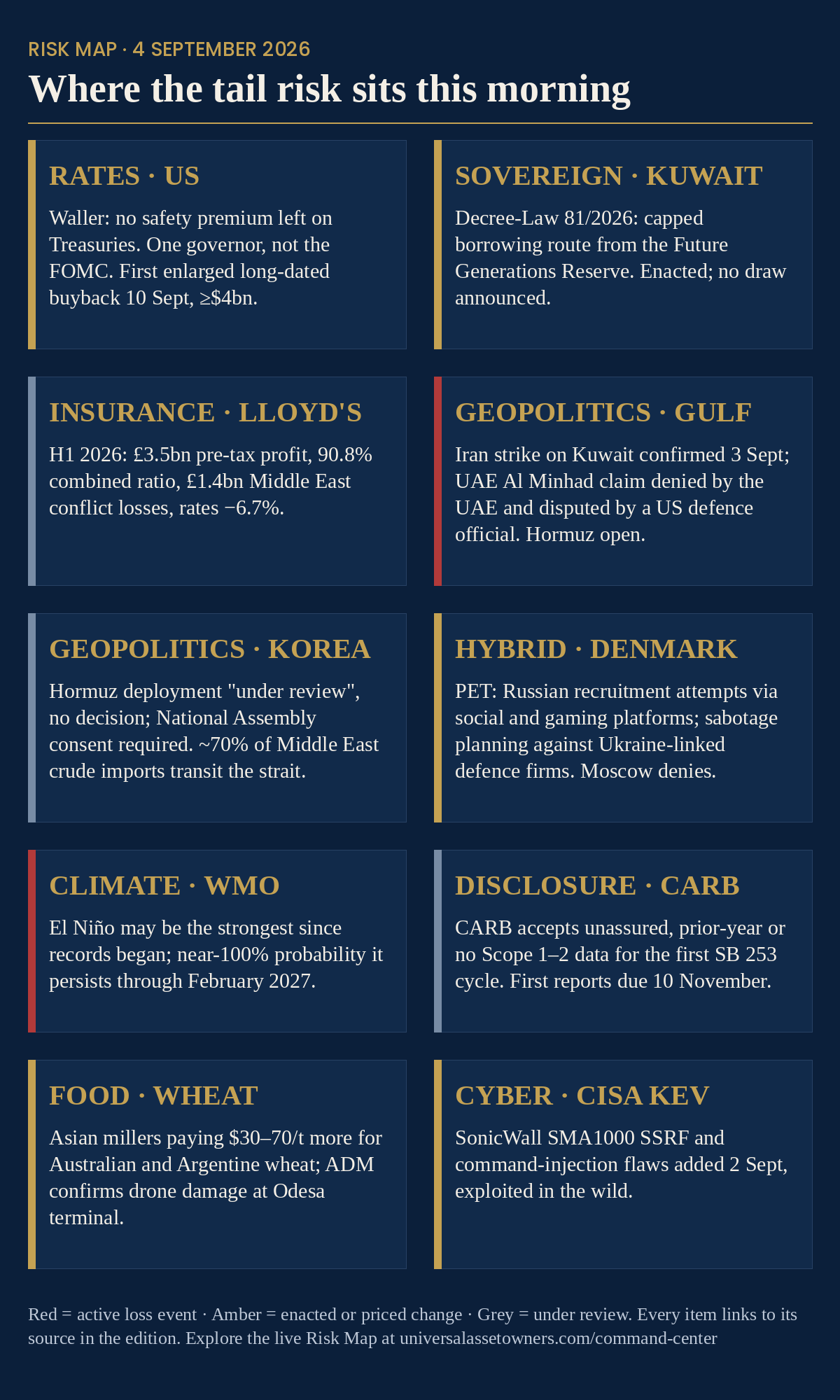
Every item carries an outbound authority link.
| Item | Detail | Link |
|---|---|---|
| Rates / market structure | Fed Governor Christopher Waller: no safety premium for safe, liquid US government debt; raising his own neutral-rate estimate. One governor's view, not an FOMC position. Treasury long-end buyback size increase (at least $4bn) effective 9 September; first long-end operation on the published schedule 10 September | reuters.com |
| Sovereign capital | Kuwait Decree-Law 81/2026, gazetted 1 September: capped borrowing route from the Future Generations Reserve to the General Reserve. Enacted; no draw announced | arabnews.com |
| Insurance | Lloyd's H1 2026: £3.5bn pre-tax profit, 90.8% combined ratio, £48.4bn capital, market-wide rate change −6.7% | lloyds.com |
| Geopolitics — Iran/Gulf | 3 September Kuwait strike confirmed by Kuwait's military; UAE denies the Al Minhad claim; a US defence official separately disputes it | aljazeera.com |
| Geopolitics — Asia (second item, radar only) | South Korea: Cheong Wa Dae said on 4 September that deployment of military personnel to the Strait of Hormuz is under review as one of several options; no decision made; National Assembly consent required under Article 60(2) of the Constitution; the discussion has not reached that stage. A senior presidential official: nearly 70% of the crude South Korea imports from the Middle East passes through the strait. Lee–Macron summit Tuesday | koreaherald.com |
| Hybrid threat — Denmark | Denmark's PET said on 3 September it had identified concrete Russian attempts to recruit Danes via social-media and gaming platforms for tasks including photographing companies and infrastructure, and that Danish defence firms connected to Ukraine are the subject of concrete sabotage planning. Russia's ambassador denied it, saying no evidence was presented | euronews.com |
| Climate | WMO: El Niño may be the strongest since monitoring began; near-100% probability of persistence through February 2027 | aljazeera.com |
| Disclosure | CARB will accept unassured, prior-year, or no Scope 1 and 2 data for the first mandatory SB 253 cycle; first reports due 10 November 2026 | esgtoday.com |
| Food security | Asian millers paying $30–70/t more for Australian and Argentine wheat; ADM confirms 31 August drone damage to its Odesa terminal | ukragroconsult.com |
| Capital formation — AI infrastructure | PwC / Oxford Economics, 2 September: baseline US$31.6trn of cumulative data-centre capex to 2050; $800bn a year now to $1.8trn; US 48% / $15.1trn; ICT equipment 70% → 93% of spend. A projection with published alternative scenarios, not a commitment | pwc.com |
| Allocator move — closed | CPP Investments and Equinix completed the US$4bn acquisition of atNorth on 2 September; CPP ~51% / US$1.3bn, Equinix ~34% / US$895m, Partners Group ~10% / US$260m; US$4.1bn debt package. Announced February, completed September | newsroom.equinix.com |
| Natural hazard | GDACS Orange Flood alert, China, 31 July – 3 September 2026 | gdacs.org |
| Seismic | USGS M6.3, 84km SSW of Nikolski, Alaska, 2026-09-03 11:17Z, tsunami-flagged | earthquake.usgs.gov |
| Space weather | NOAA SWPC: continued alert, Electron 2MeV Integral Flux >1,000 pfu, through 3 September | swpc.noaa.gov |
| Cyber | CISA KEV: SonicWall SMA1000 SSRF (CVE-2026-83548) and OS command injection (CVE-2026-83549), added 2026-09-02, exploited in the wild | cisa.gov |
Not carried, and why. The Munich incident of 3 September — incendiary devices thrown at a construction site outside Rohde & Schwarz, with two Bulgarian nationals arrested shortly afterwards, minor damage, and no motive or foreign direction established — is not carried, because attributing it to anything would be the inference the evidence does not support, and running it beside the Denmark item invites exactly that inference. It is left for a later edition, awaiting a prosecutor's statement.
Long Horizon
Long Horizon
The question this week actually asks: what replaces a category?
For most of the post-Bretton Woods era, institutional finance ran on a small number of categorical distinctions that did not require pricing. Government debt was safe, not merely low-risk. A sovereign wealth fund's endowment portion was intergenerational, not merely long-dated. Reserves were a buffer, not a position. Each of those categories let an institution stop analysing something and start assuming it.
Three of them moved this week, in three jurisdictions, for three unrelated reasons. Lustig's paper puts a relative price on Treasury safety and finds it negative at long maturities. Kuwait's decree puts a cap, a seniority and a repayment rule on the Future Generations Reserve. India's liquidity surplus puts a sterilisation cost on an FX buffer within days of accumulating it. None of these is a crisis; all of them are the conversion of an assumption into a number.
The long-horizon consequence is not that any of these pools becomes unsafe. It is that the analytic work an institution used to be able to skip now has to be done, every year, by someone. That work has a cost, a headcount and a governance owner, and at most large asset owners it has none of the three today. The parallel in the climate and disclosure section is exact: when California made assurance optional, the verification did not disappear, it migrated to whoever consumes the data. When Treasuries stop supplying costless insurance, the insurance does not disappear either — it has to be bought, modelled or forgone, and each of those has a budget line.
The institutions that handle the next decade well will be the ones that noticed early that a category had become a calculation, and staffed for it before the calculation was urgent. That is a boring conclusion. It is also the one the evidence supports.
And the largest competing claim on that capital now has a number
On 2 September, PwC published its Global Data Centre Outlook 2026–2050, modelled by Oxford Economics across 46 countries and territories. Its baseline projection is US$31.6 trillion of cumulative data-centre capital expenditure through 2050, rising from roughly US$800 billion a year in 2026 to US$1.8 trillion a year in 2050. The United States is projected to take 48% — US$15.1 trillion; Asia Pacific US$8.2 trillion, led by China and India.
Two findings in it matter more to an allocator than the headline. The first is that this build-out does not behave like an infrastructure cycle. Traditional infrastructure booms taper once the building is up; this one is projected to accelerate, because the equipment inside the building has to be replaced every few years. ICT equipment rises from 70% of the spend today to 93% by 2050. That is not a construction programme with a maintenance tail. It is a rolling capital requirement that never completes — which is a different asset, with a different duration, from the one an infrastructure mandate is usually written for.
The second is what governs where the money lands. PwC names the factors that will direct where investment flows — power, connectivity, security, policy certainty and community consent, with GPU access alongside — and puts power first, on the ground that affordable, reliable, low-carbon electricity at scale is the hardest requirement for most markets to meet. Clara Cutajar, PwC's global infrastructure leader, frames the consequence for capital directly: "Investors should recognize data centres as hybrid assets with a complicated risk profile."
Two disciplines on this number, and the second is a correction to how the study is being reported. First, it is a projection, not a commitment: nobody has appropriated $31.6 trillion, and PwC publishes its own alternative scenarios — tighter export controls cut cumulative investment to about US$25.5 trillion, roughly US$6 trillion below the baseline, while a digital-sovereignty push redistributes investment rather than reducing it. Second, the study is being summarised elsewhere as showing that power rather than semiconductors is the binding constraint. PwC does not make that contrast. GPU access is among the factors it names, and the only scenario that moves the total by trillions is the chip scenario. Power is named the hardest requirement; chips are the biggest modelled downside. Both are true, and collapsing them into a single villain loses the part an allocator needs.
Why it belongs beside the lead. The lead's argument is that the safe asset is being repriced as an ordinary credit and must now compete for capital on price. This is the largest single competing claim anyone has yet put a number on, and it is structurally the opposite of a government bond: undiversifiable against its own inputs, dependent on electricity and export policy, and requiring reinvestment forever. Capital Flows records what that looks like as a transaction rather than a forecast — CPP Investments closing US$1.3 billion into eight Nordic data centres on the same day the study published. One is a projection through 2050. The other is a pension fund's money, moved.
Stewardship and Voting
Stewardship and Voting
Three regulatory withdrawals inside one quarter, and every one of them sends the bill to the owner.
- The SEC has stopped responding to no-action and no-objection requests under Rule 14a-8 — in force since mid-August. The Commission is no longer the body that adjudicates whether a shareholder proposal may be excluded. A law-firm memo dated 21 August resurfaced on the Harvard Law School Forum on Corporate Governance on 3 September; that is a republication, not a new regulatory step, and the distinction matters this week. The separate proposal to rescind Rule 14a-8 sits at the Office of Management and Budget, with publication for comment indicated for October per the regulatory agenda. Only the first has changed what a company may do with a proposal today.
- CARB will exercise enforcement discretion across the entire first cycle of SB 253. The regulator is not, this year, the body that tests whether a filing is adequate.
- The SEC has proposed rescinding the adviser pay-to-play rule outright — and of the three, this is the one that is directly about who is allowed to manage public pension money. On 3 September the Commission issued a proposal to rescind Advisers Act Rule 206(4)-5, adopted in 2010, which bars an investment adviser from providing compensated advisory services to a government client for two years after the adviser or a covered associate makes a political contribution to an elected official or candidate with influence over the award of advisory business. Related recordkeeping provisions would go with it. The comment period runs 60 days from publication in the Federal Register. The Commission's stated reasoning is that the rule has produced "significant unintended consequences" and operates as "a de facto strict liability standard" in which small donations or "foot faults" trigger substantial prohibitions. Chairman Paul S. Atkins: "matters involving political contributions are more properly governed by local ordinances, state laws, and federal election regulations — not by the SEC." The SEC is explicit that the Advisers Act's antifraud provisions, the fiduciary duty, the compliance rule and the code of ethics rule would all continue to apply.
Why this one is different from the other two. Rule 206(4)-5 is not a disclosure rule and not an adjudicative service. It is a bright-line prophylactic sitting on the single most conflicted relationship in institutional asset management: the one between a manager seeking a public pension mandate and an elected official with influence over awarding it. Rescinding it does not make that conflict legal to act on — fraud and fiduciary duty remain — but it moves the control from a mechanical, self-executing bar to a facts-and-circumstances judgement made after the fact, by somebody. For a public plan, that somebody is its own board and its own general counsel. A trustee whose manager-selection policy currently says, in effect, "the SEC's two-year timeout handles this" has a policy with a load-bearing assumption that is now out for comment.
The practical point, and it has a date. The 60-day clock starts at Federal Register publication, not at the 3 September announcement, so the comment window is not yet running. A public plan that wants its own experience of the rule on the record — in either direction — should be drafting now rather than after publication, and should decide whether it comments as an investor, as a government entity, or both. This desk takes no position on whether the rule should be rescinded. It observes only that a plan which relies on the rule has an interest in saying so, and that the deadline will be short once it starts.
Different agencies, different politics, one instrument: a regulator withdrawing from an adjudicative, verification or prophylactic function it previously performed. In no case does the function disappear. On 14a-8, exclusion determinations move to the issuer's counsel and then to state courts — turning a letter to the Commission into a litigation risk assessment, which will quietly reduce filing volume before any rule is finalised. On SB 253, adequacy moves to whoever consumes the filing.
The practical point for a stewardship team. Governance budgets are built on the assumption that a public regulator performs the screening and the owner performs the judgement. When the screening layer withdraws on the shareholder-rights side, the disclosure side and the manager-conflict side inside a single quarter, a stewardship and governance function acquires three new jobs — legal pre-clearance of its own proposals, verification of its own data inputs, and conflict screening in its own manager selection — with no corresponding budget line. The correct response is a staffing question raised before the 2027 proxy season, not a policy statement.
One European item with a date attached. The EU's ESG Ratings Regulation now has its product-disclosure RTS, penalty procedure and fee regime in force, with the disclosure RTS applying retroactively from 2 July 2026. As at 13 August, ESMA's register listed 13 ESG rating providers, all registered under the Article 5 temporary regime for small undertakings. The large houses are inside the transitional path — notification of intent was due 2 August, applications are due by 2 November 2026. Between now and then, a large owner has more leverage than it will ever have again to ask a provider, in writing, which data vintages and assurance statuses feed a given rating product — because the provider is assembling exactly that documentation for a regulator right now. After authorisation it becomes a service request. Before it, it is aligned with the provider's own workstream.
Read at source. ESMA's own register of ESG rating providers, last updated 13 August 2026, lists exactly thirteen providers, every one of them "Registered under Article 5" — the temporary regime for small undertakings — and none yet authorised under Article 8. ESMA's guidance page says it encourages medium and large providers to file their authorisation applications between 2 September and 2 November 2026, so that register is a snapshot that can change on any working day. ESMA, "List of registered ESG providers" (PDF, last updated 13 August 2026); ESMA, ESG Rating Providers — registration and timeline
Sources: "SEC Proposes Rescission of Political Contribution Rule for Investment Advisers," US Securities and Exchange Commission press release 2026-85, 3 September 2026 — primary, opened and read in full — sec.gov · "SEC to propose recission of rule governing shareholder proposals: OMB," ESG Dive, 1 September 2026 — esgdive.com · "SEC says it will stop responding to no-action requests 'entirely'," ESG Dive, 17 August 2026 — esgdive.com · "Climate and Energy: EU Policy and Regulation Update for 2 September 2026," Cleary Gottlieb — clearygottlieb.com
Dispatches
Dispatches · Latin America
 | Latin America · Nicolás Bohórquez UAO Correspondent · Latin America desk · Filed 4 September 2026 |
- Brazil equities and the real. The Ibovespa closed at 179,722 points on Wednesday 2 September, up 1.30% on the session, with Petrobras preferred shares leading at +4.1% as oil advanced internationally — a direct read-through from the Gulf risk premium above. The real strengthened to 5.1558/USD, down 0.54% on the day. Rio Times Online, Brazil Markets wrap, 2 September 2026
- A tighter election race is being priced as less tail risk, not more. A local poll showed President Lula and Senator Flávio Bolsonaro in a statistical dead heat for next year's election; investors are reading the tighter race as reduced risk of an abrupt policy lurch. The market is pricing centrist continuity odds, not chaos. TradingEconomics, "Ibovespa Rises as Election Polls Show Tighter Race"
Editorial Watchlist
Nepal
Rescuers pulled two workers alive from the Upper Trishuli 3A hydropower tunnel in Nepal on Friday 4 September — Kabir Maharjan, 45, a supervisor from Kathmandu, and Sanjaya Sah, 30, a foreman from Saptari district — nine days after floods, likely caused by a glacier collapse, devastated towns and swept away villages on 26 August. They are the first live rescues from the affected projects.
The scale, as reported by the Associated Press early on Friday 4 September, citing the Independent Power Producers Association of Nepal: at least 557 workers are missing from the Trishuli 3A project along the Trishuli River, with about 115 believed trapped in the main tunnel. Officials said rescuers believe some people may still be alive inside. Across the wider disaster, at least 1,259 people have been killed and more than 5,000 remain missing, according to Nepal's disaster management agency as of the same report; both counts have moved across the day's wires and should be read as a floor. The rescued foreman's surname is given as Sah or Shah depending on the wire.
Why it is on the watchlist rather than in the brief. The allocator-relevant point is narrow and should not be dressed up: tunnel exposure cannot be inferred from surface destruction. Adjacent underground projects hit by the same event are showing materially different damage and survivability, which means an insurance or infrastructure book that has aggregated these projects into one loss estimate is aggregating things that are not alike. That is a real modelling caution. It is also, at this moment, secondary to a search operation with 557 people missing, and this desk is not going to lead with the modelling caution.
The loss now has a shape, and it lands on the modelling caution above. Two dated figures were published on Friday 4 September, and they are different kinds of number:
| Figure | What it is | Attribution |
|---|---|---|
| $2.56 billion | Estimated economic loss across the disaster | Nepal's disaster authority chief, to Reuters, Friday 4 September |
| Above NPR 20 billion ($132.3 million) | Estimated commercial insurance losses, hydropower accounting for most claims | Toton Chakraborty, chief executive of Oriental Insurance Company Nepal |
| NPR 25.87 billion ($171.13 million) across 583 claims | Flood-related claims received by the regulator as of 31 August | Nepal Insurance Authority data |
Read the third row carefully. It is dated 31 August and was published on 4 September — it is four days stale on the day it appears, and it is not a settled loss. Chakraborty's own qualification is the one that governs: these figures "largely reflect insured exposure rather than final claims, which will only be clear once detailed surveys are completed," and the Nepal Insurance Authority requires licensed surveyors to assess insured damage before claims are settled. Claims could also rise for a reason that has nothing to do with physical damage: some policies compensate developers for lost revenue from postponed commercial operations, so a repair schedule that delays commissioning converts into a further claim.
Eleven Nepali hydropower projects lie in the affected region. Rasuwagadhi, Upper Trishuli-3A, Chilime and Devighat were directly affected; assessments at five others are ongoing. That is the same Upper Trishuli-3A as the tunnel above, which is precisely why the aggregation caution matters: the four named projects are being assessed individually, and the five unassessed ones are not yet in anybody's number.
The consequence a universal owner should actually price is the reinsurance one. Nepal's own market is small — 14 non-life insurers wrote about NPR 5.3 billion ($35.06 million) of premium in July–August, against about ₹314 billion ($3.3 billion) written by Indian insurers over a comparable period — and it is supported by domestic reinsurers Nepal Re and Himalayan Re alongside India's GIC Re and Germany's Hannover Re. The forward-looking statements are on the record and named. Benjamin Ng, power leader for Asia at Aon: recent mountain floods in South Asia "may lead insurers to further review hydropower and infrastructure risks, particularly in highly exposed locations," with insurers likely to impose exclusions, lower sub-limits and narrower coverage, producing higher premiums and more selective underwriting. Sanjay Mokashi, chief underwriting officer at GIC Re, said the floods could reshape industry views on risk accumulation and glacial-lake-outburst-flood exposure.
Why that is the allocator-relevant line. An owner with infrastructure or private-credit exposure to Himalayan hydropower is not primarily exposed to this loss — the insured numbers are small in global terms. It is exposed to what the reinsurers do next. Exclusions, sub-limits and narrower coverage do not show up as a loss; they show up later as an uninsurable tranche in a project's financing plan, or as a covenant that can no longer be met, in assets that were underwritten on the assumption that the cover would be there and renewable. That repricing is a decision taken in Munich, Hanover and Mumbai over the coming renewal season, and it is the thing to watch, not the claims tally.
Not established: any allocation of the insured total between classes of business. A split attributing the largest share to engineering and contractor-risk cover appears only in secondary summaries, not in the publisher's own words, and is therefore not carried. Nor is any estimate of the reinsured portion, which no source quantifies.
Sources: "2 trapped workers rescued from a hydropower tunnel 9 days after Nepal floods," NPR, 4 September 2026 — npr.org · "Nepal floods could cost insurers over $130 million even before death, injury claims," Ashwin Manikandan, 4 September 2026, read in full via a non-paywalled syndication — whtc.com
Week Ahead
Week Ahead
- Wednesday 9 September / Thursday 10 September — the enlarged US Treasury long-end buyback (at least $4bn per operation, up from a $2bn maximum) takes effect on the 9th; the first long-end operation after that on the last-published schedule is the 10-to-20-year operation on the 10th. Waller has publicly said he doubts short-run interventions do much. Whether the operation moves the long end is the cleanest available test of the plumbing-versus-repricing question at the heart of today's lead.
- The September FOMC and its longer-run projections. If the Committee's longer-run dot drifts up, the convenience-yield argument stops being one governor's estimate. If it does not, the counterclaim in the opening thesis strengthens considerably.
- The RBI's sterilisation choice. A swap announcement, a longer-tenor VRRR, a CRR move or an OMO sale each transmits the cost of India's record ₹9.70trn surplus to a different balance sheet. Watch overnight rates against the corridor.
- Any Kuwaiti Council of Ministers or KIA board approval of a first loan under Decree-Law 81/2026. Until one appears, this remains an enacted facility with no draw.
- Tuesday — the Lee–Macron summit. A senior South Korean presidential official said it would be difficult to rule out Hormuz freedom-of-navigation being on the agenda. Any move toward a National Assembly consent motion would be the first consequential Asian military contribution to Gulf security.
- Joint War Committee listed-areas updates and P&I club circulars. With Lloyd's now having published a conflict loss number, underwriter behaviour is the leading indicator of how Gulf risk is actually being repriced, as distinct from how it is being reported.
- Federal Register publication of the SEC's proposal to rescind Rule 206(4)-5. The 60-day comment clock starts on publication, not on the 3 September announcement. A public plan that intends to comment should have a draft before the clock starts, not after.
- Japan's fiscal 2027 bond-issuance plan, and the drafting of the budget itself. The ¥143.1trn request total is not an appropriation; the Cabinet-approved draft comes at the end of the year. The number that transmits to global duration is next year's issuance against the stated ambition of holding it near ¥40 trillion.
Scenario · The Scenario Lab
The safe asset and the sovereign buffer
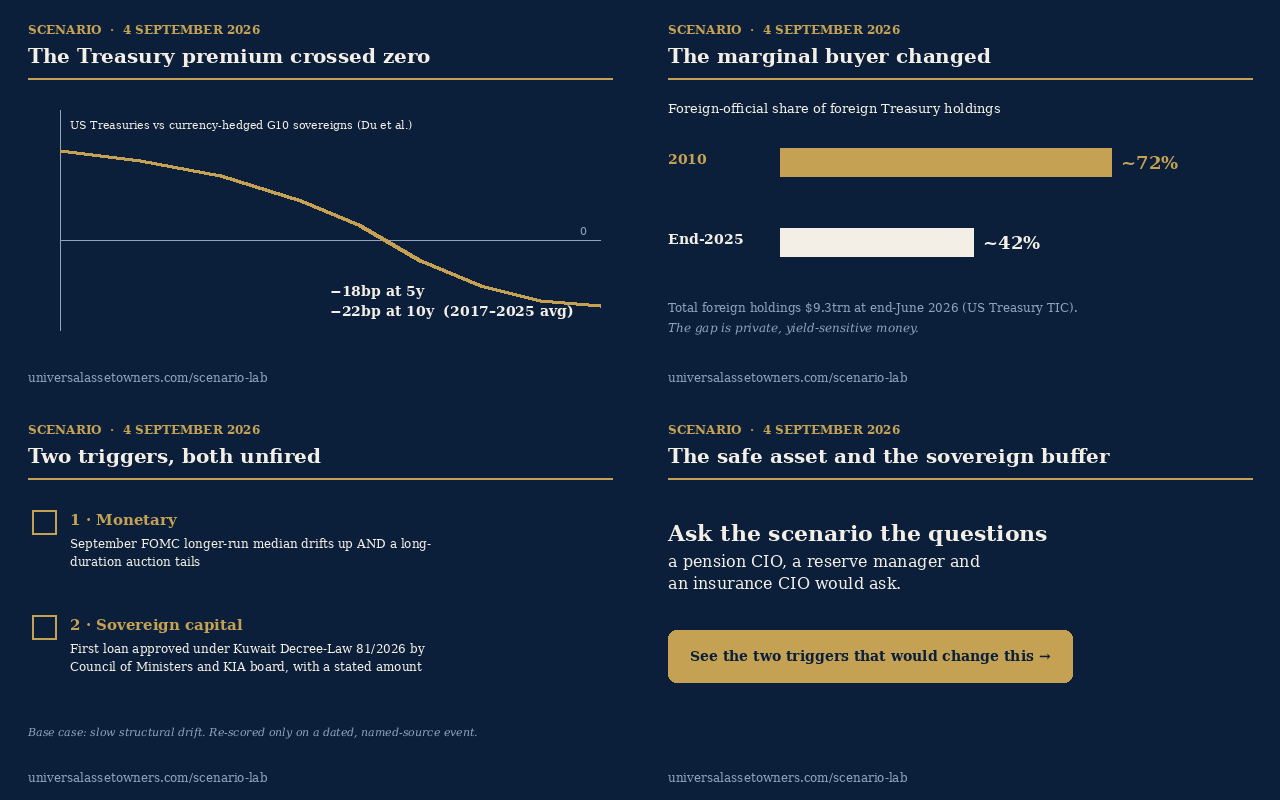
See the two triggers that would change this →
Base case. The convenience-yield erosion Lustig documents persists as a slow structural drift: long-end Treasuries retain greater fiscal sensitivity than in the 2010s, the stock–bond correlation stays positive or near zero, and FOMC longer-run neutral estimates drift up modestly over several policy cycles. Sovereign buffers continue to be converted into capped, priced facilities rather than drawn — Kuwait's decree without a draw is the template.
Escalation trigger 1 (monetary). The September FOMC's longer-run projections show a clear upward drift in the median longer-run rate, and a long-duration auction tails materially. That would move this from one governor's estimate to a Committee view with a price attached.
Escalation trigger 2 (sovereign capital). A first loan approved under Kuwait's Decree-Law 81/2026 by both the Council of Ministers and the KIA board, with a stated amount. An approved, sized draw converts an enacted facility into capital moved.
Update rule. Re-score only on a dated, named-source trigger event. No bare probability is assigned without a stated method, timestamp and update rule. As of this pull, neither trigger has fired.
Podcast · The Universal Owner
“The safe asset stopped behaving like one” · 10 min 22 sec
The day’s core contradiction, the counterclaims and the one number that survives — the full edition, spoken.

Extended Listen
Today’s deep dive — What a broken hedge actually costs, and the one number that survives it — read in full. 6 min 48 sec.
The Job Board · Open Seats
Roles at the world’s largest asset owners
|
The Allocator Desk · Careers
Roles at the world’s largest asset owners
Verified open against the employer’s own record on 2026-09-04. Ontario Teachers' — Managing Director – Private Capital, Software · Toronto, Canada Apply → BCI — Director, Partnership Portfolio · Victoria, BC Apply → PSP Investments — Intern, Credit Investments - London (Off-Cycle January – June 2027) · London Apply → OMERS — Intern, Real Estate Investments (Spring 2027 - January to May) · Singapore, Central Singapore Apply → AIMCo — Student, Economics & Investment Research (May 2027) · Calgary Apply → HOOPP — Sr. Analyst, Performance Systems · Toronto, Ontario, Canada Apply →
|
The Back Page
Meet The Allocator: the number to carry into Monday’s investment committee
Minus twenty-two basis points — what global investors now pay, at ten years, to own a currency-hedged foreign bond instead of a Treasury. The Allocator on what to do about it without selling a single bond. 51 seconds.

Sources
Source ledger
- "Fed's Waller says safety premium for Treasuries is gone, pushing neutral rate higher" — David Lawder and Howard Schneider, 3 September 2026 — reuters.com
- "America's Risky Debt: What Markets See That Policymakers Don't" — Hanno Lustig, Aspen Economic Strategy Group, August 2026 — economicstrategygroup.org
- "Kuwaiti government to borrow from Future Generations Fund" — Arab News (Asharq Bloomberg), 2 September 2026 — arabnews.com
- "Kuwait amends Future Generations Reserve law, sets strict borrowing limits" — Times Kuwait — timeskuwait.com
- "Kuwait ends ban on borrowing from wealth fund" — MEED — meed.com
- "Kuwait allows borrowing from sovereign fund for state finances" — Xinhua, 2 September 2026 — english.news.cn
- "Fitch affirms Kuwait's AA- rating on strong external assets" — Arab News — arabnews.com
- "Lloyd's market delivers solid first half performance, despite softening rate environment and rising geopolitical tensions" — Lloyd's of London, 3 September 2026 — lloyds.com
- "Lloyd's puts a $1.9bn number on the Iran war. Washington's own fix has written nothing" — Matthew Sellers, Insurance Business, 3 September 2026 — insurancebusinessmag.com
- "How India's RBI could tackle a liquidity deluge triggered by dollar deposits" — Business Recorder, 3 September 2026 — brecorder.com
- "Asia replaces Black Sea wheat with more expensive Australian and Argentine grain" — UkrAgroConsult, 3 September 2026 — ukragroconsult.com
- "Seoul reviews Hormuz troop deployment among options, no decision yet" — Ji Da-gyum, The Korea Herald, 4 September 2026 — koreaherald.com
- "Presidential office says no decision reached on troop deployment to Hormuz; review ongoing" — The Korea Times, 4 September 2026 — koreatimes.co.kr
- "South Korea reviewing military options for Hormuz, no decision made, official says" — Al-Monitor, September 2026 — al-monitor.com
- "Denmark's intelligence agency warns Russia 'actively' preparing acts of sabotage" — Euronews, 3 September 2026 — euronews.com
- "Sabotage — Threats to Denmark" — Danish Security and Intelligence Service (PET), standing assessment — pet.dk
- "2 trapped workers rescued from a hydropower tunnel 9 days after Nepal floods" — NPR, 4 September 2026 — npr.org
- "Two trapped workers rescued alive from a tunnel in Nepal" — NBC News, 4 September 2026 — nbcnews.com
- "UN warns El Niño could be 'off the charts', strongest in decades" — Al Jazeera, 3 September 2026 — aljazeera.com
- "California Confirms Series of Reliefs to Ease First Year of Climate Reporting for Companies" — ESG Today, 3 September 2026 — esgtoday.com
- "SEC to propose recission of rule governing shareholder proposals: OMB" — ESG Dive, 1 September 2026 — esgdive.com
- "SEC says it will stop responding to no-action requests 'entirely'" — ESG Dive, 17 August 2026 — esgdive.com
- "Climate and Energy: EU Policy and Regulation Update for 2 September 2026" — Cleary Gottlieb, 2 September 2026 — clearygottlieb.com
- "Iran fires missiles and drones at Kuwait as strikes resume in U.S. war" — The Washington Post, 3 September 2026 — washingtonpost.com
- "Iran war live" — Al Jazeera live blog, 3 September 2026 — aljazeera.com
- "What do we know about the fatal US bombing of a wedding in Iran's Sirik?" — Al Jazeera, 2 September 2026 — aljazeera.com
- "Iran Red Crescent urges ICC probe into deadly US strike on wedding party" — Al Jazeera, 3 September 2026 — aljazeera.com
- "US air strikes kill 18, wound 142 in Iran, health official says" — TRT World, 3 September 2026 — trtworld.com
- "Iran says it attacked US forces at UAE's Al Minhad Air Base" — The Times of Israel liveblog, 3 September 2026 — timesofisrael.com
- "UAE denies Al Minhad Air Base is a target after Iran claims it attacked base" — Marine Link, 3 September 2026 — marinelink.com
- "BlackRock Says $2.1 Trillion Gulf Spending Boom Could Reshape Global Capital Flows" — Yahoo Finance, 3 September 2026 — finance.yahoo.com
- "UAE at centre of $2.1 trillion GCC investment shift, says BlackRock" — Khaleej Times — khaleejtimes.com
- "GCC becomes a provider of capital, infrastructure for global growth: report" — Trade Arabia / GDN Online — tradearabia.com
- "Brazil Markets: Ibovespa & the Real — Wednesday, September 2, 2026" — Rio Times Online — riotimesonline.com
- "Ibovespa Rises as Election Polls Show Tighter Race" — TradingEconomics — tradingeconomics.com
- St. Louis Fed Financial Stress Index; 10y–2y Treasury spread; US high-yield OAS; VIX; Broad USD Index — Federal Reserve Bank of St. Louis (FRED), pulled 2026-09-04 — fred.stlouisfed.org
- GDACS active disaster alerts — gdacs.org
- USGS earthquake event page, M6.3 Nikolski, Alaska — earthquake.usgs.gov
- NOAA Space Weather Prediction Center alerts — swpc.noaa.gov
- CISA Known Exploited Vulnerabilities Catalog — cisa.gov
- "SEC Proposes Rescission of Political Contribution Rule for Investment Advisers" — US Securities and Exchange Commission, press release 2026-85, 3 September 2026 — sec.gov
- "Japan budget requests swell to pandemic-era scale under Takaichi" — Makiko Yamazaki and Takaya Yamaguchi, 4 September 2026 — finance.yahoo.com
- "Japan FY2027 budget requests to hit new high of about ¥143 tril" — Kyodo News via Japan Today, 1 September 2026 — japantoday.com
- "La Caisse and SMBC Aviation Capital double the size of their aircraft leasing platform, Maple Aircraft Company Holdings, to USD 3 billion" — La Caisse, 3 September 2026 — lacaisse.com
- "BNP Paribas AM wins additional US$600m from pension fund" — Vinny Vucago, Financial Standard, 4 September 2026 — financialstandard.com.au
- "Arizona pension fund doubles down on SRTs" — Alternative Credit Investor, 3 September 2026 — alternativecreditinvestor.com
- "Nepal floods could cost insurers over $130 million even before death, injury claims" — Ashwin Manikandan, 4 September 2026 — whtc.com
- "Major Foreign Holders of Treasury Securities, Table 5" — Treasury International Capital System, US Department of the Treasury, holdings to end-June 2026, read 4 September 2026 — ticdata.treasury.gov
- "Investment boost for climate action and forest protection" — Department for Energy Security and Net Zero, GOV.UK, 3 September 2026 — gov.uk
- "STATEMENT: UK Invests in Tropical Forest Forever Facility, Boosting Momentum" — World Resources Institute, 3 September 2026 — wri.org
- "Global investment in AI infrastructure to hit US$31.6 trillion through 2050" — PwC, press release, London, 2 September 2026 — pwc.com
- "Where $31.6 trillion of capex flows in the era-defining AI build-out" — PwC Global Data Centre Outlook 2026–2050, modelled with Oxford Economics — pwc.com
- "CPP Investments and Equinix Complete atNorth Acquisition to Support Growth of Leading Nordic Data Center Platform" — Equinix newsroom, 2 September 2026 — newsroom.equinix.com
- "CPP Investments and Equinix to Acquire atNorth for US$4 Billion" — Equinix newsroom, 27 February 2026 (the announcement, cited to establish that 2 September is the completion and not the announcement) — newsroom.equinix.com
Universal Asset Owners · The Editorial Team. Capital at the scale of the world. Research, charts and analysis for the institutions investing at the scale of the world. Not investment advice.