
Written for the desks that steward the world’s long-horizon capital — sovereign wealth funds, public pensions, endowments, insurers and family offices, an institutional class managing more than $40 trillion. One edition a day. Every claim carried to its source. The second-order read the headlines don’t give you.
If this was forwarded to you, you are reading what the largest allocators read before the market opens.
98% of the world’s sovereign wealth funds |
18 of 20 of the world’s largest pension funds |
10 of 10 of the largest charitable foundations |
85% of the world’s largest family offices |
100+ billionaires, every morning |
Norges Bank has told Norway’s government not to cap the largest companies, sectors or markets in the Government Pension Fund Global. Concentration, it says, must be accepted as a feature of a market-weighted index — and the owner, not the manager, is the one who should decide otherwise. A second letter proposes the change it will make: to the bond benchmark.
The briefing
Ninety-nine seconds: what the Bank advised, what the cap back-tests show, and why a pension fund should not copy the bond letter.
What happened
On 1 September Norges Bank and its investment arm sent two letters to the Ministry of Finance, both published the next day, answering questions the Ministry put in February. The first advises against caps on markets, sectors or companies “at this time”. The second proposes cutting the government share of the bond benchmark from 70 to 50 per cent, moving to market weights, and adding agency mortgage-backed securities. The fund held NOK 22,683 billion at 30 June: 72.1 per cent listed equities, 25.8 per cent fixed income, 2.1 per cent unlisted. Nothing is policy; the expert group appointed in 2025 reports by 25 January 2027.
Dispatches
Filed by our correspondents, in their own time zones. Bullets, not analysis — what they are seeing on the ground before New York opens.

ISLAMABAD · NAVEED IQBAL
- FBR collected Rs901bn in August against a Rs930bn target — a Rs29bn miss — yet July–August came in Rs12bn ahead at Rs1.722tn. Cushion: 0.7 per cent. Dawn
- Income tax fell Rs70bn short and declined 3 per cent year on year; sales tax beat by Rs85bn and rose 14 per cent, attributed to inflation and petroleum prices. August CPI 11 per cent.
- The petroleum levy — up to Rs120 a litre — sits outside the FBR target as non-tax revenue and accrues wholly to the federal government. It flatters the fiscal line, not the tax base.
- Finance Ministry says it raised $3bn in a dual-tranche Eurobond on 3 September: $1.75bn 5.5-year at a 7.5% coupon, $1.25bn 10-year at 7.9%, books ~$6bn. July’s current account narrowed; expensive oil is a prospective risk, not a realised one.

LATIN AMERICA · NICOLÁS BOHÓRQUEZ
- Chevron said on 2 September it will expand in the Orinoco Belt: over $7bn across five years to reach ~600,000 b/d. NPR
- Separately, the US announced on 28 August an arrangement covering 17 fields and a stated 65bn barrels with North American Blue Energy Partners. The two are distinct; the reserve figure remains a US government assertion.
- Rystad: full restoration to ~3m b/d is a decade and ~$183bn away — but brownfield additions of 300–350k b/d are plausible within about three years. Rehabilitation and restoration run on different clocks.
The advice against caps — and the qualifier that matters
The Bank “does not advise introducing caps on individual markets, sectors or companies at this time.” Those last three words are in the letter and they carry weight: this is a judgment about present evidence, not a doctrine. It also declines to repurpose the limit for deviation from the benchmark index as a concentration tool, on the grounds that the measure is not clearly linked to excess return and would reduce the room for strategies intended to add value.
The Bank does publish stress tests, and they are stark. A severe geopolitical upheaval: a fall in total fund value of 30 to 40 per cent. An artificial-intelligence disappointment, in which the technology fails to deliver the productivity gains and earnings investors expect: 18 per cent in the 2024 exercise and 35 per cent in the 2025 one.
It is tempting — and wrong — to read those as the price of declining to cap. The stress tests contain no capped-index counterfactual. They do not model what a cap would have saved. They are an estimate of what this portfolio can lose, published by an institution that has decided to bear that loss and to say so in public.
The 18-to-35 comparison needs the same care. In the 2024 exercise, equities fell 29 per cent and fixed income rose 9. In the 2025 version, equities fell 53 per cent and fixed income rose 10. The later scenario applied a far harsher equity shock across broader transmission channels to an updated portfolio. Greater concentration contributed; so did a much larger assumed shock. The Bank does not decompose the 17-point difference, and it should not be decomposed on its behalf.
Against all of it, the equity portfolio has returned more than 70 per cent cumulatively over three years — a run the Bank says “we cannot expect to continue.”
Why breadth does not rescue you
The letter names the mechanism. Many of the benchmark's largest companies share exposure to the same three factors: the return on investments in artificial-intelligence infrastructure, developments in US technology regulation, and access to advanced semiconductors. A shock to any of them “could therefore affect a large part of the index.”
Diversification still does its job against company-specific risk. What it cannot do is eliminate a common factor. Owning seven thousand companies and owning one bet are not mutually exclusive.
The strongest argument against caps is in the appendix
The Bank ran them. From 1994 through June 2026, an uncapped index returned 8.80 per cent a year. A 1 per cent company cap returned 8.71 per cent, with almost no reduction in volatility. A 3 per cent cap returned 8.82 per cent — marginally better than doing nothing.
The cap you choose determines the answer you get, and none of them bought much safety. That is the evidence behind “at this time,” and it is a stronger argument than assertion.
Which leaves the decision where the Bank says it belongs. A market-cap index is not neutral: it accepts the market's allocation of capital. But asking a manager to undo that structural exposure inside an active risk budget blurs accountability — two years on, nobody can separate the strategy from the tidying. If Norway wants a structurally different portfolio, its elected owner should say so in the benchmark.
The second letter proposes a risk swap, not a retreat
The bond submission is the more actionable of the two, because it carries implementation detail.
Norges Bank is not proposing to change the fund's 70/30 split between equities and bonds. It proposes recutting the fixed-income sleeve. The government subindex falls from 70 per cent of the bond benchmark to 50.
The denominator most coverage has dropped: the letter states that developed-market government bonds currently account for “around 70 per cent of the bond index, or 21 per cent of the fund's benchmark index.” Fifty per cent would be roughly 15 per cent of the total benchmark. This is a six-point shift at fund level, not twenty.
Within that sleeve, market weights replace GDP weights. Agency mortgage-backed securities enter at just under 13 per cent of the bond index. Government-related bonds rise from about 4 per cent to about 11. Supranationals — 3.7 per cent of the current index — stay invested but move to the non-government half. Yen, Australian dollars, New Zealand dollars and Singapore dollars join the corporate side. Inflation-linked sovereigns stay; emerging markets stay out; duration continues to follow the market.
Look at what that actually is. US government bonds fall from about 34 per cent of the bond benchmark to about 22, while US non-government debt rises from 16 to nearly 28. Add the 50 per cent government sleeve to government-related debt and agency mortgages, and roughly three-quarters of the proposed index remains government, government-linked or agency-guaranteed. Norway is not walking away from the state. It is exchanging some direct sovereign liquidity and term premium for prepayment risk and government-related credit. Duration barely moves — about 6.2 against 6.3.
The return case is modest, and the Bank says so. At 30 June the proposed index yielded about five basis points more than the current benchmark. In the backtest from 2015 it returned less — 0.76 per cent a year against 0.97 — with a slightly lower Sharpe ratio, though marginally lower volatility. The Bank also notes the mortgage prepayment premium has weakened over the past decade and may not materialise. This is a diversification and benchmark-design argument, not a free lunch.
A reversal on GDP weighting
GDP weights came in in 2012, on the argument that they diversified sovereign credit risk better than market weights. The Bank now says that rationale no longer clearly holds: high government debt “has gone from being a distinctive feature of individual countries, particularly Japan and some euro area countries, to becoming a more general characteristic of developed economies.”
It concedes GDP weights outperformed market weights from 2001 to 2025, then sets its own result aside — the excess return was “largely driven by the underweighting of Japan and the depreciation of the yen,” one country over one period, and “not an argument that GDP is a good measure of fiscal risk.” GDP weighting is also named as the most important source of complexity and operational risk in constructing the index.
Two details show the margin kept. The Bank's own simulations say a 40 per cent government share would cover the fund's liquidity needs even in turbulence; it recommends 50 for safety, against stress that “may deviate from historical patterns.” And it costs the change at NOK 6.6 million a year ongoing — which it says sits inside its own model uncertainty and “should not be given weight” — plus a one-off transition cost of around NOK 750 million as an upper limit.
None of it is policy. No public Ministry position had been identified as of this morning, and the expert group appointed by the Ministry in 2025 — whose broader remit covers the fund's purpose and the owner's risk tolerance — is due to deliver its report by 25 January 2027. (That is a different body from the Expert Council for the GPFG, which reported on 23 January 2026.).
|
Allocator Lens: why a pension fund should not copy Norway The letter makes a distinction most coverage will skip. The GPFG, it says, “differs from these in that the fund has no explicit liabilities to be covered.” Its bonds do three portfolio-level jobs: damp overall volatility, supply liquidity for rebalancing, and earn risk premiums. A mature defined-benefit plan's bonds do a different job. They hedge benefit payments, defend a regulatory funding ratio and meet collateral calls. For that institution duration and inflation linkage are constraints, not preferences — and cutting the sovereign sleeve can make the total balance sheet riskier even as the asset-only portfolio looks better diversified. The 50/50 recommendation is not a template. And a caution on the obvious escape route. If the worry is concentrated exposure to AI capital spending, power and semiconductors, moving into private markets does not automatically fix it. A data centre, a tower portfolio or a private financing of the same build-out can load on the same electricity, capex, regulatory and chip constraints as the listed platforms. The legal wrapper changes; the economic factor may not. The portable lesson is the discipline, not the allocation: state the job each sleeve is meant to do, then test whether the benchmark still performs it. |
Questions for the next investment committee
- Which bond risks are deliberate — duration, sovereign credit, spread, prepayment, liquidity, inflation?
- Which of those belong in the benchmark, and which belong in active management?
- Is the government-bond allocation sized for liabilities, liquidity, collateral, crisis convexity — or habit?
- Could you explain the expected drawdown and the rebalancing plan to your board before a market break rather than during one?
- Do you have the internal capability to price prepayment and structured-credit risk, or would you be outsourcing a risk you cannot evaluate?
The deal tape
La Caisse said on 2 September it had completed the purchase of a 24 per cent stake in Altius, which operates more than 258,000 telecom towers and sites in India, for INR 121 billion (C$1.76 billion), alongside Brookfield.
It is a clean example of an asset owner buying the infrastructure beneath digital demand. It is also the counterpoint to the easy reading of Norway's letter: this is private infrastructure whose economics run on the same data-growth and capital-spending cycle as the listed platforms. Diversifying legal form is not the same as diversifying factor exposure.
Decisions due today
- Norway’s Ministry of Finance — no public position on either letter had been identified as of this brief. The base case is deferral until the expert group reports by 25 January 2027.
- Pakistan — the Finance Ministry’s Eurobond pricing statement is the only live decision in this edition; both tranches are stated as coupons, not yields.
The Universal Owner Risk Radar
| 1 Sep — Norges Bank advises against caps on markets, sectors or companies “at this time”; index concentration must be accepted — NBIM letter |
| 1 Sep — Norges Bank advises cutting the government subindex from 70% to 50% and adding agency MBS — NBIM letter |
| 1 Sep — US 2-year 4.39%, 10-year 4.79%, 2s10s 0.40 — FRED DGS2 · DGS10 |
| 1 Sep — Brent spot $96.02, +7.0% from 28 August — EIA |
| 2 Sep — Chevron commits $7bn over five years to Orinoco Belt expansion — NPR |
| 2 Sep — La Caisse completes INR 121bn purchase of 24% of Altius — La Caisse |
| 2–3 Sep — Pakistan raises $3bn in a dual-tranche Eurobond (5.5yr 7.5% / 10yr 7.9% coupons, books ~$6bn, per the Finance Ministry); August CPI 11% — Dawn |
Financial conditions
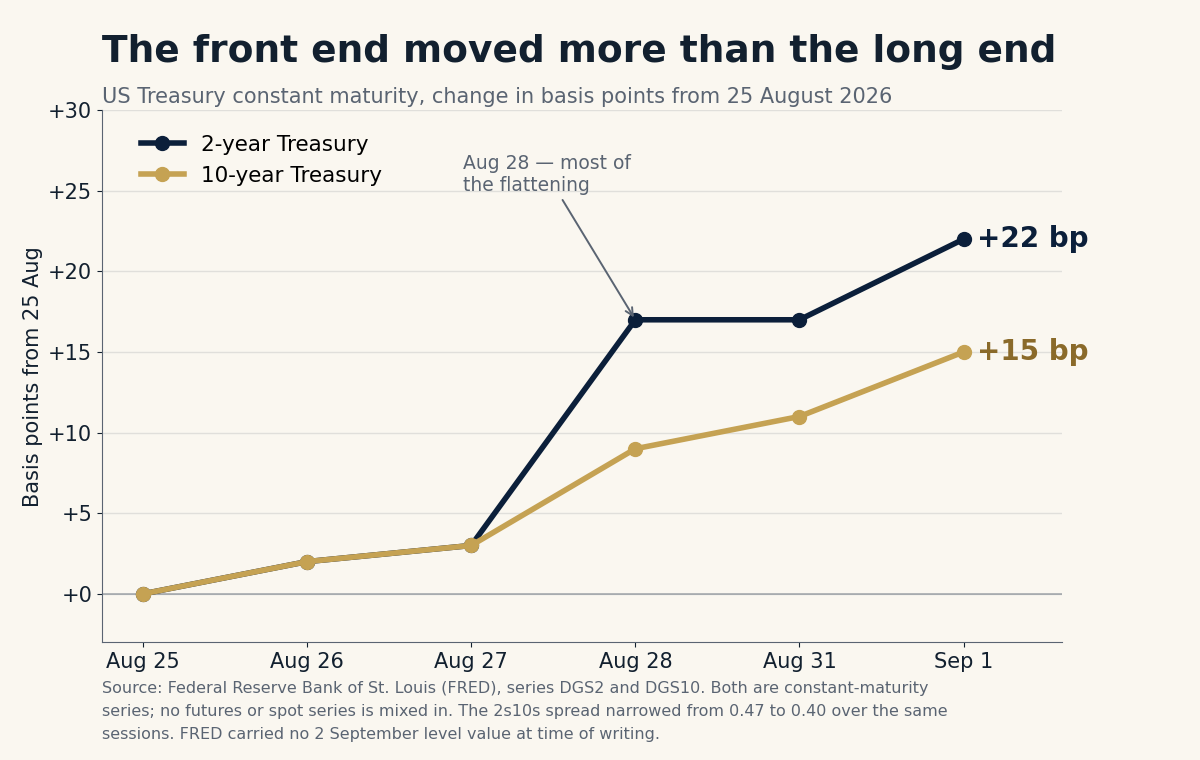
The US 10-year Treasury constant maturity rose from 4.64 per cent on 25 August to 4.79 per cent on 1 September. Over the same sessions the 2-year rose from 4.17 to 4.39. The 10-year-minus-2-year spread narrowed from 0.47 to 0.40, where it also stood on 2 September.
Rates rose as the curve bear-flattened: the 2-year moved 22 basis points against the 10-year's 15, and almost all of the flattening happened on 28 August. What combination of rate expectations, term premium, supply and hedging flows produced that is not something these series can settle, and this brief does not claim to.
Energy · price now, supply later
The US Energy Information Administration's Europe Brent spot series, released 2 September, put Brent at $96.02 on 1 September against $89.75 on 28 August — a move of +$6.27, or 7.0 per cent. For scale, the series peaked at $138.21 on 7 April and its 2026 low through 1 September was $61.08 on 7 January. These are spot FOB assessments, not futures settlements; the 31 August row is blank in the source and no value is imputed.
Week ahead
- Capex commentary. Whether utility and hyperscaler disclosures attach completion dates to announced megawatts. The gap between announcement and energisation is the governor on the AI capital-spending thesis — and it is one of the three dependencies Norges Bank named.
- Oil, volatility and credit divergence. Brent moved 7 per cent off the 28 August print while credit spreads and volatility sat near prior-week levels. Divergences resolve.
- The Ministry's calendar. Any Norwegian Finance Ministry communication referencing either submission, and any signal on whether it waits for the Expert Council in January.
The contradiction, in one line
The world’s largest sovereign fund has told its owner it will not engineer away the concentration that could cost it a third of its value, and in the same post has proposed rebuilding the one sleeve where a rule-based change is possible. It is not passivity. It is a decision about which risks belong in the benchmark and which belong to the owner — and every board running a market-weighted index now has that decision in writing, with the back-tests attached.
Scenario · Two letters, one Ministry
Base case and escalation triggers. Built 3 September 2026, horizon 6–18 months.
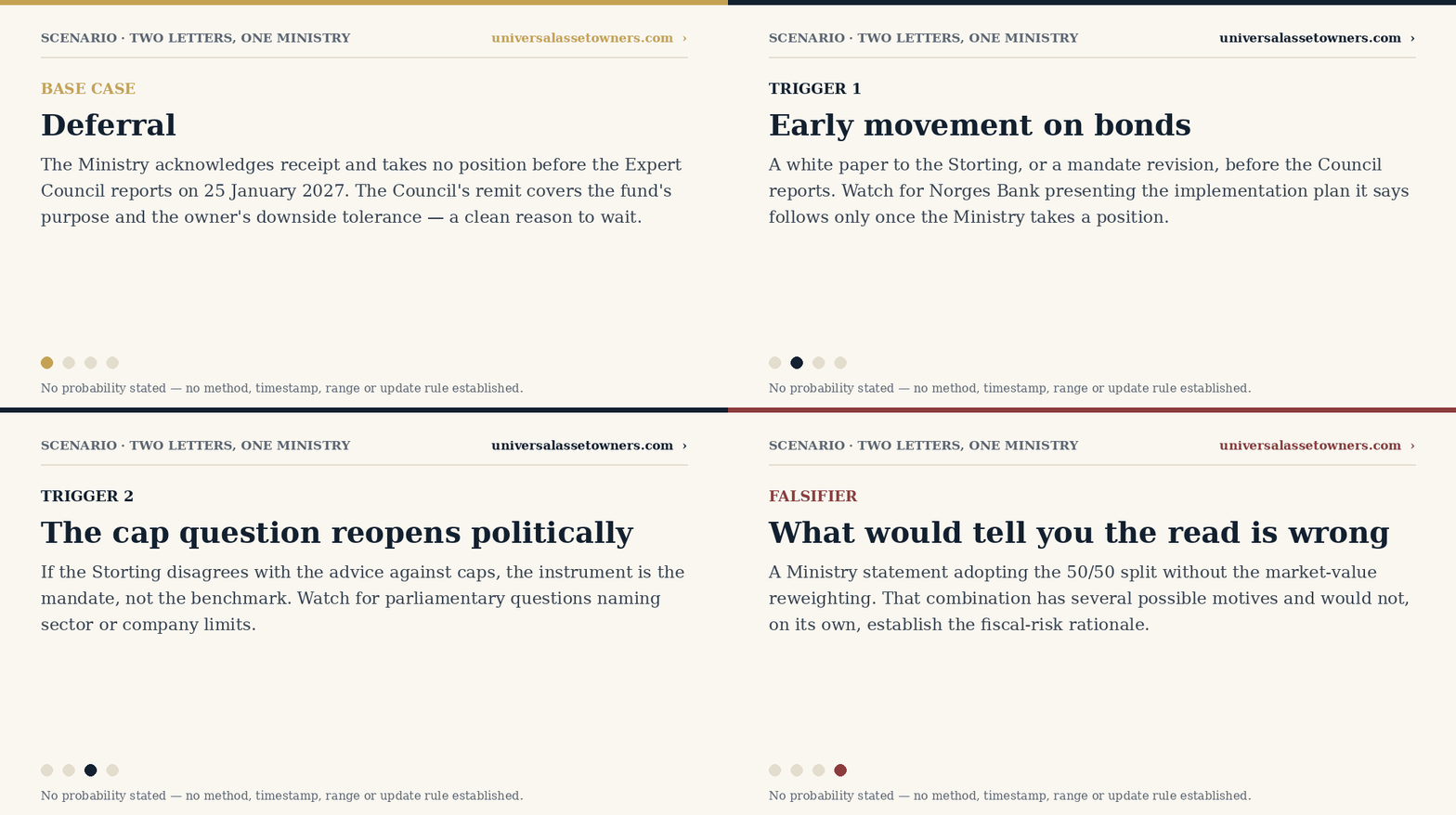
Base case: the Ministry defers any decision on either letter until the expert group appointed in 2025 reports by 25 January 2027. Desk estimate 0.65 (range 0.55–0.75), as of 3 September 12:00 UTC; updated on any Ministry communication referencing either letter.
It escalates if a white paper or mandate revision on bonds arrives before that report; a Storting question names sector or company caps; or Norges Bank publishes the implementation plan it says follows only once the Ministry takes a position.
Open the interactive scenario →
Podcast · The Universal Owner
Norway accepts the concentration it cannot easily hedge · 9 min 34 sec.
Apple Podcasts Spotify Podbean
The Back Page — meet The Allocator
The Allocator is our resident universal owner: a composite chief investment officer who holds a slice of every listed company on earth, cannot sell his way out of a systemic problem, and takes the day’s contradiction personally.
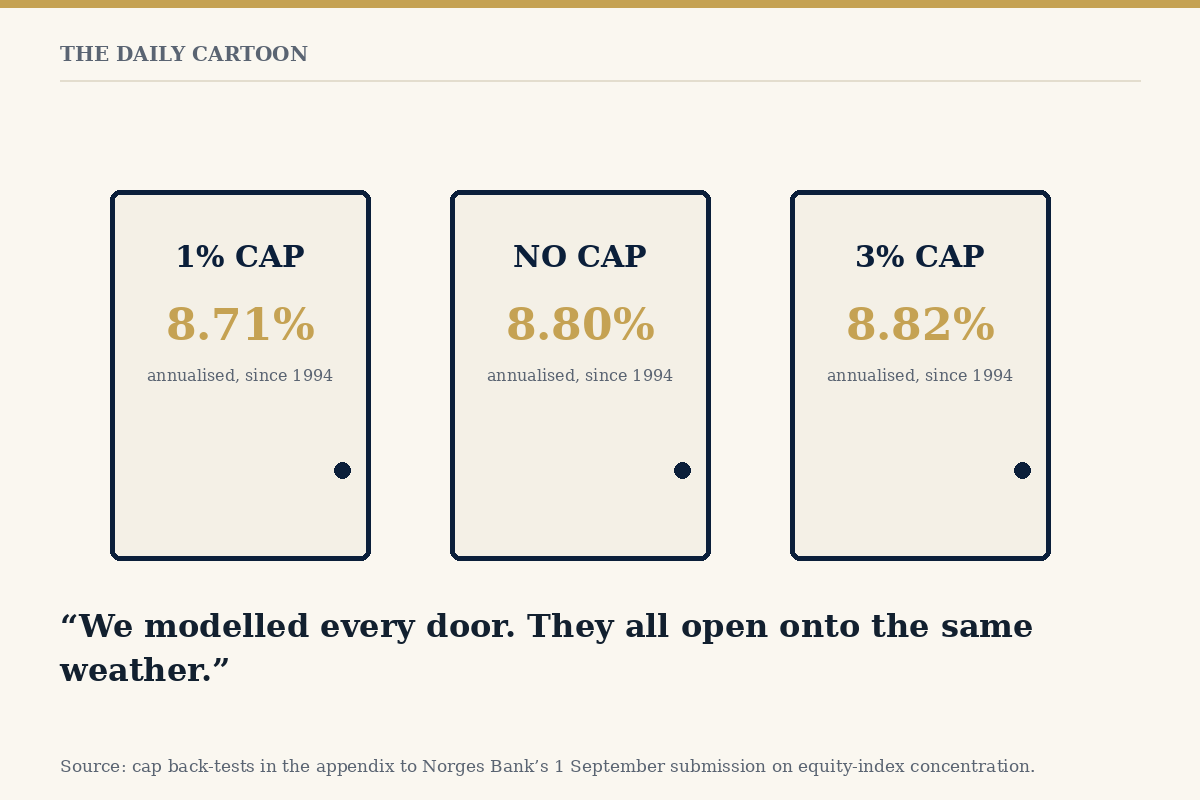
Today’s editorial cartoon, and the Allocator’s monologue — “The cap you pick decides the answer you get.”
The bottom line. A benchmark cap is not a hedge; it is a coin with the committee’s fingerprints on it, and Norway’s own back-tests say the coin barely moves the volatility. Before the next investment-committee meeting, ask three things: what job each bond sleeve is actually doing; whether your private-market allocation diversifies the AI factor or merely hides it behind appraisal lag; and whether you could explain a 30 per cent drawdown to your board before it happens. If nobody on the desk can answer the first one, that’s the work.
Careers, moves and mandates
- BP — Ian Tyler named chair; Amanda Blanc steps down as senior independent director. A governance change at a company held in essentially every universal owner’s index sleeve.
- Norges Bank Investment Management — Carine Smith Ihenacho’s departure as chief governance and compliance officer was announced 1 September; she remains through year-end. Watch whether Legal and Compliance stays bundled with Ownership in the successor’s remit.
SWF, pension & family office jobs Search the Top 100 Registry
Sources checked through 3 September 2026. Material claims are linked to named sources; primary or first-party sources are used where available.