98% of the world’s sovereign wealth funds |
18 of 20 of the world’s largest pension funds |
10 of 10 of the largest charitable foundations |
85% of the world’s largest family offices |
100+ billionaires, every morning |
QIA signed $20 billion of paper. GIC took 9% off to leave.
Qatar’s sovereign fund put a memorandum with J.P. Morgan Asset Management on the record a day after creating a platform for its domestic holdings. A GIC vehicle sold out of a hospital group at a reported 9% below the previous close. In a survey published the same day, 38% of 430 respondents managing $5.76 trillion said they plan to hold more cash, up from 9% a year earlier.
The paper is running ahead of the money. Memoranda, disclosures and survey intentions multiplied overnight. The one sovereign transaction with a reported price was a sale.
$20bn QIA–J.P. Morgan AM memorandum: $15bn equities, $5bn U.S. mid-market senior financing | 9% reported discount to Monday’s close on a GIC vehicle’s full exit from Sunway Healthcare | 38% Marsh respondents planning more cash; 9% in 2025 (comparison directional) | 1.34 Australia’s projected fertility rate by 2065–66; 1.44 starting rate, Treasury IGR |
For each Gulf sovereign you co-invest with, name the entity that signs, the mandate it acts under, and the approval path a transaction follows — and check whether your deal flow runs through the team whose mandate is growing or the one whose management is being contracted out.

Qatar contracts out $15bn of equities a day after creating Doha Investment
QIA and J.P. Morgan Asset Management signed a memorandum of understanding for a $20 billion strategic partnership, announced from Doha and New York on 21 September, with two initial areas: a $15 billion public-equities mandate, with J.P. Morgan managing customised global equity portfolios for QIA, and a $5 billion private-markets initiative providing senior financing to established U.S. middle-market companies, focused on industrials, services, healthcare and technology. Joint release, 21 September
The document is a memorandum. It does not disclose a funding date, a first transaction, a vehicle, fees or the credit protections behind “senior.” QIA’s chief executive, Mohammed Saif Al-Sowaidi, said the fund would “gain access to one of the world’s leading global equity and private credit platforms.” Mary Callahan Erdoes, who runs J.P. Morgan Asset and Wealth Management, called it “a privilege to partner with QIA on this strategic initiative.”
QIA and Goldman Sachs announced a separate memorandum in January with a combined target of $25 billion. Neither figure is a record of deployed capital. Goldman Sachs, 20 January · Reuters
The context is Sunday. On 20 September, at the Qatar Economic Forum in New York, Qatar launched Doha Investment, a wholly owned QIA platform with its own board and mandate to oversee existing domestic holdings: more than 40 companies and, on the commerce minister’s account to Reuters, 45 state-owned enterprises representing roughly a third of QIA’s assets. That is a consolidation of oversight. It does not establish that overseas capital is being brought home. QIA, 20 September · Reuters
Read the sleeves, not the total
Three quarters of the memorandum is listed equity, among the most liquid assets a sovereign fund holds and one it can run in-house. Engaging an outside manager for a customised $15 billion equity book means QIA is buying something beyond market access: capacity, research, or a deeper relationship with a bank it already transacts with. The release does not say which.
The $5 billion is the more consequential instrument. Senior loans to U.S. middle-market companies are a claim on U.S. operating cash flow, ranked by whatever terms the eventual documents set. They would be bought by a fund whose LNG cash engine, on QatarEnergy’s 20 September account, still faced constraints from the Hormuz disruption. And they arrive in a segment where, in the Marsh survey published the same day, the share of respondents planning to increase private debt fell from 48% to 34% (item 02). The comparison is directional, not like-for-like, but a large new entrant is announcing itself in a sleeve where fewer respondents plan to add.
What changes for an investment committee
Institution-specific (sourced). The $20 billion is an MoU. Book it as pipeline, not as a bid.
Archetype-conditional. If you lend to U.S. middle-market companies, or back managers who do, a $5 billion sovereign sleeve could be new competition for the same borrowers, if it funds with incremental capital and if it reaches the same segment. Neither is disclosed.
Counterparty-specific. QIA’s decision rights now run through at least three channels: Doha Investment, the global book, and external mandates. For a co-investor, the diligence question is which entity signs and under what mandate, not which headline is larger.
The countercase. This may be ordinary portfolio management at scale. Sovereign funds have long used external managers for listed equities; QIA calls the deal a growth of an existing partnership. Nothing here shows QIA short of liquidity or reducing U.S. exposure. A memorandum that funds in full would add to U.S. demand.
What would change the read. Definitive agreements and a first funding date. Continued silence would leave deployment unknown; it would not prove failure.
More cash, less appetite for private debt
Marsh’s 2026 Global Asset Owner Barometer, published 21 September, reports the views of 430 respondents managing $5.76 trillion across 25 countries, collected in June and July. The sample includes institutional investors as well as wealth managers, private banks and family offices. Marsh, 21 September
38% plan to increase cash over the next year, against 9% in the 2025 study. 51% plan to add infrastructure, 47% emerging-market equities, 41% inflation-linked assets. 34% plan to add private debt, against 48% a year earlier; 96% hold some private-market exposure. Near-term risks rated significant: geopolitics 75%, inflation 73%, AI or technology disruption 73%. 58% call AI tools a capital-expenditure priority; 13% have enterprise-wide AI policies with defined investment use cases.
Marsh cautions that comparisons with earlier studies are directional rather than like-for-like. “Capital is on the move in pursuit of true diversification, inflation protection, and flexibility,” said Niall O’Sullivan, Marsh’s global chief investment officer for its investments business.
Our analysis. These are stated intentions, not flows, and the share planning an increase says nothing about how many plan to cut. What the survey can support is a committee question: does your cash reserve cover benefit or spending payments, capital calls and collateral calls under one common stress? A mature pension has to reconcile all three; an endowment or family office adds its spending commitments. If existing buffers and commitment pacing already clear that test, the survey alone is no reason to move.
A GIC vehicle takes a discount to exit Sunway Healthcare
Greenwood Capital, a GIC investment vehicle, sold its remaining Sunway Healthcare stake: 575 million shares at RM2.08, about 9.2% below Monday’s close of RM2.29, implying gross consideration of roughly RM1.2 billion, according to sale terms reported by Bloomberg and carried by Malaysian outlets on 22 September. The block was about 5% of the company; Greenwood had held 16% before the March listing. Reported terms; the sale documents are not public. The Edge Malaysia, 22 September · DagangNews
Our analysis. A discount on a large block is the price of executing it in one go; it is not, by itself, evidence of liquidity pressure, and the reporting does not establish the seller’s reason. In the same window, Korea Investment Corporation was reported to be reviewing a sale of more than $1 billion of private-equity fund stakes with PJT Partners advising; KIC and PJT declined to comment as reported. For a portfolio team, the relevant comparison is the executable price of a whole position against the closing price of a small trade. DealStreetAsia, 22 September · Caproasia, 21 September
A Fed alternate puts AI on the demand side
Speaking at an OMFIF event in London on 21 September, Chicago Fed President Austan Goolsbee said he was “especially attuned to elevated inflation in service-sector industries, and to any evidence that AI data center construction is spilling out of its own lane and raising aggregate output beyond what the economy can absorb.” His wider argument was that persistent supply shocks cannot simply be looked through either. The distinction that matters for rates: “the central bank may not react as aggressively to a supply-driven imbalance as it does to a demand-driven one.” Federal Reserve Bank of Chicago, prepared remarks, 21 September
Goolsbee is a 2026 FOMC alternate: he attends and participates but does not vote this year. The Committee raised the target range by a quarter point to 3¾–4% on 16 September, 12–0. FOMC roster · Statement, 16 September
What it does to a liability book. If the Committee came to treat AI construction as demand, the case for a higher path would strengthen; productivity gains or other inputs could offset it. A policy move also need not shift the longer-dated curve used to value pension promises.
For a defined-benefit scheme discounting on market rates, a higher relevant discount rate lowers the present value of otherwise unchanged promised payments. Funding also depends on what assets do.
The liquidity question is separate. Receive-fixed swaps and repo-financed bond holdings post mark-to-market losses and face margin calls when yields rise. An economically hedged scheme can still need cash. So a committee can see its funding ratio rise and its collateral buffer fall in the same month. Bank of England, Financial Stability Report, December 2022, section 5
The curve. The 10-year minus 2-year Treasury spread was +0.20 percentage points on 21 September (St. Louis Fed, from Treasury yields). ICE BofA U.S. high-yield OAS was 2.68% on 18 September (FRED). Cboe VIX was 14.81 on 18 September (FRED).
Run one stress: policy rates held above 3¾% through 2027 as an assumption, not a forecast. Show the funded-position change and the cash the hedge book would need, side by side.
The curve after September’s hike

The voting file goes to court
ISS announced on 18 September that it is contesting an SEC subpoena for client voting data in the U.S. District Court for the Eastern District of Pennsylvania; Responsible Investor’s 21 September account added detail. As reported, ISS argues that clients who voted against the administration’s preferences reasonably fear reprisal, and says it offered on-site inspection or anonymised production. The SEC’s position, in its 4 September application to compel, is that it needs the records to examine adherence to client instructions and fiduciary obligations. Neither side’s characterisation is a finding; the court has not ruled. ISS, 18 September · SEC litigation release LR-26632
Separately, the SEC’s proposal to rescind Rule 14a-8 and amend Rule 14a-4(c), issued 16 September (Release 34-106383, File S7-2026-32), remains a proposal; the rule page lists comments due 20 November. SEC, 16 September · Rule page
Our analysis. Proxy advice and vote execution are infrastructure for almost every public-market owner. Whatever the court decides, test your own workflow now: could you evidence an independent voting policy if your agent’s records were compelled, and do you have a fallback if the proposal channel narrows?
Nature enters the supervisor’s brief
The Network for Greening the Financial System published its 2026 Guide for Supervisors on 21 September, developing its 2020 guidance to cover nature-related risk, transition planning and the prudential treatment of residual climate risk. It is guidance to supervisors, not a capital charge. NGFS, 21 September
The same day, TNFD’s 2026 Status Report counted more than 1,000 organisations in 56 countries and areas publishing some level of TNFD-aligned disclosure, twice last year’s count, and 802 adopters including financial institutions with $26.6 trillion under management (their total assets, not money invested in nature). In TNFD’s survey, 56% of investor respondents said they were exploring or deploying capital in nature-related opportunities; that combined category cannot show how much has been deployed. TNFD, 21 September
Our analysis. Disclosure is growing faster than anyone can yet measure the capital behind it. The first cost for a universal owner is data and assurance: deciding which of TNFD’s disclosures will be used in underwriting and manager scorecards, and asking managers which identified exposures changed a decision.
The UK regulator maps the barriers to private markets
The Pensions Regulator’s report, “Market oversight: UK pension funds – private market investment,” published 21 September and drawn from more than 40 stakeholders, found private-sector DB and DC schemes willing to invest in UK private markets where it serves members, but facing several barriers: limited suitable opportunities, costs and fee transparency, governance and capability, and regulatory uncertainty. TPR, PN26-17, 21 September · Report
Our analysis. A growing DC scheme and a mature DB scheme heading for an insurer transaction can rationally reach different answers on the same illiquid asset. A stronger pipeline helps; it does not remove the need for the right vehicle, acceptable fees and a fit with members’ interests. Identify the binding constraint in your own case before changing a mandate.
Europe renews its Russia listings for 36 months, minus two names
EU ambassadors agreed on the afternoon of 22 September to extend the bloc’s targeted sanctions on more than 2,600 Russia-linked individuals and entities for 36 months, hours before a seven-day extension ran out, according to Euronews. As reported, the compromise removes Alisher Usmanov from the list at France’s request and Mikhail Fridman after Slovakia refused to renew his listing; Latvia, which had blocked the deal on Monday, moved to a constructive abstention so that unanimity could be reached. Renewals had previously run six months at a time. A diplomat quoted by Euronews: “No one is happy about this. But the consensus in the room was that it’s better to maintain the rest of the listings under the regime and make sure we don’t have to do this circus again any time soon.” These are the individual listings; the EU’s sectoral sanctions are a separate regime. The Council’s formal adoption and legal text were not yet published at the time of writing. Euronews, 22 September, 16:47 CET · Euronews, morning report · Council of the EU
Why it matters to an owner. Custody screening, frozen-asset handling and side letters assume the designations roll; a 36-month term removes the six-monthly cliff that produced this week’s standoff. Two delistings change the status of specific frozen assets: what that means in law is for compliance and counsel, not this page.
The stage is the story
| Institution | Counterparty | Amount | What | Stage | Date |
|---|---|---|---|---|---|
| QIA | J.P. Morgan AM | $15bn | Customised global equity mandate | Memorandum | 21 Sep |
| QIA | J.P. Morgan AM | $5bn | U.S. middle-market senior financing | Memorandum | 21 Sep |
| GIC (Greenwood Capital) | Sunway Healthcare | ~RM1.2bn gross | Full exit, block ~9% below prior close | Reported sale | 22 Sep |
| Korea Investment Corporation | PJT Partners (adviser) | >$1bn | PE fund stakes | Reported review | 21 Sep |
| Korea NPS | SEBI G-sec-only route | Not disclosed | First dedicated India government-bond vehicle | Reported licence process | 22 Sep |
| Virginia Retirement System | 14 mandates incl. GTCR XV ($300m) | ~$2.22bn | PE ~44% · real assets ~26% · credit ~20% · other ~10% | Commitments (18 Jun–17 Sep) | disclosed 21 Sep |
Australia plans for fewer births than deaths
Australia’s 2026 Intergenerational Report, released by the Treasury on 21 September, projects the total fertility rate at 1.34 by 2065–66, from a starting rate of 1.44 in 2025–26, after a rise toward 1.5 in the 2030s. Replacement is 2.1. For the first time in the series, it projects deaths outnumbering births by the 2060s. The central case assumes 235,000 net migrants a year. Australian Treasury, 2026 IGR · Full report · AAP
In a lower-population scenario, with fertility at 1.24 and migration cut by 50,000 a year from 2036–37, the population in 2065–66 is 2.8 million below baseline, including 1.9 million fewer people of working age, and real GDP is 7.4% lower; living standards per person are broadly similar. These are modelled differences from a baseline, not forecasts of decline.
The counterweight, from the same report. In the central projection, Age and Service Pension spending falls from 2.3% to 1.8% of GDP as the superannuation system matures. Ageing does not mechanically raise every pension-spending ratio.
Why a universal owner cares. A national fertility projection does not change a pension already promised. It changes the future membership, the contribution base and the tax base that stand behind long-dated promises. At the next long-term strategy review, test whether the projected membership profile changes net cash flow and the capacity to hold illiquid assets. National data are an input to that exercise, not a substitute for the fund’s own membership and benefit data.
The countercase. Participation, productivity, migration policy and benefit design all move faster than a birth rate. The investment consequence runs through those choices.
The UAO Signal Ledger
Signal D · EARLY OBSERVABLE (new) · A sovereign’s decision rights split across a domestic platform, a global book and external mandates
| Field | |
|---|---|
| Verified | QIA–J.P. Morgan AM MoU (21 Sep); Doha Investment created (20 Sep) |
| Unknown | Whether and when the $15bn funds; whose balance sheet holds the $5bn; whether other Gulf funds follow |
| Evidence strength | Strong on announcements; weak on deployment |
| Conviction | Low. One fund, one observation |
| Confirms / weakens | Definitive documents and a funding date; a second Gulf fund announcing a comparable external mandate (confirms). No documents by Q1 2027 leaves deployment unknown |
| Next catalyst | Disclosure of definitive agreements |
Signal E · EARLY OBSERVABLE (new) · Do stated cash intentions become allocations?
| Field | |
|---|---|
| Verified | Marsh Barometer (21 Sep): 38% plan more cash vs 9%; private-debt increase-intent 34% vs 48%; directional comparison |
| Unknown | Whether any respondent has moved; the share planning to reduce private debt is not reported |
| Conviction | Low |
| Confirms / disproves | Q4 board papers showing slower private-debt pacing and higher cash targets (confirms); no change in disclosed allocations (disproves) |
| Next catalyst | Q4 board cycles |
Carried forward: bpfBOUW/BlackRock fiduciary · NZAOA private-markets specification · U.S. large-load cost allocation (H.R. 9340) · Rule 14a-8 rescission (update: proposal confirmed on the SEC’s release; comments due 20 November) · Paramount–Warner Gulf equity · Acciona Energía consortium. Statuses stand as last published.
Careers, moves and mandates
Northwestern Medicine has named Harisha Koneru Haigh chief investment officer. She moves from managing director at the Northwestern University Investment Office. Effective date not published. Alternatives Watch, 21 September
The Job Board · Open Seats
| Institution | Role | Location | Note |
|---|---|---|---|
| Employees’ Retirement System of the State of Hawaii | Chief Investment Officer | Honolulu | Priority consideration in October (Kumabe HR) |
| Future Fund | Chief Executive Officer | Melbourne | Incumbent departs at year-end; succession process under way |
| PensionDanmark | Chief Investment Officer | Copenhagen | Recruitment announced for a successor from February 2027 |
| OPTrust | Managing Director and Director, Value Creation (Private Markets) | Toronto | Per the posting, applications close 23 September |
| All open seats → |
Next triggers
| When | Event | Why it matters |
|---|---|---|
| 22 Sep | EU targeted Russia listings renewed for 36 months per Euronews; formal Council adoption and legal text to follow | Custody and screening continuity; two delistings |
| 23 Sep | OPTrust value-creation postings close (per posting) | Job board |
| 24 Sep | BoJ’s 1.25% guideline takes effect; SNB and Norges Bank decisions | Currency and duration assumptions |
| 26 Sep | UN Panel of Experts on Iran sanctions mandate lapses after the 17 Sep veto (UK statement) | Monitoring changes; obligations continue |
| 27 Sep | EU EmpCo anti-greenwashing rules apply | Consumer-facing claims by portfolio companies |
| 30 Sep, 08:30 EDT | BEA: Q2 GDP third estimate; August personal income and outlays | Rate path. No funding cliff: appropriations run to 11 December |
| 20 Nov | SEC comment deadline on the 14a-8 rescission proposal | Stewardship channel |
Seniority over scale
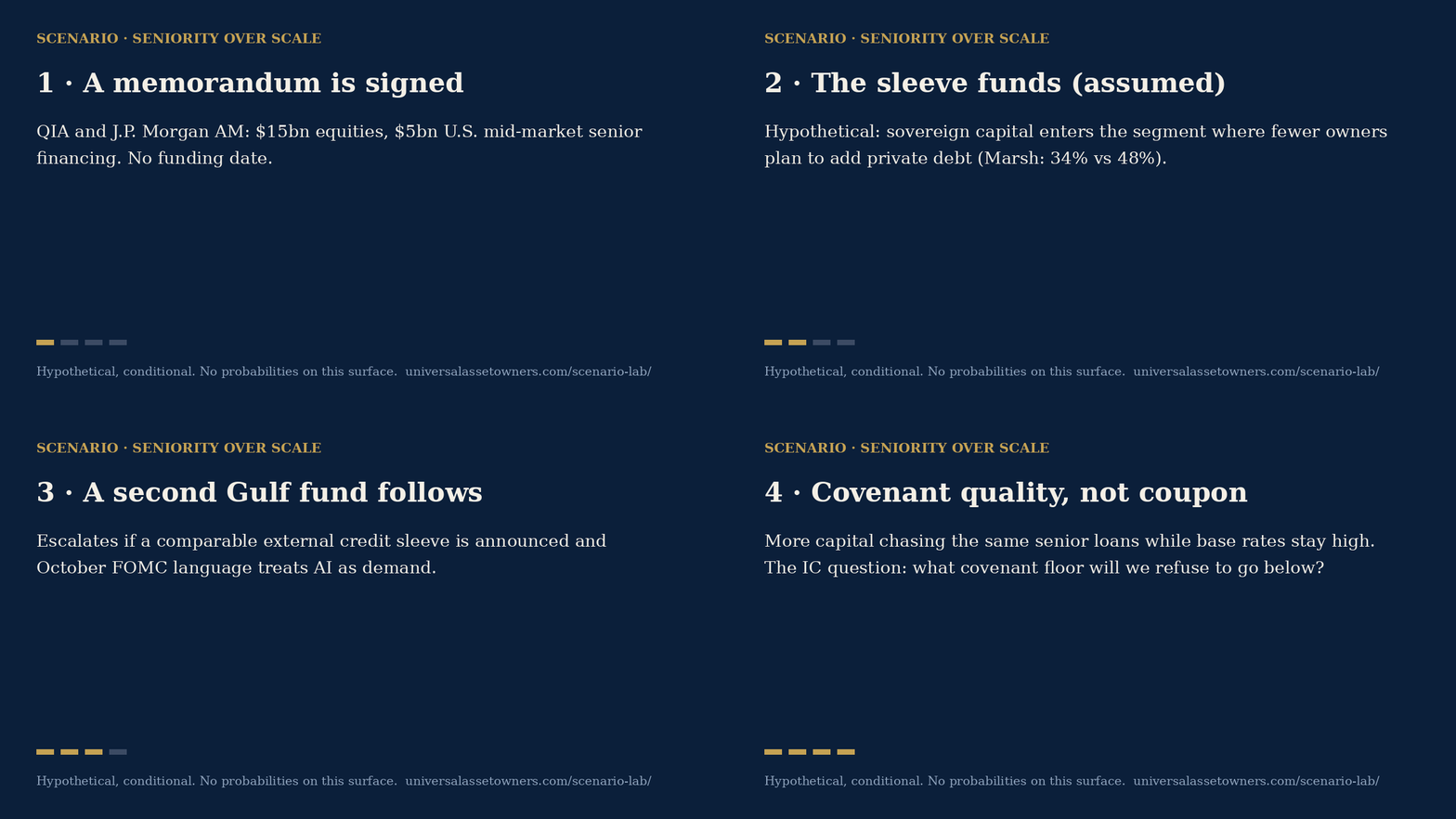
Hypothetical, conditional. The assumptions are stated: the $5bn sleeve funds within 12 months as a managed account and lends floating-rate senior paper to the same sponsor-backed borrowers other owners lend to. Base case: modest spread compression at the margin in U.S. middle-market senior lending. It escalates if a second Gulf fund announces a comparable external credit sleeve and October FOMC language treats AI construction as demand; then covenant quality, not coupon, is the risk to monitor. It fades if no definitive documents appear by Q1 2027.
If more sovereign money competes for the same senior loans, what covenant floor will we refuse to go below?
| Open in the Scenario Lab → | Explore the live Risk Map → |
In one line
Podcast · The Universal Owner
| Apple Podcasts | Spotify | Podbean |
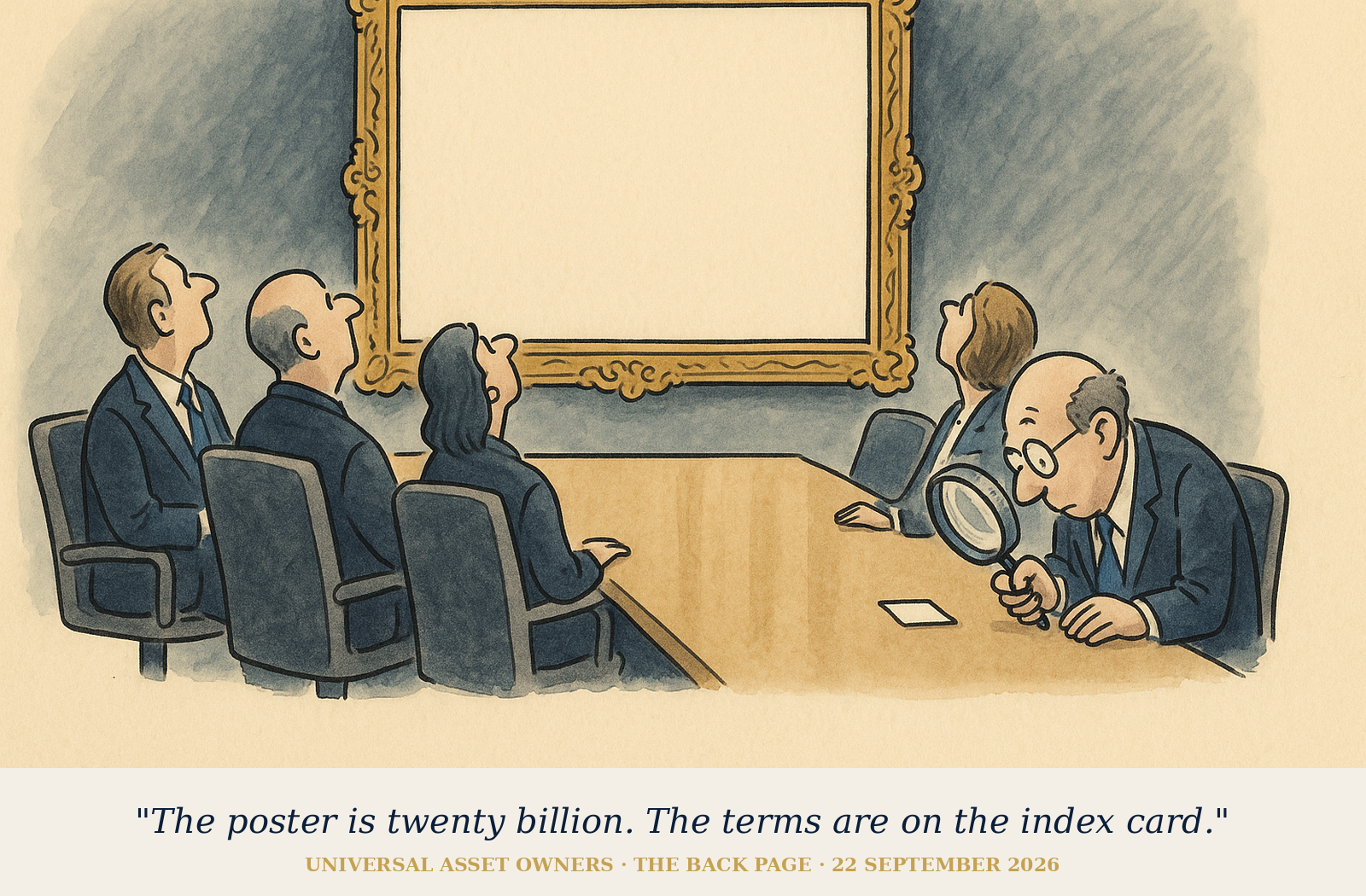
The Back Page — meet The Allocator