
UAO Daily Brief — Thursday, July 23, 2026
Vol 1, Issue 68 · The Universal Owner
Recency floor: July 22, 2026. Every dated item is verified to a named primary source.
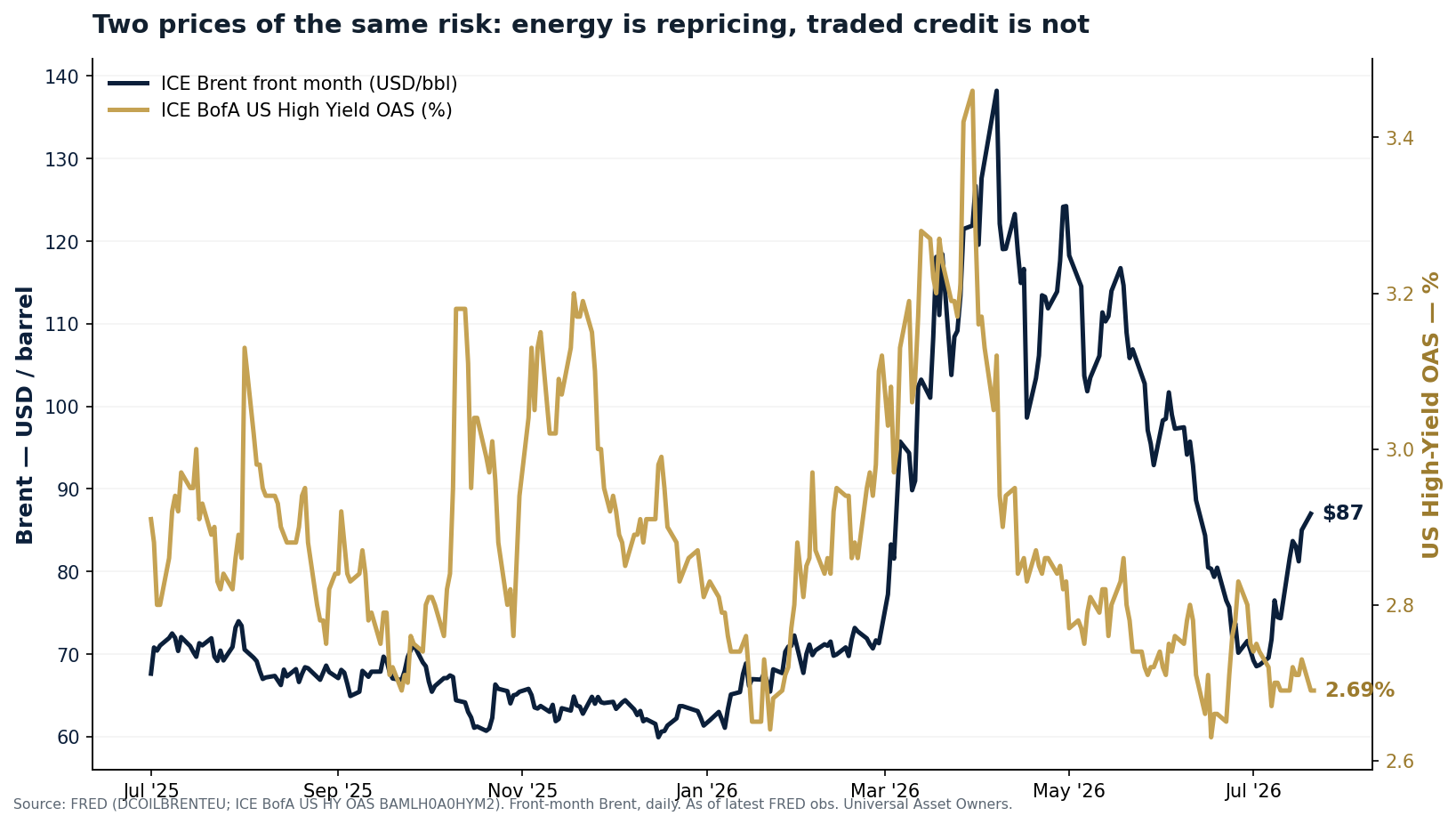
Lead — The Load That Disappeared
Artificial intelligence's electricity problem has always been framed as a shortage. On Wednesday the largest US power grid met the opposite problem. After a transmission line went out of service in northern Virginia — home to the world's biggest data-centre cluster — data centres' own protection systems disconnected them from the grid and switched them to backup power, and PJM watched more than 3 gigawatts of demand vanish in an instant — about 3% of the grid's entire load. The imbalance moved system frequency and produced a voltage disturbance reportedly felt from Washington to Chicago; northern-Virginia customers reported flickering lights and noises from air conditioners and refrigerators. It took roughly ten minutes to fully stabilise — an eternity on a grid that usually corrects disturbances in milliseconds. PJM says reliability was never impaired and Dominion restored normal conditions within minutes (Reuters).
The same week, the financial system committed record capital to that very infrastructure. Alphabet raised its 2026 capital-expenditure guide to $195–205 billion (from $180–190 billion in April) after Google Cloud revenue jumped 82% to $24.8 billion — and reported negative free cash flow of −$5.9 billion, which the company identifies as a first in its public history, as quarterly capex more than doubled to $44.9 billion (Reuters). Tesla told the same story from the other side: capex up 142% to $5.79 billion, free cash flow −$1.09 billion. And this is not only a market story: the day before, FERC directed NERC to file binding reliability standards for large "computational loads" — AI data centres among them — by December 31, 2026, after documenting disturbances in which such loads shed 17%–95% of their draw within milliseconds of a fault. The regulator is already moving to treat large loads more like power plants.
Why it matters to a universal owner. AI infrastructure has become a shared utility and balance-sheet system, and this week exposed fragility on both sides at once. Physically, data centres are not merely the grid's fastest-growing load — they are tightly controlled industrial loads that can disconnect in clusters, so the same protection that saves the servers can push the disturbance back onto the grid. Financially, the market is funding that same infrastructure on front-loaded capex with deferred — now negative — cash flow, into a rising cost of capital: Brent back near $94 on Middle-East tension, and euro-area banks tightening credit again. A fund that owns the index, the grid, the data centre and the lender is exposed to every leg.
The counter-case, carried inside the lead. Both fragilities were, this week, contained. PJM held reliability; Dominion restored the system in minutes. And the market price of risk is still calm: US high-yield spreads sit at 2.69%, the VIX at 17.05, the St. Louis Fed Financial Stress Index at −0.70 (below average), the yield curve positive. The new data-centre question is no longer only "can the grid serve it?" It is "can the grid safely lose it?" — and, on the balance-sheet side, whether AI returns stay superior once financing and depreciation are fully recognised.
The cost of capital is rising on two fronts
Front-month Brent jumped about 4% to roughly $94 on renewed Middle-East tension (we carry the confirmed price move; with no named primary for any specific strike, we do not print a strike count). At the same time the ECB's July Bank Lending Survey (159 banks; fieldwork 15–30 June, published 21 July) showed euro-area banks tightening credit standards again — a net +7% for firms, +9% for mortgages, +12% for consumer credit — most sharply in car manufacturing and energy-intensive sectors, with further tightening expected in the third quarter (ECB). The traded market (HY OAS 2.69%) and the bank survey (net +7% tightening) are two prices of the same credit risk — and this week they diverged.
Allocator read. The bank channel is tightening before defaults or spreads show it. Revolver use, inventory days and rejected loan applications lead the cycle; a private-credit book priced off "spreads are fine" should stress-test the bank-channel squeeze the traded market has not yet ratified.
Patient capital into the physical layer
If Wednesday's grid event asked who bears the physical risk, this week's deal tape answered who is financing the build. And the logic is direct: when the public hyperscalers run cash-negative, private infrastructure and private credit absorb the remaining funding gap — which is precisely what these cheques did.
- Aligned Data Centers — ~$40bn close. The AI Infrastructure Partnership, MGX and BlackRock's Global Infrastructure Partners closed the acquisition of 100% of Aligned from Macquarie-led funds at an enterprise value of ~$40 billion — one of the largest private digital-infrastructure investments on record — plus a further $5 billion for expansion. Aligned runs 51 campuses and >6.4 GW across the Americas, including São Paulo, Querétaro and Santiago (Business Wire).
- Caruna — the grid leg. Iberdrola agreed to buy 80% of Caruna, Finland's largest electricity distributor, from KKR and Ontario Teachers' for ~€2.0 billion (100% ~€5 billion incl. net debt); Finnish pensions AMF (12.5%) and Elo (7.5%) stay; ~89,000 km network, 1.5m customers; close end-2026/Q1-2027 (Iberdrola/MarketScreener).
- LXP — the logistics leg. Brookfield and CPP Investments are taking LXP Industrial Trust private for $5.2 billion all-cash, $61.20/share (12.3% premium to the 30-day average) — ~53m sq ft across 108 properties, a 40-day go-shop through 28 August, Q4 close (GlobeNewswire).
- CPP as issuer. CPP Investments is internationalising its C$100 billion bond programme (central banks + insurers): ~C$98bn outstanding, ~C$20bn targeted issuance, 1,200+ investors, ~11–12% of assets (net assets C$793.3bn) (Reuters).
A universal owner is long the capex (hyperscaler equity), the energy that powers it (Brent, utilities, grids — Caruna), and the credit that funds the gap (bank + private credit + CPP-type issuance). This cycle wires three "diversified" sleeves into one correlated AI-financing bet — and the PJM event adds a fourth wire: physical correlation among the loads themselves. Practical tilt: an embedded-gas climate/infra mandate is more of the oil leg, not a hedge; a private-credit sleeve financing a data-centre build is the same trade as the equity. Underwrite data-centre assets for ride-through and backup behaviour, not only power availability.
Private markets widen the entrance, keep a narrow exit
Wellington, Vanguard and Blackstone launched two funds giving wealthy and mass-affluent Merrill / Bank of America Private Bank clients access to public and private assets: the WVB All Markets Fund (public + private, up to 10% quarterly repurchase) and the WVB Blackstone All Privates Fund (up to 3% quarterly). They arrive as some traditional investors are trying to withdraw more from private-credit and private-equity funds than managers are prepared to buy back (Reuters).
Allocator read. Democratization redistributes the liquidity mismatch, it does not remove it. A 3% quarterly buyback is not daily liquidity. Report requested vs. offered vs. fulfilled liquidity separately.
Two more that matter
- Africa's $4 trillion pool is waiting for a rating. African development institutions are putting debt guarantees at the centre of an effort to mobilise domestic pension, insurance and sovereign savings. The Africa Finance Corporation estimates up to $4 trillion of domestic savings could fund infrastructure if projects reached investment grade; the annual gap is about $100 billion; MIGA's guarantee issuance has more than doubled in five years to $9.5 billion (Reuters). The constraint is rating and currency, not the absence of capital — but guarantees transfer risk to another balance sheet (track them as contingent liabilities).
- The oil shock reaches the central-bank balance sheet. The Reserve Bank of India sold a net $6.1 billion spot in May and lifted its outstanding net forward-dollar sales to a record $106.6 billion as the rupee hit a record low near 96.96/$; reserves still cover ~10 months of imports (Reuters). Reserve adequacy has to be read net of forwards — board materials should report gross and net side by side.
Gulf capital: a US–Saudi nuclear opening
On 22 July the US and Saudi Arabia signed a 30-year civilian-nuclear "123 agreement" (Energy Secretary Chris Wright with Prince Abdulaziz bin Salman), plus a bilateral safeguards agreement, that could pave the way for a US-built uranium-enrichment facility in the kingdom after a joint two-year study — notably below the UAE "gold standard" that forfeited enrichment, and without the IAEA Additional Protocol. It must go to Congress for a 90-day review (Washington Post, CNN). For universal owners: a new leg of Gulf civil-nuclear and energy-infrastructure capital formation (PIF and energy diversification) arriving with a real proliferation and geopolitical-risk premium attached.
Capital Flows
- Taiwan's Bureau of Labor Funds awarded a $3 billion climate-transition passive-infrastructure mandate — five managers at $600 million each (Amundi, BNP Paribas AM, Geode, Northern Trust AM Australia, State Street Singapore), benchmarked to the FTSE Global Core Infrastructure ex-China TPI Climate Transition Index; selection completed 16 July (ESG Today).
- MN8 Energy agreed to acquire Greenbacker for up to ~$375 million, forming a >6 GW clean-power platform across 33 states positioned for AI/hyperscale offtake (Business Wire).
- Brazil announced R$18.5 billion (~$3.66 billion) of credit for firms hit by US tariffs and conflict (Treasury R$13.5bn + BNDES R$5bn), pending Congress (Reuters). Portugal ordered €766.9 million of Novo Banco proceeds toward public-debt reduction (Reuters).
The Universal Owner Risk Radar
- Correlated data-centre disconnection (new, elevated): Wednesday's PJM event is the confirmation instance — watch for a second multi-GW load-loss or the FERC/NERC large-load standard due by year-end (Reuters).
- Sovereign-reserve liquidation (Russia): the central bank sold ~43.5–44 tonnes of gold in H1 — its largest in at least 25 years — raising ~$5.6 billion to help cover a ~6-trillion-rouble deficit; reserves now ~2,282 tonnes, sold mostly to domestic banks as sanctions block foreign sales (Kitco).
- Fiscal-rule governance (Czech): President Pavel vetoed a bill exempting road, rail, nuclear, dam and defence spending from deficit rules (Reuters).
- Cyber: CISA added Check Point SmartConsole (CVE-2026-16232) and Microsoft SharePoint deserialization (CVE-2026-50522) to its exploited-in-the-wild catalogue (CISA KEV).
- Sized down (not a tail risk): NOAA reports a Kp-4 geomagnetic level — below the G1 minor-storm threshold; M5-class quakes in Chile and the Kermadecs with no damage; GDACS alerts all green (NOAA SWPC).
Watch — the next 72 hours
- PJM / FERC: FERC is expected to take up PJM's supply-demand imbalance and the White House to broaden a non-binding "Ratepayer Protection Pledge" (~80% of US delivered power) — both after our cutoff; forward-watch only.
- Capex vs. cost of capital: whether Brent near $94 and the ECB squeeze pull high-yield spreads (2.69%) and the VIX (17) off their lows.
- Insurance / advisories: Gulf shipping and war-risk advisories for the physical read on the oil move.
Research. World Bank Chief Economist Indermit Gill (22 Jul) warned that prolonged US–Iran hostilities could cut 2026 global growth to as low as 1.3% (from ~2.9%) and lift inflation toward 4.5% — a "slow-moving train wreck." Gill's tail-risk scenario would materially raise the cost of capital you are underwriting this AI build-out into. Separately, the IMF finds AI may add just 0.2% to sub-Saharan GDP over a decade at current readiness, versus nearly 4% with stronger foundations.
Deep Dive — When demand can vanish, and who pays for the build-out
The AI capital cycle has entered its cash-consumption phase — and, this week, revealed a second, quieter phase: physical correlation. The same week Alphabet's free cash flow turned negative on a $195–205 billion build, three gigawatts of data-centre demand left the PJM grid in a heartbeat. For a thirty-year owner, both are the same question seen from two sides: is the system — financial and physical — being built to absorb not just the growth of AI load, but its sudden reversal?
The build is real, and it is now consuming cash. Alphabet — for two decades among the market's most reliable cash generators — reported negative free cash flow of −$5.9 billion (a first, per the company) and raised 2026 capex to $195–205 billion, even as Cloud grew 82%. Tesla lifted capex 142% and ran free cash flow −$1.09 billion. The debate has shifted from can they afford it? to do the returns survive full recognition of financing and depreciation? Cloud growth answers "yes" for now; the margin for error narrows as the capital base compounds.
Who intermediates the funding gap. Front-loaded capex with deferred returns needs a financier, and this week named several: private infrastructure and sovereign capital (GIP and MGX) closed $40 billion for Aligned's 6.4 GW; Iberdrola bought a Finnish grid from KKR and Ontario Teachers'; Brookfield and CPP took a US logistics REIT private for $5.2 billion; and CPP widened its foreign lender base for a C$100 billion bond programme. The equity, the infrastructure, the real estate and the credit legs of the AI trade are all being repriced and refinanced at once, by the same small set of very large balance sheets.
The physical system is the binding constraint — in both directions. The usual worry is supply: can the grid serve the load? Wednesday reframed it. When a northern-Virginia line tripped, data centres' protection systems disconnected and switched to backup — removing 3% of PJM's demand at once, moving frequency and voltage across a multi-state footprint for ten minutes. Individually prudent behaviour, when thousands of facilities share similar thresholds, becomes systemically correlated behaviour. Regulators are already moving: FERC has directed NERC to file binding large-load reliability standards by December 31. The same discipline applies to the physical delivery of every announced build — South Korea's ~₩800-trillion ($540bn) Honam chip hub would need 6.3 GW (four to five new reactors), power for its four fabs alone equal to 70–80% of the southwest's current use, and ~646,000 tonnes of water a day. Capital can authorise a project it cannot physically deliver.
- Quantify overlapping AI-financing exposure across equity, infrastructure, private credit and vol — the same trade in four costumes.
- Specify ride-through / backup-behaviour standards in data-centre mandates, not just contracted megawatts — ahead of the FERC/NERC rule.
- Track Brent and the ECB lending survey jointly, not separately — the physical and bank-channel cost of capital are one signal.
- Report reserves gross and net of forwards side by side (the RBI's $106.6bn forward book shows why the headline understates the commitment).
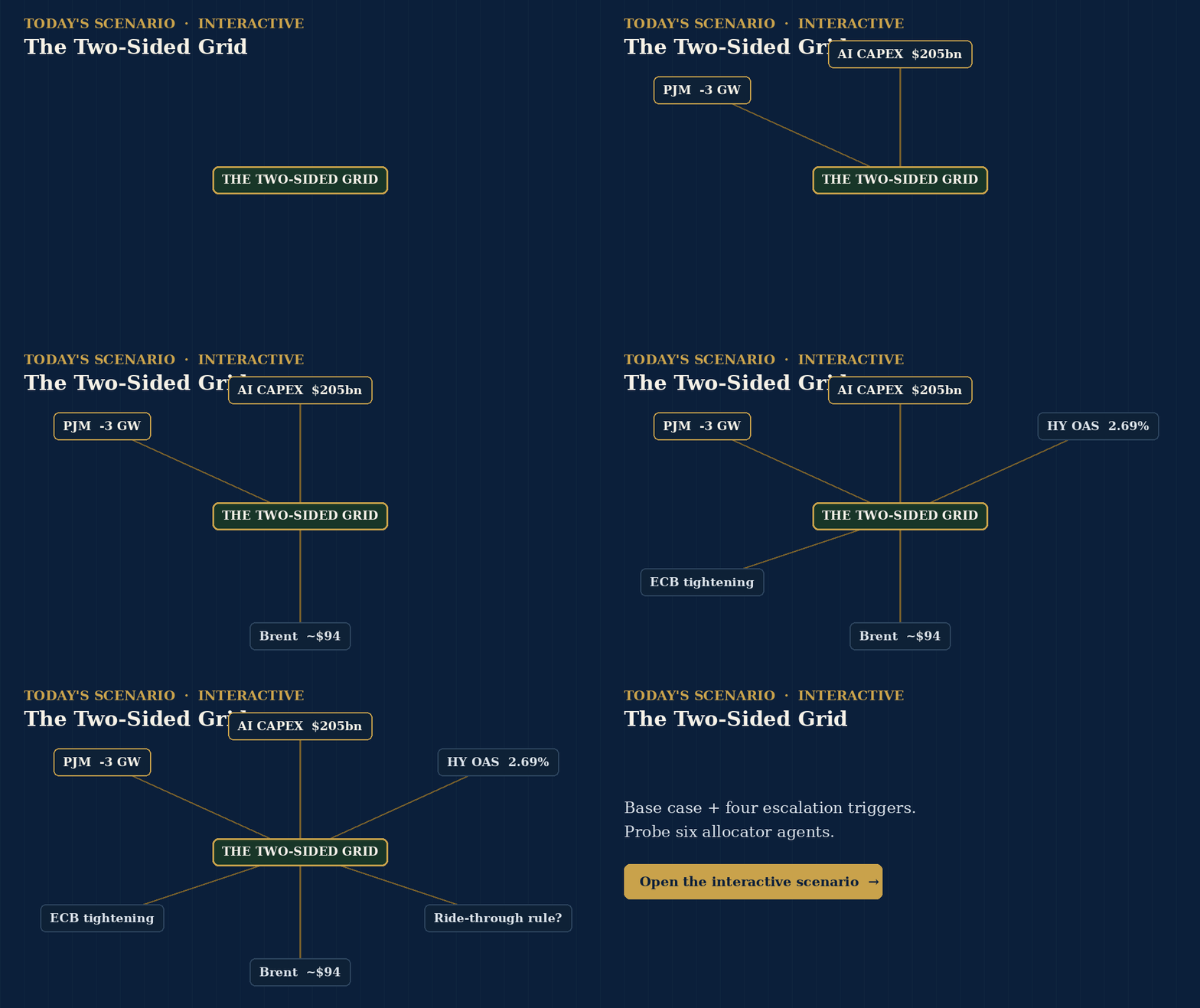
Open the interactive scenario — The Two-Sided Grid →
Base case: traded credit and equity vol stay near current lows through the capex-guide digestion; the PJM event is a one-off; Brent is the main swing factor. Escalation triggers (not probabilities): a second multi-gigawatt correlated disconnection or a FERC/NERC ride-through mandate → utility + data-centre re-rating; Brent above $100 for more than two weeks → margin pass-through + reserve rotation; HY OAS gaps more than +75bp toward the ECB bank signal → private-credit mark stress; a hyperscaler cuts its capex guide → power + semiconductor de-rating. Any probability shown carries method, timestamp, range and update rule — none is asserted here.
Today's episode (~3.5 min): why the grid must now be underwritten to lose AI, not just serve it.
The Back Page — with The Allocator
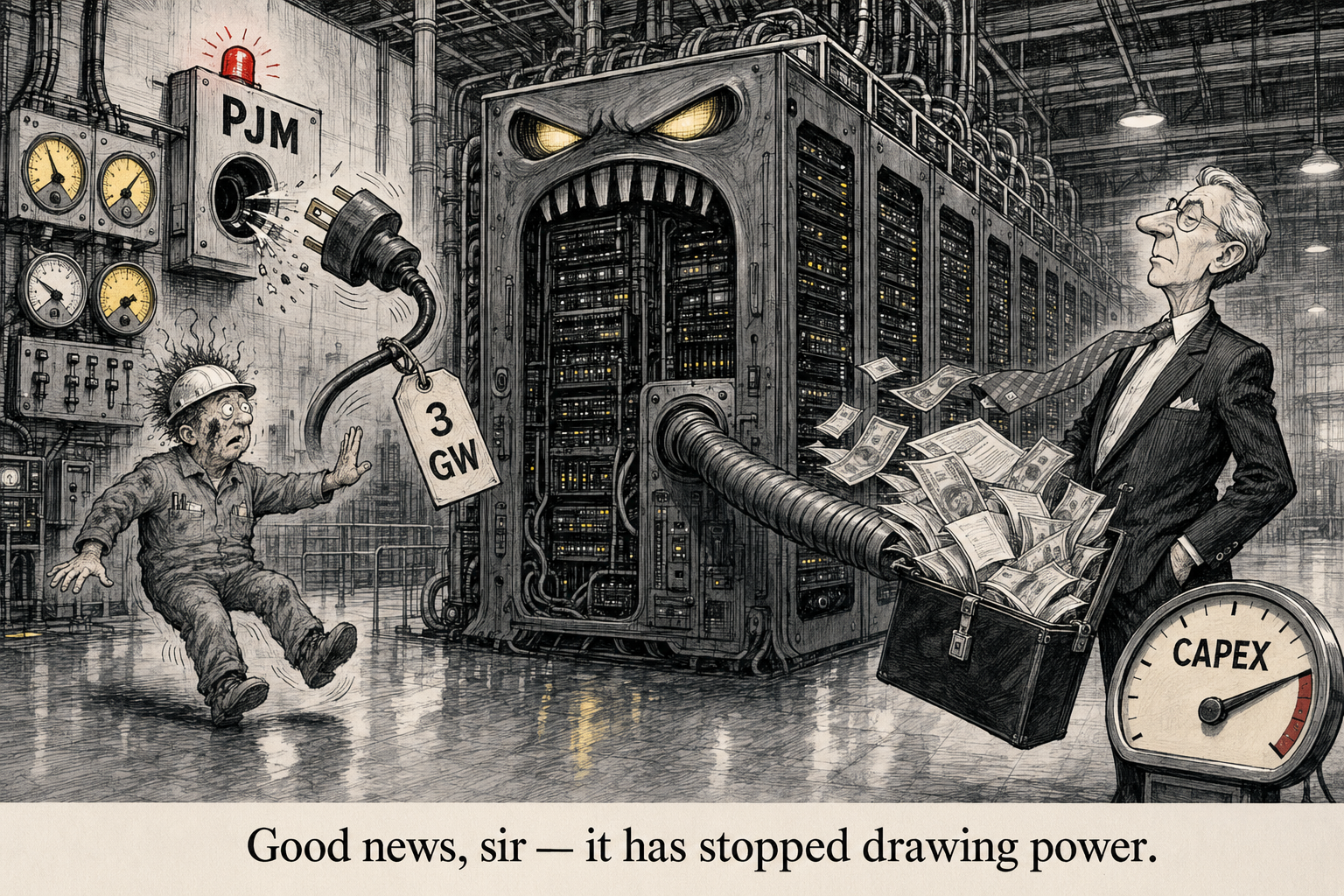
A lighter look at the week from the desk of a man who owns a slice of everything — and this week owned the switch on both sides of it.
Source ledger (primary / named, dated)
- PJM 3 GW disconnect, ~10 min, no reliability impact — Reuters, 22 Jul 2026.
- Alphabet capex $195–205bn / FCF −$5.9bn / Cloud +82% $24.8bn — Reuters + company IR, 22 Jul. Tesla capex +142% $5.79bn / FCF −$1.09bn — company IR.
- FERC directs NERC on large computational-load standards by 31 Dec 2026 — FERC order / NERC Large Loads Action Plan, 2026.
- Brent ~$94.13 — Trading Economics. ECB Bank Lending Survey July 2026 (+7/+9/+12%) — ECB. HY OAS 2.69% / VIX 17.05 — FRED.
- Aligned ~$40bn — Business Wire / GIP. Caruna 80% — Iberdrola / MarketScreener. LXP $5.2bn — GlobeNewswire. CPP bonds — Reuters / CPP.
- WVB funds — Reuters / Vanguard. Africa guarantees — Reuters. RBI forwards — Reuters. Taiwan BLF — ESG Today / BLF. MN8/Greenbacker — Business Wire. Brazil / Portugal / Czech — Reuters.
- US–Saudi 123 nuclear agreement — Washington Post / CNN / Al Jazeera, 22 Jul. Russia gold — Kitco / Reuters. World Bank Gill — Business Standard / Reuters. Honam 6.3 GW / 646,000 t — Reuters. Signals — USGS / GDACS / NOAA / CISA KEV.
Every material figure above is verified to the named primary source. This is editorial analysis for institutional readers and is not investment advice.