Universal Asset Owners Daily Brief · Wednesday 19 August 2026
The Measurement Gap
In less than a week the Securities and Exchange Commission withdrew from a core part of the shareholder-proposal process; Delaware Life agreed to replace up to $6.5bn of affiliate-linked investments following an internal review that reclassified more than $16bn of its assets; the Bank of Canada published a detailed estimate of Canadian private-credit exposure; and a Wall Street Journal analysis put technology companies’ unstarted AI commitments at roughly $3trn. None of these is the same event. Together they pose one question for a long-horizon owner: how much risk now sits outside the systems used to measure, govern and price it — and what does it cost to carry when the thirty-year Treasury is at its highest since 2007?
Watch · Today’s briefing
98% of the world’s sovereign wealth funds |
18 of 20 of the world’s largest pension funds |
10 of 10 of the largest charitable foundations |
85% of the world’s largest family offices |
100+ billionaires, every morning |
What happened
Governance: the SEC withdraws from the proposal process. On 14 August the SEC’s Division of Corporation Finance said it would no longer respond to any request from a company to exclude a shareholder proposal under Exchange Act Rule 14a-8 — including requests under Rule 14a-8(i)(1), which permits exclusion where a proposal is not a proper subject for shareholder action under the law of the state of incorporation, and which was the one ground the Division had continued to answer after narrowing its scope last November. The rule itself is unchanged and proposals may still be submitted. Companies remain required to notify the Commission and the proponent at least eighty calendar days before filing a definitive proxy statement. What has gone is the staff’s response, and with it the free, simultaneous guidance both sides had relied on.
Private credit: a $16bn reclassification at a life insurer. On 17 August Delaware Life and its parent, TWG Global, agreed that up to $6.5bn of investments predominantly dependent on affiliated entities would be exchanged for an equal stated amount of non-affiliated assets. The transaction remains subject to approval by the Delaware Department of Insurance. The agreement follows an internal review that reclassified more than $16bn of Delaware Life assets as affiliated or related-party — an exposure Fitch calculated at roughly 40% of invested assets, the highest concentration among the North American life insurers it reviews. That review came amid federal scrutiny: Delaware Life and Clear Spring Life received grand-jury subpoenas from the US Attorney’s Office for the Southern District of New York in February, and the SEC has a parallel inquiry into whether private credit investments categorised as unaffiliated were in fact affiliated. Those investigations remain unresolved and may conclude without enforcement action. TWG says the Group 1001 insurers’ capital and liquidity remain strong and their ratings unchanged.
Private markets: Canada maps a C$500bn exposure. On 18 August Bank of Canada staff researchers published a detailed estimate of Canadian private-credit exposure: roughly C$500bn (about $360bn) across financial institutions and investment funds, the majority of it in the United States. Large Canadian pension funds held about C$215bn at end-2025, around 9% of invested assets. The three largest life insurers held just over C$200bn in the first quarter of 2026 — around 22% of theirs, a share the authors say has been broadly stable for five years, with less than 1% in higher-risk credit. The estimates use a broad definition and may understate some exposures, and the article is staff research rather than a Governing Council finding.
Corporate obligations: $3trn of AI commitments outside the ratios. A Wall Street Journal analysis of the most recent filings of nine of the largest technology companies put their AI-infrastructure commitments at roughly $3trn — about five times the ~$600bn of capital expenditure the same companies reported across their most recent twelve months. Unstarted data-centre leases account for between roughly $904bn and $1.2trn; purchase commitments for chips, construction and energy for between roughly $1.52trn and $1.9trn; Alphabet alone for about $811bn on the WSJ’s method. These are disclosed obligations, not hidden ones — they appear in contractual-obligation tables. What they are not, yet, is recognised balance-sheet liabilities, because an unstarted lease is not yet a lease.
The price of duration. On 18 August the thirty-year Treasury yield topped 5.33% intraday, its highest since 2007, before easing; the last released constant-maturity observation is 5.31% on 17 August. Japan’s ten-year reached 2.935%, having touched 2.945% — the highest since September 1996. The S&P 500 closed at 7,691.76, down 0.69%, a third consecutive decline from last Thursday’s record. Gold eased 0.60% to about $4,387.25. The ten-year/two-year spread stood at 0.52.
Four measurement gaps, one rising carry cost
Each of these developments opens a different gap between the risk an owner holds and the system it uses to see that risk. They are not one event. What links them is that the cost of carrying whatever falls into those gaps went up in the same window.
The governance gap. Rule 14a-8 is procedural infrastructure, not headline material. It is the mechanism by which a scheme holding 0.4% of a company can put a question to every other holder. The no-action process was the traffic control: a company said “this may be excluded”, the staff said yes or no, and both sides planned accordingly. Remove the staff response and the argument does not disappear — it is resolved instead through private negotiation or litigation. That change could raise the cost of pursuing contested proposals, and the increase is likely to fall unevenly: a large institution is better placed to absorb litigation costs than a small scheme. How much it matters depends on how issuers, proponents and courts behave through the 2027 season. What is certain today is that a low-cost administrative forum has been removed three months before that season begins.
The classification gap. The Delaware Life disclosure is the most consequential finding in this edition, and not because of the dollar amount. The $6.5bn is the remedy. The substance is that more than $16bn had been recorded as unaffiliated and was reclassified, by the company’s own review, as affiliate-dependent — at an insurer where that exposure came to roughly 40% of invested assets. Opacity is a familiar risk in private credit, and investors differ greatly in the data, governance rights and reporting they obtain. A classification issue is a different problem: no discount-rate adjustment compensates for a risk that does not appear in the category where the owner is looking. The reclassification emerged through the insurer’s internal review amid regulatory scrutiny, rather than through ordinary limited-partner reporting — and the underlying investigations remain unresolved.
The measurement gap. The Bank of Canada’s work matters for a related reason, and the central bank’s own assessment is measured: most of the lending sits outside Canada, and much of it is structurally protected. What the analysis provides is an unusually granular public estimate — the three largest life insurers holding just over C$200bn, about 22% of invested assets. The same characteristics that make private credit attractive to a patient balance sheet make that balance sheet harder to read for everyone who owns it.
The recognition gap. The $3trn is the listed-market version of the same problem, and the distinction matters: these commitments are disclosed. They sit in contractual-obligation tables in public filings. What they do not sit inside are the ratios that screens and covenants actually use — debt-to-equity, net leverage and interest cover are computed without them, at least until commitments convert into recognised lease liabilities or debt. And a substantial share of the purchase-commitment bucket is energy. For some owners, long-dated power procurement creates both an energy-transition exposure and a credit-like contractual obligation, in the same instrument.
The register, as the through-line. ADQ’s offer for the AD Ports minority is a coherent commercial decision with a real premium attached; the stated reason — that the next growth phase is capital-intensive and may need more equity or leverage than a listing allows — is the honest one. For diversified public-equity owners, though, delistings and concentrated private ownership reduce the share of the economy reachable through index exposure, routine disclosure and shareholder voting. Set beside PIF’s disclosure of a $26.4bn SpaceX position — about 69.5% of its disclosed US-listed equity portfolio at 30 June, a dated 13F snapshot that does not show the fund’s whole balance sheet — the direction is consistent, even as the universal owner’s total claim on the economy increasingly runs through private, sovereign and infrastructure holdings as well.
And the carry cost. A thirty-year at its highest since 2007 and a Japanese ten-year at 1996 levels mean the present value of distant promises has fallen and the cost of carrying long-dated obligations has risen. The positive 0.52 ten-year/two-year spread is consistent with a steeper curve, though it does not by itself establish why long yields rose. The auctions registered it first: the thirty-year cleared at 5.216% on 13 August, the highest since 2001, and the ten-year at 4.683% on 12 August, the highest since 2007.
Buyer composition is the part worth reading twice, with the periods kept straight. June TIC data show private foreign purchases of Treasury notes and bonds at $16.6bn, the lowest since January. Foreign official institutions were net sellers of $9.8bn in June; the larger $34.9bn figure is their net selling across the twelve months through June, and the “down more than 40%” comparison is likewise a rolling twelve-month measure ($329.3bn against $561.1bn, −41.3%), not a monthly year-on-year change. In the same month private foreign investors bought a record $144.7bn of US equities, and total flows were a $133.5bn net inflow. That pattern is consistent with a relative preference for equities over Treasury duration in June. It does not identify the same investors, isolate demand for the thirty-year, or establish the cause of August’s move — and Treasury cautions that custodial structures prevent precise identification of ultimate beneficial owners.
Put plainly: risks that are harder to measure grew more consequential in the same week that the cost of long-duration capital rose. The two developments are separate. For an owner carrying both, they compound.
The counterargument
The strongest case against this edition’s frame is that it reads improvement as deterioration. Every one of these four developments is, on another reading, a disclosure mechanism working. The Bank of Canada went and measured an exposure that had not been measured this way before. Delaware Life’s own review caught a classification problem and the company is remediating it under regulatory supervision. The technology companies’ commitments are in the filings — the WSJ analysis aggregated disclosed data, not leaked data. Even the SEC’s withdrawal leaves Rule 14a-8 intact and proposals submittable; only the staff’s free adjudication has gone.
The response is that the tests are not symmetrical. A measurement produced by a central bank rather than by the holders’ own reporting, and a classification corrected after prosecutors began asking rather than at the point of filing, both tell you where the routine machinery was not looking. The honest formulation is therefore not whether opacity is rising everywhere — it plainly is not — but whether disclosure and governance are improving fast enough to keep pace with the migration of risk into private contracts, affiliated structures and long-dated commitments. On the evidence of one week, that remains open.
Stewardship & Voting
The window was thin on classic voting news; the substantive items sit just behind it and are dated accordingly. Against the SEC’s withdrawal, two owners moved the other way.
CPP Investments disclosed on 14 August that it voted against 950 directors during the 2026 proxy season, citing inadequate oversight of climate risk, alongside expanded portfolio-level carbon-footprint reporting mapping holdings by carbon intensity against transition-governance indicators. The metric is debatable; the mechanism is not. With the proposal route narrowing, the director vote is the lever that needs nobody’s permission.
Norges Bank Investment Management’s human-rights expectations — first published in 2016 and since updated — call on every portfolio company to maintain a human-rights policy, integrate it into strategy, risk management and operations including supply chains, and report against the UN Guiding Principles. At end-2025 the fund reported holdings in 7,201 listed companies across 68 countries. Its governance staff have separately flagged the erosion of independent shareholder influence: dual-class structures, the drift to voluntary reporting, narrowing litigation rights.
The largest owners are raising what they expect of companies in the same season the machinery for asking is being narrowed. Expectation up, enforceability down. The gap between them is where stewardship budgets now have to go. One capital consequence is already visible: Pensioenfonds Recreatie has replaced BlackRock with Cardano on an equity mandate, a board member telling Het Financieele Dagblad the incoming manager scored better on both cost and ESG policy. Manager selection is becoming the enforcement mechanism of last resort.
|
Allocator Lens What this means for the portfolio The same four developments land on different balance sheets in different places — but the practical response converges. The implication differs by mandate: a Canadian pension plan, a US public plan, a life insurer and a sovereign fund face different liquidity constraints, reporting rules, base currencies and governance tools. First, re-underwrite the ratios. For the largest index constituents, add disclosed purchase commitments and unstarted leases to the leverage screen as a memo item and require managers to show the adjusted figure alongside the reported one. The data is in the filings; the screens are not reading it. Second, ask every private-credit manager one question in writing: what proportion of this book is affiliate-dependent, on what definition, and who makes that determination? At Delaware Life the reclassification emerged through the insurer’s internal review amid regulatory scrutiny, not through ordinary limited-partner reporting. The question is cheap; the answer is diagnostic. Third, treat the 2027 proxy season as a budget decision rather than a policy one. With the staff response gone, choose now between funding litigation, escalating to director votes, or routing influence through mandate selection. Attempting all three unfunded delivers none of them. Fourth, on duration, do the whole-balance-sheet arithmetic rather than assuming the usual result. Higher long-term yields reduce bond values and can also reduce the present value of liabilities. Whether the funding position improves depends on liability duration, hedge ratio, inflation linkage, asset mix and the applicable funding regime. Embedded power exposure — one illustration, not a general rule. The proposed Portsmouth campus pairs 10 GW of data-centre capacity with 10 GW of new generation, including at least 9.2 GW of natural gas, on the Department of Energy fact sheet accompanying the 20 March 2026 announcement. It does not establish the fuel mix of the broader $3trn estimate — but it is the reason a listed-infrastructure or climate-aligned mandate should ask what generation sits behind any data-centre exposure it takes. |
Capital Flows
| Institution | Action | Amount | Status |
| ADQ / L’IMAD (UAE) | Voluntary conditional cash offer for the 24.58% minority of AD Ports at AED6.25; closes 15 Sep | ~AED7.8bn (~$2.1bn); ~$8.66bn group equity value | Offer open |
| TWG Global / Delaware Life (US) | Exchange of affiliate-dependent investments for non-affiliated assets | up to $6.5bn | Signed; regulator approval pending |
| Goldman Sachs (US) | Acquisition of LCN Capital Partners, sale-leaseback and net-lease specialist, ~$3bn AUM; ~$260m at close plus up to $150m earn-out, ~80% stock | up to $410m | Signed; close expected end-2026 |
| PIF (Saudi Arabia) | SpaceX Class A position disclosed in 13F, ~154.15m shares, ~69.5% of disclosed US-listed equity portfolio | ~$26.4bn (at 30 Jun) | Disclosed |
| CPP Investments (Canada) | KKR Global Infrastructure Investors V (US$750m) · ArcLight Infrastructure Partners VIII (US$300m) · AI infrastructure alongside EQT / EdgeConneX (US$1.75bn, 3 Jul) · Tarchon UK–Germany 1.4GW HVDC interconnector with Elia’s WindGrid (~C$1bn, majority; close expected end-2026) | see action | Committed / agreed |
| Partners Group | Open-ended evergreen Asia private-credit mandate for an unnamed major Asian institutional investor; senior and junior direct lending | US$1bn | Closed 17 Aug |
| Blackstone / Brookfield / KKR + KOC (Kuwait) | Insurance-industry capital reportedly planned for part of the debt financing of the lease-and-leaseback (consortium 49%, KOC 51% and operational control; 13 pipelines; 20.5-yr tariff; ~$7.85bn upfront) | Debt amount undisclosed; $16bn total headline | Reported plan; signed 25 Jul |
| Absa / GEPF (South Africa) | GEPF master custody mandate; GEPF reported a R2.69trn portfolio at 31 March 2025, managed by the PIC | Value not disclosed | Award disclosed by Absa |
| Korea MOEF / KIC | 20trn-won strategic investment account inside KIC — ~16trn won in KDB/Eximbank/IBK shares plus ~4trn won received in lieu of inheritance and gift taxes; domestic investment for the first time | ~20trn won (~$13.9bn) | Bill being submitted |
Three of these deserve a line beyond the row. Goldman/LCN is a bet on contractual duration — triple-net and sale-leaseback income, bought in the month the competing liquid fixed-income opportunity set repriced sharply higher; tenant credit is the risk the lease length disguises. The Kuwait financing plan points to insurance balance sheets displacing bank syndicates in long-dated infrastructure debt — the duration-matching logic that makes a pension a natural infrastructure holder, operating one layer down the capital structure. And CPP Investments is now visible on both sides of the intermediation question in the same quarter: buying a majority of a 1.4GW interconnector directly while committing to the largest general partners’ funds to reach deals it would not underwrite alone.
The Long Horizon — demographics, longevity and the liability curve
The long-end repricing that makes long-dated commitments more expensive to carry is simultaneously creating the conditions for a wave of pension liability transfers — and those transfers raise a diligence question that no single counterparty’s reporting answers. Higher long-dated yields reduce the value of long-duration bonds and, where a scheme’s own discount curve also rises, reduce the present value of liabilities; whether funding improves depends on the relevant currency curve, asset mix, liability duration and hedge ratio. Where it does improve, schemes transact.
They are transacting. WTW’s De-Risking Report 2026 forecasts that insurers and reinsurers will absorb around £70bn of UK pension risk this year, up about 15% on 2025, with longevity swaps up to £20bn of it. In July the Smiths Industries Pension Scheme completed a £760m buy-in with M&G covering more than 10,000 members, taking all roughly 17,000 members fully insured across five policies.
The structural item is access. WTW launched Longevity Stream in late July — a streamlined longevity-swap route for UK defined-benefit schemes with £100m to £1bn of liabilities, a segment where the transaction cost of a bespoke swap has historically exceeded the benefit. It earns this section because it is the first development in this beat with a structural consequence rather than a monthly statistic.
The consequence is a transfer of longevity risk from scheme sponsors to insurer and reinsurer balance sheets. These transactions raise a common diligence question across different institutions: where does transferred longevity or infrastructure risk ultimately sit, and how is it financed? The answer must be established institution by institution — and the concentration of several such flows into the same category of counterparty is exactly the kind of exposure that only shows up when someone aggregates it, which is the day’s theme arriving from another direction.
Germany is the scale version of the shift. The private-pension overhaul takes effect on 1 January 2027, replacing the guarantee-centric Riester structure and subsidising a broader range of investments including index trackers and private credit, with providers free to offer products with or without contribution guarantees. Bloomberg reported on 15 August that German private-pension assets could roughly double to about €500bn over a decade; S&P Global Ratings estimates €26bn to €56bn of additional annual inflows after an onboarding period of up to two years. A guarantee withdrawn is a risk transferred to the saver — and a mandate created for whoever can price it.
Climate, insurance and the maintenance bill
The most useful climate finding of the week is not a pledge. It is a fire report. A confidential Greek fire-department investigation seen by Reuters concluded that a 27 June blaze near Agios Vasileios, which burned about twelve acres, was likely caused by a short circuit 150 metres away on the same network — and warned the incident “constitutes a serious indication of the existence of recurring problems in the operation and/or condition of the specific network.” Data from Greece’s Arson Crimes unit attribute about 75% of the land burned in Greece this year to suspected electricity-network failures; Reuters reported that court cases involving grid-linked fires rose from 369 to 681 in 2024. HEDNO, the public distribution operator, disputes the 75% attribution, saying its network has historically been involved in well below 1% of fires. Both positions belong in the record. What is not disputed is the capital response: HEDNO has raised annual investment from about €150m in 2019 to roughly €800m, and now undergrounds about 1,800km of network a year — roughly 0.7% of a 250,000km network. The disclosure does not establish how much of that network should be buried, so no completion date can be inferred — but the ratio is the number to argue with. The cause of the 31 July wind-farm fire remains under investigation.
For a diversified owner this is the investable form of physical climate risk, and it is unglamorous: undergrounding, vegetation management, fault detection, sensors, replacement cycles. Hotter, drier conditions amplify the consequences of deferred grid maintenance, turning operational weaknesses into larger wildfire and insurance exposures — which can make a regulated utility’s maintenance capex less a drag on returns than a liability hedge, for the utility, its insurer, the municipality, and the sovereign that becomes residual insurer where private cover is unavailable.
Geopolitics & chokepoints
For oil logistics, the most consequential reported development in the Gulf this week was not a missile or a strike — it was a set of rerouting decisions by major Chinese state-linked tanker operators. Reuters reported on 18 August that COSCO Shipping Energy Transportation and China Merchants Energy Shipping have kept their tankers out of both the Strait of Hormuz and Bab el-Mandeb since late July, following communications with Chinese central authorities. The two companies previously carried roughly half of China’s Middle Eastern oil imports. Four COSCO-run supertankers and a fifth operated by CMES loaded via ship-to-ship transfers at Fujairah in July, on Vortexa tracking cited by Reuters; from August to mid-September, about a dozen supertankers controlled by each company are slated for loadings outside the Gulf, mostly at Fujairah. The instruction itself is source-based and unconfirmed; the vessel movements are independently tracked, subject to AIS and transponder gaps.
Japan’s Idemitsu supplied the cost of the same adjustment, on the record: Saudi voyages routed to avoid Bab el-Mandeb now take 50 to 60 days, against roughly twenty normally. That is the story, and it is not a supply disruption — the barrels still flow. It is a logistics repricing: each barrel now requires two to three times the voyage, an offshore transfer, more vessels per delivered tonne and more working capital to finance inventory in transit. The binding constraint shifts from production capacity toward delivered volume, vessel availability, transit time and working capital. Costs embedded in a rebuilt logistics architecture do not reverse on the day a strait reopens.
The kinetic events are the context. Early on 18 August the Joint Maritime Information Centre advisory carried through UKMTO reported that a vessel transiting outbound through the Strait of Hormuz was struck by an unknown projectile, sustaining engine-room damage and one crew fatality, with the Omani coastguard assisting. On Reuters’ 19 August count, six commodity vessels crossed on Tuesday against nine on Monday and a ten-day average of eleven; tracking gaps limit certainty. On 18 August the President described the Strait as “open and operating.”
The chronology of the UAE measures runs across two days. On 18 August the UAE Ministry of Defence said its air defences detected two ballistic missiles launched from Iran, assessed as targeting maritime navigation, both falling into the sea, one inside territorial waters; Iran denied responsibility, and physical attribution is not independently established. On 19 August the UAE Foreign Ministry announced a suspension of trade, commercial exchanges and financial transactions with Iran. The June memorandum expired on Monday; asked on 18 August whether he would seek an extension, the President said no. Treasury Secretary Bessent has said measures “unlike anything seen in the history of economic isolation on a country” will be announced next week; no instrument has been published.
For a diversified owner, the UAE measure is the one to watch. A single vessel strike is a marine-insurance event. If confirmed in implementation, a Gulf financial centre suspending commercial and financial transactions with a neighbour could have broader consequences for trade finance, settlement and counterparty risk — and it is a measure other states in the region could replicate quickly. Brent traded above $91 intraday, a third consecutive session of gains. It is worth holding the AD Ports transaction against all of this: in the same week, a sovereign owner offered a premium for full ownership of a ports and logistics platform whose value rises precisely when the region’s default trade route does not work. The offer is voluntary and conditional, and has not completed.
Signals — not yet confirmed
Each item below is reported but not confirmed by the institution named. A scheduled action is not a completed one.
REPORTED · KKR / UGI. KKR has made an unsolicited offer of about $9bn, or $42.50 a share, for UGI, the Pennsylvania gas and electricity distributor — a premium of more than 20% to Monday’s $35.09 close, per the Wall Street Journal. KKR declined to comment and no transaction has been signed. Why it matters if it happens: private capital would be paying a control premium for dispatchable distribution at the moment data-centre load is making flexibility the scarce commodity.
REPORTED · ADIC / Dymon Asia. Abu Dhabi Investment Council has committed about $1bn in tranches to Singapore’s Dymon Asia Capital — Bloomberg, 18 August, citing people familiar; ADIC has not confirmed it. Context: Bloomberg separately reported a ~$1bn ADIC commitment to macro manager Deem Global on 10 July. Two billion-dollar macro tickets from one sovereign investor in six weeks would be an allocation policy, not a trade.
REPORTED · Kembangan Capital Partners. A first close of $725m for an Asia private equity and venture vehicle, anchored by an unnamed sovereign wealth fund — Bloomberg, 18 August, people familiar; the firm declined to comment.
REPORTED · PAG. An Asia buyout fund of roughly $4–5bn in preparation — Reuters, 19 August, three people familiar; PAG has not announced it.
EMERGING · US–EU sustainability rules. The US Mission to the European Union has told Brussels it will “take any actions necessary to address unreasonable burdens on US commerce” if the CSDDD and CSRD are not further limited, asking that the United States be designated a negligible-risk jurisdiction with presumed compliance and that mandatory net-zero transition plans not be reintroduced (reported 14 August). The single fact that would confirm or kill it: a published EU implementing guideline or Omnibus amendment granting or refusing the designation. Divergent climate and supply-chain disclosure across the two largest equity markets is a direct cost to anyone who owns both.
Decisions due / Week ahead
The NVIDIA exhibit. NVIDIA has said the guarantee agreements behind the up-to-$105bn Portsmouth arrangement will be filed as an exhibit to its Form 10-Q for the quarter ended 26 July — the document that turns an 8-K disclosure into a priceable obligation. Not yet filed.
Oil, volatility and credit. Brent above $91 intraday with equity volatility near 15 is an unusual combination: an energy market pricing chokepoint risk while volatility measures price little of it. The divergence deserves scrutiny rather than a verdict; the transmission path from shipping story to credit story runs through whether the UAE measure propagates.
Insurance advisories. Any change in war-risk terms following the 18 August strike, and whether the UAE suspension pulls trade-credit and settlement cover with it.
Jackson Hole, 27–29 August, under the theme “Financial Innovation: Implications for Payments and Policy.” The public agenda has not yet confirmed the chair’s speaking slot. With the thirty-year at its highest since 2007, the long end is the question whether or not it appears on the programme.
Delaware Department of Insurance approval of the Delaware Life exchange, and the identity and valuation of the replacement assets — the disclosure that determines whether concentration actually falls or merely changes label.
UNCCD COP17 runs to 28 August in Ulaanbaatar; the legally binding global drought framework unresolved at Riyadh is back on the table. Korea’s KIC Act revision is due to be submitted late this month.
The Universal Owner Risk Radar
Every item carries a dated, reproducible observation. Explore the live Risk Map ›
| Item | Dated observation | Authority |
| Hormuz — vessel strike | Outbound transit struck; engine-room damage; one crew fatality; 18 Aug | UKMTO / JMIC |
| Hormuz — transit volume | Six commodity vessels Tue vs nine Mon; ten-day average eleven; tracking gaps limit certainty; 19 Aug | Reuters |
| Chokepoint bypass architecture | COSCO and CMES out of both Hormuz and Bab el-Mandeb since late July; ~a dozen supertankers per company slated for outside-Gulf loading to mid-Sep; 18 Aug | Reuters |
| UAE–Iran commercial channel | All trade, commercial exchanges and financial transactions suspended until further notice; announced 19 Aug | The National |
| Long-end repricing | DGS30 5.31% on 17 Aug, highest since 2007; ~5.33% intraday 18 Aug (market quote, separate series) | FRED DGS30 |
| Curve shape | 10y–2y spread 0.52; 18 Aug | FRED T10Y2Y |
| Foreign duration demand | June TIC: private foreign purchases of notes and bonds $16.6bn, lowest since Jan; record $144.7bn of US equities the same month | US Treasury TIC |
| Private-credit classification | Delaware Life to exchange up to $6.5bn affiliate-dependent investments; >$16bn reclassified; regulator approval pending; 17–18 Aug | TWG release |
| Grid-caused wildfire liability | Fire-service report attributes 27 Jun fire to a network short circuit; HEDNO disputes the 75% attribution; 18 Aug | Reuters |
| Exploited vulnerabilities | CVE-2026-33824 (Microsoft IKE), CVE-2026-59310 (VMware vCenter), CVE-2026-55040 (SharePoint), CVE-2026-65400 (macOS); added 18 Aug | CISA KEV |
| Seismic | M5.9 — 269km SSE of Dunhuang, China; 18 Aug 21:36:29 UTC; depth 10km | USGS |
| Geomagnetic | K-index 5 warning issued 18 Aug 20:43Z; grid, satellite, GPS risk | NOAA SWPC |
| Land-degradation finance | UNCCD COP17 opened 17 Aug, Ulaanbaatar, runs to 28 Aug; drought framework unresolved | UNCCD |
Chart of the day
The repricing is in the long end, not the policy rate.

Federal Reserve H.15 via FRED (DGS30, DGS10, T10Y2Y), retrieved 19 Aug 2026; last DGS30 observation 17 Aug. The ~5.33% of 18 Aug is an intraday market quote and is not plotted. Auction yields are annotated, not plotted.
Podcast · The Universal Owner
Apple Podcasts · Spotify · Podbean
Scenario · Disclosure resolution and the long end
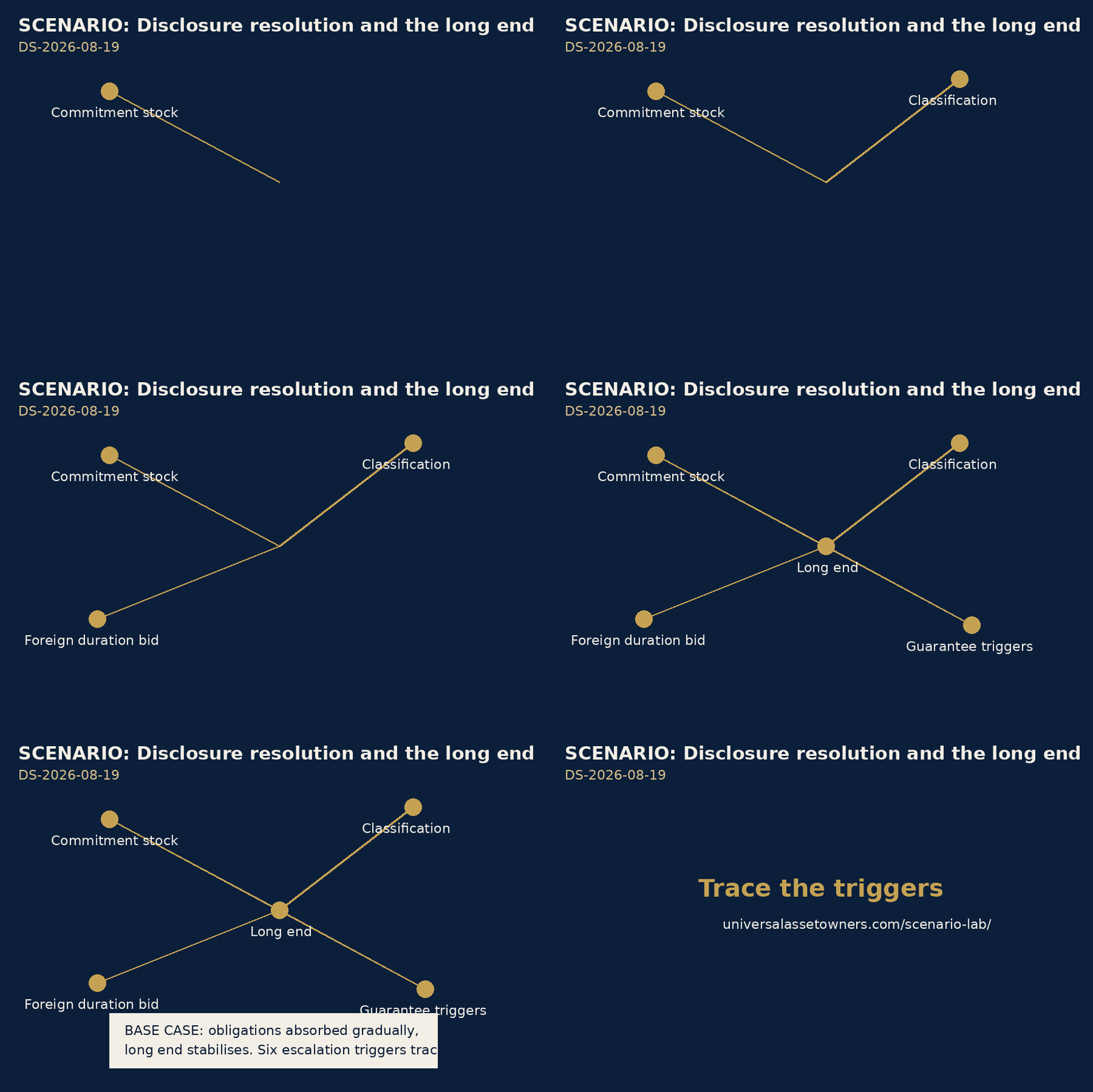
Base case. Commitment stock converts into started leases and delivered purchases on schedule; the Delaware Life exchange is approved with disclosed replacement assets; the thirty-year stabilises in a 5.0–5.4% band; foreign duration demand recovers toward its trailing average. Obligations become visible gradually and are absorbed without a repricing event.
Escalation triggers — each observable, each dated:
1. A second regulated insurer discloses a material related-party reclassification of private-credit assets.
2. The Delaware exchange is approved without disclosure of the identity and valuation of the replacement assets — concentration relabelled rather than reduced.
3. A quarterly filing from any of the nine companies restates a material share of purchase commitments as recognised liabilities, or discloses a step-up in guaranteed minimum values — the NVIDIA 10-Q exhibit is the first place this becomes readable.
4. The thirty-year constant-maturity yield closes above 5.50% for five consecutive sessions (an early-warning threshold, not a crisis level).
5. Two further monthly TIC releases show private foreign purchases of notes and bonds below $20bn while equity inflows stay positive.
6. High-yield spreads widen materially while the thirty-year holds above 5.25% — the combination, not either alone.
De-escalation: thirty-year sustained below 4.75%; TIC duration purchases back above their trailing 12-month average; a filing that materially reduces disclosed commitment stock without substitution; an interconnection or permitting decision that defers the obligations’ start dates.
No probability is attached to this scenario: none has an established method, timestamp, range and update rule.
Careers & mandates
NZX has appointed Hishaam Mirza chief executive, starting 14 September, after fourteen years at the Guardians of New Zealand Superannuation, most recently leading the Direct Investments team, which oversees roughly NZ$8bn across real assets, healthcare, technology and financial services. Earlier: EDF Energy, Lazard, BP. The read for allocators: direct and private-markets origination experience is now bid for outside the asset-owner sector entirely.
GESB (Western Australia, ~A$46bn, more than 250,000 members) has appointed former WA Under Treasurer Joann Wilkie PSM chief executive, effective 12 August. Previously the Western Australian Under Treasurer; before that, Deputy Secretary of the Economic Strategy and Productivity Group at NSW Treasury (2019–2025). She succeeds Ben Palmer, who left in April after nine years.
Singapore’s Ministry of Manpower announced on 19 August that Hsieh Fu Hua — GIC board director, former Temasek president, former SGX chief executive and chairman of the NUS Board of Trustees — becomes chairman of the National Wages Council, succeeding Peter Seah, who asked to relinquish the appointment for personal reasons. Wage policy feeds the liability assumptions of every Singapore-exposed plan; the appointment also puts a sitting GIC director at the centre of it.
The Back Page
Meet The Allocator
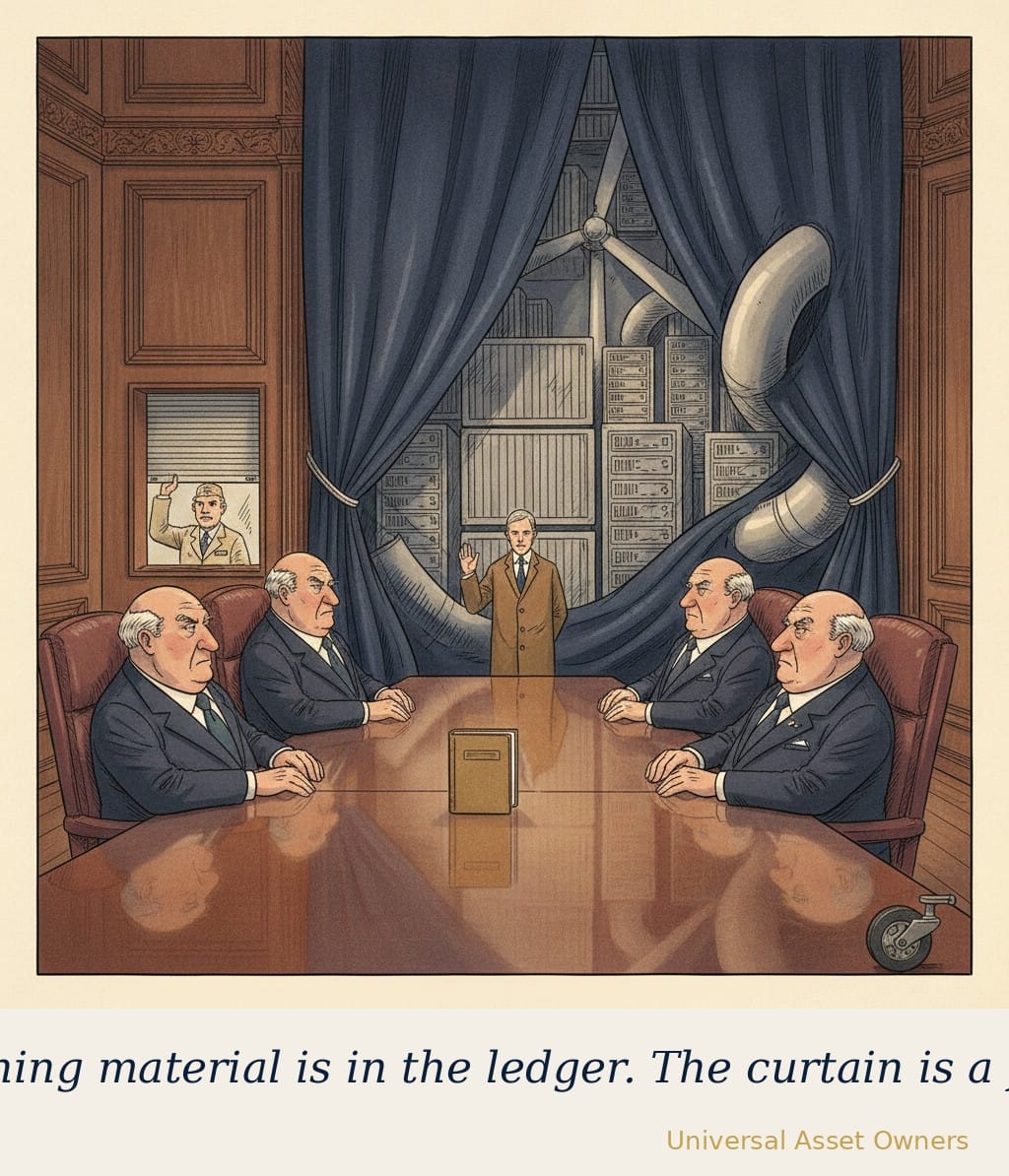
The editorial cartoon
Sources
Primary or first-party sources where available. Live shipping and market facts are snapshots subject to revision.
1. Statement Regarding the Division of Corporation Finance’s Role in the Exchange Act Rule 14a-8 Process — SEC, 14 Aug 2026
2. SEC Will No Longer Respond to Any No-Action Request for Rule 14a-8 Shareholder Proposals — Sullivan & Cromwell
3. TWG Global Commits Up to $6.5 Billion to Strengthen Group 1001 Insurance Portfolios — Business Wire, 17 Aug 2026
4. Dodgers owner Mark Walter’s insurer to cut $6.5 billion in investments amid probe — Reuters, 18 Aug 2026
5. Walter’s Insurer to Slash Scrutinized Loans by $6.5 Billion — Bloomberg, 18 Aug 2026
6. Private credit in Canada — Bank of Canada (staff research), 17–18 Aug 2026
7. Canadian Firms Have $360 Billion of Private Credit Exposure, Mostly in US — Bloomberg, 18 Aug 2026
8. Why Big Tech’s AI Spending Is $3 Trillion Higher Than It Seems — The Wall Street Journal
9. Announcement of Notification to Submit a Voluntary Conditional Cash Offer to Acquire ADPG Shares — AD Ports Group, 17 Aug 2026
10. L’imad announces intention to acquire 100% shares of AD Ports Group — The National, 17 Aug 2026
11. SCFEA Resolution to Consolidate the Assets and Investments of L’IMAD Holding and ADQ — Abu Dhabi Media Office, Jan 2026
12. Saudi Arabia’s PIF discloses $26.38bn stake in SpaceX — SatellitePro ME, 18 Aug 2026
13. 30-year Treasury yield tops 5.33%, new 19-year high — CNBC, 18 Aug 2026
14. 30-Year Treasury Auction Yield Highest since 2001, 10-Year Auction Yield Highest since 2007 — Wolf Street, 15 Aug 2026
15. Market Yield on U.S. Treasury Securities at 30-Year Constant Maturity (DGS30) — FRED
16. 10-Year Minus 2-Year Treasury Constant Maturity (T10Y2Y) — FRED
17. Treasury International Capital Data for June — US Treasury, 17 Aug 2026
18. Plunging private foreign demand could fan US bond rout flames — Reuters (McGeever), 18 Aug 2026
19. Japan’s 10-year yield hits three-decade peak on inflation worries — Reuters via Yahoo Finance, 18 Aug 2026
20. How major US stock indexes fared Tuesday 8/18/2026 — The Washington Post
21. Gold prices today, Tuesday, August 18, 2026 — Yahoo Finance
22. CPP Investments launches expanded portfolio carbon footprint reporting — CPP Investments, 14 Aug 2026
23. Human rights — expectations of companies — Norges Bank Investment Management (first published 2016)
24. Pensioenfonds Recreatie verruilt BlackRock voor Cardano — Het Financieele Dagblad, 17 Aug 2026
25. U.S. to “Take Any Actions Necessary” on EU Sustainability Reporting Regulations — ESG Today
26. China’s state shippers deploy oil tankers outside Gulf, avoid chokepoints — Reuters, 18 Aug 2026
27. Idemitsu starts sourcing Saudi crude via Suez route — Reuters, 18 Aug 2026
28. JMIC Advisory Note, 18 August — UKMTO
29. Hormuz traffic slows as uncertainty over waterway persists — Reuters, 19 Aug 2026
30. UAE suspends trade and financial transactions with Iran — The National
31. UAE Ministry of Foreign Affairs statement — MoFA, 19 Aug 2026
32. Trump says US won’t seek to extend Iran deal — Nikkei Asia, 18 Aug 2026
33. Bessent says new measures against Iran coming next week — Washington Trade & Tariff Letter
34. Devastating Greek wildfires stoke fear of faulty power lines — Reuters, 18 Aug 2026
35. Goldman Sachs Announces Agreement to Acquire LCN Capital Partners — Goldman Sachs, 18 Aug 2026
36. KKR Offers to Buy UGI Corp. for $42.50 a Share, WSJ Says — Bloomberg, 18 Aug 2026
37. Partners Group closes USD 1 billion private credit mandate in Asia — Partners Group, 17 Aug 2026
38. CPP Investments commits more than $1bn to infrastructure funds — IPE Real Assets
39. CPP Investments Partners with EQT to Support Global Digital Infrastructure Growth — CPP Investments, 3 Jul 2026
40. Elia Group and CPP Investments expand partnership with acquisition of the Tarchon interconnector project — Elia / CPP, Jul 2026
41. Kuwait Oil Company Signs US$16.0 Billion Infrastructure Partnership — Blackstone, 25 Jul 2026
42. Wall Street Firms Tap Insurance Capital for $16 Billion Kuwait Pipeline Deal — Bloomberg, 17 Aug 2026
43. WTW launches streamlined longevity swap solution for sub-£1bn UK pension schemes — Artemis
44. Longevity Stream — WTW
45. Smiths completes landmark £760m pension scheme buy-in — Smiths Group, Jul 2026
46. Absa wins GEPF custody contract long held by rival Standard Bank — Business Day, 19 Aug 2026
47. GEPF FY2024/25 results (R2.69trn portfolio) — GEPF
48. Korea to Propose Sovereign Wealth Fund Bill This Month — Seoul Economic Daily, 18 Aug 2026
49. Korea to launch $13.9 bil. sovereign wealth fund for strategic industries — The Korea Times, 31 Jul 2026
50. Germany’s Pension Reform Opens €500 Billion Market for Fund Managers — Bloomberg, 15 Aug 2026
51. NZX appoints Hishaam Mirza as new chief executive — RNZ, 18 Aug 2026
52. GESB names former Western Australia Under Treasurer Joann Wilkie CEO — Markets Group
53. Hsieh Fu Hua takes over as National Wage Council chair — AsiaOne, 19 Aug 2026
54. UNCCD COP17 — UNCCD, 17–28 Aug 2026
55. Hedge Fund Dymon Raises $1 Billion From ADIC, Ramps Up Hires — Bloomberg, 18 Aug 2026
56. DOE fact sheet: Ensuring Affordable Energy Access in Ohio While Powering the Future — US Department of Energy
57. Jackson Hole Economic Symposium — Federal Reserve Bank of Kansas City, 27–29 Aug 2026
This briefing distinguishes reported facts, official statements and our own analysis. Private-credit estimates, cross-border capital-flow data and shipping activity are snapshots subject to revision, classification differences and incomplete visibility into ultimate beneficial owners.
Universal Asset Owners · The Editorial Team