

98% of the world’s sovereign wealth funds |
18 of 20 of the world’s largest pension funds |
10 of 10 of the largest charitable foundations |
85% of the world’s largest family offices |
100+ billionaires, every morning |
NVIDIA has filed a Form 8-K disclosing residual-value guaranties capped at $105 billion behind OpenAI’s twenty-year Ohio lease[1] — on a campus whose new power is at least 92 per cent natural gas, a fact the US Department of Energy published in February.[4] The disclosure is exemplary. The scrutiny channel is what thinned: nine days apart in August, the SEC stopped refereeing shareholder proposals[5] and the Justice Department withdrew the letter beneath the proxy-advice market.[6]
What happened
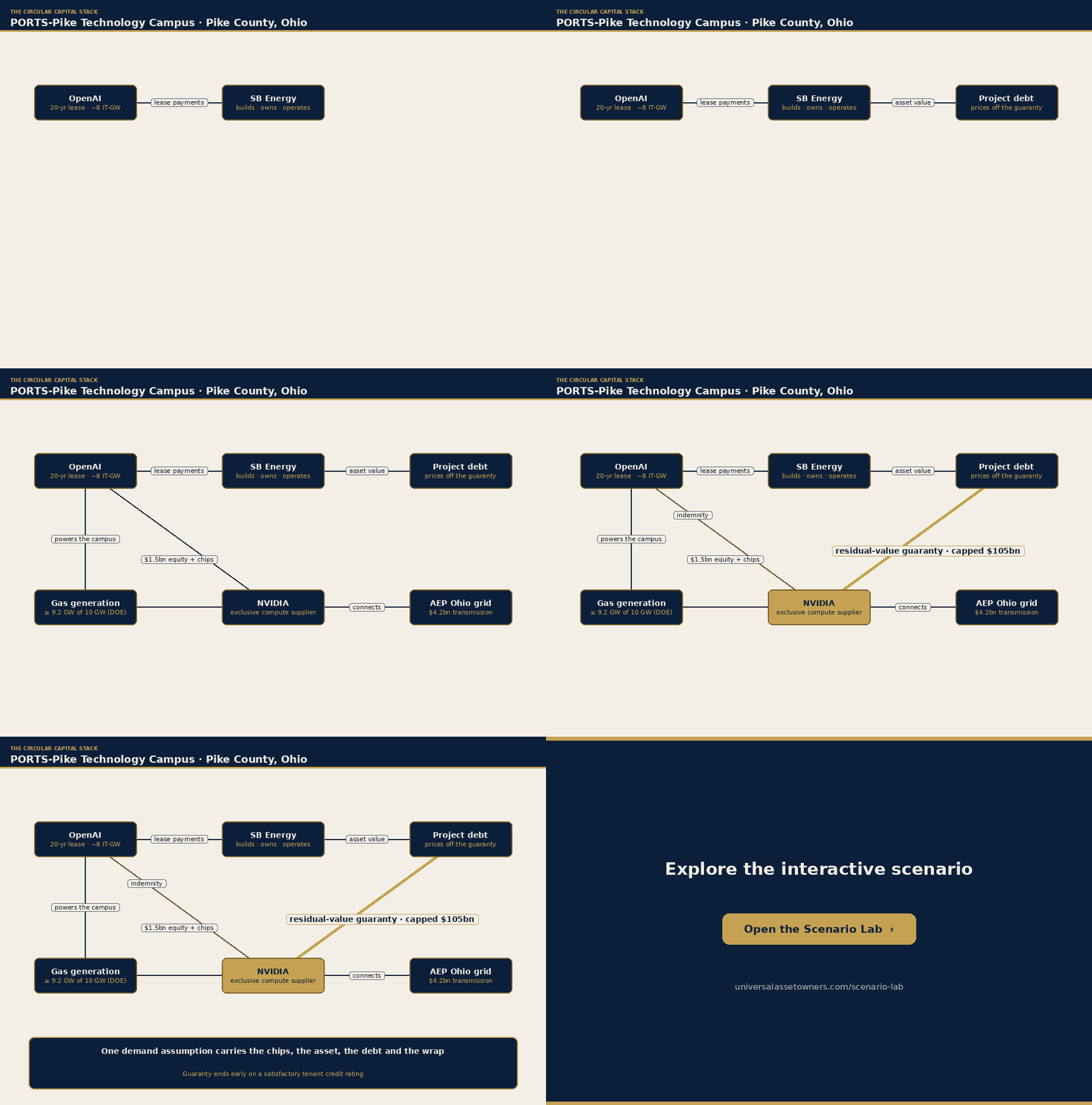
On 17 August NVIDIA filed a Form 8-K, signed by its chief financial officer, disclosing “multiple residual value guaranties” with SB Energy covering leases for approximately 4.25 gigawatts of IT load at the Portsmouth site in Pike County, Ohio — the campus OpenAI will occupy under a 20-year lease. The filing states: “NVIDIA’s aggregate payment obligation is cumulatively capped at $105 billion for its initial commitment under the Agreements.”[1]
The mechanism is specified. If OpenAI becomes insolvent or fails to pay, NVIDIA pays “an amount generally equal to any shortfall between the guaranteed minimum value of a lease… and amounts recovered through a replacement lease or sale.” OpenAI “has agreed to reimburse and indemnify NVIDIA for any and all amounts actually paid.” NVIDIA can extend credit support to a further 3.8 gigawatts at its sole discretion. The obligations take effect as leases commence — first capacity expected in 2028[3] — and terminate at the earliest of twenty years, OpenAI ending the lease, or “OpenAI achieving a satisfactory credit rating.”
Separately, NVIDIA said it will invest $1.5 billion in SB Energy, joining SoftBank Group and OpenAI as investors, and will be the exclusive AI compute provider on the site.[2]
And the power behind it is not unspecified. A Department of Energy fact sheet published in February states that SoftBank Group and SB Energy “plan to build 10 gigawatts (GW) of new power generation—including at least 9.2 GW of natural gas generation—to power 10 GW of data center development,” financed in part by “$33.3 billion in Japanese funding” under the US–Japan Strategic Trade and Investment Agreement, alongside $4.2 billion of transmission investment with AEP Ohio.[4]
What a residual-value guaranty moves
Read the filing the way a lender will. The guaranty does not fund the campus and it is not debt on NVIDIA’s balance sheet today — it is a contingent cap, disclosed under Item 2.03, effective only as leases commence. What it does is relocate the tail. A project lender’s residual risk — what the asset is worth if the anchor tenant fails — now terminates at the chip supplier rather than at the project. That is what makes the debt financeable, and it is also what makes the exposure circular: the guarantor’s own revenue depends on the tenant it is guaranteeing, and the collateral’s value depends on demand for the guarantor’s product.
The termination clause deserves the most attention: the guaranty ends early if “OpenAI achiev[es] a satisfactory credit rating.” NVIDIA is, in effect, lending OpenAI its balance sheet until the market no longer requires it. The full agreements are promised as an exhibit to the next 10-Q — the guaranteed minimum values and the definition of a satisfactory rating will be legible then.
| The numbers | |
| Aggregate cap (8-K, Item 2.03) $105bn | Leases covered ~4.25 GW + option 3.8 GW |
| Equity into SB Energy $1.5bn | Lease to OpenAI 20 years · ~8 IT-GW |
| New generation 10 GW | Of which natural gas (DOE) ≥9.2 GW |
| Japanese funding for the gas build $33.3bn | AEP Ohio transmission $4.2bn |
| First capacity, per OpenAI 800 MW in 2028 | |
The gas nobody priced. The DOE document has sat on energy.gov since February, and it settles a question most coverage has not asked: what actually powers an AI campus this size. At least 9.2 of the 10 new gigawatts are gas. For an allocator holding this complex through listed infrastructure, private credit or a transition sleeve, that is not a footnote — it is the asset. The stranded-asset question and the credit question are the same question here, and they mature on the same schedule.
The case for the structure is in the filing itself. The disclosure is complete and early: cap, triggers, remedies, indemnity, sunset. The guaranty is staged and conditional, NVIDIA holds remedies short of payment, and a completed campus with 765 kV transmission has value to replacement tenants. If OpenAI’s credit matures, the guaranty dies quietly and will look, in hindsight, like cheap credit enhancement that built real infrastructure. That outcome is genuinely available.
Stewardship & voting
Nine days apart in August, the two American institutions that set the cost of contesting corporate arrangements both stepped back. On 5 August the Justice Department’s Antitrust Division withdrew the business review letter it issued to Institutional Shareholder Services in 1987, saying it “does not reflect ISS’s current business practices or the Antitrust Division’s view of those practices” — ISS now sells consulting to companies alongside voting advice about them — and that “the concentration of market power in the proxy advisory market raises significant competition concerns.” The Division said ISS and Glass Lewis “control more than 90 percent” of the market, while noting that “proxy advising is not inherently problematic.”[6]
Be precise about what was withdrawn. A business review letter states only the Division’s enforcement intention on the day it is written — Justice quoted that disclaimer in its own release. The 1987 letter conferred no immunity and bound no one. What it did was let a market organise itself around a stated intention for thirty-nine years.
On 14 August the SEC’s Division of Corporation Finance said it had “determined to discontinue responding to Rule 14a-8 no-action requests entirely, including those submitted under Rule 14a-8(i)(1), effective immediately, unless and until the Division announces otherwise” — closing the last exception in a policy begun in November 2025. Companies must still file exclusion notices; they will receive no reply.[5] A no-action letter was never a ruling either — it allocated cost. The live example: in April a Massachusetts federal court enjoined BJ’s Wholesale Club from excluding the New York State Common Retirement Fund’s deforestation proposal, while BJ’s held a staff “we will not object” response on a contemporaneous proposal from a different proponent. The non-objection, resting “solely on” the company’s own representation, bound nobody.[8]
The Commission’s chairman argues little changes: Paul Atkins said on 9 July that “the world did not end,” citing six lawsuits — under 4% of exclusion notices — and, for steady omission rates, the law firm Cooley and the research arm of ISS.[7] That is a claim about volume. The question for an owner of everything is allocation: who pays when a dispute does not resolve.
The owners’ side of the fortnight was busier. CPP Investments, which manages the Canada Pension Plan Fund at arm’s length from governments, published a framework on 14 August classifying a $787 billion portfolio (at 31 March 2026, excluding government-issued securities) on carbon intensity — 86.7% of the portfolio below 40 tCO₂e per $1 million of investee enterprise value including cash — and said it voted against 950 directors for inadequate climate-risk oversight; the release does not define the voting period.[9] GPIF’s manager survey (12 August) shows climate and governance ranking high everywhere while active managers reduce weight on human rights, labour and supply chain.[10] A passive manager cannot sell; its only instrument is the vote — the instrument whose cost just went up.
The long horizon · Concentration and index structure
Before this morning’s open, Reddit replaced AvalonBay Communities in the S&P 500. AvalonBay leaves on completion of its acquisition by Equity Residential; the combined company, renamed Vivmark Residential, stays in the index.[11] An index change obliges every tracking strategy to reach the new weights within its own tolerance — full-replication funds trade near the effective date; sampled, synthetic and tax-aware mandates get there earlier, later or derivatively. The method is the manager’s. The decision was a committee’s, owing no fiduciary duty to any allocator.
Allocator lens What this means for the portfolio The triple exposure. Once through equity: NVIDIA shareholders stand behind a contingent obligation capped at $105bn whose trigger is a single tenant’s credit. Once through credit: project debt against PORTS-Pike will be underwritten to NVIDIA’s guaranty — the paper prices off the chip cycle, not the property. Once through the transition sleeve: the campus’s power is at least 92% gas, per DOE, so a mandate holding this as climate-aligned infrastructure is carrying a two-decade gas exposure with a stated federal funding chain behind it. The practical tilt. Read the 10-Q exhibit when the agreements file — the guaranteed minimum values and the “satisfactory credit rating” definition are the whole risk. Ask every infrastructure manager whether AI-campus paper is underwritten to tenant credit, vendor guaranty or asset value — three different trades now. And with the no-action channel closed and vote-advice unbundling, a voting policy that stands without a vendor recommendation, a written record on contested votes, and explicit stewardship terms in manager mandates are no longer hygiene — they are the referee you have left. |
Capital flows
No new sovereign-fund or public-pension purchase cleared verification with a 17–18 August event date. That absence is stated rather than filled.
Saudi Arabia’s Public Investment Fund published its 2025 results on 17 August, and the audited statements — KPMG-signed, posted on the fund’s site — carry a sharper picture than the release. Profit for the year was SAR 65.2 billion ($17 billion), with SAR 46.4 billion attributable to the fund’s owner. But other comprehensive loss attributable to the owner was SAR 111.2 billion, taking total comprehensive result attributable to the owner to a loss of SAR 64.7 billion, and total equity down 2.0% to SAR 2.63 trillion. The loss sits in reserves, not the income statement; the statements do not break out currency translation against fair-value movements. The release reports an annualised total shareholder return of 5.8% since September 2017 — a since-inception figure, not a 2025 return — revenue up 9% to $120 billion, and assets under management above $900 billion.[12]
The release also says PIF invested more than $199 billion in Saudi Arabia across 2021–2025 and contributed more than $342 billion to real non-oil GDP. These are different kinds of claim: the first is deployment; the second is the fund’s own impact estimate, published without methodology. A dual-mandate sovereign is entitled to both scorecards. A reader is entitled to know which one is money that moved — and that the audited bottom line this year is a comprehensive loss.
NVIDIA’s $1.5 billion equity investment in SB Energy is the largest new corporate capital action in the window. The six-manager financing platform with Apollo, BlackRock, Blackstone, Brookfield, Goldman Sachs and KKR — mobilising over $500 billion of third-party capital — is a separate NVIDIA announcement dated 10 August.[2]
Geopolitics & chokepoints
Brent settled at $90.87 on Monday, up 2.7%, the front-month ICE October contract’s highest close since late July, as the 60-day US–Iran negotiating period expired without agreement.[13] Six commodity vessels transited the Strait of Hormuz on Monday — three in, three out — against a ten-day average of eleven, with no VLCC and no LNG carrier; the count is preliminary and excludes vessels with transponders off. UKMTO reported Tuesday that an outbound vessel was struck by an unknown projectile, with engine-room damage and one crew casualty — UKMTO’s word is “casualty”; it has not said injured or killed, and the vessel is unnamed. An IMO tracker via UN News records 65 confirmed incidents and 17 seafarers killed from early March to 12 August; some 6,000 crew on ~500 vessels remain trapped.[14] Saudi Aramco is in talks to supply Arab Medium and Arab Heavy by ship-to-ship transfer off Fujairah for September loading, per trade sources cited by Reuters and Bloomberg; Aramco declined to comment.
Signals — not yet confirmed
REPORTED — Microsoft cut voluntary carbon-removal purchases by roughly 80% year on year (ESG News and Gizmodo, 17 August, on BloombergNEF data; underlying event mid-July). Microsoft has not confirmed the figure. What settles it: Microsoft’s own 2026 purchase disclosure.
REPORTED — AustralianSuper is under activist pressure over its Whitehaven Coal stake (Market Forces modelling, 17–18 August; the fund is reported as largest shareholder at ~11.8% and has not responded). Whitehaven results ~19 August. What settles it: the fund’s statement or its next substantial-holder notice.
REPORTED — New York’s data-centre bill awaits the Governor. A11560/S10642 passed both chambers on 4 June; as of 18 August it has not been delivered to the Governor and is unsigned, while Executive Order 62 (14 July) holds DEC discretionary permits in abeyance for facilities at or above 50 MW, with exemptions and no fixed end date. The bill’s threshold is 20 MW.[15] What settles it: delivery and signature or veto.
EMERGING — Six US grid operators were due to answer FERC show-cause orders on large-load interconnection on 17 August (dockets EL26-67 to EL26-72, issued 18 June). Whether responses were filed is not yet verifiable. What settles it: the eLibrary dockets.
Decisions due / week ahead
Capex commentary: Whitehaven full-year results ~19 August — management against live activist modelling. NVIDIA’s 10-Q exhibit with the full guaranty agreements follows the quarter ended 26 July. Oil, vol and credit: Brent settled $90.87 with Hormuz single-digit; Marsh’s last published war-risk level (7.5–10% of hull vs ~0.25% pre-war) is dated 22 July — a month without a fresh print is itself the signal. Insurance advisories: UNCCD COP17 Finance Day 24 August and “Drought in Numbers 2026” 25 August — the land-and-drought finance gap is $278 billion a year against $77 billion invested, private capital ~6%.[16] Also dated: US TIC for July, 16 September; EU Delegated Regulation 2026/904 in force 19 August.
The Universal Owner risk radar
Vendor-guaranteed AI credit — $105bn cap, Item 2.03, 17 Aug (NVIDIA 8-K) · Gas behind the compute build — ≥9.2 GW of 10 GW (US DOE) · Proxy referee withdrawn — 14 Aug (SEC) · Proxy-advice concentration — 5 Aug, >90% per DOJ (DOJ) · Hormuz transit collapse — 6 vessels 17 Aug (IMO) · Seafarer casualties — 65 incidents, 17 killed to 12 Aug (UN News) · China FAI −6.7% (NBS) · Foreign Treasury holdings −$72.1bn (US Treasury) · Curtailment 26.1% vs official 8.6/9.1% (NEA · GEM) · Land/drought gap $278bn/yr (UNCCD). Explore the live Risk Map ›
Scenario · The Supplier Becomes the Backstop
Open the interactive scenario — base case, triggers, and the questions six allocators are asking ›
Chart of the day

The circular capital stack. All figures from NVIDIA’s Form 8-K (17 August 2026), the NVIDIA and OpenAI releases (17 August) and the US DOE fact sheet (February 2026). The $105bn is a contingent cap, not deployed capital.
Podcast · The Universal Owner
| Apple Podcasts | Spotify | Podbean |
Careers
Martin Noven becomes chief executive of the Iowa Public Employees’ Retirement System (~$47 billion, 424,000+ members) on 24 August, appointed 7 August; previously executive director of the Maryland State Retirement and Pension System, and before that SURS Illinois. He replaces Greg Samorajski, serving to 30 April 2028.[17]
Deputy Chief Investment Officer — Employees’ Retirement Fund of the City of Dallas. Listed on the fund’s own careers page, applications open. View the listing ›
Every role printed here is verified on the hiring institution’s own site before publication. Senior searches reported elsewhere this week — including portfolio-manager roles at two sovereign vehicles — did not clear that check and are not listed.
The back page · Meet The Allocator
The Allocator on the week: “We are the bridge. I’d want to be paid for that.”

Sources
[1] NVIDIA — Form 8-K, accession 0001045810-26-000069, Item 2.03, 17 Aug 2026
[2] NVIDIA — NVIDIA Guarantees SB Energy’s PORTS-Pike Technology Campus in Ohio to Exclusively Host NVIDIA AI Compute, 17 Aug 2026
[3] OpenAI — OpenAI joins PORTS-Pike project, 17 Aug 2026
[4] US Department of Energy — FACT SHEET: Ensuring Affordable Energy Access in Ohio While Powering the Future of AI, Feb 2026
[5] SEC Division of Corporation Finance — Updated Statement Regarding the Division’s Role in the Exchange Act Rule 14a-8 Process, 14 Aug 2026
[6] US Department of Justice — Justice Department Withdraws Business Review Letter Issued to Proxy Advisory Firm, release 26-886, 5 Aug 2026
[7] SEC — Chairman Paul Atkins, remarks to the Society for Corporate Governance Conference, 9 Jul 2026
[8] DiNapoli v. BJ’s Wholesale Club Holdings, Inc., 1:26-cv-11075 (D. Mass.), preliminary injunction 22 Apr 2026
[9] CPP Investments — CPP Investments Launches Expanded Portfolio Carbon Footprint Reporting, 14 Aug 2026
[10] GPIF — Survey of asset managers on material ESG issues, 12 Aug 2026
[11] S&P Dow Jones Indices — Reddit Set to Join S&P 500, 13 Aug 2026
[12] Public Investment Fund — Consolidated financial statements FY2025 (KPMG) and results release, 17 Aug 2026
[13] CNBC — Brent front-month settlement, 17 Aug 2026 (wire settlement print)
[14] UN News — IMO Strait of Hormuz tracker, as of 12 Aug 2026
[15] NY Assembly — A11560 action history; Executive Order 62
[16] UNCCD — COP17, Ulaanbaatar, 17–28 Aug 2026; UNRIC opening report
[17] Office of the Governor of Iowa — Gov. Reynolds appoints Martin Noven CEO of IPERS, 7 Aug 2026
Sources checked through 18 August 2026. Material claims are linked to named sources; primary or first-party sources are used where available.
— The Editorial Team