
Universal Asset Owners · Daily Brief · July 24, 2026
The Price of Optionality
Brent clears $100, GIC budgets US$30bn for agility, and the Red Sea becomes a second oil chokepoint.
Your morning briefing
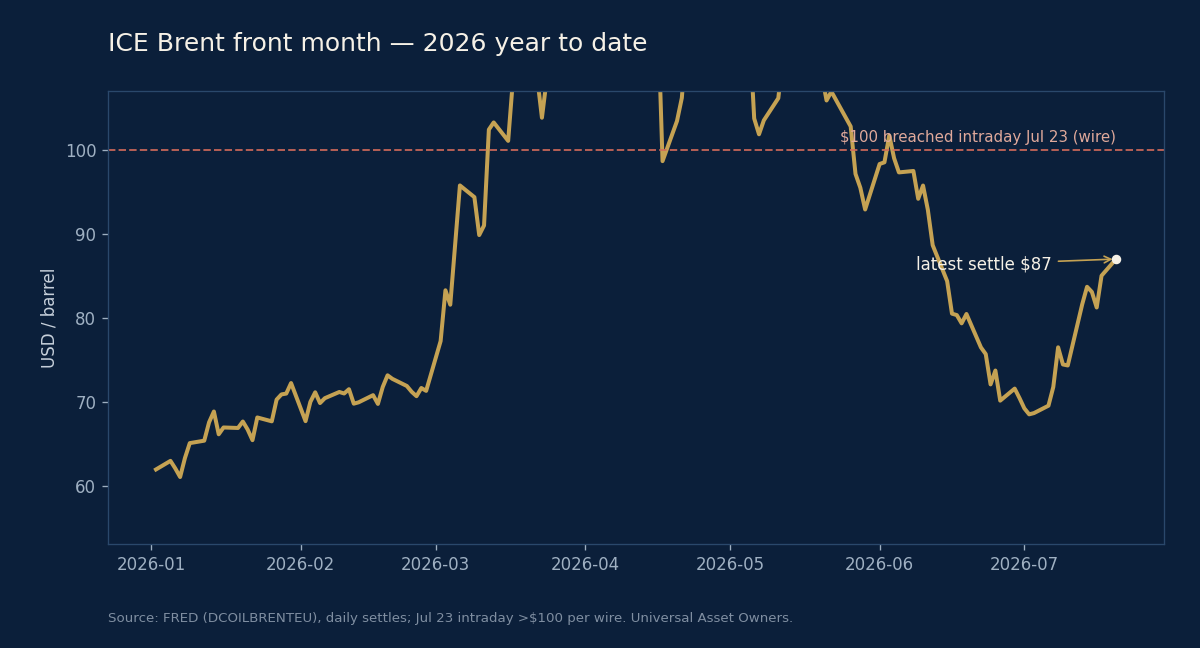
Brent clears $100 as the war reaches a second chokepoint
Brent crude climbed above US$100 a barrel on July 23 after Yemen’s Houthis said they had attacked two Saudi oil tankers — the Encelia and the Layla — in the Red Sea, threatening a second shipping chokepoint alongside the Strait of Hormuz. One strike was supported by a distress call and Saudi reporting; the second had not been independently confirmed. Saudi Arabia suspended Red Sea oil shipments in response. The escalation came amid renewed US strikes on Iran, with the US naval blockade of Iranian ports — resumed July 14 — still in force. (Reuters, CENTCOM)
For an owner of a slice of the whole economy, this is a deliverability shock — transmitting through inflation expectations, term premia, shipping and insurance costs, and the credit of energy importers. A barrel can be cheap to produce and, with two chokepoints under threat, impossible to move.
Podcast · The Universal Owner
The Capital Tape
| Institution | Action | Size | Status |
|---|---|---|---|
| GIC | Add to hedge funds; new growth/income/inflation framework ↗ | ~US$30bn/3yr (reported) | Reported |
| Brookfield + CPP | Take-private, LXP Industrial (Jul 20) ↗ | US$5.2bn | Signed; go-shop to Aug 28 |
| PIF/Silver Lake/Affinity | Acquire Electronic Arts ↗ | US$55bn | EU cleared; FSR ~Jul 30; CFIUS outstanding |
| HSBC → Allianz | Sell Singapore insurer ↗ | S$2.7bn | Signed; close H1 2027 |
| Partners Group | Infra-secondaries close ↗ | >US$5.5bn | Closed |
| Danantara | Four Indonesian SOE managers ↗ | AUM ~US$10.5bn | Announced |
GIC redesigns the portfolio around adaptability
GIC’s official 2025/26 results report a 20-year return of 5.6% nominal, 3.4% real, and a refreshed framework around growth, income and inflation. In executive comments reported by Reuters, GIC signalled ~US$30bn into hedge funds over three years. It is paying for the ability to move — while conceding physical climate risk now belongs in the baseline. (The $30bn is intended, multi-year; GIC discloses no AUM.)
Brookfield and CPP to take LXP Industrial private ($5.2bn)
Announced July 20: US$5.2bn all-cash ($61.20/share, 12.3% premium) for ~53m sq ft across 108 logistics properties; 40-day go-shop to Aug 28; close Q4. A template for pension access to scaled logistics — in markets that also concentrate grid and insurance risk.
Peer Radar — what other large owners are doing
- Florida SBA is building an active-credit book across public and private markets that CIO Lamar Taylor frames as a first step toward a return-driver, not asset-class, portfolio — the same shift GIC is making. (Top1000Funds)
- Aware Super is mapping its AI exposure and finds at least 15% of assets touch the theme — concentration that dollar aggregation alone misses.
- Generali committed €300m to a “European Sovereignty Programme” (Italy/France/Germany SMEs, via PE, infra and listed equity). (Responsible Investor)
- Border to Coast raised £1.35bn for an ESG-labelled bond fund.
Physical-Economy Monitor
- Chokepoints — Red Sea & Hormuz: two routes under threat at once; Saudi Arabia suspended Red Sea shipments. Transmission: freight + war-risk insurance → delivered-energy cost → inflation.
- Power & grid: interconnection and power — not just chips — are the binding constraint on AI build-out, with consequences for infrastructure and AI-adjacent private credit.
- Insurance: war-risk and reinsurance pricing across Gulf and Red Sea lanes is the fastest-moving transmission channel.
Governance & Stewardship
Korea’s KIC has taken on an expanded mandate after a separate national fund plan was shelved. Canada’s proposed national fund remains in formation. At South Africa’s PIC, the chair has resigned while the CEO remains suspended pending a review — unadjudicated matters; we report the process, not any finding.
Deep Dive — The Price of Optionality
Every allocation is, at bottom, a decision about how much freedom to give up. Lock capital into a ten-year private asset and you are paid a premium precisely because you cannot leave. Hold cash and liquid hedges and you pay for the privilege of being able to change your mind. Most of the time that trade sits quietly in the background of portfolio construction. This week it moved to the foreground, because the same day’s news priced both sides of it.
The buyer. GIC’s redesign is the clearest statement a major sovereign fund has made that agility is now a funded objective rather than a by-product. Moving from asset-class buckets to three return drivers — growth, income, inflation resilience — is not cosmetic: it removes the internal borders that slow reallocation. The reported ~US$30bn hedge-fund programme buys managers whose entire mandate is to change exposure as regimes shift. And the admission that the world will “widely accepted” miss its climate targets converts physical risk from scenario to baseline. GIC is not predicting the next shock; it is paying — in fees, opacity and governance burden — to be able to respond to whichever one arrives.
The demonstration. The Red Sea showed what the absence of that freedom costs. When the Houthis claimed strikes on two Saudi tankers, the barrels did not become worthless — they became undeliverable. Saudi Arabia, holder of the world’s cheapest reserves, suspended shipments through an entire sea. Kazakhstan’s CPC disruption earlier this window ran the same logic inland: when the route closes, the wellhead follows. Production cost, reserve size and deliverable supply are three different numbers, and the market only prices the difference when it is too late to buy it cheaply.
The transmission. Between those two poles sits the machinery that converts a chokepoint into a portfolio event: marine war-risk insurance. Cover for Gulf and Red Sea lanes reprices in days, not quarters. If underwriting capacity tightens while two chokepoints stay hot, the cost of moving energy rises independently of the oil price — a second, stealthier inflation channel that flows into freight, delivered-energy cost, EM importer credit and, eventually, the term premium on the long bonds held against long liabilities. That squeeze — not the headline crude print — is the mechanism a universal owner actually owns. It is today’s interactive scenario below.
The audit. The practical response is not a directional oil bet. It is an honest accounting of how much of the balance sheet can genuinely move, and how fast: what is liquid today, in 30 days, in a year; which mandates carry embedded gas and LNG exposure underwritten for production cost but not war-risk interruption; which private commitments assume exit windows that a correlated shock would close. GIC has effectively published its answer. The Red Sea published the alternative.
Allocator Lens
A universal owner is exposed to this week three times over — marked up as an energy holder, marked down as a broad equity-and-credit holder through the margin and rate channel, and repriced as an insurer and real-asset owner facing chokepoint concentration. The response is a deliverability and time-to-liquidity audit across the whole balance sheet — and a check that embedded gas and LNG in listed-infrastructure and climate mandates is underwritten for war-risk interruption, not just production cost.
Board question: how much of the portfolio can genuinely be repositioned in a shock — and what does that capacity cost to hold?
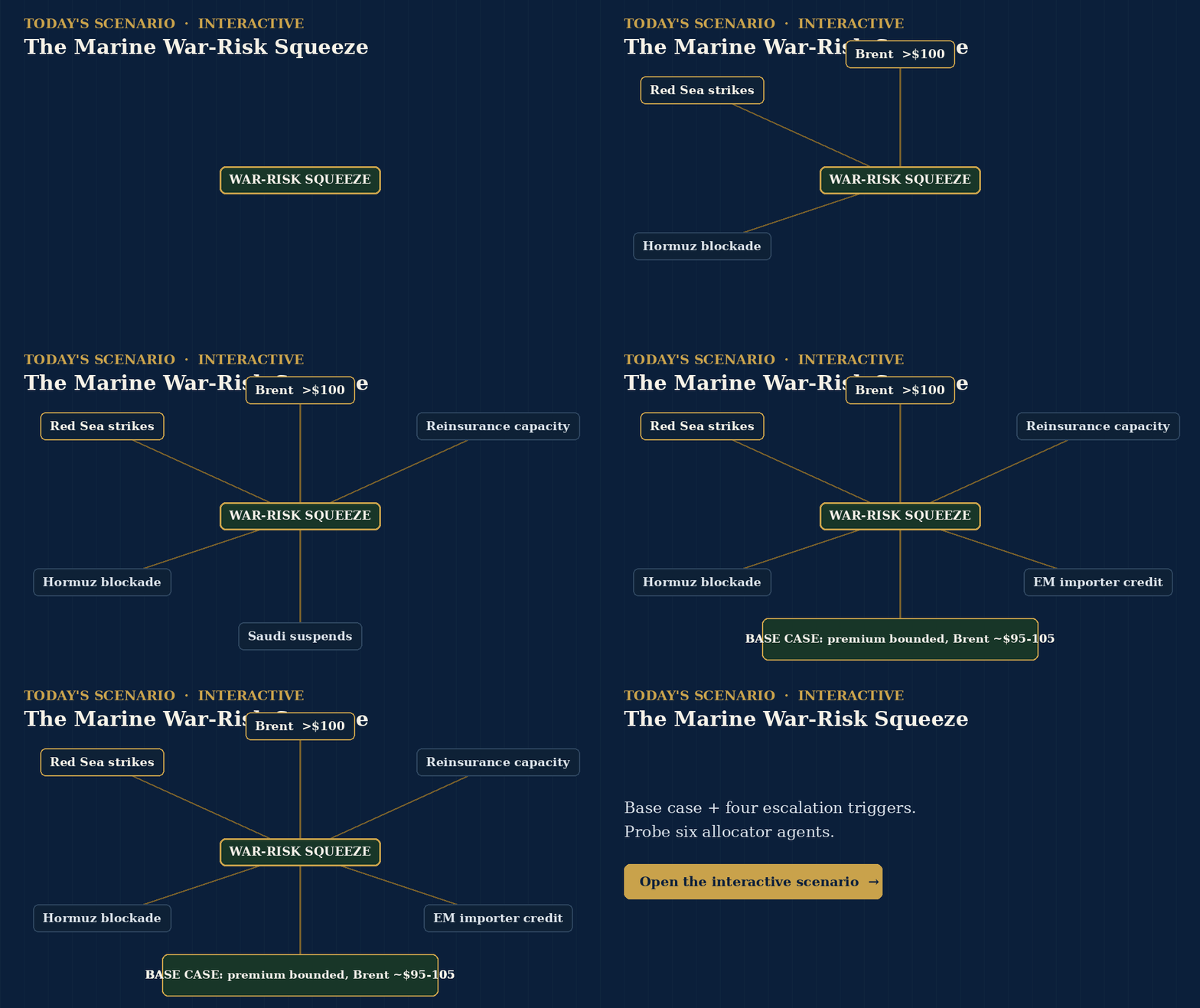
Today’s Scenario — The Marine War-Risk Squeeze
A dual-chokepoint disruption forces a simultaneous repricing of war-risk underwriting capacity, term premia and energy-importer credit. Base case: the premium stays bounded and Brent oscillates roughly $95–105. Four escalation triggers — a sustained closure or terminal outage, three straight weeks of rising marine war-risk rates, Brent settling above $100 for two weeks, or a second producer suspending shipments — and one de-escalation path. Probe the six allocator agents inside.
Research Shelf
- Equable 2026: US public-pension funded ratio 85.0% (best since the Great Recession); unfunded liabilities ~US$1.13tn. Equable
- WTW / Thinking Ahead 2026: global pension assets a record US$68.3tn, up 9.6%. TAI
OSINT Watchlist — to monitor (unconfirmed)
- Off-balance-sheet AI-infrastructure obligations migrating into private credit / insurers.
- Private-credit → insurer wrappers concentrating correlated risk.
- The chokepoint operational-risk premium (marine insurance, hazard pay).
- Reported Gulf sovereign divergence: PIF trimming international exposure vs Mubadala adding; QIA slowing. Enterprise
Where the buy-side operating community meets.
Meet The Allocator

The Allocator Desk — Careers
- NBIM — Portfolio Manager, Consumer (New York; closes Aug 3). Apply →
- NBIM — 2027 Graduate Programme (opens today; closes Aug 15). Apply →
- Current openings at CPP, GIC, CalPERS.
The Editorial Team · Universal Asset Owners. Research analysis, not investment advice.