
Written for the desks that steward the world’s long-horizon capital — sovereign wealth funds, public pensions, endowments, insurers and family offices, an institutional class managing more than $40 trillion. One edition a day. Every claim carried to its source. The second-order read the headlines don’t give you.
If this was forwarded to you, you are reading what the largest allocators read before the market opens.
Tuesday 11 August 2026 · Toronto / London / Riyadh / Singapore
98% of the world’s sovereign wealth funds |
18 of 20 of the world’s largest pension funds |
10 of 10 of the largest charitable foundations |
85% of the world’s largest family offices |
100+ billionaires, every morning |
On Monday, six of the largest managers of institutional capital signed memorandums of understanding with Nvidia to lend against computer chips as if they were toll roads — platforms intended to mobilize more than $500 billion. On the same day, Ontario Teachers’ reported a 9.5% half-year driven by venture marks, the Rhine’s critical gauge was forecast to become practically impassable by Friday, and severe disruption at the Strait of Hormuz — running since late February — acquired a reported fee schedule. Permanence is being repriced in both directions.
1 · The briefing
Ninety seconds: the six firms, the $500 billion of intentions, the demand side reporting the same morning, and the two pieces of permanent infrastructure that stopped behaving permanently.
2 · What happened
On Monday Nvidia announced memorandums of understanding with Apollo, BlackRock, Blackstone, Brookfield, Goldman Sachs and KKR to establish what it calls AI compute infrastructure financing platforms — structures intended to mobilize more than $500 billion of third-party capital so that hyperscalers, frontier labs, enterprises and governments can finance data centres and Nvidia hardware the way the market finances commercial real estate and toll roads: long-duration, collateralized, usage-linked.S1 Jensen Huang told CNBC his chips are an “investable asset.”S2
Be precise about the stage, because the coverage mostly is not. These are MoUs. “Intended to mobilize” is not committed capital; no fund closes, no term sheets and no committed amounts were disclosed.S1 Bloomberg, sourcing the FT, characterised the arrangements as talks formalised into announced platforms on Monday.S3
One disclosure did not travel with the headline and should have. Jensen Huang said Nvidia has the option to backstop up to 25% of the potential transactions — around $125 billion.S38 Read that against what the platforms are for. The vendor may end up guaranteeing a quarter of the paper that finances purchases of its own product. There is a respectable reading — a manufacturer with the best view of residual values taking first-loss is a credit enhancement, and it is optional, not committed. There is also the reading an allocator has to underwrite: if the backstop is ever drawn, the lender’s recovery would lean on the financial condition of the company whose sales the loan funded. Be precise about what is not known: the public record does not state whether that support would be a guarantee, a purchase commitment, subordinated capital, a liquidity facility or something else, nor its priority, triggers, duration or recourse. It should not be modelled as first-loss protection until documents say so. That is not a criticism of the structure. It is the single term sheet line that will determine whether this paper behaves like infrastructure debt or like vendor financing.
And Nvidia’s was not the day’s only enormous headline number that is not committed capital. Hours earlier Morgan Stanley launched what it calls the U.S. Innovation Infrastructure Initiative, saying it intends to facilitate approximately $1.5 trillion of capital raising, financing, advisory and related investment activity over ten years across AI, advanced computing, quantum, semiconductors, data infrastructure, cybersecurity, aerospace and defence, pharmaceuticals and critical minerals.S34 Read the verb. To facilitate is to intermediate: the bank is not deploying its own balance sheet, and advisory and underwriting activity that would have occurred anyway can be counted inside the total. Two headline figures in one Monday, $2 trillion of combined ambition — and neither is a commitment by anyone to fund anything. That is not a criticism of either announcement. It is the reading discipline this week requires.
3 · The collateral question
A toll road earns its keep in its thirtieth year. A graphics processor rarely earns its keep in its fifth. The announcement’s central idea — that compute belongs in the same financing category as bridges and commercial property — asks lenders to treat the economy’s fastest-depreciating major asset as its most permanent. If the platforms fill as intended, that depreciation risk will sit on balance sheets that measure in decades, and the six counterparties are, to a first approximation, the firms through which universal owners hold their private-markets exposure.
The serious case on the other side deserves the floor, and it is Huang’s: the asset is not the metal but the contracted, usage-linked cash flow from investment-grade counterparties queuing for scarce compute.S2 Toll-road lenders never owned asphalt either; they owned the concession. If compute scarcity persists, the paper performs like infrastructure whatever the resale value of the silicon. The footnote worth reading before anyone signs: contract tenors in compute run three to five years against concession tenors of thirty — and who bears the gap if resale values and renewal rates fall together is precisely what an MoU does not specify.
The honest comparison set, when the first platform deal prices, is wider than infrastructure debt alone — equipment finance, data-centre real estate, project finance and vendor credit all belong in it. Wide of it, and the market is being honest about obsolescence. Inside it, and someone is selling permanence they do not own.
It is worth being exact about which asset here is actually long-duration, because the structures diverge on precisely this point. The scarce, durable things are the grid connection, the water right and the firm-power contract; the accelerator is the high-depreciation module installed inside them. The Theseus platform announced the same day (below) allocates ownership accordingly — long-horizon capital takes the shell and the contracted tenant, and obsolescence stays with the technology user. The six-manager platforms, as described, are aimed at financing the contents as well as the shell — though what lenders would actually hold security over is exactly what the MoUs do not yet specify. Both can be sound structures. They are not the same trade, and until documents say otherwise they should not be priced as if they were.
Set against $2 trillion of Monday ambition, it is worth recording what actually converted into money the same day. ADNOC Gas took final investment decisions and awarded $8.2 billion of engineering, procurement and construction contracts for phases two and three of its Rich Gas Development programme — $3.9bn to Wison Engineering, $4.3bn to Tecnimont — taking committed RGD investment to $13.2 billion including the 2025 first phase; the company also raised its 2030 EBITDA growth target to 60% against 2023 and flagged roughly $28bn of investment across 2026–2030, which is a plan, not a contract.S39 And Intel priced an upsized $20 billion equity offering — 210,526,315 shares at $95, about $19.7 billion net, expected to close 12 August — having announced it that morning at $15 billion.Proceeds are earmarked for general corporate purposes including capital expenditure.S40 Two lessons in one session — with the stages kept straight: a contract award is firmer than an MoU but is not cash paid that day, and a pricing is not a closing. Even so, $8.2bn of awarded contracts and a $20bn pricing deserve more analytical attention than $2 trillion of intention; and a $15bn proposal that became a $20bn pricing inside a day says the institutional bid for domestic semiconductor capacity is real in a way an MoU cannot.
And there is a piece of regulatory plumbing under all of this that got almost no attention. On 29 July the SEC’s Office of Structured Finance issued an interpretive letter, sought by Latham & Watkins, confirming that securities issued in data-centre securitizations are not “asset-backed securities” within the meaning of Section 3(a)(79) of the Exchange Act — taking those structures outside the Dodd-Frank credit-risk-retention and conflicts-of-interest rules that would otherwise apply.S44 It surfaced in reporting on 10 August, the same day as the platforms.
Read the staff’s reasoning, because it contains this edition’s argument in one line: data-centre facilities are tangible, physical assets that endure beyond the tenor of the securities and may appreciate in value. That is true of the shell. It is emphatically not true of the accelerators racked inside it — which are the collateral the new platforms are being built to finance. The distinction between the building and its contents is exactly where a compute-backed credit structure lives or dies, and the regulatory logic that lightens the retention and disclosure burden rests on the half that behaves like a warehouse. Two caveats an allocator should hold: this is a staff interpretive position responding to one set of facts, not a Commission rule and not a blanket exemption for data-centre debt; and participants had been complying with the ABS regime voluntarily, so the letter removes friction rather than protection that was ever certain. For qualifying structures it may reduce compliance friction — in the same week six managers signed MoUs to explore platforms that could one day use such structures. It establishes nothing about the economics or regulatory treatment of GPU-backed debt generally.
The most consequential companion announcement of the day involved a universal owner directly. Anthropic, Macquarie Asset Management and GIC launched Theseus Infrastructure, a platform to develop, operate and lease purpose-built data centres to Anthropic under long-term agreements, initially in the United States. Funds managed by Macquarie, together with GIC, will own the platform and fund the majority of the equity for each project; Anthropic is the anchor tenant — and has committed to covering any consumer electricity price increases arising from the facilities.S46
Notice how differently that is built from the six-manager platforms. Here the long-horizon capital takes the equity and the real estate, and the technology tenant takes the lease and the political cost of the power. The allocator owns a building with a contracted tenant, which is a shape infrastructure investors have underwritten for decades. What the release does not disclose matters as much: investment amounts, lease economics, equipment ownership, residual-value allocation and remedies if demand changes were not stated, and should be treated as open questions rather than inferred. The rate-cover commitment is the distinctive disclosed term: a tenant pre-agreeing to cover specified consumer electricity-price increases addresses one social-licence issue in cash, visibly, in a contract. Grid connection, water, generation mix and permitting remain project risks. Watch whether other labs adopt the language.
4 · The demand side reported the same morning
Ontario Teachers’ Pension Plan reported a 9.5% total-fund net return for the first half of 2026 — net investment income of C$26.6 billion, net assets of C$303.2 billion, a one-year return of 14.5%, and a preliminary funding surplus of C$31.2 billion as at 1 January 2026 (not 30 June).S5 The plan described the result as broad-based, naming venture growth, public equities and inflation-sensitive assets among the most significant contributors — which is not the same as saying the half was venture-led. At 30 June venture growth stood at 9% of net investments against 6% at year-end, public equity at 21% against 18%, and private equity at 16% against 19%; those are point-in-time weights moved by marks, flows and classification as much as by allocation; the plan’s SpaceX stake alone is reported at about US$8.7 billion.S7
Read beside the lead, this is the demand side of the same trade. The return engine of one of the world’s most conservatively governed pension plans is already, in meaningful part, unlisted technology marks. The Nvidia platforms are an invitation to hold the same theme in credit form as well — which makes the correlation question, not the return question, the one an investment committee should ask first.
A universal owner now plausibly holds the AI build-out three ways at once: in public equity through the mega-caps, in private marks through venture and growth sleeves — OTPP’s half-year shows how large that leg already is — and, if the platforms fill, in credit collateralized by the hardware itself. Three line items, one underlying cycle. The practical tilt: before any platform commitment, price the three exposures as one; insist on documentation that specifies who marks the collateral and against what curve; and treat a first deal pricing inside infrastructure spreads as a warning, not a validation.
Note for climate and listed-infrastructure mandates: financing data-centre build-out is, today, financing firm power demand — and in most grids that carries embedded gas exposure the label “digital infrastructure” does not disclose.
- Price the three AI exposures — public mega-caps, private and venture marks, and any GPU-collateral credit — as one correlated book, not three sleeves.
- Get in writing who marks the residual values, and against what curve. Model marks and observable resale prices are not the same input.
- Treat a first deal that prices inside comparable infrastructure debt as a warning, not a validation.
- Map contract tenor against debt tenor — typically three to five years against infrastructure maturities — and name who holds the gap if renewal rates and resale values fall together.
5 · The river
The infrastructure that really is permanent spent the weekend proving that permanence is conditional. The Rhine’s critical gauge at Kaub touched a record-low 17 centimetres, and Germany’s federal waterways administration expects as little as 4 centimetres by 14 August — practically impassable for standard barge transit. German shipowners’ warning, in their words: the river could be “split in two.”S8 By Tuesday the Kaub reading was down to 15cm — below the 25cm low of 2018 — and commercial sailings past Kaub have essentially stopped, with cargo no longer bookable through the chokepoint, freight shifting to road and German authorities relaxing weekend truck bans.S47 (Coverage quotes both gauge readings and fairway depth at Kaub; they are different measures and we do not mix them — the figures here are the Kaub reading on the same basis as the weekend record.)
The operating economics are already war-economy shaped: a 1,200-tonne vessel sailing with 180 tonnes aboard; the run from the Amsterdam–Rotterdam–Antwerp hub to Karlsruhe taking five days instead of two; oil-product barge traffic in western Germany largely at a standstill.S9 At the weekend, North Rhine-Westphalia, Lower Saxony, Rhineland-Palatinate and Saarland relaxed trucking curbs to move cargo by roadS8 — the physical constraint becoming an administrative one, the transmission chain this desk flagged as an early signal yesterday. This is not only a German logistics story. The EU’s Copernicus Climate Change Service reported on Monday that western Europe has just recorded its hottest June–July on record — averaging 21.62°C across the two months, beating the 2022 record — with soil moisture significantly lower than in July 2022, the last severe drought, and unusually low flows on the Seine, Rhine and Danube alike.S35 The caveat matters: ERA5 is a reanalysis product, and a continental average establishes no project-level loss. What it does establish is that three of Europe’s working rivers are constrained in the same season — a correlation an allocator holding European utilities, inland logistics, agriculture and industrial water cannot net out across the region.S10 England is the same regime in a different jurisdiction: the Environment Agency put 71.3% of England in drought on Monday after the driest July in 190 years — 45 million people inside drought areas and more than 27 million under water-use restrictions, with irrigation limits on farms and no region in normal water status.S41 The allocator translation is not the hosepipe ban. It is that water is becoming a permitting variable: a jurisdiction courting data centres, fabs or advanced manufacturing may soon have to demonstrate incremental water the way it already demonstrates grid capacity. Watch low-water surchargesS11, industrial guidance that names the river, and the first federal — not state — measure.
6 · The strait, disrupted since late February
Severe disruption at the Strait of Hormuz has now persisted since late February, and Monday put a sharper number on it than this desk carried earlier: Kpler counted six visible transits — four vessels in, two out, including two empty product tankers and a small LPG carrier — against a ten-day average of about eleven and a pre-war norm of roughly 130 to 140 a day.S42 Visible traffic is a floor, not a total: transponders can be dark, and one session is noisy. But it is an observable operating metric, which is worth more than another week of negotiating statements. What changed in the past week is the shape of the endgame: Iran and Oman have agreed coordinates for new commercial shipping routesS12, and Iran is reported to be demanding service fees on transiting tankers, in an emerging arrangement Fortune characterises as recognising Iranian control of inbound traffic.S13 On Monday the White House described itself as “only semi-negotiating,” and crude repriced on the fading deal odds: WTI settled at $82.13 and Brent at $87.72, both up about 5% on the day.S14 Overnight into Tuesday the deadlock hardened rather than eased: Tehran restated that reopening requires the US naval blockade lifted first, Washington added new demands, and Brent traded near $88 in early dealing, holding Monday’s gain.S33
The crowd, for what a labelled crowd-price is worth: Polymarket’s “Iran charges Hormuz fees by December 31” market stood at Yes 56% on roughly $100,000 of volume this morning.S27 The week’s regional realignment sits underneath: the joint-defence agreement signed by Saudi Arabia, Pakistan and Türkiye in Mecca on 7 August — four days old, carried here as context — commits the three to treat an attack on one as an attack on all.S18 Note what did not move: the VIX finished Monday near 14.9 in the session wraps — the same level as FRED’s published 7 August close.S23 The war premium lives in oil, and almost nowhere else on the tape.
7 · Colombia
A magnitude 7.4 earthquake struck Colombia’s Chocó department on Monday at 12:34 UTC, roughly 107 kilometres beneath San José del Palmar.S15 Colombia has declared a state of national disaster: at least 175 people are dead and about 700 injured, with roughly 5,000 homes damaged or destroyed and Pereira, Cali, Quibdó, Manizales and Armenia under red alert — the country’s highest disaster level. Buildings are down across the coffee belt, a tower of the historic cathedral in Manizales cracked open, and the airport terminal at Pereira partially collapsed.S48 Casualty and damage figures remain provisional.S16 Deep earthquakes cause damage across a wide radius: some 10.5 million people felt strong or very strong shaking, from Quibdó to Manizales.S15 The human toll comes first, and loss estimates will take days. For portfolios the exposure runs through reinsurance programmes and Colombian sovereign and infrastructure credit; the first catastrophe-model estimates and any sovereign-spread reaction are the prints to watch.S17
8 · The deep dive — two case studies in the second calendar
Response-led analysis from the newsroom: both institutions answered our questions on the record.
HKMA’s Hong Kong equity exposure: 1998 origins, an HK$11.8 billion first-half drag. The Exchange Fund’s retained Hong Kong-equity book traces to the 1998 intervention — but its benchmark, managers and retention rules are current governance decisions, and the published accounts do not let an outsider compute the legacy book’s weight, return or decision rules.S31 Origin is not governance.
KENFO’s 29% private-markets target faces a €2.8 billion liquidity-coordination question. Germany’s nuclear-waste fund must coordinate €2.778 billion of uncalled commitments with annual public payments as it raises unlisted assets from 14.3% to 29% by 2028 — without new contributions. One pool of money, two calendars it does not control.S32 The four numbers that matter: invested value, uncalled commitments, the call-and-distribution schedule, and the payment schedule.
The Allocator Lens on both: a legacy asset still creates current market risk, and an uncalled commitment is a claim on tomorrow’s liquidity — the same discipline today’s lead will eventually demand of compute-collateral vehicles.
9 · The deal tape
An MoU, a results print and a quiet tape. Unlike quantities — there is no day total.
- Nvidia’s six-manager financing platforms. MoUs intended to mobilize over $500bn of third-party capital for AI compute; counterparties Apollo, BlackRock, Blackstone, Brookfield, Goldman Sachs, KKR; no committed amounts disclosed. (NVIDIA Newsroom, 10 August.)
- India’s largest operating-solar block changes hands. Purvah Green Power, CESC’s renewable platform in the RP-Sanjiv Goenka group, agreed to acquire a 1.4 GWp operating solar portfolio from ReNew Solar Power at an enterprise value of ₹4,859 crore (about $509m) — six project SPVs across Rajasthan and Karnataka, more than 90% contracted to SECI on 25-year power-purchase agreements with the balance to Karnataka distribution companies, funded by the parent and expected to close before 31 October. Purvah’s contracted capacity rises to 4.8 GW (1.8 GW operating, 3 GW under construction). (Business Standard; Mercom India, 10 August.) Note the unit: GWp is DC peak, not AC capacity — routinely conflated in coverage, and not the same number. What makes this an allocator item rather than a sector item is its shape: operating assets, one creditworthy offtaker on 25-year contracts, and a developer recycling capital out of completed projects. That is the structure institutional infrastructure capital says it wants from emerging-market renewables. Undisclosed and load-bearing: project-level leverage, tariff quality, curtailment history and SECI payment performance.
- Critical minerals consolidate into a policy-aligned platform. TechMet — Dublin-based, with the US government among its largest shareholders — is forming a Washington-based US subsidiary to hold its stakes in EnergySource Minerals (lithium), U.S. Vanadium, Momentum Technologies (battery recycling) and Xerion Advanced Battery, and to raise public and private capital against them. More than $400m is already invested across the four, in each of which TechMet is the largest shareholder; the stated near-term goal is bringing all four to commercial production. (Mining.com, 10 August.) No new capital commitment and no production timetable were disclosed. The direction of travel is the point: critical-minerals exposure is moving from single-mine equity toward integrated extraction, processing and recycling platforms whose economics are partly a function of industrial policy.
- Two capital pools now contest North America’s only significant cobalt refinery. A US investor group including Glencore, London-based Kyma Capital, Brevan Howard co-founder Trifon Natsis and an unidentified US anchor investor disclosed on Monday a fully-funded recapitalization proposal for Sherritt International at C$0.12 a share — participation rights for eligible existing shareholders, no third-party debt-financing condition, submitted 26 June — pitched explicitly as the alternative to Sherritt’s negotiated arrangement with Gillon Capital, which runs through a warrant that could deliver control without immediate equity. Sherritt rose 24% to C$0.15, valuing it near C$105m. (Mining.com; Northern Miner, 10 August.) The strategic content sits underneath small numbers: control of non-Chinese cobalt refining is now contested by private capital, with Cuban operations suspended and US sanctions clearance the gating condition. Read alongside TechMet, it is the same trade in two forms — and a reminder that critical-minerals exposure increasingly carries a sanctions-and-permitting overlay rather than a commodity-price one.
- CPP Investments builds hotel exposure in two growth markets in one day — at two different stages. CPP Investments will invest approximately C$200m for a 49.5% interest in two Brazilian Hilton properties — the 545-room Copacabana and the 503-room Morumbi, São Paulo — in a joint venture with HSI (announced). A separate Indian exchange filing records a binding framework agreement under which CPP may invest up to ₹30bn for up to 28% of Prestige Hospitality Ventures — subject to due diligence, definitive documents and approvals: not closed capital. (CPP Investments; NSE filing, 10–11 August.)
- US corporate DB funding hits a 25-year high — for a liability reason. Milliman’s index of 100 large corporate plans reached a 112.1% funded ratio and a $139bn surplus in July: a 41bp rise in the discount rate to 6.02% cut liabilities by $52bn while assets lost $27bn on a −1.55% return. (Milliman Pension Funding Index, reported ~10 August.) That is a de-risking, LDI and pension-risk-transfer window created by liability mathematics — not evidence portfolios strengthened. Test hedge ratios and settlement economics before treating the surplus as durable.
- A $5bn refined-products pipeline is sanctioned. Phillips 66 (49.9%), Kinder Morgan (35.1%) and HF Sinclair (15%) finalized their joint venture and sanctioned the Western Gateway Pipeline, connecting Midcontinent and Gulf Coast supply to Arizona and California, targeting 2029. (Reuters, 10 August.) A sanction with named ownership is a firmer stage than any MoU on this page.
- Governance before scale: the Kahnawà:ke Sovereign Wealth Fund restructures. The Mohawk Council announced a limited partnership to hold the fund’s public securities and selected direct investments, with a separate management company under an MCK-appointed board — ring-fencing liability, enabling independent project financing, requiring annual public reporting, and reinvesting gains through FY2034–35 before any distribution policy begins. (Official release, 10 August.) The lesson for funds a thousand times its size is constitutional design: define ownership, authority, borrowing, reporting and the distribution rule before political claims on the pool intensify.
- Morgan Stanley’s $1.5trn intermediation target — see the lead. Facilitation, not deployment; it belongs on a tape only as an ambition. (Businesswire, 10 August.)
10 · The Film
Forty seconds. Permanence, repriced in both directions.
11 · Listen · The Extended Listen
Eight minutes on the deep dive’s two case studies — HKMA’s inherited book and KENFO’s two calendars — with both institutions’ on-the-record responses.
12 · Decisions due
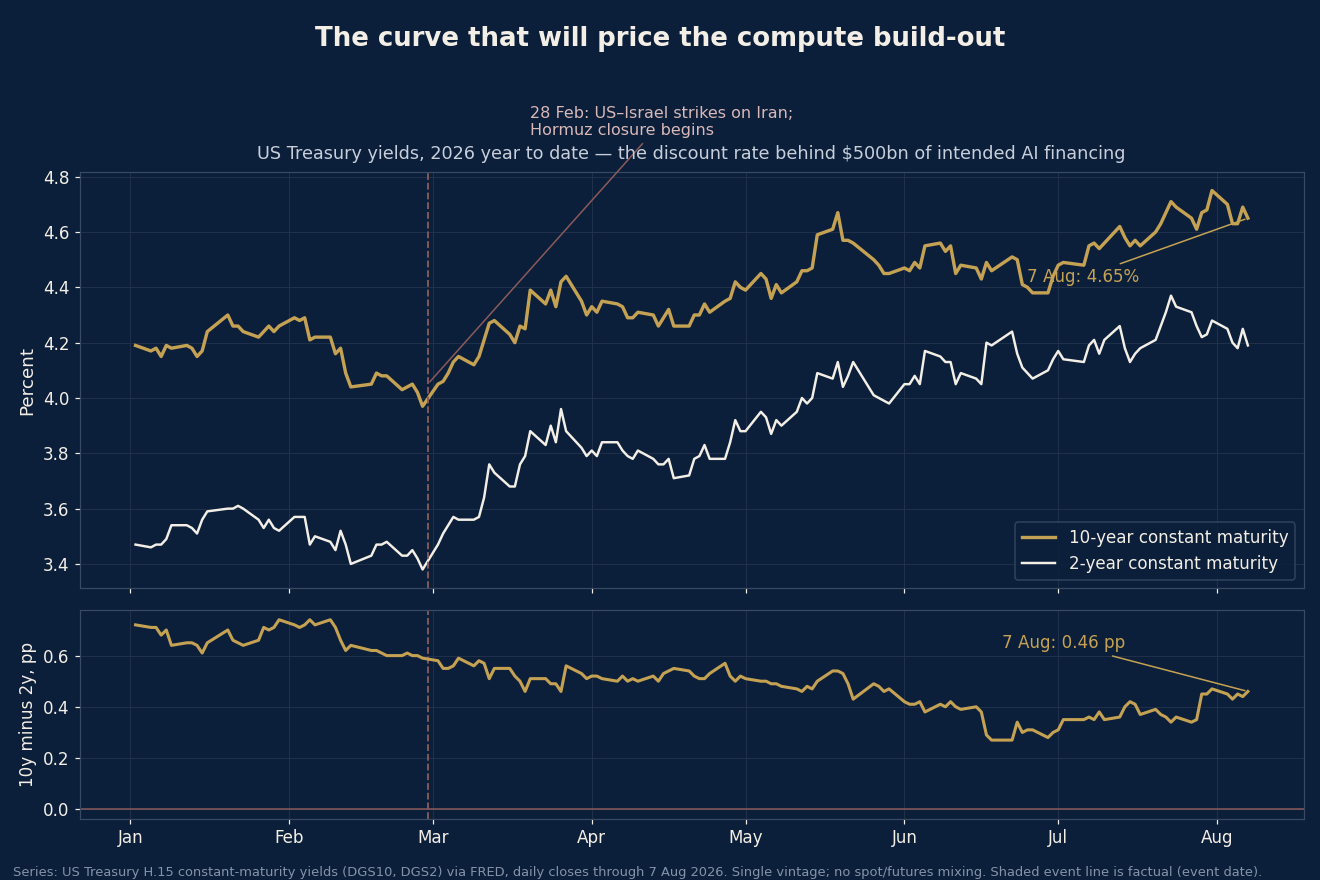
- US consumer prices, Wednesday 12 August; producer prices, Thursday 13 August. The prints land with St. Louis Fed president Alberto Musalem on record — São Paulo, 6 August — that policy should put “meaningful restraint on underlying inflation,” and expressing a preference to raise rates.S19 An upside surprise may raise market-implied odds of a September hike; any effect on defined-benefit liabilities depends on valuation rules, duration and hedging — mechanically, a higher discount rate lowers reported liabilities even as it marks growth assets down. Nothing about Wednesday’s number is a fact until the Bureau of Labor Statistics publishes it.
- Rhine forecast checkpoint, Friday 14 August — the waterways administration’s ~4cm projection for Kaub either verifies or it does not.S8
- California SB 253 — the first-year deadline is 10 November, not 10 August. Anyone still working to an August date is working to a superseded one: CARB deferred the initial Scope 1 and Scope 2 emissions reports under the Climate Corporate Data Accountability Act to 10 November 2026 through expedited rulemaking, with Scope 3 beginning in the 2027 cycle. It binds companies above $1bn of revenue doing business in California — which is to say a large share of any US equity book.S37
- Britain’s grid gets a live test on Wednesday, under rules that took effect this week. For the first time, the National Energy System Operator can call rotating, short-notice electricity disconnections to stabilise the system without first obtaining emergency government powers.S45 The first operational test arrives with Wednesday’s solar eclipse: NESO forecasts a drop of roughly 700 MW of British solar output and considers up to 1.3 GW possible on historical modelling, with up to 95% of the sun obscured between 6pm and 8pm — against roughly 9.7 GW of solar lost across Europe. NESO describes the disconnection protocol as a last resort for extreme and unlikely circumstances, and no activation notice has been issued; a predictable two-hour astronomical event is not a crisis. The durable point for anyone financing compute is narrower: in a system this tight, firm power is a contractual status rather than an assumption, and protected-site standing and on-site generation become diligence items on any asset whose economics require continuous load.
- NOAA G1 window, Wednesday 06–09 UTC — greatest expected Kp 5.00 (G1, minor) in the SWPC three-day forecast issued this morning. Minor scale; no broad grid impact expected at this level.S24
13 · The Universal Owner Risk Radar
Each item carries a dated observation and a link to the issuing feed or catalogue.
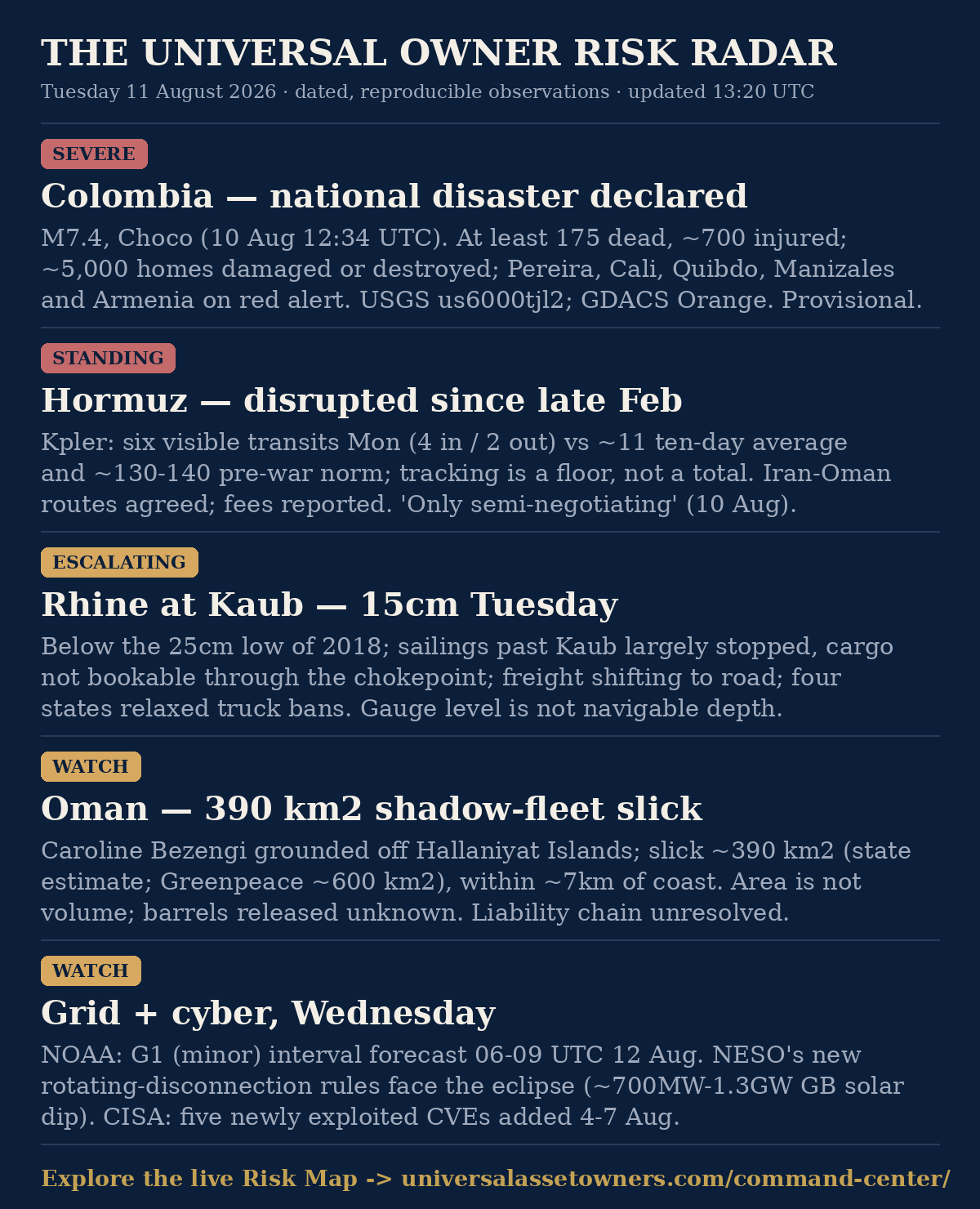
- Colombia — M7.4 earthquake, Chocó. 10 August, 12:34 UTC; national disaster declared, at least 175 dead, ~700 injured (11 Aug); GDACS Orange. Figures provisional. → USGS event page · GDACS
- Hormuz — severe disruption since late February. Kpler counted six visible transits on 10 August (four in, two out) against a ten-day average of about 11 and a pre-war norm of roughly 130–140; tracking data are an observable floor, not a complete count. Iran–Oman route coordinates agreed; Iran reported to demand transit service fees; White House: “only semi-negotiating.” → Reuters/Kpler, 11 Aug · Fortune, 7 Aug
- Rhine at Kaub — record low, ~4cm forecast by Friday. Shipowners warn of a river “split in two”; four states relaxed trucking curbs 8–10 August. → Insurance Journal, 10 Aug · Argus
- Oman — a sanctioned tanker’s slick reaches roughly 390 km². Oman’s Environment Authority said on Monday the spill from the grounded Caroline Bezengi — a shadow-fleet vessel carrying close to a million barrels of Russian crude, aground off the Hallaniyat Islands near a nature reserve since trouble was first reported on 8 June — covers about 390 square kilometres and has come within about 7km of the coast; no threat to desalination or tourism facilities was reported. Greenpeace put the area nearer 600 km² from satellite imagery last week, and surface area is not discharged volume — the barrels actually released remain unknown. The institutional point: a vessel outside conventional Western insurance can leave remediation, fisheries and coastal-economy costs with a sovereign that neither financed the ship nor bought the cargo. → Al Jazeera, 10 Aug · Insurance Journal
- Space weather — G1 (minor) interval forecast Wednesday. SWPC 3-day forecast issued 11 August 00:30 UTC: greatest expected Kp 5.00, 06–09 UTC window on 12 August. → NOAA SWPC 3-day forecast
- Cyber — five exploited-in-the-wild CVEs added 4–7 August. Progress LoadMaster (CVE-2026-8037), JetBrains TeamCity (CVE-2026-63077), N-able N-central, Apache Tomcat, IBM Langflow — portfolio-company software supply chain, not an IT footnote. → CISA KEV catalogue
14 · Financial conditions
All series via FRED with as-of dates; retrieved 11 August, 06:05 UTC. Monday’s market closes are reported in the text with their own sources; the series below carry their own vintages and are not being mixed.
| Series | Latest | As of |
|---|---|---|
| St. Louis Fed Financial Stress Index | −0.51 | 31 Jul 2026 |
| 10y−2y Treasury spread | +0.47 | 10 Aug 2026 |
| US high-yield OAS | 2.70% | 7 Aug 2026 |
| VIX | 14.9 | 7 Aug 2026 |
| Broad USD index | 119.06 | 7 Aug 2026 |
Monday’s session, from the close-carrying wraps: S&P 500 −0.06%, Dow −0.11%, Nasdaq 100 −0.34%; the 10-year traded up toward 4.70% intraday and finished near 4.65%.S29 A 5% oil repricing against a subdued VIX is a divergence worth holding in mind all week; which market has it right is the open question, not a settled one.
15 · Chart of the day
16 · The week ahead
- Capex commentary, not capex. CPI Wednesday and PPI Thursday set the discount rate under $500bn of intended compute financing; the first platform term sheet — if one appears — is the print that tells you whether obsolescence is being priced as permanence.
- Semiconductor policy is becoming water-and-grid policy. Seoul announced a ₩5 trillion (about $3.5bn) semiconductor fund for materials, components, equipment and fabless firms, plus a further ₩5 trillion of trade finance for export suppliers — and, in the same package, 650,000 tonnes of water supply by 2030 for Honam projects and 14.7 GW of power for the Yongin cluster by 2041, with a Mega Special Zone Act sought to speed permitting.S43 Those utility figures are plans with 2030 and 2041 dates, not delivered capacity, and should never be read as current supply. The discipline they impose is the useful part: an investment committee underwriting a fab or a compute campus should model water, grid connection and permitting on the same schedule as the project finance, because capital can be fully committed while the asset remains unusable.
- The demand side of compute: efficiency is being treated as capacity. Malaysia — where data-centre build-out is a live driver of electricity demand — adopted a ten-year national energy-efficiency action plan targeting an 11.6% reduction in energy demand, cumulative savings of 815,382 terajoules and RM85.24bn (about $21.5bn) in utility savings by 2035, with 26.1 million tonnes of CO₂-equivalent avoided.S36 These are modelled targets, not delivered savings, and the plan’s treatment of data-centre load is the detail worth reading. The structural point for an allocator: where new generation cannot be built fast enough, avoided demand becomes the marginal capacity asset — and cooling, controls, retrofits and performance contracting become an infrastructure pipeline rather than a reporting line.
- The oil / volatility / credit divergence. Crude settled ~5% higher on Hormuz stall; the VIX sits near 14.9 and high-yield spreads at 2.70% (7 August vintages). The war premium sits in one asset class out of three. That is a divergence to watch converge — not proof that any one market is wrong.
- Insurance advisories. Repricing of conditional permanence appears first in insurance advisories — Rhine low-water surcharges, Hormuz war-risk quotes under a reported fee regime, and the first Colombia catastrophe estimates — before it registers in any other market. A desk that reads advisories as a leading indicator sees this week’s repricing before the tape does.
17 · Scenario · Compute as collateral
Base case and escalation triggers. Built 11 August 2026, horizon weeks to three quarters.
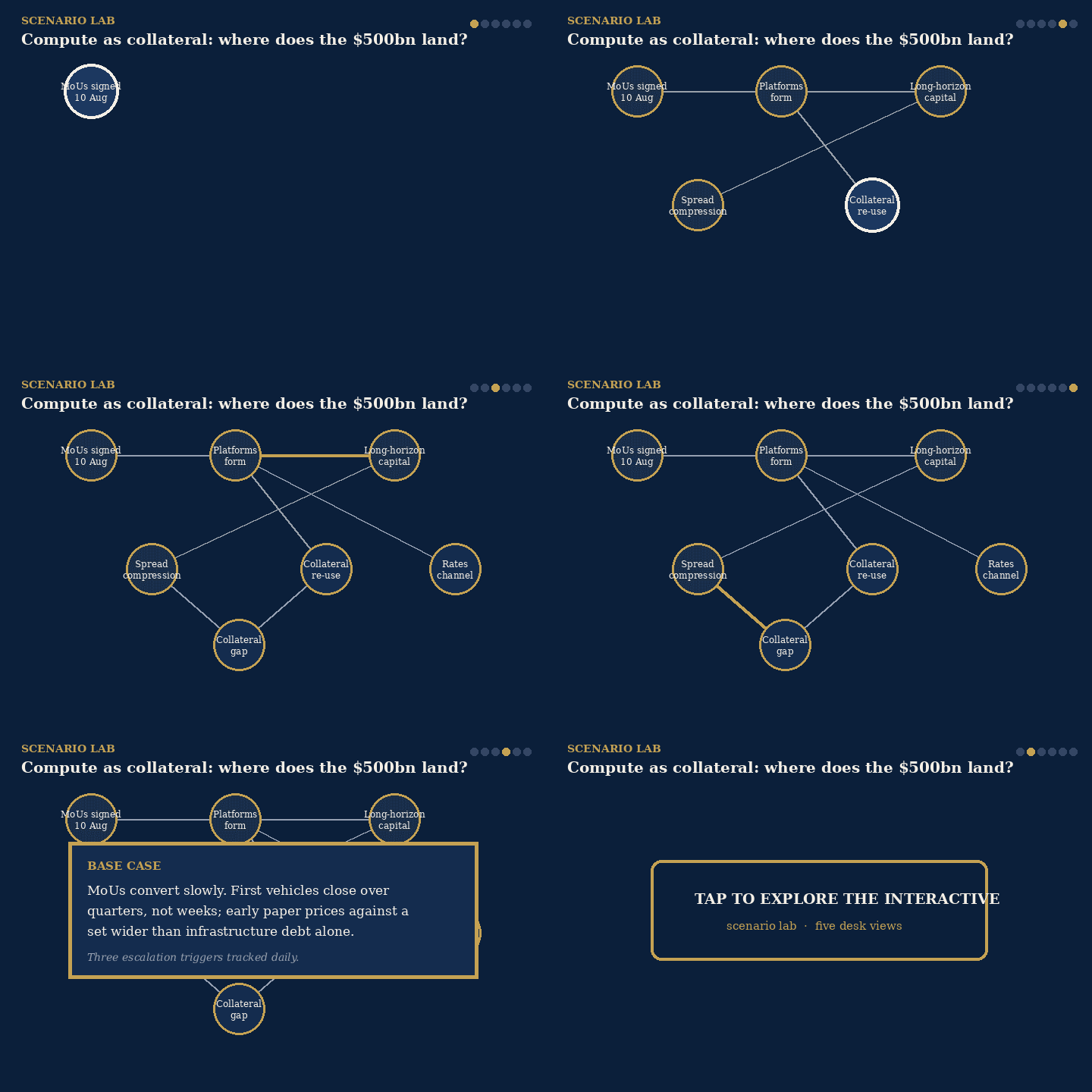
Base case: MoUs convert slowly; first vehicles close over quarters, not weeks, at modest size; early paper prices against a comparison set wider than infrastructure debt alone. No single probability captures this; the interactive scenario sets out the base case, the three escalation triggers, and the observable test that would move each.
It escalates if a first platform deal prices inside comparable infrastructure debt; a hyperscaler pledges deployed GPU fleets against non-AI borrowing; or GPU resale values fall more than 30% year-on-year while platform loan-to-values hold.
Open the interactive scenario →
18 · Podcast · The Universal Owner
The chip becomes a toll road · 7 minutes.
Apple Podcasts Spotify Podbean
19 · The Back Page — meet The Allocator
The Allocator is our resident universal owner: a composite chief investment officer who holds a slice of nearly everything, cannot diversify away from a systemic problem, and takes the day’s contradiction personally. Today they were brought a loan book whose collateral is a warehouse of processors.

20 · The contradiction, in one line
Monday produced roughly $2 trillion of announced ambition — Nvidia’s $500bn of intended mobilization, Morgan Stanley’s $1.5trn to be facilitated — while two announcements crossed firmer execution thresholds the same day: $8.2bn of EPC contracts awarded in Abu Dhabi, and an equity offering priced in Santa Clara that is expected to produce about $19.7bn of net proceeds if it closes on Wednesday. Neither is cash deployed on Monday, and neither adds to the ambition totals — they are different legal stages, which is the point. The market spent the day extending infrastructure treatment — long-duration, collateralized, toll-road economics — to hardware that loses value in three years, with the vendor offering to backstop a quarter of the paper. Meanwhile the assets that genuinely cannot be moved spent the day proving conditional: a strait down to six visible transits from a hundred and forty, a river forecast impassable by Friday, and 71% of England in drought. Capital is buying permanence precisely where it does not exist, and discovering the price of it precisely where it was assumed.
21 · Careers
Premium research, probability-weighted scenario analysis, weekly research calls and board-ready briefings for sovereign funds, pensions, endowments, family offices and institutional allocators.
View membership tiers →22 · Sources
Every material claim above carries a marker into this ledger. Primary or first-party sources are used where available.
- NVIDIA Newsroom, “NVIDIA Partners With Apollo, BlackRock, Blackstone, Brookfield, Goldman Sachs and KKR to Establish AI Compute Infrastructure Financing Platforms to Mobilize Over $500 Billion of Third-Party Capital,” 10 August 2026 (primary).
- CNBC, “Nvidia lines up $500 billion in financing as CEO Jensen Huang tells CNBC his chips are ‘investable asset’,” 10 August 2026.
- Bloomberg, “Nvidia, Wall Street Firms in Talks on $500 Billion AI Funding, FT Reports,” 10 August 2026.
- NBC News, “Nvidia partners with Wall Street giants to raise $500 billion for AI buildout,” 10 August 2026.
- Ontario Teachers’ Pension Plan, “Ontario Teachers’ delivers 9.5% total-fund net return in first half of 2026,” 10 August 2026 (primary).
- BNN Bloomberg, “Ontario Teachers’ earns 9.5 per cent net return for first half of 2026,” 10 August 2026.
- Yahoo Finance, “Ontario Teachers’ pension plan posts 9.5% return, boosted by $8.7 billion SpaceX stake,” 10 August 2026.
- Insurance Journal, “German Shippers Warn Rhine Could Be ‘Split in Two’ by Low Water,” 10 August 2026.
- Argus Media, “Rhine oil traffic stops as water still dropping: Update,” August 2026.
- CNN, “Extreme weather is drying up Europe’s rivers in a crisis so dire it can be seen from space,” 5 August 2026 (context).
- Hapag-Lloyd, “Here’s an update on the Rhine River low water surcharge,” July 2026 (standing surcharge notice).
- The Washington Times, “Iran, Oman agree to new shipping routes in Hormuz as Washington, Tehran circle new agreement,” 5 August 2026.
- Fortune, “The emerging deal to reopen the Strait of Hormuz reportedly recognizes Iran’s control,” 7 August 2026.
- CNBC, “U.S. oil rises back above $82 as doubt grows Washington and Tehran will reach Hormuz deal,” 10 August 2026 (carries the WTI $82.13 / Brent $87.72 settles).
- USGS, “M 7.4 — 5 km S of San José del Palmar, Colombia,” event page, 10 August 2026 (primary).
- CNN, “Colombia earthquake” live updates, 10 August 2026 (initial-toll reporting; superseded by the 11 August Reuters count).
- CBS News, “Strong earthquake strikes western Colombia, killing over 100 people,” 10 August 2026.
- Al Jazeera, “Saudi Arabia, Pakistan and Turkiye sign defence deal amid regional turmoil,” 7 August 2026 (context).
- Bloomberg, “Fed’s Musalem Calls for Meaningful Restraint on Inflation,” 6 August 2026.
- Federal Reserve Bank of St. Louis (FRED), US Treasury H.15 constant-maturity series DGS10 and DGS2, closes through 7 August 2026 (primary data).
- FRED, St. Louis Fed Financial Stress Index, −0.51, 31 July 2026.
- FRED, ICE BofA US High Yield OAS, 2.70%, 7 August 2026 (FRED attribution; as-of date shown).
- FRED, CBOE VIX close, 14.9, 7 August 2026; Monday session wraps reported the same 14.9 level on 10 August.
- NOAA Space Weather Prediction Center, 3-Day Forecast, issued 11 August 2026 00:30 UTC (primary).
- CISA, Known Exploited Vulnerabilities catalogue, entries added 4–7 August 2026 (primary).
- GDACS, Orange earthquake alert, Colombia, 10 August 2026.
- Polymarket, “Iran charges Hormuz fees by December 31?” — Yes 56%, ~$99,900 volume, snapshot 11 August 2026 06:00 UTC (crowd odds, labelled).
- Straits.live, “Strait of Hormuz Closed, Day 163 — Live Tracker,” retrieved 11 August 2026; transit counts as reported by the tracker.
- TS2 market wrap, “Stock Market Today,” 10 August 2026 (carries the index closes; 10-year intraday range corroborated by CNBC US10Y).
- Rigzone, “Oil Climbs as Hormuz Deal Remains Elusive,” 10 August 2026 (corroborates the Monday settles).
- Universal Asset Owners Newsroom, “HKMA’s Hong Kong Equity Exposure: 1998 Origins, an HK$11.8 Billion First-Half Drag,” 10 August 2026 (response-led; HKMA statement on the record).
- Universal Asset Owners Newsroom, “KENFO’s 29% Private Markets Target Faces a €2.8 Billion Liquidity Test,” 6 August 2026 (response-led; KENFO statement on the record).
- Bloomberg, “Latest Oil Market News and Analysis for Aug. 11,” 11 August 2026; Al Jazeera, “Oil prices climb as Iranian demands cloud outlook for Strait of Hormuz,” 10 August 2026.
- Businesswire, “Morgan Stanley Launches the U.S. Innovation Infrastructure Initiative, Facilitating Approximately $1.5 Trillion to Support America’s Next Era of Growth,” 10 August 2026 (company release).
- Copernicus Climate Change Service monthly climate bulletin, reported 10 August 2026 — western Europe’s hottest June–July on record at 21.62°C, soil moisture below July 2022, low flows on Seine/Rhine/Danube; via Al Jazeera and Euronews; ERA5 reanalysis methodology at climate.copernicus.eu.
- New Straits Times, “Malaysia targets RM85.2bil energy savings by 2035 under efficiency plan,” 10 August 2026; corroborated by The Edge Malaysia.
- Proskauer, “CARB Defers Initial SB 253 GHG Emissions Reporting Deadline to November 10, 2026”; see also Mayer Brown, August 2026.
- Reuters, “Nvidia partners with Wall Street giants to raise $500 billion for AI buildout,” 10–11 August 2026 — carries Jensen Huang’s statement that Nvidia has the option to backstop up to $125bn, or 25% of potential deals, and that terms, individual commitments and timetable were not disclosed.
- ADNOC Gas, “ADNOC Gas Delivers Resilient Q2 Net Income, Takes FID on Major Growth Projects,” 10 August 2026 (company release); contract split per World Oil.
- Intel, “Intel Announces Upsize and Pricing of $20 Billion Common Stock Offering,” 10 August 2026 (company release; 210,526,315 shares at $95, ~$19.7bn net, expected close 12 August), superseding the $15bn proposal announced the same day.
- UK Environment Agency / National Drought Group, “More areas in England declared in drought after record dry July,” 10 August 2026 (primary).
- Reuters, “Gulf shipping traffic via Strait of Hormuz falls to six vessels,” 10–11 August 2026, citing Kpler vessel-tracking data as of 04:20 GMT.
- Reuters, “South Korea to launch $3.5 billion chip fund, speed development of semiconductor hubs,” 10 August 2026.
- US Securities and Exchange Commission, Division of Corporation Finance / Office of Structured Finance, interpretive letter, “Certain Data Center Securitizations,” 29 July 2026 (primary); analyses via Latham & Watkins and Alston & Bird.
- Reporting on the Great Britain rotating-disconnection code change effective August 2026 via PA; eclipse load forecasts (~700 MW GB, up to 1.3 GW; ~9.7 GW Europe) via Trending Topics, citing NESO; statutory framework at Electricity Supply Emergency Code.
- Macquarie Group, “Anthropic, Macquarie Asset Management, and GIC announce strategic partnership to develop dedicated data center infrastructure at scale,” 10 August 2026 (joint release, primary); corroborated by HPCwire.
- Reuters, “Rhine water levels fall to new lows, some ship sailings halted,” 11 August 2026 — Kaub at 15cm Tuesday against the 25cm low of 2018; sailings past Kaub largely stopped.
- Reuters, “Colombia rescue efforts press on after quake, death toll expected to rise,” 11 August 2026 — superseded by CNN live updates, 11 August: national disaster declared, at least 175 dead, ~700 injured, ~5,000 homes damaged. Provisional.
- CPP Investments, “CPP Investments and HSI form joint venture to acquire landmark Hilton hotels in Brazil,” 10 August 2026 (primary); Prestige Hospitality Ventures framework per NSE filing, 10–11 August 2026.
- Milliman, “Pension Funding Index July 2026” — 112.1% funded, $139bn surplus; discount rate 6.02% (+41bp); assets −1.55%.
- Reuters, “Phillips 66, Kinder Morgan and HF Sinclair sanction $5 billion Western Gateway Pipeline,” 10 August 2026; Mohawk Council of Kahnawà:ke, sovereign wealth fund restructuring release, 10 August 2026.
Sources checked through 11 August 2026, 06:30 UTC. Material claims are linked to named sources; primary or first-party sources are used where available. Not investment advice.