
UAO Daily Brief — Friday, July 17, 2026
Vol 1, Issue 63 · The Universal Owner
Recency floor: July 15, 2026. Every dated item below is verified to a named primary source.
AssetOps Chicago — August 11, 2026. The operating-model summit for institutional asset owners and allocators. Register →
Lead — The market has stopped charging for the war
Wednesday night's wave of U.S. airstrikes on Iran was, by the U.S. military's own count, the sixth consecutive night of the campaign — and the first to reach targets near Tehran, per Iranian state media (CNN, Jul 16; Euronews, Jul 16). CENTCOM said the strikes targeted "Iranian command centres, air defence sites, missile and drone capabilities, and coastal surveillance facilities" to reduce Iran's ability to disrupt Hormuz shipping; U.S. forces also hit an oil tanker near Kharg Island attempting to skirt the blockade (NPR, Jul 15). Iran answered with missile and drone attacks on facilities used by U.S. forces at Ali Al Salem Air Base in Kuwait, Sheikh Isa Air Base in Bahrain, and Jordan's al-Azraq Air Base (Al Jazeera, Jul 16). Iran's Health Ministry says at least 35 people have been killed and more than 300 injured since fighting resumed. Traffic through the Strait — the corridor for roughly a fifth of global oil and LNG trade — continued to dwindle (Bloomberg, Jul 16).
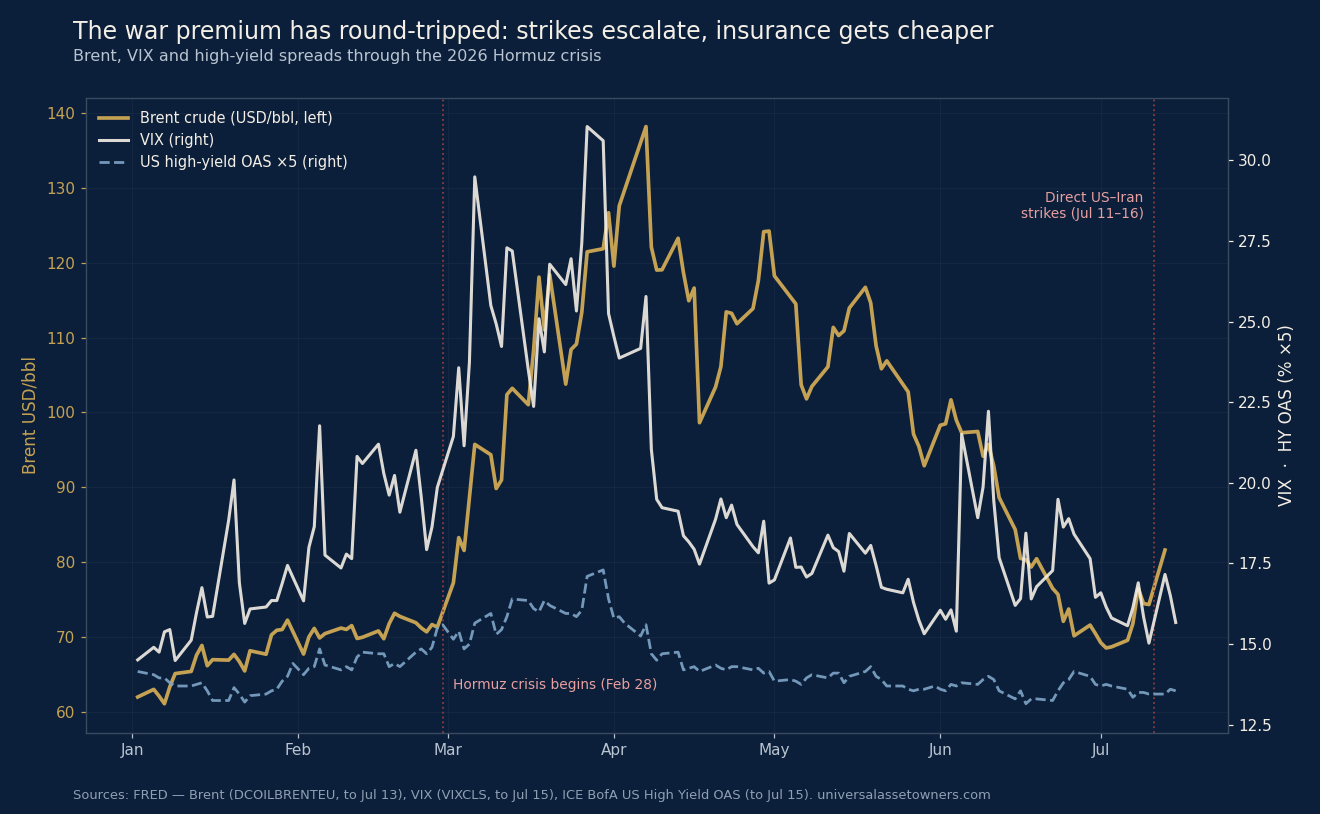
Now look at what the market charged for all of that. Brent settled near $84.63 on Jul 16, down 0.37% on the day (settle data) — near a one-month high, but flat into a live escalation. The VIX closed at 15.67 (Jul 15, FRED). U.S. high-yield spreads sat at 2.71% (ICE BofA HY OAS, Jul 15, FRED) — historically tight. And Bank of America's July Global Fund Manager Survey, published Jul 14, found the most bullish positioning since February, with average cash at 3.6% — below BofA's own 4.0% "sell signal" threshold and down from 4.1% in June (Reuters via US News, Jul 14). BofA counts only 16 prior readings at 3.6% or lower since 2002; on average, global equities fell about 1% over the following two weeks.
Yesterday's brief warned that June's energy-led disinflation survives only until it makes contact with Gulf risk. The contact happened — and the tape barely moved. That is not resilience; it is a market that has re-classified a shooting war at the world's most important energy chokepoint as background noise, at the exact moment positioning has left no cash buffer for being wrong. For the universal owner, the risk premium has migrated: it is no longer priced into the assets — it is embedded, unpriced, in the physical world the assets depend on.
Implication for owners: when hedges are this cheap against a risk this visible, the trade is not to predict escalation — it is to notice that insurance is being given away. Review energy-shock and Hormuz-closure stress tests while option-implied and credit pricing still charge peacetime rates.
The Decoupled Tape
A cinematic short (~5 minutes) on the war the market refuses to price — the physical tape, the financial tape, and the gap between them. Watch it before the deep dive.
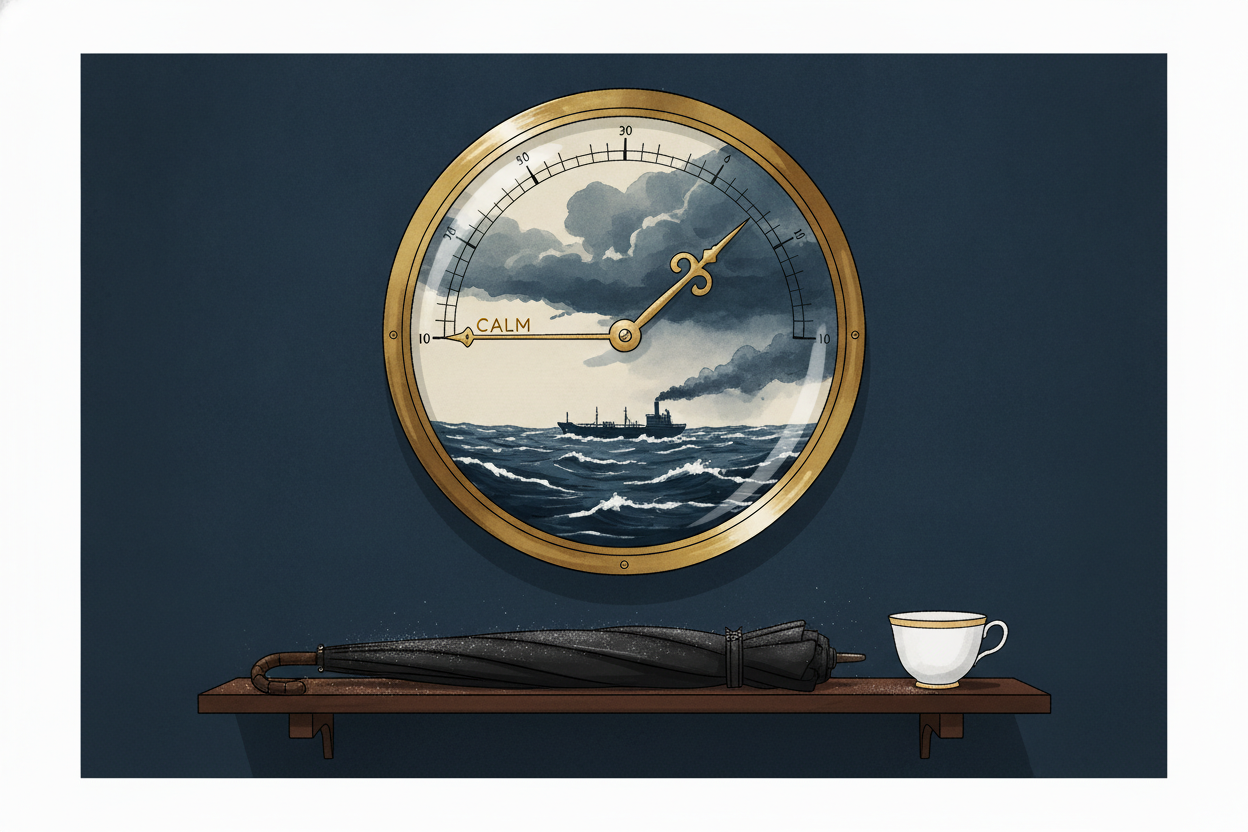
War-risk premiums, credit spreads, volatility and cash buffers have all compressed while a shooting war runs at the world's most important chokepoint. Where the premium went — and what to pay for insurance when the market stops selling it honestly.
A record quarter met a full market: TSMC's 77% problem
TSMC reported second-quarter results on Jul 16: revenue of US$40.20bn (+33.7% y/y in USD; +36.0% y/y in NT$), net income +77.4% y/y to NT$706.56bn, gross margin 67.7%, and guidance for Q3 revenue of $44.6–45.8bn (TSMC release, Jul 16; SEC 6-K). Advanced nodes — 7nm and below — supplied 77% of wafer revenue.
The stock fell more than 4%, dragging the Nasdaq down 1.47% and the S&P 500 down 0.51%; the S&P technology sector lost 2.28% (CNBC, Jul 16; Schwab). A 77% earnings increase that produces a 4% decline is not a verdict on the company — it is a verdict on the buyer base. The same BofA survey that found cash at 3.6% also found "AI bubble" cited as the top tail risk for the first time. When the marginal buyer is already fully invested, record fundamentals stop moving prices — positioning does.
Implication for owners: distinguish the AI cash-flow story (intact, and accelerating at the foundry layer) from the AI pricing story (exhausted at current positioning). The first is a decade trade; the second is a quarter trade wearing the first's clothes.
Macro — strong data, hawkish voices, and a policy rate that isn't moving
The Jul 16 data run came in solid: June retail sales +0.2% m/m (in line; ex-autos −0.2% against +0.2% expected), initial jobless claims 208,000 (down 8,000, below the 218,000 consensus), and a Philadelphia Fed manufacturing index of 41.4 (Schwab, Jul 16; Marketplace, Jul 16). Dallas Fed President Lorie Logan, verbatim: "I currently believe modestly higher interest rates would better balance the outlook and risks for the FOMC's dual mandate goals." The Fed's July Monetary Policy Report (Jul 10) keeps the funds target at 3.5%–3.75% (Federal Reserve MPR).
The hawkish turn is not only American. The Bank of Korea raised its base rate 25bp to 2.75% on Jul 16 — its first hike in three and a half years, by unanimous vote, citing inflation pressure driven by war-elevated oil prices and a weak won, with June CPI at 3.2% and a semiconductor-led rebound lifting growth forecasts (Bank of Korea, Jul 16; CNBC). Read that carefully: a central bank at the heart of the AI supply chain just started tightening because of the war the financial tape refuses to price — the clearest official-sector acknowledgment yet that the two tapes cannot stay decoupled forever.
Strong growth data plus a hawkish tilt plus a war-adjacent energy tape is exactly the combination that stresses "cuts are coming" positioning. The St. Louis Fed Financial Stress Index printed −0.882 (Jul 10, below-average stress) and the 2s10s curve is positive at +0.41 — the official dashboard sees calm everywhere the positioning data sees crowding.
Capital-flow watch — the sovereign bid underneath the crowded trade
The items below are from the past two weeks, carried as the structural backdrop to this week's tape — not as breaking news.
Who keeps buying when fund managers are out of cash? Increasingly, sovereign capital. The IE University / ICEX-Invest in Spain Sovereign Wealth Funds Report 2026 counts $15.1 trillion across 109 sovereign funds (+14% on the prior edition) and documents a decisive tilt toward national priorities — AI, infrastructure, energy security — over pure financial return (Reuters, Jul 9; report PDF). Gulf funds deployed a record $53.9bn across 108 transactions in 1H 2026 despite the war (Global SWF via EnterpriseAM, Jul 2), with Mubadala the most active globally at $15.2bn (GulfEconomist, Jul 3), and Abu Dhabi's MGX closed its inaugural AI fund at a reported $49bn (Forbes, Jul 3).
The bid also showed up in fresh mandates this week. Taiwan's Bureau of Labor Funds selected five managers — Amundi, BNP Paribas AM (Europe), Geode, Northern Trust AM (Australia) and State Street Global Advisors (Singapore) — for a $3bn, five-year "Global Climate Transition Passive Infrastructure Securities" mandate, $600m each, benchmarked to the FTSE Global Core Infrastructure ex China TPI Climate Transition Index (BLF announcement, Jul 16; P&I). Note the benchmark: a climate-transition mandate that is also, quietly, a geopolitical filter. And in private credit, Churchill Asset Management closed a ~$400m collateralized fund obligation structured with Seviora Holdings — Temasek's asset-management platform — pairing U.S. junior capital and PE secondaries with Asian private credit, 50/50 (Dechert, Jul 2026): sovereign-linked capital engineering its way deeper into exactly the spread-starved credit market described above.
People & mandates: Ontario Teachers' named Cathy Cranston Board Chair effective Jan 1, 2027, succeeding Steve McGirr — a 32-year BMO veteran and OTPP director since 2019 (OTPP, Jul 16).
The synthesis matters more than any single number: private allocators are fully invested and out of cash; sovereign allocators are deploying at record pace into the same corridors — AI infrastructure, energy, logistics — for policy reasons that do not respond to price. A buyer who does not respond to price is why premiums can stay compressed longer than fundamentals justify — and why they reprice violently when the policy bid pauses.
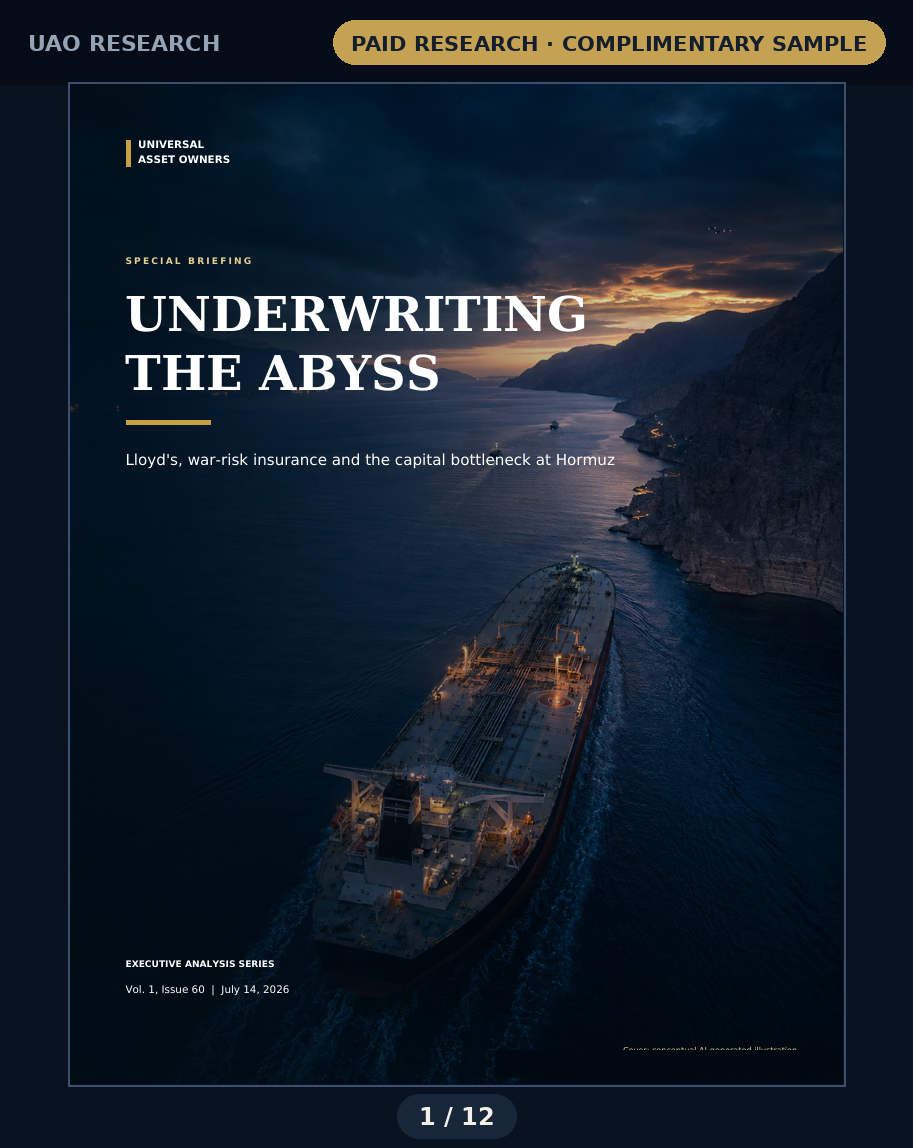
Today’s lead argues the market has stopped charging for the war. This 12-page special briefing shows the one market that never stopped: Lloyd’s and the war-risk underwriters who reprice the strait daily. A complimentary sample of UAO’s paid research — read the full briefing.
The Universal Owner Risk Radar — dated physical & systemic signals
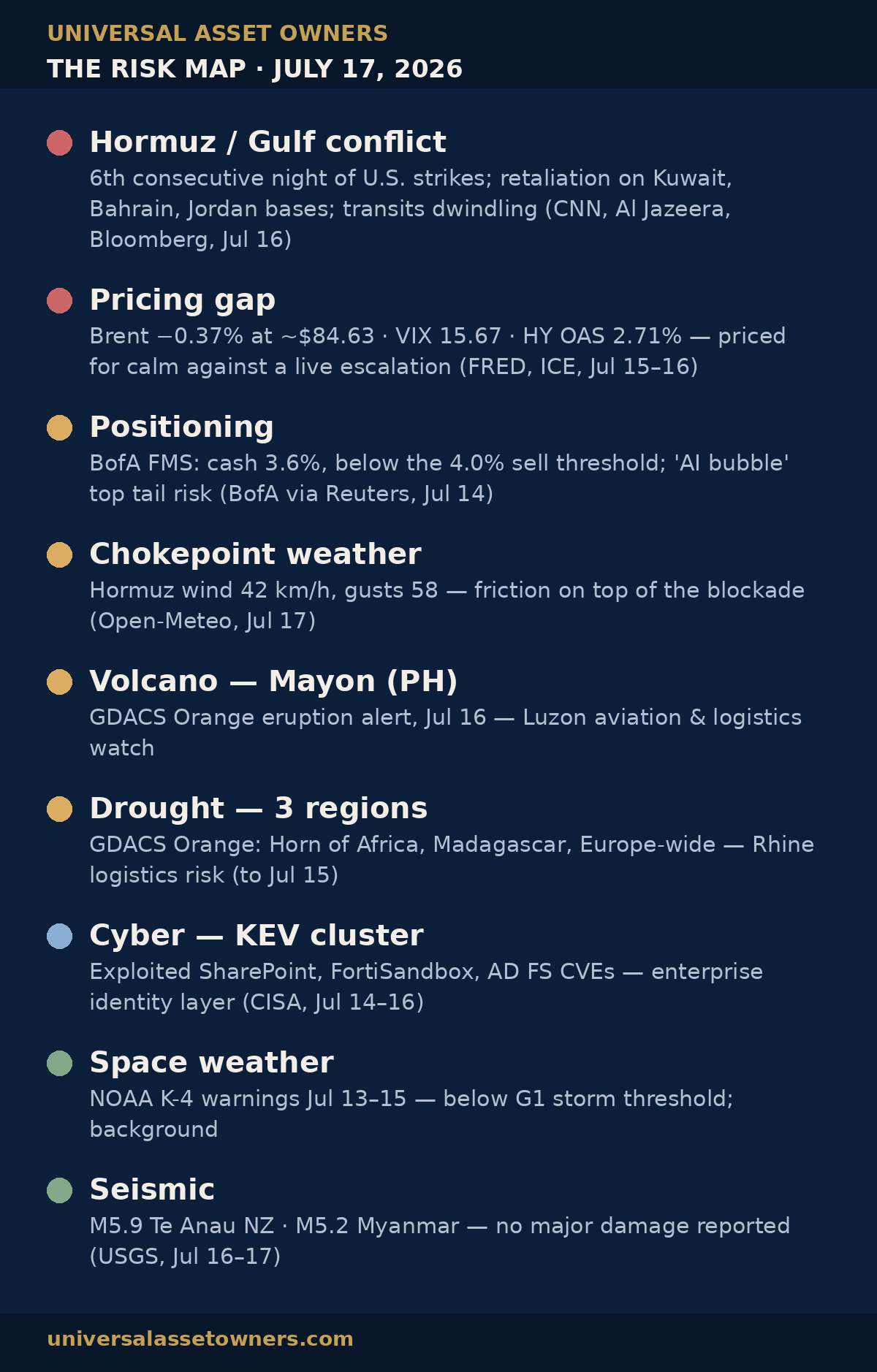
- Energy chokepoint (physical layer): Hormuz wind at 42 km/h with gusts to 58 km/h on Jul 17 (Open-Meteo chokepoint feed) — elevated transit friction layered on the blockade-driven traffic slump.
- Volcano (GDACS Orange): Mayon (Philippines) erupting, alert raised Jul 16 — a Luzon aviation and logistics watch item.
- Drought (GDACS Orange): the standing Horn of Africa (since April) and Madagascar droughts, plus a broad European drought spanning Germany, France, Spain and central Europe — the physical driver behind Rhine-water-level risk to European fuel and industrial logistics.
- Flood (GDACS Orange): the China flood event active since early June remains a supply-chain and insured-loss signal.
- Seismic (USGS, 24h): M5.9 near Te Anau, New Zealand (Jul 16) and M5.2 near Shwebo, Myanmar (Jul 17); no major damage reported at time of writing. Background.
- Space weather: NOAA SWPC issued repeated K-index 4 warnings Jul 13–15 — below the G1 storm threshold; low-severity background, not a portfolio event.
- Cyber (CISA KEV, last 72h): actively exploited vulnerabilities added in Microsoft SharePoint (CVE-2026-58644, CVE-2026-56164), Fortinet FortiSandbox (CVE-2026-25089, CVE-2026-39808) and Microsoft AD FS (CVE-2026-56155) — a cluster in the enterprise identity layer that owners should expect to surface in portfolio-company incident disclosures.
Watch — the next 72 hours
- The war-risk premium itself: whether Brent, tanker war-risk insurance quotes and Hormuz transit counts start charging again for night 7+. The gap between the physical tape and the financial tape is the trade.
- Fed speakers into the blackout: whether Logan's "modestly higher" framing is echoed — a second hawkish voice against 3.6% cash positioning would test the soft-landing consensus quickly.
- AI earnings follow-through: after TSMC's sell-the-record print, watch whether the same pattern hits the next AI-complex reporters — confirmation that positioning, not fundamentals, is setting prices.
- Gulf sovereign announcements: any second-wave AI/infrastructure commitment after MGX's close — the policy bid stepping in exactly where private cash ran out.
OSINT watchlist — UNCONFIRMED, monitor only
Weak signals with named provenance and a confirm/kill test. Watching, not trading.
- Gulf capital — a second wave of sovereign AI-fund commitments after MGX's $49bn close. Status: EMERGING (Forbes reporting, Jul 3). Confirm: a formal close/mandate naming size and targets. Kill: no follow-on within the quarter.
- Europe — Rhine water levels falling toward disruption thresholds amid the GDACS Orange European drought. Status: EMERGING (GDACS, active to Jul 15). Confirm: official gauge readings below critical marks at Kaub. Kill: sustained rainfall normalisation.
- Gulf escalation — strikes extending to Iranian power/energy infrastructure beyond maritime and military targets. Status: EMERGING (CENTCOM statements Jul 16 cover military/coastal targets; energy-grid strikes not confirmed). Confirm: named-facility damage assessments. Kill: de-escalation or talks resuming.
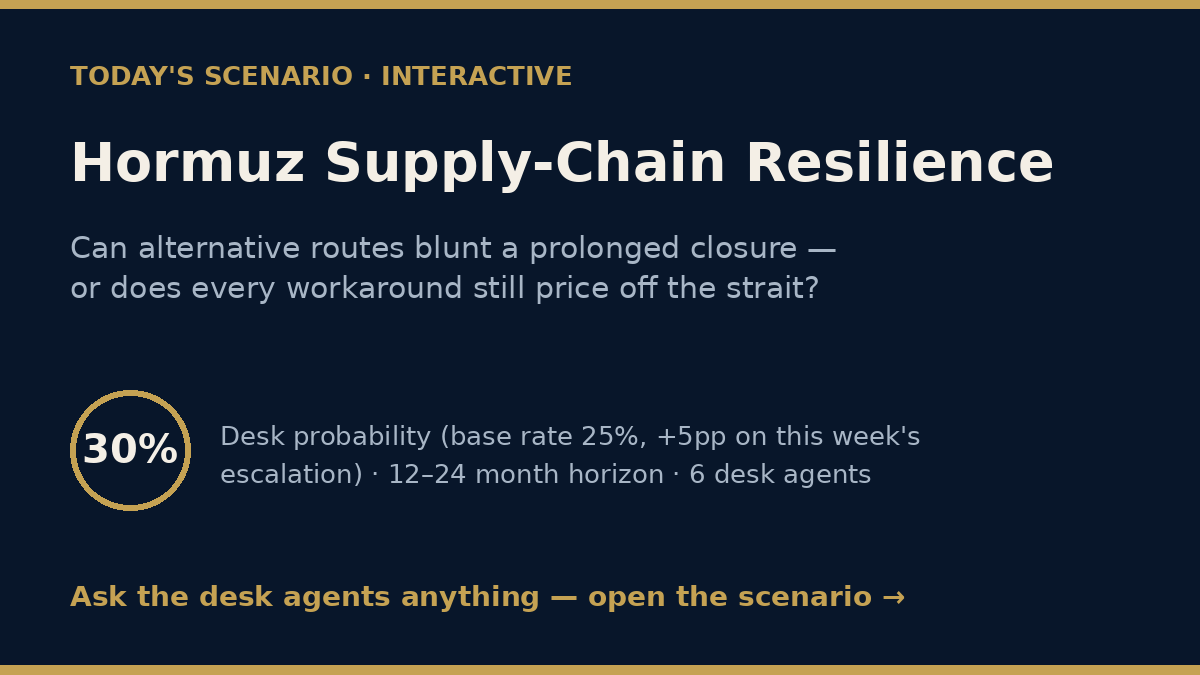
Can alternative supply routes blunt a prolonged closure — or does every workaround still price off the strait? Probe six desk agents — the Sovereign Allocator, Pension CIO, Insurance CIO, Markets Desk, Geopolitical Analyst and Board Member. Desk probability 30% (base rate 25%, +5pp on this week's escalation).
Today's episode (~6.5 min): who is still charging for risk — the two tapes, the three mechanisms, and the TSMC experiment. Sponsored by AssetOps Chicago, by Corinium.
Why Markets Ignore the Gulf War
The most contested question in today's edition, argued from both sides (~23 minutes): is the vanished war-risk premium a rational read of a contained conflict — or a positioning-driven blind spot that ends badly? One voice defends the market's calm: workarounds, spare capacity, a war that has stayed off the sea lanes that matter. The other answers with the mechanics in today's lead — full positioning, industrialised volatility-selling, and a policy bid that never asks the price. Listen for the collision, then decide where your committee lands.
The Back Page — with The Allocator
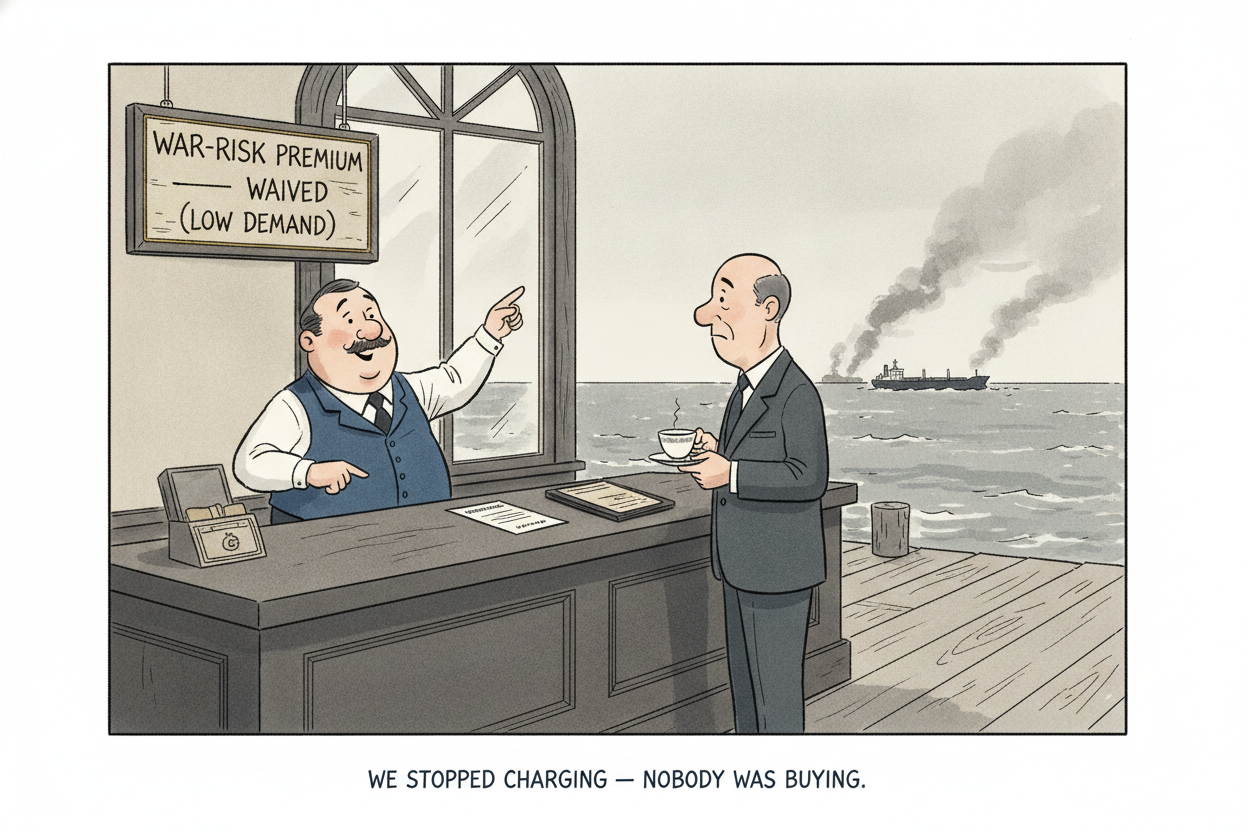
Meet The Allocator: UAO's resident everyman of institutional capital — he owns a small piece of nearly everything, is pitched by everyone, and is rarely surprised, only disappointed by the footnotes. A lighter look at the institutional week, from his desk.
Where the Risk Premium Went
The long-form audio feature on today's theme (~10 minutes): the two tapes that no longer agree, the three mechanisms that silenced the premium — positioning, industrialised insurance, and the buyer who never asks the price — and the four moves an owner makes while insurance is still being given away. Best with headphones.
Source ledger (primary/named, dated)
- U.S. strikes, sixth consecutive night; CENTCOM target list; strikes near Tehran (per Iranian state media); tanker hit near Kharg Island; Iran strikes on Ali Al Salem AB (Kuwait), Sheikh Isa AB (Bahrain), al-Azraq AB (Jordan); ≥35 killed / 300+ injured (Iran Health Ministry): CNN, Al Jazeera, Euronews, France24, NPR (Jul 15–16). Hormuz traffic dwindling: Bloomberg (Jul 16).
- Brent settle ≈$84.63, −0.37% (Jul 16): ICE settle via TradingEconomics.
- BofA July Global Fund Manager Survey (Jul 14): cash 3.6% vs 4.1% June; 4.0% sell threshold; most bullish since Feb; net 24% OW U.S. equities; "AI bubble" top tail risk; 16 prior ≤3.6% readings since 2002: BofA Global Research via Reuters/US News.
- TSMC Q2 2026: US$40.20bn revenue (+33.7% y/y USD), net income +77.4% y/y, GM 67.7%, Q3 guide $44.6–45.8bn, advanced nodes 77% of wafer revenue: TSMC earnings release + SEC Form 6-K (Jul 16).
- Jul 16 closes: Nasdaq −1.47%, S&P 500 −0.51%, Dow −0.20%, tech −2.28%; TSM ADR −4%+: CNBC, Schwab.
- Retail sales +0.2% m/m (ex-autos −0.2%); claims 208k; Philly Fed 41.4: Census / DOL / Philadelphia Fed via Schwab, Marketplace (Jul 16).
- Logan quote (verbatim): Dallas Fed remarks, Jul 16, via Schwab/Marketplace coverage.
- Fed funds target 3.5–3.75%: Federal Reserve Monetary Policy Report, Jul 10. FRED dashboard: STLFSI −0.882 (Jul 10); 2s10s +0.41 (Jul 16); HY OAS 2.71% (Jul 15); VIX 15.67 (Jul 15): FRED.
- IE/ICEX SWF Report 2026 ($15.1tn, 109 funds, +14%): Reuters (Jul 9) + report PDF. Gulf SWFs $53.9bn/108 deals 1H26: Global SWF via EnterpriseAM (Jul 2). Mubadala $15.2bn H1: GulfEconomist (Jul 3). MGX $49bn: Forbes (Jul 3).
- Bank of Korea +25bp to 2.75% (first hike in 3.5 years, unanimous; June CPI 3.2%; oil/won-driven inflation): Bank of Korea Monetary Policy Decision, Jul 16; CNBC, Korea JoongAng Daily.
- Taiwan BLF $3bn climate-transition infrastructure mandate (5 managers × $600m, 5 years, FTSE ex-China TPI benchmark): Bureau of Labor Funds announcement, Jul 16; Pensions & Investments.
- Churchill/Seviora ~$400m CFO (U.S. junior capital + PE secondaries with Asian private credit, 50/50): Dechert client announcement, Jul 2026.
- OTPP: Cathy Cranston appointed Board Chair eff. Jan 1, 2027: Ontario Teachers' announcement, Jul 16.
- Physical signals: Open-Meteo, GDACS, USGS, NOAA SWPC, CISA KEV, Polymarket (Jul 15–17 pulls).
Every material figure above is verified to the named primary source. This is editorial analysis for institutional readers and is not investment advice.