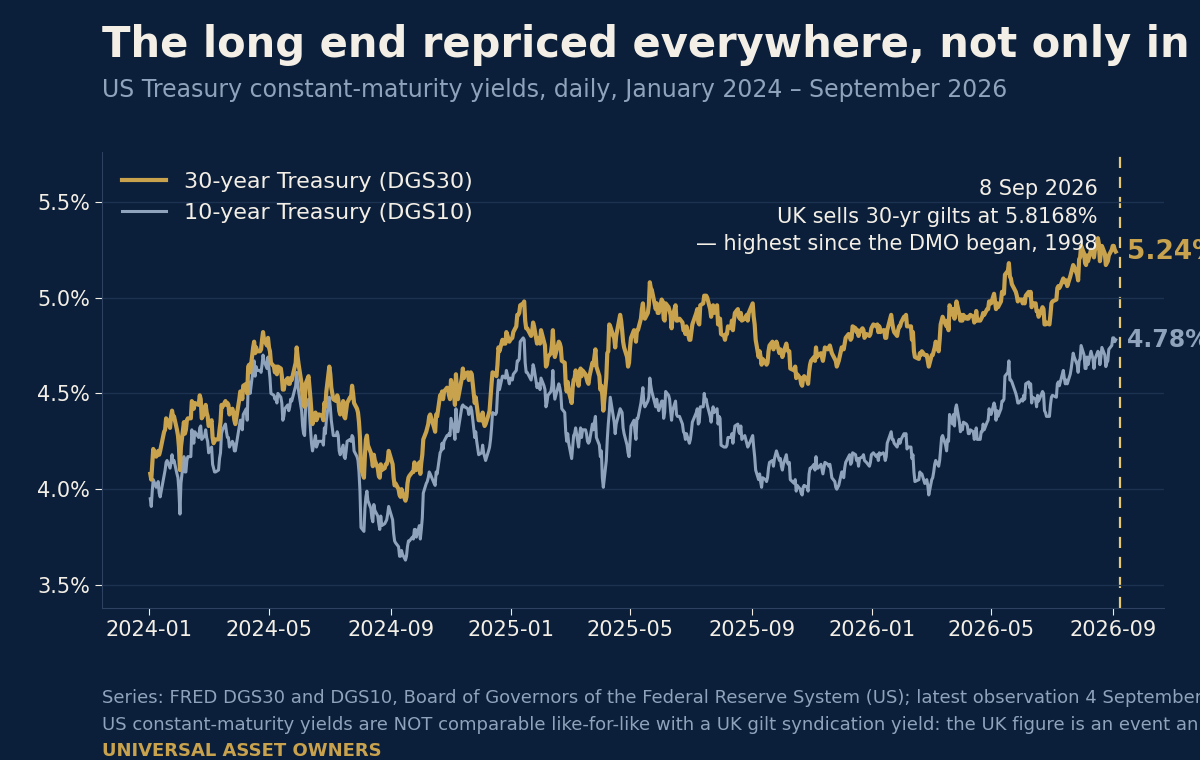
The pool everyone needs is getting bigger — and more concentrated
The world’s 300 largest pension funds ended last year with a record $27.7 trillion. The top 20 alone held $11.9 trillion of it. Around that increasingly concentrated pool, a state-anchored platform has built a capital-raising function, a government is moving a policy liability between its own balance sheets, and Britain has paid the highest 30-year yield in its debt office’s history.
98% of the world’s sovereign wealth funds |
18 of 20 of the world’s largest pension funds |
10 of 10 of the largest charitable foundations |
85% of the world’s largest family offices |
100+ billionaires, every morning |
The number first
The world’s 300 largest pension funds grew assets 13.4% in 2025, the fastest annual increase since 2017, to a record US$27.7 trillion, according to the Thinking Ahead Institute and Pensions & Investments.
The top 20 grew faster still — 14.7%, to US$11.9 trillion — taking their share of the Top 300 to a record 42.8%. Norway’s Government Pension Fund passed US$2.1 trillion and remains the largest, 12.7% bigger than Japan’s GPIF. North America’s share of the Top 300 fell to 44.7% from 47.2%; Asia-Pacific rose to 26.6% and Europe to 24.6%. Defined benefit is still 57.8% of the pool.
The vintage matters. These are December 2025 assets published this week — not live September balances.
What happened around that pool is current
On 7 September, India’s sovereign-anchored National Investment and Infrastructure Fund appointed Gauravjit Singh Managing Partner and Global Head of Capital Formation. He arrives from PAG in Singapore, where he ran investor relations and fundraising for private equity; before that, investor relations at True North and nearly nine years at KKR in Hong Kong. NIIF says it has mobilised roughly US$3 billion of new equity commitments over the past two years, and that Singh will broaden its international and domestic institutional investor base.
Read the title. Not head of investments. Head of capital formation. A platform anchored by the Government of India has built a distribution function and staffed it from a pan-Asian private equity house — which means it now competes for the same pension, insurer and sovereign tickets as the managers its own investors already own.
For roughly two decades the shorthand held: sovereign funds and large pensions deploy; general partners raise. That is breaking, and the institutions it is breaking toward are more concentrated than they were a year ago.
The first question for an investment committee is no longer whether a sovereign-linked asset is attractive. It is which balance sheet ultimately stands behind it — and by what mechanism it can be moved. For every sovereign-linked co-investment, the diligence file should name the legal owner, the economic owner, the guarantor, transfer powers, step-in rights and change-of-control terms. Most co-investment agreements treat transferability as customary boilerplate. Indonesia is about to demonstrate why it is not.
Dispatches
Filed this morning by our correspondents, in their own time zones — what they are seeing on the ground before New York opens.
 | KARACHI · NAVEED IQBAL UAO Correspondent · Contributing Journalist, Digital Assets & Web3 · filed 22:24 local |
Pakistan repriced petrol twice in five days. The buffer between a chokepoint and a forecourt has been legislated away
OGRA notified a Rs12.90 rise in petrol, from Rs345.87 to Rs358.77 a litre, and a Rs3.72 rise in high-speed diesel, from Rs378.05 to Rs381.77, effective 8 September. Four days earlier, petrol was cut by Rs3.13. Both moves came under the daily pricing framework the federal cabinet approved in July 2026, under which OGRA publishes rates against a seven-day rolling average of international product prices.
That seven-day average is the notified basis, per Petroleum Minister Ali Pervaiz Malik. Strait of Hormuz disruption is the context behind it — not the regulator’s stated reason. The strait is open. Traffic is severely reduced, not stopped.
Until July, a fortnightly pricing lag blurred external energy shocks before they reached a Pakistani household. That lag is gone. A risk premium now reaches a forecourt inside seven days, and you can watch it in a single week: cut on the 4th, raised on the 8th.
Three consequences that belong to a universal owner rather than a Pakistan desk. First, the same crude move that marks up an energy sleeve and a Gulf sovereign book marks down importer credit, currency and consumer demand — and a diversified owner holds both sides, now inside the same reporting period. Second, the petroleum levy is Rs80 a litre on petrol, about 22% of the pump price, plus a Rs5 Climate Support Levy; it is volumetric, so state revenue firms while household real income falls. Diesel carries Rs70.82, not Rs80 — the two are frequently and wrongly quoted as one. Third, there is a dated test four days out: the State Bank announces on 14 September, with average CPI at 10.18% across the first two months of FY27 and petrol up Rs38.04 in two months.
Pakistan is the clean read, not the exception. The buffer between a chokepoint and a household is being removed one importer at a time, and here it is removed by statute and visible daily.
 | ASIA-PACIFIC · KHAWAJA OBAID UR REHMAN UAO Correspondent · Contributing Journalist, South & Central Asia · filed 4–8 September |
- Vladivostok — Indonesia arrives as guest of honour, and opens the subsoil. President Prabowo Subianto was principal guest at the 11th Eastern Economic Forum, pressing Eurasian business to use the emerging Indonesia–EAEU free trade agreement to double bilateral trade and calling the Pacific an “economic highway.” He then invited Russian energy companies to bid on 138 newly opened oil and gas exploration blocks, alongside refineries, storage terminals, mineral processing and gas-based fertiliser. Jakarta wants Russian capital and extraction technology to offset declining domestic production.
- Hanoi to Paris — and Moscow first. Vietnam’s To Lam is on a 7–12 September trip taking in both Russia and France, with the International Space Summit in Paris on 9–10 September. The agenda is the 2026–2028 Action Plan: high-tech, transport and rail, renewables and aerospace. Vietnam and France have held a Comprehensive Strategic Partnership since 2024 — France was the first EU state to reach that tier with Hanoi.
- The digital rulebook gets its salesmen. ASEAN Secretary-General Dr Kao Kim Hourn keynoted the DEFA Foresight Forum in Hong Kong on 7 September; the next day Philippine Trade Secretary Ma. Cristina A. Roque named the ASEAN Digital Economy Framework Agreement the key deliverable of Manila’s 2026 Chairship. ⚠️ Corrected against the filed copy: DEFA negotiations concluded 27–29 May 2026 at the 57th ASEAN Senior Economic Officials Meeting — not this week. Signing is targeted for the 49th ASEAN Summit in November. It covers AI, fintech and source-code protection, and is projected to double ASEAN’s digital economy to US$2 trillion by 2030.
Why it belongs beside today’s second item: the government moving a railway’s debt off its sovereign fund next Tuesday spent last weekend offering 138 exploration blocks to Moscow. Both are the same instrument — a state using its balance sheet and its subsoil to raise capital it cannot get on ordinary terms.
 | BOGOTÁ · NICOLÁS ANDRÉS BOHÓRQUEZ CARREÑO UAO Correspondent · Contributing Journalist, The Americas · filed 11:21 local, 8 September |
- Colombia — three negotiations at once. US Secretary of State Marco Rubio arrived for meetings with President De La Espriella on trade, security and narcotics. It lands on an already dense agenda: removal of the 12.5% forced-labour tariff, a corporate tax reform in drafting, and a public warning from the Banco de la República about a 9.4% fiscal deficit projected for 2027. Portafolio
- Argentina — Malvinas pressure reaches the treaty. Sea Lion-linked stocks extended losses to 11.54% across three sessions after Milei’s national broadcast last week. Tierra del Fuego’s Malvinas secretariat has formally asked Congress to repeal the bilateral investment treaty with the United Kingdom — Ley 24.184, which guarantees Britain most-favoured-nation treatment. The same cabinet met separately on an expanded Super RIGI. One government is unsettling South Atlantic energy investors and deepening the onshore incentive architecture that drew foreign capital to Vaca Muerta, in the same week. Infobae
 | LATIN AMERICA · ANTOINE TIGNÈRES UAO Correspondent · Macroeconomic Analyst and Financial Writer · weekly brief, 28 August – 4 September |
A weekly strategic brief rather than a same-day dispatch; the window closes 4 September and is stated on the card.
- Four Andean states put their geology on one table. Chile, Argentina, Bolivia and Peru signed a joint declaration at their first Strategic Minerals Ministerial in Santiago — geological data-sharing, regulatory alignment and joint pursuit of multilateral financing for copper and lithium. Not a cartel, and not capital: an intent framework committing to no specific project. (Reuters)
- ByteDance is building a US$37.7–39 billion campus at Pecém — and Brazil’s grid is the chokepoint. Its largest outside China, powered by a 20-year wind PPA. The government’s PDE 2035 transmission plan, a roughly US$24 billion grid expansion, decides whether the gigawatt-scale target is deliverable. (Bloomberg)
- Alibaba Cloud opened its first South American region in São Paulo with two data centres, following Mexico — adding to 120-plus active Brazilian data centres representing roughly US$88 billion of regional investment. (BNamericas)
- Liontown farms into Argentina’s lithium triangle. A binding agreement to earn up to 100% of NEXT Lithium’s Centenario brine project in Salta: US$40 million staged over four years plus up to US$155 million in milestones. The staging says project-level execution risk — permits, water rights — now matters more to long-horizon miners than headline sovereign risk. (GlobeNewswire)
- Mexico is the counter-example, still without binding capital commitments on critical minerals. Proximity to the US does not crowd in capital absent bankable guarantees and regulatory clarity. (Mexico Business News)
⚠️ Filed with outlet attributions rather than article links; URLs are owed before these items are cited again. Read the Pecém item against this edition’s Finland story: two hyperscalers, two hemispheres, one week, both buying grid and generation rather than compute.
Indonesia is moving a liability. That does not make its value zero
On 15 September, Indonesia’s Finance Ministry takes the 60% Indonesian stake in the Jakarta–Bandung high-speed rail consortium from Danantara, the sovereign investment body, and assumes responsibility for the associated debt through a ministry vehicle. A Chinese consortium retains the other 40%. Finance Minister Purbaya Yudhi Sadewa confirmed the date and mechanism on 8 September (ANTARA; The Jakarta Post).
Note the direction. Most coverage reported the stake moving to sovereign fund INA or to SMI. The state news agency reports it moving from Danantara to the Finance Ministry, with Purbaya saying “it is sufficient to be handled by one SMV under the Ministry of Finance.” A sovereign fund is being relieved of a policy asset, not handed one.
The ministry makes no upfront payment for the equity while assuming future debt service. The restructured debt is reported at annual instalments of around Rp1 trillion — about US$56.7 million — over an 80-year tenor. The ministry also projects the servicing vehicle could earn up to Rp800 billion a year; that is a projection, not a contractual entitlement.
The conceptual point matters more than the arithmetic. Zero consideration does not mean zero economic value. It means the transfer creates no arm’s-length price that an outside investor can use to value either the equity or the liability. Accounting values may still exist; impairment or disposal treatment may still be required. What the structure avoids is a market-clearing price — and a negotiated one would have forced both numbers into the open.
The published terms remain incomplete. The original China Development Bank facility was about US$4.5 billion, originally at 2% fixed for the first 40 years, with roughly 75% of the project’s ~US$7.27 billion cost CDB-financed and a US$1.2 billion overrun funded above 3%. On that original rate, annual interest alone would have exceeded the newly reported instalment.
That does not prove the restructuring is inconsistent. It proves something material has changed: the rate may have been cut, principal reduced, amortisation reprofiled, or a balloon left at the end. The restructured interest rate has not been published. For a long-duration infrastructure investor, that missing number is the story — because a legal owner can change by administrative act, and the question is not who owns this today but who can move it tomorrow, and what happens to your rights when they do.
Britain’s record 30-year yield, and a smaller long-dated programme
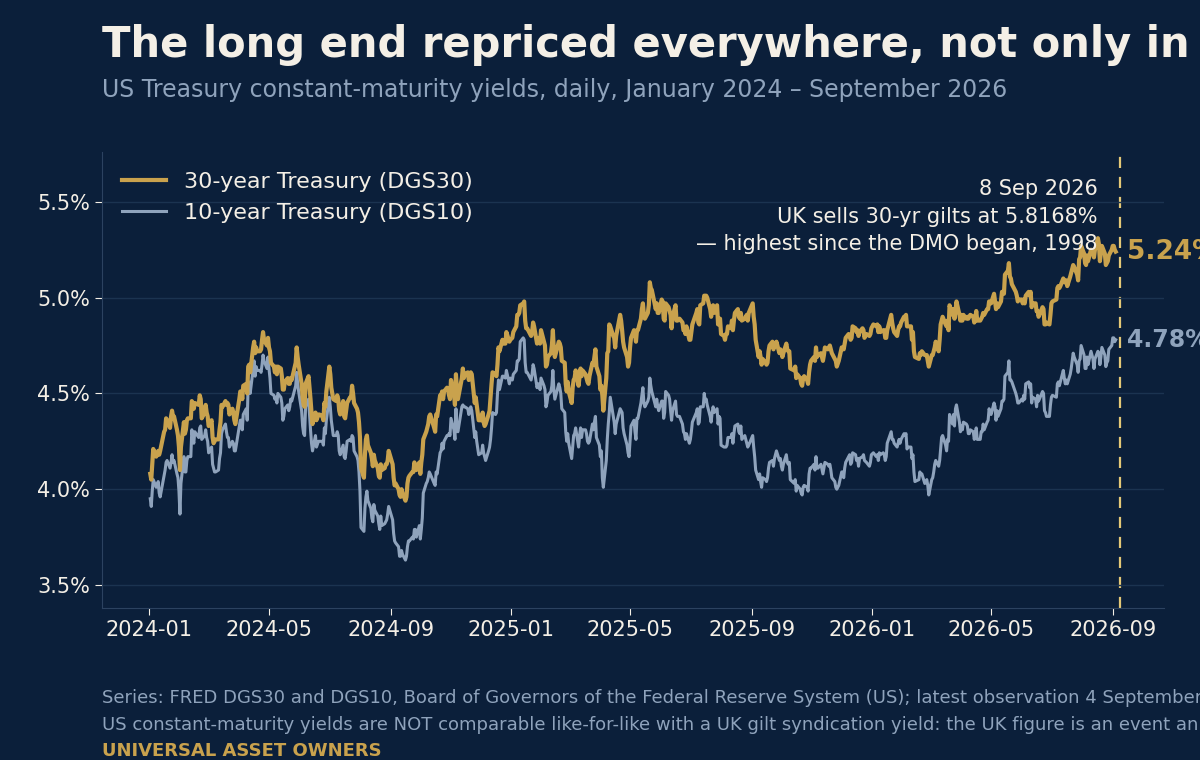
Britain sold £4.25 billion of the 5⅜% Treasury Gilt 2056 on Tuesday at a yield of 5.8168% — the highest at any gilt auction or syndication since the Debt Management Office was created in 1998, above the 5.79% set at auction in May 1998. Orders exceeded £85 billion. Those transaction terms are wire-reported; this desk did not reach the DMO’s own result notice. The gilt itself is a re-opening — launched at £4.0 billion in May 2025 and tapped £1.5 billion at auction that September.
The supply picture comes from the DMO’s own Revision to the DMO Financing Remit 2026-27, 23 April 2026 — the operative document, not the superseded March plan.
| 2025-26 outturn | 2026-27 plan | |
| Total gilt sales | £303.9bn | £246.2bn |
| Long conventional (over 15 years) | £32.7bn | £22.4bn |
| Long conventional, share of sales | 10.8% | 9.1% |
| Initially unallocated — any maturity, any method | — | £29.8bn |
The long-conventional allocation is £7.4 billion across five auctions plus £15.0 billion across three syndications. Tuesday’s £4.25 billion is one of those three.
But do not call it a settled cut. The DMO holds £29.8 billion initially unallocated, issuable at any maturity by any method, and states it may increase the syndication programme by up to 10% at the final non-green offering of each type. Britain has planned a materially smaller long-dated programme and kept the flexibility to change its mind.
Now put that beside pension funding. The PPF 7800 index for August: aggregate surplus up £2.3 billion to £273.6 billion, funding ratio 133.4%, and 3,838 of 4,838 schemes in surplus.
One caveat is essential. That is the section 179 basis, built around PPF-level compensation. It is not a buyout measure, and the PPF warns different measures give different answers. So the conclusion is not “four in five schemes can afford buyout.” It is narrower and still striking: UK defined-benefit balance sheets in aggregate have far more de-risking capacity than a few years ago, at the moment the sovereign has planned a smaller long-dated programme.
And get the sign right, because it is reported backwards constantly. A higher long yield lowers the present value of a defined-benefit liability — which is precisely why the funding ratio is where it is. The pain sits on the asset side: long bonds already held are marked down, and leveraged matching positions face collateral calls into the same move. For a scheme nearing self-sufficiency, the question this week is not whether 5.8168% looks attractive. It is whether the duration will be there in size when it is wanted, and what the substitutes cost.
Britain is reviewing the rights attached to capital in the same week it paid more for capital
A day before the gilt sale, the UK government opened Modernising corporate reporting, published 7 September and closing 11:59pm on 30 November 2026. Its stated objective is “supporting economic growth and strengthening the UK’s international competitiveness.” The proposals cover, in the government’s own list: the corporate reporting framework, financial reporting, non-financial reporting, corporate governance, remuneration reporting, and greater use of digital reporting and communications.
There is no evidence connecting the consultation to gilt issuance, and we do not suggest there is. Two departments, two processes. The useful observation is institutional: the same pools of capital act simultaneously as sovereign creditors and corporate owners, and they care about the return on capital and the rights attached to it. Only one of those two things gets a market price.
Norges Bank Investment Management supplied the counterpoint this week. In its letter of 3 September on the German Corporate Governance Code — Germany is its fourth-largest market, with EUR 75 billion invested, EUR 38 billion of it in listed equities — the fund supports a shorter Code and then draws a line: simplification “does not inadvertently lead to lowering the governance ambitions expressed through the Code.”
Its specific asks are worth reading. Keep recommendation F.2 on 90- and 45-day reporting deadlines — because without it those deadlines “would then rest on the DAX index methodology, which may not cover all the listed companies we invest in and which can be changed by the index provider.” A reporting standard, outsourced to a commercial index committee. More frequent board elections, ideally annual. Former management-board members not treated as independent “until significantly more than two years have passed.” CEO pay settled in shares locked five to ten years and beyond retirement. And on meetings: “hybrid meetings … represent the appropriate standard: remote participation should complement rather than replace in-person attendance.”
Regulatory regimes are diverging. A universal owner cannot plausibly hold one principle for shareholder participation in Frankfurt and another in London because domestic rules evolved differently. The consultation closes 30 November; for a large owner that is not a policy date but an opportunity to put a global stewardship principle on the record.
€13 billion says Finland’s power system is now part of the AI stack
Google said today it will invest at least €13 billion (about US$15.1 billion) in AI infrastructure in Finland over the next two years — at least three new data centres plus expansion at Hamina, with activity in Hamina, Kajaani, Muhos and Vaala. Construction runs across 2027 and 2028. Google estimates it adds about €3.6 billion a year to Finnish GDP and supports more than 37,000 jobs, and describes it as its largest single investment in Europe.
The detail that makes it a universal-owner story: alongside the data centres, Google has signed a 22-year life-extension power purchase agreement with Fortum supporting the Loviisa nuclear plant, which supplies about 10% of Finland’s electricity.
Read that against Washington. On 8 September the US Department of Energy’s Office of Energy Dominance Financing financially closed a loan of up to US$1.9 billion to NextEra for restarting the 615 MW Duane Arnold plant in Iowa, offline since 2020 and still “pending required U.S. Nuclear Regulatory Commission licensing approvals.” The DOE release names the loan, the megawatts and the jobs — and no buyer of the power. The widely reported 25-year Google PPA is not in the document announcing the public credit.
Two reactors, two continents, two days, the same corporate name on the offtake. That is not a series of energy transactions; it is a procurement strategy, and its effect is to convert a hyperscaler’s balance sheet into credit support for nuclear life-extension and restart — the two cheapest sources of firm low-carbon power, and the two markets have been least willing to finance on merchant terms.
Do not read €13 billion as €13 billion of servers. Compute sits at the end of a physical chain: generation, grid connection, substations, storage, cooling, building, then accelerators. A headline AI number is partly a grid number and partly a generation number. What has not been disclosed is how much is grid versus compute, how much new generation must be built, what connection capacity is secured, and when announced spending becomes deployed capital. This is forward investment. None of it is deployed.
Two pensions sold a ten-year infrastructure holding. The price is private
Ontario Teachers’ Pension Plan and Universities Superannuation Scheme have agreed to sell the Westerleigh Group to ICG’s European Infrastructure team after owning it jointly since 2016. Westerleigh operates 42 crematoria across England, Scotland and Wales and has opened 21 since 2016. Completion is expected in Q4 2026, subject to customary regulatory conditions.
The consideration is undisclosed. So is the ownership split between the two sellers, the proceeds, the IRR and the multiple — and no reason for selling is given. Both seller quotes are valedictory.
A decade-long hold in UK crematoria is close to a pure expression of what a universal owner is supposed to do: a long-duration, demographically underwritten service, held patiently and professionalised, with the estate doubled. Doing all of that and disclosing not one number about how it went is legal, common, and a choice. Private owners routinely argue for better disclosure at portfolio companies while disclosing relatively little about their own realised economics. That is not necessarily hypocrisy — competitive information and fund confidentiality are real. But it leaves beneficiaries unable to judge whether a decade of their capital created value. The board question is simple, and it should be answered before the sale rather than after: what performance information are you willing and able to disclose on exit?
Also this week
Temasek and BlackRock-managed funds are committing about $1 billion to Indian airports — but not all at once. Adani Enterprises filed on 9 September that Adani Airport Holdings has binding agreements to raise ₹9,825 crore of primary equity from Alpha Wave Global, Premji Invest, Temasek and BlackRock-managed funds, at a pre-money equity valuation of about US$18 billion, in three tranches with the final expected by July 2027, reaching approximately 5.54% on completion. The platform manages eight airports and serves “over 23%” of India’s passenger traffic. The staging is the point: institutional investors can price execution risk by lowering the price, or by preserving the valuation and making the capital arrive over time against conditions. Here they chose the second. $1 billion committed is not $1 billion deployed, and that distinction belongs in every mention of this deal.
Pantheon bought private-credit duration twice in one day. On 8 September, PennantPark raised US$745 million for a private-credit continuation fund with Pantheon as lead buyer — roughly 100 mostly first-lien loans drawn from seven funds. The same day, Pantheon led a €1.2 billion continuation vehicle for Bridgepoint Credit’s 2017-vintage direct lending portfolio. Continuation vehicles transform and extend risk; they do not extinguish it. Two led by the same buyer on the same day, on two continents, is a fact about buyer concentration in an asset class our readers have spent five years increasing exposure to. The question is not whether these portfolios are sound. It is: when your own manager needs a continuation bid, how many Pantheons are there?
China’s central bank bought gold for a 22nd straight month — and most of the headline rise was price. PBOC data released 7 September show holdings of 76.73 million troy ounces at end-August, up 650,000 ounces — roughly 20 tonnes, the largest monthly addition since October 2023. The reported value of reserves rose to about US$350 billion from US$306 billion, but that increase is overwhelmingly the gold price, not buying. Valuation and flow are different quantities and should not be added. What matters for a reserve manager is that official demand has persisted through a substantial price rise — the opposite of price-sensitive behaviour.
CPP Investments says opportunity is not investibility — and its own headline number needs a currency symbol. Two reports published 8 September find market opportunity leads allocation at 80%, followed by regulatory efficiency and predictability at 72% and policy stability at 69%. Digital and AI infrastructure leads themes at 65%. Among eight developed markets, 94% expect to maintain or increase Canadian exposure, ahead of Japan at 82% and the US at 77%. Two disclosures the coverage will not carry: the reports were developed in support of the Canada Investment Summit that CPP convenes on 14–15 September, and the release states the respondents represent “approximately $65 trillion” with no currency given, while secondary coverage of the same 65 investors reports about US$47 trillion. Sixty-five divided by forty-seven is 1.38 — the Canadian dollar. They are almost certainly the same number in two currencies, and a missing symbol has propagated an apparent $18-trillion discrepancy through several write-ups. Cite the respondent count.
Held, not printed. Nike shareholders rejected an environmental proposal supported by Norges Bank and approved executive compensation NBIM opposed — but the company did not publish vote tallies, and a directional account is not a tally. We are not printing a vote result we cannot source. Separately, US Central Command says it destroyed five IRGC-linked tankers after its warship was targeted twice; CENTCOM is a party to the conflict, no independent damage survey exists, and Iranian counter-claims are likewise unverified. Kpler counted six commodity-vessel transits through the Strait of Hormuz on Tuesday against a ten-day average of about twelve. The strait is open. Constrained is not closed.

Connect the dots
The world’s largest pension funds have never controlled a larger pool of capital, and the largest among them control a growing share of it. Around them, almost every other actor in this edition is doing something different with long-duration risk.
NIIF is building capital-formation capacity. Indonesia is transferring a policy asset and its liability between state balance sheets without producing a price. Ontario Teachers’ and USS are recycling mature infrastructure and disclosing nothing about the outcome. Britain is selling duration at a record cost while planning to issue less of it. Temasek and BlackRock-managed funds are staging capital into Indian airports. Google is converting Finland’s power and grid advantage into AI infrastructure, and underwriting two reactors in two days.
That is not evidence of a shortage of capital. It is evidence that high-quality long-duration capital has become a strategic input — and that the institutions holding it are being asked to absorb risks that used to be priced elsewhere.
Apply one test to each: if this is mispriced, when do we find out? The gilt, immediately and continuously. Adani, by July 2027 or earlier if a tranche is missed. Duane Arnold, at the NRC and not before. Westerleigh, never — no price was disclosed, so no comparable was created. Indonesia, possibly never, because there is no market price for an 80-year bilateral obligation held inside a state vehicle at an undisclosed rate. That ordering is also the order of how confidently anyone should hold a view.
For the largest owners the opportunity is bargaining power. The risk is becoming everybody’s preferred buyer, financing partner and shock absorber at the same time. The question for an investment committee is not what is being offered. It is which risks are migrating toward our balance sheet because of our scale, and what contractual rights are we receiving for taking them.
Thinking Ahead Institute and Pensions & Investments, The World’s Largest Pension Funds (8 September 2026, reporting 2025 year-end assets) · NIIF, NIIF appoints Gauravjit Singh as Managing Partner, Global Head of Capital Formation (7 September) · ANTARA News, RI Govt restructures Whoosh debt to US$56 million annual installments (8 September) · The Jakarta Post, Indonesia to shift controlling stakeholder of China-funded railway next week (8 September) · Indonesia Business Post, Ministry of Finance to take over Whoosh high-speed rail management in Sept 2026 (26 August) · UK Debt Management Office, Revision to the DMO Financing Remit 2026-27 (23 April 2026) · Pension Protection Fund, PPF 7800 index (August 2026) · Department for Business, Innovation, Science and Trade, Modernising corporate reporting (7 September) · Norges Bank Investment Management, Proposed amendments to the German Corporate Governance Code (3 September) · US Department of Energy, Energy Department Closes $1.9 Billion Loan to Restart Duane Arnold Nuclear Plant (8 September) · Adani Enterprises, media release filed with BSE and NSE (9 September) · Ontario Teachers’ Pension Plan and ICG, ICG Infra agrees to acquire Westerleigh Group (8 September) · CPP Investments Insights Institute (8 September) · Daily Times, Govt maintains petroleum levy on petrol at Rs80, diesel at Rs70.82 per litre · Geo, Petroleum rates in Pakistan today · Express Tribune, Govt announces daily petroleum pricing · People’s Bank of China, August reserve data (7 September) · US Central Command, U.S. Destroys 5 IRGC Tankers (8 September).
Universal Asset Owners is institutional research and discussion, not investment advice. Figures are quoted from the sources named above; where a figure could not be confirmed at a primary source it has been labelled or withheld.
Capital in Motion
Stage is stated on every line. Announced is not committed; committed is not deployed.
- Adani Airport Holdings — ₹9,825 crore (~US$1bn) primary equity from Alpha Wave Global, Premji Invest, Temasek and BlackRock-managed funds at ~US$18bn pre-money. Binding agreements; three tranches to July 2027; not deployed.
- UK Debt Management Office — £4.25bn of the 5⅜% Treasury Gilt 2056 at 5.8168%. Issued. Transaction terms wire-reported; DMO result notice not reached by this desk.
- Pantheon — lead buyer on a US$745m PennantPark private-credit continuation fund and a €1.2bn Bridgepoint Credit continuation vehicle, both 8 September. Completed.
- Ontario Teachers’ and USS → ICG Infra — Westerleigh Group, 42 crematoria. Agreed; Q4 2026 completion; consideration undisclosed.
- US Department of Energy → NextEra — loan of up to US$1.9bn for the Duane Arnold restart. Financial close. Reactor offline; NRC approvals outstanding.
- Google → Finland — at least €13bn across 2027–28, plus a 22-year life-extension PPA with Fortum for Loviisa. Announced. None deployed.
- Danantara → Indonesian Ministry of Finance — 60% of PSBI for zero consideration, assuming ~Rp1tn a year for 80 years. Effective 15 September; not yet executed.
- People’s Bank of China — +650,000 troy ounces in August to 76.73m oz, a 22nd consecutive month. Settled. Valuation change is mostly price, not flow.
Risk Radar
- US–Iran maritime escalation. US Central Command says it destroyed five IRGC-linked tankers — Kaviz, Charminar, Horizon 1, Riesco and Derya — after its warship was targeted twice; crews were ordered to abandon ship and the vessels “rendered inoperable.” CENTCOM is a party to the conflict and no independent damage survey exists. Iranian counter-claims are likewise unverified and are not printed here.
- Strait of Hormuz traffic. Kpler counted six commodity-vessel transits on Tuesday against a ten-day average of about twelve. The strait is open. Constrained is not closed, and no percentage is derived from mixing transit definitions.
- Texas interconnection pause. Roughly 49.8 GW of data-centre grid connections paused — about a fifth of the US pipeline — against an ERCOT large-load queue of some 474 GW of requests. Requests are not capacity.
- Anak Krakatau. Eight Indonesian airports closed 6–7 September; airspace reopened 8 September. Physical risk in the same jurisdiction as this edition’s second item, in the same week.
The UAO Signal Ledger
Meaningful but not fully confirmed. Every signal carries one status, and no signal leaves the ledger quietly.
- EARLY OBSERVABLE Hyperscaler balance sheets are becoming the credit support for nuclear
Verified: a 22-year Fortum life-extension PPA in Finland and a US$1.9bn DOE loan close in Iowa, two days apart, both with the same corporate name reported on the offtake · Unknown: whether the Duane Arnold PPA terms are take-or-pay — the DOE release names no offtaker · Evidence against: one is a life extension, the other a restart; they are not the same risk. - DEVELOPING State-anchored platforms are building distribution, not just deploying
Verified: NIIF has appointed a Global Head of Capital Formation from a pan-Asian private equity house · Unknown: whether the desk is aimed primarily at international LPs or domestic insurers · Evidence against: one hire is not a trend. - EARLY OBSERVABLE Buyer concentration in private-credit continuation vehicles
Verified: one buyer led two continuation vehicles on two continents on the same day · Unknown: the depth of the competing bid in either process · Evidence against: a single day is not a market structure.
The reproducibility test
- The gilt supply finding. Open the DMO’s Revision to the DMO Financing Remit 2026-27 (23 April 2026), Annexes A and C. Long conventional £32.7bn outturn → £22.4bn planned. Total £303.9bn → £246.2bn. 22.4 ÷ 246.2 = 9.1%. And £29.8bn sits unallocated.
- The Whoosh arithmetic. Original CDB facility US$4.5bn at 2% fixed for the first 40 years. Annual interest ≈ US$90m. Restructured instalment ≈ Rp1tn ≈ US$56.7m. The instalment is below the interest. The restructured rate has not been published — that is the finding, not that the figures are wrong.
- The CPP currency. Divide 65 by 47. You get 1.38, which is the Canadian dollar. The release states “approximately $65 trillion” with no currency; secondary coverage of the same 65 investors reports about US$47 trillion.
Editorial watchlist — named, unsized, not promoted
- Nike vote tallies. The company did not publish them. A directional account is not a tally; we are not printing a result we cannot source.
- Public Investment Fund, New York. A single-source exclusive built on unnamed people; PIF has not commented. Cut from this edition rather than run on one source.
- The gilt result notice. A reported 71% domestic allocation would sharpen the duration story considerably. This desk could not reach the DMO notice; held, not printed.
- GIC’s 20-year real return. Widely circulated this week as current. The Singapore MOF reply is dated 5 August; the September stamp is a site footer. Thirty-five days old — dropped.
Future Signals — next triggers
- 24 hours — Thursday 10 September. The European Parliament’s ECON committee is scheduled to vote on SFDR II. Scheduled, not held; no Parliament text exists.
- 5 days — Sunday 14 to Monday 15 September. The Canada Investment Summit in Toronto, convened by CPP Investments, which published this week’s investibility research in support of it.
- 6 days — Tuesday 15 September, Jakarta. The Whoosh transfer completes. Watch which single Special Mission Vehicle is named, and whether the restructured interest rate appears in the documentation. If it does not, that is the story.
- 82 days — Sunday 30 November, 11:59pm. The UK Modernising corporate reporting consultation closes. For a large owner this is not a policy date; it is the last day to put a stewardship principle on the record.
The rate that was never published
Base case: the 15 September transfer completes, a single Special Mission Vehicle is named, and the documentation discloses the tenor and the instalment — but not the restructured interest rate. Coverage treats the matter as closed. Spreads are unmoved, because nothing observable has changed.
Escalation triggers, in order: the transfer slips past the 15th without a stated reason · two vehicles are named rather than one · Danantara books a disposal loss · the restructured rate is published materially below the original 2% · the Surabaya extension is funded before the rate is disclosed.
⛔ No probability is attached to any branch. This desk attaches one only with a stated method, timestamp, range and update rule, and none exists for a bilateral sovereign negotiation with no public price.
The Job Board
Live openings at asset owners, each with its closing date, taken from the institution’s own careers portal. Today’s board was not re-verified against the source portals before this edition went out, so no roles are listed here rather than carry a stale closing date. All current roles →